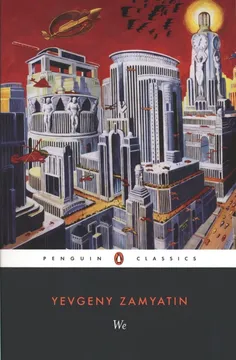


Plot Summary
A Builder Meets an X
D-503, the mathematician building the Integral, starts a journal meant to praise the One State before its spacecraft carries State literature to other planets. In his city, glass walls make every home visible, a timetable regulates the day, and sexual partners are assigned by coupon. D-503 accepts this order as the definition of happiness.
He spends scheduled time with O-90, a gentle, round-faced woman registered to him, and joins the marching ranks that embody the State’s ideal of collective harmony. During one walk, he meets I-330, whose sharp wit and unusual confidence unsettle his certainty. She invites him to an auditorium, predicting he will be assigned there. He is, and the improbable coincidence begins to trouble his arithmetic.
D-503’s journal is both propaganda and a record of the mind that propaganda has shaped. He sincerely treats obedience as beauty, yet his attention to I-330’s difference exposes the personal perception that the State’s collective language cannot erase. The Integral’s mission extends this contradiction outward: a regime that calls its coercion benevolent intends to impose its definition of happiness beyond its own borders. The opening disturbance is therefore intimate and political at once. D-503 does not begin as a rebel; he begins as a believer whose capacity to notice is already exceeding his doctrine.
The Ancient House
At the auditorium, I-330 plays an old piano while a lecturer dismisses spontaneous music as a sickness. D-503 laughs with the crowd, but the performance has moved him more than he can admit. Later, I-330 takes him to the Ancient House, a preserved pre-State dwelling filled with opaque doors, old furniture, books, and objects that resist measurement.
Its elderly caretaker greets I-330 as a familiar visitor. I-330 asks D-503 to skip a required lecture and stay with her. He refuses, leaves for class, and tells himself the encounter is finished. Yet he delays reporting her behavior to the Guardians, whose inspector S-4711 has already made him uneasy. His postponed report gives I-330 leverage over him.
The Ancient House makes political history tactile. D-503 has learned to treat privacy, art, and unscheduled desire as defects, but the old rooms give those abstractions physical form: doors close, objects accumulate, and a life can remain hidden from public inspection. His refusal to stay with I-330 seems like a victory for discipline, yet his failure to report her reveals an early fracture between belief and conduct. The episode also defines I-330’s method. She does not persuade D-503 through a coherent alternative philosophy; she puts him in contact with experiences his categories cannot contain.
The Green Liqueur
A sexual appointment notice orders D-503 to I-330’s room. There she drinks alcohol, smokes, and reminds him that his failure to report her could bring punishment. Instead of exposing her, D-503 stays. I-330’s deliberate transgressions draw out a possessiveness he has never permitted himself to feel. When he learns that S-4711 has also been close to her, D-503 reacts with jealousy and abruptly leaves before curfew.
He returns to his regulated apartment shaken by the desire he has tried to deny. Soon, his friend R-13, a State poet, casually reveals his own intimacy with I-330. D-503’s friendship with R-13 and his long-standing triangle with O-90 begin to feel unstable, as emotion refuses the State’s neat accounting.
D-503 experiences desire first as an invasion and then as a claim of ownership. The State has abolished exclusive attachment by assigning sexual access, but its system cannot prevent jealousy; it merely deprives him of a language for understanding it. His reaction to R-13 shows how quickly private feeling can destabilize relationships built on official assumptions of equality. I-330’s power over D-503 is not simply erotic. By making him choose between reporting her and protecting her, she turns his inward conflict into an action with political risk.
An Incurable Soul
D-503 begins dreaming, losing concentration, and seeing himself as a stranger in the mirror. After I-330 draws him into an unauthorized meeting in the fog, he returns to the Ancient House and finds a concealed route behind a wardrobe. It carries him down into old underground corridors, where he encounters the thin doctor who has helped I-330 evade the State.
The doctor calls D-503’s new inner life a soul and warns that it is incurable. I-330 reappears, and D-503 follows her through the hidden passages, unable to tell whether his experiences are dreams or events. His orderly account grows increasingly unreliable, while his longing to see I-330 becomes stronger than his duty to report her.
The diagnosis of a soul reverses the State’s definition of illness. D-503 experiences individuality as frightening because it makes him vulnerable to memory, desire, and uncertainty, but the doctor recognizes that this vulnerability is also an expansion of consciousness. The concealed corridors literalize what the glass city suppresses: a past and an alternative social life beneath the surface of apparent transparency. D-503’s journal registers the change formally. Its once confident explanations now contain gaps and contradictions, making the reader experience the failure of his rational framework rather than merely hear him describe it.
O-90 Wants a Child
O-90 notices D-503’s estrangement and leaves him after realizing he has changed. Her letter makes clear that she still loves him, though she believes he now wants only I-330. Later, O-90 returns with a more dangerous request: she wants D-503 to father a child, though the State’s rules make pregnancy outside approved norms punishable by death.
D-503 gives her the pink coupon meant for I-330 and sleeps with her. He tells himself that the decision is irrational, yet cannot refuse O-90’s hope. The act becomes more than an affair. It creates a possible life beyond State permission and binds D-503 to consequences he cannot calculate or control.
O-90’s request exposes the distance between the State’s claim to have abolished private property and its control over reproduction. Sexual access may be distributed by coupon, but the State still claims authority over which bodies may carry children. D-503’s decision is not a clean conversion to rebellion. He acts from tenderness toward O-90, guilt, and a desire he cannot reconcile with his public identity. The unborn child becomes a concrete challenge to the State’s arithmetic: a future person cannot be reduced to a scheduled function without first denying the human attachments that created it.
The Unanimous Vote Breaks
At the annual election, the One State expects its familiar unanimous endorsement of the Benefactor. Instead, thousands of numbers raise their hands against him. The crowd erupts; Guardians lose control, and R-13 carries I-330 through the fleeing assembly. D-503 pushes after them and strikes R-13 in the confusion, then takes I-330 away himself.
The public ritual that has always presented obedience as universal has split in full view. O-90 watches from a passage, protecting her abdomen, while D-503 leaves the State’s ceremonial order behind. For the first time, he acts openly on personal attachment, even though he still cannot explain what the rebellion wants or what his own role in it may be.
The election is a political rupture because it makes dissent visible rather than private. The regime’s legitimacy depends on presenting unanimity as a fact, so a raised hand against the Benefactor exposes the vote as a performance maintained by surveillance and force. D-503’s rescue of I-330 is emotionally decisive but politically inarticulate: he acts before he understands the movement. His violence toward R-13 also complicates the romance. Love does not make him morally clear; it makes him capable of abandoning the State’s rules while still carrying the possessiveness and confusion those rules helped produce.
Beyond the Green Wall
I-330 and the doctor lead D-503 through the hidden route and beyond the Green Wall, which he has been taught is the boundary between civilization and savage disorder. In the forest, he finds a community of fur-covered people, survivors whose lives depend on the natural world the One State has excluded.
I-330 identifies them as the Mephi and describes a movement seeking to break down the Wall and free people from imposed happiness. D-503 is stunned by the living landscape and by the possibility that the city’s enemies are not monsters. I-330 also reveals that the Integral, which he is building to spread the State’s rule, could be captured and turned against it.
The forest does not simply replace a false civilization with an ideal one. Its bodily and environmental disorder confronts D-503 with a form of existence that the State has erased from its official history. The Mephi’s challenge is therefore epistemic as well as political: they make visible the people and desires that the One State calls impossible. I-330’s plan to seize the Integral gives this revelation practical stakes. D-503’s technical skill, previously an instrument of expansion, can become a weapon against the system that trained him to use it.
The Operation Is Announced
As dissent spreads, the State announces a Great Operation that will remove imagination from its citizens. The announcement turns D-503’s private turmoil into an immediate threat: people who submit will lose the capacity that has made rebellion, love, and uncertainty possible. O-90, now pregnant, asks D-503 to help her preserve the child.
He agrees to guide her to I-330, but S-4711 follows them. To keep the Guardian occupied, D-503 pretends to write a note and sends O-90 away with instructions to reach I-330 alone. She disappears into the city’s turmoil. D-503 has helped protect a life the State would condemn, even as he remains under observation and the Integral’s trial flight approaches.
The Great Operation gives the State’s psychological control a bodily procedure. Rather than merely punish dissent, it seeks to remove the faculty that makes dissent imaginable. D-503’s aid to O-90 is a small act with immense ethical weight: he uses deception against surveillance so that she and her child may escape the State’s reproductive control. Yet the episode also reveals the limits of his courage. He does not join O-90 on the road to safety; he sends her onward while remaining entangled with I-330 and the Integral.
The Integral Is Seized
D-503 boards the Integral for its trial flight while I-330 and the Mephi prepare to take control at lunchtime. In the air, I-330 tells him that O-90 and her child have reached safety beyond the Wall. Just as the conspirators move toward their plan, a man with exceptionally long arms addresses the passengers and reveals that the Guardians know their identities and intentions.
I-330 believes D-503 has informed the State; he insists inwardly that he has told no one. The takeover collapses. D-503 orders the engines stopped and the Integral begins to fall, but the Second Builder restarts the engines in time to prevent a crash. D-503 returns to the city with the rebellion compromised and I-330 distrustful.
The failed seizure turns D-503’s private indecision into a public crisis. His uncertainty about whether he betrayed the rebels matters because the State has trained him to distrust his own motives; even his account cannot fully establish whether he acted freely or automatically. I-330’s suspicion makes the cost relational as well as strategic. The Integral, designed to carry the State’s ideology outward, becomes a contested space in which engineering, surveillance, and political loyalty converge. Its near-crash dramatizes the instability of a system that appears precise only while everyone obeys.
The Wall Comes Down
A storm tears open the Green Wall, and birds pour into the city. The breach makes the world D-503 saw beyond the barrier impossible to dismiss as fantasy. Operated citizens move mechanically toward the Great Operation, while Mephi fighters advance through the streets. D-503 searches I-330’s room and finds scattered pink coupons bearing his number, then waits until she returns.
He tells her that the Benefactor claimed the rebels had used him only to build the Integral. The revelation deepens the distance between them; I-330 leaves without restoring his trust. Outside, the State’s city is no longer sealed, and resistance continues amid disorder, arrests, and the beginning of the mass effort to remove imagination.
The Wall’s destruction converts the novel’s central metaphor into an event: the boundary between regulated life and excluded nature fails materially. The invasion is not a simple liberation, since the city fills with violence and confusion, but it breaks the State’s monopoly on what can be seen and believed. D-503’s encounter with I-330 also shows that political awakening does not guarantee intimacy. He has learned to question the State, yet the Benefactor’s account of his usefulness wounds him precisely because it echoes his own fear that he has been instrumentalized.
Reason Claims D-503
After R-13 is found dead, D-503 goes to the Guardians intending to confess what he knows. S-4711 reveals that he too belongs to the Mephi, but the confession cannot halt the State’s response. D-503 and others are captured and subjected to the Great Operation. His imagination removed, D-503 later reports the rebels’ secrets to the Benefactor and watches I-330 endure repeated questioning under the Gas Bell without speaking.
The State claims the election was unanimous after excluding its opponents, and high-voltage barriers contain part of the unrest. D-503 ends convinced that Reason will prevail, even as the report admits that the city’s western districts remain in chaos and resistance is still active.
The ending makes psychological defeat more unsettling than physical punishment. The Operation does not refute D-503’s awakening; it disables the faculty through which he could recognize it, leaving his obedience to feel like health. His final account therefore carries dramatic irony: the reader can see the violence and uncertainty that his altered consciousness labels rational. Yet the State’s victory is incomplete. The Wall has fallen, the western districts remain unsettled, and I-330’s silence under torture preserves a form of refusal the official narrative cannot absorb.
Analysis
We is structured as the education of a narrator who has been trained to mistake consistency for truth. D-503’s mathematical vocabulary is not merely a personal quirk; it is the One State’s governing metaphor, a way of making moral decisions appear measurable and political coercion appear hygienic. His journal initially reproduces that system, then records evidence that the system cannot assimilate: dreams, jealousy, sexual attachment, fear, and the persistence of a world beyond the Green Wall.
The novel’s deepest conflict is not a simple contest between reason and emotion. The State uses calculation to eliminate uncertainty, but its arithmetic is already ideological: it counts individuals as negligible when they suffer and describes imposed obedience as universal happiness. D-503’s awakening does not make him consistently brave or clear-sighted. He lies, hesitates, acts from possessiveness, and struggles to distinguish care from self-interest. That inconsistency makes his psychological change credible and prevents freedom from becoming an easy moral cure.
The characters embody different forms of intimacy. I-330 provokes and recruits; O-90 seeks tenderness and a future for her child; R-13 turns artistic language toward both State service and unruly humor. Their different desires reveal what a system of standardized relationships cannot contain. The Integral, the Wall, and the Operation translate these conflicts into physical stakes: outward conquest, sealed borders, and the surgical removal of imagination.
The ending refuses a clean resolution. D-503’s altered certainty allows the State to claim victory, but the breached Wall and continuing unrest contradict his confidence. His final account is therefore divided against itself: a voice that insists disorder has been defeated while describing evidence that the regime has not regained control. Zamyatin makes the reader the witness D-503 can no longer be, preserving the distinction between enforced happiness and a life capable of wanting something not yet authorized.
Review Summary
We is a groundbreaking dystopian novel that influenced later works like 1984 and Brave New World. Set in a totalitarian future society, it follows D-503 as he questions the rigid control of the One State. Readers praise Zamyatin's poetic writing and prophetic vision, though some find the style challenging. The book's themes of conformity, individuality, and rebellion resonate strongly. While not as widely known as its successors, We is considered a seminal work in the dystopian genre, offering a powerful critique of authoritarianism and the dangers of sacrificing freedom for perceived happiness.
People Also Read





Characters
D-503
The State’s gifted builderD-503 is a mathematician and chief builder of the Integral, trained to regard precision, collective obedience, and scheduled pleasure as proof of happiness. His journal begins as a tribute to the One State, but its careful record of bodily sensations reveals a mind increasingly unable to reduce experience to formulas. He is observant but initially dependent on official explanations, and he often mistakes certainty for understanding. His relationships with O-90, I-330, and R-13 expose different pressures on that certainty: tenderness, erotic possession, and friendship. D-503’s central conflict is not simply whether he opposes the State, but whether he can recognize his own desires when the State has supplied the terms by which he judges them.
I-330
The insurgent provocateurI-330 is a poised, sharp-witted woman whose confidence unsettles the routines surrounding her. She seeks out D-503 because his work on the Integral gives him unusual importance, but she also tests him through deliberate violations of State rules. Her attraction to him is entangled with strategy, secrecy, and a need to judge whether he can act beyond obedience. I-330 is not an uncomplicated emblem of freedom: she can be playful, demanding, and willing to manipulate another person’s uncertainty. Her presence forces D-503 to experience contradiction rather than solve it, while her commitment to the Mephi places her in direct opposition to the State’s promise of settled, universal happiness.
O-90
D-503’s tender companionO-90 is warm, affectionate, and emotionally direct, qualities D-503 initially interprets as childishness. She shares an officially registered sexual relationship with him and remains attached to him even when she senses his attention turning elsewhere. O-90’s longing for motherhood gives her a purpose that the State’s reproductive rules cannot accommodate. Unlike I-330, she does not approach D-503 through provocation or political argument; she asks for care and risks punishment to pursue a deeply personal hope. Her gentleness should not be mistaken for passivity. She makes difficult choices in a world where the State claims authority over intimacy, pregnancy, and the future of every child.
R-13
The State’s unruly poetR-13 is a poet and D-503’s old friend, known for his energetic speech, humor, and unruly presence. He writes verse in service of the State, including poetry for public ceremonies, yet his temperament resists the neatness his work is meant to celebrate. His friendship with D-503 and his connection to both O-90 and I-330 make him part of a relationship network that official sexual rules cannot fully simplify. R-13’s irreverence brings warmth and disruption into D-503’s life, while his public role shows how artistic skill can be recruited by the State.
S-4711
The watchful GuardianS-4711 is a Guardian whose bent posture, keen eyes, and frequent appearances make surveillance feel personal. He observes D-503 at moments when the mathematician is already uncertain, prompting D-503 to imagine that every private hesitation has been detected. S-4711 is not merely an instrument of menace; he sometimes intervenes in ways D-503 cannot interpret, which makes his motives difficult to read. His presence embodies the State’s reach into everyday life and the psychological strain of never knowing whether a glance signals protection, suspicion, or something else.
The Benefactor
The ruler of unanimityThe Benefactor governs the One State as its living emblem of order. Public ceremonies present him as the source of collective happiness, while the Machine used in executions gives his authority a physical and theatrical form. He treats individual freedom as a threat to the population’s welfare and understands punishment as a necessary instrument of rule. His great power rests not only on force but on the citizens’ learned habit of interpreting coercion as care.
U
The watchful controllerU is a middle-aged building controller who records residents and manages the ordinary procedures of their lives. Her awkward appearance and fussing manner make her easy for D-503 to dismiss, but she watches him closely and develops a personal concern for him. She works with children and believes that care may require severity, reflecting the State’s habit of recasting control as kindness. U’s mix of emotional attachment and institutional loyalty makes her intentions difficult for D-503 to interpret.
The thin doctor
A physician beyond the rulesThis thin, sharp-featured doctor works within the State’s medical system but helps I-330 evade its routines. He treats D-503’s new emotional life as an actual condition, giving him the startling diagnosis that he has developed a soul. His clinical manner offers a rare alternative to the State’s claim that every deviation is simply criminal or defective. The doctor’s quiet assistance links private illness to the hidden resistance beneath the city.
The old caretaker
Keeper of the old houseThe elderly caretaker tends the Ancient House, a museum of the private, cluttered world that existed before the One State. She knows I-330 and welcomes her without asking for official explanations. Her presence makes the past feel inhabited rather than merely archived.
The Second Builder
D-503’s practical colleagueThe Second Builder works alongside D-503 on the Integral and measures events through engineering problems and production schedules. His practical focus anchors the spacecraft’s construction in everyday labor. He remains close enough to D-503’s work to influence the consequences of the flight.
Plot Devices
The Table of Hours
Schedules collective lifeThe Table assigns waking, work, meals, exercise, walks, and rest to the citizens of the One State. Personal hours and sexual coupons create limited spaces for private activity, but even those spaces are administered and monitored. The schedule is both infrastructure and ideology: it teaches citizens to experience regularity as happiness and spontaneity as disorder. As D-503’s feelings disrupt his ability to follow it, his changing habits make internal rebellion visible in concrete ways.
The Green Wall
Seals the State from natureThe transparent barrier separates the One State’s geometric city from the forests and people beyond it. Citizens are taught that the world outside represents primitive disorder, and the Wall therefore shapes their understanding as much as it controls movement. D-503 first encounters the outside through glimpses of animals and vegetation, then crosses it and discovers a living alternative to the State’s account of history. Its eventual breach turns a private revelation into a public crisis. Spoiler for the plot’s later events.
The Integral
Carries State power outwardThe Integral is the glass spacecraft D-503 is building for the One State. Its intended mission is to transmit State writing and impose the regime’s version of happiness on other planets. Because D-503 controls its design, the ship gives the Mephi a way to imagine a direct attack on the State’s power. The vessel turns his professional identity into a political liability: the work he considers a triumph of engineering may serve either conquest or revolt. Spoiler for the plot’s later events.
D-503’s Journal
Records a mind changingD-503 writes his entries as a formal account for unknown readers, initially believing that they will prove the One State’s perfection. His descriptions become less orderly as dreams, jealousy, desire, and uncertainty overtake his mathematical language. The journal thus functions as both narrative frame and evidence: the reader can compare D-503’s claims of rational control with the experiences he records despite himself. Its changing style makes psychological transformation visible without requiring an outside narrator to explain it.
The Great Operation
Removes imagination surgicallyThe State announces an operation intended to excise the brain’s center of imagination. It is presented as a medical cure for the uncertainty and disobedience spreading through the population, turning political repression into an invasive procedure. The operation gives the government a way to target not only rebel actions but the capacity to envision alternatives. Its effects on D-503 make the ending’s return to certainty chilling: he experiences the loss of his former inner life as recovery. Spoiler for the ending.
FAQ
Synopsis & Basic Details
What is We about?
- Dystopian society under control: We depicts a future society, the One State, where individuals are known as "Numbers" and live under strict, mathematically-precise control, believing it leads to ultimate happiness.
- Individual vs. collective conflict: The story follows D-503, a builder of the spaceship Integral, as he grapples with emerging emotions and desires that challenge the One State's rigid logic and his own identity.
- Rebellion and self-discovery: D-503's journey involves a forbidden love, a growing awareness of the world beyond the One State, and a struggle against the suppression of individuality, leading to a rebellion against the system.
Why should I read We?
- Pioneering dystopian vision: We is a foundational work of dystopian literature, offering a chilling and thought-provoking exploration of totalitarian control and its impact on human nature.
- Exploration of complex themes: The novel delves into profound themes such as the conflict between reason and emotion, the nature of freedom and happiness, and the dangers of unchecked power.
- Unique narrative style: Zamyatin's use of a diary format, combined with his sharp, satirical prose, creates a compelling and immersive reading experience, offering a unique perspective on a society obsessed with order.
What is the background of We?
- Post-revolutionary Russia context: Written in the early 1920s, We reflects the anxieties and disillusionment of post-revolutionary Russia, where the promise of a utopian society was giving way to totalitarian control.
- Technological and social control: The novel explores the potential dangers of technology and social engineering, depicting a society where every aspect of life is regulated and monitored by the state.
- Influence of scientific rationalism: The One State's emphasis on mathematical precision and scientific logic reflects the growing influence of rationalism and its potential to dehumanize society when taken to extremes.
What are the most memorable quotes in We?
- "There is no final revolution.": This quote encapsulates the core theme of the novel, highlighting the cyclical nature of change and the impossibility of achieving a static, perfect society.
- "The only means of ridding man of crime is ridding him of freedom.": This chilling statement reveals the One State's belief that absolute control is necessary for maintaining order, even at the cost of individual liberty.
- "What is it to you if I stay here—alone? What is it to you if I don't want others to want for me, if I want to want myself—if I want the impossible....": This quote captures the essence of the rebellion, emphasizing the importance of individual desire and the pursuit of the impossible, even in the face of overwhelming odds.
What writing style, narrative choices, and literary techniques does Yevgeny Zamyatin use?
- Diary format for intimacy: Zamyatin employs a diary format, allowing readers direct access to D-503's thoughts and feelings, creating a sense of intimacy and immediacy as he grapples with his changing worldview.
- Satirical and ironic tone: The novel uses satire and irony to critique the One State's ideology, exposing the absurdity and dehumanization inherent in its pursuit of absolute control and mathematical perfection.
- Symbolism and recurring motifs: Zamyatin uses recurring symbols and motifs, such as the Green Wall, the Integral, and the color yellow, to reinforce the novel's themes and create a rich, layered reading experience.
Hidden Details & Subtle Connections
What are some minor details that add significant meaning?
- The "pink coupon" system: The seemingly mundane system of pink coupons for sexual encounters reveals the One State's attempt to control even the most intimate aspects of human life, reducing love to a regulated function.
- The old woman's mouth: The old woman at the Ancient House, with her "ingrown" mouth, symbolizes the suppressed past and the distortion of human expression under the One State's control.
- The recurring "X" motif: The recurring "X" motif, often associated with I-330, represents the unknown, the irrational, and the disruptive forces that challenge the One State's rigid order.
What are some subtle foreshadowing and callbacks?
- D-503's dream of sap: D-503's early dream of sap flowing from a Buddha statue foreshadows his awakening to the irrational and emotional aspects of life, which are suppressed by the One State.
- The "It's clear" phrase: D-503's repeated use of the phrase "It's clear" highlights his initial reliance on logic and reason, which is gradually undermined as he experiences the complexities of human emotion.
- The lilies of the valley: O-90's gift of lilies of the valley, initially dismissed by D-503, becomes a symbol of the natural world and the emotional connections that the One State seeks to eradicate.
What are some unexpected character connections?
- The doctor and I-330: The doctor's connection to I-330, revealed through the "liqueur" and the medical certificates, suggests a hidden network of resistance within the One State's seemingly monolithic structure.
- R-13 and I-330: The subtle connection between R-13 and I-330, hinted at through their shared ideas and R-13's sudden change in demeanor, reveals a deeper level of resistance and a challenge to the One State's control over thought.
- S-4711 and the Guardians: S-4711's role as a Guardian, yet his apparent sympathy for D-503, suggests a potential for dissent even within the One State's enforcers, blurring the lines between loyalty and rebellion.
Who are the most significant supporting characters?
- R-13, the poet: R-13, the poet, represents the creative spirit and the power of language, which the One State attempts to control and manipulate for its own purposes.
- The old woman: The old woman at the Ancient House serves as a link to the past and a reminder of the human experiences that the One State seeks to erase.
- U, the controller: U, the controller, embodies the One State's bureaucratic and controlling nature, highlighting the insidious ways in which the regime seeks to regulate every aspect of its citizens' lives.
Psychological, Emotional, & Relational Analysis
What are some unspoken motivations of the characters?
- D-503's desire for connection: Beneath his initial adherence to the One State's logic, D-503 yearns for genuine human connection, which is ultimately fulfilled through his relationship with I-330.
- I-330's need for change: I-330's rebellious actions are driven by a deep-seated need for change and a rejection of the One State's oppressive control, as well as a desire to experience life fully.
- O-90's longing for motherhood: O-90's desire for a child represents a fundamental human longing for connection and creation, which is suppressed by the One State's rigid control over reproduction.
What psychological complexities do the characters exhibit?
- D-503's internal conflict: D-503's internal struggle between his logical programming and his emerging emotions reveals the psychological toll of living under a totalitarian regime.
- I-330's calculated manipulation: I-330's calculated manipulation of D-503, while serving her rebellious goals, also reveals a complex and perhaps vulnerable side to her character.
- O-90's naive acceptance: O-90's naive acceptance of the One State's rules, while seemingly simple, also reveals a deep-seated desire for love and connection, even within the confines of the system.
What are the major emotional turning points?
- D-503's first encounter with I-330: D-503's first encounter with I-330 marks a turning point, as it awakens emotions and desires that challenge his belief in the One State's ideals.
- D-503's visit to the Ancient House: D-503's visit to the Ancient House exposes him to the past and the world beyond the Green Wall, further fueling his internal conflict and his desire for freedom.
- D-503's betrayal of O-90: D-503's betrayal of O-90, driven by his obsession with I-330, highlights the destructive power of his newfound emotions and his struggle to reconcile them with his former self.
How do relationship dynamics evolve?
- D-503 and I-330's power dynamic: The relationship between D-503 and I-330 evolves from one of seduction and manipulation to one of shared rebellion and a complex, often painful, connection.
- D-503 and O-90's contrasting love: The contrasting relationships between D-503 and O-90, and D-503 and I-330, highlight the different forms of love and connection that exist within and outside the One State's control.
- D-503 and R-13's friendship: The breakdown of D-503's friendship with R-13, due to their differing views on the One State and their shared connection to I-330, reveals the destructive impact of the regime on personal relationships.
Interpretation & Debate
Which parts of the story remain ambiguous or open-ended?
- The fate of I-330: The ultimate fate of I-330 is left ambiguous, leaving the reader to wonder whether she escaped the One State or was captured and punished.
- The success of the rebellion: The success of the rebellion is also left open-ended, with the One State regaining control but the seeds of dissent still present, suggesting a potential for future uprisings.
- The nature of the "soul": The nature of the "soul" and its relationship to imagination and individuality remains ambiguous, prompting readers to consider the true meaning of human consciousness.
What are some debatable, controversial scenes or moments in We?
- D-503's actions towards O-90: D-503's treatment of O-90, particularly his use of her to obtain a pink coupon and his subsequent rejection of her, raises questions about his morality and the extent of his transformation.
- The Benefactor's justification of cruelty: The Benefactor's justification of cruelty as a necessary means to achieve happiness is a controversial moment, forcing readers to confront the ethical implications of totalitarian control.
- The ending and D-503's lobotomy: The ending, with D-503's lobotomy and his return to a state of conformity, is a controversial moment, prompting debate about the nature of free will and the possibility of resistance.
We Ending Explained: How It Ends & What It Means
- D-503's forced conformity: The ending sees D-503 undergoing the Great Operation, which removes his imagination and individuality, leaving him a compliant citizen of the One State.
- Suppression of rebellion: The rebellion is ultimately crushed, with many of its leaders captured and punished, highlighting the One State's ability to maintain control through force and manipulation.
- Ambiguous future: The ending leaves the future of the One State ambiguous, with the seeds of rebellion still present, suggesting that the struggle between freedom and control is an ongoing process.
Download PDF
Download EPUB
.epub digital book format is ideal for reading ebooks on phones, tablets, and e-readers.








