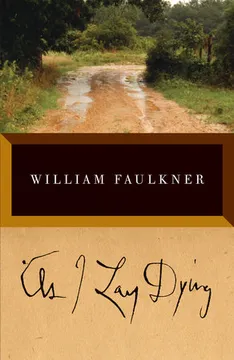


Plot Summary
The Coffin Under Addie's Window
Darl Bundren, the second son, describes his brother Cash shaping a coffin outside the window of their dying mother, Addie. The carpenter measures and planes each board while Addie lies too weak to move, her face turned toward his work. Their father, Anse, says he promised to carry her body to Jefferson, where her family is buried, though the town lies forty miles away.
A neighbor, Vernon Tull, questions the timing as rain threatens and the family needs money. Anse remains fixed on the promise, presenting the trip as Addie's own wish and his duty to her. The coffin becomes both a practical preparation for death and the first obligation that will pull the family onto the road.
The novel begins with labor performed beside a person who cannot participate in it. Cash's careful craftsmanship offers a concrete form of care, while Anse's promise turns Addie's death into a family project before she has died. The two actions are not equivalent: Cash attends to the body in front of him, while Anse invokes a future journey that will demand sacrifice from everyone. Faulkner makes the coffin visible through Addie's window, so the object cannot be separated from her awareness of being prepared for burial. From the outset, intimacy and duty overlap, but they do not mean the same thing to each Bundren.
The Three Dollar Departure
Anse sends Darl and Jewel to earn three dollars, although Darl warns that Addie may die before they return. Jewel protests that she is not yet so ill, but Anse chooses the paid work and trusts that she will hold on. Darl pauses at her doorway before leaving; neighbor Cora Tull later mistakes his silent farewell for proof that he is the only loving son.
While he is gone, Addie calls for Cash to show her the coffin boards, then dies. Vardaman, the youngest, comes home with a fish and cannot fit its death beside his mother's. He chops the fish apart and insists on seeing the pieces, as if making death visible might make it understandable.
The three dollars are small enough to sound reasonable and large enough to expose the family's priorities. Darl recognizes that time is running out, yet cannot prevent Anse from treating the trip as an ordinary work decision. Cora's interpretation of Darl's farewell offers comfort, but it also shows how readily observers replace difficult family truths with a moral story. Vardaman's fish is not a clever symbol he consciously chooses. It is a child's failed attempt to build a usable explanation from what he can touch. His grief begins as an effort to make death concrete, then makes the boundary between animal and mother unstable.
Addie's Hidden Arithmetic
After Addie's death, her own account reaches back to her years as a schoolteacher, when she felt isolated from the children she disciplined and mistrusted the words people used to describe love and duty. She married Anse, then had an affair with the Reverend Whitfield. Jewel was conceived in that relationship, and Addie came to regard him as the child who answered her private hunger.
Darl's birth, by contrast, intensified her anger at the marriage and at the life she had entered. She later asked Anse to promise that, after her death, he would take her to Jefferson. Whitfield learns she is dying and resolves to confess his own wrongdoing, but reaches the Bundren home after she has died.
Addie's history revises the journey's meaning without making her a simple explanation for it. Her demand for Jefferson is not merely nostalgia for a birthplace; it is an attempt to claim a final choice after a life in which marriage, motherhood, and religious language have been imposed on her. Her distinction between words and actions clarifies why Anse's promise matters, but also why it cannot repair their relationship. The affair with Whitfield is a private act that reshapes the children's kinship without their knowledge. His late confession repeats the novel's pattern: people reach for moral closure only after the person who might answer them is gone.
Holes in the Coffin
The family completes the coffin through a night of rain, with Cash continuing to work as the storm threatens his lantern and boards. Before the coffin is closed, Vardaman drills holes through its lid. He believes Addie needs air, and the holes become his private way of resisting the fact that she is dead.
When the family finds the damage, two holes have reached her face. They cover the marks with a mosquito net and place Addie in her wedding dress, arranging her body headfirst so the flared skirt will fit. Vardaman's act cannot restore her, but it changes the coffin from Cash's finished piece of carpentry into an object marked by the youngest child's panic.
The holes make Vardaman's grief physical, but their consequence is not a simple expression of childish innocence. He has seen Cash build the coffin and understands, in fragments, what it is for; drilling becomes an attempt to interrupt the family's practical certainty. The adults respond by concealing the holes and preserving Addie's appearance, converting a child's desperate intervention into a problem of presentation. This section also complicates Cash's craftsmanship. His work is exact, yet the coffin must contain a body, a dress, a child's fear, and the family's conflicting ideas about what respect requires. No amount of neat construction can seal those differences away.
The Flooded Road
After waiting for Darl and Jewel to return, the Bundrens load Addie's coffin onto their wagon and set out for Jefferson. Their route immediately narrows when the swollen river has destroyed the bridge at Tull's. Vernon advises them to wait or bury Addie at nearby New Hope, but Anse refuses because he has promised Jefferson.
The family reaches a second crossing and finds that the flood has made the bridge unusable there too. Anse treats each obstacle as another reason to persist rather than reconsider the destination. The journey is no longer simply a fulfillment of Addie's request: it becomes a test of whether her sons will keep risking themselves and their possessions for a promise their father claims to honor.
The washed-out bridges turn landscape into pressure, but the conflict is not nature against a determined family alone. Anse repeatedly declines safer alternatives, making the flood a test of judgment as much as endurance. His insistence can be understood as loyalty to Addie's stated wish, yet it also gives him a fixed principle behind which he can avoid weighing consequences. Vernon offers practical help and a nearer burial place, but Anse's refusal leaves the labor and danger to his children. The journey therefore exposes a central contradiction: the family claims to act for Addie, while the living use her wish to justify choices shaped by pride, fear, and self-interest.
The Ford Takes Its Toll
At the flooded ford, Cash studies the current and warns that the coffin is unbalanced. Jewel rides his horse into the water to test the route, while Cash and Darl guide the wagon with a rope. A heavy log surges downstream and strikes the wagon, overturning it. The mules drown, Cash is thrown and breaks his leg, and the coffin is swept away.
Darl jumps into the river to reach it, but the current carries Addie's body beyond his grasp. The family and Vernon recover the coffin and Cash's scattered tools from the water, while Jewel brings his horse to safety. Their attempt to honor Addie's burial wish has now cost them their team and turned the journey into a rescue operation.
The crossing concentrates the novel's competing forms of care into one dangerous procedure. Cash tries to calculate the wagon's balance; Jewel risks his horse; Darl abandons the wagon to pursue the coffin. Each acts from a different understanding of responsibility, and the flood makes none of them fully effective. The log does not punish a single guilty person. It exposes the limits of human control, while the family's earlier refusal to wait has made the risk harder to dismiss as unavoidable. Darl's failed attempt to retrieve Addie also echoes his position within the family: he can perceive the disaster approaching, but insight does not grant him the power to prevent it.
Jewel's Horse Is Traded
Neighbors take the Bundrens in after the river crossing. At Armstid's, Cash's broken leg is splinted, and Anse searches for a team to replace the drowned mules. He eventually trades Jewel's beloved horse to the trader Flem Snopes, adding family property to the price. Jewel rides away in anger when he learns what Anse has done, but later returns to the journey without the horse.
The family accepts further help from neighbors and must take a longer route as floods cut off roads and crossings. Cash remains in pain, yet insists on staying with the wagon. The Bundrens make progress toward Jefferson, but every mile now rests on borrowed help, depleted resources, and another sacrifice made without agreement.
Jewel's horse is more than transportation: it is the one possession he has earned and protected without relying on Anse. Trading it turns the father's promise into a debt paid from a son's private labor. Jewel's departure expresses anger that he cannot make effective through argument, while his eventual return shows how attachment to Addie and the family still draws him back. Cash's insistence on continuing is similarly double-edged. His endurance preserves his place in the family undertaking, but it also allows Anse's decisions to keep imposing costs on him. Help from neighbors keeps the journey possible while making the Bundrens' claim of self-sufficiency increasingly hollow.
Dewey Dell's Ten Dollars
In Mottson, Dewey Dell leaves the wagon carrying a wrapped bundle and ten dollars given to her by Lafe, the young man with whom she has become pregnant. She seeks medicine to end the pregnancy, first approaching the respectable druggist Moseley, who refuses to help and sends her away.
At another store, MacGowan pretends to be a doctor and uses her desperation to draw her into the cellar. He gives her harmless capsules and sexually exploits her. Dewey Dell returns to the wagon with no real treatment and no safe person to confide in. Her private emergency continues as the family presses toward Jefferson, hidden beneath the same silence that surrounds Addie's body.
Dewey Dell's errand reveals how poverty and sexual vulnerability restrict her choices in ways the men around her barely register. Moseley's refusal is framed as moral advice, but it leaves her with no trustworthy source of care. MacGowan then turns the authority of medical language into a tool of coercion. The ten dollars are not simply a plot token: they represent the small amount of agency Lafe has given her, and the limited options available to her once she reaches town. Her silence is not evidence of passivity. It is a defensive response to a world in which disclosure might invite judgment without producing help.
The Barn Burns
At Gillespie's, the family shelters with Addie's coffin while Cash's leg continues to worsen. During the night, Darl sets fire to the barn, apparently trying to destroy the coffin and end a journey that has brought the family only injury and humiliation. Jewel wakes and plunges into the burning building to rescue the animals, then returns for the coffin.
He is badly burned but gets Addie out. Cash survives the fire, though the damage to his broken leg remains. Vardaman later reveals that he saw Darl start the blaze, and Gillespie learns enough to threaten legal action. Darl's attempt to stop the burial has instead made him the family's most dangerous liability.
Darl's arson is both a desperate refusal and an assault on the work that has defined the family journey. He appears to believe that destroying the coffin could release everyone from a mission that has become grotesque, but he acts without asking the others to share his judgment. Jewel's rescue of the animals and coffin reverses the role Darl expected fire to play: rather than ending the burden, it makes Jewel carry it at bodily cost. The episode also changes Darl's place in the family. His unusual perception has often made him an observer of others' motives; now his intervention gives them a concrete reason to restrain him.
Buried in Jefferson
The Bundrens finally reach Jefferson with Addie's coffin, Cash lying on it with his broken leg, and Jewel riding beside the wagon. In Mottson, Anse has bought cement and applied it to Cash's injury, believing the hard casing will steady the bone; removing it later costs Cash skin and leaves his leg badly damaged.
In Jefferson, the family endures the smell of Addie's body and the hostility of townspeople before burying her among her kin. Anse borrows spades from a woman in town, then takes Dewey Dell's ten dollars despite her protests. Once the grave is filled, Gillespie's men arrive for Darl, and Dewey Dell helps seize the brother who had once known her secret.
Arrival does not restore order. Cash's cement cast makes Anse's improvised care a source of lasting harm, while the town's disgust turns the family's private ordeal into public spectacle. Addie's burial fulfills the promise, but the promise has not protected her sons or united them. Anse's taking of Dewey Dell's money is especially revealing because it follows the burial he presented as an act of selfless duty. Dewey Dell's role in Darl's capture sharpens the family's moral fractures: she acts against the brother who knows about her pregnancy, choosing secrecy and self-protection at the moment he loses his freedom.
Anse Comes Back Changed
The men take Darl away to the state institution at Jackson. He laughs as they put him on the train, while Cash wonders whether the family has the right to decide which of them is sane. Anse then returns to the wagon with new teeth and a new wife, a woman he has met in Jefferson, who carries a small graphophone.
The money he took from Dewey Dell has helped him get the teeth he has wanted for years. Cash, still injured, watches the newcomer join the family, while Vardaman remains caught between grief, the journey, and his own strange explanations of death. The burial is complete, but the family has not returned to what it was.
The ending refuses the idea that completing the burial has purified the Bundrens. Darl's removal is justified through legal and social pressure, but Cash's uncertainty leaves the decision morally unsettled. Anse's new teeth and wife make the final image brutally practical: while one son is carried away, the father acquires the comforts he has long claimed deprivation denied him. The graphophone adds a conspicuous object of pleasure to a family whose journey has been governed by duty and scarcity. Anse does not resolve grief so much as move beyond it, taking what he wants and presenting the resulting change as ordinary family life.
Analysis
As I Lay Dying turns a burial journey into a study of how families make meaning under pressure, but its deepest subject is the gap between a person's private reality and the explanations others impose on it. Addie distrusts words such as love and duty because they can claim moral authority without producing intimacy. After her death, her family repeatedly uses those very terms to justify action: Anse cites his promise, Cora praises religious devotion, and the children struggle to name grief in forms the adults will accept.
The many narrators prevent any one account from becoming definitive. Their voices reveal partial knowledge, self-protection, and genuine care in uneven combinations. Anse's sense of persecution does not erase the material consequences of his choices. Darl's insight does not make him a reliable moral ruler. Vardaman's strange associations can express emotional truth even when they fail as literal explanation. The reader must hold these perspectives together without treating them as interchangeable.
The landscape is not a symbolic backdrop separate from poverty. Floods destroy bridges, animals drown, and distance turns a promised burial into a physical ordeal. Scarcity intensifies every decision, while neighborly help both sustains the Bundrens and exposes their dependence. The family's claim that they owe nothing to outsiders becomes harder to maintain each time someone lends a team, a bed, or a hand.
The ending refuses catharsis. Addie is buried, yet the family remains divided; Darl is removed, yet the question of his sanity remains unsettled; Anse acquires the comforts he wanted while others absorb the costs. The novel suggests that a completed ritual is not the same as moral repair. What survives is not a unified family story, but a collection of competing memories, each shaped by the speaker's need to live with what happened.
Review Summary
As I Lay Dying receives mixed reviews, with many praising Faulkner's unique writing style and complex character development. Critics admire the novel's innovative narrative structure, featuring multiple perspectives and stream-of-consciousness techniques. Some readers find the book challenging due to its non-linear storytelling and difficult language, while others appreciate its profound exploration of family dynamics, death, and Southern Gothic themes. The novel's dark humor and tragic elements are often highlighted, with many considering it a masterpiece of American literature.
People Also Read









Characters
Darl Bundren
The family's watchful sonDarl is Anse and Addie's second son, a perceptive young man whose inward attention often makes him seem distant from the people around him. He notices what others conceal, including the tensions that shape his siblings' choices, but this knowledge does not give him control over the family. His closeness to Addie is difficult to describe through conventional gestures of affection, and he often observes rather than joins. Darl's sensitivity makes him a powerful interpreter of the Bundrens' world, yet it also isolates him: the more clearly he sees the costs of their actions, the less easily he can fit into the family's shared account of what they are doing.
Addie Bundren
The mother at the centerAddie is a former schoolteacher, Anse's wife, and the mother of Cash, Darl, Jewel, Dewey Dell, and Vardaman. She is proud, private, and deeply suspicious of the words people use to explain love, religion, and family duty. Her teaching years leave her with a sharp awareness of how little language can guarantee genuine connection. Addie rarely presents herself as the comforting center others expect a mother to be; instead, she guards an inner life that the family only partly understands. Her wish to be buried in Jefferson is one of the few explicit choices she makes about what should happen to her, and it shapes the family's journey.
Anse Bundren
The father pleading necessityAnse is a poor farmer who presents himself as a man worn down by bad luck, hard work, and obligations he cannot escape. He speaks often in the language of duty and hardship, especially when explaining what the family must do for Addie. His reluctance to spend money and his dependence on neighbors sit beside a strong insistence that the Bundrens should owe nothing to anyone. Anse's self-pity can obscure the consequences of his choices for his children. He is not a forceful patriarch so much as a man who allows others to carry burdens while claiming that circumstance has left him no alternative.
Cash Bundren
The family carpenterCash is the eldest Bundren son, a skilled carpenter whose patience and precision give him a practical way to care for others. He measures before he cuts, values balance, and tends to express concern through work rather than explanation. That steadiness makes him a natural anchor for his siblings, though his loyalty can also keep him committed to plans that injure him. Cash rarely competes for attention or argues for authority. His careful approach to objects offers a striking contrast to the family's impulsive decisions, but even his craftsmanship cannot make the journey safe or prevent his father's improvised remedies from causing harm.
Jewel Bundren
The fiercely independent sonJewel is Addie's third child and one of the most physically forceful members of the family. He is guarded, quick to anger, and uncomfortable with dependence, especially when accepting help would make him feel indebted. His attachment to Addie is intense but rarely tender in a conventional way; he often expresses it through action, risk, and stubborn protection. Jewel's independence is partly a defense against a household where his labor and choices are regularly claimed by others. He can be difficult to approach, yet the people around him rely on his strength, creating a tension between his desire to stand apart and his repeated involvement in family crises.
Dewey Dell Bundren
The daughter guarding a secretDewey Dell is Addie and Anse's only daughter, a seventeen-year-old who works on the farm and lives within a family that rarely gives her privacy. She is inwardly preoccupied, but finds it difficult to sustain a thought long enough to turn it into a plan. Her feelings are often expressed through bodily anxiety and urgent, repetitive thinking rather than open explanation. Dewey Dell resents being treated as merely useful, yet she is also responsible for much of the household care that others overlook. Her relationship with Darl is distinctive because he seems able to perceive what she has not said, a closeness that brings both recognition and fear.
Vardaman Bundren
The youngest son searchingVardaman is the youngest Bundren child, still young enough to understand events through images and physical comparisons rather than adult explanations. He watches animals, tools, roads, and objects with a seriousness that makes ordinary details take on emotional weight. When the family cannot explain what has happened, he invents explanations of his own, repeating them until they briefly hold together. His thinking is not simply confused: it reveals how a child tries to make a world coherent when the adults around him avoid speaking plainly. Vardaman is attached to his siblings, though his grief and fear often leave him unable to interpret their actions.
Vernon Tull
The practical neighborVernon is a farmer and neighbor who repeatedly offers the Bundrens practical advice and assistance. He understands the local roads, the weather, and the risks of crossing the river, and he tries to persuade Anse to consider safer choices. His help is grounded in ordinary neighborly obligation rather than grand declarations. Vernon is observant, but he is also cautious about imposing himself on another family's decisions. His presence gives the story a measure of practical judgment, making the Bundrens' refusals more visible without turning him into a simple moral judge.
Cora Tull
The devout neighborCora is Vernon's wife, a religious woman who measures conduct through Christian duty and public respectability. She helps the Bundrens and watches Addie's decline, but her certainty about what a good wife or mother should feel often leads her to misread the people she observes. Cora's generosity is real, as is her need to interpret suffering within a moral framework. Her perspective exposes the distance between religious language and another person's private experience. She is especially drawn to stories of sacrifice and devotion, even when the evidence before her is more complicated.
Lafe
Dewey Dell's young companionLafe is a young man connected to Dewey Dell, but he remains largely outside the Bundren household and its daily labor. His limited presence matters because Dewey Dell carries concerns about him that she cannot safely discuss with her family. He represents a private relationship that has consequences far beyond the small amount of attention he gives it.
Reverend Whitfield
A preacher facing conscienceWhitfield is a local minister whose public standing rests on religious authority and whose private conscience is more troubled than his reputation suggests. He thinks in terms of sin, confession, and divine judgment, yet struggles to make those ideas govern his own conduct. His presence connects the family's personal history with the community's religious language. Whitfield is not simply hypocritical or repentant; he is a man who can recognize a moral failure and still be tempted to arrange his account of it so that it costs him less.
Dr. Peabody
The blunt country doctorPeabody is an older physician who serves families across the countryside and is accustomed to being called late, after practical concerns have delayed treatment. His humor is sharp, but his irritation comes from seeing preventable suffering treated as an inconvenience. He speaks with a professional bluntness that cuts through Anse's excuses. Peabody also offers an outside perspective on the Bundrens, though his judgments do not give him the power to change their behavior.
Armstid
A farmer offering shelterArmstid is a local farmer who gives the traveling Bundrens shelter and practical help after the river crossing. He is generous without pretending that their choices make sense to him. His assistance briefly stabilizes the family and helps them continue when their own resources have failed.
Samson
A host on the routeSamson is a farmer who encounters the Bundrens during their difficult passage and offers them food and shelter. He observes their insistence on continuing even when roads and bridges make the trip hazardous. His household provides a temporary refuge, while his account shows how the family's ordeal looks to people who are not inside it.
Moseley
The Jefferson druggistMoseley is a druggist in Jefferson who conducts himself as a respectable shopkeeper and takes a moralizing view of the young women who seek his help. He is important as a contrast to the more predatory clerk Dewey Dell later encounters. His refusal is shaped by his own standards of propriety, not by an understanding of the desperation that has brought her to his store.
MacGowan
The dishonest store clerkMacGowan is a young clerk in a Jefferson drugstore who likes to posture as more knowledgeable and powerful than he is. He treats other people's vulnerability as an opportunity for amusement and advantage. His casual manner disguises the seriousness of the harm he causes, making him a small but revealing example of how easily authority can be faked.
Gillespie
The barn's ownerGillespie is a farmer whose property provides the Bundrens a place to stop during their journey. He is a practical landowner who expects others to respect what he has built and relies on legal remedies when they do not. His barn becomes part of the family's crisis, bringing their private decisions into conflict with the rights of people outside the household.
Plot Devices
The Family's Journey
A promise made physicalThe wagon journey to Jefferson gives the novel its outward plot and forces the Bundrens' private conflicts into shared space. Addie's burial wish supplies the stated destination, while roads, rivers, weather, and the family's poverty repeatedly make progress costly. Each obstacle exposes a different member's understanding of duty: Anse insists on the promise, Cash calculates practical risks, Jewel acts through force, and Darl questions the purpose of continuing. The journey's physical hardships do not merely symbolize grief; they produce concrete injuries, lost animals, delays, and dependence on neighbors.
The Coffin
A burden everyone interpretsCash's coffin is at once a carefully constructed object, the container for Addie's body, and the reason the family undertakes a hazardous trip. Each character assigns it a different meaning. Cash treats it as a craft problem, Vardaman tries to preserve his mother's breath, Jewel protects it through action, and Darl eventually tries to destroy it. The coffin's physical damage and repeated transport make private grief visible to neighbors and strangers. Its presence also gives the family a shared task without giving them a shared understanding of why they are doing it.
Rotating Narrators
Conflicting versions of truthThe story moves through brief first-person sections voiced by family members and neighbors. These accounts do not combine into a single neutral explanation. Anse describes himself as burdened by circumstance, Cora interprets events through religious certainty, Darl notices motives others avoid, and Vardaman reshapes events through a child's associations. The shifts make readers compare testimony rather than simply accept it. Contradictions reveal both what the characters know and what they need to believe, turning point of view into a central part of the plot's moral uncertainty.
The Fish
A child's map of griefVardaman's fish becomes a concrete object through which he tries to understand his mother's death. He catches it shortly before Addie dies, then watches it cut apart and prepared for food. His mind links the fish's transformation to the coffin and to the possibility that his mother has changed form rather than disappeared. The fish motif makes his grief legible without translating it into adult language. It also shows how the novel's symbols arise from actions in the household, not from detached commentary.
Download PDF
Download EPUB
.epub digital book format is ideal for reading ebooks on phones, tablets, and e-readers.








