

Key Takeaways
Treat violence as a last-resort tool, not a moral identity.
Separate means from motive. Larkin argues that violence, like any instrument, does not carry its own moral purpose. The same capacity for force can be used to harm an innocent person or protect someone under attack. His hypothetical story of a mother facing an intruder illustrates how the act may look similar while its intent and moral meaning differ. He insists that preparation is not an endorsement of aggression, but a recognition that avoiding harm is sometimes impossible.
A personal lesson. Larkin’s own career changed after an inner-ear injury during Navy SEAL training left him disoriented underwater. Physical strength could not protect him from a vulnerable body. The incident helped shape his focus on understanding violence as a practical danger, while reserving moral and legal judgment for the circumstances and purpose of its use.
The distinction between a capacity and its use is valuable well beyond self-protection: medicine, law, and engineering all separate a tool’s function from the intentions governing it. That separation helps people discuss uncomfortable abilities without treating discussion as approval. Yet moral context cannot be set aside entirely. A person’s perception of an emergency may be mistaken, and force can create lasting harm even when sincerely intended as protection. The strongest version of this principle pairs clear-eyed preparation with restraint, proportionality, and respect for the legal and ethical consequences of action.
Read the interaction before choosing between de-escalation and escape.
Two kinds of conflict. Larkin distinguishes social aggression, which he describes as conflict shaped by status, demands, or communication, from asocial violence, which aims at harm rather than negotiation. A heated argument or robbery may still involve communication and a chance to withdraw or comply. A sudden attack with no meaningful exchange may leave fewer options. The distinction matters because the same response may not work in both situations.
The boundary can shift. British lawyer Thomas Pryce handed over his belongings during a robbery, but his attackers returned and murdered him because they feared he could identify them. Larkin uses the case to show that an apparently transactional encounter can change abruptly. He offers communication as a clue, not a promise of safety; people cannot reliably know another person’s intent from a single signal.
This framework gives readers a useful alternative to treating every confrontation as either harmless or inevitably lethal. It also resembles decision-making under uncertainty: cues update a judgment, but no cue provides certainty. The book’s communication test is memorable, yet it should not be treated as a dependable diagnostic rule. A person may speak while intending serious harm, or remain silent for reasons unrelated to violence. The practical value lies in staying attentive to changing circumstances and preserving an exit, not in assuming that one behavioral sign reveals the whole situation.
Let a bruised ego go before it becomes a life-changing fight.
Ask what it costs. Larkin proposes imagining the consequences a few days after an argument: would proving a point still seem worth injury, arrest, or death? He calls this the three-day test. It is meant to interrupt the short-term pull of anger and status, especially when a person is tempted to turn a minor grievance into physical confrontation.
A champion misjudged the risk. Muay Thai fighter Alex Gong chased a driver who had hit his car and began confronting him. The driver was an escaped felon trying to avoid capture and shot Gong. Larkin contrasts this with his own decision to apologize and leave after a stranger threatened him during a road dispute, despite feeling provoked. In both stories, walking away preserved more than pride could.
The three-day test is a compact form of temporal distancing. It asks a person to evaluate an impulse from a future vantage point, when the emotional reward of retaliation has faded and the costs are easier to see. That technique is useful because anger narrows attention toward immediate redress. Still, the test is not a substitute for judgment in a genuine emergency. Its strength is narrower and more reliable: it exposes how often ego disguises itself as necessity, particularly in disputes over property, disrespect, or status.
Prepare for rare danger instead of using denial as insurance.
Low odds, serious consequences. Larkin compares preparation for violence with fire extinguishers and emergency supplies: an event can be unlikely and still deserve modest preparation when the consequences are severe. He reports that about 70 percent of his first-time students had sought training after surviving violence. For him, that figure shows how often people wait for painful experience before taking the risk seriously.
Preparedness begins before a crisis. The book does not promise immunity or suggest that vigilance can control every event. Larkin’s own injury during elite military training is a reminder that capability has limits. His central proposal is to replace wishful thinking with knowledge, practical awareness, and some preparation, so fear is less likely to become helplessness when circumstances turn dangerous.
This is a form of risk management: preparation can be rational even when an event is uncommon, if the potential loss is large and the preventive step is proportionate. The challenge is calibration. Repeatedly imagining worst cases can make rare threats feel inevitable, a familiar distortion in how people perceive risk. Preparation works best when it is bounded and practical, rather than a demand to monitor every stranger. The book’s strongest point is not that danger is everywhere, but that denial is not itself a safety plan.
Make ordinary routines less predictable and your surroundings more visible.
Small choices change exposure. Larkin argues that distraction, predictable habits, and assumptions of safety can make people easier to surprise. He points to headphones and phone use in public, repeated routines, and poor home security as examples. A gated neighborhood did not protect entrepreneur Rick, who spent a night in an unfinished home without working security or lockable doors and was attacked by men who had mistaken his house for someone else’s.
Prevention is not blame. Larkin is explicit that the criminals alone were responsible for the attack. The lesson is to consider inexpensive precautions, such as locking doors, improving lighting, and paying attention to surroundings. He also recommends safer transport at night and notes that a dog may provide an early warning. Such measures can reduce opportunity, not guarantee safety.
Environmental design is a powerful complement to personal skill because it changes the situation before a confrontation begins. Better lighting, functioning locks, and attention to surroundings can reduce concealment and buy time without requiring anyone to become combative. The qualification about blame matters: prevention advice can easily be misheard as an accusation against victims. A precaution may improve odds, but its absence does not transfer responsibility from an offender. The soundest reading treats these steps as options for reducing exposure, not as rules whose failure makes a person culpable.
Train judgment and composure, not confidence in a memorized script.
Readiness is mental, too. Larkin says that people often picture themselves only as the person being attacked, which can reinforce a sense of helplessness. He argues that preparation should help a person recognize when ordinary negotiation may no longer be possible and act without being immobilized by disbelief. His account of Sara, a college student who had attended one self-protection session, illustrates the point: during an assault, she remembered the training and escaped rather than freezing.
Confidence is not certainty. The book’s broader claim is that familiarity with difficult possibilities can make decision-making less foreign under pressure. It does not mean that everyone will respond the same way, or that training guarantees a successful outcome. Larkin’s emphasis is on preparing the mind to respond to a real threat, while using avoidance and de-escalation whenever they remain viable.
The story shows how prior rehearsal can make an unfamiliar crisis feel less cognitively alien. That is a useful insight for emergency planning generally: people benefit from having considered what they might do before stress consumes their attention. But confidence should not be confused with control. Trauma responses vary, and no short course can promise a particular reaction or outcome. A humane account of preparedness leaves room for freezing, confusion, and recovery rather than treating survival as a simple test of courage.
Practice fundamentals slowly so pressure does not erase good decisions.
Build skill before speed. Larkin argues that self-protection training should emphasize flexible principles rather than memorized sequences for imagined scenarios. Real events differ, so he recommends practicing fundamentals deliberately, with attention to accuracy, balance, and control. In his account of David, a student confronted by two men in Tijuana, the first attempt to stop an attacker was ineffective. David recognized the error and corrected it, drawing on movements practiced slowly in training.
Transfer matters. The book compares this approach with firearms practice, music, and other demanding skills, where careful repetition can establish reliable habits before speed is added. Larkin also warns that high-speed role-play can reward messy performance. Training quality matters: practice should be progressive and supervised, with safety, lawful conduct, and sound de-escalation judgment treated as part of competence.
Slow practice can expose errors that speed conceals, which makes it a persuasive approach to learning a complex movement. The deeper principle is feedback: a learner needs enough control to notice what failed and adjust. Yet practice does not automatically transfer to every real-world setting. Training must be relevant, safe, and varied enough to avoid creating false confidence in a narrow routine. The book’s emphasis on fundamentals is strongest when understood as a learning strategy, not as proof that any specific method reliably predicts performance under extreme stress.
Study violent outcomes clinically, but never confuse analysis with endorsement.
Learn from uncomfortable evidence. Larkin describes reviewing prison incidents and speaking with correctional officers to understand how violence unfolds. In one example, prisoners observed changes to guards’ protective equipment and discussed what they had learned. He presents this as a demonstration of attention, information-sharing, and rehearsal, not as evidence that criminal behavior is admirable.
Separate observation from imitation. His broader argument is that refusing to examine harmful events leaves people less informed about risk. The reader can study how a situation developed, what assumptions failed, and what might have prevented exposure without adopting a criminal worldview. Larkin repeatedly frames this analysis as a means of protecting people, while acknowledging the discomfort of learning from those who use violence for predatory ends.
This is a form of adversarial learning: systems improve when they study how they fail, not only how they succeed. The method is useful in aviation, cybersecurity, and public safety, where near misses and attacks reveal weak assumptions. Its ethical boundary is equally important. Observation can extract information without granting moral status to the people who caused harm. Prison cases, however, represent an unusual environment; strategies that make sense within coercive institutions may be inappropriate or dangerous in ordinary civic life.
Use preparedness to become calmer, not to see danger everywhere.
Readiness can reduce ego. Larkin’s closing argument is that understanding the consequences of violence encourages people to avoid petty confrontations. He describes apologizing after accidental slights, ignoring insults, and choosing not to escalate road rage while his young son watched. In his view, calm restraint comes not from feeling powerless, but from knowing that pride is a poor reason to accept serious risk.
Make room for ordinary kindness. The book ends not with a victory story but with a stranger holding a door for Larkin. He treats the small gesture as a reminder that most daily encounters are not threats. Preparation, in this account, is meant to free attention for ordinary life, not consume it with suspicion. Violence remains possible, but it should not become the lens through which every person is seen.
The ending gives the book a useful counterweight to its stark descriptions of harm. Readiness is not valuable only because it may support action in a crisis; it can also make everyday restraint feel less like surrender. That is a compelling account of confidence as a source of peace. Still, the balance requires care: preparedness can soothe anxiety, but it can also intensify threat-monitoring if practiced as constant vigilance. The book’s final emphasis on kindness helps define the goal: proportionate awareness in service of a fuller life.
Analysis
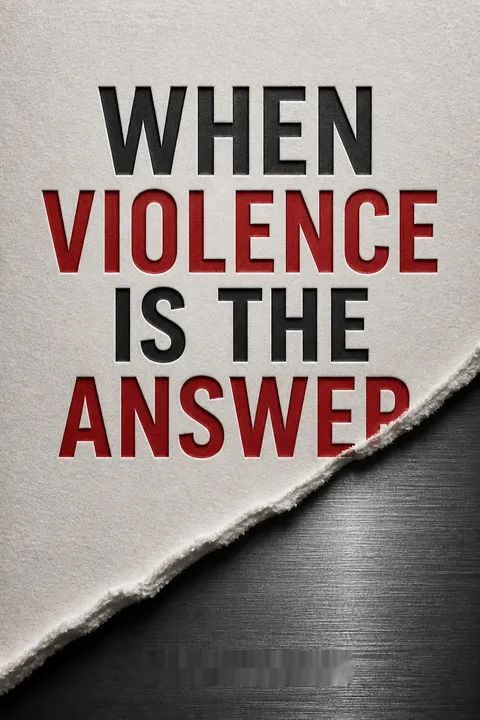
When Violence Is the Answer is a self-protection manifesto built from memoir, case studies, and a training philosophy. Its organizing movement is from interpretation to action: first reconsider what violence means, then distinguish kinds of conflict, then consider prevention and preparation. Larkin’s account of his failed SEAL career supplies a personal origin story, while incidents involving students, officers, prisoners, and ordinary citizens make abstract claims emotionally immediate. The book’s central contribution is not a catalogue of moves, but a demand to replace fantasies of clean, consequence-free defense with a sober view of risk, uncertainty, and human vulnerability.
Its most useful ideas are also its most portable: avoid ego-driven escalation, attend to surroundings, prepare before a crisis, and practice adaptable fundamentals rather than relying on cinematic scripts. The distinction between social aggression and asocial violence offers a memorable way to think about different encounters, and the author’s stories show why situations can change quickly. His closing appeal to kindness matters because it prevents readiness from being mistaken for suspicion or aggression.
The method of argument deserves scrutiny. Vivid cases can clarify possibilities, but they cannot by themselves establish how common a pattern is or how reliably a proposed response works. The book often presents strong claims about initiative, injury, and survival from an instructor’s experience, not from systematic comparisons across outcomes. Its behavioral cues are heuristics, not dependable tests of another person’s intent. Nor does preparedness eliminate chance, trauma, legal consequences, or the possibility that force will worsen an encounter.
A responsible reading therefore holds two ideas together. Denial is not a plan, and some people face dangers that cannot be negotiated away. But the book’s most broadly useful lesson is proportionate readiness, not a general license to use force. Its practical center is prevention, discernment, and disciplined preparation, with any physical response understood as an exceptional choice carrying serious consequences.
Review Summary
When Violence Is the Answer receives mostly positive reviews for its insights on self-defense and distinguishing between social aggression and asocial violence. Readers appreciate Larkin's emphasis on mental preparation and the importance of understanding when violence is necessary. Some criticize the repetitive nature and potential danger of the advice. The book is praised for changing perspectives on violence as a tool for survival, though some find it unsettling. Overall, readers find it thought-provoking and valuable for those interested in self-defense.
People Also Read






Glossary
Social aggression
Status-driven conflictLarkin’s term for confrontations shaped by social competition, dominance, demands, or status. Such encounters may include threats or physical contact, but he argues they often retain communication and may be avoided through withdrawal, compliance, or de-escalation. The term is a framework for interpreting conflict, not a guaranteed way to identify another person’s intentions.
Asocial violence
Destructive, non-negotiable attackLarkin’s term for violence aimed at causing harm rather than communicating, bargaining, or changing social status. He presents it as unpredictable and potentially life-threatening, with little or no opportunity for negotiation. The category helps organize his self-protection argument, though real events may not fit neatly into a single category and intent can be difficult to judge.
Cause State
Initiating rather than reactingLarkin’s term for a decision-making posture in which a person takes initiative and shapes what happens, rather than allowing another person’s actions to dictate every response. In the book, it is presented as an alternative to passive, purely reactive thinking during an unavoidable threat. It describes a mindset, not a guarantee of control over an encounter.
Effect State
Reacting to another’s initiativeLarkin’s term for a posture in which a person is responding to an existing situation created by someone else. He argues that hesitation and fixation on an attacker’s next move can keep a person in this reactive mode. The idea is used to explain why preparation matters, although real decisions under threat may involve both reaction and initiative.
Target
Body structure whose damage impairs functionLarkin uses target to mean an anatomical structure whose serious injury can disrupt normal bodily function. He argues that training should focus on the intended effect and the circumstances of an encounter rather than memorizing a fixed list of responses. This is the book’s specialized vocabulary for discussing physical vulnerability, not a recommendation to seek out confrontation.
spinal reflex reaction
Automatic response to traumaThe book uses this term for an involuntary bodily response to severe physical trauma that can occur before conscious decision-making. Larkin presents such responses as one reason a person may be temporarily unable to act normally. The term is part of his explanatory model; it should not be read as a universal or predictable outcome of injury.
Target Focus Training
Principle-based self-protection trainingThe name of Larkin’s training approach and organization. In the book, it emphasizes understanding violence, assessing vulnerability, preparing mentally, and practicing broad principles rather than memorizing a long sequence of techniques for imagined situations. The approach is presented as civilian self-protection training, though the book’s claims about effectiveness are grounded primarily in the author’s experience and examples.
FAQ
What's When Violence Is the Answer about?
- Understanding Violence as a Tool: The book explores the concept of violence as a necessary tool in life-or-death situations, emphasizing its pragmatic use over moral judgment.
- Mindset Shift: Tim Larkin encourages readers to change their perception of violence, viewing it as a practical response rather than a moral failing.
- Real-Life Applications: Drawing from Larkin's self-defense training experience, the book shares stories and lessons from individuals who have faced violence.
Why should I read When Violence Is the Answer?
- Practical Self-Defense Knowledge: The book offers insights into self-defense principles, helping readers prepare for unexpected confrontations.
- Real Stories and Examples: Larkin uses real-life narratives to illustrate the importance of understanding and responding to violence.
- Empowerment Through Knowledge: Readers gain knowledge to minimize violence risk and prepare to act decisively if necessary.
What are the key takeaways of When Violence Is the Answer?
- Violence is a Tool: Violence is not inherently evil; it can protect or harm based on the user's intent.
- Mindset Matters Most: A proactive mindset is crucial for survival, allowing decisive action in violent situations.
- Recognizing Social vs. Asocial Violence: Differentiating between these types of violence helps navigate dangerous situations effectively.
What are the best quotes from When Violence Is the Answer and what do they mean?
- “Violence is rarely the answer, but when it is, it’s the only answer.”: Highlights the necessity of recognizing when violence is essential for self-defense.
- “Techniques get you killed. Principles save your life.”: Emphasizes understanding violence principles over memorizing techniques for adaptability.
- “If it breaks, it’s a target.”: Encourages identifying vulnerable areas on the body to inflict injury during an attack.
How does Tim Larkin define violence in When Violence Is the Answer?
- Violence as a Tool: Defined as a tool for both good and bad purposes, depending on intent.
- Pragmatic Approach: Focuses on violence's mechanics and effectiveness rather than moral judgments.
- Universal Application: Violence affects everyone, underscoring the need for preparedness.
What is the difference between social aggression and asocial violence in When Violence Is the Answer?
- Social Aggression Defined: Involves conflicts from social hierarchies, often de-escalated through communication.
- Asocial Violence Explained: Characterized by unpredictability and intent to harm, requiring immediate action.
- Importance of Recognition: Recognizing these differences is crucial for effective self-defense.
What strategies does Larkin suggest for avoiding violence in When Violence Is the Answer?
- Situational Awareness: Be aware of surroundings and avoid distractions to identify threats early.
- De-escalation Techniques: Use social skills to defuse conflicts, preventing escalation into violence.
- Preventive Measures: Secure your environment and habits to reduce violence likelihood.
How can I prepare myself mentally for a violent encounter as suggested in When Violence Is the Answer?
- Visualize Scenarios: Mentally rehearse responses to potential violent situations for effective reaction.
- Adopt an Offensive Mindset: Focus on offense, preparing to incapacitate an attacker if necessary.
- Training and Practice: Engage in self-defense training to build confidence and muscle memory.
What role does intent play in self-defense according to When Violence Is the Answer?
- Intent to Injure: Crucial for decisive and effective action in self-defense situations.
- Clarity of Purpose: Focus on actions and targets during confrontation to prevent hesitation.
- Mindset Shift: Balancing being a good person with using violence effectively for safety.
How does Larkin suggest using the principles of violence in real-life situations in When Violence Is the Answer?
- Target Vulnerabilities: Focus on vulnerable body areas like the throat and eyes for quick incapacitation.
- First Strike Advantage: Being the first to inflict injury often determines confrontation outcomes.
- Acting with Intent: Maintain control in chaotic situations with clear intent and purpose.
How does Tim Larkin suggest one should train for violence?
- Slow and Deliberate Practice: Master fundamentals slowly to develop muscle memory without speed chaos.
- Focus on Injury: Emphasize intent to inflict injury, understanding effective mechanics.
- Use of Principles: Learn violence principles for adaptability in various situations.
What is the significance of understanding the human body's vulnerabilities in When Violence Is the Answer?
- Equalizer in Violence: Knowledge allows effective self-defense against larger attackers.
- Target Identification: Helps identify best targets to strike, increasing incapacitation chances.
- Empowerment: Empowers decisive and confident action in violent situations.
Download PDF
Download EPUB
.epub digital book format is ideal for reading ebooks on phones, tablets, and e-readers.








