

Key Takeaways
Train your attention to catch warning signs before the first attack
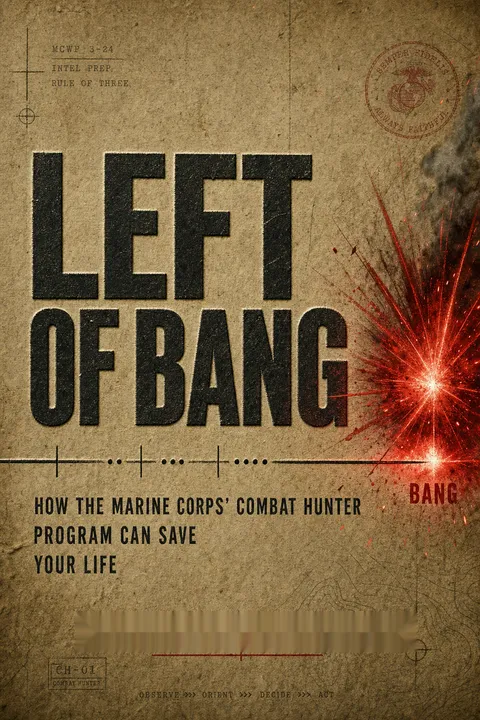
Move before the crisis. In the book’s vocabulary, the “bang” is the violent event: an explosion, a shot, or an ambush. Being “left of bang” means noticing earlier signs and acting while prevention is still possible. The idea grew from Iraq, where heavier armor protected Marines from some blasts but did not stop insurgents from choosing when and where to attack. The authors argue for a proactive mindset called Condition Yellow: stay alert to the surroundings rather than assuming a situation is safe.
Small cues can matter. In 1999, customs agent Diana Dean noticed that a traveler named Ahmed Ressam seemed unusually anxious during routine questions. A search uncovered explosives intended for an attack at Los Angeles International Airport. Dean did not predict the future; she noticed behavior that differed from what she normally saw and investigated it.
What's powerful here is the shift from emergency response to hazard prevention. Safety engineering often works the same way: systems become safer when they identify weak signals before a failure, rather than relying only on better recovery afterward. The comparison has limits, however. A suspicious cue is not proof of malicious intent. Treating early detection as a reason to observe, verify, or seek help is safer and more accurate than treating it as permission to accuse.
Compare people with the local normal, including what has disappeared
Define normal first. A baseline is the usual pattern of behavior in a particular person, place, or situation. An anomaly is a meaningful departure from that pattern, including something that appears unexpectedly or something normally present that disappears. The authors describe a village in Afghanistan where people were usually outdoors, including a man who sat outside drinking tea. One day the streets were unusually empty, and his house was closed. A large explosive device later detonated beneath a military vehicle.
Absence can be evidence. A quiet street is not automatically dangerous, just as a crowded one is not automatically safe. Its significance comes from comparison: what normally happens here, and what has changed? The same logic can apply to an individual whose routine shifts or to an area where familiar activity suddenly stops.
This is a practical form of anomaly detection, familiar in fields such as medicine and cybersecurity: a signal becomes meaningful against a known pattern. It also exposes a common weakness in human judgment. People notice dramatic events more readily than missing ones, even when an absence is informative. Baselines must remain flexible, though. Weather, holidays, local customs, and ordinary variation can change a scene without signaling danger, so departures should prompt inquiry rather than automatic suspicion.
Read six behavioral lenses, not race, religion, or a hunch
Give observation a structure. Combat profiling is the authors’ method for identifying possible threats through behavior and environmental cues, not racial or religious categories. It organizes observations into six domains: kinesics, or body movement; biometric cues, or bodily responses to stress; proxemics, or how people use interpersonal space; geographics, or how people move through an environment; iconography, or symbols and affiliations; and atmospherics, or the shared mood of a place.
Look across the scene. A person’s tense posture, unusual distance from others, and unfamiliar movement pattern may together deserve attention. A tattoo or flag may provide context, but is not proof of threat. The domains help observers sort a flood of information into a common vocabulary, then compare what they see with the local baseline.
The framework’s strength is organizational: it gives teams a shared way to describe observations without relying on vague labels such as “looks suspicious.” That can reduce arbitrary judgments and make decisions easier to review. The domains are not independent evidence, however. Nervous gestures and bodily signs of stress may arise from the same cause, so counting them separately can exaggerate certainty. Cultural context matters too, especially for space, clothing, and symbols. The framework is most useful as a disciplined checklist, not a universal decoder.
Treat body-language clusters as clues, never as proof of guilt
Context beats gesture dictionaries. A single gesture can have several explanations. Crossed arms might signal discomfort, cold, or simply a comfortable posture. The authors therefore recommend looking for at least three cues that point toward the same interpretation, then checking whether that cluster fits the situation. A person who appears tense, keeps turning toward an exit, and repeatedly touches a concealed area presents a stronger reason for attention than any one behavior by itself.
Notice broad responses. The book groups visible reactions to perceived threat around freezing, distancing, and preparing to fight. It also describes biometric changes such as sweating, trembling, or faster breathing. These can reveal stress, but stress has many possible causes. The key question is not “Is this person lying?” but “What has changed, and what else supports that reading?”
The preference for clusters is a useful corrective to popular body-language claims that one gesture reveals a lie or a hidden intention. Human behavior is noisy, and the same physiological response can accompany fear, embarrassment, exertion, or illness. Even several cues can be correlated rather than independent. The authors’ emphasis on context helps, but observers still need to separate an observable fact from an inference about what it means. That distinction reduces both false alarms and overconfidence.
Map routines, routes, and restricted places to understand human terrain
Place shapes behavior. Geographics examines how people relate to their surroundings. Natural lines of drift are the easy, familiar routes people tend to use. A habitual area is open to ordinary public access, while an anchor point is a place controlled by a person or group. Together, these ideas help describe where people gather, how they travel, and which locations carry special significance.
Read locations through behavior. The authors use Osama bin Laden’s escape from Tora Bora to show how local knowledge and unblocked paths can matter. They also discuss the compound in Abbottabad where he was eventually found: its walls, lack of ordinary communications, and unusual trash disposal stood out against the surrounding area. Such details narrowed attention, but only because observers compared the compound with what was normal nearby.
This is a human-centered map: not just streets and buildings, but habits, access, and social meaning. In urban planning, a path people repeatedly choose often reveals more about how a space works than its official design does. The same approach can illuminate both convenience and control. Yet an unusual building or restricted entrance may have an entirely benign explanation. Geographic clues are strongest when they converge with independent observations, rather than being made to fit a theory after the fact.
Use intuition as pattern recognition, then test it against evidence
A gut feeling has inputs. The authors describe intuition as rapid pattern recognition shaped by experience, not a supernatural warning. In recognition-primed decision-making, an experienced person recognizes a familiar pattern and selects a workable response without comparing every possible option. A Marine sergeant on patrol in Mosul saw two boys sitting in a closed car in extreme heat. Something about the scene felt wrong, so he ordered his team to move away. The car held an explosive device, which detonated after they had withdrawn.
Make intuition learnable. The sergeant may not have consciously listed every cue, but his experience helped him register a mismatch. The book’s aim is to give less experienced observers explicit categories and practice, so they can build useful patterns instead of waiting years for exposure.
Fast recognition can be valuable when time is short and experience is relevant. It is also vulnerable to false pattern-matching: a familiar story can make unrelated details seem connected. Decision science distinguishes skilled intuition, built in environments with reliable feedback, from mere confidence. The book’s strongest implication is therefore not to obey every hunch, but to notice it, identify observable cues, and use a prepared response proportionate to the evidence.
Choose your decision threshold before uncertainty becomes paralysis
Decide when enough is enough. The Combat Rule of Three is the authors’ threshold for action: when three meaningful anomalies or indicators appear, make a decision rather than endlessly seeking more information. One unmistakable hostile act may demand an immediate response, while less conclusive signs may call for further observation or contact. The point is to prevent uncertainty from turning into inaction, not to declare that three clues establish guilt.
Match action to role. For military settings, the authors describe choices of killing or preparing to kill, capturing, or contacting a person. For civilians facing an immediate attacker, they discuss running, hiding, or fighting. These are not interchangeable scripts. The appropriate response depends on the threat, the person’s role, and applicable law and safety procedures.
A precommitted threshold can counter the human tendency to freeze while searching for certainty that a chaotic situation cannot provide. But a fixed number is a decision aid, not a scientifically universal cutoff. Three weak or related clues may be less informative than one highly specific sign. The important practical lesson is to decide in advance what kinds of evidence justify which safe, lawful next steps, and to keep the response proportional to the situation.
A sudden shift in the crowd can matter more than one person
Read the shared mood. Atmospherics means the collective mood and activity of a place. It can be inferred from body language, interpersonal distance, noise, movement, symbols, and the general degree of order. During a Vietnam patrol described in the book, a normally active village became strangely quiet before an ambush. The silence was not mystical; it was a sharp departure from the expected behavior of the place.
Watch for change. A sudden shift from ordinary conversation to silence, or from relaxed behavior to visible tension, suggests that something in the situation has changed. The observer’s next task is to identify what caused the shift. The change might follow the arrival of a person, a sound, or an event, and it can direct attention toward other evidence.
Collective behavior can reveal a change that no single person makes obvious. Social psychology describes how emotion and attention can spread through a group, while crowd movement can expose shared expectations. Still, quiet may mean many things: respect, routine, fatigue, or fear. Atmospherics works best as an early alert to look more carefully, not as a standalone verdict about danger. The useful question is what changed in the environment and whether other domains support the interpretation.
Find the real leader by watching who others follow
Influence is often indirect. The authors use MADE as a memory aid for four possible signs of leadership: Mimicry, Adoration, Direction, and Entourage. A leader may initiate gestures others copy, receive signs of respect, guide others’ actions, or have people who accompany and support them. These cues can reveal influence that a formal title or loud voice does not.
Observe the whole group. In one account from Afghanistan, Marines initially misjudged a quiet villager as unimportant. They noticed that others repeatedly came to him and watched how people responded when he was present. After building a relationship with him, they saw other villagers become more willing to engage. The example shows why observers should look for patterns of attention and deference, not simply ask who speaks most.
The framework resembles network analysis: influence is visible in who attracts attention, whose behavior gets copied, and who connects people. That perspective can reveal informal leadership missed by an org chart. But social influence is not always authority, and deference can reflect culture, age, or circumstance. MADE is best used to generate a hypothesis about who matters in a group, then checked through repeated observation and interaction.
Practice observation deliberately, and keep correcting your own confidence
Turn noticing into a skill. The authors compare profiling to learning to drive: initially, each task demands attention, but repeated practice makes observation more fluid. They recommend returning to familiar public places, establishing a baseline, recording predictions, and seeking feedback where appropriate. Training in malls or cafes can build experience with ordinary behavior before a person must interpret an unfamiliar setting.
Expect slow progress. Marines interviewed about one deployment estimated that a squad needed about fifteen patrols to understand a village’s baseline. With three squads, the enemy and residents could observe many patrols while the unit was still learning. Explicit notes and shared terminology can speed up that learning, but confidence should not outrun accuracy. The authors warn that people often overestimate their expertise, making correction and humility part of training.
Deliberate practice is most effective when it includes feedback, not merely repetition. Recording what was observed, what was inferred, and what later proved true can expose faulty assumptions and improve calibration. There is also an ethical boundary: observing people in public should not become intrusive surveillance or profiling based on identity. A good observer learns not only to detect patterns, but also to recognize uncertainty, protect privacy, and revise a mistaken interpretation.
Analysis
Left of Bang turns a military problem into a general model of attention: threats often have precursors, but people miss them because they are overloaded, habituated, or waiting for certainty. Its most valuable move is procedural. Instead of demanding extraordinary instinct, it asks observers to establish a baseline, scan several kinds of evidence, notice departures, and prepare a response before pressure arrives. The result is a practical bridge between perception and action.
The book is strongest when it treats profiling as structured observation rather than mind-reading. Its stories, especially the customs agent who noticed Ressam’s unusual behavior, make the preventive logic vivid. The six domains also give teams a shared vocabulary, an important advantage when observations must be communicated quickly. Its emphasis on behavior instead of race or religion is both ethically important and analytically sound: demographic stereotypes are poor substitutes for evidence about a particular situation.
The greatest caution concerns calibration. Body language and stress responses are not unique signatures of criminal intent, and the same cue can have several causes. A rule such as three anomalies is useful as a prompt against paralysis, but it cannot guarantee that a judgment is accurate. Nor should a catalogue of cues encourage observers to interpret ordinary difference as threat. The safest reading treats indicators as provisional evidence, distinguishes observation from inference, and seeks corroboration where time allows.
The book’s practical contribution is therefore less a promise of prediction than a discipline of attention. It encourages people to notice what is present, what is absent, and what has changed, then to choose a response suited to their role and the evidence. Its framework is most credible when paired with humility, feedback, and safeguards against false accusation. Prevention depends not on seeing danger everywhere, but on noticing meaningful change without confusing suspicion with certainty.
Review Summary
Left of Bang receives mixed reviews, with an average rating of 3.98 out of 5. Many readers find value in its approach to situational awareness and threat detection, praising its application of Marine Corps combat techniques to everyday life. However, some criticize the book for being repetitive, overly focused on military scenarios, and lacking practical exercises. Several reviewers note that while the core concepts are useful, the book could benefit from more civilian-oriented examples and less self-promotion. Overall, readers appreciate the book's emphasis on proactive awareness but have varying opinions on its broader applicability.
People Also Read






Glossary
Left of Bang
Before a violent eventThe period before an attack or other harmful event occurs. The phrase describes the goal of recognizing pre-event indicators early enough to prevent, disrupt, or prepare for the event, rather than reacting only after violence has begun.
Combat profiling
Behavior-based threat assessmentA real-time method for assessing people and surroundings through observable behavior and contextual cues. It combines situational awareness, comparison with a baseline, recognition of anomalies, critical thinking, and quick decisions. The authors distinguish it from racial profiling and from criminal profiling conducted after a crime.
Cooper’s Color Code
Levels of alertnessA system describing states of awareness and readiness. The book emphasizes Condition Yellow as active awareness of surroundings, Condition Orange as focus on a specific possible threat, and Condition Red as readiness to act. It also discusses Condition White as unpreparedness and Condition Black as extreme arousal that impairs processing.
Six Domains
Lenses for observing behaviorThe book’s six categories for organizing observations: kinesics, or body language; biometric cues, or bodily responses to stress; proxemics, or use of interpersonal space; geographics, or people’s relationship with the environment; iconography, or symbols and affiliations; and atmospherics, or the collective mood of a place.
Baseline
The expected local patternThe normal pattern of behavior for a person, place, or situation. A baseline may include routines, movement, interaction, activity, noise, or symbols. It provides the comparison needed to recognize meaningful changes, and it should be updated as circumstances shift.
Anomaly
A departure from normalA person, behavior, object, or absence that differs from the relevant baseline. An anomaly may be something present that should not be, or something missing that would normally be expected. It is a reason to look more carefully, not proof that a threat exists.
Combat Rule of Three
A threshold for decidingThe authors’ heuristic that three meaningful anomalies or indicators should trigger a decision rather than continued hesitation. It is a practical threshold for action under uncertainty, not a guarantee of accuracy or a claim that three observations prove hostile intent. Some unmistakable hostile acts may warrant immediate action.
Natural lines of drift
Common paths through terrainRoutes people tend to choose because they are familiar, relatively easy, safe, or unobstructed. These paths can include informal shortcuts as well as ordinary roads and walkways. Observing them helps explain how people move through an area and where their routines lead.
Habitual area
A place open to ordinary accessA location where people can generally come and go without special permission, such as a public market or town center. Habitual areas attract routine activity, making their normal patterns useful for comparison and their unusual behavior easier to notice.
Anchor point
A controlled home baseA place claimed or controlled by a person or group, where access is restricted or governed by informal or formal rules. An anchor point may serve as a home base or meeting place. Its significance is often revealed by patterns of access, protection, and the behavior of people nearby.
Atmospherics
The collective mood of a placeThe shared emotional and behavioral character of a situation or location. It can be assessed through cues such as activity, noise, body language, interpersonal distance, symbols, and order. A sudden change in atmospherics may indicate that something important has changed, though it does not identify the cause by itself.
MADE
Four signs of group influenceA mnemonic for Mimicry, Adoration, Direction, and Entourage, four behaviors the authors use to help identify influential people in a group. Others may copy a person, show deference, take direction from them, or gather around them. The signs suggest influence but require contextual confirmation.
Recognition-primed decision-making
Experience-guided rapid decisionsA model of decision-making in which an experienced person recognizes a familiar pattern and selects a workable response without systematically comparing every option. It can be effective under time pressure when experience is relevant, but its reliability depends on useful learning and feedback.
FAQ
1. What is "Left of Bang" by Patrick Van Horne and Jason A. Riley about?
- Combat Hunter Program Explained: The book details the Marine Corps' Combat Hunter program, which teaches proactive threat detection and situational awareness based on human behavior analysis.
- Staying Left of Bang: "Left of Bang" refers to identifying and acting on pre-event indicators before a violent or dangerous event ("bang") occurs, rather than reacting after the fact.
- Universal Application: While rooted in military training, the book emphasizes that these skills are valuable for law enforcement, security professionals, and civilians in everyday life.
- Behavioral Profiling Focus: The core of the book is on combat profiling—reading and interpreting human behavior to prevent attacks and increase survivability.
2. Why should I read "Left of Bang" by Patrick Van Horne and Jason A. Riley?
- Proactive Safety Skills: The book provides actionable methods to detect threats early, potentially saving lives in both combat and civilian settings.
- Applicable to Everyone: Its lessons are relevant not just for military or police, but for anyone interested in personal safety, from travelers to corporate professionals.
- Bridges Intuition and Science: It demystifies gut feelings and intuition, offering a structured approach to reading human behavior and making quick, informed decisions.
- Endorsed by Experts: The book is praised by military leaders, law enforcement professionals, and security experts for its practicality and effectiveness.
3. What are the key takeaways from "Left of Bang" by Patrick Van Horne and Jason A. Riley?
- Baseline and Anomalies: Learn to establish what is normal (the baseline) in any environment and identify anomalies that may signal threats.
- Six Domains of Behavior: The book introduces six domains—Kinesics, Biometrics, Proxemics, Geographics, Iconography, and Atmospherics—as frameworks for observation.
- Heuristic Decision-Making: Emphasizes making quick, "good enough" decisions using heuristics, rather than waiting for perfect information.
- Bias for Action: Encourages a proactive mindset, acting on observed indicators rather than hesitating or overanalyzing.
- Universal Human Behavior: Shows that despite cultural differences, certain behavioral patterns and responses to stress are universal and can be reliably interpreted.
4. What does "Left of Bang" mean in the context of the book?
- Timeline of Events: "Bang" represents the moment of attack or crisis; "left of bang" is the time before the event, where prevention is possible.
- Proactive vs. Reactive: Being "left of bang" means identifying and acting on warning signs before violence occurs, rather than responding after the fact.
- Early Detection: The book teaches how to spot pre-event indicators—subtle cues in behavior or environment that precede an attack.
- Mindset Shift: It advocates for a shift from a reactive to a proactive approach in personal and organizational security.
5. What is the Combat Hunter program, and how does it relate to "Left of Bang"?
- Origins in the Marine Corps: The Combat Hunter program was developed to improve Marines' situational awareness and ability to detect threats in complex environments.
- Three Pillars: The program focuses on enhanced observation, combat tracking, and combat profiling, with "Left of Bang" centering on the profiling aspect.
- Hunter vs. Prey Mindset: It trains individuals to think like hunters—actively seeking out threats—rather than passively waiting to react.
- Real-World Success: The book shares feedback and case studies demonstrating the program's effectiveness in saving lives and improving mission outcomes.
6. What are the Six Domains of Combat Profiling described in "Left of Bang"?
- Kinesics: The study of body language—postures, gestures, and movements that reveal emotions and intentions.
- Biometrics: Observing involuntary physiological responses to stress, such as pupil dilation, sweating, or changes in breathing.
- Proxemics: Understanding how people use space and distance to communicate relationships, intentions, and comfort levels.
- Geographics: Analyzing how people interact with their environment, including habitual areas, anchor points, and natural lines of drift.
- Iconography: Interpreting symbols, clothing, tattoos, graffiti, and other visual cues that indicate group affiliations or beliefs.
- Atmospherics: Sensing the collective mood or emotional tone of a place, and identifying shifts that may signal impending danger.
7. How does "Left of Bang" by Patrick Van Horne and Jason A. Riley teach you to establish baselines and spot anomalies?
- Baseline Definition: A baseline is what is normal for a given environment, situation, or group of people, established through observation.
- Anomaly Identification: An anomaly is any deviation from the baseline—something that stands out as unusual or unexpected.
- Continuous Observation: The book emphasizes the need for ongoing assessment, as baselines can shift over time or with changing circumstances.
- Action on Anomalies: Spotting an anomaly is a cue to investigate further or take action, as it may indicate a potential threat.
8. What is the Combat Profiling heuristic and the "Rule of Three" in "Left of Bang"?
- Heuristic Decision-Making: The book advocates for making quick decisions based on limited but critical information, rather than exhaustive analysis.
- Rule of Three: When you observe three anomalies or indicators, you must make a decision and act—do not wait for more information.
- Threshold for Action: While three is the standard, sometimes a single clear threat indicator is enough to warrant immediate action.
- Pre-Established Responses: The book suggests having a set of predetermined actions (e.g., kill, capture, contact for military; run, hide, fight for civilians) to avoid hesitation.
9. How does "Left of Bang" differentiate between combat profiling and other types of profiling?
- Behavior-Based, Not Bias-Based: Combat profiling focuses on observable behavior, not race, religion, or ethnicity, avoiding prejudicial or discriminatory practices.
- Proactive vs. Reactive: Unlike criminal profiling, which is often used after a crime to identify suspects, combat profiling is used in real-time to prevent incidents.
- Not Psychological or Personality Profiling: The method is not about inferring deep psychological traits, but about reading immediate, situational cues.
- Universal Application: The approach is designed to work across cultures and environments, relying on human universals rather than cultural stereotypes.
10. What practical steps does "Left of Bang" recommend for developing your profiling ability?
- Practice Observation: Regularly observe people and environments to build experience in establishing baselines and spotting anomalies.
- Use the Six Domains: Systematically apply the six domains to structure your observations and improve accuracy.
- Seek Feedback: Whenever possible, confirm your observations through interaction or follow-up to refine your skills.
- Deliberate Repetition: Repeatedly practice in various settings (e.g., malls, airports, public spaces) to build a mental database of patterns and behaviors.
- Stay Humble: Recognize your limitations and avoid overconfidence; continuous learning and humility are essential for improvement.
11. What are some real-world examples or case studies from "Left of Bang" that illustrate its principles?
- Millennium Bomber Case: Customs agent Diana Dean detected subtle behavioral anomalies in Ahmed Ressam, preventing a major terrorist attack at LAX.
- Target Store Abduction: A loss prevention officer noticed odd behavior, recorded a license plate, and helped recover a kidnapped child.
- Military Patrols: Marines using combat profiling identified IED threats and key leaders in Afghan villages, improving safety and mission success.
- Atmospheric Shifts: Stories illustrate how changes in collective mood or activity (e.g., a village going silent) can signal imminent danger.
12. What are the best quotes from "Left of Bang" by Patrick Van Horne and Jason A. Riley, and what do they mean?
- "It's better to detect sinister intentions early than respond to violent actions late." — Emphasizes the core philosophy of proactive threat detection.
- "Being left of bang means that we can identify the people doing the surveillance or emplacing the IED and prevent an attack from happening by stopping the process there." — Highlights the value of early intervention.
- "Intuition is nothing more than a person’s sense about a situation influenced by experience and knowledge." — Demystifies intuition, framing it as a skill that can be developed.
- "A good solution applied with vigor now is better than a perfect solution ten minutes later." — Stresses the importance of timely action over perfect analysis.
- "We see it all, but we edit out most of it. Thus, when something does call out to us, we ought to pay attention." — Encourages readers to trust and act on their observations and instincts.
Download PDF
Download EPUB
.epub digital book format is ideal for reading ebooks on phones, tablets, and e-readers.








