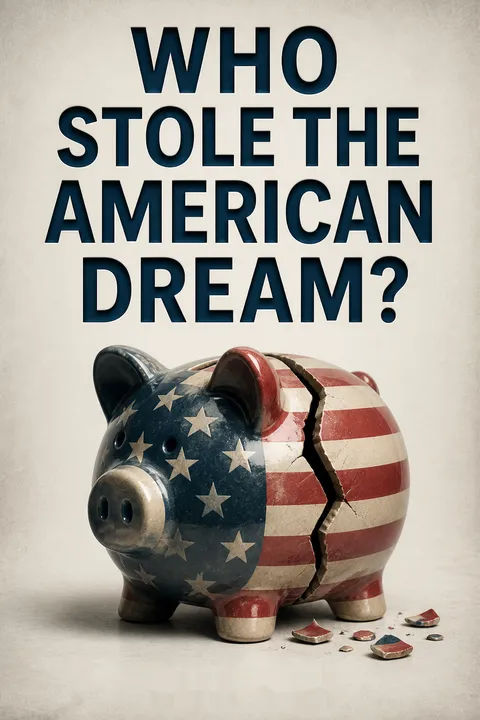


Key Takeaways
Treat the middle-class squeeze as a political choice, not globalization's fate
The gains went upward. Smith's central claim is that America's widening divide was not an automatic bill for technology or global trade. Public policy and corporate strategy shaped who benefited. From 2002 to 2007, the top 1 percent received two-thirds of the country's economic gains; in 2010, it received 93 percent of gains during the recovery. Most families faced stagnant pay and greater insecurity.
Other paths existed. Germany also competed in a global economy, yet preserved more manufacturing jobs and shared wage gains more broadly. The comparison does not prove that one country's policies can simply be copied by another. It does challenge the claim that U.S. outcomes were inevitable, and puts choices about labor, taxes, finance, and trade at the center of the story.
What's striking is the shift from treating markets as weather to treating them as institutions shaped by rules. The same technological shock can produce different outcomes depending on bargaining power, tax policy, and who bears risk. This framing restores agency without pretending that globalization is painless or controllable. The Germany comparison is useful as a counterexample, but not a controlled experiment: national histories and industrial structures differ. Its strongest lesson is narrower and more persuasive: policy choices mediate economic shocks, so a country's response deserves scrutiny alongside the shock itself.
Pay workers enough to keep the economy's demand engine running
Prosperity once reinforced itself. The virtuous circle of growth describes a cycle in which steady wages give households money to spend, consumer demand encourages businesses to invest and hire, and that expansion supports another round of incomes and spending. Henry Ford's high wage policy reflected the logic: workers who could afford products also became customers.
The link weakened. From 1948 to 1973, productivity rose about 97 percent and average hourly compensation rose about 94 percent. From 1973 to 2011, productivity rose about 80 percent, while hourly compensation increased only about 4 percent. Smith argues that subdued pay weakened household demand and contributed to jobless recoveries, even as many companies became more profitable.
This account connects the household budget to the macroeconomy: wages are not only a cost to employers, they are purchasing power for the customers businesses need. That feedback loop makes distribution an economic question, not just a fairness question. Still, high wages alone do not guarantee growth; firms also need productive investment, and consumers can spend beyond their means. The book's contribution is to show why wage suppression can become self-defeating when many companies pursue it at once. A decision that improves one firm's margins may weaken demand across the whole economy.
Recognize that business power shifted before Reagan took office
A political campaign began in 1971. Lewis Powell, a prominent corporate lawyer, urged business leaders to organize, plan over the long term, and engage more aggressively in politics. Companies responded by opening Washington offices, funding policy organizations, and forming influential business coalitions. The number of company offices in the capital rose from 175 in 1971 to 2,445 a decade later.
The pivot came under Carter. In 1977 and 1978, business groups helped defeat a proposed consumer agency and labor law reforms, while winning deregulation in transport industries. Congress also passed the 401(k) provision and a bankruptcy law that gave company management greater control in restructuring. Smith's point is not that one memo caused every change, but that organized, sustained lobbying altered the balance of influence before the 1980s.
The story underscores a basic feature of collective action: organized groups can shape policy even when their members are a minority, especially when participation is sustained and well-resourced. The contrast is not simply business against government. It is between groups with durable institutions and citizens who mobilize episodically. The memo offers a memorable starting point, but political power rarely has a single origin. Smith's more useful claim is cumulative: organization, expertise, and repeated access can turn a temporary advantage into lasting policy influence.
Measure corporate success by durable capacity, not layoffs and stock spikes
A new yardstick took hold. Wedge economics is Smith's term for separating employee pay from company revenues and profits, while prioritizing returns to investors. In this model, downsizing and offshoring can lift short-term profits without sharing much of the gain with workers. CEO Al Dunlap showed the logic at Sunbeam: he cut thousands of jobs, including at a profitable Tennessee plant, and the stock initially rose.
The apparent win was fragile. Sunbeam later collapsed amid accounting abuses and bankruptcy. Smith contrasts this approach with companies that invested in worker training and production capacity. He also describes CEO pay rising from roughly 40 times average worker pay in the 1970s to more than 350 times by the early 2000s. The issue is not that every layoff is avoidable, but that stock price can reward choices that damage long-term capability.
The distinction between financial performance and productive capacity is important. A stock price is a signal about expected returns, not a complete measure of whether a firm is building skills, reliable products, or resilient operations. Short-term incentives can therefore reward extraction over investment. Yet the alternative is not to protect every job regardless of economic reality. The more demanding test is whether restructuring improves a firm's long-term ability to compete, and whether workers share in gains when their expertise helps create them.
Do not mistake shifting financial risk onto families for self-reliance
Households inherited more risk. The Great Risk Shift describes the transfer of costs and uncertainty from employers and government to workers and families. Traditional pensions promised a predictable retirement payment; 401(k) plans made workers responsible for saving, investing, and managing market swings. In companies with more than 100 employees, the share of workers covered by employer-funded pensions fell from 84 percent in 1980 to 33 percent in 2006.
The replacement often fell short. The typical 401(k) balance for people in their sixties who had participated for about twenty years was roughly $80,000, far below many experts' estimates of retirement needs. The book also traces growing reliance on consumer debt as wages stagnated and health costs rose. Individual saving matters, but families cannot reliably manage risks they lack the income, information, or bargaining power to absorb.
The distinction between responsibility and capacity matters. A system can formally give people control while leaving them exposed to market volatility, job changes, fees, and emergencies they cannot predict. That is not necessarily autonomy; it can be risk transfer disguised as choice. At the same time, defined-benefit pensions are not costless or automatically secure, as underfunded plans demonstrate. The central design question is who can pool risk most effectively, and whether workers receive enough income and guidance to make individual accounts a real benefit rather than a fragile substitute.
Keep mortgage profits tied to whether borrowers can repay
The lending chain lost accountability. In the New Mortgage Game, brokers and banks originated loans, then sold them into a secondary market where Wall Street bundled and resold mortgage debt. Because the originator could pass the default risk to investors, loan volume and fees could matter more than whether borrowers could afford payments. Some loans used teaser rates, minimal documentation, or payments that allowed the debt balance to grow.
The costs reached ordinary owners. Borrowers such as Bre Heller, a mortgage employee whose income fell before her loan closed, and Eliseo Guardado, whose application listed far more income than he says he earned, faced unaffordable loans and foreclosure. Smith estimates that homeowners' share of housing value fell from 69 percent in 1985 to 38 percent in 2011, with about $6 trillion in wealth lost, much of it through equity extraction.
This is a vivid case of incentives changing behavior: when the party earning fees does not retain meaningful exposure to default, careful screening becomes less attractive. Selling risk can diversify a sound system, but it can also obscure who is responsible for assessing it. The account makes the chain legible, from a sales pitch to a distant security holder to a household's loss of equity. Its focus on systemic design does not erase borrower decisions; it explains why individual judgment was often made inside a market engineered to reward volume.
Follow the money to see whose preferences Congress hears
Access was unequal. Smith calls the insider relationship between Washington and finance the New Power Game. From 1998 to 2010, business interests spent about $28.6 billion on lobbying, compared with roughly $492 million for labor. The financial sector also recruited former public officials as lobbyists and placed its leaders in major government posts.
Unequal influence shaped policy. Political research cited by Smith finds that lawmakers respond more to affluent constituents than to people of modest means. The book links that imbalance to tax policy, weak financial regulation, and gridlock. It describes how frequent Senate filibuster tactics allowed a minority to block legislation, while policies such as minimum-wage increases stalled and tax cuts for wealthy households advanced. The point is not that every vote is bought, but that concentrated resources create constant access that ordinary voters rarely match.
Political equality depends on more than equal ballots. It also depends on whose concerns receive attention between elections, when legislation is drafted and technical choices are made. Lobbying can provide lawmakers with expertise, but that benefit becomes distorted when one side can supply far more of it, repeatedly. The book's figures make the disparity concrete. Still, money is not the only source of influence: party loyalty, voter geography, and ideology also shape outcomes. The strongest diagnosis is that financial power operates within, and can amplify, a broader institutional imbalance.
Keep production and innovation connected if you want high-value jobs
Offshoring reaches beyond factories. Wal-Mart's purchasing power pushed suppliers to cut costs and move production abroad; the closure of Rubbermaid's Wooster plant cost the town hundreds of jobs. In the 2000s, U.S. multinationals added 2.4 million workers overseas while cutting 2.9 million at home, according to the figures Smith cites. IBM's Indian workforce grew until it exceeded its U.S. workforce around 2010.
Production supports future invention. Smith argues that manufacturing experience, engineering, and research reinforce one another. Moving production can also move know-how and supplier networks. Germany offers a contrast in the book: about 21 percent of its workforce was in production, versus 9 percent in the United States, while Germany maintained stronger export performance and wage growth. Lower prices are real consumer benefits, but they do not by themselves replace lost jobs or industrial capability.
The argument goes beyond nostalgia for factories. Production can generate practical knowledge that designers and engineers need, while local supplier networks make experimentation easier. A company may capture lower costs by moving work abroad, but the national effects differ from the company's balance sheet. The book rightly asks who captures the gains and who absorbs the disruption. Its case should not be read as proof that every domestic job can be preserved or that manufacturing is always superior to services. It is a warning against assuming that innovation remains strong when the capacity to make things disappears.
Treat military commitments as choices with domestic opportunity costs
Long wars carry long bills. Smith describes imperial overstretch as the risk of maintaining global military commitments beyond a country's economic capacity. The wars in Iraq and Afghanistan were projected to cost about $3.5 trillion through direct spending and broader obligations, including veterans' care. He argues that deficit financing made those costs less visible to the public and that expanding missions, from counterterrorism toward nation-building, prolonged the burden.
The trade-offs reached home. During budget fights, local leaders and members of Congress questioned why domestic services were being cut while war spending continued. Smith draws on Dwight Eisenhower's warning that military strength cannot be built without regard to economic capacity. This is not an argument that security is unimportant. It asks whether a mission serves a clear national purpose, whether its costs are transparent, and whether the same resources could address pressing needs at home.
The opportunity-cost lens makes foreign policy part of domestic political economy. Spending is not just an abstract national total; it competes with investment in infrastructure, education, and public health. Requiring leaders to state the mission, duration, and funding plan can improve democratic oversight. Yet cost alone cannot determine whether a military commitment is justified. Security benefits are uncertain and may be difficult to quantify, while withdrawal also has risks. The book's most durable point is procedural: citizens should be able to see both the aims of a mission and the domestic trade-offs attached to it.
Build citizen power alongside a domestic jobs and investment plan
The proposed repair is political and economic. Smith's Domestic Marshall Plan calls for coordinated investment in infrastructure, research, manufacturing, worker retraining, fairer taxes, and housing relief, alongside protection for Social Security and Medicare. He points to past public-private projects, from railroads to the interstate highway system, as evidence that government can help create conditions for private growth.
Public pressure makes action possible. The book's final step is renewed civic participation. The civil-rights and environmental movements show how organized citizens made problems visible and pushed leaders to act. Tea Party organizing demonstrated that a focused grassroots movement can change political debate, though Smith rejects its policy agenda. He argues that voting alone is insufficient: citizens must remain engaged between elections, when policy is negotiated and moneyed interests exert influence.
The proposal joins two levers often treated separately: productive investment and political mobilization. Public spending can build infrastructure or fund early research, while citizen organization can make officials answerable for how those resources are used. This combination is more realistic than waiting for unusually benevolent leaders or expecting markets alone to distribute gains fairly. The challenge is practical: a broad agenda can lose force unless it establishes priorities, coalitions, and measurable goals. The book's emphasis on participation is therefore not merely inspirational. It is a condition for making its economic program politically achievable.
Analysis
Smith's book is best understood as a political-economic history organized around a feedback loop: economic resources buy political access, policy can reinforce economic advantage, and growing insecurity weakens the civic participation that might challenge the cycle. Its narrative strength lies in moving from structural claims to lives readers can picture: a laid-off factory worker, an airline mechanic whose pension is cut, and borrowers who discover that a mortgage's fine print has shifted risk onto them. Those stories make the institutional chain legible without reducing every outcome to a statistic.
The book also usefully contests the idea that globalization alone explains American inequality. Comparisons with Germany and the postwar record show that institutions, labor power, and industrial strategy influence how economic gains are distributed. The virtuous-circle argument adds an important macroeconomic point: wages are also demand, so a strategy that suppresses pay widely may undermine the market that firms depend on.
Its limitations follow from its persuasive ambition. The text favors an explanation centered on business influence and policy choices, which can understate the complexity of technological change, consumer preferences, fiscal constraints, and variation among industries. Germany is a revealing counterexample, not proof that its institutions can be transplanted unchanged. Likewise, the correlation between polarization and inequality does not by itself establish which drives which. The book is strongest when it traces mechanisms, such as financial institutions separating loan origination from default risk, rather than presenting every trend as the result of a unified plan.
The lasting value is a method of inquiry: ask who gains from a rule, who bears the risk, and who has the organization to influence the next rule. That lens turns debates about retirement, trade, housing, taxes, and defense into connected questions about power and shared prosperity. Smith's proposed remedies are ambitious and politically difficult, but the diagnosis insists that civic disengagement is not neutral. When organized interests remain active and ordinary citizens withdraw, the rules are still being written.
Review Summary
Who Stole the American Dream? receives mostly positive reviews for its detailed analysis of economic inequality and the erosion of the middle class. Readers appreciate Smith's clear writing, thorough research, and historical perspective. Many find the book eye-opening and infuriating, as it exposes how corporate interests and policy changes have favored the wealthy. Some criticize its left-leaning bias, while others praise its proposed solutions. Overall, reviewers consider it an important, accessible work that illuminates complex economic issues affecting average Americans.
People Also Read










Glossary
Powell memo
business mobilization blueprintA 1971 memorandum by corporate lawyer Lewis Powell that urged business leaders to organize politically, plan for the long term, and counter forces they saw as hostile to free enterprise. Smith treats it as a catalytic call to action, followed by increased corporate lobbying, policy organizations, and coordinated business influence in Washington.
virtuous circle of growth
wages fuel expanding demandA cycle in which well-paid workers have money to spend, strong consumer demand encourages companies to invest and hire, and that expansion supports further incomes and spending. Smith uses the idea to explain postwar middle-class prosperity and to argue that widespread wage stagnation can weaken the demand on which business growth depends.
Great Compression
narrower postwar income gapsThe term economists use for the relatively compressed income distribution of the decades after World War II. In Smith's account, rising wages, strong unions, progressive taxation, and broad economic growth helped people at different income levels advance together, reducing the distance between the richest households and the rest.
wedge economics
profits separated from worker paySmith's term for corporate practices that break the link between company growth and employee compensation. Under this approach, revenue and productivity gains can accrue to executives and investors while workers experience stagnant pay, layoffs, or reduced benefits. The book presents it as a major reason corporate prosperity failed to translate into broad household prosperity.
Great Risk Shift
costs transferred to householdsEconomist Jacob Hacker's term, used by Smith, for the transfer of economic risk from employers and government to individuals and families. Examples include replacing guaranteed pensions with employee-managed retirement accounts and making workers pay a larger share of health costs. The result is greater household exposure to job loss, markets, and unexpected expenses.
401(k)
employee-funded retirement accountA tax-advantaged retirement savings plan that lets employees contribute earnings to an individual investment account, often with an employer match. Smith traces its expansion from a provision initially aimed at executive deferred compensation into a widespread replacement for traditional pensions, shifting more responsibility for saving and investment risk onto workers.
Economic Insecurity Index
measure of severe household shocksAn index developed by Yale political economist Jacob Hacker and his research team to track serious financial shocks to families. It counts experiences such as a substantial annual income loss, unusually high medical expenses, or the exhaustion of financial reserves. Smith cites it to show that acute economic insecurity became more common over time.
New Power Game
inside lobbying shapes policySmith's description of a Washington political environment in which professional lobbyists, campaign spending, revolving-door careers, and private access give organized business interests substantial influence. It contrasts with earlier periods when visible grassroots movements could help set the public agenda and compel elected officials to respond.
imperial overstretch
commitments exceed national capacityA concept associated with historian Paul Kennedy, describing the danger that a country's global military obligations will exceed its economic resources. Smith applies it to the United States, arguing that prolonged wars and a wide overseas military presence can constrain domestic investment and intensify pressure on public finances.
Domestic Marshall Plan
public-private national investment strategySmith's proposed program for rebuilding broad prosperity through coordinated government and private-sector action. It groups measures such as modernizing infrastructure, funding research, expanding domestic manufacturing, retraining workers, reforming taxes, and helping homeowners. The name evokes postwar reconstruction, but the proposed focus is renewing economic capacity within the United States.
FAQ
What's Who Stole the American Dream? about?
- Focus on Economic Inequality: The book examines the growing economic divide in America, highlighting how wealth has shifted from the middle class to the top 1%.
- Historical Context: It traces the roots of this divide back to the 1970s, emphasizing the impact of policies and corporate practices on the middle class.
- Call to Action: Author Hedrick Smith advocates for a grassroots movement to reclaim the American Dream, urging citizens to engage politically and demand changes that promote fairness and opportunity.
Why should I read Who Stole the American Dream??
- Insightful Analysis: The book provides a comprehensive analysis of the factors leading to economic inequality, making it essential for understanding contemporary American economic issues.
- Informed Citizenship: It encourages readers to engage in civic activism and understand their role in shaping policies that affect their lives.
- Practical Solutions: Smith proposes actionable solutions, such as a domestic Marshall Plan, to address economic inequality and revitalize the American economy.
What are the key takeaways of Who Stole the American Dream??
- Two Americas: The book emphasizes the concept of "Two Americas," where the rich get richer while the middle class struggles.
- Power Shift: It discusses the shift in power from the middle class to corporate elites, particularly after the 1970s.
- Need for Unity: Smith calls for a new unity among citizens to reclaim the American Dream, suggesting that collective action is essential to address systemic issues.
What are the best quotes from Who Stole the American Dream? and what do they mean?
- Democracy vs. Wealth Concentration: “We may have democracy, or we may have wealth concentrated in the hands of a few, but we can’t have both.” This highlights the conflict between economic inequality and democratic governance.
- Unity and Division: “A house divided against itself cannot stand.” Quoting Lincoln, Smith emphasizes the need for unity to address America's challenges.
- Retirement System Critique: “The 401(k) system has proven to be totally inadequate.” This critiques the 401(k) as a flawed solution for retirement savings.
How does Who Stole the American Dream? address the concept of the "New Economy"?
- Definition of New Economy: The "New Economy" refers to the economic landscape characterized by deregulation, globalization, and a focus on shareholder value.
- Wedge Economics: Smith describes "wedge economics" as prioritizing corporate profits at the expense of workers, leading to stagnant wages.
- Consequences for Workers: This shift has dismantled the social contract that once provided job security and benefits, leaving many workers vulnerable.
What is the Powell Memorandum and its significance in Who Stole the American Dream??
- Corporate Call to Arms: The Powell Memorandum, written in 1971, urged businesses to engage in politics to protect their interests against regulations.
- Shift in Power Dynamics: It marked a significant shift in power from the middle class to corporate elites, influencing policies favoring business interests.
- Long-term Impact: The memo is seen as a catalyst for the economic and political changes leading to current inequality.
How does Who Stole the American Dream? propose to revitalize the American economy?
- Domestic Marshall Plan: Smith calls for a comprehensive strategy to create jobs and rebuild the manufacturing sector through public-private partnerships.
- Investment in Infrastructure: Emphasizes the importance of investing in infrastructure to create jobs and boost the economy.
- Focus on Middle-Class Needs: Advocates for policies prioritizing the middle class, ensuring economic growth benefits a broader population.
What role does the middle class play in Who Stole the American Dream??
- Foundation of Democracy: A strong middle class is essential for a healthy democracy, fostering civic engagement and political participation.
- Victims of Economic Policies: The middle class has been systematically undermined by policies favoring the wealthy, leading to economic stagnation.
- Call for Empowerment: Smith emphasizes the need for the middle class to reclaim its power through collective action and advocacy.
How does Who Stole the American Dream? address the role of government in the economy?
- Government as a Player: Smith argues that government has always played a crucial role in shaping the economy, often intervening to support industries.
- Historical Examples: Provides examples like the New Deal to illustrate how government actions have fostered growth and stability.
- Call for a New Industrial Policy: Advocates for a proactive policy leveraging government resources to revitalize manufacturing and create jobs.
What are the implications of the wealth gap discussed in Who Stole the American Dream??
- Social Fabric Threatened: The growing wealth gap threatens America's social fabric, undermining equal opportunity and leading to unrest.
- Political Polarization: Economic inequality is linked to political polarization, making the system unresponsive to the majority's needs.
- Long-term Economic Risks: Extreme wealth concentration can lead to economic instability, diminishing consumer demand and growth.
How does Who Stole the American Dream? address the issue of corporate influence in politics?
- Corporate Lobbying: Smith discusses the overwhelming influence of corporate lobbying, highlighting how special interests overshadow citizens' needs.
- Historical Context: Provides a historical overview of how corporate power has grown, leading to a political environment favoring corporate interests.
- Call for Reform: Advocates for reforms to reduce corporate influence, including campaign finance reform and greater transparency.
How does Who Stole the American Dream? suggest we can reclaim the American Dream?
- Civic Engagement: Advocates for a revival of grassroots activism, encouraging citizens to become involved in political processes.
- Policy Changes: Outlines a ten-step strategy for a "Domestic Marshall Plan" aimed at restoring economic fairness.
- Unity and Consensus: Stresses the importance of finding common ground among diverse groups to build a united front against inequality.
Download PDF
Download EPUB
.epub digital book format is ideal for reading ebooks on phones, tablets, and e-readers.








