

Key Takeaways
Treat conspiracy as a response to uncertainty, not a diagnosis of stupidity
Fear seeks a story. Kelly Weill traces modern Flat Earth belief to Samuel Rowbotham, who began shaping the idea in the upheaval of industrial England. He had helped establish Manea Fen, a socialist commune that soon collapsed amid conflict and financial trouble. Economic change, religious anxiety, and the loss of control made simple explanations attractive. Conspiracy theories can do similar work: they turn confusing events into an intentional plot with identifiable culprits. Research cited in the book finds that people prompted to recall feeling powerless become more likely to accept conspiracy claims.
This does not make every theory harmless or every believer equally vulnerable. It does explain why ridicule alone rarely answers the need that belief is meeting. Flat Earth is not just a mistaken map. It offers a story about who is deceiving whom, and why.
The useful shift is from asking whether believers are irrational to asking what their belief organizes for them. Social psychology distinguishes the factual content of a belief from its emotional function: a theory may offer control, identity, or a sense of agency even when its claims are false. That distinction helps explain why a correction can fail to persuade. Still, hardship does not automatically produce conspiracism, and many people under pressure seek reliable institutions or collective action instead. The conditions are risks, not destiny. Understanding the need behind a theory improves the response without excusing the harm it can cause.
Require theories to risk disproof, not merely collect convenient observations
Skepticism needs rules. Rowbotham called his method zetetic, meaning knowledge should rest on personal observation rather than accepted theory. He argued that a flat horizon and distant boats supported his model, especially after experiments on England's straight Bedford Canal. But he ignored evidence that did not fit, misused scientific measurements, and relied on selective readings of the Bible. When naturalist Alfred Russel Wallace tested the canal's curvature against him in 1870, Rowbotham's followers obstructed the experiment and declared victory despite contradictory results.
The method sounds skeptical, but it treats other people's knowledge as suspect while granting the believer's own interpretation special authority. It also makes a claim hard to test: contrary evidence can always be dismissed as staged, distorted, or misunderstood. A real test needs agreed procedures and a result that could change the conclusion.
This is a problem of epistemology, the study of how claims become knowledge. Modern science does rely on testimony and specialized instruments, but it also builds checks around them: methods are disclosed, results are replicated, and competing explanations are compared. Personal observation is valuable, yet it is not automatically neutral. A telescope, a camera, or a canal measurement can mislead when the observer selects the setup or interprets the result to protect a prior belief. The challenge is not to abandon skepticism, but to make it symmetrical: apply doubt to one's favored explanation as rigorously as to institutions.
Watch beliefs migrate from pamphlets into schools, churches, and political power
Ideas need institutions. Rowbotham's theory survived its originator because followers carried it into new settings. The starkest case was Zion, Illinois, a religious settlement first led by faith healer John Dowie and then controlled by Wilbur Glenn Voliva. Voliva made Flat Earth part of religious life, imposed it on the city's schools, and restricted lessons in conventional geography and science. His radio station, launched in 1923, broadcast the message well beyond Zion. After opponents won school-board seats and Voliva's authority declined, the town's schools eventually returned to a globe-based curriculum.
The episode shows how a fringe idea can become more than a private belief. When leaders control education, media, or local government, they can shape what evidence people encounter and which doubts are safe to express. Flat Earth endured not because it improved as science, but because it found institutions willing to teach it.
Zion's history makes the distinction between belief and governance concrete. A mistaken cosmology becomes more consequential when it determines what children learn, whether doctors are trusted, or how dissenters are treated. Political science calls this institutionalization: a view gains durability when routines and organizations reproduce it beyond any single leader. Yet the eventual return of globe education also shows that institutional control is not total. Local opposition, elections, and shared public systems can reopen space for disagreement. The case argues for protecting pluralistic institutions, not merely correcting individual errors.
Expect each communication revolution to make fringe claims newly visible
The channel changes the crowd. Rowbotham drew audiences partly because expanding newspapers treated his lectures as amusing spectacle. Voliva used radio to reach listeners outside Zion. In the twentieth century, Flat Earth Society leader Charles Johnson circulated newsletters and later inspired successors. The internet changed the scale and speed: forums, blogs, and videos let believers find one another without waiting for a local organizer or newspaper editor.
The revival did not begin with new evidence. It began as online conspiracy communities grew, and creators such as Eric Dubay packaged old claims into videos that could be copied, debated, and recommended. The once-small Flat Earth Society's online forum helped renew interest, but the larger movement soon developed beyond it. Each medium lowered the cost of publishing and connecting. Each also rewarded spectacle, making mockery and attention part of the same distribution system.
Communication technologies do not simply transmit ideas; they change who can publish, gather, and compete for attention. That can weaken old gatekeepers and let isolated people find genuine companionship. It can also make provocation a viable strategy, because outrage travels farther than careful qualification. The history cautions against nostalgia for a supposedly pure pre-internet public sphere: newspapers and radio also amplified sensationalism. The more precise question is how a medium allocates visibility, credibility, and audience feedback. Access is democratizing, but attention is scarce, and its incentives are not neutral.
A recommendation engine can turn one curious click into a worldview
Attention follows escalation. Many recent Flat Earthers did not search for the theory at first. YouTube placed it beside other videos they watched, from astronomy to 9/11 conspiracy claims. A study discussed in the book found that 35 percent of a sample of YouTube search results framed Flat Earth as true, and 90 percent of recommended videos shown to someone already watching Flat Earth content promoted it. The figures describe a particular experiment, not every user's feed, but they reveal how recommendations could magnify fringe material.
The incentive was watch time: the longer users stayed, the more advertising the platform could sell. Former YouTube engineer Guillaume Chaslot said extreme videos performed well by that measure. Facebook's internal research similarly found that its recommendation tools drove many users into extremist groups. The path is not automatic, but platforms can make the next, more radical video unusually easy to find.
This is a case of choice architecture, the way a system's design nudges decisions without issuing commands. A viewer still clicks, but the menu of available next steps is curated by a platform optimizing for engagement. That shifts the explanation away from a simple story of either personal gullibility or technological determinism. Users retain agency, while platforms shape the probabilities around them. The book's historical statistics are time-bound, and algorithms change, so they should not be treated as a permanent diagnosis of every service. The durable insight is to scrutinize the objective being optimized, not just the content being hosted.
Recognize that belonging can make a false theory feel safer than doubt
Rejection can bind believers. Flat Earth communities offer friendship to people who have been mocked or pushed away by family, employers, or churches. At conferences, attendees described losing close relationships after sharing their beliefs. Researchers cited by Weill explain how conspiracy theories create an ingroup of supposedly awakened people and an outgroup accused of deception. The identity of a persecuted minority can make criticism feel like further proof of the plot.
That bond can become a trap. Pastor Nate Wolfe lost his job after his church learned he believed in Flat Earth. Other believers described turning to online peers after family ties weakened. Some communities also police their own members, accusing them of betrayal or infiltration. The resulting isolation strengthens dependence on the group that supplies recognition. Rejection is real, but it can deepen the very conviction that provoked it.
Belonging is not an optional extra in belief formation. Social identity research shows that people often evaluate information partly through the groups they trust, especially when a claim marks membership in a threatened community. This explains why a correction from an outsider may sound less like evidence than an attack. It also suggests a practical response: preserve relationships where possible, while setting firm boundaries around harmful conduct. The nuance matters. Not every believer is isolated, and some have legitimate reasons to distrust institutions. A supportive community can protect people, but a closed community that punishes questions can narrow their choices.
Do not confuse dramatic proof-seeking with reliable investigation
The stakes can turn physical. Mike Hughes, a stuntman and committed Flat Earther, planned to ascend in a homemade rocket and photograph the world for himself. His launch in February 2020 went wrong, and he died in the crash. The book presents him as neither a punchline nor a simple publicity seeker. Friends disagreed about how his belief began, but several said he had taken it seriously and pursued private experiments. His death made the theory's cost unmistakable.
Other believers sought dangerous journeys to Antarctica, sometimes falling for alleged expedition scams. Elsewhere, Pizzagate believers turned online rumors into armed visits to a Washington restaurant. Conspiracy claims can move from interpretation to action when people believe the next test, trip, or confrontation will finally settle the matter. Risk is not evidence, and a dramatic sacrifice cannot rescue a false premise.
Hughes's story separates courage from sound inquiry. A willingness to take risks may demonstrate sincerity, but it does not validate the belief motivating the risk. In scientific research, danger is not a substitute for controlled methods, independent review, or a clear possibility of failure. The story also resists an easy moral: Hughes was not simply foolish, and his friends' warnings did not overcome his determination. That complexity is useful because contempt can make dangerous behavior harder to interrupt. Respect for a person and skepticism toward a claim can coexist, especially when a proposed test risks someone's life.
Treat antisemitic conspiracy tropes as structural risks, not fringe exceptions
Old scapegoats return. Flat Earth began before modern antisemitic conspiracy movements, and its earliest advocates did not make Jews the central villains. But the theory's broad claim of a hidden world-domination plot can absorb older prejudices. Weill traces how European myths accused Jews of poisoning wells during the Black Death, then follows modern versions through forged texts such as The Protocols of the Elders of Zion. The same pattern recurs in parts of today's Flat Earth scene, where some influencers blame Jews or praise Hitler.
Most Flat Earthers are not neo-Nazis, but the overlap is not imaginary or harmless. Antisemitic books and rhetoric circulate at conferences and online, sometimes softened as jokes or complaints about elites. Humor and coded language can make bigotry seem deniable while still giving it an audience. A movement's majority position does not erase the damage done by its tolerated fringes.
The historical pattern matters because conspiracy narratives need a hidden agent, and prejudice supplies a ready-made target. Once a group is cast as secretly powerful, contradictory evidence can be reframed as proof of its reach. Scholars of antisemitism have documented how this structure survives even where Jewish communities are tiny, because the accusation serves local political needs. That does not mean every suspicion of power is antisemitic. It does mean that claims about shadowy global control deserve scrutiny for inherited tropes, coded substitutions, and unequal standards of evidence. Calling a remark a joke does not neutralize its social function.
Create off-ramps through trust, while limiting platforms' engineered amplification
Correction needs a landing place. Former Flat Earthers Jose Gonzales and Craig Pennock changed their minds after evidence challenged their assumptions and Globe Earth acquaintances remained in conversation with them. Gonzales used a powerful camera to examine distant buildings, saw their lower portions remain hidden, and eventually accepted the curvature explanation. The important part was not a single perfect fact-check. He had people he trusted with whom he could discuss the evidence without being immediately cast out.
Platforms also matter. YouTube reduced recommendations for harmful misinformation, and bans sharply cut traffic to Alex Jones's Infowars, though creators found ways back online. Moderation can limit amplification, but errors and government censorship are real risks. The book's alternative is neither blind trust nor total suspicion: question claims, keep communication open, and allow uncertainty without treating every institution as an enemy.
This approach joins interpersonal trust with structural accountability. A correction is more likely to be heard when it comes from someone who has not made the relationship conditional on immediate agreement. At the same time, individual patience cannot compensate for systems that repeatedly serve extreme content because it holds attention. Platform governance must therefore be transparent, appealable, and careful about who bears the costs of mistakes. No moderation system can adjudicate truth perfectly, and no open platform is incentive-free. The practical aim is not a frictionless consensus, but a public sphere where evidence can travel without engineered escalation.
Analysis
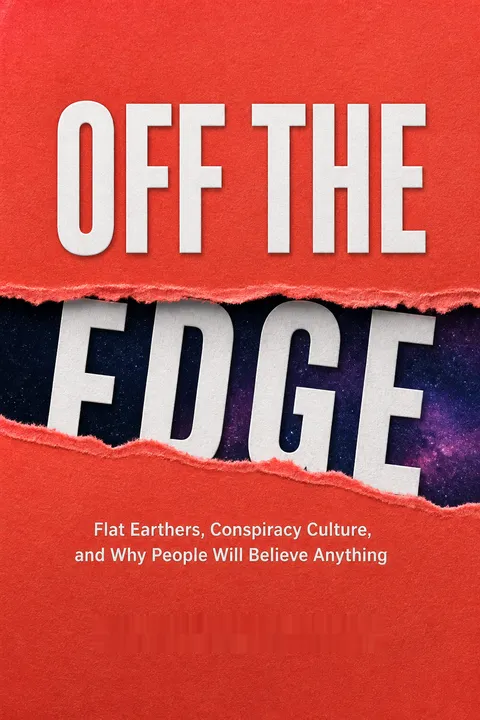
Off the Edge is strongest when it refuses two convenient explanations: that Flat Earthers are merely foolish, and that digital platforms alone manufacture belief. Its historical narrative shows recurring patterns across very different media. Rowbotham exploited religious anxiety and the spectacle of newspapers; Voliva used a closed community, schools, and radio; contemporary creators use recommendation systems and online networks. The content stays remarkably stable while the means of recruiting, reinforcing, and monetizing belief change.
The book's central explanatory model is relational. Conspiracy claims promise order during uncertainty, then offer belonging to people who feel dismissed. That belonging can harden into isolation, and isolation makes outside correction feel hostile. The personal stories give this cycle moral weight: Mike Hughes's death is not a colorful anecdote but a limit case of belief translated into action. The account of antisemitism adds an essential warning that conspiratorial forms are not politically neutral. Their empty space for a hidden villain can readily be filled by inherited prejudice.
The most productive tension is between epistemic correction and social repair. Flat Earth claims are empirically easy to disprove, but proof alone does not resolve the losses, distrust, or identity attached to belief. Conversely, empathy cannot require tolerating harassment, bigotry, or dangerous conduct. A credible response must preserve distinctions between understanding someone and endorsing their claims, and between protecting speech and amplifying it through opaque systems. The book's platform analysis is persuasive as a historical account of a particular period, but its figures should not be read as timeless measurements. Recommendation systems, user behavior, and moderation policies change. The deeper lesson lasts: information systems shape what seems common, credible, and worth attention. The book ultimately asks readers to defend both shared standards of evidence and the human relationships that make revision possible. Neither is sufficient by itself.
People Also Read







Glossary
zetetic
Personal-observation approachRowbotham's term for an approach that privileges personal observation and inquiry over accepted theories or inherited authority. He presented it as skeptical investigation, but used it selectively: observations that appeared to support Flat Earth counted as proof, while contrary evidence could be rejected as unreliable or deceptive.
conspiracy theory
Claim of a hidden malevolent plotIn the book's usage, a conspiracy theory alleges an unproven, deliberate, ongoing, and harmful secret plot involving multiple actors. It explains events through coordinated deception rather than accident or ordinary institutional behavior. The definition distinguishes such claims from proven conspiracies and from benign secrets, such as planning a surprise.
rabbit hole
Escalating chain of beliefA rabbit hole is a path through related material that takes a person from initial curiosity toward increasingly extensive conspiracy beliefs. In the book, online videos and recommendations often move viewers from one subject, such as space or 9/11, to Flat Earth, QAnon, or medical misinformation. The path can deepen through repeated viewing and social reinforcement.
flat-smacking
Confrontational Flat Earth evangelismFlat-smacking is a tactic used by some Flat Earthers who confront strangers in public to challenge globe belief or distribute Flat Earth material. These encounters are often recorded and shared online. The confrontational performance can generate attention for the movement, but is unlikely to create a constructive exchange and can frighten or alienate its targets.
controlled opposition
Alleged fake oppositionA conspiracy-scene accusation that an apparent opponent or moderate organization is secretly controlled by the government or another powerful group. Flat Earth factions used the label against rival groups they considered insufficiently radical, including the Flat Earth Society. The claim explains disagreement as sabotage rather than as evidence of genuine differences.
operating in the gray
Critical trust without certaintyA counseling approach described in the book that helps people leave closed belief systems without replacing total distrust with unquestioning faith. It means accepting uncertainty, evaluating sources critically, and remaining open to safe relationships and credible evidence. The approach offers a middle ground between believing every official account and treating every institution as malicious.
Download PDF
Download EPUB
.epub digital book format is ideal for reading ebooks on phones, tablets, and e-readers.








