

Key Takeaways
Treat your symptoms as messages from inner wisdom, not random betrayals
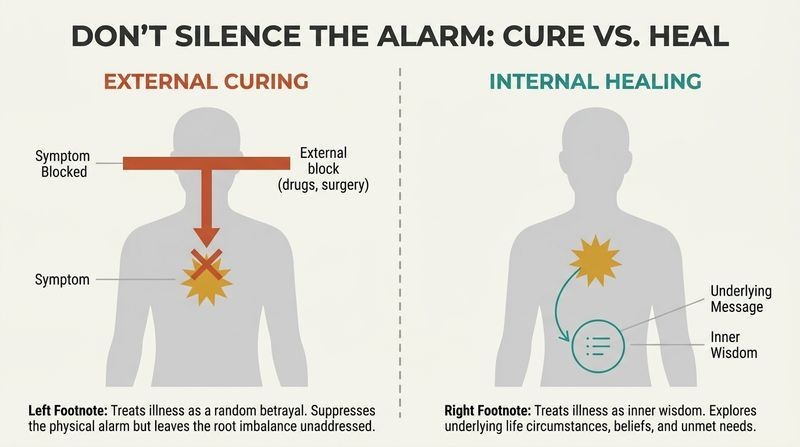
Illness carries information. Northrup, a board-certified ob-gyn, argues that PMS, pelvic pain, fibroids, and chronic vaginitis often reflect a woman's life circumstances, beliefs, and unmet needs, not just biochemistry. She separates curing (an external fix via drugs or surgery that masks a symptom) from healing (addressing the underlying imbalance from within). One patient's stubborn genital herpes cleared only after she finally said aloud a childhood truth she had buried for decades.
Responsible, not to blame. The body, Northrup writes, is an impeccable barometer of how well you are living right now. She is careful to reject self-blame: you do not consciously manufacture disease, but you can become curious about its meaning while still using medicine as a bridge toward health.
The claim that symptoms carry meaning aligns with the biopsychosocial model and psychosomatic research, though Northrup pushes further than most clinicians. Her strongest support is trauma science: the landmark Adverse Childhood Experiences study she cites ties early adversity to adult heart disease, diabetes, and cancer. The danger is overreach, implying every condition hides an unlearned emotional lesson, which can curdle into blaming patients for infection or cancer. She guards against this by distinguishing responsibility from blame, a move borrowed from cognitive therapy. Readers gain most by treating symptoms as data worth interrogating rather than verdicts to accept or moralize about.
Patriarchal culture trained women to apologize for their own bodies

Naming the dominator system. Northrup calls the prevailing worldview the dominator or addictive system, borrowing from Anne Wilson Schaef: a culture that ranks intellect over emotion, mind over body, and masculine over feminine. She recounts new mothers apologizing to husbands for delivering daughters, and catching that same unbidden apology surface in her own mind at her second daughter's birth.
Bodies framed as flawed. This inheritance teaches that menstruation, birth, and menopause are diseases requiring management and that female bodies are inherently dirty. She points to global evidence of devaluation: female genital mutilation, sex-selective abortion, and a fashion ideal weighing far less than the average woman. Recognizing this programming, she argues, is the first act of refusing it.
Framing a whole culture as an addiction is provocative and echoes feminist medical historians like Barbara Ehrenreich, who documented how women healers were displaced and pathologized. Northrup's observation that women reflexively apologize has since surfaced in workplace research on gendered speech. The argument strains when patriarchy becomes a single engine explaining conditions with clear biological drivers. The durable, testable insight is subtler: internalized shame shapes how women perceive and report bodily experience, and shame reliably elevates stress physiology and delays care-seeking. Treating that shame as modifiable rather than fixed is where the empowerment actually lives.
Your beliefs about aging can add or subtract years of your life

Belief becomes biology. Every thought carries a biochemical echo through the immune, endocrine, and nervous systems. Northrup marshals striking research: Ellen Langer's study in which men in their seventies who lived for five days as though it were decades earlier grew measurably younger in strength, vision, and memory. Becca Levy found people with positive self-perceptions of aging lived about seven and a half years longer than pessimists, an effect larger than low blood pressure or not smoking.
Perception is an input. She frames this not as wishful thinking but as evidence that expectation is a physiological signal you can revise. The ACE study reinforces the point from the shadow side, linking buried childhood pain to measurable adult disease.
This is the book's scientific spine, and it has held up. Levy's longevity findings and Langer's counterclockwise experiments now anchor health psychology, and placebo research confirms expectation alters measurable outcomes. The mind-body mechanisms Northrup invokes, neuropeptides and nitric oxide, sit within psychoneuroimmunology. The necessary caveat: observational studies tangle correlation and causation, and optimism travels with wealth, education, and social support that independently extend life. Still, the practical prescription, deliberately updating limiting beliefs about what a body can do at any age, costs nothing and carries almost no downside, which is rare in health advice.
Stop fighting your monthly cycle; its ebb and flow is guidance
Two phases, two modes. Northrup reframes the menstrual cycle as an internal guidance system. The follicular phase (from menstruation to ovulation) is outgoing, energetic, and creative, while the luteal phase (ovulation to bleeding) turns inward and reflective, surfacing what is not working in a woman's life. PMS, she argues, is the wake-up call of the monthly cycle, and symptoms intensify when women block this natural inward turn.
Honor the darkness. She notes the parallel between PMS and seasonal affective disorder, both eased by light exposure. Her practical fixes include stabilizing blood sugar, cutting caffeine and dairy, and resting during bleeding, echoing traditional Chinese medicine's counsel to stay warm and slow down during menstruation.
The cyclic-wisdom frame pushes back on a medical tradition that treated menstruation mainly as pathology. Chronobiology supports parts of it: hormone shifts across the cycle do influence mood, cognition, and immune function, and light genuinely modulates circadian and menstrual regularity. The PMS-as-message idea is harder to test and risks romanticizing real suffering that responds to concrete treatment. The most actionable kernel, that many women feel better honoring a slower luteal phase instead of powering through identically all month, anticipates today's cycle-syncing conversation, though that evidence base remains thin and deserves the same skepticism as its intuitive appeal earns enthusiasm.
Menopause is the springtime of your second half, not a deficiency disease
Reject the failed-production frame. Northrup rejects the medical view of menopause as a breakdown needing correction. Perimenopause is the wake-up call of the entire life cycle, surfacing decades of unfinished business and often prompting women to end marriages, launch ventures, and reorder priorities. Physiologically, as ovarian output falls, other sites (adrenals, fat, skin, brain) can take over hormone production, so well-nourished women often transition smoothly.
Repair, then supplement. She stresses restoring exhausted adrenal glands through sleep, stress reduction, and nutrients, and favors bioidentical hormones (molecularly identical to a woman's own) over conjugated horse-derived estrogens like Premarin. The Women's Health Initiative linked Premarin's synthetic progestin partner to raised risks of heart attack, stroke, and breast cancer.
Northrup was early to popularize bioidentical hormones and to distrust the one-size-fits-all HRT of the 1990s, a stance the 2002 WHI reversal partly vindicated. Her adrenal-repair advice on sleep and stress is sound, though adrenal fatigue as a discrete diagnosis is not accepted by endocrinology. The bioidentical-versus-synthetic chemical distinction is real, but safety-superiority claims rest on far smaller studies than the giant synthetic trials. The most enduring contribution is cultural: treating midlife as an initiation into authority and creativity, a reframe backed by anthropology showing menopause experience varies dramatically with a woman's social status and expectations.
Fibroids and pelvic problems can mirror blocked creativity, money, or relationships
The second-chakra map. In Northrup's energy anatomy, the lower centers govern safety, belonging, and especially money, sex, power, and creativity, which she links to the uterus and ovaries. She reads fibroids as creative energy poured into dead-end jobs or relationships, reporting patients whose growths shrank after they left stifling situations or reclaimed a passion. She distinguishes the uterus (inner self-worth) from the ovaries (outward creativity vulnerable to control and criticism).
Surgical caution. Fibroids appear in 20 to 50% of women, and hysterectomy is the second most common major surgery in the U.S., frequently performed when organ-sparing options exist. She urges second opinions before removing organs that also affect hormones, bladder function, and sexual response.
The chakra framework is the book's most metaphysical and least falsifiable element, and readers will split over it. Stripped of energy language, a defensible core survives: chronic psychosocial stress about autonomy, money, and relationships measurably shifts cortisol, inflammation, and immune function, all plausibly relevant to gynecologic conditions. The genuinely evidence-adjacent message is her surgical restraint. Hysterectomy and cesarean rates vary enormously by region and provider rather than by disease severity alone, a documented marker of overtreatment. Encouraging organ-preserving alternatives and second opinions is wise regardless of whether one buys the symbolic reading of the pelvis.
A turned-on woman turns on the whole world, and her own health
Pleasure as medicine. Northrup argues female sexual pleasure is a health force, not a luxury. Arousal floods the body with nitric oxide, a gas released by blood-vessel linings during sex, exercise, and joyful thought that boosts circulation and balances serotonin and dopamine. She calls a turned-on woman virtual Viagra, citing partners whose erections improved as their wives rediscovered desire.
Own your arousal. Rather than waiting to be aroused, she urges women to take charge through self-cultivation, fantasy, knowledge of the clitoral system, and pelvic-floor Kegel exercises. The brain, she stresses, is the largest sex organ; desire begins in thought, which is why some women reach orgasm through imagination alone.
The nitric oxide thread anchors an intangible in physiology, and it is broadly accurate: nitric oxide signaling is exactly how erectile drugs work and it does influence vascular and mood pathways. Extending that to one woman raising a couple's collective nitric oxide is poetic extrapolation more than proven mechanism. The lasting insight converges with modern sex research from Emily Nagoski and others: desire is often responsive and context-dependent rather than spontaneous, and self-knowledge plus reduced shame predict satisfaction better than technique. Reframing pleasure as preventive medicine rather than indulgence remains one of the book's freshest and most clinically plausible moves.
Stable blood sugar, not calorie counting, is the master key to health
Glycemic stress drives disease. Northrup names glycemic stress, the cellular inflammation from refined carbohydrates that spike blood sugar and insulin, as the shared pathway to weight gain, PMS, fibroids, heart disease, and many cancers. Our Stone Age metabolisms never adapted to the sixty extra pounds of grain and thirty of sweeteners eaten per person yearly. Insulin is a storage hormone that locks fat in place, so chronically high levels defeat low-calorie dieting.
Eat and supplement well. Her fixes: protein, healthy fats, and low-glycemic vegetables at every meal, never skip breakfast, and supplement generously with vitamin D, iodine, magnesium, and omega-3 fats, nutrients depleted by modern soil and processing.
The insulin-centric model Northrup adopted from Sears and the Eades has since moved toward mainstream metabolic-health science, though the strict calories-don't-count framing overstates the case; energy balance still governs weight, while insulin mostly shifts appetite and fat partitioning. Her supplement bets have aged unevenly: vitamin D and omega-3 evidence is strong for some outcomes and disappointing in large trials for others, while magnesium and iodine shortfalls are genuinely underrecognized. The least controversial and most actionable advice is her protein-rich breakfast rule and anti-inflammatory whole-food pattern, which independently mirrors the well-validated Mediterranean-diet findings.
Birth is built to be ecstatic and safe, so stop treating it as an emergency
The emergency mind-set backfires. Having delivered babies and given birth herself, Northrup indicts the cultural reflex that turns normal labor into surgery. The U.S. cesarean rate near 33% far exceeds the 10 to 15% the World Health Organization deems optimal, and interventions cascade: continuous fetal monitoring raises C-sections without improving outcomes, epidurals can stall labor, and routine episiotomy causes more damage than it prevents.
Mother the mother. Her antidote is a doula, a trained woman who provides continuous emotional support, shown across six trials to shorten labor and halve cesarean rates. Birth, she argues, belongs to the continuum of female sexuality and can be ecstatic when a woman feels safe, supported, and unhurried.
The overintervention critique is well supported and now echoed by ACOG's own revised monitoring and episiotomy guidelines. The doula evidence is genuinely robust, among the cleaner findings in obstetrics. Northrup courts controversy on home-birth safety and on framing birth as ecstatic, an expectation that can leave women with hard or surgical births feeling they failed, a burden she tries to preempt. Her deeper physiological point transcends the debate: fear is biochemically active, raising stress hormones that constrict uterine blood flow and impede labor, which is precisely why emotional safety and environment deserve a place in obstetric planning, not just as comfort but as mechanism.
Question the fear-based screening machine and become CEO of your own health
Stop outsourcing your body. Northrup urges women to reclaim authority from experts and insurance rules. She is skeptical of routine mammography, citing false positives, overdiagnosis of harmless lesions, and studies showing no clear mortality edge over clinical exam, and she champions thermography, which reads the heat of cellular inflammation. She sharply criticizes the rushed approval and adverse-event reports for the HPV vaccine Gardasil.
Partnership and placebo. Her model: your doctor holds a body of knowledge, but you hold knowledge of your body. She invokes the placebo effect, in one trial fake knee surgery relieved pain as well as the real operation, as proof that belief and expectation are potent, physiological medicine you can enlist deliberately.
Northrup's screening skepticism ran ahead of official caution; task forces have since scaled back mammography frequency and acknowledged overdiagnosis. But her enthusiasm for thermography outpaces evidence that it prevents cancer deaths, and her Gardasil criticism collides with strong post-marketing safety data, a place where reflexive skepticism can cause harm. The unimpeachable core is agency: iatrogenic injury ranks among leading causes of death, second opinions cut unnecessary surgery, and literate, engaged patients fare better. Read as a summons to active, informed self-advocacy rather than blanket rejection of screening or vaccines, this chapter delivers real value; read literally, some claims warrant independent verification.
Forgiveness is physical medicine that frees energy trapped in your past
Release, not condoning. Northrup treats forgiveness as a bodily release rather than a moral duty. It does not mean approving of harm; it means refusing to let the past keep injuring you now. Crucially, she rejects premature forgiveness that silences legitimate anger: first feel the rage fully, then let it go, otherwise forgiveness becomes suppression that harms.
Evidence and experience. She cites Fred Luskin's Stanford work, in which forgiveness training for people who lost family members to violence in Northern Ireland cut stress symptoms by 35% and depression by 20%. She describes her own visceral experience of a knot dissolving in her solar plexus the moment she forgave a surgeon who had reported her to the medical board.
The physiology here is sturdier than the chakra vocabulary implies. Luskin's research and later studies link forgiveness to lower blood pressure, reduced cortisol, and healthier cardiovascular markers, while chronic hostility predicts heart disease. Northrup's sequencing is psychologically astute and often skipped: forgiveness that bypasses grief and anger becomes repression, a point trauma therapists stress against glib just-let-it-go advice. The heart's electromagnetic-field claim she adds ventures into speculative HeartMath territory. But the central prescription, that releasing resentment primarily serves the body of the one who releases it, is among the best-supported mind-body findings the book offers.
Analysis
Women's Bodies, Women's Wisdom is best read as a manifesto wearing the clothes of a medical reference. First published in 1994 and revised through 2010, it braided three streams that rarely met on the same page: conventional obstetric expertise, the emerging science of psychoneuroimmunology, and a feminist, energy-based spirituality. Its lasting influence comes not from any single protocol but from a paradigm shift it helped move toward the mainstream: the notion that a woman's body is a source of information and authority rather than a defect to be surveilled and corrected.
The book's central engine is the claim that belief becomes biology. Northrup deploys genuinely strong evidence for this, the ACE study, Ellen Langer's aging experiments, Becca Levy's longevity data, and placebo research, then extends the principle into terrain that outruns the data, mapping emotions onto specific organs through chakras. This is the interpretive fault line. Readers comfortable with metaphor will find the organ-by-organ symbolism illuminating; readers demanding falsifiability will bristle. The wisest use treats the energy language as a heuristic pointing at a real phenomenon: chronic psychosocial stress measurably reshapes hormones, inflammation, and immunity.
Where Northrup is most reliably valuable is as a critic of medical overreach: excessive hysterectomy and cesarean rates, routine episiotomy, one-size-fits-all synthetic hormones, and screening framed to maximize fear. Much of this has since been vindicated by professional guidelines. Where she is riskiest is in advancing alternatives, thermography over mammography, skepticism of Gardasil, that the evidence has not caught up to.
The throughline, from menstruation to menopause to birth to nutrition, is agency: cultivate pleasure, honor rhythms, forgive, question authority, and take responsibility without accepting blame. Read as empowerment rather than prescription, it remains a landmark. Read as literal medicine, it demands the same discernment Northrup asks readers to bring to any expert.
Review Summary
Women's Bodies, Women's Wisdom receives mostly positive reviews for its comprehensive coverage of women's health issues from a holistic perspective. Readers appreciate the blend of Western and Eastern medicine approaches, empowering women to understand and listen to their bodies. Many find it life-changing and recommend it for all women. However, some criticize the book for promoting unscientific ideas and blaming emotional issues for physical ailments. The book's length and depth of information are seen as both strengths and weaknesses, depending on the reader's preferences and needs.
People Also Read






Glossary
Dominator system (addictive system)
Culture ranking masculine over feminineNorthrup's term, adapted from Riane Eisler and Anne Wilson Schaef, for a five-thousand-year-old worldview that prizes intellect over emotion, mind over body, and masculine over feminine. It frames female processes as diseases needing control and, like an addiction, keeps people cut off from their feelings and inner knowing. Naming it is presented as the first step to reclaiming bodily authority.
Inner guidance
Body-based intuitive knowing systemThe felt intelligence Northrup says reaches women through emotions, dreams, gut reactions, and bodily symptoms, steering them toward what enhances life and away from what depletes it. She positions it as a more reliable everyday health barometer than lab data alone, with the intellect meant to serve it rather than override it.
Curing versus healing
External fix versus inner wholenessNorthrup's distinction between curing, an external treatment like a drug or surgery that removes or masks a symptom without touching its cause, and healing, an inner process of restoring wholeness and addressing the imbalance behind the symptom. She stresses that one can be healed yet still die, and cured yet remain unhealed.
Second chakra
Energy center of creativity, relationshipsIn Northrup's energy anatomy, the pelvic energy center governing money, sex, power, creativity, and relationships, corresponding physically to the uterus, ovaries, and lower back. She reads gynecologic problems such as fibroids as blocked or misdirected creative and relational energy in this center.
Emotional incision and drainage
Feeling and releasing buried emotionNorthrup's metaphor, drawn from lancing an abscess, for fully feeling, expressing, and releasing suppressed emotions so they no longer fester in the body. She argues unexpressed feelings become walled off like pus, causing physical pain and illness, and that crying, sounding, and moving discharge them.
Glycemic stress
Inflammation from blood-sugar spikesThe cellular inflammation and blood-vessel damage caused by frequently eating high-glycemic refined carbohydrates that spike blood sugar and insulin. Northrup frames it, drawing on Ray Strand's work, as the common early pathway to insulin resistance, weight gain, and chronic diseases including heart disease and some cancers.
Thermography
Heat-based breast screening toolA screening technology using an infrared camera to detect heat from increased blood flow and cellular inflammation in tissue, especially the breast. Northrup promotes it as a proactive alternative to mammography that flags inflammation early enough to reverse through lifestyle, though its cancer-prevention benefit is not established in mainstream evidence.
Bioidentical hormones
Hormones matching the body's ownHormones such as estradiol, estriol, and progesterone that are molecularly identical to those a woman's body produces, typically synthesized from plant sterols. Northrup favors them over synthetic or animal-derived hormones like Premarin and its progestin partner, arguing that a hormone's three-dimensional structure determines how safely and effectively the body uses it.
FAQ
What's Women's Bodies, Women's Wisdom about?
- Holistic Health Focus: The book emphasizes the interconnectedness of physical, emotional, and spiritual health in women, advocating for a holistic approach to well-being.
- Empowerment Through Knowledge: Dr. Christiane Northrup encourages women to understand their bodies and health issues, promoting self-advocacy and empowerment.
- Cultural Critique: It critiques societal norms and patriarchal influences that disempower women, urging readers to reclaim their narratives and authority over their health.
Why should I read Women's Bodies, Women's Wisdom?
- Comprehensive Resource: The book serves as a guide to understanding women's health issues, covering topics from menstruation to menopause.
- Empowerment and Self-Care: It inspires women to prioritize self-care and make informed health decisions, offering practical advice and tools.
- Personal Growth: Dr. Northrup encourages personal growth and self-acceptance, helping women embrace their bodies and experiences.
What are the key takeaways of Women's Bodies, Women's Wisdom?
- Mind-Body Connection: The book highlights how thoughts and emotions directly affect physical health, emphasizing the importance of understanding this connection.
- Inner Guidance: Dr. Northrup stresses listening to one's body and emotions as a source of inner guidance for better health choices.
- Cyclical Nature of Women: Embracing the menstrual cycle and its connection to nature can enhance well-being and creativity.
What are the best quotes from Women's Bodies, Women's Wisdom and what do they mean?
- “Belief becomes biology.”: This underscores the idea that thoughts and beliefs can manifest physically, highlighting the importance of positive beliefs for health.
- “We heal and flourish to the degree that we consciously invite the Sacred into our lives.”: It suggests that spiritual connection is essential for true well-being.
- “The world we have created is a product of our thinking.”: This reflects the theme that societal beliefs shape experiences and health, encouraging readers to challenge limiting beliefs.
How does Women's Bodies, Women's Wisdom address the mind-body connection?
- Interconnectedness of Emotions and Health: Emotional states significantly impact physical health, particularly in reproductive health issues.
- Psychological Factors in Illness: Unresolved emotional trauma can manifest as physical symptoms, urging women to address emotional wounds for better health.
- Empowerment Through Awareness: Understanding the mind-body connection allows women to take proactive steps in their health journey.
What is "body wisdom" as defined in Women's Bodies, Women's Wisdom?
- Intuitive Knowledge: Body wisdom refers to the innate knowledge the body possesses about its health and needs.
- Physical Symptoms as Messages: Physical symptoms often serve as messages from the body, indicating emotional or physical imbalances.
- Empowerment Through Awareness: Tuning into body wisdom empowers women to make informed health decisions and foster healing.
How does Women's Bodies, Women's Wisdom approach menopause?
- Transformative Phase: Menopause is presented as a natural and empowering transition, encouraging women to embrace this stage of life.
- Holistic Health Strategies: The book offers practical advice for managing symptoms through lifestyle changes, nutrition, and emotional support.
- Focus on Personal Power: Menopause can be a time of personal growth and self-discovery, urging women to tap into their inner wisdom.
What nutritional advice does Dr. Northrup provide in Women's Bodies, Women's Wisdom?
- Balanced Diet: Emphasizes a diet rich in whole foods, including fruits, vegetables, whole grains, and lean proteins.
- Specific Nutrients: Highlights the importance of nutrients like calcium, magnesium, and omega-3 fatty acids for women's health.
- Avoiding Processed Foods: Advises against high-glycemic-index carbohydrates and processed foods, focusing on nutrient-dense options.
How does Women's Bodies, Women's Wisdom address emotional health?
- Mind-Body Connection: Emotional health significantly impacts physical well-being, emphasizing the need to address emotional issues.
- Healing Through Self-Care: Advocates for practices like meditation, journaling, and therapy as essential tools for emotional healing.
- Empowerment Through Expression: Encourages women to express their emotions and experiences openly for healing and empowerment.
What role does spirituality play in Women's Bodies, Women's Wisdom?
- Connection to Inner Wisdom: Emphasizes the importance of connecting with one's inner self and intuition for guidance and strength.
- Healing Through Spirituality: Spiritual practices like meditation and prayer can aid in healing and coping with health challenges.
- Collective Healing: Individual healing contributes to collective healing among women, empowering communities.
How does Women's Bodies, Women's Wisdom address fertility issues?
- Holistic Approach to Fertility: Emphasizes addressing both physical and emotional factors in fertility challenges.
- Nutrition and Lifestyle Changes: Recommends dietary changes and lifestyle adjustments to enhance fertility.
- Emotional Healing: Highlights the significance of emotional healing and self-awareness in improving fertility.
What methods does Dr. Northrup suggest for healing in Women's Bodies, Women's Wisdom?
- Listening to Your Body: Tuning into bodily sensations and emotions as a form of inner guidance for self-awareness and healing.
- Diet and Nutrition: Discusses the role of a balanced diet in maintaining hormonal health and overall well-being.
- Emotional Cleansing: Advocates for emotional release through journaling, meditation, and therapy to process and release past traumas.
About the Author


Download PDF
Download EPUB
.epub digital book format is ideal for reading ebooks on phones, tablets, and e-readers.








