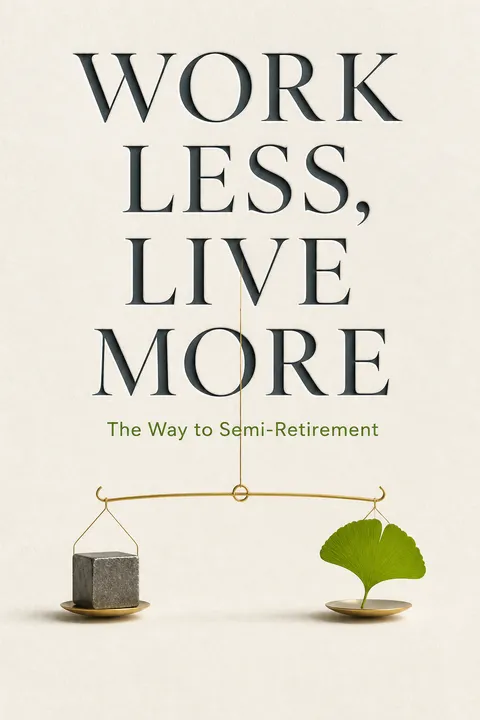


Key Takeaways
Build a bridge out of full-time work, not a cliff into permanent leisure
A middle path. Semi-retirement means leaving full-time employment while supporting yourself through some combination of savings, pension income, and paid or unpaid work. The aim is not to stop contributing, but to stop letting a full-time salary dictate every hour. Bob Clyatt's own exit illustrates the distinction: after twenty years in demanding work, he and his wife retired fully in 2001, enjoyed more time for family and travel, then grew anxious about their portfolio and missed work's structure. Modest, chosen work made a better fit than either the old career or total leisure.
Freedom needs a floor. The model depends on matching spending to durable resources. It leaves open the possibility of earning extra income or changing location if the numbers require it. It can suit people in their forties through later life, but it is not a financial shortcut: it requires accumulated assets, a pension, or reliable part-time earnings.
The book's most useful reframing is that retirement need not mean either endless employment or endless vacation. It treats work as something that can be resized, rather than a permanent identity or an all-or-nothing obligation. That middle position also makes the financial plan less brittle, since part-time earnings can supplement savings and provide structure. The model is most accessible to people with some financial cushion or control over where they live; it cannot erase low wages, caregiving burdens, or unstable employment. Its promise is agency where circumstances allow it, not a universal escape hatch.
Name what work costs you, then design the life you are leaving for
Clarify the motive. Clyatt asks readers to identify what is no longer working, then imagine how they would spend a free week without financial anxiety. The reason matters: distress about health or family can push someone out, while an appealing new pursuit can keep the transition meaningful after the immediate pain fades. His images of carrots and sticks describe those two kinds of motivation.
Reserve the important hours. The book calls a person's defining priorities “Big Rocks”: the few major commitments that should be scheduled before errands and minor obligations fill the calendar. A semi-retirement plan should include concrete pursuits, not just a wish to have more time. Talk through expectations with a partner, make lifestyle changes gradually, and avoid extreme saving that damages relationships or health before the goal arrives.
This approach borrows the logic of strategic planning and applies it to a personal life: define the destination before optimizing the route. The emphasis on positive motives is important because escaping an unpleasant job alone does not answer what should replace it. The “Big Rocks” image also makes a subtle point about calendars: unclaimed time is easily occupied by low-priority tasks. Yet a vivid ideal week is a hypothesis, not a contract. Testing interests in small ways while still employed can reveal whether they are genuinely sustaining or merely attractive from a distance.
Make your spending plan reflect real costs, not your old paycheck
Count the whole year. Living below one's means is not necessarily austerity. It means spending intentionally, so recurring wants and status purchases do not quietly determine how long someone must work. Clyatt suggests estimating post-work spending by subtracting savings, commuting and other job expenses, and debts that will be paid off, then adding costs such as health insurance, investment fees, car replacement, and home maintenance.
Look for structural savings. A sample comparison in the book shows a working family's annual budget near $120,000 and a semi-retired family's near $41,000. The difference comes not only from frugality, but also from a paid-off mortgage, fewer work costs, lower taxes, and one less car. Parents should estimate education costs separately rather than treating them as an undefined reason to keep working. Moving to a lower-cost area is another option, provided the lifestyle fits.
The key financial insight is to compare the life being planned with the life being lived, not to replace a salary with a standard percentage of that salary. Work itself carries costs, and a job-free schedule can change housing, transportation, and tax needs. This is a more useful exercise than treating thrift as a contest in denying oneself small pleasures. The sample budget is illustrative, not a forecast for every household: housing, medical coverage, family support, and location can reverse the apparent savings. A realistic plan should stress-test the expenses that are hardest to change.
Diversify broadly, keep fees low, and let rules outrank market moods
Build an investing system. Clyatt calls his approach “Rational Investing”: a long-term portfolio spread across different asset classes, using low-cost funds where possible and periodic rebalancing instead of frequent predictions. His suggested portfolio includes stocks, bonds, and other assets, with tilts toward smaller, value-oriented, and international investments. He argues that assets with different return patterns can reduce the portfolio's overall volatility.
Make decisions in advance. The system rejects hot-manager chasing, panic selling, and the assumption that the S&P 500 represents every useful investment. Rebalancing, usually once a year or every two years, means trimming assets that have grown beyond their target and adding to those that have fallen. The book reports a 10.2% annual return and 6.86% standard deviation for its portfolio between 1988 and 2006, while warning that future performance may be lower.
The strength of this framework is behavioral as much as mathematical. A written allocation and rebalancing schedule reduce the number of emotionally charged decisions an investor must make, particularly when withdrawals make losses feel personal. Diversification also challenges the instinct to treat familiar companies or domestic markets as a complete portfolio. But low historical volatility is not a promise of low future risk. Asset relationships can change, and specialized funds may add cost or complexity. The practical test is not whether a portfolio looks sophisticated, but whether its owner understands it well enough to keep following it through a downturn.
Treat 4% as a tested guide, not a promise from the market
Withdraw with flexibility. A Safe Withdrawal Rate is the share of savings used for annual living costs while aiming to preserve the portfolio's inflation-adjusted value. Clyatt presents roughly 4% as a cautious starting point for people who may need their savings for decades, with 4.5% carrying more risk. Unlike a fixed inflation-adjusted payment based on the original portfolio, his Safe Withdrawal Method recalculates an annual amount from current portfolio value and allows spending to adjust.
Soften bad years. The “95% Rule” allows withdrawals to remain at least 95% of the previous year's amount, even when market losses would otherwise force a sharper cut. In the book's historical tests, a diversified portfolio using this approach preserved real value in every tested 40-year period at a 4% rate. These are backtests, not guarantees. The author emphasizes that market sequence, inflation, and lifespan can all change the outcome.
The method addresses a real tension: rigid inflation increases can strain a portfolio after poor early returns, while abrupt cuts can make a carefully planned life feel unstable. A rule that permits modest adjustment offers a compromise between financial caution and livable spending. The distinction between preserving a portfolio and merely avoiding a zero balance is also valuable for someone planning a long retirement. Still, historical success rates can create a false sense of precision. The result depends on the data, portfolio assumptions, and spending rules chosen, so 4% should be treated as a planning benchmark that calls for ongoing review.
Use the tax code's lower-income terrain, but verify every rule
Income type matters. The book argues that semi-retirees may owe less tax than salary earners because they rely less on wages and more on dividends, interest, and capital gains. It recommends limiting taxable earned income when practical, avoiding unnecessary sales that realize gains, and using legitimate business deductions when self-employed. In Clyatt's 2007 examples, semi-retirees paid much less tax than comparable wage-earning households, sometimes little or no federal income tax.
Plan across decades. The author also describes converting traditional retirement accounts to Roth accounts during low-income years, when the tax cost may be lower, and keeping tax-advantaged savings invested when possible. These strategies depend on the individual's income, account types, and applicable law. The tax brackets, contribution limits, insurance rules, and examples in this edition are historical, so they should not be used as current instructions without professional or authoritative verification.
The important lesson is that a household's tax burden depends not just on how much it spends, but on how its resources are earned and withdrawn. That makes tax planning part of the retirement design rather than an afterthought. The Roth discussion captures a useful tradeoff: paying some tax sooner can be worthwhile if it reduces future tax exposure, but only when the numbers support it. This section is especially time-sensitive. Tax rules change, and a deduction that appears attractive can have little value when taxable income is already low. The framework is useful; the old-year figures are not current advice.
Let meaningful work replace the structure and identity a career supplied
Work can change shape. The book defines semi-retirement work broadly: paid employment, an avocation, volunteering, teaching, consulting, creative projects, or another commitment that uses skills and gives others a reason to rely on you. Many people begin by doing familiar work for fewer hours, then experiment with new interests, and may eventually earn income from something they care about more. The sequence is individual, not a required ladder.
Allow a transition. Clyatt recommends taking a period of rest after leaving a demanding job, then returning to activity gradually. His examples range from a former engineer building equipment in his workshop to a former executive serving on local boards and helping start a fund. Both find challenge without recreating the old schedule. Unpaid work can also offer purpose, learning, and community; the central warning is against letting either idleness or overachievement take over.
This chapter treats work as a source of connection and competence, not simply income. That distinction explains why a person can be financially secure yet feel disoriented after leaving a career: the job supplied routines, status, and social contact along with a paycheck. Small experiments are a sensible way to discover what can replace those functions without forcing every interest to become a business. The model also respects a hard boundary: meaningful activity is not automatically pleasant or well-managed. Volunteering, entrepreneurship, and creative work can become demanding, so the freedom to set limits remains essential.
Protect relationships and purpose by treating time as a finite budget
Expect an adjustment. New semi-retirees may feel guilty about weekday leisure, bored without deadlines, anxious about investments, or unsettled when professional status disappears. Clyatt advises responding with practical structure: choose projects, exercise, and social commitments; examine financial fears instead of reacting to every market move; and keep work skills current if returning to employment is a possible backup.
Give each person room. Couples need both shared plans and independent interests. The newly available partner should not monitor the other's routine or become an on-call household helper. The book's closing checklist spans physical health, reflective practice, relationships, meaningful activities, enjoyment, and a supportive home. Its online reader poll found that 95% of respondents reported lower stress after semi-retirement, though the author notes that this was not a large academic study. Regularly reviewing how time is spent helps keep the new freedom aligned with what matters.
The book's emotional advice is strongest when it treats transition problems as predictable rather than as proof that leaving work was a mistake. Guilt and status loss often reflect old measures of worth, while financial panic can prompt decisions that undermine a long-term plan. Structure helps, but it need not mean filling every hour; a calendar packed with volunteer duties can reproduce the same overwork under a nobler label. The counsel for couples is particularly concrete: extra time together is not the same as constant togetherness. A sustainable arrangement protects each person's autonomy as carefully as it protects the household budget.
Analysis
This book is both a practical manual and an argument about what retirement is for. Its distinctive contribution is to connect financial independence with a life design problem: savings create the option to reduce paid work, but purpose, relationships, and chosen commitments make that option livable. The narrative of Clyatt's own full retirement, followed by money anxiety and restlessness, gives the proposal credibility because the solution grows out of a failed binary. Neither the old career nor unstructured leisure was enough. The book's strongest method is integration. Spending decisions determine the size of the portfolio required; investment choices influence the reliability of withdrawals; tax planning affects usable income; and meaningful activity helps the person tolerate a less consumption-intensive life.
Its financial prescription is unusually attentive to behavior. Diversification and scheduled rebalancing are not merely technical choices. They are safeguards against panic and overconfidence. The flexible withdrawal method similarly recognizes that people need a plan they can actually follow, not just a mathematically attractive model. Yet its historical tests cannot establish future safety. The reported returns and tax examples belong to the book's period, and health insurance, tax treatment, investment costs, and market conditions change. Readers should preserve the reasoning while independently checking current assumptions.
The model also has a boundary that deserves emphasis. Semi-retirement is easiest for people with savings, pensions, marketable skills, and the ability to relocate or reduce expenses. The book shows many ways to adapt, but not everyone can turn free time into part-time work or lower their housing costs. Its deeper claim is therefore not that everyone can retire early. It is that the amount and meaning of work deserve deliberate examination, and that even a gradual reduction can be designed around values rather than status or default expectations. That argument remains more durable than any single withdrawal percentage.
Review Summary
Work Less, Live More receives mixed reviews. Readers appreciate its insights on semi-retirement, financial planning, and alternative lifestyles. Many find the non-financial advice and personal stories valuable. However, some criticize the book for being outdated, especially regarding financial strategies and market conditions. The target audience seems to be higher-income individuals. While some praise the practical steps and emotional aspects of semi-retirement, others find the content too simplistic or irrelevant to their situation. Overall, readers value the book's perspective on balancing work and life.
People Also Read





Glossary
Semi-retirement
Life beyond full-time workA way of living in which a person leaves full-time employment but remains financially and personally active. Income may combine savings withdrawals, pensions, part-time work, or other sources. Work can be paid or unpaid, and may take the form of a new vocation, consulting, volunteering, or a personally meaningful project.
Rational Investing
Diversified, low-cost investingClyatt's name for a long-term investing approach that spreads money across multiple asset classes, keeps fees low, favors index funds when suitable, and periodically restores target allocations through rebalancing. The goal is to seek reasonable returns with less volatility than a concentrated portfolio, reducing both investment risk and the temptation to make emotional trades.
Safe Withdrawal Rate
Planned annual portfolio drawThe percentage of an investment portfolio that can be withdrawn for living expenses while aiming to preserve its purchasing power over a long retirement. Clyatt presents about 4% as a cautious guide for early semi-retirees, with higher rates involving greater risk. The rate is an estimate based on assumptions and historical testing, not a guarantee.
Safe Withdrawal Method
Flexible annual withdrawal processClyatt's approach to drawing income from savings: use a diversified portfolio, calculate a withdrawal amount based on current portfolio value, allow spending to adjust with market conditions, and rebalance regularly. It differs from automatically increasing the original withdrawal by inflation every year, which can place heavy strain on a portfolio after poor market returns.
The 95% Rule
Limits sharp spending cutsA withdrawal guideline in which a retiree may take at least 95% of the previous year's withdrawal during a difficult market period, even if that amount exceeds the usual percentage calculated from the current portfolio. It aims to soften sudden reductions in spending while retaining a high historical likelihood of preserving the portfolio's real value.
Big Rocks
Highest-priority life commitmentsClyatt's metaphor for the major priorities that give a life its shape, such as family, health, creative work, or community service. If these commitments do not receive time first, errands and minor obligations can consume the calendar. In semi-retirement, earning a living is meant to become one important activity among several, rather than the dominant claim on time.
FAQ
What's Work Less, Live More about?
- Focus on Semi-Retirement: The book explores the concept of semi-retirement, allowing individuals to reduce work hours while maintaining financial stability. It emphasizes balancing work and life to pursue passions outside a full-time job.
- Financial Strategies: Offers practical advice on managing savings, investments, and spending to support a semi-retired lifestyle. Bob Clyatt shares methods for living below one’s means and utilizing savings effectively.
- Real-Life Examples: Includes stories of various semi-retirees, showcasing different paths and strategies. These examples illustrate the diversity of experiences and potential for a fulfilling life beyond traditional work.
Why should I read Work Less, Live More?
- Inspiration for Change: If you're feeling trapped in a demanding job, this book offers inspiration and practical steps to transition to semi-retirement. It encourages envisioning a life prioritizing personal fulfillment over conventional career paths.
- Comprehensive Guidance: Serves as a roadmap for those considering semi-retirement, providing detailed advice on financial planning, budgeting, and lifestyle adjustments. Equips readers with tools for informed future decisions.
- Addressing Concerns: Clyatt addresses common fears about leaving full-time work, helping readers navigate anxieties about financial security and lifestyle changes. This reassurance empowers individuals to pursue a more satisfying life.
What are the key takeaways of Work Less, Live More?
- Living Below Your Means: Emphasizes the importance of living below your means to achieve financial independence. This involves creating a spending plan prioritizing essential expenses while minimizing unnecessary costs.
- Rational Investing Approach: Introduces Rational Investing, emphasizing low-cost, diversified portfolios requiring minimal management. This method helps maintain financial health while enjoying newfound freedom.
- Safe Withdrawal Rate: Discusses the Safe Withdrawal Rate, suggesting withdrawing around 4% of savings annually for sustainable income during semi-retirement. This strategy ensures savings last throughout retirement years.
How does Work Less, Live More define semi-retirement?
- Flexible Work-Life Balance: Describes semi-retirement as reducing full-time work commitments while engaging in meaningful activities, paid or unpaid. It allows for a balanced approach to life, focusing on personal fulfillment.
- Variety of Experiences: Highlights that semi-retirement can look different for everyone, from pursuing hobbies to starting new ventures. Encourages readers to define what semi-retirement means personally.
- Engagement with Life: Emphasizes that semi-retirees often find themselves more engaged in communities and personal interests, leading to a richer, more satisfying life. Engagement is a key aspect of the semi-retirement experience.
What is Rational Investing as described in Work Less, Live More?
- Diversified Asset Allocation: Involves spreading investments across various asset classes to reduce risk and volatility. This approach helps maintain portfolio stability while aiming for reasonable returns.
- Low Fees and Costs: Emphasizes keeping investment fees low, as high fees can erode long-term returns. Advocates for using index funds and ETFs to achieve this goal.
- Rebalancing Strategy: Regularly rebalancing your portfolio to maintain target asset allocations is crucial. This disciplined approach helps avoid emotional decision-making and ensures a balanced investment strategy.
What is the Safe Withdrawal Rate mentioned in Work Less, Live More?
- 4% Rule: The Safe Withdrawal Rate is typically set at 4%, allowing retirees to withdraw this percentage from their portfolio annually without depleting funds. Based on historical data, it maintains the portfolio's inflation-adjusted value.
- Adjustments for Market Conditions: Suggests adjusting withdrawals based on market performance, using strategies like the 95% Rule for spending stability during downturns. Flexibility helps protect against portfolio depletion.
- Long-Term Viability: Designed to ensure retirees can sustain their lifestyle over the long term, even with market volatility. Emphasizes careful planning and monitoring of portfolio performance.
What are some practical steps to achieve semi-retirement according to Work Less, Live More?
- Assess Your Finances: Begin by evaluating your current financial situation, including savings, income sources, and expenses. This assessment helps understand necessary adjustments for a semi-retired lifestyle.
- Create a Spending Plan: Develop a budget reflecting your desired lifestyle in semi-retirement, focusing on essential expenses and cutting back on non-essentials. Aligns with living below your means.
- Explore Work Options: Consider part-time or freelance work aligning with your interests and passions. Provides additional income while allowing more free time.
What are some common misconceptions about semi-retirement in Work Less, Live More?
- It’s Only for the Wealthy: Many believe only those with substantial savings can afford semi-retirement, but Clyatt argues careful planning and budgeting make it accessible. Living below your means is crucial.
- You Must Stop Working Completely: Some think semi-retirement means leaving the workforce entirely, but many engage in part-time or freelance work aligning with interests. Allows a balanced approach to work and leisure.
- It’s a Step Backward: Misconception that semi-retirement is a retreat from ambition or productivity. Clyatt illustrates semi-retirees often find new passions and contribute meaningfully to communities, enriching lives.
How can I create a spending plan for semi-retirement as suggested in Work Less, Live More?
- Identify Essential Expenses: Start by listing necessary expenses like housing, food, and healthcare to understand baseline spending needs. Forms the foundation of your spending plan.
- Track Your Spending: Use budgeting tools or spreadsheets to monitor expenses and compare them against income. Regular tracking helps identify areas to cut back and stay within budget.
- Adjust for Changes: Be prepared to adjust your spending plan as circumstances change, like moving or taking on part-time work. Flexibility is key to maintaining financial stability in semi-retirement.
How does Work Less, Live More address the challenges of boredom and guilt in semi-retirement?
- Embrace New Activities: Suggests engaging in new hobbies and interests to combat boredom. Finding meaningful activities can lead to a more satisfying semi-retirement experience.
- Reframe Guilt: Encourages recognizing the right to enjoy your time. Reminding yourself of accomplishments and sacrifices can help alleviate feelings of guilt.
- Balance Work and Leisure: Emphasizes maintaining a balance between work and leisure activities. Ensures engagement and fulfillment during semi-retirement.
What are some strategies for finding meaningful work in semi-retirement as outlined in Work Less, Live More?
- Explore Interests: Encourages exploring passions and interests, leading to fulfilling work opportunities. Engaging in resonant activities can uncover potential career paths.
- Network and Connect: Building connections with former colleagues and industry contacts can open doors to part-time or consulting opportunities. Networking is valuable for finding work aligning with skills and interests.
- Consider Volunteering: Volunteering provides a sense of purpose and fulfillment while offering opportunities to develop new skills. Can serve as a stepping stone to paid work in a related field.
What are the best quotes from Work Less, Live More and what do they mean?
- “Do I really have to do this until I’m 65?” Challenges the traditional notion of working until a specific retirement age, encouraging consideration of alternative paths.
- “Don’t kill the goose laying the golden eggs.” Emphasizes sustainable financial practices, reminding to manage withdrawals carefully to preserve the portfolio long-term.
- “Do anything you want, but do something.” Encourages staying engaged and active in semi-retirement, suggesting finding meaningful work or activities is essential for personal fulfillment.
Download PDF
Download EPUB
.epub digital book format is ideal for reading ebooks on phones, tablets, and e-readers.








