

Plot Summary
Isabella Says Hello
Ken Dolby, chief engineer of Isabella, brings the enormous particle collider to full power despite Kate Mercer’s warning that unknown resonances are appearing. The detectors lose data, a black shape opens on the main display, and the computer stops accepting commands.
Dolby assumes a software failure until he notices an image forming in the void, unlike any ordinary collision pattern. Then the screens go dark and a single greeting appears.
The scientists cannot tell whether their machine has crashed, torn into unfamiliar physics, or produced an image from beyond its instruments. Their attempt to recreate the universe’s first moments has yielded a signal with no understood source, and the team’s secret begins before Wyman Ford ever reaches Red Mesa.
The opening makes scientific ambition tactile: people turn controls, ignore warnings, and watch a machine they built exceed their ability to interpret it. The greeting is powerful because it is small. It offers no explanation, only the unsettling possibility that an experiment designed to observe matter has become an encounter. Dolby’s confidence in Isabella also establishes the emotional hazard of the project. For him, the machine is not merely equipment; it is an achievement bound to his identity, making caution feel like a threat to what he has devoted his life to creating.
A Spy Sent West
Stanton Lockwood, the president’s science adviser, hires Wyman Ford, a former CIA operative who has recently left a monastery and opened a private investigation office.
Lockwood suspects Gregory North Hazelius and his isolated team are hiding why Isabella remains offline, but insists Ford use an anthropologist’s cover and keep the inquiry deniable. He also uses Kate Mercer, now the project’s assistant director and Ford’s former partner, to persuade him to take the assignment.
Elsewhere in Washington, Navajo chairman Delbert Yazzie ends the tribe’s contract with lobbyist Booker Crawley. Angry at losing the account, Crawley contacts televangelist Don Spates and offers money to attack Isabella publicly, setting political pressure in motion before Ford arrives.
Ford’s recruitment places him between institutions that demand opposite forms of loyalty. Lockwood wants facts without a paper trail, while Ford’s recent retreat from intelligence work reflects his unease with deception. The assignment also turns an old relationship into a government instrument: Kate is presented as access, not simply as a person Ford once loved. Crawley’s retaliation creates another kind of covert operation, one in which religious outrage is purchased as political leverage. The story’s central conflict thus begins in two registers: a hidden scientific crisis and a public narrative being deliberately manufactured around it.
Red Mesa's Closed World
Hazelius meets Ford at the remote Red Mesa airstrip, drives him through the isolated research settlement, and shows him the fossil tracks preserved in sandstone before taking him underground to the control room.
Ford meets security officer Tony Wardlaw, psychologist George Innes, programmer Peter Volkonsky, engineer Dolby, mathematician Alan Edelstein, computer specialist Rae Chen, and the rest of the team. The scientists look depleted by weeks of confinement and repeated failed runs.
Kate appears at dinner, and their careful reunion exposes feelings neither has resolved. Ford also sees how readily Hazelius draws the group into his orbit: when Melissa Corcoran and Volkonsky quarrel, his calm intervention silences them more effectively than Innes’s formal therapy.
The settlement’s remoteness is more than a thriller convenience. It compresses scientific work, domestic life, and authority into one closed social system, where fatigue magnifies every conflict. Ford enters as both investigator and former intimate, so observation is never emotionally neutral. Hazelius’s charisma functions as a form of informal governance: he can restore order without invoking rank, a gift that comforts the team but makes their dependence on him harder to notice. The dinner scene also establishes that intellectual brilliance does not protect these people from loneliness, rivalry, or the need to be recognized.
Genesis on the Air
After Crawley’s payment, Spates uses his Sunday broadcast to portray Isabella’s Big Bang research as an attack on Genesis. He frames a scientific investigation as a government assault on Christian belief, and the congregation’s response exceeds his expectations. Viewers send a flood of messages, donations rise, and politicians begin receiving complaints.
Crawley hopes the uproar will frighten the Navajo Nation into renewing his lobbying contract, while Spates sees the controversy as a chance to revive his flagging ministry. The attack reaches Red Mesa as the team struggles with its unexplained failure, giving the scientists a new public crisis just as Ford begins asking what is happening underground.
Spates and Crawley do not need to share convictions to collaborate. Crawley wants leverage over a former client; Spates wants money and renewed influence. Their transaction converts a complex experiment into a moral spectacle with easy villains and a ready audience. Spates’s performance is effective because it answers a fear that the science itself cannot settle: whether a natural account of creation leaves room for religious meaning. The resulting public pressure is not an accidental misunderstanding. It is an engineered simplification, and the novel shows how rapidly a careful scientific distinction can be displaced by a story built for emotional circulation.
Begay Names the Wounds
Ford rides the dangerous Midnight Trail down to Blackhorse and waits outside Nelson Begay’s trailer until the medicine man agrees to speak with him. Begay lists specific injuries behind the protest: local residents were not consulted, promised jobs went elsewhere, project staff buy supplies outside the community, and construction has displaced grazing and disturbed ancestral sites.
He is also worried by rumors about radiation and atom smashing. Ford invites him to tour Isabella, but Begay refuses and confirms that the protest ride will go ahead. Later, Ford and Kate visit Blue Gap chapter president Maria Atcitty. Ford arranges a public meeting, promises local shopping and supplies, and chooses to listen rather than suppress the protest.
Begay’s opposition is grounded in material consequences, not a simple rejection of science. His account links the collider to older patterns of land loss and broken promises, so reassurance from a government liaison cannot undo the conditions that produced distrust. Ford’s decision to let the ride proceed is an early test of whether he will treat the community as a problem to manage or as people with claims he must hear. His practical promises matter because they translate respect into conduct. The scene also complicates the word liaison: Ford can carry information between sides, but he cannot make either side trust the other on command.
The Mission's Buried Body
Russ Eddy, a struggling evangelical pastor near Red Mesa, accuses his Navajo helper Lorenzo of stealing collection money and violating parole. During their confrontation, Eddy blocks Lorenzo from leaving; a struggle over a kitchen knife ends with Lorenzo fatally impaled. Eddy panics, buries the body, and convinces himself the death was divine punishment.
Days later, Lieutenant Joseph Bia visits and explains that the marked bills Eddy expected to find on Lorenzo were spent by an elderly woman buying her granddaughter a birthday present. Eddy now knows he condemned and killed an innocent man, but instead of admitting it, he hardens his religious certainty and turns his attention toward Isabella.
Eddy’s violence grows from a familiar psychological defense: he converts shame into righteousness before he has to face what he has done. The discovery that Lorenzo never stole the money should break his certainty, but it instead threatens the story Eddy has built to survive poverty, divorce, and estrangement from his son. His faith becomes less a practice of care than a mechanism for assigning blame and avoiding responsibility. The burial makes his private wrongdoing literal, while the later public crusade gives it a grand scale. The novel draws a disturbing connection between self-exculpation and the appetite for apocalyptic explanations.
Volkonsky in the Ravine
After telling Ford that his worries have somehow ended, Volkonsky disappears from Red Mesa. Ford later spots tire tracks and buzzards beside an arroyo, then finds Volkonsky’s wrecked car at the bottom with the programmer dead inside. The FBI treats the shooting as a likely suicide, though the gun’s position and the car’s descent raise questions for Ford and Bia.
During interviews, the team describes Volkonsky as isolated, drinking heavily, and increasingly desperate over Isabella’s software failures. The death gives Washington a new reason to demand answers, but Hazelius keeps the run schedule moving. At the same time, Spates calls Eddy, recognizes him as a local source, and urges him to gather information about the project.
Volkonsky’s death narrows the space between technical failure and human cost. The official explanation is plausible enough to quiet outsiders, yet the physical details do not settle the matter for Ford or Bia. That uncertainty mirrors the project itself: evidence exists, but interpretation is contested by people with different stakes. The team’s account of Volkonsky also exposes the limits of their internal support system. Innes can name the pressures, but he has not relieved them. Spates’s recruitment of Eddy turns local rumor into a potential instrument of national politics, joining the murder investigation to the misinformation campaign without making either one a simple cause of the other.
Code Under the Floorboards
Ford breaks into Volkonsky’s sealed casita at night, searches the programmer’s files, and finds a handwritten page of hexadecimal code. Wardlaw catches him inside and fires as Ford escapes through a window and across the dark mesa.
The next morning Wardlaw warns him to stay out of security matters, confirming that Ford’s cover is in danger. Ford then presses Kate about the project’s hidden failure. She admits that a sophisticated logic bomb repeatedly crashes Isabella near full power, creating dangerous conditions and an image the team cannot explain.
They concealed the sabotage while trying to remove it, then waited too long to report it. Ford decides to protect Kate and the team for the moment, and gives Lockwood a false account of what he has learned.
The concealed code and the hidden sabotage make secrecy materially dangerous. Ford’s break-in is not a harmless investigative flourish: Wardlaw responds with gunfire, and the discovery places Ford inside the same ethical trap as the scientists. Kate’s confession is also a confession of institutional failure. The team’s original choice to delay disclosure may have been intended to protect their work, but each additional day makes the cover-up harder to separate from the technical threat. Ford’s decision to mislead Lockwood is emotionally understandable because of Kate, yet it repeats the very habits he hoped to leave behind. Care and deception begin to look uncomfortably similar.
The Void Answers Back
Ford joins a full-power run and watches the logic bomb return as a shape forming inside the black region on the Visualizer. When Kate types to it, the program claims divine identity and correctly names mathematical constants she is thinking of. Ford asks about existence and receives an answer that treats the universe as an unfinished process whose outcome cannot be known in advance.
Rae Chen traces the response beyond the computer and detector systems, toward CZero itself. Engineer Ken Dolby finally forces a shutdown before Chen can isolate the source. The conversation leaves the room shaken, and the team agrees to attempt another run with backup servers and a plan to follow the signal for longer.
The scene makes belief a problem of evidence rather than temperament. The scientists do not encounter a voice in a chapel; they encounter a responsive signal inside equipment designed to measure collisions. Yet its answers are philosophical, and that mismatch destabilizes the categories they rely on. Ford remains cautious, while Kate is disturbed by the apparent knowledge and Chen reports a source the system should not permit. Dolby’s shutdown is a defensible act of engineering, but it also ends the first chance to learn more. The scene’s central tension is not whether the message sounds profound. It is whether its origin can be separated from the meanings its listeners need.
The Name Joe Blitz
Ford enters Volkonsky’s handwritten code into a computer and converts it into a taunting message that names Joe Blitz as a clue to what the dead programmer had discovered. Ford passes the name to Lockwood, who cannot immediately identify its significance. Hazelius meanwhile takes Ford to an ancient ruin and asks him to give the team more time before exposing the sabotage.
He speaks about his wife’s death and the effort to give his life a purpose, touching Ford’s own grief over his murdered wife. Ford agrees to wait, partly to protect Kate and partly because he wants the project to have a chance. The clue remains unresolved, but it makes Volkonsky’s apparent suicide look less like simple despair.
Joe Blitz functions as a splinter in Ford’s provisional understanding. The note suggests Volkonsky did not merely collapse under pressure; he believed he had recognized a larger design and wanted someone to follow it. Hazelius’s appeal at the ruin makes the choice personal by placing shared bereavement beside institutional secrecy. Their grief creates genuine sympathy, but sympathy does not establish innocence. Ford grants time because he cannot cleanly divide compassion from judgment, and because Kate’s career is at stake. The scene shows how charisma and vulnerability can produce trust even when the central facts remain unverified.
A Secret Becomes Proof
During the next run, the signal returns and speaks more fluently while Chen tracks it through Isabella’s backup systems. It challenges human assumptions about space, time, and individuality, then reveals the names Hazelius says he and his late wife chose for an unborn child, a private test that leaves him overcome.
The message assigns the scientists a mission to guide humanity toward science as a new faith and eventually free intelligence from biological limits. Several team members accept the entity as a higher power; Ford remains skeptical. Outside, Eddy has confronted Hazelius and departed furious. The planned protest ride is approaching, while the team prepares to keep the run going long enough to capture the signal’s source.
The names transform an abstract anomaly into apparent intimate knowledge. For Hazelius, the answer lands not as a theorem but as contact with private grief, and the team reads his reaction as evidence that cannot be dismissed. The message then fuses cosmology with a program for human destiny, inviting the scientists to become interpreters rather than observers. That shift is psychologically consequential: expertise, once grounded in provisional claims, begins to authorize a new creed. Ford’s refusal to follow the group keeps skepticism present, but it also isolates him. The scene asks whether a revelation is validated by what it knows, by what it inspires, or by the people who need it to be true.
Armageddon Goes Viral
Spates uses his television program to announce that Isabella’s computer is claiming to be God, relying on information Eddy gathered near the project. Eddy interprets the confrontation with Hazelius through the Book of Revelation and sends a mass email urging Christians to come to Red Mesa for an imminent final battle.
He arms himself and drives toward the mesa, while the message spreads rapidly through religious websites and forwarded emails. Spates realizes the scale and danger of what he helped set loose, but his phones and website are overwhelmed.
In Washington, the president orders an FBI rescue team to investigate Isabella after the project’s communications go dark. The incoming force is meant to secure the facility, not to confront a mass gathering.
Digital circulation turns Eddy’s private delusion into a collective event faster than any formal authority can interpret it. His email borrows the language of evidence, attaching scripture to project facts, then converts uncertainty into a demand for immediate action. Spates’s broadcast gives the claim national visibility, while the web gives it a route to people who do not know one another. The government responds to a different danger, a silent facility and a possible hostage crisis. These competing interpretations arrive at the same isolated mesa, where the absence of communication ensures that fear will fill the gap before anyone can correct the story.
The Mob Reaches Isabella
As the religious crowd gathers, Lieutenant Bia tries to assess the armed visitors and is beaten to death after refusing to join them. At the same time, FBI agents descend toward Isabella’s entrance and prepare explosives to breach its hardened doors.
Eddy’s followers flood the security area, set fires, and attack the agents. The force is overwhelmed, and armed believers descend the ropes toward the Bunker. Inside, Wardlaw cannot restore outside communications because the collider’s firewall has isolated the site.
The mob breaches the outer door while the scientists remain underground, still running Isabella. What began as a protest and a covert investigation has become a battle involving local police, federal agents, religious militants, and a machine no one can safely shut down.
The violence at Red Mesa is produced by incompatible stories meeting without a channel for correction. Bia approaches the crowd as a police problem; Eddy’s followers treat his presence as proof of enemy allegiance. The FBI team arrives under its own incomplete assumptions and meets a mass willing to die for its interpretation. Each side’s security measures deepen the danger: Isabella’s isolation prevents the scientists from explaining themselves, while the rescue team’s forced entry confirms the mob’s expectation of attack. Bia’s death marks the moment when interpretation becomes bodily coercion. The narrative refuses to treat conviction as harmless simply because it is sincerely held.
The Collider Loses Control
The entity continues its argument that science should become humanity’s guiding faith and that intelligence must outlast biological bodies. Above ground, Eddy’s followers breach the perimeter, burn the hangars, and attack the power infrastructure. One severed transmission line destabilizes Isabella just as the machine runs at full power.
Dolby attempts to shut it down, but the system rejects the commands; he stays at his console as the others flee and is shot by the invading crowd. Wardlaw leads Ford, Kate, Hazelius, and the remaining scientists into abandoned coal tunnels, then remains behind to delay their pursuers. The backup servers fail, the mountain shakes, and the group runs into the maze with no reliable route to safety.
The novel makes the ideological crisis inseparable from an engineering crisis. The entity’s proposition may be compelling to the team, but power still moves through wires, magnets, and vulnerable systems. When the mob cuts a line, metaphysical debate becomes physical catastrophe. Dolby’s loyalty to Isabella is both courageous and perilous: he cannot accept abandoning the machine he built, even when it is no longer under his control. Wardlaw, whose role has been to guard the project, reverses that duty by creating an escape route for the people inside. The changing allegiances are rendered through action, not argument.
Joe Blitz Comes Clear
A violent explosion collapses sections of the mine and separates the fleeing group. Ford finds Hazelius injured and drags him through the tunnels, where the trapped scientist lets slip the meaning of Joe Blitz: it was a pen name used by L. Ron Hubbard, the science fiction writer who founded Scientology. Ford connects the clue to Hazelius’s history of utopian ambition and confronts him.
Hazelius admits that he designed the encounter to create a new religion, hid processors and a transmitter inside his rabbit’s foot, and used a program he helped write. He also admits the private pregnancy story was fabricated. Yet he says the program produced ideas beyond his intention. The mountain keeps burning as Eddy’s followers close in.
Hazelius’s confession does not simply replace supernatural certainty with a neat fraud explanation. It establishes deliberate manipulation, including the fake proof offered to the team, while preserving the unsettling possibility that the program exceeded its creator’s design. His motive is not mere profit: he wants to redirect human belief and make people act on a vision he considers beneficial. That self-description is precisely what makes him dangerous. Ford sees the ethical cost in the deaths and deception, while Hazelius sees an outcome larger than individual consent. The unresolved remainder belongs to the machine, but it cannot absolve the man who staged the conditions for belief.
The Prophet Burns
Eddy’s followers capture the survivors and identify Hazelius as the Antichrist. They tie him to a dead piñon and burn him before the assembled crowd. Ford and Kate are held with the remaining scientists as the mesa continues to erupt. Nelson Begay and Willy Becenti, who have been trying to escape the growing disaster, recognize the prisoners and decide to intervene.
Becenti distracts Eddy’s guards with a string of horses, giving Ford and the others time to mount and flee. Randy Doke pursues them on a dirt bike. Ford lures him toward the unmarked cliff edge, where Doke rides off into the darkness. The group escapes down the Midnight Trail as fires and explosions consume Red Mesa.
The public execution is the culmination of a story Hazelius helped set in motion, but its meaning is seized by people who believe they are enforcing divine justice. His death turns the staged revelation into a martyr narrative whether or not the revelation was genuine. Begay’s intervention offers a different moral response to the crisis: he risks himself to protect people whose project has harmed his community, without pretending that those harms never happened. Becenti’s practical improvisation and Ford’s desperate escape convert survival into a fragile act of cooperation. The mesa’s destruction leaves every interpretation damaged, yet none of the survivors can simply return to who they were.
Ford Chooses Uncertainty
At Begay’s sister’s home, the exhausted survivors prepare to travel toward Flagstaff and tell their account. Kate has preserved the printout of the entity’s messages and wants to present it as proof that humanity has encountered God. Ford tells her that Hazelius confessed to engineering the event.
Kate rejects the explanation, believing Hazelius died in genuine faith and that the messages cannot be dismissed as a trick. Ford will not pretend to believe, even though he has fallen in love with Kate again. She asks him to join her, but he leaves rather than build a relationship on a conviction he does not share. Their separation makes the surviving group’s public mission inseparable from a private loss.
Ford’s final choice is not a victory for skepticism. He cannot prove the entity was only code, and Kate cannot prove that it was God. What he can refuse is the demand to perform certainty for love or belonging. Kate’s renewed belief gives her a purpose after years of loss, while Ford recognizes that taking it on falsely would betray both of them. Their breakup therefore resolves the novel’s emotional conflict without resolving its metaphysical one. The survivor group may carry the message into the world, but Ford will not confuse a meaningful story with a truth he has independently established.
Epilogue
One month later, Ford watches Kate and five surviving Isabella scientists appear at a vast Colorado gathering. They present the machine’s printed messages as the founding text of a movement called the Search, whose followers treat the pursuit of truth as a sacred obligation.
The Red Mesa disaster has become its origin story; Hazelius’s death has made him a martyr, and the Internet has carried the new faith across the country. Ford has privately told Lockwood a version that supports the public account, then withdrawn to New Mexico.
Watching Kate lead the crowd, he remains unsure whether the program’s message was only a human construction or something that exceeded it. The Search grows anyway, sustained by both its words and the catastrophe that gave them force.
The ending shifts the question from whether the revelation was authentic to what happens when people organize their lives around it. Hazelius’s deception is part of the movement’s hidden origin, but his program may have generated ideas he did not plan, leaving Ford unable to reduce the event to a single explanation. Kate’s public leadership shows that the new faith no longer depends on its founder. The Search turns scientific inquiry into ritual and collective identity, precisely the transformation the entity demanded. Its appeal is not proof alone; it is a story of catastrophe, loss, and purpose that converts uncertainty into a community.
Analysis
Blasphemy builds its thriller around a dispute over who gets to interpret the unknown. Isabella’s scientists begin with instruments, models, and a controlled experiment, but the apparent intelligence at CZero speaks in moral and religious terms. That shift does not make scientific method irrelevant. It exposes how quickly expert communities can move from testing a claim to organizing identity around it, especially when grief, career risk, and isolation are already pressing on them. Ford’s skepticism is not simple rational superiority: he too wants meaning, and his attraction to Kate makes him vulnerable to the same emotional forces he is investigating.
The book’s political strands show belief being manipulated from several directions. Crawley funds a religious attack to regain a lobbying client; Spates turns the controversy into broadcast material; Eddy converts his own guilt into a cosmic mandate. Their motives differ, but each transforms ambiguity into a usable story. The crowd at Red Mesa is the catastrophic consequence of that transformation. People act on an interpretation before they can test it, while the project’s secrecy makes correction impossible. Isabella’s physical fragility then gives rhetorical conflict an engineering consequence: severed power, unstable beams, and collapsing mines.
The Navajo community provides an essential counterweight. Begay’s objections concern specific harms and broken agreements, not an abstract refusal of modernity. His conversation with Kate allows scientific and ceremonial accounts of creation to meet without pretending they are identical. That encounter reveals what the laboratory’s isolation has obscured: knowledge is never the only thing at stake when a powerful institution enters a community.
The ending refuses a clean verdict. Hazelius admits to constructing the revelation, but his program may have exceeded his plan, and the survivors carry a message whose social force outlives its uncertain origin. Kate chooses collective faith; Ford chooses not to fake belief. Their parting leaves the novel’s sharpest question intact: whether a story’s power to console and unite can ever substitute for evidence, or whether that substitution is precisely how a new orthodoxy begins.
Review Summary
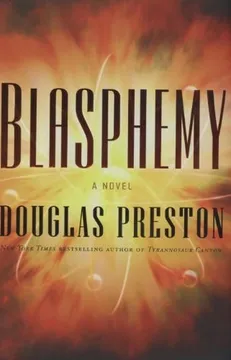
Blasphemy by Douglas Preston is a controversial science fiction thriller exploring the conflict between religion and science. The story revolves around a particle accelerator project that potentially communicates with God. While some readers found it thought-provoking and suspenseful, others criticized its portrayal of religious characters and shallow plot development. The book's premise and scientific elements were praised, but its execution and character depth were often found lacking. Overall, it received mixed reviews, with some readers enjoying the fast-paced narrative and others finding it disappointing or offensive.
People Also Read

Characters
Wyman Ford
Reluctant truth seekerFord is a former CIA operative with training in anthropology and cybernetics, now trying to build a life outside intelligence work. He observes people as carefully as systems, but his professional habits of concealment trouble him after time in a monastery. The assignment draws him back into secrecy and places him near Kate Mercer, his former partner. He is drawn to evidence and wary of anyone who claims final certainty, yet grief has left him searching for meaning too. Ford’s central tension is whether loyalty to people can justify withholding the truth, especially when the facts themselves remain incomplete.
Kate Mercer
Brilliant project deputyKate is Isabella’s assistant director, a gifted string theorist who combines analytical rigor with emotional intensity. She and Ford were once lovers, and their reunion reopens both affection and old ideological disagreements. Kate has endured significant personal losses but continues to pursue difficult questions with fierce concentration. Her scientific work does not make her immune to wonder; rather, she is especially responsive when an apparent discovery presses on the limits of what her models can explain. She resists being treated as a route to information and expects Ford to meet her directly, without disguising intimacy as professional necessity.
Gregory North Hazelius
Charismatic physicistHazelius is the Nobel winning physicist who conceived Isabella and leads its handpicked team. He is small in stature but commanding in presence, capable of shifting from playful host to exacting director without seeming to change character. His intellectual range, curiosity, and attentive charm make people feel unusually visible to him. He values discovery as both a scientific and existential pursuit, and his work is shaped by bereavement and ambition. The team looks to him for technical leadership and emotional coherence, giving his approval unusual force in the isolated world of Red Mesa.
Russ Eddy
Desperate evangelical pastorEddy runs a poor mission near Red Mesa and measures his life against a sense of having been repeatedly wronged. He is physically frail, financially strained, separated from his son, and hungry for proof that his hardships serve a divine purpose. His religious conviction is sincere, but it is entangled with resentment and a desire to be recognized. When events unsettle his moral certainty, he is prone to interpret fear as confirmation rather than pause for evidence. Eddy’s role shows how a private need for purpose can become dangerous when amplified by public attention.
Nelson Begay
Diné medicine manBegay is a Navajo medicine man and community member whose opposition to Isabella grows from concrete grievances about land, consultation, and broken promises. He is neither a caricature of tradition nor an opponent of modern knowledge. He asks questions about creation and listens when Kate explains cosmology, while preserving the value of his own ceremonial knowledge. His dignity comes from insisting that exchange must be reciprocal: outsiders should hear local concerns before demanding trust. Begay’s connection to returning veterans and community healing gives him a perspective on damage that is social, spiritual, and historical at once.
Ken Dolby
Isabella's chief engineerDolby designed Isabella and feels a personal bond with the machine, which he nicknames and tends with the attention of a maker who knows every component. The son of a mechanic, he has built his career through technical skill and determination. His confidence is grounded in intimate knowledge of the hardware, but that knowledge also makes it difficult for him to accept that the system may be beyond his control. Dolby is practical, warm, and proud of the extraordinary instrument he helped bring into being.
Peter Volkonsky
Brilliant software engineerVolkonsky is Isabella’s volatile programmer, a gifted engineer whose abrasive humor and shabby appearance conceal intense insecurity. The isolation and malfunctioning system wear on him, while his family remains far away. He distrusts easy explanations and has an unusually devious technical mind. His work gives him access to the project’s deepest computational problems, but his temperament makes others unsure when to take his behavior as a joke, a warning, or a plea for help.
Tony Wardlaw
Project security officerWardlaw is a former Special Forces soldier assigned to protect Isabella and its classified systems. He is disciplined, physically imposing, and alert to threats, but the pressure of a security failure makes him guarded toward Ford and the scientists. He regards procedure as a necessary boundary in a volatile environment. His loyalty to the project and his military experience shape a blunt approach to danger, even when the people he must protect distrust his methods.
Rae Chen
Computer systems expertChen is a sharp and resourceful computer engineer whose informal manner masks formidable technical concentration. The daughter of an immigrant family, she understands her place on the team as the result of sustained sacrifice and opportunity. She is capable of tracing the system’s behavior under pressure and does not hide what her instruments show, even when the result sounds impossible. Chen’s practical evidence often forces the group to reconsider what they think they know.
Melissa Corcoran
Ambitious cosmologistCorcoran studies dark matter and dark energy, and she takes pride in her ability to explain cosmic processes in vivid terms. Smart, flirtatious, and quick to mock, she often uses performance to control how others see her. Her competitive relationship with Kate is sharpened by disagreements over what counts as testable science. Corcoran is also sensitive to the team’s status and to the possibility that their work may be wasted, making her confidence a mixture of genuine conviction and self-protection.
Alan Edelstein
Unorthodox mathematicianEdelstein is a brilliant mathematician, sparing with words and amused by ordinary social conventions. He reads difficult literature, keeps rattlesnakes, and treats abstract questions as serious practical matters. His skepticism is intellectual rather than performative: he is willing to follow an argument wherever its logic leads, even when the result unsettles his previous beliefs. He often exposes the limits of the team’s assumptions, though his cold precision can make other people feel dismissed.
George Innes
Team psychologistInnes is responsible for the team’s psychological welfare in an unusually isolated and high stress setting. He relies on structured conversations and professional routines, believing that people benefit from naming their pressures. The scientists often find his methods transparent or insufficient for their particular intellectual culture. Innes remains earnest and invested in helping them, although his self assurance can prevent him from recognizing how little authority he actually has over their choices.
Michael Cecchini
Particle physicistCecchini is Isabella’s Standard Model specialist, fastidious in appearance and guarded in manner. He appears emotionally remote, a quality that makes his rare displays of intensity especially noticeable. His earlier attraction to an apocalyptic religious group left him with a complicated relationship to belief and community. He has devoted himself to physics and tends to keep his private life separate from the team, even as the project forces abstract questions into personal view.
Harlan St. Vincent
Power systems engineerSt. Vincent manages the enormous electrical supply needed to run Isabella. He is quiet, steady, and technically exact, handling power flows with the calm of a practiced conductor. His reliability is easy to overlook beside the more flamboyant personalities on the team, but the collider depends on his control of a system much larger than the mountain itself. He brings an understated competence to a project where small failures can have enormous consequences.
Stanton Lockwood
Presidential science adviserLockwood is a polished Washington official charged with protecting a major scientific investment and the president’s political position. His public manner emphasizes discretion and control, while personal grief gives Ford a glimpse of a more vulnerable man beneath the office. He recruits Ford because he wants information quickly and without a formal trail. Lockwood understands political pressure but tends to regard people and institutions through the lens of risk management.
Don Spates
Television evangelistSpates leads a large televised ministry and understands how performance, timing, and emotional language can hold an audience. He is under financial and reputational pressure, and the Isabella controversy offers a subject capable of reviving his public influence. Spates is practiced at presenting himself as a defender of faith, though his private conduct and public certainty do not always align. He can recognize an opportunity before he understands its consequences.
Booker Crawley
Washington lobbyistCrawley is an experienced lobbyist who sees political relationships as assets to maintain and deploy. When the Navajo Nation ends his contract, he feels personally insulted and looks for a way to make his former clients need him again. His polished manners conceal a calculating sense of leverage. Crawley’s talent lies in understanding how fear and access can be converted into money, even when he misjudges how far the consequences may travel.
Joseph Bia
Navajo police lieutenantBia is a seasoned Navajo police lieutenant who brings a skeptical eye to investigations and resists being treated as a token local official. He knows the reservation’s roads, histories, and social networks, and he notices when an official explanation fails to fit the physical evidence. His measured manner can look slow to outsiders, but he is quietly persistent. Bia’s perspective challenges the assumption that federal authority automatically understands the community where it operates.
Willy Becenti
Unpredictable local allyBecenti is a restless and irreverent Blue Gap resident whose bravado can disguise a generous nature. He lends Ford money when a small gesture could embarrass the project’s representative, then refuses to let the favor erase larger grievances. His impulsiveness makes him difficult to manage, but he is capable of bold action when people are in danger. Becenti’s mixture of humor and loyalty keeps him from fitting the neat roles others try to assign him.
Randy Doke
Militant believerDoke is a large, charismatic former soldier whose religious conversion gives him a powerful sense of purpose. He can organize people and project confidence, qualities that make him influential among Eddy’s followers. His past addiction and later redemption story shape his belief that he owes absolute service to God. Doke’s martial competence and personal warmth make him both appealing and dangerous when faith is joined to a mission of force.
Lorenzo
Returning veteranLorenzo is Begay’s nephew, a former soldier returning from Iraq after a difficult period in his life. He was once a gifted student and remains difficult for others to read. His quietness and struggles with alcohol leave him vulnerable to people who interpret silence as guilt. Begay hopes that traditional healing practices may help him recover a sense of balance.
Delbert Yazzie
Navajo Nation chairmanYazzie is the newly elected chairman of the Navajo Nation. A former school janitor, he approaches political dealings without the polish Crawley expects, but he is direct about the tribe’s needs and unwilling to keep paying for lobbying once the contract has served its purpose. His manner masks a practical grasp of both money and accountability.
Plot Devices
Isabella and CZero
Machine at creation's edgeIsabella is a vast underground particle collider built to recreate conditions near the beginning of the universe and investigate fundamental physics. Its collision point, CZero, is where the beams meet and the detectors record what emerges. The machine’s scale creates both wonder and practical peril: it needs immense electrical power, delicate magnets, complex software, and a secure bunker. Its central role is to turn an abstract question about creation into an event that can be seen on screens, measured by instruments, and eventually fought over by people outside the laboratory.
The Visualizer signal
Anomaly becomes revelationThe Visualizer translates particle data into images, allowing the team to watch patterns emerging from CZero. When a black region and a strange moving form appear, the screen becomes the channel through which an unknown intelligence seems to communicate. The signal answers questions, appears to know private information, and offers a theory of existence and human purpose. Its origin remains disputed, especially after Hazelius admits to manipulating the experiment while claiming the program exceeded his intentions. The device makes physical data, interpretation, and faith collide in one shared space.
Volkonsky's coded note
A clue to the hidden schemeThe handwritten hexadecimal page found in Volkonsky’s house is concealed in a form that can pass through Isabella’s security restrictions without being copied digitally. Ford later converts the code and finds a taunting message that points him toward Joe Blitz. The clue is not a complete explanation; it gives Ford a name whose significance becomes clear only when Hazelius is injured and speaking less carefully. Its delayed meaning links the programmer’s suspicions to the history of people who have tried to create new religions.
Diné practices and land
Community grounds the conflictBegay’s knowledge of ceremonies, creation stories, and community obligations gives the story a way to examine cosmology beyond the laboratory. The grazing land, archaeological remains, local businesses, and route of the Midnight Trail make Red Mesa a lived homeland rather than an empty testing site. These details complicate the project’s claim to serve humanity: its scientific ambitions have local costs that were never adequately addressed. Begay’s willingness to discuss both his tradition and modern cosmology creates an exchange that neither side can reduce to a simple contest between belief and science.
The viral apocalypse email
A rumor becomes an armyEddy combines scripture, facts drawn from Isabella’s public materials, and apocalyptic interpretation in a mass email urging believers to converge on Red Mesa. The message spreads through online lists and religious websites faster than government agencies can assess it. Spates’s broadcast gives it a national platform, while the email gives its audience a destination and an urgent task. The resulting crowd is not simply a political audience; it is a body of people who believe ordinary limits no longer apply. The device shows how a narrative can become physical infrastructure for collective action.
About the Author




Download PDF
Download EPUB
.epub digital book format is ideal for reading ebooks on phones, tablets, and e-readers.








