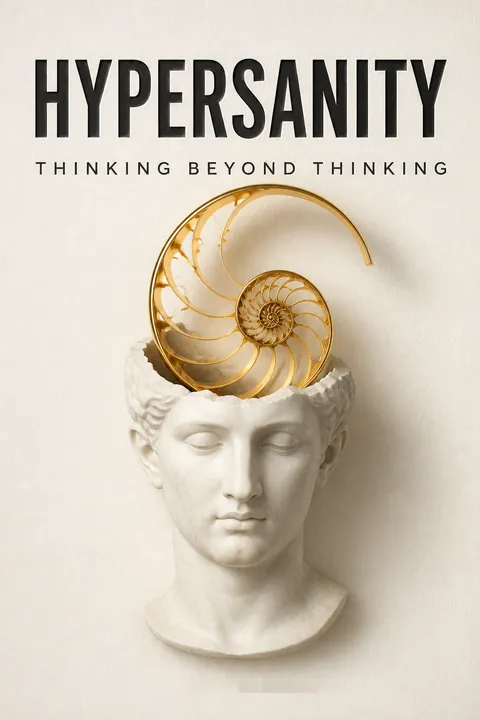


Key Takeaways
Aim beyond mere normality by widening attention, not courting breakdown.
Beyond ordinary sanity. Neel Burton uses hypersanity to describe a freer, more expansive way of thinking that exceeds what society labels normal. It is not mental illness: psychosis can be frightening and disabling, while hypersanity is presented as liberating. The idea comes partly from psychiatrist R. D. Laing, who imagined that a crisis could sometimes become an awakening, and from C. G. Jung, who treated his troubled inner experiences as material for a lifetime of work.
Question convention. The ancient Cynic Diogenes challenged the values of Athens by living simply and exposing the gap between public respectability and human potential. His example frames the book’s central challenge: ordinary life can narrow perception through fear, custom, and self-protection. The route beyond that narrowness is not to seek madness, but to think more fully and tolerate uncertainty.
The distinction between unusual insight and mental disorder matters. Romantic accounts of madness can obscure the suffering and impairment many people experience, so hypersanity is most useful as a metaphor for expanded awareness, not a diagnosis or goal of destabilization. Its social critique also has a practical edge: habits and institutions can make a limited outlook seem like common sense. The question is not whether normality is bad, but whether a person can examine the assumptions that normality quietly rewards.
Test the hidden premises before trusting a persuasive conclusion.
Arguments need inspection. A conclusion may look convincing because its assumptions have gone unspoken. The book distinguishes deductive reasoning, where a conclusion follows necessarily from premises, from inductive reasoning, where evidence makes a conclusion more or less likely. Valid form alone does not guarantee truth: an argument can be valid but unsound if a premise is false. A claim that rising life expectancy proves increased health spending caused it, for example, overlooks other possible causes.
Watch the mind defend itself. Burton groups faulty argument with self-deception, cognitive bias, and cognitive distortion as enemies of clear thought. People may blame another person’s character for a mistake but excuse their own by citing circumstances. They may also focus on evidence that confirms an existing belief, or turn a painful reality into an abstract puzzle to avoid its emotional force. Scrutinize both the reasoning and the motive it may be protecting.
This framework joins formal logic to the less comfortable psychology of motivated reasoning. Checking an argument’s structure is teachable, but noticing why a conclusion feels irresistible requires self-observation and social feedback. One useful extension is to ask what evidence would change a person’s mind, including one’s own. The approach has limits: emotional investment does not automatically make a belief false, and suspicion of motives can itself become a way to dismiss a sound argument without answering it.
Use language as a lens, not a cage.
Words direct attention. Language does not dictate everything a person can think, but it supplies categories that make some distinctions easier to notice. Russian speakers, for instance, use separate everyday terms for lighter and darker blues; a study described in the book found they distinguished those shades more quickly than English speakers. Grammar can also direct attention: English speakers tend to name the agent in accidents, while speakers of some other languages more often describe the event without naming who caused it.
More languages, more angles. Learning another language can offer access to different cultural assumptions and ways of expressing an idea. Burton cites studies associating bilingualism with cognitive advantages and reports that people sometimes make more utilitarian choices when considering moral dilemmas in a second language. These findings do not prove that language determines character or judgment. They suggest that switching linguistic frames can help a person notice what their usual phrasing leaves in the background.
The most useful claim is modest: language can make certain features salient without making alternatives unthinkable. That distinction avoids the trap of treating speakers as prisoners of grammar. A second language can function like a change of camera angle, revealing that a familiar idea has more than one description. Yet bilingual effects vary with proficiency, context, and culture. The practical lesson is not that another language guarantees better judgment, but that deliberate rephrasing can expose assumptions hidden inside familiar words.
Let reason guide you, but never mistake logic for judgment.
Logic has a narrow job. It tests whether a conclusion follows from premises; it cannot establish that those premises are true or worth accepting. Everyday knowledge relies heavily on induction, the inference that patterns observed so far are likely to continue. That inference is useful, but it cannot deliver certainty merely by repeating past success. Human decisions are harder still: several causes and competing goals may be tangled together, beyond what a neat chain of reasoning can settle.
Reason needs company. Emotions help determine which facts matter and what a decision is for. Burton notes that people with severely diminished emotional capacity can struggle to decide, even when their reasoning remains available. He also presents reason as a collective activity: debate can reveal flaws that private reflection misses. Socrates and Protagoras, in Plato’s dialogue, each end up questioning their starting position after arguing about whether virtue can be taught. Their disagreement advances thought rather than simply declaring a winner.
The chapter’s distinction between logic and reason resembles the difference between following rules and exercising judgment. A formal system can check consistency, but selecting relevant evidence and deciding what matters require context and values. Emotion is part of that context, not a rival faculty that can simply be removed. Still, feelings can mislead when fear or desire narrows attention. The stronger model is reciprocal: reasoning examines emotional reactions, while emotions disclose the priorities that reasoning would otherwise leave unspecified.
Treat scientific consensus as corrigible knowledge, not a final verdict.
Methods reduce error, not uncertainty. Scientific experiments try to isolate causes by controlling for other variables, but results can be distorted by weak randomization, lack of blinding, selective reporting, or searching data for convenient patterns. Burton cites a review finding that published drug trials funded by pharmaceutical companies were four times more likely to report positive results than published independently funded trials. Publication itself can skew what appears to be the evidence.
Frameworks shape what counts. The book follows philosophers who disagree about scientific progress. Karl Popper emphasizes attempts to falsify claims; Thomas Kuhn describes paradigms, shared frameworks that shape normal research; Imre Lakatos asks whether a research program gains predictive power or survives through ad hoc repairs. These accounts differ, but each resists the picture of science as a simple march toward unquestionable certainty. Scientific claims can be powerful and useful while remaining open to revision.
This is a case for calibrated trust, not cynicism. A finding gains credibility through methods that make error visible, replication, and comparison with competing explanations. The discussion of funding and publication also points to an institutional issue: knowledge depends not only on individual honesty but on incentives that determine which results become visible. At the same time, showing that science is historically situated does not make every claim equally credible. The relevant comparison is between degrees of evidential support, not between certainty and total skepticism.
Protect memory from distraction, but distrust it as a record.
Memory builds a life. Burton describes memory as the system that registers, stores, and retrieves information to guide future action. Without it, learning, relationships, planning, and sustained reasoning would collapse. Memory also links a person to a life story. In the book’s example, an older woman with advanced Alzheimer’s invents a wedding and a lively night out, creating a coherent identity where reliable recall has failed.
Recall is reconstruction. Memories can be selective, shaped by emotion, expectations, and later information. In a study discussed by Burton, people asked how fast cars were going gave different estimates depending on whether the question described them as smashing or merely contacting. The wording also affected reports of broken glass. To remember new material more effectively, Burton recommends sleep, focused attention, organizing ideas, connecting them to existing knowledge, and reviewing them over time. These practices support recall; they do not make memory infallible.
Memory is both an archive and an active act of reconstruction. That makes it essential to identity, but risky as evidence in conflict or legal testimony. The car-question study is especially instructive because the distortion comes not from deliberate deception but from the way a question reshapes recall. External records, contemporaneous notes, and independent accounts can therefore complement memory. The goal is not to distrust every recollection. It is to distinguish the felt certainty of remembering from proof that an event happened exactly that way.
Let intuition propose possibilities; make evidence decide whether they stand.
Intuition connects scattered clues. Burton defines intuition as a disposition to believe that arises without deliberate reasoning or strong, explicit evidence. It differs from instinct, which is an inborn tendency to act. A psychiatrist’s quick sense that a man serving wine had written poetry proved accurate, though the relevant cues were not consciously assembled. Intuition can surface because many small observations and experiences have converged outside focused awareness.
Create room for connections. Burton suggests widening experience, resting, daydreaming, and loosening the biases or fears that keep ideas apart. The caution is essential: intuitions can conflict, as when people with opposing political or religious commitments feel equally certain. They can help generate a question or hypothesis, but they cannot establish its truth. The book’s practical sequence is to listen for the hunch, then investigate what might explain it and what evidence could disconfirm it.
Intuition is especially valuable when a person has accumulated relevant experience, because expertise can make subtle patterns perceptible before they are easy to articulate. But a strong feeling can also reflect familiarity, stereotype, or anxiety rather than insight. Treating intuition as a generator of hypotheses preserves its creative value while limiting its authority. The key is to ask what the hunch is based on, even if the answer is not yet clear, and then to seek checks that do not depend on the same first impression.
Practice wisdom by seeing causes, limits, and the wider human context.
Wisdom is a way of seeing. Burton distinguishes wisdom from simply knowing a great deal. Socrates becomes the book’s model because he recognizes the limits of his knowledge, while Aristotle’s account emphasizes understanding causes and connections. Wisdom requires stepping back from immediate appearances to see how events relate, what matters, and what may follow. It also takes courage: a broader view can unsettle beliefs that once felt secure.
Put distress in perspective. For bad news, Burton proposes three moves: contextualize it within the whole of a life, consider the worst, best, and most likely outcomes, and look for a constructive response. A lost job, for example, can be painful while also prompting a reassessment of priorities or a career change. This approach is not proof that every setback is beneficial. It is a way to recover perspective and agency when distress makes one outcome feel like the entire future.
Perspective can interrupt catastrophizing by restoring neglected possibilities and resources. The method also resembles scenario planning: distinguishing the worst case from the most probable one can make a vague threat easier to evaluate. Its ethical strength is that it asks what a person can do without pretending the harm is imaginary. The caution is to avoid rushing from pain to a lesson. Contextualization supports clear judgment when it widens the frame; it becomes invalidation when it tells someone that their loss should not hurt.
Treat emotion as information to interpret, not noise to suppress.
Feelings carry evaluations. Burton separates an emotional experience, such as a moment of pride, from an enduring emotion or sentiment, and from a trait, such as being a proud person. Emotions reveal what seems important, and they can guide action where analysis alone stalls. But they also focus attention selectively, so fear, envy, or anger may disguise their causes or distort a judgment. The book’s example of snobbery shows how status anxiety can turn superficial attributes into a measure of human worth.
Cultivate better responses. Emotional habits can be shaped through repeated action. Burton draws on Aristotle’s view that arguments alone rarely make people virtuous; practice helps form the dispositions from which good actions become more natural. Music offers another route: it can give difficult feelings structure and expression, and the book describes its use in supporting people with anxiety, depression, dementia, and brain injury. Emotional education means learning to notice, name, and refine feelings, not obeying every impulse.
Emotions provide a kind of value signal: they tell a person what feels threatened, desired, or important. But signals need interpretation. Anger may identify a genuine injustice, or defend status; guilt may prompt repair, or become disproportionate self-punishment. This makes emotional literacy a form of judgment rather than a simple celebration of feeling. Music is a particularly revealing example because it can organize emotion without requiring a neat verbal explanation. Its effects are not identical for everyone, but it shows that cognition is not limited to argument.
Make room for music, sleep, and idleness to unlock imagination.
Imagination expands the possible. Burton describes imagination as the ability to form and manipulate ideas, images, and feelings beyond immediate sensory input. It helps children test possibilities through pretend play, helps scientists formulate hypotheses, and helps people picture another person’s point of view. Without it, experience would be a stream of impressions with little pattern or meaning. Knowledge can constrain imagination, especially when mistaken beliefs are treated as facts, but knowledge can also give imagination better material to work with.
Create conditions for insight. Inspiration combines a vision with energy to pursue it, while making something of an idea still requires effort and opportunity. Burton recommends curiosity, time away from distractions, changes in routine, sleep, and starting work without forcing a complete result at once. He describes inspiration as difficult to command directly: attention and rest make room for connections, but do not guarantee them. Idleness is useful here not as escape from work, but as space for thought to recombine what focused effort has gathered.
Imagination is not an ornamental extra to rational thought. It supplies the alternatives that reasoning compares and the hypothetical cases that help test a theory. This makes creative work dependent on both freedom and constraint: a mind needs room to associate, but also enough knowledge to distinguish a fruitful possibility from a fantasy. The book’s defense of rest is therefore more than a productivity trick. Yet unstructured time is not equally available to everyone, and institutions that value only visible output can make the conditions for creative thought a privilege.
Analysis
Hypersanity is best understood not as a clinical category but as a proposal for cognitive breadth. Burton begins with the suspicion that ordinary social functioning can conceal intellectual and emotional sleepwalking, then moves through the tools commonly treated as the whole of thought: argument, logic, and scientific method. He does not discard those tools. He places them inside a larger account that includes language, memory, intuition, feeling, and imagination.
The book’s strongest through-line is its attention to limits. Arguments depend on premises; scientific observation depends on interpretation; memory is reconstructive; and intuition can be insightful or biased. The recurring demand is epistemic humility without resignation. Uncertainty should prompt better inquiry, not the conclusion that all claims are equivalent. This is particularly important in the discussion of science, where criticism of institutional incentives sits alongside recognition that systematic testing remains valuable.
The breadth is also the book’s central difficulty. Its chapters range from formal fallacies to music therapy and ancient philosophy, so the reader may mistake the work for a collection of interesting topics rather than a unified thesis. The connective idea is that human thought is plural and embodied: reasoning works with emotion and experience, while language and memory shape what can be noticed and shared. The final appeal to reduce the ego is powerful as a metaphor for loosening self-protective certainty, but potentially too absolute if taken literally. A stable sense of self can support responsibility and relationships. The practical aim is less self-erasure than enough self-distance to question one’s favored beliefs. Read that way, the book offers a demanding but usable ideal: preserve critical rigor while recovering forms of awareness that narrow definitions of rationality leave out.
Review Summary
Hypersanity receives mixed reviews, with readers praising its thought-provoking content and accessible writing style. Many find it insightful, offering a fresh perspective on thinking and cognition. Some readers appreciate the book's focus on logic, fallacies, and cognitive biases. However, others feel it falls short of delivering on its promise of "hypersanity" and lacks depth in certain areas. Despite this criticism, many readers find value in the book's exploration of human thought processes and its potential to enhance self-awareness and critical thinking skills.
People Also Read





Glossary
Hypersanity
expanded, liberating awarenessA term Burton takes from R. D. Laing to describe a form of awareness that goes beyond conventional, socially approved normality. It suggests greater freedom, perspective, and use of human potential, rather than mental illness. The book presents it as an aspiration for fuller thought, not a medical diagnosis or a reason to pursue psychological crisis.
the five enemies of rational thought
obstacles to clear reasoningBurton’s grouping of formal fallacies, informal fallacies, self-deception, cognitive bias, and cognitive distortion. The first two concern defects in arguments; the others describe ways psychological protection, mental shortcuts, or distorted interpretation can interfere with judgment. The categories overlap, and their purpose is to help identify different sources of error rather than to provide rigid boundaries.
cognitive bias
shortcut that can distort judgmentA mental shortcut or heuristic that saves time, effort, or discomfort but can reduce accuracy. Burton gives confirmation bias as an example: people tend to notice and remember information consistent with existing beliefs while overlooking conflicting evidence. Biases can also protect self-image or reinforce a worldview, making them difficult to detect through reasoning alone.
cognitive distortion
interpretation shaped by outlookA term from cognitive-behavioural therapy for interpreting events in ways that reinforce a person’s outlook, often on scant or partial evidence. Burton discusses selective abstraction, in which one negative detail dominates a broader picture, and catastrophic thinking, in which a feared event is imagined to lead to increasingly severe consequences. Such patterns can reinforce distress.
tripartite theory of knowledge
knowledge as justified true beliefA traditional account that says a person knows a proposition only if the person believes it, the proposition is true, and the belief is justified. Burton explains that this account faces the Gettier problem: a belief may be true and justified yet true by luck or for the wrong reason, so it may not count as knowledge.
prospective memory
remembering to rememberMemory for an intention that must be carried out in the future. Remembering a birthday is not enough; a person must also remember to make the call when the occasion arrives. Burton uses the concept to show that memory supports planning and goal-directed action, not merely the retrieval of past events or facts.
paradigm
shared framework for researchIn Burton’s account of Thomas Kuhn, a paradigm is the shared worldview and set of assumptions within which scientists conduct research. It influences which questions seem important and how evidence is interpreted. When persistent findings conflict with a paradigm, resistance may precede a broad change in the framework used by a scientific community.
intuition
non-deliberate disposition to believeA disposition to believe that develops without strong explicit evidence or conscious deliberation. Burton distinguishes intuition from instinct, which is an innate tendency toward a behaviour. Intuition can combine many subtle observations and experiences, making it useful for generating hypotheses, but it is not necessarily accurate and cannot by itself justify a claim.
About the Author

Download PDF
Download EPUB
.epub digital book format is ideal for reading ebooks on phones, tablets, and e-readers.








