

Key Takeaways
Explain civilizations through energy flows, but never mistake constraint for destiny.

Energy makes action possible. Every human activity depends on converting energy into useful work. Photosynthesis captures less than 0.05% of incoming sunlight, yet that flow underpins plants, food, and the biomass fuels of traditional societies. Human history is also a story of reaching beyond muscle: tools, fire, draft animals, waterwheels, engines, and electricity let people command larger, more concentrated energy flows.
Energy is not fate. Smil rejects the claim that more energy automatically produces higher culture or better choices. Coal helped power British industry, but its effects depended on inventions, institutions, finance, and human purposes. Energy supply sets limits on what a society can do; it does not explain, by itself, what people decide to do.
What's striking is the distinction between a necessary condition and a sufficient explanation. Energy resembles the material budget of a society: it opens or closes possibilities, but it cannot tell observers which possibility people will choose. This avoids both a purely cultural history that forgets physical limits and a mechanistic account that treats people as passive outputs of fuel supply. The caution matters because aggregate energy statistics can describe a civilization's capacity without revealing who controls that capacity, who benefits, or what goals it serves.
Measure energy by useful work, density, and access, not totals.

The units hide differences. Energy density measures energy stored in a given mass; power density measures the rate of energy production or use over an area; efficiency compares useful output with input. These measures answer different questions. A barrel of oil and a mass of wood can be counted in joules, but oil is denser and easier to transport, while wood may be renewable and locally gathered.
Place matters. Sustainable fuelwood growth in a temperate forest produces at best about 0.6 watts per square meter, while a large preindustrial city might use 20 to 30 watts per square meter of built land. Cities therefore drew on surrounding territory many times their size, and charcoal production made the land demand still greater. A total-energy figure alone misses this geography, along with pollution, access, and conversion losses.
These measures turn energy history into a study of logistics as well as physics. A resource is useful only if it can be reached, moved, stored, and converted at the required rate. That perspective helps explain why concentrated fuels and high-capacity transport can reorganize settlement patterns even when alternative sources contain ample energy. It also warns against treating a single efficiency or return ratio as a complete verdict: boundaries and resource quality shape the result, and a technically efficient system can still impose substantial land or health costs.
See farming as a population strategy, not an automatic improvement in life.

Farming changed the scale. Foragers generally lived at low densities, although coastal groups with abundant fish and marine mammals could build larger, settled communities. Agriculture emerged in several world regions between roughly 10,000 and 5,000 years ago. Its adoption had no single cause: population pressure and environmental change interacted with the social benefits of settled life, including larger families, stored surpluses, and defense.
More people, not immediate ease. Early farming could demand more labor and offer lower energy returns than foraging, yet it supported denser populations and more dependable stores. In Mexico's chinampa system, raised fields built from lake mud and plant matter could yield several times more corn than dryland plots. Traditional farming still brought monotonous diets, malnutrition, and recurrent famine. Higher output per area did not guarantee more food or comfort for each person.
The distinction between supporting more people and improving each person's welfare is essential. It challenges a familiar progress narrative in which farming simply replaces scarcity with abundance. Population growth can absorb productivity gains, while storage and settlement change social organization even when daily work remains arduous. The account also resists a single-cause explanation of agriculture, a useful model for studying transitions in which ecology, technology, and social incentives reinforce one another. Energy balances clarify the trade-offs, but surviving archaeological evidence cannot recover every community's typical diet or experience.
Expect new energy systems to take generations, not arrive as instant swaps.
Old systems linger. Human labor remained the dominant source of mechanical power for millennia. Water and wind machines spread slowly and served particular tasks; even after steam engines appeared, waterwheels and draft animals continued to matter. New sources did not simply erase old ones. They entered economies through long periods of experimentation, investment, and practical adaptation.
Transitions need infrastructure. In Smil's reconstruction, major fuels generally took about 50 to 75 years to capture a large share of global energy supply. Coal required mines, transport, and furnaces; coke made larger iron furnaces possible; steam engines helped drain deeper coal mines and later powered railways and factories. A new fuel becomes transformative only when connected to converters, distribution networks, skills, capital, and markets.
The historical record makes transition speed a question of installed systems, not just technical promise. Mines, vehicles, power plants, and skills are long-lived investments, so the replacement of an energy source carries economic and political costs as well as engineering tasks. This is a strong corrective to forecasts that extrapolate rapid early growth into instant dominance. Still, past transition rates are not a law of the future: policies, crises, and the urgency of environmental damage can alter incentives, even if they cannot make infrastructure appear overnight.
Build the whole conversion system, not just the headline invention.
Electricity was a network achievement. A durable light bulb was only one piece of the solution. Commercial electricity also required generators, wiring, meters, switches, motors, and a way to transmit power economically. Edison helped assemble a workable lighting system, while transformers and alternating current made longer-distance distribution practical. The outcome was a new energy service, not merely a better lamp.
Factories changed with the network. Electric motors let manufacturers power individual machines instead of routing force through overhead shafts and belts driven by one central engine. That made layouts more flexible and allowed precise control at each machine. Across the broader fossil-fueled transition, useful energy grew far faster than primary energy: Smil estimates more than thirty times as much useful energy in 2015 as in 1900, despite a roughly fourteenfold rise in fossil fuel supply.
This is a case of a general-purpose technology whose value comes from complementary parts. Systems thinking explains why an invention can exist for decades before it reshapes everyday life: the surrounding network may be missing, costly, or incompatible. The same logic applies beyond energy, since standards and reliable connections often matter as much as the central device. Smil's account also shows that measuring delivered services can reveal progress obscured by raw fuel totals. The caveat is that greater usefulness does not establish that benefits are evenly distributed.
Efficiency can lower costs while expanding total energy demand.
Cheaper service invites use. Jevons observed that more efficient steam engines did not necessarily reduce coal consumption; by making steam power cheaper, they encouraged wider use. This is commonly called the Jevons paradox: an efficiency improvement can be partly or wholly offset by increased demand. The effect is not automatic, and Smil notes that economy-wide rebounds may be small, especially when demand is already near saturation.
Intensity is not the total. Energy intensity measures energy used per unit of economic output. It has declined as economies mature, thanks to better converters, structural shifts toward services, and more efficient production. Yet global energy use can still rise as population and output expand. After the 1970s oil shocks, new North American cars cut average fuel demand roughly in half between 1973 and 1987, but later growth in larger vehicles weakened that progress.
The key distinction is between doing the same task with less energy and using less energy overall. Efficiency can reduce costs, improve access, and lower pollution per unit of service, while the scale of consumption continues to grow. That makes policy design important: technical standards can be paired with limits or incentives that address total demand, rather than assuming savings will happen on their own. At the same time, rebound is not a reason to dismiss efficiency. It is a reason to measure both service gained and energy consumed.
Use enough energy for human development, then question the excess.
Basic welfare needs modern energy. The book finds that countries using less than about 5 gigajoules of commercial energy per person annually struggle to provide basic necessities to everyone. The relationship between energy and quality-of-life measures then weakens: roughly 60 to 65 gigajoules per person can coincide with strong outcomes on health and human development measures, while consumption above about 110 gigajoules shows little further improvement in those indicators.
Distribution changes the picture. In 2015, the United States used about 300 gigajoules per person and Canada about 385, yet the book reports poorer U.S. infant mortality and life-expectancy results than in several countries using much less energy. National averages also conceal inequality: a modern city dweller and a rural household without reliable electricity do not receive the same services from each unit of primary energy.
The distinction between access and excess gives energy policy a human measure rather than a purely industrial one. More energy can support refrigeration, clean water systems, medical care, and education, but beyond a point institutions and distribution matter more than gross supply. The thresholds should be read as patterns in comparisons, not universal biological cutoffs. Health and education depend on public services, social equality, and political choices as well as energy. The central insight survives that qualification: high consumption is not a reliable proxy for high welfare.
Treat concentrated energy as concentrated political and environmental power.
Control carries consequences. Modern energy systems put large flows under the authority of governments, firms, and a small number of decision-makers. Oil price decisions by OPEC in the 1970s sent economic shocks across importing countries. Yet energy does not explain every war: resource interests interact with broader strategic aims, and abundant military power did not guarantee U.S. success in Vietnam.
The physical costs accumulate. Fossil fuel use enabled industrial production and mass mobility, but combustion also raised atmospheric carbon dioxide from about 316 parts per million in 1959 to nearly 399 in 2014. Smil reports an average global surface temperature rise of about 0.85 degrees Celsius between 1880 and 2012. Energy's benefits and harms are linked: the same concentrated flows that power cities and industry can reshape climate and ecosystems.
The passage from energy capacity to political power is not merely metaphorical. Control over grids, fuels, and infrastructure can shape prices, security, and the distribution of opportunity. But the account appropriately avoids reducing conflict to resource competition; ideology, strategy, and domestic politics also matter. Environmental effects create a related problem of delayed responsibility: fuel users receive immediate services, while costs spread across populations and generations. That mismatch makes transparent accounting and public oversight essential complements to technical change.
Plan decarbonization as a materials-and-infrastructure transition, not a fuel swap.
Fossil dependence is embedded. In 2015, fossil fuels still supplied about 86% of global primary energy. Wind and solar had grown quickly, but together they remained a small share of total energy, and their variable output creates grid-integration challenges. Replacing electricity generation alone would not replace fossil fuels used for transportation, industrial heat, or chemical feedstocks.
The material chain matters. Modern food production depends partly on ammonia made through the Haber-Bosch process; plastics rely on hydrocarbons; and blast furnaces use coke both as fuel and as physical support for the iron-bearing charge. These systems require machines, metals, and transport networks that themselves embody energy. Smil argues that a shift away from fossil fuels is possible, but the scale of dependence makes it a multigenerational undertaking, not a quick substitution.
This framing improves on the idea that a cleaner electricity mix automatically creates a low-carbon economy. Energy sources serve different functions, and some are also chemical ingredients or structural materials. A credible transition therefore needs to track whole supply chains, storage, grids, and industrial processes, not just installed renewable capacity. The argument is demanding but not fatalistic: the historical record shows that societies can build new systems, while also showing the time and coordination required. Climate risk makes delay costly, but haste without system planning can produce brittle solutions.
Analysis
Smil's central achievement is to make energy visible across domains that are often studied separately: food systems, transport, warfare, cities, manufacturing, and political power. The book's strongest method is comparative accounting. It asks not only how much energy entered a society, but what form it took, how concentrated it was, what converters made it useful, and what losses or dependencies accompanied it. That method makes the enormous discontinuity after fossil fuels and electricity legible without implying that history suddenly became simple.
Its restraint about determinism is as important as its physical emphasis. Energy is indispensable, but the same supply can support sharply different outcomes depending on institutions, distribution, technology, and political choices. This is a productive model for interdisciplinary history: physical constraints explain the feasible range, while social analysis explains selection within that range. The book also exposes a common accounting error: equating efficiency, output, or national energy use with welfare. Useful services, access, and external costs are better measures, though each remains incomplete.
The scale of the work creates its main limitation. Global comparisons rely on estimates whose uncertainty varies greatly, especially for ancient biomass use, crop yields, and population totals. A common unit makes unlike systems comparable but cannot fully represent quality, labor burden, or social meaning. The detailed engineering can also leave cultural and institutional causes appearing secondary, even when the closing argument correctly rejects that hierarchy. Readers should treat the numerical series as disciplined approximations, not precise measurements of whole civilizations.
The book's enduring question is therefore not whether civilization needs energy. It does. The more useful questions are which energy services improve human welfare, who controls them, what material systems they require, and which costs are shifted onto others. That agenda makes energy history relevant to contemporary transition debates without pretending that a historical analogy can dictate a timetable or prescribe a single technological future.
Review Summary
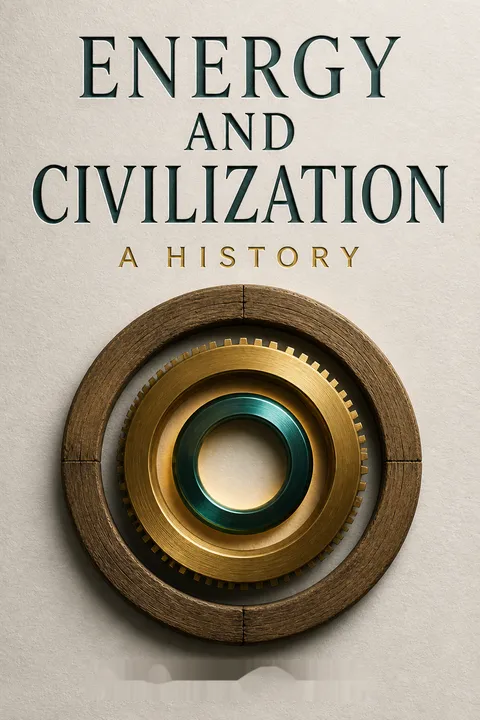
Energy and Civilization by Vaclav Smil receives mostly positive reviews (4.09/5) for its comprehensive, data-driven examination of energy's role throughout human history. Readers praise its thorough research and unique perspective, noting how energy transitions shaped civilization from prehistoric foraging to fossil fuel dependence. However, many find it densely written with overwhelming statistics, better suited as a reference text than casual reading. The book's greatest strength—exhaustive detail and quantitative analysis—also proves its weakness, with some reviewers struggling through tedious sections. Most agree it offers invaluable insights despite challenging readability, particularly regarding future energy transitions.
People Also Read










Glossary
Energy return on energy investment
Energy gained per energy spentThe ratio between energy obtained from a resource and the energy required to find, extract, process, and deliver it. Smil emphasizes that comparisons are meaningful only when methods, assumptions, and system boundaries match. Values vary with resource quality and extraction technique, so a single ratio cannot by itself describe accessibility, environmental effects, or the usefulness of the energy delivered.
Power density
Energy flow per areaThe rate at which energy is produced or consumed per unit of land area. It helps explain why energy systems shape settlement and land use. Traditional fuelwood production, for example, yielded far less power per area than a preindustrial city required, forcing cities to draw food and fuel from extensive surrounding territories.
Energy intensity
Energy per economic outputA measure of the energy used to produce a product, service, or unit of economic output, commonly GDP. Energy intensity often declines as economies mature because of efficiency improvements and shifts toward less energy-intensive activity. A falling ratio does not mean total energy consumption falls, since population and output can grow faster than intensity declines.
Jevons paradox
Efficiency can increase total useThe possibility that an efficiency improvement lowers the cost of using an energy service and thereby encourages enough additional use to offset some or all of the expected energy savings. Jevons drew attention to the pattern in coal use after steam engines became more efficient. Smil stresses that rebound effects vary and can be small in saturated economies.
Agricultural involution
More labor, little productivity gainA pattern of agricultural intensification in which growing populations are supported through increasingly labor-intensive cultivation of limited land, especially irrigated rice systems. Output per area may rise while output per worker stagnates or declines. Smil uses the term to describe a route to high population density that differs from the substitution of human labor with draft animals and machinery.
Haber-Bosch synthesis
Industrial ammonia productionA high-pressure catalytic process that combines atmospheric nitrogen with hydrogen to produce ammonia. Commercialized in Germany in 1913, it enabled large-scale synthetic nitrogen fertilizer production. The process consumes substantial energy, but its nitrogen inputs support a large share of modern crop production and therefore a significant portion of the global food supply.
Law of maximum energy
Tendency to expand energy flowsAlfred Lotka's proposed evolutionary tendency for natural selection to favor systems that increase their mass, the rate at which matter circulates, and total energy flow while unused resources remain available. Smil presents it as a broad biological idea relevant to civilization's rising energy use, not as a complete explanation of human cultural choices or a guarantee of unlimited growth.
Expensive-tissue hypothesis
Brain growth balanced by gut reductionThe hypothesis, associated with Leslie Aiello and Peter Wheeler, that humans could support a metabolically costly larger brain partly by reducing the size of another energy-demanding tissue, especially the digestive tract. Higher-quality, energy-dense foods helped make this trade-off possible. The hypothesis connects diet, metabolism, and brain evolution, while remaining one explanation among several for human encephalization.
About the Author
Other books by Vaclav Smil






Download PDF
Download EPUB
.epub digital book format is ideal for reading ebooks on phones, tablets, and e-readers.








