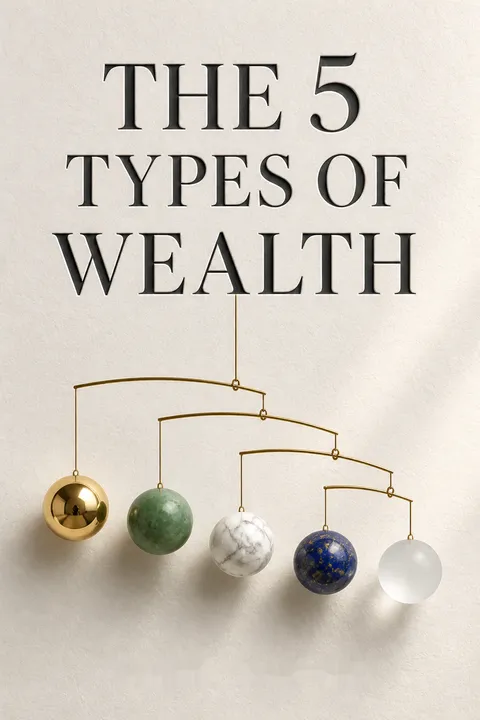


Key Takeaways
Count wealth in time, people, purpose, health, and money.

A wider scoreboard. Bloom's turning point came when a friend calculated that, if he saw his aging parents once a year, he might see them only fifteen more times. The number exposed the cost of a life organized around career and income. Later, conversations with people of different ages and circumstances pointed to a shared picture of a good life: time with loved ones, meaningful activity, and health. The elders' advice to Bloom repeatedly centered on those things, not money.
The book's central framework adds five measures to the usual financial one: Time, Social, Mental, Physical, and Financial Wealth. Money matters, especially when it eases basic burdens, but it is a means to support a life, not a complete measure of one.
The framework's strength is that it makes neglected costs visible before a crisis forces them into view. In organizational theory, a metric does not merely describe performance; it steers behavior. A broader scoreboard can therefore change decisions, not just feelings about them. The categories are useful as prompts, though not as equal-weight targets. A person facing illness, caregiving, or financial insecurity may reasonably prioritize one domain for a season. The point is not to maximize five numbers simultaneously, but to notice what a money-only measure leaves out.
Define enough before each financial milestone moves the finish line.

Make sufficiency concrete. Bloom contrasts two responses to wealth. Author Joseph Heller felt richer knowing he had enough than a billionaire host who had more money. Business magnate John D. Rockefeller, by contrast, reportedly described enough as a little more. The book connects this restless chase to hedonic adaptation: people often become accustomed to gains, then treat the new level as ordinary and want another increase. A larger yacht can make the first one feel less impressive without changing anyone's actual needs.
Bloom calls the personally sufficient life an Enough Life. Describe where you live, what an ordinary day contains, whom you spend it with, what you own, and what financial cushion you need. That vision turns vague wanting into a target that can be examined and revised deliberately.
A written picture of sufficiency counters a familiar behavioral-economics problem: preferences shift with comparison and recent experience. Making the target specific gives spending and career choices a reference point. Yet enough should not become a moral test. Housing costs, dependents, disability, and economic instability change what security requires. The useful distinction is between needs grounded in one's real circumstances and desires imported from status competition. A good definition of enough can grow, but it should grow by conscious choice rather than by automatic imitation.
Use a personal rule to reject victories that cost the war.

Choose a fixed point. During the Apollo 13 emergency, the damaged spacecraft's crew used Earth in a small window to orient a manual course correction. Bloom turns this into the Life Razor: one clear statement that helps a person navigate choices when circumstances become noisy. It should be controllable, create positive effects beyond itself, and express the kind of person one wants to be.
Netflix cofounder Marc Randolph maintained a recurring evening with his wife despite a demanding start-up career. The ritual was more than a date. It made his relationship a visible priority and helped others understand his boundaries. A Life Razor can guide decisions about work, family, and risk by asking what the person described in the rule would do.
A concise rule resembles an implementation intention, a plan that links a situation to a chosen response. This can reduce decision fatigue and make private values legible to colleagues and family. Its usefulness depends on the rule being genuinely chosen, not inherited from a culture that prizes one ideal family or career. A rule can also become rigid when circumstances change. Regular revision keeps it a compass rather than a cage, especially when caregiving, health, or work conditions shift unexpectedly.
Treat time as finite, then focus it where it compounds.
Awareness precedes control. Time Wealth means having meaningful choice over how, where, and with whom time is spent. Bloom organizes it into awareness of time's limits, attention to what matters, and control over the calendar. The American Time Use Survey data he discusses show that time with parents, siblings, children, and friends tends to decline as people age, while time alone increases. Those patterns make it easy to miss important windows.
A practical audit is the Energy Calendar: mark activities that create, drain, or neither notably change energy. Pair that with a short list of priorities, focused work blocks, and limits on interruptions. Research on attention residue suggests that switching tasks leaves mental attention partly stuck on the previous one, so constant checking can erode presence and concentration.
The useful distinction is between hours available and hours experienced with attention. Behavioral research on task switching supports the idea that frequent interruptions carry cognitive costs, while rituals and calendar boundaries can protect sustained focus. Mortality calculations can also prompt action, as they did for Bloom and for a reader who increased visits to his ill mother. But such arithmetic is an alarm, not a forecast. It should motivate connection without turning relationships into quotas or making every ordinary moment feel like a countdown.
Protect deep bonds, and build community beyond your inner circle.
Relationships are infrastructure. Social Wealth includes close, dependable relationships, broader belonging, and respect earned through how one lives rather than what one buys. The long-running Harvard Study of Adult Development found that relationship satisfaction was strongly associated with later-life health and life satisfaction. Bloom's account of his grandmother's isolation during pandemic restrictions gives the finding a human face: renewed contact and conversation seemed to revive her engagement.
Map important relationships by how supportive they are and how often contact occurs. Preserve frequent, healthy ties, and reconnect with supportive people seen too rarely. Community groups, shared activities, and recurring gatherings widen the circle. The book also warns against status purchases as substitutes for respect, which grows through trust, care, competence, and time.
Social connection is not merely pleasant; it can provide practical help, emotional regulation, and a sense of belonging. The distinction between close ties and wider community is valuable because each offers different forms of support. Still, relationship maps should not reduce people to scores or imply that every difficult connection can be repaired. Some relationships are unsafe, and distance may be necessary. The more general lesson is to invest attention where mutual care is possible and to seek belonging through shared activity rather than passive digital contact alone.
Keep curiosity alive through purpose, deliberate learning, and mental space.
Protect the mind's range. Mental Wealth rests on purpose, growth, and space for reflection. The ninety-year-old Hank Behar chose to spend his birthday attending astronomy classes at Harvard, arriving early and taking notes. His example captures the book's argument that curiosity can remain active across a lifetime. Purpose need not be a prestigious job: it may center on family, community, craft, or service, and can change with life's circumstances.
Bloom suggests identifying what gives energy, what one can do well, and what one's current world needs. Learning can be strengthened by explaining a subject simply, then studying whatever one could not explain. Walking, journaling, or setting aside a quiet day can create room to think. These practices protect growth from being crowded out by urgent routine.
The emphasis on curiosity is a useful counterweight to the assumption that learning matters only when it boosts income. Self-determination research distinguishes intrinsic motivation, driven by interest or meaning, from motivation based mainly on external reward; the former can sustain exploration. Purpose, however, need not arrive as one grand revelation. It may be provisional and plural, especially for people whose obligations constrain choice. The practical advantage of small experiments is that they let someone test an interest before reorganizing an entire life around it.
Build a body for your eightieth birthday, not a fad.
Start with durable basics. Physical Wealth is the capacity to remain healthy and capable, built through movement, nutrition, and recovery. The book's story of Dan Go shows how a modest beginning can alter more than fitness: he started exercising with a short-term gym pass, noticed a small change in his belt, and gained confidence that his actions could change his circumstances.
Bloom argues for fundamentals before elaborate wellness routines: regular movement that includes cardiovascular and resistance activity, mostly whole foods, and consistent sleep, generally seven to eight hours. His staged approach begins with accessible habits, then adds training structure and nutritional detail. The aim is not to imitate an extreme longevity regimen, but to build a repeatable foundation suited to one's capacity and health needs.
This is a strong antidote to a wellness market that sells novelty before consistency. Public-health evidence broadly supports movement, nutritious food, and adequate sleep as foundations of health, though individual needs and safe exercise levels vary. The staged approach also lowers the psychological cost of starting: a manageable routine is more valuable than an ideal plan abandoned after a week. Physical habits can create a sense of agency, but they cannot guarantee control over illness, aging, or disability. The framework works best when health goals include adaptation and professional guidance where needed.
Grow financial freedom by widening the gap and giving compounding time.
Build the financial engine. Financial Wealth comes from growing income, keeping expenses below it, and investing the difference for the long term. The book uses Jakob Fugger, a Renaissance-era financier who accumulated extraordinary riches while neglecting much else in his life, as a warning that financial success alone can be a costly victory. The goal is not maximum accumulation at any price, but enough money to support the life one has chosen.
Compounding rewards patience: returns can generate further returns, so time invested matters. Bloom favors simple, low-cost diversified investments for many people, while noting that more hands-on assets bring extra work and risk. Consider return on hassle as well as expected returns. Investing in skills, health, and learning also counts as investing in future capacity.
The financial model is memorable because it links three controllable levers instead of treating wealth as a market forecast. Compounding explains why starting early can matter more than chasing a slightly better return, while diversification reduces dependence on a single bet. The return-on-hassle lens adds an often neglected cost: attention. Yet simple investing is not a universal prescription, and suitable choices depend on debts, taxes, time horizon, and risk tolerance. Financial security is also partly shaped by wages, family resources, and public systems, not discipline alone.
Turn values into small recurring systems, not motivational declarations.
Measure, then adjust. The Wealth Score is a self-assessment across five forms of wealth. Each has five statements rated from zero to four, producing a score for each domain and a combined maximum of one hundred. Its purpose is to reveal a baseline and prompt useful action, not to certify whether a life is successful.
The book pairs measurement with practical systems: an energy audit for time, a relationship map for social life, recurring reflection with a partner, small learning rituals, basic health tracking, and automatic saving or investing. Review whether the actions still fit current priorities and whether they are moving the intended areas forward. A score becomes useful when it leads to a concrete adjustment, such as protecting an evening, calling a relative, or scheduling movement.
Self-monitoring can turn vague intentions into feedback, a principle used in behavior change and performance coaching. The score's greatest value is comparative: it can help someone notice a shift in their own life, rather than rank people against one another. Its limitation is measurement precision. A number compresses complex relationships, health, and purpose into a subjective snapshot. Treating the score as a dashboard, with conversation and context alongside it, avoids confusing what is easy to count with what matters most.
Let priorities shift by life season without letting any domain disappear.
Balance across seasons. Bloom rejects the idea that every part of life must advance equally at all times. A person may prioritize learning and income early in a career, then emphasize family, health, or purpose in another period. He compares this to a dimmer switch: turn some areas up while keeping others from going dark long enough to deteriorate.
For each priority, set goals, identify anti-goals, and choose daily systems. Anti-goals are outcomes to avoid while pursuing success, such as gaining a senior role at the cost of health or family connection. A monthly review can check whether current actions still fit; a quarterly review can identify what creates or drains energy and what fear may be delaying a needed move. The aim is deliberate trade-offs, not perfect balance.
This seasonal model is more humane than permanent optimization. Developmental psychology and life-course research both emphasize that roles and priorities change with age, family structure, and circumstance. The dimmer metaphor also encourages maintenance, which is often wiser than neglect followed by an expensive repair. Its challenge is that not everyone can freely choose the season's focus. Economic pressure, caregiving, and illness can sharply restrict options. Naming trade-offs still helps, but the framework should not imply that every imbalance is a personal failure.
Analysis
The book's most useful contribution is not a novel claim that family, health, and purpose matter. It is the attempt to convert that familiar wisdom into a decision system. The five domains broaden the definition of success, while the Wealth Score, personal rule, goals, and recurring audits aim to make that definition operational. The opening calculation about visits with aging parents supplies the emotional mechanism: an abstract value becomes concrete when time is counted.
The framework is strongest when used as a diagnostic, not as a universal formula. Its categories overlap. A walk can build health, create solitude, and deepen a friendship; a career choice can affect income, identity, community, and time at once. That overlap is a feature for reflection but a problem for scoring. A numerical rating can create false precision, especially when people compare scores rather than examine the circumstances that produced them. The tool should invite questions, not settle them.
The book also speaks most directly to readers with enough discretion to redesign work, housing, or schedules. Its advice to relocate near family or reject lucrative work may be transformative for some and unavailable to others. Structural realities such as caregiving duties, unstable employment, health, and housing costs shape the choices on offer. Recognizing those constraints strengthens the model: wealth is partly personal design, but also access and security.
Its lasting test is practical. Does a new opportunity fit the person's chosen definition of enough? Does it improve one kind of wealth by quietly damaging another? Can a small recurring action preserve an important relationship, health routine, or source of meaning? The framework cannot promise that the right choices eliminate grief or uncertainty. It can make it harder to mistake a profitable life for a flourishing one, and easier to revise course before regret becomes the only source of clarity.
Review Summary
The 5 Types of Wealth redefines wealth beyond finances, exploring time, social, mental, physical, and financial aspects. Readers praise Bloom's practical approach, actionable strategies, and compelling storytelling. The book challenges conventional success metrics, encouraging readers to design fulfilling lives aligned with personal values. Many find it transformative, offering a fresh perspective on wealth and life design. Critics note some content overlap with other self-help books and question the rigor of certain quotes. Overall, reviewers appreciate the book's comprehensive framework for achieving a balanced, meaningful life.
People Also Read







Glossary
The 5 Types of Wealth
Five-part life scoreboardBloom's framework for evaluating a life through Time, Social, Mental, Physical, and Financial Wealth. It treats money as one important domain rather than the sole measure of success. The framework is intended to help people assess trade-offs, identify neglected areas, and make choices that support a satisfying life across changing circumstances.
Wealth Score
Self-assessment across five domainsA self-rating tool that measures perceived strength across Time, Social, Mental, Physical, and Financial Wealth. Each area is assessed with five statements scored from zero to four, giving each domain a maximum of twenty and the full assessment a maximum of one hundred. It is meant to establish a personal baseline and track changes, not provide an objective diagnosis.
Life Razor
Identity-based decision ruleA brief personal rule used to simplify decisions and keep behavior aligned with a chosen identity. Bloom proposes that a useful Life Razor be within one's control, produce beneficial effects beyond the immediate action, and express the kind of person one aims to be. It can guide decisions during uncertainty and should be revisited as life circumstances change.
Anti-goals
Outcomes to avoidSpecific negative outcomes a person commits to avoiding while pursuing a goal. They are created by considering how success could become a costly victory, such as achieving a career milestone while damaging health, relationships, or ethical standards. Anti-goals clarify which sacrifices are unacceptable and help guide choices along the way.
Time Wealth
Choice over one's timeThe ability to decide how, where, and with whom to spend time, together with an appreciation of time's limits. Bloom describes its development through awareness of finitude, attention to important activities, and control over time allocation. It is not simply having leisure hours; it includes being able to direct time toward personally meaningful priorities.
Social Wealth
Connection and earned respectThe quality and range of one's relationships, community ties, and earned standing among peers. It includes close relationships that provide love and support, broader connections that create belonging, and respect built through trustworthy behavior rather than material display. Bloom emphasizes that the appropriate balance of close and wider ties varies by person.
Mental Wealth
Purpose, learning, and reflectionA sense of meaning and direction, a willingness to keep developing, and enough mental space for reflection and renewal. Bloom organizes it around purpose, growth, and space. It can be built through work, family, community, or personal pursuits, and does not require a single grand mission or a career that supplies all meaning.
Physical Wealth
Health, fitness, and vitalityThe health and physical capacity that support present enjoyment and future independence. Bloom focuses on three controllable foundations: regular movement, mostly whole and minimally processed food, and adequate sleep and recovery. The framework encourages people to build habits progressively, while recognizing that individual health conditions and abilities affect appropriate routines.
Financial Wealth
Resources serving a chosen lifeFinancial assets and liabilities considered alongside a person's expectations about what is enough. Bloom's model emphasizes increasing income, managing spending, and investing the remaining difference for long-term growth. Financial resources support other forms of wealth, but rising expectations can make even substantial assets feel inadequate if a person never defines a sufficient life.
Enough Life
Personal picture of sufficiencyA specific description of the life a person considers financially sufficient. It can include where and with whom one lives, what an ordinary day looks like, which possessions bring real value, and how much security is needed. Writing it down makes a changing target more conscious and helps distinguish chosen aspirations from automatic lifestyle inflation.
Return on hassle
Return weighed against effortA way of evaluating an investment by considering the time, energy, and operational burden it requires, not only its expected financial return and risk. A demanding property or business may offer higher potential gains but consume attention and personal time. Comparing that burden with simpler alternatives helps determine whether the additional return is worth the added work.
FAQ
What's The 5 Types of Wealth about?
- Holistic Wealth Framework: The book by Sahil Bloom categorizes wealth into five types: Time, Social, Mental, Physical, and Financial Wealth, emphasizing a balanced approach to life.
- Beyond Financial Success: It challenges the conventional notion of wealth, advocating for a broader definition that includes personal fulfillment and happiness.
- Personal Insights: Bloom shares personal anecdotes and insights, illustrating how these types of wealth contribute to a meaningful existence.
Why should I read The 5 Types of Wealth?
- Life-Changing Insights: The book offers practical frameworks and tools to help readers assess and improve their lives across multiple dimensions of wealth.
- Holistic Perspective: It encourages readers to consider their overall well-being, challenging the traditional focus on financial success.
- Actionable Strategies: Bloom provides practical advice and systems that readers can implement immediately to start transforming their lives.
What are the key takeaways of The 5 Types of Wealth?
- Five Types of Wealth: The book identifies Time, Social, Mental, Physical, and Financial Wealth as crucial for overall well-being.
- Interconnected Wealth: Each type of wealth is interconnected, and neglecting one can negatively impact the others.
- Defining Enough: It emphasizes the importance of defining what "enough" means personally, aligning life with one's values and priorities.
What is the Wealth Score and how does it work?
- Self-Assessment Tool: The Wealth Score is a quiz designed to help readers evaluate their current standing across the five types of wealth.
- Scoring System: Participants respond to statements on a scale from 0 to 4, with a maximum score of 100, identifying strengths and areas for improvement.
- Baseline Measurement: This score serves as a baseline for tracking progress as readers implement the book's strategies to enhance their wealth in various dimensions.
What is Time Wealth and why is it important?
- Definition of Time Wealth: Time Wealth refers to the freedom to choose how to spend your time, emphasizing its value as a precious asset.
- Finite Nature of Time: The book encourages readers to recognize the limited time they have with loved ones, prompting them to prioritize meaningful interactions.
- Control Over Time: By cultivating Time Wealth, individuals can direct their attention to what truly matters, leading to a more fulfilling life.
How can I improve my Social Wealth?
- Depth of Relationships: Focus on building deep, meaningful connections with a small circle of loved ones who provide support and love.
- Breadth of Connections: Expand your social network by engaging with a larger circle of acquaintances and community members to foster a sense of belonging.
- Earned Status: Work on gaining the respect and admiration of peers through genuine actions and contributions rather than material possessions.
What is Mental Wealth, and how can I cultivate it?
- Definition of Mental Wealth: Mental Wealth involves clarity of purpose, a desire for growth, and creating space for reflection and learning.
- Curiosity and Growth: Actively pursue interests and hobbies outside of professional life to foster curiosity and enhance Mental Wealth.
- Creating Space: Establish routines for stillness and reflection, such as journaling or meditation, to recharge and gain perspective.
What are the three pillars of Physical Wealth?
- Movement: Emphasizes daily physical activity, including cardiovascular exercise, strength training, and flexibility work.
- Nutrition: Focuses on whole, unprocessed foods, prioritizing protein intake and maintaining hydration for optimal health.
- Recovery: Highlights the importance of high-quality sleep and recovery practices for maintaining physical health.
How can I define my Enough Life?
- Personal Reflection: Reflect on values and what constitutes "enough" personally, considering aspects like living arrangements and lifestyle choices.
- Writing Exercise: Write down responses to prompts about your ideal life to clarify your vision and set actionable goals.
- Regular Reassessment: Revisit and adjust your vision periodically to ensure alignment with current values and circumstances.
What are some effective strategies for expense management?
- Create a Budget: Emphasizes the importance of having a clear budget to track income and expenses, preventing overspending.
- Automate Savings: Set up direct deposits into savings accounts to build a financial cushion without constant attention.
- Avoid Lifestyle Creep: Warns against allowing expectations to grow faster than income, maintaining a healthy financial balance.
What is the significance of compounding in financial wealth?
- Power of Compounding: Compounding allows investment returns to generate their own returns over time, leading to exponential growth.
- Long-Term Focus: Time is the most important factor in compounding; starting early and allowing investments to grow is key.
- Investment Strategy: Recommends focusing on low-cost index funds for long-term investments, providing reliable returns with minimal hassle.
What are the best quotes from The 5 Types of Wealth and what do they mean?
- "You’re going to see your parents fifteen more times before they die.": Emphasizes the finite nature of time with loved ones, urging readers to prioritize relationships.
- "The scoreboard is broken.": Highlights the flawed focus on financial wealth as the sole measure of success, advocating for a broader definition of wealth.
- "When in doubt, love.": Reminds that love and connection are fundamental to a fulfilling life, encouraging prioritization of relationships over material pursuits.
Download PDF
Download EPUB
.epub digital book format is ideal for reading ebooks on phones, tablets, and e-readers.








