

Plot Summary
Southbound Through Ash
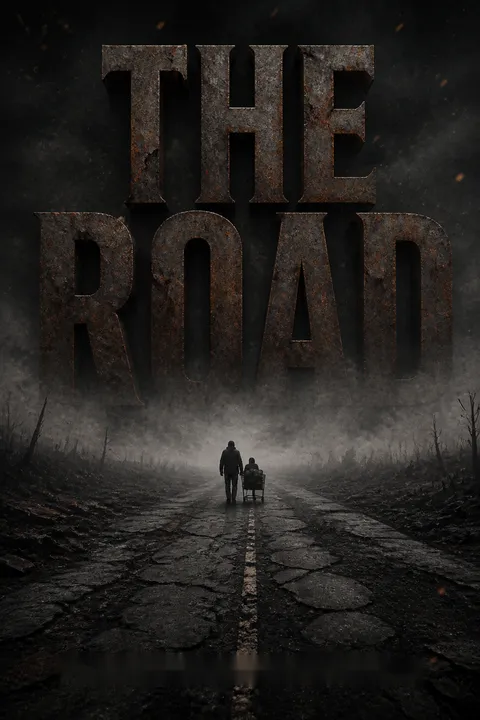
The father and his young son travel south through a country buried in ash, pushing a grocery cart loaded with their few supplies. The father checks the road behind them in a small mirror and keeps a pistol within reach; his son stays close, asking when the cold will end.
At a ruined gas station, the father finds a little motor oil to fuel their lamp, then remembers his childhood home as they pass its stripped rooms. He gives the boy a rare Coca-Cola scavenged from a machine, sharing a taste of a vanished ordinary life. Their destination is the coast, where the father hopes the weather may be kinder, though he has no proof that anything there can still be saved.
The journey begins not with a plan grounded in evidence, but with the father’s refusal to let his son become expendable. South is less a destination than a structure for hope: a direction that gives their days sequence and effort. The boy’s questions expose how little the father can promise, while small acts such as sharing the soda give care a material form. Their cart is both sheltering storehouse and burden, a portable fragment of domestic life dragged across a landscape where nearly every institution has vanished.
Winter on the Pass
The father repairs the cart’s damaged wheel in a roadside garage while sleet drives across the mountains, then keeps them moving through snow and blackened forest. They find a preserved ham and eat a meal rich enough to briefly quiet their hunger. At a waterfall, the father lets the boy swim in the icy pool, and they discover edible morels nearby, turning the place into a rare refuge.
It cannot last: the father worries that other travelers may find them, and the season is worsening. As they press toward the mountain pass, they cross a bridge and find a truck trailer filled with dead people. The boy sees the father’s discovery, and their brief peace gives way to renewed vigilance.
The passage shows survival as skilled attention rather than triumph. The father can mend a wheel, identify mushrooms, and make warmth from scattered fuel, but none of these competencies alters the larger collapse. The waterfall matters because the boy experiences pleasure without first earning it through danger; the father allows that moment, then insists they leave. Their discovery in the trailer makes the cost of stopping visible. In this world, beauty and horror occupy neighboring ground, and the father’s task is to teach his son how to encounter both without surrendering to either.
The Burned Stranger
After a wildfire crosses the road, the father and boy encounter a badly burned man who can no longer walk safely. The boy begs his father to help, but the father refuses because they have too little food and no means to treat the injuries. He later apologizes, yet the boy’s silence makes clear that explanation has not repaired the hurt.
The encounter opens onto the father’s memories of the boy’s mother. After the catastrophe, she gave birth to their son, then rejected the father’s insistence that they could survive and left, choosing death rather than waiting for capture or violence. The father has since made protecting the child his reason to live, even as the boy questions the limits of that protection.
The burned traveler turns an abstract moral code into a decision with a body attached. The father’s refusal is practical, but the boy experiences it as a breach in the promise that goodness means helping the vulnerable. The mother’s remembered choice complicates the father’s certainty: she sees survival as prolonged exposure to horrors, while he treats continued care as an obligation that can outlast hope. Neither position is simple cowardice or courage. The child inherits the tension between them, learning that moral identity is tested most sharply when kindness carries an immediate cost.
The Road Gang
A group of armed road travelers approaches with a truck, and the father hides the cart and takes the boy into the woods. One man wanders close while separated from the others. The father questions him about the truck and the group’s supplies, but the stranger grabs the boy and presses a knife to his throat.
The father shoots him at close range, then carries the stunned child away before the rest of the gang can find them. They spend a freezing night moving through the woods, with little food and only one blanket. When the father later finds the cart plundered and the gang’s discarded remains, the boy must face what his father has done and what the armed travelers might have done to them.
The shooting is a point of no return because the father’s violence is no longer hypothetical defense. He acts decisively to keep his son alive, but the boy must carry the image of a man killed at arm’s length. The father’s protection therefore produces both safety and injury: it preserves the child’s body while making the moral world harder to interpret. His later insistence that they remain good cannot erase the necessity of the shot. It becomes a demanding practice, not a claim of innocence.
A Boy Left Behind
In a ruined town, the boy hears a dog and is relieved when his father promises not to harm it, but the animal soon disappears. Later he sees another child near a house and runs after him; the father finds no one and pulls his son away, afraid that the search will expose them. The boy keeps asking whether the unseen child has anyone to protect him.
Soon they hide as a large armed procession passes, driving enslaved people and carrying women and children among its followers. The father identifies the marchers as dangerous, and they wait until the road is clear. The boy’s concern for strangers does not fade. It becomes a measure of the distance between his instinct to help and his father’s fear of being found.
The missing dog and possibly glimpsed child turn the boy’s moral attention outward, beyond the compact world his father has built around him. That attention is not naïveté alone: he understands danger, yet refuses to treat every unknown person as disposable. The armed procession confirms the father’s suspicion that human communities can organize cruelty as efficiently as isolated raiders. The boy responds by asking who has been left unprotected. His insistence unsettles the father because it asks him to measure survival not only by whether his own child lives, but by what kind of person that child is becoming.
The House of Captives
Snow and hunger drive the pair to a grand, abandoned house where the father finds a locked hatch in the pantry. Beneath it, naked captives hide in a cellar, including a man whose legs have been cut off. Before the father can help them, armed residents approach the house. He and the boy flee through the woods, leaving the prisoners behind and hearing their cries from a distance.
The boy is terrified, and the father gives him the revolver while warning him that capture could mean death. They travel on through deep snow, lose the cart, and struggle to keep warm. The father’s search for food and shelter has brought them close to becoming victims themselves, but escaping does not lessen what they saw.
The locked cellar reveals the logic beneath the landscape’s scattered violence: people are not merely dying from scarcity, but are being converted into provisions. The father’s decision to flee saves the boy, yet abandons captives whose predicament resembles the boy’s worst fear. There is no clean rescue available, only a rapid calculation made under threat. By placing the gun in his son’s hands, the father passes along responsibility before the child is ready to carry it. The scene strips away any comforting distinction between a dangerous world and a safe moral position within it.
Water Beneath the Farm
After escaping the house, the father reaches a farm and searches its barn, finding a few seeds and several apples hidden among the dead orchard trees. His more important discovery lies beneath the farmhouse: a covered cistern filled with clean water. He carries apples and jars of water back to the boy, who has been sleeping in the woods, and they eat and drink until they can move again.
The cache gives them enough strength to resume the road, but it cannot make the farm safe or permanent. They take what they can carry and leave. As hunger returns, the father keeps searching buildings and yards, knowing that each untested door may conceal food, another traveler, or a trap.
The farm offers a rare reversal in which patient observation, rather than force, produces abundance. Apples and water have survived because someone prepared a system for collecting and storing rain, turning ordinary infrastructure into an unexpected gift. Yet the father does not confuse relief with security. Their departure shows how scarcity shapes even gratitude: they must carry away what they can and surrender the place that provided it. The boy’s trust in the father’s discoveries grows alongside a more troubling lesson, that survival often depends on taking from a home whose owners can no longer speak for themselves.
The Bunker’s Stores
Near collapse from hunger, the father notices a concealed door beneath the earth beside an abandoned house. He digs it open while the boy warns him that something may be buried there. Below, they find a stocked bunker containing canned food, water, blankets, fuel, and basic supplies. The boy asks whether the dead owners would have wanted them to take it, and his father assures him that the provisions were saved for people in need.
They eat, bathe, put on clean clothes, and sleep safely for several days. The father knows that staying too long risks discovery, so he packs the grocery cart with what they can manage and closes the shelter behind them. The refuge restores their bodies, but not their ability to remain.
The bunker is a material answer to the father’s fear that effort may no longer lead anywhere. Its contents offer more than calories: soap, warmth, clean clothes, and sleep briefly return them to recognizable human routines. The boy’s question about rightful ownership makes the cache an ethical test, not simply a windfall. The father imagines the dead owners as people who would approve of sharing, giving the child a way to accept help without abandoning his principles. But the shelter cannot become a home; safety depends on leaving before its abundance attracts others.
Ely on the Road
On the road, the father and boy meet an elderly wanderer who calls himself Ely, though he admits that it is not his real name. The boy persuades his father to give the man fruit and let him share their fire and food for a night. Ely speaks bleakly about a world without God and refuses to imagine that anything can improve.
The father will not take him along, and in the morning they leave him food before continuing south. Later, the pair find an abandoned train and briefly explore its empty coaches, then keep moving through exhausted towns and dwindling stores. Their destination finally appears: the gray sea, empty of birds and offering no clear sign of rescue.
Ely gives voice to a survival strategy based on reducing attachment: if nothing can be trusted to last, then hope itself can feel like a trap. The boy’s generosity challenges that strategy without pretending to disprove it. The father permits a single night of shared food, a compromise that keeps compassion alive while preserving his responsibility to his son. Ely’s departure leaves no conversion or tidy lesson behind. The sea, when they reach it, continues this refusal of certainty: it fulfills the route they have followed without delivering the refuge they imagined.
The Wrecked Hope
Along the coast, the pair discover a sailboat wrecked in shallow water. The father swims out alone while the boy guards their clothes and pistol on shore. Inside the tilted cabin, he finds usable clothing, tools, rope, gas, food, and a flare pistol. He returns with a load of salvage, and the flare gives the boy a brief sense that they might signal someone beyond the visible horizon.
Soon the boy falls ill with a high fever. The father stays beside him, cools his body, gives him water and medicine, and watches through the night until the fever breaks. As the boy recovers, they prepare to leave the exposed beach, taking only what their cart can carry.
The wreck supplies practical means but cannot restore the social world that produced them. The sextant and flare pistol have become objects whose original functions outlast the systems that made them useful; the flare can brighten darkness, yet cannot guarantee an answering signal. The boy’s fever narrows the father’s entire world to a pulse, a cup of water, and the next breath. His careful nursing shows tenderness as labor, not sentiment. When the boy recovers, their renewed movement carries both the salvaged tools and the knowledge that even a well-stocked refuge can be broken by illness.
The Thief’s Empty Road
While the pair are away from camp, a thief steals their cart, food, blankets, and clothing. The father follows the tracks with the boy, catches the thief on the road, and forces him to surrender every possession, including his clothes and shoes. The boy pleads for his father to spare the starving man.
The father leaves the thief exposed in the cold, then hears his son’s grief and turns back, but the thief has vanished. They leave the man’s clothes where he might find them and continue without knowing whether he will survive. Later, a bowman shoots the father in the leg in a port town. The father wounds the attacker with a flare and stitches his own injury while the boy watches.
The thief episode reverses the earlier road encounter: this time the father has power over a desperate stranger, and the boy insists that helplessness should matter. The father’s punishment reproduces the abandonment he has feared, revealing how easily protection can harden into retaliation. His partial attempt to repair the harm cannot restore the unknown man or settle the boy’s judgment. The later arrow wound compounds the pressure on a father whose body is already failing. The boy is no longer only the person being guarded; he watches, evaluates, and increasingly acts as the conscience of their small household.
The Father’s Last Mile
The father’s cough worsens as the pair travel inland and then back toward the coast, where storms and fallen trees obstruct the road. Their cart becomes impossible to manage, so they carry their remaining supplies in bags. At a crossroads, the father can go no farther.
He urges his son to keep heading south, protect the revolver, and search for decent people, while the boy begs to stay with him. The father dies beneath a makeshift shelter. His son remains beside him for three days, then waits in the road with the pistol when a bearded traveler approaches. The stranger offers to take him to his family, including a boy and a girl around his age.
The father’s final instruction transfers the burden of judgment to the boy, but it cannot transfer certainty. His death ends the protective arrangement that has organized the child’s life and leaves the boy to decide whether a stranger’s offer is safer than solitude. The pistol remains in his hand, a tool inherited together with the fear that made it necessary. The father’s promise that his son can continue speaking to him becomes a psychological bridge between dependence and autonomy. Grief does not disappear; it becomes something the child must carry while choosing his next step.
A Stranger’s Family
The traveler explains that his family has children and that they do not eat people. The boy asks whether the stranger is among the good people his father taught him to seek, but receives no proof beyond the man’s assurance and the presence of a wife and children. After covering his father’s body with a blanket and saying goodbye, the boy goes with the family.
Their woman welcomes him and speaks with him about God. The boy finds it easier to keep talking inwardly to his father, and she accepts that comfort. The book closes with the memory of trout in mountain streams, a precise image of a living world that cannot be restored, but can still be remembered by those who survived it.
The ending does not verify the stranger’s goodness through a dramatic test. The boy makes a measured risk from the clues available: a family, children, and a promise that they do not prey on others. His choice marks a new form of agency, neither blind trust nor the father’s near-total suspicion. The woman allows his bond with his father to persist rather than demanding that grief be replaced by faith. The trout image returns the story to vanished abundance, preserving beauty as memory rather than offering nature as a repaired world.
Analysis
The Road places its central moral question inside an intimate relationship: how can a parent keep a child alive without teaching him that other people are only threats? The father’s caution is not irrational. He encounters organized cannibalism, enslavement, armed groups, and a man who steals the family’s last supplies. Yet the boy repeatedly notices what caution leaves outside its frame: the burned traveler, the missing child, Ely, and even the thief. Their conflict is therefore not between naïveté and wisdom, but between two forms of knowledge. The father knows how violence works; the boy keeps asking what that knowledge is allowed to excuse.
The ash-covered landscape intensifies this question by removing ordinary structures of meaning. Roads remain after governments, commerce, and community have failed. A map can still indicate direction but cannot promise a destination. Food caches, tools, and fuel preserve traces of preparation by people who are now gone, making survival depend on taking from a vanished social world. Even the bunker, the closest the pair come to abundance, cannot restore a durable home. Its safety is temporary because possession attracts risk and because the father cannot know who may come next.
Care is rendered as repeated physical work: repairing a wheel, sharing scarce food, warming the boy’s feet, tending his fever, cleaning him after violence. These acts are more persuasive than the father’s assurances because they give love a cost and a body. But the boy’s compassion also exposes the limits of care when it stops at the family boundary. The father’s refusal to help some strangers may preserve his son, while the son’s objections preserve a moral horizon beyond mere survival.
The ending offers no proof that the world is recovering. Instead, the boy accepts a calculated risk and enters a family whose goodness he cannot verify in advance. That choice completes his development without resolving the danger. Memory, grief, and the possibility of trust become what he carries forward, fragile inheritances in a world that has destroyed nearly everything else.
Review Summary
The Road is a post-apocalyptic novel that deeply affects readers with its bleak, haunting atmosphere and sparse prose. The story follows a father and son traversing a desolate landscape, facing moral dilemmas and struggles for survival. Many praise McCarthy's minimalist style and poetic language, while some find it pretentious. The book's exploration of love, hope, and humanity in the face of overwhelming despair resonates strongly with most readers, though some find it overly depressing. Overall, it's widely regarded as a powerful, thought-provoking work of literature.
People Also Read




Characters
The father
A guarded protectorAn unnamed father who measures each day by what it takes to keep his son alive. He is practical, watchful, and capable of frightening violence, but his rules are not simply about defeating threats; he wants the boy to remain kind in a world that rewards suspicion. Memories of his wife and the lost world reveal a man who carries grief privately and distrusts consolation. His recurring cough and exhaustion make his authority fragile, even as he continues to repair equipment, find food, and teach the boy. His deepest conflict is that protecting the child sometimes requires choices that contradict the generosity he hopes to preserve in him.
The boy
A stubborn conscienceThe father’s young son has never known the former world as a lived reality, yet he inherits its stories and the burden of deciding what remains good. He is frightened by darkness, hunger, and violence, but repeatedly notices people and animals his father would rather avoid. His compassion is active: he asks to help strangers, gives food to Ely, and challenges his father when punishment becomes cruel. He also depends deeply on his father’s reassurance, making his gradual growth less a triumph over fear than a willingness to act while afraid. The boy’s questions test the rules that keep them alive and give those rules their moral purpose.
The mother
The absent motherThe boy’s mother appears through the father’s memories of the catastrophe and their life afterward. She sees the dangers around them with ruthless clarity and does not share the father’s belief that continued survival is necessarily worth its cost. Her absence shapes both his devotion to the boy and his fear of failing him. She is not merely a lost source of comfort: her judgment remains an unresolved challenge to the father’s optimism and to the survival ethic he teaches.
Ely
A road-worn skepticAn elderly traveler who admits that Ely is not his real name. He survives by moving alone and keeping his identity guarded, wary of what other people might do with knowledge of him. His outlook is shaped by prolonged exposure to scarcity: he doubts God, rejects easy hope, and regards the end of the world as something no one could truly prepare for. The boy’s kindness unsettles his isolation, while the father remains cautious about bringing him closer.
The traveler with a family
A possible new guardianA scarred, armed traveler who approaches the boy after the father is gone. He offers the boy a place with his wife and children and claims that his family does not eat people. The boy has no independent way to verify him, so the man represents the difficult possibility of trust rather than guaranteed safety. His practical manner and willingness to wait while the boy says goodbye make him the first opening toward a life beyond the road.
The thief
A desperate takerA starving, injured man who steals the father and boy’s cart and supplies while they are away from camp. His theft places the family in immediate danger and provokes a harsh response from the father. When confronted, he appears less like a powerful villain than another ruined person trying to survive, which is why the boy insists that he deserves mercy.
The boy’s new guardian’s wife
A welcoming motherThe traveler’s wife welcomes the boy into the family and speaks with him about God. She does not insist that he abandon his private bond with his father, allowing his grief and new companionship to coexist. Her calm acceptance offers a gentler kind of care than the road has allowed.
Plot Devices
The grocery cart
Carries their fragile worldThe cart stores the food, blankets, tools, and small comforts that allow the father and boy to keep moving. Its weight slows them down and its noisy, exposed presence makes concealment difficult, but abandoning it can mean losing everything they have gathered. The father repairs its wheel, covers it when they hide, and continually recalculates what can fit inside. Its changing condition tracks their fortunes: it serves as a mobile household, becomes a target for theft, and eventually proves impossible to take through the coastal wreckage. The cart makes survival visible as both labor and dependence on material things.
The revolver
Last defense, final burdenThe revolver protects the pair from armed travelers and gives the father a final means of resisting capture. Its ammunition is scarce, so every threat forces him to weigh the possibility of using it against the danger of attracting others. He teaches the boy how to handle it and, at the worst moments, places it in his hands. The weapon changes meaning as responsibility shifts: it begins as the father’s tool of protection, becomes a source of terror for the boy, and remains with him when he must face a stranger alone. Its limited rounds make the cost of security impossible to ignore.
The hidden bunker
A temporary reprieveThe bunker is a concealed reserve of canned food, water, fuel, bedding, and basic household supplies beneath an abandoned property. The father finds it only after hunger and exhaustion have narrowed their options, and the cache gives them a brief chance to eat, bathe, sleep, and wear clean clothes. The boy’s question about whether they may take the dead owners’ provisions turns the discovery into a test of their ethics as well as their luck. The shelter cannot become permanent: the father worries that someone may find it and loads the cart for departure. Its abundance interrupts the road’s deprivation without undoing it.
The road maps
Keep south in viewThe father uses a battered, fragmented map to give their journey a route when familiar geography and public institutions have ceased to function. He and the boy assemble the loose pages, mark their location, and estimate how far remains to the coast. The map cannot tell them whether food, people, or safety lie ahead, and their estimates are often wrong. Still, it lets the boy imagine a destination and gives the father a practical reason to keep moving. Its usefulness is therefore partly geographic and partly emotional: it turns an immeasurable wasteland into a line they can follow.
The flare pistol
Light without rescueThe father salvages the flare pistol from the stranded sailboat, along with several flares. The boy imagines using it to signal distant people, though neither knows whether anyone could see or answer. Later, the father fires it to defend them from a bowman, and the flare becomes a weapon as well as a beacon. Its bright arc briefly makes the dark visible, but it cannot summon a dependable community. The device concentrates the book’s uneasy distinction between being seen and being saved: a signal can announce their presence, yet may attract danger as readily as help.
FAQ
Synopsis & Basic Details
What is The Road about?
- Post-apocalyptic survival journey: The Road follows a father and son as they travel through a devastated, ashen landscape, struggling to survive and reach the coast.
- Focus on human connection: The core of the story is the intense bond between the father and son, their love and commitment to each other in the face of extreme adversity.
- Exploration of morality: The novel examines the characters' moral choices and the challenges of maintaining humanity in a world where civilization has collapsed.
Why should I read The Road?
- Powerful emotional impact: The Road is a deeply moving story that explores themes of love, loss, and the will to survive, leaving a lasting emotional impression.
- Unique post-apocalyptic vision: Cormac McCarthy's stark and brutal depiction of a world after an unnamed cataclysm is both haunting and thought-provoking.
- Philosophical depth: The novel raises profound questions about the nature of good and evil, the meaning of life, and the importance of human connection in the face of despair.
What is the background of The Road?
- Unspecified cataclysmic event: The novel does not explicitly state the cause of the apocalypse, leaving the reader to imagine the nature of the disaster.
- Environmental devastation: The world is depicted as a barren wasteland, with ash-filled skies, dead trees, and a lack of resources, reflecting a profound ecological collapse.
- Social breakdown: The collapse of society has led to widespread violence, cannibalism, and the loss of moral order, highlighting the fragility of civilization.
What are the most memorable quotes in The Road?
- "We're carrying the fire.": This recurring phrase encapsulates the theme of preserving humanity and hope in a desolate world, representing the father and son's inner light.
- "If he is not the word of God God never spoke.": This quote reveals the father's profound belief in his son's significance, viewing him as a divine warrant and the reason for his own survival.
- "You have to carry the fire.": This line, spoken by the father to the son, emphasizes the passing of responsibility and the continuation of hope and goodness in the face of despair.
What writing style, narrative choices, and literary techniques does Cormac McCarthy use?
- Sparse and minimalist prose: McCarthy's writing is characterized by its lack of punctuation, simple sentence structures, and avoidance of flowery language, creating a stark and direct tone.
- Focus on sensory details: The narrative emphasizes the characters' physical experiences, using vivid descriptions of the desolate landscape and the harsh conditions they endure.
- Limited omniscient point of view: The story is told from the father's perspective, but with occasional glimpses into the boy's thoughts and feelings, creating a sense of intimacy and emotional depth.
Hidden Details & Subtle Connections
What are some minor details that add significant meaning?
- The Coca-Cola can: The discovery of a single can of Coca-Cola becomes a symbol of a lost world and a rare moment of shared joy and nostalgia between the father and son.
- The morels: The finding of morel mushrooms represents a small victory and a reminder of the natural world's resilience, offering a brief respite from their constant struggle.
- The boy's book: The boy's book, though rarely read, symbolizes the importance of stories and the preservation of culture and knowledge in a world that has lost its past.
What are some subtle foreshadowing and callbacks?
- The father's dreams: The father's recurring dreams of a creature with "eyes dead white and sightless as the eggs of spiders" foreshadow the dangers and inhumanity they will encounter on their journey.
- The mention of the bloodcults: The reference to "bloodcults" consuming one another foreshadows the cannibalistic groups they will later encounter, highlighting the depths of human depravity.
- The mother's obsidian: The mention of the mother's obsidian foreshadows her suicide and the father's knowledge of how to use it, highlighting the theme of self-destruction.
What are some unexpected character connections?
- The old man, Ely: The encounter with the old man, Ely, reveals a shared understanding of the bleakness of their world and the futility of hope, creating a brief but profound connection.
- The thief: The encounter with the thief, though violent, highlights the shared desperation and moral compromises that define the characters' existence, creating a dark mirror of their own struggles.
- The family at the end: The family that takes in the boy at the end represents a continuation of the "fire" and a connection to a future that the father could not reach, offering a sense of hope and continuity.
Who are the most significant supporting characters?
- The old man, Ely: Ely serves as a philosophical foil to the father, embodying a nihilistic view of the world and challenging the father's belief in the importance of carrying the fire.
- The thief: The thief represents the moral decay and desperation that pervades the post-apocalyptic world, forcing the father to confront the harsh realities of survival.
- The family at the end: The family represents the possibility of hope and the continuation of humanity, offering a sense of closure and a new beginning for the boy.
Psychological, Emotional, & Relational Analysis
What are some unspoken motivations of the characters?
- The father's fear of losing his son: The father's actions are driven by an overwhelming fear of losing his son, which motivates his constant vigilance and his willingness to make difficult moral choices.
- The boy's desire for connection: The boy's compassion and empathy stem from a deep desire for human connection and a longing for a world where kindness and goodness still exist.
- The father's guilt over the mother's death: The father's actions are also influenced by his guilt over the mother's suicide, which fuels his determination to protect his son and ensure his survival.
What psychological complexities do the characters exhibit?
- The father's internal conflict: The father struggles with the moral compromises he must make to survive, torn between his desire to protect his son and his own sense of right and wrong.
- The boy's emotional resilience: Despite the horrors he witnesses, the boy maintains a sense of innocence and compassion, demonstrating a remarkable capacity for emotional resilience.
- The father's detachment: The father's emotional detachment is a coping mechanism to deal with the trauma and loss he has experienced, but it also creates a distance between him and the world.
What are the major emotional turning points?
- The discovery of the bunker: The discovery of the bunker filled with supplies offers a brief moment of hope and relief, but also highlights the fragility of their existence and the constant threat of loss.
- The boy's illness: The boy's illness forces the father to confront his own mortality and the possibility of losing his son, leading to a profound sense of fear and desperation.
- The father's death: The father's death marks the end of their shared journey and the beginning of the boy's new life, highlighting the themes of loss, grief, and the continuation of hope.
How do relationship dynamics evolve?
- The father's increasing vulnerability: As the father's health deteriorates, he becomes more vulnerable and dependent on the boy, highlighting the shifting power dynamics in their relationship.
- The boy's growing independence: The boy's increasing understanding of the world and his own moral compass leads to a growing sense of independence, preparing him for life without his father.
- The deepening bond: Despite the challenges they face, the bond between the father and son deepens, becoming a source of strength and resilience in their desolate world.
Interpretation & Debate
Which parts of the story remain ambiguous or open-ended?
- The cause of the apocalypse: The novel never explicitly states the cause of the cataclysm, leaving the reader to speculate about the nature of the disaster and its implications.
- The nature of the "good guys": The identity and motivations of the "good guys" are left ambiguous, raising questions about the possibility of redemption and the nature of hope in a post-apocalyptic world.
- The boy's future: The boy's future with the new family is left open-ended, leaving the reader to imagine the challenges and possibilities that lie ahead for him.
What are some debatable, controversial scenes or moments in The Road?
- The father's decision to leave the thief naked: The father's decision to leave the thief naked and exposed to the elements raises questions about the limits of compassion and the moral compromises necessary for survival.
- The father's willingness to kill: The father's willingness to kill to protect his son raises questions about the nature of violence and the justification of extreme measures in a desperate situation.
- The ending: The ending, with the boy finding a new family, is open to interpretation, with some readers finding it hopeful and others finding it too simplistic or sentimental.
The Road Ending Explained: How It Ends & What It Means
- The father's death: The father's death is a culmination of his failing health and the harsh conditions of their journey, marking the end of his role as the boy's protector.
- The boy's new beginning: The boy's discovery by a new family represents a continuation of the "fire" and the possibility of hope in a world that has lost its way, suggesting that humanity can endure even in the face of devastation.
- The legacy of love and compassion: The ending emphasizes the enduring power of love and compassion, highlighting the importance of carrying these values forward even in the darkest of times, as the boy carries the fire.
About the Author
Other books by Cormac McCarthy

Download PDF
Download EPUB
.epub digital book format is ideal for reading ebooks on phones, tablets, and e-readers.








