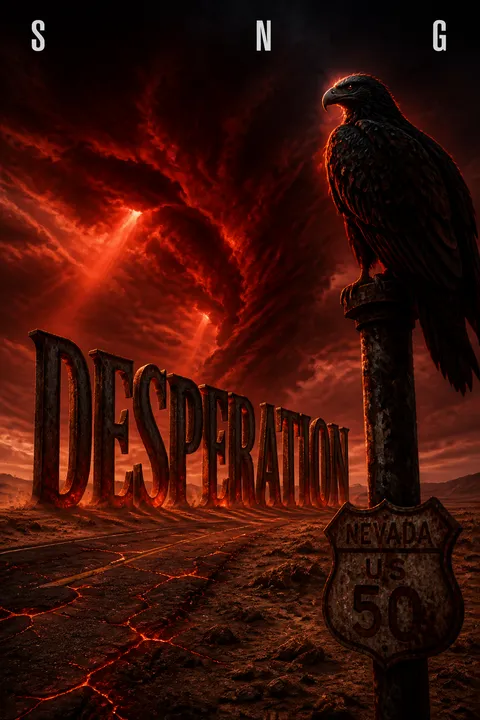


Plot Summary
A Cat on Highway 50
Driving their sister's Acura across Nevada, Peter11 and Mary Jackson3 spot a dead cat nailed to a speed-limit sign, then watch a huge local officer7 pull them over. He cites a missing rear plate, which he says was stolen during their stop in Fallon. When Peter11 opens the trunk to find tools for moving the front plate, the officer7 discovers a large bag of marijuana hidden beneath the spare tire.
He takes the couple's keys and arrests them, ignoring their explanation that the car belongs to Peter's sister, Deirdre.17 The cruiser carries them toward Desperation, past a stranded RV and a child's abandoned doll. At the municipal building, the officer7 ushers Mary3 inside, embraces Peter,11 and shoots him dead.
The stop turns ordinary vulnerabilities into instruments of capture: a borrowed car, a missing plate, and a careless stash become enough to make the Jacksons legible as suspects. The officer's calm procedural manner is more frightening than an immediate display of force because Peter keeps trying to restore a familiar social contract through explanations. His killing makes plain that the legal process is only camouflage. The dead cat and deserted RV are not atmospheric ornaments; they are early evidence that violence has already spread beyond the road, while the doll makes the danger intimate before Mary understands whose child it belonged to.
The Carvers Enter Desperation
Elsewhere on Highway 50, Ralph Carver's5 RV hits a strip of nail-studded mesh and loses every tire. The same officer7 warns Ralph5 that an armed attacker may be nearby, hustles Ralph,5 his wife Ellen,10 and children David1 and Kirsten12 into his cruiser, and leaves Kirsten's12 doll behind.
The apparent rescue ends at the municipal building, where the officer7 shoves Kirsten12 down the stairs and punches Ellen10 aside. When Mary3 is forced into the holding area, she sees Ralph5 bloodied, David1 and the white-haired veterinarian Tom Billingsley9 imprisoned, and Kirsten12 dead at the foot of the stairs.
The officer's7 casual treatment of the child exposes the RV rescue as another step in his campaign. Mary3 grabs a desk shotgun, but the officer7 ducks and batters her into submission.
Ralph's protective instincts are made tragically inadequate by a situation he cannot interpret. The cop uses a credible warning about a rifleman to make compliance seem like care, then converts the family's trust into confinement. Kirsten's death is the first unmistakable rupture of the Carvers' family world, and Ralph's inability to prevent it becomes a source of guilt that later complicates every decision about David. Mary responds with force rather than deference, but the empty shotgun and the officer's strength show that courage alone cannot defeat an opponent who controls the setting and its rules.
Soap, Bars, and Faith
David's1 resolve has roots in the previous fall, when his friend Brian Ross13 fell into a coma after a drunk driver struck him. David1 visited Brian,13 prayed alone in a tree platform they had built, and later learned Brian13 had unexpectedly awakened.
In the jail, that experience gives David1 a reason to pray even as his mother doubts him and the officer7 taunts his faith. David1 secretly takes a shotgun shell from the floor, then uses Irish Spring soap to grease himself and squeeze between the cell bars.
His head sticks fast until he turns it and pushes through sideways. A coyote guards the room, so Johnny Marinville2 distracts it with his leather jacket while David1 forces his way out. David1 reaches the town office and takes the dead chief's cell key and revolver.
David's faith begins not as certainty but as a response to an experience he cannot explain and grief he cannot contain. The earlier miracle matters because it gives his present prayer a history, while the shell hidden in his pocket keeps belief grounded in practical action. His escape literalizes the tension between spiritual trust and bodily vulnerability: soap, careful positioning, and Johnny's improvised diversion matter as much as prayer. David is not a supernatural action hero. He is a frightened child choosing to act while afraid, and that distinction gives his faith moral weight rather than magical convenience.
The Writer's Stolen Road
John Edward Marinville,2 a once celebrated novelist trying to rebuild his career and sobriety, is crossing the desert on his Harley to gather material for essays. A giant deputy7 stops him after he steps away from the road, first acting like an awestruck reader and discussing Marinville's2 proposed book.
While Marinville2 is distracted, the officer7 slips a bag of marijuana into his saddlebag, then accuses him of possession and beats him when he objects. The deputy7 takes the Harley, buries it in sand, and drives Marinville2 toward Desperation.
Bruised and terrified in the cruiser, Marinville2 uses a cellular phone to call his assistant, Steve Ames.4 Static breaks the connection, but Steve4 hears enough to know that his boss is in danger somewhere west of Ely.
Marinville's professional reinvention is already shadowed by his fear that reputation has replaced genuine life. The deputy exploits that insecurity by briefly appearing to offer recognition, then turns admiration into a trap. The planted drugs echo the Jacksons' hidden bag, suggesting that the crime is not the cause of arrest but a pretext fitted to each victim. Marinville's call is a small but consequential act of resistance: his public persona cannot protect him, yet the practical device he once regarded as a nuisance gives Steve a direction to follow.
The Mining Office Dead
Steve Ames4 drives west in a rental truck with Cynthia Smith,6 a wary hitchhiker headed toward Bakersfield, after Marinville's2 broken call. They find the abandoned Carver5 RV, then uncover the Harley half buried in the desert, confirming that the deputy7 reached their boss.
At Desperation Mining Corporation, they find fourteen workers hanging from hooks, one victim's severed hand preserved in an aquarium. A recorded message repeats unfamiliar religious terms, and a crude stone carving of a wolf with a snake for a tongue seems to disturb their thoughts when they touch it.
The office contains no help and no working phone. The dead staff, the mutilated hand, and the carving turn Steve's4 search from a rescue mission into evidence of a townwide catastrophe.
The mining office makes violence materially undeniable. The aquarium hand is not a symbol in the abstract; it is a severed body part placed among living fish, a collision of ordinary work and grotesque display. The stone carving introduces another kind of threat, one that acts through desire and mental disturbance rather than direct attack. Steve and Cynthia's discovery also changes their relationship: each has become a witness to what the other cannot safely dismiss. Their bond grows from mutual usefulness into trust under pressure, while the missing phone leaves them dependent on observation and judgment.
The Town Turns Hostile
Trying to reach a telephone, Steve4 and Cynthia6 enter Desperation as wind drives sand through the streets. A house lit from within contains two dead parents, their baby, and rattlesnakes crawling among the dinner dishes; Steve4 carries Cynthia6 out when fear leaves her unable to move. Back in the truck, they find house trailers dragged across the road.
Buzzards dive at the windshield while scorpions and snakes gather underneath, forcing Steve4 to reverse rather than escape. At a gas station, spiders and a rat threaten him as he searches for a place to hide the vehicle. A frightened geologist, Audrey Wyler,8 emerges from a laundromat and says the deputy7 has been hunting residents. She leads Steve4 and Cynthia6 toward the old theater.
The town's threats are designed to close every ordinary route of escape. Roads are physically blocked, phones fail, and even a lit house offers only the illusion of shelter. Cynthia's paralysis before the snakes recalls her history of being harmed by men, but here the danger exceeds human intention and makes her dependent on Steve without reducing her to helplessness. The animals behave less like a collection of natural hazards than a coordinated perimeter. Audrey's appearance offers human testimony and a route to others, yet her fear also establishes how thoroughly the deputy has dismantled the town's capacity for collective resistance.
The Coyote at the Door
David1 reaches the municipal offices, finds the dead town safety officer, and takes his revolver and magnetic cell key. He returns to the holding area while a coyote blocks the door. With Mary3 and the others under their bunks, David1 opens the door and fires twice as the animal leaps. It knocks him down, but the shots have mortally wounded it; David1 fires once more at close range to end its attack.
He uses the magnetic key to free Ralph,5 Mary,3 Johnny,2 and Billingsley.9 The group takes rifles, a shotgun, ammunition, and flashlights from the municipal offices, then shelters in the abandoned American West theater. David1 has not simply escaped for himself: by returning, he turns a room of captives into a group capable of acting together.
The coyote encounter tests David's faith at the point where it cannot be confused with invulnerability. He must expose himself to the animal, fire a gun he has never used, and then make the painful choice to kill it. The sequence makes agency collective: Mary distracts the coyote, Johnny holds it off, and David takes the risk that frees everyone. His father's fear is understandable, but David's competence forces Ralph to begin seeing his son as a person with judgment of his own. The theater becomes a temporary community built through mutual risk, not merely a place to hide.
A Theater Full of Shadows
At the theater, the survivors reunite with Steve4 and Cynthia,6 then hear Audrey8 describe the deputy's7 killings across town. Tom Billingsley,9 a retired veterinarian and former local official, explains the legend of Chinese miners buried alive in the China Shaft after a nineteenth-century cave-in.
He admits the story may be distorted but confirms that the mine has long frightened residents. While he searches the men's room, a cougar attacks him. Ralph5 fires, Steve4 wrestles with the animal, and Johnny2 kills it with Mary's3 shotgun.
Billingsley9 dies after identifying a troubling inconsistency in Audrey's8 clothes: she had worn a business dress that now fit her differently, as though she had grown taller. Before the group can investigate, Mary3 hears Ellen Carver10 outside the theater.
The theater offers a fragile refuge where stories can be compared, but the accounts do not yet form a stable explanation. Billingsley's local legend is both unreliable and indispensable: its errors conceal a real history of exploitation and burial. His final observation shifts suspicion from the deputy's known violence to Audrey, whose apparent growth echoes the officer's transformation. The cougar attack makes the group's shelter porous, while Billingsley's death removes the one person who could translate the town's local knowledge. The survivors must now act with incomplete evidence, a recurring condition that tests whether they can trust one another without pretending to certainty.
Two Women Taken
The voice outside the theater belongs to Ellen,10 who claims the deputy7 has died and asks Mary3 to help her inside. Mary3 opens the window, and the thing wearing Ellen's10 body seizes her, knocks her unconscious, and carries her toward the mine.
Elsewhere in the theater, Audrey8 corners David1 in the projection booth and chokes him while firing the revolver he recovered. Steve,4 Ralph,5 and Johnny2 rush in and pull her away. Audrey's8 skin and body begin to decay after Cynthia6 kicks the stone carvings from her reach; she crawls onto the theater balcony, which collapses beneath her.
David1 lies unconscious, and Mary3 is missing. Their apparent victory leaves the group more exposed, since the enemy can use familiar faces and exploit the survivors' desire to rescue one another.
The two attacks expose different forms of intimacy weaponized by the threat. Mary is captured because she recognizes Ellen's voice and chooses compassion over suspicion; Audrey reaches David through the disguise of an ordinary colleague and the force of a carved object. Neither failure means kindness or trust is foolish, but the scenes show that moral instincts become dangerous when an enemy can imitate their familiar cues. Audrey's decay after losing the carvings suggests that power is mediated through objects rather than simply residing in a violent personality. The collapsing balcony converts the theater's refuge into rubble just as David loses consciousness.
David's Deadland Lesson
While unconscious, David1 walks through a dreamlike version of Ohio, where he sees his dead sister,12 his mother, and Reverend Gene Martin,14 the minister who taught him to study scripture. A mysterious man in a Yankees cap questions him about faith, cruelty, and the purpose of his life, then shows him Desperation and the China Pit from above.
David1 learns that the old shaft has been reopened and that a force called Tak is trapped beyond it. He returns to consciousness in Steve's4 truck, bruised and hoarse. He tells the group that Ellen10 is dead but Mary3 is alive in the pit, and insists they must go there rather than flee. The vision deepens his grief without resolving his anger at a God who allowed his family to suffer.
David's vision does not soothe grief; it makes grief intellectually harder to evade. The dead appear as loved individuals rather than consoling abstractions, and the questioning guide refuses to let faith become a simple bargain for protection. David's belief remains entangled with anger at God's cruelty, which keeps his religious commitment from becoming an easy explanation for loss. His decision to return for Mary follows from this unsettled conviction: faith means accepting responsibility without receiving guarantees. The vision also supplies concrete geography, linking the reopened mine to the threat and giving the survivors a destination that is both spiritual test and physical danger.
The First Vessel
David1 tells the others that the local legend confuses the truth about the China Shaft. In 1859, miners broke into a chamber filled with animal carvings and a narrow, funnel-shaped well.
Contact with the carvings drove some men mad, while brothers Ch'an and Shih Lushan18 tried to seal the passage by bringing down the mine roof. Decades later, Cary Ripton,15 the modern pit foreman, found the chamber, killed his crew, and drew Brad Josephson16 to the mine before transferring Tak into Josephson16 through a breath-sealed kiss.
Tak then used Josephson16 and later Collie Entragian7 as increasingly powerful bodies. Hearing this history, Johnny2 refuses David's1 call to return to the pit and walks away, convinced that survival matters more than a dangerous religious mission.
The origin story reveals that Desperation's catastrophe repeats an older structure of racial exploitation and concealed violence. The miners' deaths were not an unfortunate accident but the consequence of owners treating Chinese workers as expendable, while later generations reshape that crime into folklore. Tak's movement from body to body makes human strength a temporary resource, but the original chamber and its artifacts remain the source of its reach. Johnny's refusal follows a different logic: after decades of treating his life as material for a public persona, he fears a death with no meaning. David's account forces the group to confront both supernatural danger and the ordinary human cruelty that made the mine's history possible.
A Wallet Calls Johnny Back
After Johnny2 leaves, David1 finds the writer's2 wallet and recognizes a photograph of a younger Johnny in Vietnam, standing outside a bar called the Viet Cong Lookout. The image matches the man who guided David1 through the Land of the Dead, and the song remembered from that meeting confirms the connection. Johnny,2 meanwhile, reaches the mining office, where Tak sends a timberwolf at him.
He kills it by throwing a hammer between its eyes. David1 arrives with the wallet and tells him what the photograph means. Johnny's2 memories of Vietnam, his destructive marriage, and his own spiritual deadness break through his defenses. He stops fleeing, accepts that he must help, and rejoins David,1 choosing a responsibility he had just rejected.
The photograph makes memory a bridge between apparently incompatible states: Johnny's ordinary past and David's visionary experience. It does not persuade Johnny through doctrine; it identifies him, exposing the distance between the man he remembers being and the life he has chosen to inhabit. His sudden return is therefore less a conversion to certainty than a recovery of responsibility. Killing the wolf shows that he can still act under pressure, but the deeper change comes when he recognizes that escape would repeat a long pattern of abandoning other people and calling the retreat self-preservation.
Mary Escapes the Pit
Tak imprisons Mary3 in the mining field office among dead workers, snakes, spiders, and scorpions. A voice in her mind tells her the creatures cannot harm her, and Mary3 tests that claim before forcing open a hole behind a dryer and crawling out across the corpses. She disables the deputy's7 cruiser and punctures the tires of two pickups, then climbs from the pit on foot.
Tak pursues her in Ellen's10 failing body, but Mary3 reaches the rim and escapes downhill. Tak transfers itself into a golden eagle and waits in the old shaft. The survivors arrive to close the mine and find Mary,3 but the eagle attacks David1 in the tunnel. Ralph5 throws himself over his son and takes the bird's talons to his face and throat.
Mary's escape is a decisive shift from survival by chance to survival through tested judgment. She does not accept the voice's reassurance blindly; she watches the creatures, finds they retreat, and uses that evidence to move. Her choice to disable the vehicles protects the group even while she is isolated. Tak's transfer into the eagle shows its adaptability, but the attack also makes its dependence on vulnerable bodies visible. Ralph's sacrifice reverses his earlier helplessness at Kirsten's death: he cannot prevent all loss, yet he can choose to place his body between David and danger.
The Well Takes Johnny
Steve4 and Johnny2 struggle with the eagle while Mary3 twists its neck and kills it. Ralph5 lies dead, and David,1 believing he alone must enter the chamber, fights Steve4 as Johnny2 holds him back.
Johnny2 takes David's1 shotgun shell from his pocket, leaves the school pass he had carried, and orders Steve4 to get the survivors out. Wearing a motorcycle helmet, Johnny2 enters the chamber and reaches the funnel-shaped ini, where Tak offers to heal him and grant success. Johnny2 refuses.
He tears open two bags of ANFO, pours the explosive pellets into the narrow throat, and places the shotgun shell on top as a primer. As Tak attacks and Johnny's2 wounds worsen, he strikes the shell with his hammer. A flash erupts from the well, sealing Tak's passage and killing Johnny.2
Johnny's final act joins the novel's material and spiritual plots without making either one disappear. ANFO, a shotgun shell, and a hammer accomplish what belief alone cannot; the work is technical, improvised, and brutally physical. Yet Johnny's refusal of Tak's promises is also a rejection of the old bargain in which success, sex, and reputation could compensate for moral emptiness. He prevents David from mistaking martyrdom for duty by taking the task himself. His death remains cruel, not triumphant, and that cost keeps the resolution from presenting sacrifice as a tidy answer to the family's losses.
An Excused Return
Steve4 drives the surviving group out as the China Pit collapses behind them, sending a vast cloud of dust into the sunrise. Desperation is left buried under sand, glass, dead animals, and broken signs. Mary3 recovers Deirdre's17 Acura and chooses to travel with David,1 while Steve4 and Cynthia6 take the rental truck.
The survivors agree to tell authorities only how the deputy7 detained them and how they escaped, leaving the larger horror unexplained. Before departing, David1 discovers a blue school pass in the pocket where Johnny2 took his shell.
Johnny2 has returned the pass David1 once left on the tree platform after praying for Brian.13 His handwritten message points to the biblical connection between God and love. David1 grieves, then prays as the cars head toward Austin.
The ending returns to the school pass that began David's spiritual life, but its meaning has changed. First it was an offering made by a child who hoped to save his friend; now it is evidence that Johnny understood the cost of the choice he made and chose to leave David a sign rather than a doctrine. The survivors' cover story recognizes that testimony has limits: they can report facts, but not expect institutions to accept an account of Tak. David's grief remains intact, yet prayer is no longer simply a request for rescue. It is a way of continuing after the people who sustained him are gone.
Analysis
Desperation organizes horror around the failure of ordinary explanations, but it does not treat explanation itself as useless. The travelers repeatedly interpret events through familiar systems: traffic law, police procedure, mining history, medical knowledge, religious language. Each system offers partial truth and then breaks under pressure. The planted drugs expose law as a tool that can be staged; the mine legend preserves a history of racialized sacrifice while distorting its particulars; Audrey's8 scientific skepticism is reasonable but insufficient to describe what she experiences. The novel's supernatural force is therefore not a replacement for human responsibility. Tak can exploit greed, isolation, and curiosity, but the mine's original atrocity was already human-made.
David's faith supplies the story's moral center precisely because it remains unsettled. He does not interpret his sister's12 death as a fair price for Brian's13 recovery, nor does prayer make him immune to grief. His belief asks him to act without certainty and to resist the temptation to claim a miracle as personal achievement. Johnny2 offers a counterpoint: a man who has repeatedly made a performance out of experience must decide whether he can stop narrating himself long enough to serve other people. His eventual choice matters because it costs him the future he had been trying to reclaim, not because the text makes sacrifice pleasant or inevitable.
The novel also distinguishes survival from restoration. The survivors escape, but they cannot recover Peter,11 Kirsten,12 Ralph,5 or the town they knew. Their cover story acknowledges the limits of public credibility, while David's1 final prayer acknowledges that grief will continue beyond the immediate emergency. The returning school pass does not erase the deaths; it gives David1 a way to carry forward the promise that began with Brian.13 The book's bleakest insight is that goodness cannot guarantee safety. Its more demanding hope is that people can still choose care, truth, and responsibility when safety has already failed.
Review Summary
Desperation by Stephen King is a horror novel that polarizes readers. Many praise its intense atmosphere, compelling characters, and gripping plot centered around a supernatural evil in a small Nevada town. The religious themes and gore are divisive elements. Some find the ending disappointing compared to the strong start. Readers appreciate King's skillful writing and ability to create tension, though some criticize the pacing and character development in the latter half. Overall, it's considered a solid King novel, if not his best work.
People Also Read




Characters
David Carver
The grieving young believerEleven-year-old David is the quiet, observant son of Ralph5 and Ellen10 and the older brother of Kirsten12. His friendship with Brian Ross13 and his response to Brian's13 coma draw him toward scripture and prayer, though his faith is not simple certainty. David thinks carefully, notices details adults overlook, and often responds to fear by asking what action is required. He is also recognizably a child: he grieves, resents unfairness, and wants his parents to protect him. His defining tension is between an unusually strong sense of obligation and the ordinary limits of a young person asked to carry more than he understands.
John Edward Marinville
The stranded literary lionMarinville is a celebrated novelist whose fame has outlasted his confidence in his own work. After years of drinking, drug use, and damaged relationships, he sets out on a motorcycle hoping to make a serious book from encounters across America. He is funny, vain, sexually opportunistic, and capable of cruelty, particularly when his pride feels threatened. Beneath the performance is a practiced noticer, a man whose memory and intelligence can serve others when he stops turning every crisis into a story about himself. His struggle is not simply to recover his reputation, but to decide whether he can again accept responsibility without controlling how the world remembers him.
Mary Jackson
The shaken poet and survivorMary is a New York poet traveling with her husband, Peter11, and is alert to the oddness of the Nevada landscape before she can name its danger. She is compassionate without being meek: when the deputy7 threatens strangers, she fights back, questions authority, and keeps looking for practical ways to help. Her recent miscarriage and her life with Peter11 give her a private history of grief that shapes how she notices other people's losses. Mary can be frightened, angry, and generous in quick succession. Her survival depends not on becoming fearless but on continuing to act while fear and grief remain present.
Steve Ames
The roadie who staysSteve is a Texas road manager whose working life has taught him to plan routes, solve equipment problems, and read volatile personalities. He takes his responsibility for Marinville2 seriously, even while recognizing the writer's2 vanity and risk-taking. His choice to pick up Cynthia6 reveals a humane streak that sits comfortably beside his practical caution. Steve is not a theologian or a hero by self-image; he relies on observation, loyalty, humor, and a willingness to keep moving when plans fail. His growing bond with Cynthia6 gives him a personal stake in the people he is trying to protect.
Ralph Carver
The frightened protective fatherRalph is an Ohio postal worker and father who has brought his family west for a vacation built partly around his love of gambling. He is affectionate and funny, but his tendency to manage fear with jokes and reassurances leaves him unprepared for the crisis that overtakes his family. Ralph loves Ellen10 and their children deeply, and his terror often comes from knowing he cannot shield them from every danger. He is neither a coward nor an uncomplicated patriarch. His central struggle is to remain present for David1 after grief and guilt threaten to make him withdraw.
Cynthia Smith
The wary hitchhikerCynthia is a young woman with brightly dyed hair, a sharp tongue, and a history of escaping abusive men and rebuilding her life through a women's shelter. Her careful questions before accepting Steve's4 ride show hard-earned caution, while her humor makes connection possible without pretending the past has vanished. She reads danger through both instinct and experience, and she is willing to confront Steve4 when his curiosity becomes reckless. Cynthia's independence does not prevent her from accepting help; she chooses trust as a risk, not as a default.
Collie Entragian
Desperation's imposing deputyEntragian is the huge local deputy whose size, uniform, and unhurried manners initially suggest dependable authority. He knows the roads and residents of Desperation and can sound genial even when his attention makes people uneasy. The gap between his public role and the menace others sense around him gives the early encounters their particular dread. He is a local official in a small, isolated town, where the badge grants him unusual access to residents and travelers.
Audrey Wyler
The mine's consulting geologistAudrey is a geologist working for the mining company, more comfortable with technical problems and fieldwork than with small-town social life. She is intelligent, skeptical, and proud of her professional competence, especially when environmental criticism seems to ignore the practical pressures of mining. Her scientific habits make her reluctant to accept explanations that cannot be tested, even as she describes events that strain ordinary categories. Audrey's confidence and isolation shape how she responds when the town's familiar routines collapse.
Tom Billingsley
The town's failing veterinarianTom is a retired veterinarian and former local official who knows Desperation's people, institutions, and mining legends. He keeps a private refuge in the abandoned theater with old friends, drawings, liquor, and memories of the town he once helped govern. His knowledge is valuable but imperfect; he repeats the stories as he heard them and admits where memory fails. Tom's alcoholism has narrowed his life, yet he retains flashes of tenderness, humor, and hard-won local insight.
Ellen Carver
The Carver family anchorEllen is Ralph's5 wife and the mother of David1 and Kirsten12. She is practical, socially engaged, and accustomed to keeping family life moving through ordinary rituals, from vacation planning to meals and school concerns. Her response to danger is shaped by fierce attachment to her children and a refusal to treat David's1 spiritual life as self-explanatory. She and Ralph5 do not always agree about how to protect their son, but both are trying to meet the family's needs with limited understanding.
Peter Jackson
Mary's thoughtful husbandPeter is an assistant professor of English making the cross-country drive with Mary3. He tends to explain unfamiliar places through observation and jokes, while his concern for his wife surfaces in small gestures. He is thoughtful but not especially prepared for a landscape where normal assumptions about law and safety fail. His relationship with Mary3 is affectionate and lived-in, marked by the ordinary teasing and shared travel decisions of a couple who know each other well.
Kirsten Carver
The family's bright youngestKirsten, whom her family calls Pie, is Ralph5 and Ellen's10 seven-year-old daughter and David's1 younger sister. She is playful, imaginative, and deeply attached to her doll, Melissa Sweetheart. Her small observations and games reveal how children make sense of adult tension without fully understanding it. Kirsten's presence gives David's1 protectiveness a concrete, affectionate shape, and her easy closeness with her brother helps show the family life that exists before the Nevada trip becomes a nightmare.
Brian Ross
David's closest childhood friendBrian is David's1 best friend, a boy who shares his games, comics, baseball cards, and private jokes. Their friendship is built from small acts of making and imagining, including a bottlecap model and a tree platform they call their lookout. Brian's serious accident becomes the event that prompts David1 to seek religious answers, but Brian himself is more than a plot catalyst: he represents the intimate, everyday bonds that make David's1 questions about life and death urgent.
Reverend Gene Martin
David's flawed spiritual guideGene Martin is a young Methodist minister who takes David's1 questions seriously and helps him approach the Bible as a guide to spiritual life. He is thoughtful, engaging, and imperfect, with private habits that complicate the authority he offers the boy. Gene encourages David1 to develop his own relationship with faith rather than merely repeat religious language. His willingness to discuss cruelty, doubt, and conscience gives David1 a vocabulary for experiences that the boy's parents find difficult to understand.
Cary Ripton
The pit foremanRipton is the foreman overseeing work at the reopened China Pit. He is frustrated by his stalled ambitions and resents the regulations and officials he believes obstruct mining. His curiosity about the newly exposed shaft competes with a clear awareness of the safety rules and personal risks involved. Ripton's bitterness and sense of being undervalued make him vulnerable to choices that promise a sudden escape from the disappointments of his life.
Brad Josephson
The mine's observant receptionistBrad works at the mining office and is known locally for his appetite, his interest in birds, and his easy familiarity with the town's routines. He brings cameras to the site when he hears the old shaft has been uncovered, combining enthusiasm for photography with genuine curiosity about local history.
Deirdre Finney
Peter's absent sisterDeirdre is Peter's11 younger sister, a former Reed College student whose car he and Mary3 are driving back east. Her history of drug use and disorganization creates a practical problem for the travelers, while her absence means the couple must explain decisions and belongings that are not their own.
Ch'an and Shih Lushan
The brothers at the mineCh'an and Shih are Chinese miners working the original China Shaft in the nineteenth century. Their brotherly loyalty and ability to act under pressure distinguish them from the men drawn toward the chamber. Their part in the mine's history survives through a local legend that confuses important details.
Plot Devices
Can tah carvings
Corruption made portableThe small, ancient stone carvings depict animals and hybrid creatures, including wolves, spiders, snakes, and rats. They are scattered through the mine and carried into town, where contact can disturb judgment, intensify destructive impulses, and make people vulnerable to Tak. The carvings also act as a material link between the sealed chamber and the outside world. Their effect is not identical in every person, which keeps the threat difficult to predict. When a person under their influence loses access to the carvings, the resulting physical collapse can be catastrophic.
The China Shaft and ini
A prison with a narrow throatThe China Shaft is the buried nineteenth-century mine reopened by modern blasting. At its end lies an underground chamber containing the ini, a funnel-shaped well whose tiny lower opening confines Tak while allowing a smoky, malign force to reach outward. The old mine's unstable rock, carved walls, and history of deliberate burial make the site both a physical hazard and the story's central supernatural geography. The final plan depends on sealing the passage again, this time using the mine's available explosive material rather than relying on the old collapse alone.
David's faith and free will
Belief without guaranteesDavid's faith develops after Brian's13 accident and the boy's unexpected recovery. His prayer is neither a reliable power nor a simple contract: he believes he has been called to act, yet he struggles with the cruelty of a God who does not prevent his family's suffering. Reverend Martin's14 teaching gives him language for conscience, scripture, and free will, but David1 must make choices without certainty that God will intervene. This framework drives the survivors toward the mine while preserving their ability to refuse. The story tests belief through decisions and consequences, not through proof that suffering is deserved or easily explained.
The animal network
Tak's eyes and handsCoyotes, wolves, birds, snakes, spiders, rats, and other animals gather around the supernatural force and serve as its messengers, guards, and extensions. Their presence can reveal that danger is near before a human sees it, as when coyotes watch the streets or a cougar is sent into the theater. The animals are not simply trained pets; their behavior suggests a shared influence that can coordinate them and sometimes let Tak perceive through them. Their deaths and departures mark changes in Tak's power, while individual survivors occasionally resist or evade its control.
The pass and photograph
Memory becomes a summonsTwo ordinary objects connect David's1 private spiritual history to the people he meets in Desperation. A Vietnam photograph in Marinville's2 wallet identifies the guide David1 saw in his vision as the writer's2 younger self, forcing Johnny2 to confront the life he has emotionally abandoned. David's1 school pass, left on a tree platform after he prayed for Brian13, later returns with a handwritten message from Johnny2. Together the objects turn recognition into action and give David1 a final sign after the losses at the mine. Their significance comes from their humble origins, not from supernatural power inherent in the objects.
FAQ
0. Synopsis & Basic Details
What is Desperation about?
- A Desert Nightmare Unfolds: Desperation plunges a diverse group of travelers into a remote Nevada mining town where they are brutally captured by Collie Entragian, a monstrously oversized and increasingly deranged sheriff, who is merely a vessel for an ancient, malevolent entity known as Tak.
- Struggle Against Ancient Evil: The narrative follows the survivors—including a cynical novelist, a grieving family, a resourceful road manager, and a streetwise hitchhiker—as they uncover the true nature of Tak, an entity awakened by mining operations in the China Pit, and fight for their lives against its escalating supernatural influence.
- Faith, Sacrifice, and Survival: At its core, the story explores themes of faith, free will, and sacrifice, particularly through the eyes of an eleven-year-old boy, David Carver, whose profound spiritual connection becomes the group's unlikely guide in their desperate struggle to contain Tak and escape the cursed town.
Why should I read Desperation?
- Intense Psychological Horror: Readers seeking a deep dive into the psychological toll of extreme terror will find King's exploration of fear, grief, and the breakdown of sanity compelling, as characters grapple with both human and supernatural evil.
- Rich Thematic Depth: Beyond the visceral horror, the novel offers a profound meditation on faith, the nature of God's cruelty and love, and the cyclical patterns of human greed and violence, inviting readers to ponder complex philosophical questions.
- Masterful Character Arcs: Witness the remarkable transformations of characters like Johnny Marinville, a jaded writer finding unexpected redemption, and David Carver, an ordinary boy thrust into the role of a reluctant prophet, making their struggles deeply resonant and emotionally impactful.
What is the background of Desperation?
- Isolated Mining Town Setting: The story is set in the fictional, desolate mining town of Desperation, Nevada, a place steeped in the history of gold and silver mining, particularly the "China Pit" (Rattlesnake Number One), which serves as the ancient prison for the entity Tak.
- Historical Exploitation Echoes: The narrative draws on the brutal history of Chinese miners in the 19th century, who were exploited and buried alive in the China Shaft, creating a historical backdrop of human cruelty and suffering that foreshadows Tak's reawakening and its cyclical nature of violence.
- Geographical and Cultural Isolation: The remote, harsh desert landscape of central Nevada, often referred to as "The Loneliest Highway in America," emphasizes the characters' isolation and vulnerability, while the town's sparse, insular culture contributes to the sense of being cut off from conventional help and understanding.
What are the most memorable quotes in Desperation?
- "God is cruel.": David Carver's stark, repeated declaration, often delivered with a child's innocent yet profound conviction, encapsulates a central theological debate of the novel, challenging conventional notions of divine benevolence in the face of immense suffering.
- "Sometimes he makes us live.": Johnny Marinville's chilling realization, delivered to David in the China Shaft, redefines cruelty not as death, but as the forced continuation of life in the face of unbearable trauma, highlighting the profound psychological impact of survival.
- "In these silences something may rise.": This cryptic graffiti, found spray-painted on the wall of the Town Office, serves as a potent thematic motif, foreshadowing the emergence of Tak and the ancient evils that stir in the quiet, forgotten corners of the world.
What writing style, narrative choices, and literary techniques does Stephen King use?
- Visceral and Unflinching Detail: King employs a highly descriptive and often grotesque style, immersing the reader in the physical and psychological horrors through vivid sensory details, such as the stench of decay, the sight of mutilated bodies, and the internal monologues of terrified characters.
- Interweaving Perspectives and Internal Monologue: The narrative structure frequently shifts between multiple third-person perspectives, offering deep insight into each character's thoughts, fears, and coping mechanisms, often blurring the line between external reality and internal delusion, particularly with Johnny Marinville's self-aware, cynical inner voice.
- Biblical Allusion and Genre Subversion: King extensively uses biblical allusions (e.g., Daniel in the lions' den, the Angel of Death, Job) to frame the supernatural conflict, while simultaneously subverting traditional horror tropes by presenting a God who is both a source of salvation and a force of refining cruelty, challenging reader expectations.
1. Hidden Details & Subtle Connections
What are some minor details that add significant meaning?
- The "Zone of Perception": Peter Jackson's early musing about the desert being "outside your zone of perception" (Chapter 1) subtly foreshadows the supernatural events that defy rational understanding, suggesting that the characters are entering a reality beyond their comprehension.
- The "Mr. Smiley-Smile" Stickers: Deirdre Finney's yellow smile stickers, found on the bag of marijuana and later on the stone can tah, initially represent her carefree, drug-addled personality but become a chilling symbol of Tak's insidious, mocking presence, turning innocence into an emblem of corruption.
- The "Reek-reek-reek" Weathervane: The monotonous squeaking of the leprechaun weathervane on Bud's Suds (Chapter 1, Chapter 2) acts as a recurring auditory motif, symbolizing the town's stagnant, repetitive nature and the inescapable, almost mechanical, presence of evil.
What are some subtle foreshadowing and callbacks?
- Johnny's Vietnam Flashbacks: Marinville's recurring thoughts of Vietnam, particularly the "kozmic Vietnam blues" and the "immaculate good cheer" of soldiers doing terrible things (Part III, Chapter 3), subtly foreshadow the extreme violence and detached cruelty he will witness and participate in, linking the horrors of war to Tak's influence.
- The "House of the Wolf, the House of the Scorpion": The epigraph to Part I, "HIGHWAY 50: IN THE HOUSE OF THE WOLF, THE HOUSE OF THE SCORPION," directly foreshadows the animalistic manifestations of Tak's power, particularly the wolf and scorpion totems, and the predatory nature of the evil awaiting the travelers.
- Billingsley's "Drunkfish": Tom Billingsley's admission of drawing "drunkfish" on the ladies' room wall (Part III, Chapter 2) subtly foreshadows his own drunken state and eventual demise, while also hinting at the warped, hallucinatory reality that Tak imposes on the town.
What are some unexpected character connections?
- Johnny Marinville as David's "Dream-Guide": David's vision of Johnny as his spiritual guide in the "Land of the Dead" (Part IV, Chapter 5), singing "The Rascals" song that was playing when Johnny "died" (stopped changing), creates an unexpected, profound bond between the cynical writer and the young prophet, transcending their initial antagonistic relationship.
- Ellen Carver's Yeast Infection: The seemingly mundane detail of Ellen's yeast infection (Part IV, Chapter 1) is revealed as the "domino" that allowed Tak to possess her, highlighting the insidious and opportunistic nature of the entity, which exploits even minor human vulnerabilities.
- Billingsley's Horse and Audrey's Legs: Billingsley's memory of treating Audrey Wyler's horse, Sally, and his later appreciation of Audrey's legs (Part III, Chapter 2, Part III, Chapter 4) creates a subtle, almost voyeuristic connection between the old vet and the geologist, hinting at the underlying human desires and weaknesses that Tak preys upon.
Who are the most significant supporting characters?
- Tom Billingsley, the Historian-Witness: The old veterinarian, Tom Billingsley, is crucial not only for his knowledge of Desperation's dark history and the China Pit legend but also as a moral compass, whose struggle with alcoholism and eventual sacrifice underscore the human cost of confronting evil.
- Audrey Wyler, the Corrupted Scientist: Audrey, the geologist, initially represents rationalism and scientific skepticism, but her gradual corruption by Tak and her grotesque transformation serve as a chilling demonstration of the entity's power to twist and destroy human identity, highlighting the fragility of reason against supernatural forces.
- Steve Ames and Cynthia Smith, the Pragmatic Protectors: Steve and Cynthia, Johnny's road manager and the hitchhiker, provide essential logistical support, emotional grounding, and a sense of enduring humanity amidst the chaos, acting as loyal companions and protectors, particularly for David.
2. Psychological, Emotional, & Relational Analysis
What are some unspoken motivations of the characters?
- Johnny's Quest for Redemption: Beneath his cynical facade and pursuit of a new book, Johnny Marinville is driven by an unspoken desire for personal and literary redemption, seeking to atone for past failures and find meaning in a life he perceives as increasingly hollow. His "Achilles' heel" for stories (Part IV, Chapter 2) reveals his deep-seated need for narrative and purpose.
- Ralph's Guilt and Desperation: Ralph Carver's fierce protectiveness of David and his desperate attempts to escape are fueled by profound guilt over Kirsten's death and Ellen's possession, believing his gambling and vacation choices led to their family's tragedy. His internal struggle is a silent battle against self-blame.
- Mary's Survival Instinct and Grief: Mary Jackson's initial focus on survival and her later acts of defiance are underpinned by a deep, unspoken grief for Peter, which she channels into a fierce determination to protect David and confront Tak, finding strength in her loss rather than succumbing to it.
What psychological complexities do the characters exhibit?
- Johnny's Self-Loathing and Denial: Johnny Marinville constantly battles self-loathing, using humor and cynicism as defense mechanisms. His internal monologues reveal a man deeply aware of his flaws ("literary Elvis Presley," "asshole") but struggling to overcome them, culminating in a profound crisis of identity when confronted by Tak's truth.
- David's Burden of Prophecy: David Carver exhibits the psychological strain of being a child prophet, grappling with visions and divine messages that are both terrifying and empowering. His "God is cruel" mantra reflects his struggle to reconcile suffering with faith, showcasing the immense burden placed on his young mind.
- Audrey's Rationality vs. Corruption: Audrey Wyler's scientific mind initially resists the supernatural, but her gradual possession by Tak reveals the terrifying vulnerability of human intellect to overwhelming evil. Her transformation highlights the psychological horror of losing one's self and becoming a puppet for an alien will.
What are the major emotional turning points?
- David's Prayer for Brian: David's desperate prayer for his friend Brian's recovery (Part I, Chapter 4), and its miraculous answer, marks his initial emotional turning point, solidifying his faith and setting him on a path of spiritual connection that will later guide the survivors.
- Johnny's Confrontation with "Terry": Johnny's hallucination of his ex-wife, Terry, on the wall of the lab (Part IV, Chapter 3), who confronts him about his "giving up real life completely," serves as a critical emotional reckoning, forcing him to acknowledge his denial and re-engage with his purpose.
- Mary's Act of Defiance in the Pit: Mary's decision to disable Entragian's cruiser and sabotage the mining equipment (Part IV, Chapter 2), despite her terror and physical pain, represents a powerful emotional turning point, transforming her from a victim into an active agent of resistance against Tak.
How do relationship dynamics evolve?
- David and Johnny's Unlikely Mentorship: The relationship between David and Johnny evolves from initial skepticism and irritation to a profound, almost spiritual, mentorship, with David guiding Johnny towards faith and Johnny finding a protective, paternal role, culminating in Johnny's sacrifice for the boy.
- Steve and Cynthia's Developing Trust: Steve and Cynthia's relationship blossoms from a pragmatic hitchhiker-driver dynamic into one of deep trust and mutual support, their shared trauma forging a bond that provides moments of humanity and levity amidst the horror.
- The Survivors as a "Collie Entragian Survival Society": The disparate group of survivors, initially strangers, coalesce into a makeshift family, bound by their shared ordeal and collective purpose. Their individual strengths and weaknesses interlock, demonstrating the power of unity against an overwhelming evil.
4. Interpretation & Debate
Which parts of the story remain ambiguous or open-ended?
- The Nature of Tak's Origin: While David explains Tak as an "ancient one, the unformed heart" (Part IV, Chapter 4) from a place "not on earth at all," its ultimate origin and true form remain largely ambiguous, leaving readers to ponder whether it's a demon, an alien entity, or a primordial force of entropy.
- The Extent of God's Intervention: The novel leaves open to interpretation the precise nature and extent of God's direct intervention. While David experiences visions and answered prayers, the suffering and sacrifices (e.g., Kirsten, Ralph) raise questions about divine cruelty and the limits of free will, making God's role a complex, debatable element.
- The Future of Desperation and Tak: Despite Tak being sealed in the China Pit, Johnny's question about the mining company potentially reopening the shaft (Part V, Chapter 2) and David's response ("That's not our problem—that's God's problem") leaves the long-term fate of Desperation and the potential for Tak's return open-ended, suggesting a cyclical nature of evil.
What are some debatable, controversial scenes or moments in Desperation?
- The Murder of Kirsten Carver: The brutal, casual murder of seven-year-old Kirsten Carver by Entragian (Part I, Chapter 2) is a highly controversial scene, shocking readers with its graphic violence against a child and immediately establishing the novel's unflinching depiction of evil.
- Johnny Marinville's "Suck My Cock" Scene: Entragian's demand for Johnny to perform oral sex (Part I, Chapter 4) is a deeply disturbing and controversial moment, pushing boundaries of sexual violence and humiliation, and serving as a catalyst for Johnny's internal defiance rather than his submission.
- David's "God is Cruel" Theology: David's repeated assertion that "God is cruel" (Part II, Chapter 2, Part IV, Chapter 4) is a controversial theological stance within the narrative, challenging traditional religious comfort and forcing characters (and readers) to confront the problem of evil in a world supposedly governed by a benevolent deity.
Desperation Ending Explained: How It Ends & What It Means
- Johnny's Sacrifice and Tak's Containment: The Desperation ending explained reveals Johnny Marinville's ultimate sacrifice, as he descends into the China Shaft, the "ini" or "well of the worlds," and uses ANFO explosives and a shotgun shell to seal Tak's physical manifestation within the earth, dying in a "bloom of brilliant, soundless red." This act contains Tak, but does not destroy it, emphasizing the cyclical nature of evil.
- David's "Excused Early" Pass and God's Love: As the survivors escape, David finds his "Excused Early" pass, which Johnny had taken from him and left in his pocket. On it, Johnny has scrawled "God is love" (Part V, Chapter 5). This final message, delivered by the cynical writer, offers a profound counterpoint to David's "God is cruel" theology, suggesting that love and grace can emerge even from the deepest despair.
- The Price of Survival and Lingering Scars: The survivors are left traumatized and forever changed, agreeing to fabricate a story for the authorities to cover up the supernatural events. The ending signifies that while they escaped physical death, they carry deep emotional and psychological scars. The "Excused Early" pass symbolizes not just David's release from his prophetic burden but also a form of divine forgiveness and a chance for a new beginning, albeit one haunted by memory.
About the Author
Other books by Stephen King




Download PDF
Download EPUB
.epub digital book format is ideal for reading ebooks on phones, tablets, and e-readers.








