
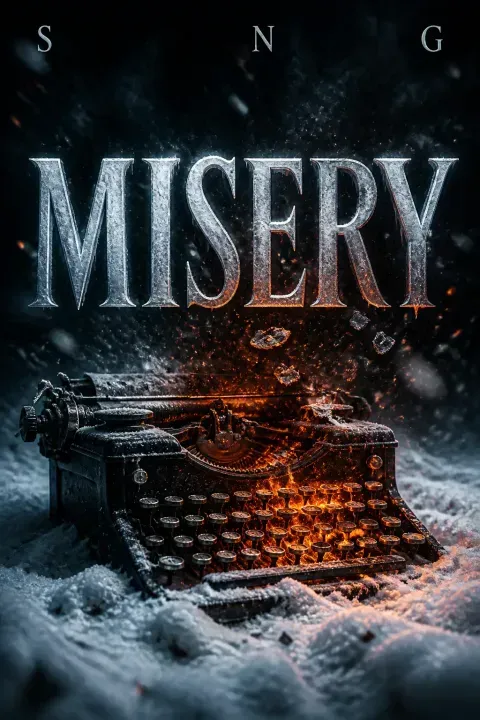


Plot Summary
Prologue
Sounds drift through the pain-haze: umber whunnnn, fayunnnn. Paul Sheldon1 floats in a storm-cloud of agony, aware only of these meaningless syllables and the rhythmic tides of suffering. A childhood memory surfaces: a barnacled piling at Revere Beach, visible only at low tide. The pain, he dimly understands, is like that piling: always there, sometimes hidden, never gone.
He does not know his name or where he is. He does not know he wishes he were dead. But the pilings are real, and they are his own legs, shattered in a car accident he cannot yet remember. Before the haze, there was only darkness. Now there are sounds, a woman's voice,2 and the bitter taste of capsules pushed between his lips. The tide will go out again. It always does.
The prologue establishes the novel's central metaphor: pain as tidal, consciousness as partial, identity as something that must be reconstructed. Paul's childhood memory of the piling, something permanent beneath temporary concealment, foreshadows both his survival instinct and the novel's structure of recurring crisis. The fragmented sensory impressions place the reader inside Paul's traumatized perspective, creating immediate identification with his helplessness. The phrase 'he does not know he wishes he were dead' introduces the book's exploration of suffering that exceeds the capacity to process it. The woman's voice and bitter capsules hint at the presence that will dominate the entire narrative: Annie Wilkes, already administering both relief and control.
Your Number-One Fan
Paul1 surfaces from the fog to find a large, solid woman sitting by his bed in Sidewinder, Colorado. Her name is Annie Wilkes.2 When he croaks that she must be his number-one fan, she smiles. She found his wrecked Camaro during a blizzard, dragged him to her remote farmhouse, and set his shattered legs with aluminum crutch splints.
A former nurse, she fed him intravenously while he was unconscious. She has told no one he is here. Paul1 notices she wears no wedding ring. He notices how she sometimes goes blank, her eyes becoming painted stones.
She has read all his Misery novels multiple times. And he notices, with growing dread, that her smile can collapse into something narrow and watchful, like a crevasse opening in a summer meadow. He is in trouble. This woman is not right.
The novel's opening scene establishes its central power dynamic through careful accretion of detail. Annie's nursing background explains her medical competence while her blank episodes signal dangerous dissociation. Her 'number-one fan' identity transforms admiration into ownership. Paul's gradual recognition of his predicament mirrors the reader's own dawning horror: the rescue is actually a capture. The crevasse metaphor suggests hidden depths of instability beneath a surface of maternal care. King introduces the theme that will drive the entire narrative: the relationship between creator and audience, warped here into something predatory and absolute.
Drink the Rinse Water
Paul,1 desperate for his Novril painkillers, accidentally offends Annie2 by suggesting her mother gave bad counsel. She hurls the soup bowl into the corner, screams, then goes blank and catatonic. When she returns, she declares she must clean the mess before he receives his medication.
She scrubs and rinses methodically while Paul1 lies in agony, the tide of pain receding farther than ever. Finally she brings three capsules, but instead of water, she lifts the yellow floor bucket toward his face.
The gray rinse water, filmed with dissolving soap and a floating rag, fills his vision. Paul1 drinks without hesitation, swallowing grit and plaster. He holds it down. He has learned his first lesson: Annie2's punishments are creative, absolute, and escape-proof.
This scene teaches Paul the grammar of his captivity through operant conditioning. Annie's obsessive cleaning ritual reveals how her need for control masks itself as domestic virtue. Making Paul drink from the bucket is a symbolic baptism into submission, an act designed to humiliate as thoroughly as it hurts. Paul's lack of hesitation disgusts him later, marking the beginning of his self-erosion. The episode establishes Annie's unique fusion of maternal tenderness and sadistic cruelty, a combination more terrifying than purely malevolent captivity because it remains unpredictable. Her temper is the weather of Paul's world, and he must learn to read its signs.
Misery Cannot Be Dead
Annie2 enters Paul1's room with her face the color of ashes. She has finished reading Misery's Child, and Misery Chastain, his beloved fictional heroine, died in childbirth on the final pages. Annie2 screams that characters in stories do not simply slip away.
She calls him a dirty bird and a murderer, brandishes a water pitcher at his face, nearly brings it down to kill him, then pivots and smashes it against the door. She tells him God happens to have broken legs and be in her house eating her food.
Then she goes blank, standing motionless while Paul1 realizes he could kill: if she had not thrown the pitcher, he would have shattered it and shoved glass into her throat. She rouses, says she must leave before she does something unwise, and drives away, locking him in.
Annie's reaction reveals her inability to distinguish fiction from reality. Misery Chastain is more real to her than Paul's actual suffering or even her own crimes. Her theological framing casts Paul as a fallen god who must be punished for betraying his own creation. Paul's murderous fantasy marks a psychological turning point: he recognizes his own capacity for violence, a capacity that will become his only path to survival. Annie's departure initiates the first of many abandonments that will test Paul's physical and psychological endurance. The locked door transforms the guest room from recovery space to prison cell.
The Barbecue Pot
After fifty-one hours alone without food, water, or medication, Paul1 is nearly dead when Annie2 returns from her 'Laughing Place.' She has prayed and received an answer. She wheels in a charcoal barbecue grill, then retrieves the manuscript of Fast Cars, the only existing copy of the literary novel Paul1 considers his finest achievement.
When he refuses to burn it, she shows him the Novril sample card. She makes him torch the title page, the first page, the last page, and nine pairs of pages from throughout the manuscript.
Then she places the remainder in the pot. Paul1 drops the match. As charred pages float through the room, one igniting a curtain, Annie2 panics and douses the fire with water. Paul1 thinks one clear thought amid the reek of burned paper: he is going to kill her.
The manuscript burning represents artistic rape, the destruction of Paul's identity as a serious writer. Annie's insistence that Paul must do it 'of his own free will' reveals her pathological need for his complicity in his own destruction. The ritualistic nine pairs of pages demonstrate her magical thinking, while her panic when the fire spreads shows the limits of her control. Most importantly, this scene crystallizes Paul's transformation from passive victim to someone capable of coldly planning murder. The creative death enacted here will eventually be answered by physical death. Paul has learned that survival requires both submission and secret resistance.
The Grinning Royal
Annie2 brings Paul1 a heavy black Royal typewriter with a missing 'n' key, a wheelchair, and a board. She announces he will write Misery's Return, a novel just for her, the single copy she will bind herself.
When he asks if she will release him when it is done, she deflects: he should be 'up to the strain of meeting people' by then. Paul1 knows she is lying, but he also recognizes an opportunity. If he writes well enough, she may not be able to kill him until she discovers how the story ends.
He has become Scheherazade, spinning tales to postpone execution. The typewriter sits on the bureau, grinning at him with its gap-toothed smile. Paul1 hates it. He asks her to turn it toward the wall. The Royal is both weapon and shield, and he must master it.
The typewriter embodies the novel's central paradox: it is simultaneously Paul's prison and his only path to freedom. Its missing 'n' is the first of many absences Paul will endure, both physical and linguistic. Annie's request for a single bound copy reveals her awareness that commercial printing would expose her. Paul's Scheherazade strategy transforms his captivity into a narrative contest: his storytelling ability against her madness. The typewriter's anthropomorphized malevolence, grinning like a young gunslinger, personifies the creative act as mortal combat. King uses the Royal to explore how artistic creation under coercion differs from free creation, and whether the product can transcend its origins.
Fair's Fair
Paul1 writes three pages resurrecting Misery through a simple plot dodge: the doctor arrived in time after all. Annie2 reads them and declares they are not right. She explains through a childhood memory of a Rocket Man serial.
In one episode, the hero was trapped in a car going over a cliff, only to appear the next week having escaped through a door supposedly welded shut. She screamed at the screen, knowing it was a cheat. Paul1's first attempt is the same cheat: Misery's Child clearly stated the doctor never arrived. Paul1 feels shame because Annie2 is right.
That night, half-dreaming about a childhood game called Can You?, he finds the answer: Misery was buried alive. The Evelyn-Hyde girl in the neighboring village suffered the same fate. They were sisters. The story becomes a gothic about premature burial and hidden kinship.
Annie functions as Constant Reader, the ultimate audience whose demands for narrative integrity are primitive but unshakeable. Her distinction between 'realistic' and 'fair' is surprisingly sophisticated for someone who cannot distinguish fiction from reality. Paul's shame at being caught cheating reveals his own artistic conscience is intact despite his circumstances. The 'Can You?' game becomes the novel's controlling metaphor for both writing and survival. When Paul finds the buried-alive solution, he discovers that constraint, even coercive constraint, can produce better art than freedom. The gothic turn the story takes mirrors his own situation: he too is buried alive, clawing toward the surface.
The Dragon Lady's Scrapbook
During Annie2's depressive episode, Paul1 escapes his room and finds a massive scrapbook titled MEMORY LANE. Inside are newspaper clippings spanning her entire life: her father dying in a 'freak fall' down stairs; her college roommate tripping over a poisoned cat on stairs; elderly hospital patients expiring from 'long illness' at every facility where Annie2 worked; infants dying in the Boulder Hospital nursery.
The final clippings detail Annie2's trial for the nursery deaths. She was acquitted but fired. The book also documents Andrew Pomeroy,6 a hitchhiker whose dismembered body was found in a wildlife preserve.
Annie2 has annotated the clippings in her neat hand. Paul1 realizes he is trapped with a serial killer whose body count spans three decades and who has never been convicted of anything.
The scrapbook transforms Annie from a deranged fan into something far more terrifying: a successful predator who has evaded justice for decades. Her collection functions as trophy case, confession, and self-justification. The pattern reveals her methodology: she kills those she categorizes as 'brats,' 'poor poor things,' or those who threaten her control. Paul's discovery seals his fate; Annie will now know he knows. The sequence deepens the novel from captivity thriller into meditation on evil's banality. Annie is not a monster from a horror movie; she is a former nurse who believes she is doing God's work by ending suffering, a logic that makes her more dangerous than any supernatural threat.
The Axe Comes Down
Annie2 returns from her mountain cabin at four in the morning and injects Paul1 with a sedative. She tells him she knows he has been out of his room and has read her scrapbook. She knows about the knife he hid. She speaks of the Kimberly diamond mines where thieves were hobbled to prevent escape.
Then she pulls back the blankets, exposing his twisted legs. She uncaps Betadine and pours it over his left ankle and the axe blade. The first blow severs most of the leg. The second finishes it. Blood jets across the room.
Annie2 lights a propane torch and cauterizes the wound while Paul1 screams. She picks up his severed foot, its toes still twitching, and carries it away, telling him he is now hobbled and it is his own fault. Paul1 passes out mouthing a single word: 'Goddess.'
The hobbling is the novel's most visceral horror, yet it operates on multiple symbolic levels. Annie literally immobilizes Paul as punishment for mobility, but the act is also a grotesque editorial intervention: she is cutting away the parts of him that resist her control. The Betadine and cauterization show her nursing training perverted into ritual torture. Paul's 'Goddess' mantra marks his psychological transformation; he has moved from fear through hatred to a kind of dark worship, his creative mind converting trauma into archetype. The scene borrows from the fairy-tale logic Annie herself employs: punishment must fit the crime, and the crime was independence.
Birthday Cake Surprise
Weeks later, Paul1 complains that the missing 'n' disrupts his rhythm. Soon after, Annie2 enters with a syringe, Betadine, and an electric carving knife. She amputates his left thumb while assuring him in her maternal voice that she loves him.
That night she wheels in a birthday cake studded with candles. Protruding from the frosting center is Paul1's severed thumb, nail slightly ragged from his habit of chewing it when stuck for a word. She tells him he may have cake if he is good, but he will not have to eat the special candle.
Paul1 does not scream. He has learned. The typewriter has begun shedding additional keys: first n, then t, then e. Like Paul1's body, it is being dismantled piece by piece. He keeps writing anyway, filling in missing letters by hand.
The thumbectomy literalizes the novel's central concern: the cost of creation under coercion. Paul's writing hand is mutilated because of his writing (the complaint about the typewriter). The birthday cake is Annie's most deranged gesture, simultaneously nurturing and sadistic, celebrating Paul's continued existence while displaying his dismembered body part as decoration. The typewriter's progressive breakdown mirrors Paul's physical disintegration, yet both continue to function, suggesting that art persists even as the artist is systematically destroyed. Paul's silence during the amputation marks his complete conditioning: he has learned that screams earn no mercy and may provoke worse.
The Lawnboy Execution
A Colorado State Police car pulls into Annie2's driveway. Trooper Duane Kushner,3 young and alone, steps out holding Paul1's photograph. Someone has found Paul1's Camaro. Paul,1 paralyzed by conditioned terror, finally screams and throws an ashtray through the window.
Kushner3 approaches, speaks four words, and then Annie2 appears. She has been mowing the lawn. She charges on the riding mower, wielding a wooden cross that marked a dead cow's grave. She stabs Kushner3 repeatedly in the back, then drives the Lawnboy over his head as he lies helpless on the driveway.
The mower blade clangs against his service pistol. Blood sprays from the grass exhaust. Paul1 vomits beside his wheelchair. Annie2 calmly dismounts, pushes the mower off the body, and begins cleaning up evidence with garbage bags and a garden hose.
Kushner's death is the novel's point of no return. Despite his terror, Paul screams, representing his first active resistance since the hobbling. Annie's choice of weapons, the grave cross and lawnmower, is grotesquely domestic, transforming farm implements into murder weapons. Her calm cleanup afterward demonstrates the compartmentalization that has allowed her to kill for decades without detection. Paul's guilt over causing Kushner's death becomes a weapon Annie uses to control him further. The scene introduces outside law enforcement as a genuine threat to Annie's world, raising the stakes for both captor and captive while demonstrating that rescue attempts carry lethal risk.
David and Goliath
Days later, two investigators arrive: a massive uniformed trooper5 and a small plainclothesman.4 Annie2 leads them through the house, answering questions with rehearsed calm. She says Kushner3 stopped by, showed Paul1's picture, and took a Pepsi before driving west.
The detectives stand in the parlor, then walk down the hall toward Paul1's closed door. He sits frozen, pulse hammering. He could scream. He does not. He later tells Annie2 he wants to finish the book, and this is partly true.
But another truth lurks beneath: months of torture have created a bond as intimate as it is toxic. He needs to be the one who ends her, not see her arrested. The cops leave, but their eyes hold suspicion. They will return. Annie2 knows this. Time is running out for them both.
Paul's silence during the police visit represents the novel's most psychologically complex moment. He has internalized his captivity so deeply that rescue feels like theft. His stated reason, wanting to finish the book, is true but incomplete. Beneath it lies a darker motivation: he has become addicted not just to Novril but to the power of the gotta, the narrative hunger that keeps them both alive. Killing Annie himself would reclaim agency that arrest would deny him. The scene also demonstrates how abuse warps the victim's decision-making, making freedom feel threatening rather than liberating.
Lighter Fluid and Lies
Paul1 writes the final pages of Misery's Return by hand, his right hand swollen and blistered. He types THE END, fills in the missing letters, then sets his trap. Months earlier, he stole a can of charcoal lighter fluid from the cellar and hid it behind a loose baseboard.
Now he retrieves it and soaks a decoy manuscript: blank pages and rejected drafts topped with a real title page. He hides the actual novel under the bed. When Annie2 arrives with a bottle of Dom Pérignon, he tells her he has a trick to show her, one he learned from her.
He strikes a single match, holds it over the soaked paper, and drops it. Blue fire uncoils across the title page. Annie2 shrieks in agony and lunges forward, seizing the burning pile, meaning to run to the bathroom and save her story.
Paul's trap exploits Annie's sole vulnerability: her desperate need for the story. The decoy manuscript inverts the earlier Fast Cars burning; this time Paul weaponizes destruction rather than submitting to it. His use of her own phrase, 'a trick I learned from you,' signals his reclamation of agency. The scene is rich with artistic irony: Paul burns a fake book to save a real one, and Annie's love of fiction becomes the instrument of her death. Months of patient plotting, hiding the lighter fluid behind the baseboard, demonstrate that Paul has been playing a long game, waiting for the right moment to strike.
Eat Your Book
As Annie2 turns with the blazing manuscript, Paul1 lifts the fifty-pound Royal typewriter and brings it crashing down on her back. She slams forward onto the floor, the burning paper beneath her, her sweater catching fire. Paul1 topples from the wheelchair onto her body.
He grabs handfuls of burning and champagne-soaked paper and rams them into her screaming mouth, telling her to eat her book, to suck on it until she chokes. Annie2's face turns purple, her neck swells grotesquely.
She throws him off, staggers upright clawing at her throat, then trips over the typewriter and strikes her head on the mantelpiece. She collapses. Paul1 drags himself into the hallway and slams the door. When he looks back, her bloody fingers are still poking under the door, twitching mindlessly against his shirt.
The climax is a primal inversion of the entire captivity. Paul force-feeds Annie her obsession, making her literally consume the story she demanded. The typewriter, his hated instrument of forced creation, becomes his weapon of liberation. Annie's death by tripping over it is poetically just: the tool of storytelling kills the audience who refused to let the story end. Her fingers still twitching after death suggest that the goddess, like Misery Chastain, might not stay buried. The scene's visceral brutality matches Annie's own violence, making Paul momentarily her equal in savagery. He has become what he had to become to survive.
The Penguin's Message
Paul1 crawls through the dark house, hallucinating Annie2 in every shadow. He reaches the parlor as headlights sweep the driveway. The same two detectives, Wicks4 and McKnight,5 have returned with a search warrant. Paul1 gropes on the knick-knack table, knocking over Annie2's ceramic figurines.
His blistered right hand closes around the penguin sitting on its block of ice. The base reads NOW MY TALE IS TOLD. He hurls it through the parlor window and screams for help. The cops break in and find a man who looks like he spent forty years in solitary confinement.
Annie2 is not in the bedroom. She crawled out the window while Paul1 slept. They find her body in the barn, beside Misery the pig's stall, one hand still wrapped around the chainsaw she intended to use on Paul.1 The tale is told.
The penguin figurine, a kitschy object Annie treasured, becomes Paul's salvation. Its inscription, 'NOW MY TALE IS TOLD,' is the novel's thesis statement: storytelling ends captivity. Annie's death in the barn, chainsaw in hand, confirms she planned to dismember Paul completely had he not acted first. Her location beside the pig named Misery creates a darkly comic tableau: the woman who worshiped Misery Chastain dies next to Misery the sow. Scheherazade has outlasted the sultan. The novel ends not with triumph but with exhaustion; Paul is rescued but fundamentally changed, his body and psyche permanently marked by what he endured.
Epilogue
Nine months later, Paul Sheldon1 lives in a Manhattan apartment, walking with a prosthesis and two canes. Misery's Return is about to be published to massive anticipation. He drinks too much bourbon and cannot write.
His editor wants a nonfiction account of his ordeal, but Paul1 knows he would fictionalize it, unable to resist the 'roundness' that novels demand and life refuses. One afternoon, returning from lunch, he hallucinates Annie2 rising from behind his sofa with a chainsaw. It is only his cross-eyed cat.
Later, staring at his blank word processor, he remembers a kid he saw pushing a shopping cart containing a skunk. Where did a New York City kid get a skunk? Paul1's fingers find the keyboard. He types a sentence about a boy hearing a noise in a deserted tenement. The hole in the paper opens. He weeps as he writes.
The epilogue completes the novel's circular journey from destruction to creation. Paul's hallucinations confirm that Annie is immortal in memory, a permanent resident of his imagination who will never fully depart. His refusal to write the nonfiction account protects the boundary between lived trauma and fictional transmutation; to narrativize his suffering would be to lose control of it. The skunk in the shopping cart is classic King: a small, strange real-world detail that opens the door to story. Paul's tears as he writes are both grief and gratitude. He has lost his foot, his thumb, and years of his life, but he has not lost the hole in the paper. The goddess is dead, but the writer lives.
Analysis
Misery is a novel about the violent entanglement of creation and captivity, a horror story that doubles as a brutal allegory for the writer's relationship with audience. Paul Sheldon,1 a commercially successful novelist who secretly despises the work that made him famous, is literally held hostage by his most devoted reader2 and forced to resurrect the character he killed in an act of artistic liberation. The novel's power lies in its refusal to treat Annie Wilkes2 as simply monstrous. She is insane, but her demands on Paul1 are merely extreme versions of what every audience wants from a beloved storyteller: more of the same, forever, exactly as before. Her critique of his first chapter as a narrative 'cheat' is, on craft grounds, entirely correct. The novel argues that constraint, even coercive constraint, can produce better art than total freedom. Misery's Return, written under threat of mutilation and death, is by Paul1's own admission the best Misery novel he ever produced. The book also functions as a harrowing study of addiction and dependency. Paul1 is chemically leashed to Annie2 through Novril, but more fundamentally leashed through the act of creation itself. He needs to finish the story as much as she needs to read it. The 'gotta,' the narrative momentum that keeps readers turning pages, becomes a mutual dependency that binds captive and captor together. Annie2's eventual death is caused by the very typewriter that was the instrument of Paul1's forced labor. King suggests that storytelling is not a neutral act; it has consequences, sometimes lethal ones. The epilogue, in which Paul1 finds his way back to writing through a random street observation, affirms that the creative impulse survives trauma, but only by transforming it. He cannot write a nonfiction account of his ordeal because he would inevitably fictionalize it, imposing the roundness of story on the shapelessness of suffering. Instead, he channels the experience into new fiction, the only form of processing available to him. The goddess2 is dead, but her memory lives in every story he will ever tell.
Review Summary
Misery is widely regarded as one of Stephen King's best works, featuring the terrifying antagonist Annie Wilkes. The psychological thriller explores themes of obsession, addiction, and the writing process. Many readers praise King's masterful character development and suspenseful storytelling, though some find parts of the book slow or repetitive. The novel's graphic violence and disturbing scenes leave a lasting impact on readers. While not universally loved, Misery remains a memorable and influential entry in King's bibliography.
People Also Read




Characters
Paul Sheldon
Captive novelist, survival storytellerA successful author with two distinct bodies of work: literary fiction he considers his 'real' writing and Victorian romances featuring Misery Chastain that pay the bills. Divorced twice, addicted to alcohol and cigarettes, Paul has just finished a new serious novel when a Colorado car crash delivers him into Annie Wilkes2's hands. His primary coping mechanism is dissociation through writing: when reality becomes unbearable, he finds 'the hole in the paper' and escapes into fiction. Intelligent and resourceful, he learns to read Annie2's volatile moods and manipulate her need for story to prolong his life. The ordeal strips away every layer of identity except the core: he is fundamentally a storyteller, and storytelling is how he survives. His dependency on painkillers, which Annie2 controls, becomes another chain binding him to his captor.
Annie Wilkes
Deranged former nurse, obsessive fanA large, solid woman living in isolation on a remote Colorado farm, Annie was once a maternity nurse tried and acquitted for multiple infant murders. She is Paul Sheldon1's self-proclaimed 'number-one fan,' having memorized every Misery novel. Her personality oscillates unpredictably between depressive catatonia, manic cheerfulness, and homicidal rage. She collects ceramic figurines, quotes her dead mother's aphorisms obsessively, and keeps a scrapbook documenting decades of violence. Annie genuinely believes she saved Paul1's life and that his talent obligates him to produce art exclusively for her. Her instability manifests in distinctive linguistic tics: unpleasant things are 'cockadoodie,' disliked people are 'dirty birdies,' and cleaning rituals are 'rinsing.' She is simultaneously terrifying and tragic, a woman whose untreated mental illness has become indistinguishable from her personality.
Duane Kushner
Doomed young state trooperA rookie Colorado State Police officer barely out of his teens, assigned to the cold trail of missing novelist Paul Sheldon1. He is the first outsider to connect Paul1's disappearance to Annie2's farm, arriving with a photograph and routine questions. His youth and inexperience make him dangerously unprepared for what he encounters.
David Wicks
Plainclothes detective, rescuerA small, slope-shouldered detective with lank blond hair and tired, faded blue eyes that miss nothing. His deliberately sleepy demeanor conceals sharp observational skills. He partners with the much larger McKnight5 to investigate Kushner3's disappearance, returning to Annie2's farm with a search warrant that saves Paul1's life.
McKnight
Veteran state trooper, rescuerA massive state trooper with shoulders like a barn beam and a face of chiseled granite. His physical presence contrasts sharply with his partner Wicks4. He is the one who first spots the driveway chain and the one who ultimately carries Paul1 out of the farmhouse on a makeshift litter.
Andrew Pomeroy
Annie's earlier victim, hitchhikerA twenty-three-year-old aspiring artist from New York, hitchhiking to California, who made the fatal mistake of accepting a ride from Annie2. She took him in, became his lover, then killed him when she discovered he had lied about having a magazine assignment. His dismembered remains were found in a wildlife preserve, documented in Annie's scrapbook.
Ralph Dugan
Annie's ex-husband, physical therapistA physical therapist who married Annie2 in 1979, bearing an uncanny resemblance to her father. Their marriage lasted only eighteen months before he divorced her on grounds of mental cruelty. He represents Annie2's one failed attempt at normal human connection, and his departure likely accelerated her final descent into isolation and psychosis.
Plot Devices
The Royal Typewriter
Instrument of forced creation and weaponA heavy black office model from an era before electrics, purchased second-hand with a missing 'n' key. Annie2 gives it to Paul1 to write Misery's Return. Over the course of the novel, it progressively breaks down, losing its 't' and 'e' keys as well, forcing Paul1 to fill in missing letters by hand. Paul1 nicknames it after a cartoon character, Ducky Daddles, and personifies it as a sneering young gunslinger out to make a reputation. The typewriter's deterioration mirrors Paul1's physical disintegration, yet both continue to function. In the climactic scene, Paul1 uses the fifty-pound Royal as a weapon, bringing it down on Annie2's back. She later trips over it and strikes her head on the mantel, a death that makes the hated machine an accidental executioner.
Novril
Painkiller and chemical leashA codeine-based pain medication that Annie2 administers to Paul1 every six hours. She has stockpiled dozens of sample boxes from her years as a nurse. Paul1 quickly becomes physically dependent on the drug, and Annie2 uses his addiction as her primary control mechanism, withholding doses to punish defiance or reward compliance. The Novril causes respiratory depression, and Paul1's breathing has stopped at least once. The drug creates a tidal rhythm in Paul1's experience: the pills bring the tide in over the pilings of his pain; their absence leaves him exposed and screaming. Paul1 secretly hoards stolen capsules under his mattress as both insurance and a potential weapon, though he never uses them against Annie2. His eventual medical detox is a second ordeal after his physical rescue.
Misery's Return
Novel within the novel, survival mechanismThe book Annie2 forces Paul1 to write, resurrecting the heroine he killed in Misery's Child. Paul1 solves the problem through a gothic plot: Misery was buried alive in a cataleptic trance caused by a rare bee-sting allergy, a condition she shares with her previously unknown half-sister. The story follows Ian, Geoffrey, and the native guide Hezekiah as they journey to Africa to find the Bourka tribe's Bee-Goddess and a cure. The novel-within-the-novel serves multiple functions: it keeps Paul1 alive by exploiting Annie2's narrative addiction, it provides him psychological escape through creative immersion, and it becomes a metafictional commentary on the coercive nature of commercial fiction. Paul1 later admits it is the best Misery book he ever wrote, produced under conditions of maximum constraint.
Memory Lane Scrapbook
Revelation of Annie's murderous historyA massive, thick scrapbook filled with newspaper clippings documenting Annie Wilkes2's life, which Paul1 discovers during an escape from his room. The clippings form a chronological record of suspicious deaths spanning three decades: her father's fatal fall down stairs, her roommate's death by tripping over a dead cat, dozens of elderly hospital patients who died of 'long illness' or 'short illness,' and the infant deaths at Boulder Hospital for which she was tried and acquitted. Annie2 has annotated the clippings in her neat handwriting. The scrapbook also documents the murder of hitchhiker Andrew Pomeroy6. The collection functions as Annie2's confession, trophy case, and self-justification, revealing her as a serial killer who has evaded justice through constant relocation and the invisibility afforded to healthcare workers.
Charcoal Lighter Fluid
Hidden escape weaponA can of Ronson Fast-Lite that Paul1 steals from the cellar during his imprisonment and hides behind a loose section of baseboard in his room. Months later, when he finishes Misery's Return, he retrieves the fluid and uses it to soak a decoy manuscript consisting of blank pages and rejected drafts. When Annie2 arrives with champagne to celebrate, Paul1 lights the decoy on fire, knowing she will try to save what she believes is the only copy of her beloved story. The trap works: Annie2 seizes the burning pages, and Paul1 attacks her while she is distracted. The lighter fluid represents Paul1's patient, long-term planning and his understanding that Annie2's narrative obsession is her only vulnerability. It also symbolizes the transformation of domestic objects into weapons, a theme that runs throughout the novel.
FAQ
Synopsis & Basic Details
What is Misery about?
- Captive Author's Ordeal: A successful novelist, Paul Sheldon, is held captive by his obsessed fan, Annie Wilkes, after a car accident.
- Forced Creativity: Annie demands Paul rewrite his novels to resurrect a beloved character, Misery Chastain, whom he had killed off.
- Psychological Thriller: The story explores themes of obsession, control, and the desperate struggle for survival under extreme duress.
Why should I read Misery?
- Intense Psychological Horror: The novel masterfully creates a claustrophobic and terrifying atmosphere, delving into the depths of obsession and madness.
- Compelling Character Study: The complex relationship between Paul and Annie is both disturbing and fascinating, showcasing the extremes of human behavior.
- Exploration of Creativity: The story examines the power of storytelling as survival and its ability to both imprison and liberate, making it a thought-provoking read.
What is the background of Misery?
- Remote Colorado Setting: The story is set in a secluded area of Colorado, enhancing the sense of isolation and vulnerability for Paul.
- Psychological Realism: The novel draws on psychological concepts of obsession and dependency, making the characters' actions feel disturbingly real.
- Literary Commentary: The book also serves as a commentary on the relationship between authors and their fans, and the pressures of commercial success.
What are the most memorable quotes in Misery?
- "I'm your number one fan.": This iconic line, repeated by Annie, encapsulates her obsessive nature and the terrifying power she wields over Paul.
- "She can't be dead!": Annie's anguished cry reveals her inability to separate fiction from reality, highlighting her unstable mental state.
- "Now I must rinse.": This chilling phrase, spoken by Annie, foreshadows her violent tendencies and the unpredictable nature of her actions.
What writing style, narrative choices, and literary techniques does Stephen King use?
- First-Person Limited Perspective: The story is primarily told from Paul's point of view, creating a sense of immediacy and allowing readers to experience his fear and desperation.
- Foreshadowing and Suspense: King masterfully uses subtle hints and ominous details to build tension and create a sense of impending doom.
- Vivid Imagery and Metaphor: The novel is rich in descriptive language and metaphors, enhancing the psychological horror and creating a visceral reading experience.
Hidden Details & Subtle Connections
What are some minor details that add significant meaning?
- The "Misery" Novels: The specific details of Paul's "Misery" series, like the characters' names and plot points, become crucial to Annie's obsession and Paul's survival.
- The Royal Typewriter: The old, clunky typewriter symbolizes Paul's forced creativity and the physical constraints of his captivity.
- The Yellow Bucket: The yellow bucket, used for cleaning and later for a horrifying act, becomes a symbol of Annie's control and Paul's degradation.
What are some subtle foreshadowing and callbacks?
- The Broken Post: Paul's childhood memory of a broken post at Revere Beach foreshadows the broken state of his legs and his feeling of being trapped.
- The "Sale Oiseau": Annie's repeated use of "sale oiseau" as an insult foreshadows her violent nature and her perception of Paul as a caged creature.
- The "Biscornuille": Annie's use of the word "biscornuille" to describe the Novril pills foreshadows her erratic behavior and her distorted view of reality.
What are some unexpected character connections?
- Annie's Past as a Nurse: Annie's medical background, initially presented as a source of help, becomes a tool for her manipulation and control over Paul.
- Annie's Connection to Misery: Annie's identification with Misery Chastain reveals her own deep-seated loneliness and her desire for a perfect, idealized world.
- Paul's Connection to His Father: Paul's memory of his father's advice about his wallet, though fabricated, highlights his own need for control and order in a chaotic situation.
Who are the most significant supporting characters?
- The Police Officer: The unnamed police officer who visits Annie's house represents the outside world's inability to penetrate Annie's carefully constructed reality.
- The Newspaper Articles: The newspaper articles about Annie's past provide crucial context for her character and foreshadow her violent tendencies.
- The Characters in Paul's Novels: The characters in Paul's novels, particularly Misery Chastain, become almost real to Annie, influencing her actions and motivations.
Psychological, Emotional, & Relational Analysis
What are some unspoken motivations of the characters?
- Annie's Need for Control: Annie's actions are driven by a deep-seated need for control, stemming from her own feelings of powerlessness and isolation.
- Paul's Desire for Freedom: Paul's primary motivation is to escape his captivity and regain his freedom, even if it means compromising his artistic integrity.
- Annie's Yearning for Connection: Despite her violent tendencies, Annie craves a genuine connection with Paul, viewing him as a kindred spirit who understands her.
What psychological complexities do the characters exhibit?
- Annie's Split Personality: Annie exhibits a complex mix of nurturing and violent behavior, reflecting her unstable mental state and her inability to distinguish between reality and fiction.
- Paul's Stockholm Syndrome: Paul's dependence on Annie and his occasional moments of empathy towards her suggest a form of Stockholm syndrome, highlighting the psychological impact of his captivity.
- Paul's Creative Struggle: Paul's internal conflict between his artistic integrity and his need to survive reveals the psychological toll of writing under duress.
What are the major emotional turning points?
- The Burning of Fast Cars: The destruction of Paul's manuscript marks a turning point, solidifying Annie's control and pushing Paul to the brink of despair.
- The Discovery of the Disconnected Phone: Paul's realization that he is completely cut off from the outside world intensifies his fear and desperation.
- The Amputation Scene: The brutal amputation of Paul's foot is a major emotional turning point, highlighting Annie's cruelty and Paul's vulnerability.
How do relationship dynamics evolve?
- From Fan to Captor: The relationship between Paul and Annie evolves from a seemingly harmless fan-author dynamic to a terrifying captor-captive relationship.
- Shifting Power Dynamics: The power dynamics between Paul and Annie constantly shift, with Paul trying to regain control through his writing and Annie asserting her dominance through violence.
- Codependency and Manipulation: The relationship becomes a complex web of codependency and manipulation, with both characters using each other to fulfill their own needs.
Interpretation & Debate
Which parts of the story remain ambiguous or open-ended?
- Annie's True Motivations: The exact reasons behind Annie's actions and her descent into madness remain somewhat ambiguous, leaving room for interpretation.
- The Nature of Misery's Appeal: The novel leaves open the question of why the Misery series is so appealing to Annie and other readers, prompting reflection on the nature of popular fiction.
- Paul's Long-Term Recovery: The novel's ending leaves Paul's long-term recovery and his ability to move past the trauma open to interpretation, suggesting the lasting impact of his ordeal.
What are some debatable, controversial scenes or moments in Misery?
- The Amputation Scene: The graphic depiction of Paul's amputation is a highly controversial moment, sparking debate about the limits of violence in fiction.
- Annie's Portrayal: Annie's character has been debated as either a caricature of mental illness or a realistic portrayal of a deeply disturbed individual.
- The Ending: The ending, while providing a sense of closure, has been debated for its ambiguity and the lingering questions it leaves about Paul's future.
Misery Ending Explained: How It Ends & What It Means
- Paul's Escape: Paul manages to escape Annie's clutches by using his writing to manipulate her and then physically overpowering her.
- Annie's Death: Annie dies from the injuries sustained during their final confrontation, but her death does not bring complete closure to Paul.
- Lingering Trauma: The ending emphasizes the lasting psychological impact of Paul's captivity, suggesting that he will forever be haunted by his experience with Annie.
About the Author
Other books by Stephen King



Download PDF
Download EPUB
.epub digital book format is ideal for reading ebooks on phones, tablets, and e-readers.








