


Key Takeaways
Treat money as shared trust, not as valuable stuff.
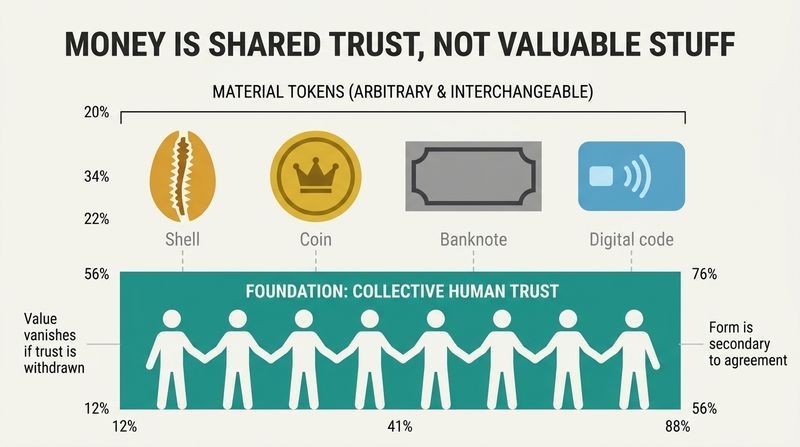
Money solves a coordination problem. In small communities, people could share through obligations or trade directly. But barter gets unwieldy as specialists and strangers multiply: with 100 goods, traders must keep track of 4,950 possible exchange rates. Money gives those goods a common measure and lets sellers accept payment without needing to want what a buyer offers in return.
Its form is secondary. Cowry shells, barley, silver, cigarettes, coins, and electronic account entries have all served as money. Their material properties may help with storage or transport, but their monetary value comes from people agreeing to treat them as a way to measure, exchange, and preserve wealth. Money is less a thing than a shared system for making unlike things comparable.
What's striking is that money compresses an enormous amount of social coordination into a simple signal: a price. That makes specialization possible without requiring people to know one another or share a culture. It also changes what can be compared. Once care, land, labor, and time acquire prices, decisions become easier to coordinate but harder to keep outside economic calculation. The framework is powerful, though it should not be mistaken for a complete account of value. A price can show what a buyer will pay, not what a thing means, whom it harms, or whether the exchange is fair.
Use money to connect strangers, but defend what should remain priceless.
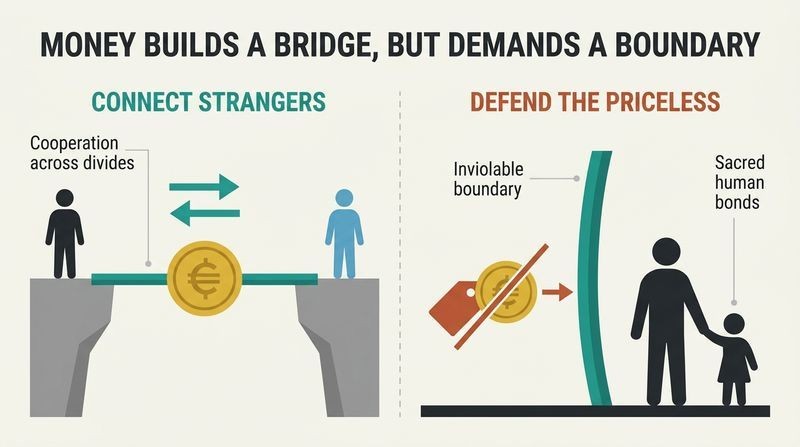
Trust makes money travel. A coin works across distance when people trust the issuer, the institutions behind it, and one another's willingness to accept it. The book's striking example is religious rivals: Christian rulers issued coins carrying Arabic declarations of Muslim faith, while Muslim merchants accepted coins bearing Christian symbols. Neither side had to share the other's religion to share a currency.
The same flexibility has a cost. Money can turn one kind of wealth into another, and its portability can weaken obligations tied to family, faith, or place. The book describes children sold to meet urgent needs, religious forgiveness bought with money, and ancestral land sold to enter global trade. Money builds cooperation between strangers, but its trust rests in the system of exchange more than in personal bonds.
Money's cross-cultural reach resembles a common language with unusually low entry costs: participants need not agree about ultimate meaning, only about what the token can buy. That can reduce barriers between communities. Yet neutrality in exchange is not neutrality in consequence. A currency does not discriminate by religion, but the people who control property, law, and access to markets still can. The useful distinction is between money's capacity to connect people and the justice of the arrangements it connects. Protecting non-market values is not nostalgia; it is a way of deciding where price should stop being decisive.
Credit lets societies build today on wealth they expect tomorrow.
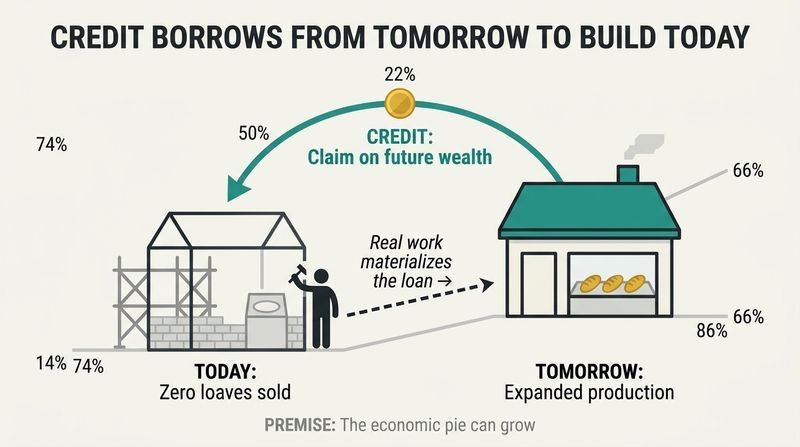
Credit gives the future a price. In the book's bakery example, a bank lends an aspiring business owner money to build a bakery before it has sold a single loaf. The contractor receives payment, the bank records a deposit, and the loan is supported by the expectation that future sales will repay it. Modern money therefore includes claims on production that has not happened yet.
Belief in growth changes the risk. Earlier societies often assumed the economic pie stayed the same size, so a lender expected a borrower to gain at someone else's expense. That made long-term loans seem dangerous. Credit existed in ancient societies, but confidence in a richer future was limited. When people began to expect production to expand, lending could finance new activity rather than merely redistribute existing wealth.
Credit is a social technology for coordinating present sacrifice with expected future output. It can finance ventures that would otherwise remain impossible, but the expectation it relies on is not proof that the promised wealth will arrive. A loan turns optimism into an obligation, and failures can spread when many obligations depend on the same rosy forecast. This makes credit neither inherently fraudulent nor automatically productive. Its value depends on how carefully lenders assess risk, how losses are allocated, and whether the financed activity creates durable goods rather than merely inflating claims on future income.
Make economic growth serve human purposes, not society's only measure.
Capitalism turns reinvestment into a creed. The book presents Adam Smith's argument that business profits can enrich society when owners use them to hire workers and expand production. Capitalism treats money invested in making more goods as capital, distinguishing it from wealth simply stored or spent. Its central discipline is to reinvest profits so that production, and then profits, can grow again.
Progress made this logic plausible. The book contrasts a largely stagnant premodern economy with a modern economy that grew dramatically. It reports global production rising from about $250 billion in 1500 to roughly $60 trillion in the period it describes, alongside higher average production per person. Growth also directs scientific research toward discoveries that may create new industries. The danger is that growth can become a proxy for justice, freedom, or happiness rather than a means to them.
The key insight is institutional: reinvestment links private ambition to collective expansion, but only under specific conditions. Profits must support productive activity, and gains must reach more than the owners of capital. Output figures cannot by themselves reveal who benefits, what harms are ignored, or whether production serves valuable ends. Treating growth as a tool keeps its achievements visible without granting it moral authority. A society can reasonably seek more prosperity while still asking what is being produced, who bears the costs, and which needs remain unmet.
Capital follows trustworthy courts, then can finance conquest.
Investors look for enforceable promises. The Dutch Republic gained financial strength partly because lenders trusted its courts and expected debts to be repaid. Spain, by contrast, weakened investor confidence when royal power overrode repayment and legal protections. Credit could then flow toward merchants and institutions seen as more predictable, even when they belonged to a smaller state.
Finance also empowered private empires. Joint-stock companies pooled many investors' money, limiting each person's risk while funding voyages, ships, and armed forces. The Dutch East India Company used this model to establish control in Indonesia; the British East India Company built a major military presence in India before the British state took direct control. Financial innovation made exploration and trade more scalable, but also placed imperial power in corporate hands.
The comparison clarifies why institutions matter to economic performance: credible rules let people cooperate without relying on a ruler's personal goodwill. But protection of investor property is not the same as protection of everyone affected by investment. The Dutch and British examples show that legal predictability for capital can coexist with coercion abroad. This is a useful warning against treating strong property rights as a complete measure of a good system. The harder question is whose rights the system recognizes, and whether those without capital can challenge the decisions made in its name.
Markets need public rules because profit alone cannot police harm.
A market does not supply its own guardrails. The book argues that exchange depends on trust, and trust depends on institutions that deter fraud, theft, and violence. It challenges the idea that unregulated competition will always protect workers or consumers: monopolies, collusion, and coercion can deprive people of meaningful alternatives.
The historical record shows the stakes. British merchants' opium trade in China was backed by military force after Chinese authorities tried to stop it. Private companies and investors financed the Atlantic slave trade, which sent about 10 million Africans to the Americas; the book says roughly 70 percent worked on sugar plantations. In the Congo Free State, the pursuit of rubber profits involved brutal forced extraction and millions of deaths. These cases show growth without ethical limits can make severe harm look like a business cost.
The examples expose a false opposition between markets and government. The opium trade required state violence, while private firms could use corporate structures to distance investors from the people they harmed. Markets are shaped by law, enforcement, and political power even when regulation is minimal. The point is not that commerce inevitably produces atrocity, but that price signals do not register every consequence. When costs fall on people who cannot refuse, organize, or seek redress, competition can reward exploitation. Public rules matter most where the people bearing the costs have the least power to set them.
Prepare for work where intelligence no longer requires consciousness.
Automation targets tasks, not whole human beings. The book's central warning is that computers need not feel, imagine, or possess a human inner life to outperform people at specific jobs. Pattern recognition can be separated from consciousness. Chess software, AlphaGo, and diagnostic algorithms illustrate how machines can excel in narrow domains once considered distinctly human.
That creates a new employment risk. Past industrial changes displaced some work but also generated new occupations. The author argues that this pattern is not guaranteed to continue when algorithms can perform both physical and cognitive tasks. A 2013 study cited in the book estimated that 47 percent of US jobs were at high risk of automation within twenty years. That was a projection, not a certainty. The practical response is lifelong learning and repeated reinvention, while recognizing that new jobs may also be automated.
The distinction between consciousness and competence is more important than the familiar image of a humanlike robot. An algorithm can replace a task without reproducing the worker's experience, which makes job disruption easy to underestimate. At the same time, occupation-level predictions can obscure how work changes: a job may be reorganized rather than erased, and technology's effects depend on ownership, regulation, and bargaining power. Retraining is valuable, but it cannot be the sole answer if entire groups lose leverage at once. The issue is not only how people adapt, but who captures the productivity gains.
Keep authority over choices even when algorithms predict you better.
Prediction can become power. The book describes a progression from an algorithm as an oracle, offering advice, to an agent, carrying out a goal, and then a sovereign, shaping choices and allocating information. Waze begins as a guide to routes; a connected self-driving car could let it act; a system directing every driver might need to decide who receives which route information.
Personal data strengthens the same shift. A Facebook study described in the book found that its algorithm could predict participants' personality questionnaire answers better than their spouses after observing 300 Likes. Such systems may infer preferences more accurately than a person can report them. But the book's concern is not only surveillance. As recommendations guide more decisions, people may grant an algorithm authority because it seems to know them better than they know themselves.
Prediction and legitimacy are different kinds of knowledge. A system may accurately infer what someone tends to choose without knowing what that person ought to choose, or what trade-offs they would endorse after reflection. This distinction matters because convenience can quietly transfer authority: a recommendation becomes a default, and a default can become difficult to refuse. Good governance therefore needs more than privacy settings. It needs meaningful consent, explanations that can be challenged, and a clear way to contest decisions, especially when an algorithm acts for someone rather than merely advising them.
Keep genetic upgrades from turning wealth gaps into biological castes.
Treatment and enhancement have different social aims. The book distinguishes medicine that brings sick people toward a shared standard of health from technologies intended to give healthy people an advantage. It uses Angelina Jolie's decision to have preventive surgery after learning she carried a BRCA1 mutation associated with an 87 percent breast-cancer risk. At the time described, the genetic test cost $3,000, beyond the reach of many people.
Access can shape more than health. If affluent people obtain better memory, intelligence, or physical abilities while others cannot, economic inequality could become biological inequality. The author argues that mass healthcare once had a practical rationale because economies and armies needed large populations of healthy workers and soldiers. If that need declines, political leaders may have less incentive to support universal care and more incentive to upgrade a small elite.
The central ethical distinction is not simply between old and new medicine, but between restoring a person's capabilities and purchasing an advantage over others. Enhancement could broaden human opportunity if access is shared, yet competitive upgrades can turn unequal resources into inherited differences in ability. The argument also raises a civic question: should basic care depend on a person's economic usefulness? A society can affirm equal standing even when abilities differ, but that principle requires institutions to preserve it. The risk is not technology alone; it is a social order that treats market value as a measure of human worth.
Analysis
The book's organizing thread is a migration of trust. Money lets strangers cooperate because they expect others to accept the same tokens. Credit extends that trust into the future, and capitalism makes growth the evidence that the wager was worthwhile. Digital systems introduce a subtler transition: trust moves from shared currencies and public institutions toward platforms that claim to predict individual behavior. In each case, an instrument of coordination can become an authority.
This structure is illuminating because it links economic history to questions of political legitimacy. The same financial arrangements that finance discovery and specialization can also enable empire, dispossession, and exploitation. Likewise, algorithmic accuracy may improve diagnosis or navigation without settling who should control decisions. The book's strongest recurring distinction is between what a system can do efficiently and what a society should permit it to do.
Its most contestable move is to treat growth as the defining engine of modernity and algorithmic displacement as a plausible route to social uselessness. Growth can be driven by public investment, collective knowledge, and regulation, not only private reinvestment. Automation also changes tasks and bargaining relationships, not just head counts. The book's scenarios are best read as stress tests of political principles, not settled forecasts. Estimates of job risk or future biological classes depend on policies, institutions, and choices that remain open.
A further distinction sharpens the technological argument: predictive systems know patterns in behavior, while political authority concerns which values should govern action. A recommendation may be useful precisely because it exposes a person's blind spots. It becomes dangerous when its superior forecast is treated as a mandate. The enduring question is therefore not whether people should trust money or algorithms, but how trust is bounded, audited, and made answerable to those affected by it.
Review Summary
Money by Yuval Noah Harari receives mixed reviews. Many readers appreciate its thought-provoking content on the history of money and future economic trends. However, some criticize it for being largely excerpted from Harari's previous works. The book's first half focuses on money's origins and impact, while the second half explores broader topics like AI and the future of humanity. Readers praise Harari's engaging writing style and ability to connect complex ideas. Overall, it's recommended for those new to Harari's work or seeking a concise overview of his economic theories.
People Also Read
Glossary
Universal convertibility
Exchange one thing for anotherA principle of money describing its ability to convert unlike forms of value into one another. Money can let a person turn labor into goods, property into services, or savings into transportable wealth. This flexibility makes complex exchange easier, while also allowing market prices to enter areas of life that communities may regard as beyond buying and selling.
Universal trust
Shared confidence in moneyThe shared expectation that other people will accept a monetary token in exchange for goods, services, or debts. This trust does not require people to know or like one another. It depends on a wider network of social, political, and economic beliefs, including confidence in issuers, laws, and the willingness of others to keep using the same money.
Capitalist Creed
Reinvest profits to growThe economic and moral outlook that treats reinvested profit and continuing production growth as central goods. It distinguishes capital, resources deployed to increase future production, from wealth that is merely stored or consumed. The creed presents private profit as potentially beneficial to society, while making growth a frequent stand-in for broader aims such as prosperity, freedom, and justice.
The Great Decoupling
Intelligence separates from consciousnessThe book's term for the possibility that intelligent performance will no longer require conscious experience. Computers may recognize patterns, make diagnoses, or execute complex tasks without feelings or awareness. If institutions need intelligence but not consciousness, human economic value may decline even though human subjective experience remains rich and meaningful to the people who have it.
dividuals
Humans as interacting subsystemsThe book's alternative to seeing each person as a single, unified self. A human being is described as a collection of biological processes and decision-making mechanisms, rather than an indivisible inner authority. This idea challenges the liberal assumption that individuals have a fully free, authentic self that uniquely knows what they want.
Quantified Self
Self-knowledge through personal dataA movement that uses systematic measurement of bodily and behavioral information to understand the self. Wearable devices and apps collect figures such as heart rate, sleep, and activity, then use analysis to inform choices. In the book's account, this approach treats personal data as a route to knowledge that introspection alone may not provide.
oracle, agent, sovereign
Stages of algorithmic authorityA progression describing how an algorithm's role can expand. An oracle provides advice while a person decides. An agent receives a goal and acts to achieve it. A sovereign gains enough influence over information and choices to shape outcomes, including by directing what different people are told. The sequence traces a shift from assistance toward control.
FAQ
What's "Money" by Yuval Noah Harari about?
- Exploration of Money's Role: The book explores the invention of money, its significance in human history, and its impact on modern society.
- Historical Journey: It takes readers on a journey from the first coins to 21st-century economics, highlighting the evolution of money.
- Future of Money: Harari discusses the potential future of money and how it might revolutionize our lives.
- Selections from Other Works: The book includes selections from Harari's previous works, "Sapiens" and "Homo Deus."
Why should I read "Money" by Yuval Noah Harari?
- Understanding Economics: It provides a clear understanding of how money influences global economics and individual lives.
- Insightful Analysis: Harari offers insightful analysis on the psychological and cultural aspects of money.
- Future Predictions: The book discusses potential future changes in the economic landscape, making it relevant for forward-thinking readers.
- Engaging Narrative: Harari's engaging narrative style makes complex economic concepts accessible and interesting.
What are the key takeaways of "Money" by Yuval Noah Harari?
- Money as a Trust System: Money is a universal system of mutual trust, not just a physical entity like coins or notes.
- Economic Growth and Capitalism: The book discusses how capitalism and economic growth are intertwined with the concept of money.
- Technological Impact: Harari explores how technology might change the role and form of money in the future.
- Social and Ethical Implications: The book delves into the social and ethical implications of money, including inequality and the potential for a post-liberal world.
How did money come to be invented according to "Money" by Yuval Noah Harari?
- Barter System Limitations: Money was invented to overcome the limitations of the barter system, which was inefficient for complex economies.
- First Forms of Money: Early forms of money included barley in Sumer and cowry shells in Africa and Asia, which were used as universal measures of value.
- Development of Coins: The invention of coins in Lydia around 640 BC marked a significant advancement, providing a standardized and trusted medium of exchange.
- Trust and Authority: The value of money was established through trust in the issuing authority, such as a king or government.
What is the "Capitalist Creed" as discussed in "Money" by Yuval Noah Harari?
- Growth as a Goal: The capitalist creed is centered around the idea that economic growth is the ultimate goal, driving innovation and prosperity.
- Reinvestment of Profits: Capitalism emphasizes reinvesting profits into production to fuel further growth, distinguishing it from mere wealth accumulation.
- Moral and Economic Justification: Harari explains how capitalism justifies greed as beneficial for society, as it leads to increased production and wealth.
- Impact on Society: The capitalist creed has shaped modern society, influencing everything from scientific research to global trade.
How does "Money" by Yuval Noah Harari explain the limitations of the barter system?
- Complexity of Exchange Rates: Barter required knowledge of numerous exchange rates, which became impractical as the variety of goods increased.
- Lack of Common Value: Without a common measure of value, it was difficult to determine fair exchanges between different goods and services.
- Inefficiency in Large Economies: Barter was inefficient for large economies with many participants, as it relied on direct exchanges of goods.
- Development of Money: Money was developed as a solution to these limitations, providing a standardized and efficient medium of exchange.
What are the social and ethical implications of money discussed in "Money" by Yuval Noah Harari?
- Corrosion of Values: Money can erode traditional values and intimate relationships, replacing them with market-driven interactions.
- Inequality and Power: The book highlights how money can lead to social inequality and concentrate power in the hands of a few.
- Trust in Money Over People: Harari discusses how money shifts trust from individuals and communities to impersonal systems.
- Potential for Corruption: The pursuit of profit can lead to unethical practices, as seen in historical examples like the Atlantic slave trade.
How does "Money" by Yuval Noah Harari address the future of money?
- Technological Revolution: Harari predicts a technological revolution that could change the form and function of money, such as digital currencies.
- Decoupling of Intelligence and Consciousness: The book explores how advancements in AI might impact economic systems and the value of human labor.
- Potential for Inequality: There is a risk of increased inequality as technology creates a divide between upgraded superhumans and the rest of society.
- Post-Liberal World: Harari suggests that these changes could lead to a post-liberal world where traditional democratic and economic systems are challenged.
What are the best quotes from "Money" by Yuval Noah Harari and what do they mean?
- "Everyone always wants money because everyone else also always wants money." This quote highlights the universal trust and demand for money as a medium of exchange.
- "Money is the most universal and most efficient system of mutual trust ever devised." It underscores the role of money in facilitating cooperation and trade among strangers.
- "The profits of production must be reinvested in increasing production." This reflects the capitalist creed's emphasis on growth and reinvestment.
- "Money is more open-minded than language, state laws, cultural codes, religious beliefs and social habits." Harari points out money's ability to bridge cultural and social divides.
How does "Money" by Yuval Noah Harari explain the relationship between money and trust?
- Mutual Trust System: Money functions as a system of mutual trust, where its value is based on collective belief rather than intrinsic worth.
- Role of Authority: Trust in money is often linked to trust in the authority that issues it, such as governments or financial institutions.
- Historical Examples: Harari provides historical examples, such as the Roman denarius, to illustrate how trust in money has been established and maintained.
- Impact on Society: The book discusses how trust in money has enabled complex economic systems and global trade networks to flourish.
What is the "Great Decoupling" as discussed in "Money" by Yuval Noah Harari?
- Separation of Intelligence and Consciousness: The Great Decoupling refers to the potential separation of intelligence from consciousness due to technological advancements.
- Impact on Employment: As AI surpasses human intelligence in many tasks, it could lead to widespread unemployment and a shift in economic value.
- Challenge to Liberalism: This decoupling poses a threat to liberal values, as it undermines the economic and political importance of individual humans.
- Future Implications: Harari explores the implications of this decoupling for society, including the potential rise of a "useless class" and increased inequality.
How does "Money" by Yuval Noah Harari address the concept of universal convertibility?
- Definition of Universal Convertibility: Universal convertibility is the idea that money can convert almost anything into anything else, facilitating trade and exchange.
- Examples of Conversion: Harari provides examples of how money can convert land into loyalty, health into justice, and even sex into salvation.
- Role in Economic Systems: This concept is central to the functioning of complex economic systems, allowing for the efficient allocation of resources.
- Ethical Considerations: The book also discusses the ethical implications of universal convertibility, such as the potential for corruption and the erosion of traditional values.
About the Author
Other books by Yuval Noah Harari



Download PDF
Download EPUB
.epub digital book format is ideal for reading ebooks on phones, tablets, and e-readers.








