

Key Takeaways
Treat creativity as a capacity to recover, not a gift reserved for artists
Creativity is recoverable. Cameron’s central claim is that creativity is a natural human capacity, not a rare talent granted to a professional few. Blocks often grow from fear, shame, discouragement, or beliefs that art is selfish and impractical. Her own method began after she stopped drinking in 1978 and feared sobriety would end her writing. She found a less punishing way to work by showing up regularly without demanding inspiration first.
Practice before belief. The book presents creativity as spiritual, but readers do not need to accept a particular idea of God. Cameron invites them to try the exercises and notice what changes. Her twelve-week course builds that experiment through daily writing, weekly play, reflection, and small creative risks.
The book’s most inclusive move is to separate creative practice from professional identity. That distinction resembles research on intrinsic motivation: people often sustain an activity longer when it expresses a personally meaningful interest, rather than serving only status or income. The spiritual language can help some readers experience creativity as connection rather than performance. It is still a worldview, not proof that a supernatural force directs artistic outcomes. The exercises remain usable without that claim, which makes the method more adaptable than its theology may initially suggest.
Write three unedited pages before your inner critic gets the microphone
Clear the mental clutter. Morning Pages are three pages of handwritten, stream-of-consciousness writing done each morning. They are not intended as literature, and the writer need not make them coherent or insightful. Cameron recommends keeping them private and avoiding rereading them for roughly eight weeks, so the exercise does not become a performance for an audience.
Catch the Censor in action. Cameron calls the habitual voice of self-criticism the Censor. It dismisses ideas as foolish, unoriginal, or too late before they can develop. The pages help expose that voice as a reaction, not an objective verdict. Cameron began writing pages while recovering from disappointment in her film work in Taos; an unplanned character appeared, and the exercise opened a route into a novel.
The method reduces two common barriers at once: the pressure to produce something good and the tendency to confuse self-criticism with judgment. Research on expressive writing suggests that putting thoughts into words can help people organize difficult experiences, though the effects vary and do not establish that a specific three-page ritual unlocks creativity for everyone. Privacy is an important design choice: it lowers social evaluation while the work is still raw. Readers who find handwriting burdensome can preserve the core principle by choosing a low-friction format that still permits uncensored thought.
Replenish imagination with solitary play, not more advice about art
Make room for input. An Artist Date is a planned block of time, usually about two hours each week, spent alone on something enjoyable and exploratory. It might mean visiting a gallery, wandering through a neighborhood, listening to unfamiliar music, or browsing a shop. The point is not to collect impressive cultural credentials. It is to give attention time to notice what attracts or surprises it.
Keep the inner well stocked. Cameron describes creative material as an inner reservoir that must be replenished, a process she calls filling the well. Making art draws on sensory memories, images, sounds, and lived details. If an artist only produces and never takes in fresh experience, the work can go stale. A change of route, a meal cooked attentively, or a walk can supply the mind with new raw material.
This is a practical account of incubation: stepping away from a task can let attention recombine information without the strain of forced problem-solving. The emphasis on sensory detail also counters a common misconception that creativity is mainly abstract thought. Still, solitude is not a universal creative requirement. Some people generate ideas through conversation, collaboration, or shared observation. The useful principle is protected, attentive novelty, with the format tailored to the person. A date that feels like homework defeats its purpose.
Trace creative fear to its source, then let yourself begin badly
Notice the inherited story. Cameron uses the term shadow artist for someone drawn to art but unable to claim that identity, often working near the desired field instead. A gifted trader named Edwin, for example, filled his life with art and supported other artists, yet could not imagine making art himself. His family had steered him toward finance. The point is not that every sensible career conceals an artist, but that absorbed expectations can make a personal desire seem illegitimate.
Protect the beginner. Early attempts are awkward, and comparing them with finished masterpieces is a reliable way to stop. Cameron argues for treating the inner artist like a child who needs encouragement, not humiliation. She asks readers to identify old discouragement and support, then to give themselves permission to learn through imperfect work.
The concept of the shadow artist gives a memorable name to indirect participation in a desired life. It can help people see how fear hides inside respectable substitutes. Its limitation is that a parallel career is not necessarily avoidance; it may be a valued choice, or the closest viable option under real financial and family constraints. The book’s strongest safeguard is its emphasis on experimentation rather than declaring a fixed identity. A small class, sketch, or rehearsal can test a desire without requiring a dramatic career conversion.
Translate envy and anger into a specific next move
Treat emotion as information. Cameron reads anger as a clue about violated boundaries, neglected ambitions, or work someone has avoided. Envy can point toward a desire that has not yet been acted on. A person furious that someone else made a play from a similar idea may be discovering a wish to write one. The feeling is not a command to attack anyone; it is a prompt to ask what action the feeling is requesting.
Turn the clue into motion. Cameron’s jealousy exercise asks readers to name whom they envy, specify what they want from that person’s situation, and write one action that could move them toward it. That might mean taking a class, finishing a draft, or submitting work. The aim is to replace rumination with a modest, testable step.
This approach resembles emotional granularity, the ability to identify what a feeling is about rather than treating it as a vague bad mood. Naming the object of envy can convert social comparison into useful information about values and goals. But emotions are clues, not reliable maps: anger may reflect exhaustion, injustice, or a real boundary violation rather than a hidden artistic calling. The strongest use of the exercise is therefore investigative. A feeling suggests a hypothesis, and a small action tests whether the desire remains meaningful.
Guard attention against habits and people that keep your art dormant
Find the drains. Cameron calls people who repeatedly seize attention through chaos, broken agreements, and manufactured emergencies crazymakers. She also describes habits such as overwork, substances, food, or romantic obsession as possible ways to interrupt creative momentum. The issue is not that work, relationships, or pleasure are inherently harmful. It is whether a pattern reliably takes over when creative risk approaches.
Set a concrete boundary. A time log can reveal where attention actually goes, while a personal bottom line turns a vague wish into a rule, such as refusing work calls during a protected evening. Cameron also proposes a week of reading deprivation to interrupt habitual consumption and make room for one’s own thoughts. That experiment is meant to expose avoidance, not to make reading itself suspect.
The book takes attention seriously as a limited resource and gives readers practical ways to notice its capture. Naming a recurring pattern can make a boundary easier to defend. Yet the language of crazymaking risks simplifying relationships, and people facing coercion or abuse should not be told that they chose their harm as a block. Time is also constrained by care work, poverty, disability, and demanding jobs. The framework is most useful when it identifies negotiable drains while recognizing that some constraints require outside support, not better scheduling.
Trade perfect plans for the next small piece of actual work
Finish the next part. Cameron defines perfectionism as getting trapped in revisions and details before a whole work can take shape. A writer may polish the opening scene repeatedly and never draft the rest. The remedy is not lower standards forever; it is to separate making a rough draft from judging it. Her idea of filling the form means taking the next practical step in the medium itself, such as writing a page, buying clay, or checking class times.
Shrink the leap. People often imagine that pursuing art requires quitting a job, moving cities, or rebuilding a whole life. Cameron argues that this grand-scale fantasy can become another excuse for not beginning. A goal becomes more usable when broken into steps for the year, month, week, and present day. The next step should fit the life that exists now.
The distinction between generating and evaluating work is central to many creative processes. Separating those modes protects exploration from premature quality control, while small actions make progress observable. This is compatible with process goals used in skill development, where attention stays on controllable practice rather than distant outcomes. There is a necessary second half: revision, craft, and feedback still matter. A rough draft is not automatically good work. The point is to reach a draft that can be improved, instead of using standards to prevent one from existing.
Grieve artistic losses, then choose the next available door
Name the injury. Rejection, a canceled project, a damaging review, or a chance declined out of fear can leave an artist reluctant to risk again. Cameron argues that losses need to be acknowledged rather than dismissed with claims that they do not matter. She distinguishes useful criticism, which identifies something specific that can be improved, from vague criticism that humiliates without helping.
Look for another route. After repeated studio setbacks, Cameron made a feature independently, using money from earlier writing work. The production faced another blow when its sound recordings were stolen, but she completed the film by dubbing it. The experience did not erase the losses; it created a different path into filmmaking. Her practical question is not only why a door closed, but what action remains possible now.
The account makes resilience concrete: recovery involves recognizing pain and then reclaiming agency, not pretending rejection is harmless. This resembles meaning-making after failure, where a person can revise a strategy without denying what was lost. The caution is that adversity does not automatically produce growth. Cameron had skills, prior work, and some financial resources to draw on. For readers with fewer options, the next door may require collaborators, time, or material support. Compassion and strategy belong together.
Build a circle that protects unfinished work and makes courage contagious
Find believing mirrors. Cameron calls a creative cluster a peer group whose members encourage one another’s work without taking control of it. A good group listens, respects privacy, and avoids shaming early attempts. The book describes a Chicago group that began with members wondering whether they could write or perform, then stayed connected long enough to celebrate significant creative milestones.
Keep the spiritual claim open. Cameron understands creativity as a partnership with a larger creative source and describes meaningful coincidences as synchronicity. Readers can adopt that language, use another spiritual framework, or simply notice how taking action brings them into contact with people and opportunities. The practical instruction is to keep making work and to share plans with people who can support them, rather than asking every skeptic for permission.
The social design is unusually thoughtful: peers are asked to witness rather than fix, and to protect emerging work from premature critique. That resembles psychological safety in teams, where people can offer unfinished ideas without expecting ridicule. Community also counters the myth that artistic life requires isolation. Cameron’s account of synchronicity adds a sense of wonder, but coincidence alone cannot establish cosmic guidance. A grounded interpretation is that commitment increases attention, contact, and readiness to recognize opportunities. Supportive peers can strengthen all three.
Analysis
The Artist’s Way is less a manual for producing masterpieces than a twelve-week course in restoring the conditions under which creative work can happen. Its sequence moves from safety and identity through power, integrity, possibility, abundance, connection, strength, compassion, self-protection, autonomy, and faith. The weekly themes are not separate doctrines so much as different names for the same practical problem: a person has learned to distrust a desire and needs enough attention, permission, and support to act on it.
The program’s most coherent design is its pairing of Morning Pages with the Artist Date. One practice externalizes private thoughts; the other creates receptive time for images and experience. Together they interrupt both internal noise and passive consumption. The later exercises then translate discoveries into boundaries, small goals, self-care, and social support. This makes the book’s spiritual vocabulary less essential than its repeated structure of noticing, experimenting, and acting.
Cameron’s personal stories give the method emotional credibility, especially her transition from painful, alcohol-fueled bursts of writing toward a steadier practice. Stories of students recovering from discouragement show how shame can restrict ambition. They are compelling illustrations, though not controlled evidence that the program works equally well for everyone. Claims that the universe responds to creative commitment are best read as spiritual interpretation, not established causal fact.
The book’s lasting contribution is its reframing of creative block. It is not necessarily laziness or lack of talent; it may be fear, grief, an environment hostile to experimentation, or attention spent on other people’s needs. That account is humane, but it should not become a universal diagnosis. Economic insecurity, disability, discrimination, and caregiving can impose genuine limits. The framework is strongest when its exercises help readers distinguish internalized prohibitions from material constraints, then choose actions proportionate to both. Its promise is not effortless inspiration, but a more livable relationship with making things.
Review Summary
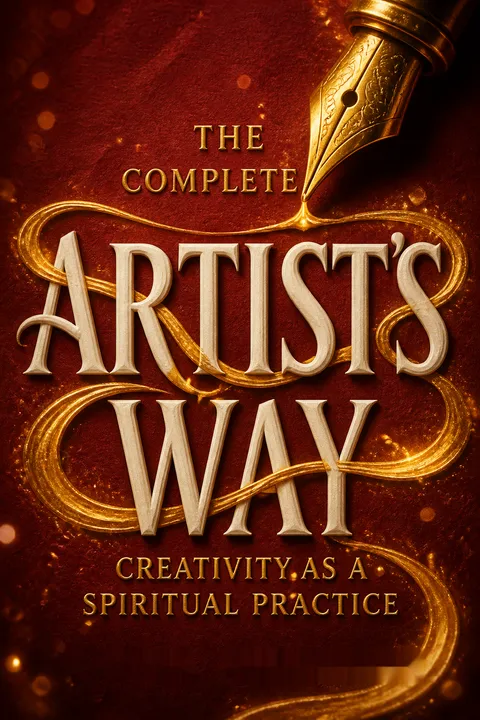
The Complete Artist's Way receives mostly positive reviews, with readers praising its potential to unlock creativity and change lives. Many find the exercises and tasks helpful, particularly morning pages and artist dates. Some readers appreciate the spiritual aspects, while others find them challenging. Critics note repetitiveness and an overly religious tone. The book is often recommended for those seeking to overcome creative blocks or explore their artistic side, though some find it overwhelming or not suited to their needs.
Glossary
Morning Pages
Daily uncensored writingThree pages of handwritten, stream-of-consciousness writing completed each morning. The pages are private and are not meant to be polished or judged as art. Cameron uses them to help people notice recurring thoughts, fears, preferences, and possible actions while loosening the grip of self-criticism.
Artist Date
Solo creative replenishmentA planned period of time, usually weekly, spent alone doing something enjoyable and exploratory. An Artist Date might involve visiting a museum, walking somewhere unfamiliar, or listening to music. Its purpose is to give the imagination fresh sensory experiences, not to produce a finished work.
Censor
Internal creative criticCameron’s name for the inner voice that attacks new ideas as foolish, derivative, or inadequate before they have a chance to develop. The Censor is treated as a protective but overactive habit of judgment, not as a reliable measure of artistic quality.
Shadow artists
Artists who hide their identityPeople who feel drawn to creative work but do not yet claim the identity of artist. They may support artists or choose careers adjacent to the art they want to make. Cameron connects this pattern to discouragement, low confidence, and the belief that artistic ambition is not permitted.
Filling the well
Replenishing creative materialCameron’s term for intentionally gathering experiences, images, sounds, and sensory details that nourish future work. It treats creativity as drawing on an inner reservoir that can become depleted through sustained production. Playful observation and unfamiliar experiences help replenish that reservoir.
Crazymakers
Attention-consuming disruptorsCameron’s term for people whose repeated drama, broken agreements, urgent demands, or boundary violations consume the time and attention others need for creative work. The concept is intended to help readers recognize disruptive patterns, though it should not be used to reduce complex relationships to a label.
Creative U-turn
Retreat from creative progressA retreat from creative work that occurs when a new opportunity, success, or exposure triggers fear. A person may abandon a project, avoid a useful next step, or suddenly decide the work does not matter. Cameron recommends identifying the fear and seeking support rather than treating the retreat as proof of incapacity.
Virtue Trap
Self-denial disguised as goodnessCameron’s name for sacrificing personal creative needs to appear endlessly helpful, responsible, or selfless. The pattern can create resentment and distance from one’s own interests. The concept encourages people to examine whether their version of being good leaves room for rest, boundaries, and personally meaningful work.
Creative clusters
Peer support for artistsSmall, preferably peer-run groups that support members’ creative practice through regular meetings, listening, and encouragement. Members share exercises and plans without trying to control or fix one another. Cameron sees these groups as a way to reduce isolation and protect early creative efforts from ridicule.
Synchronicity
Meaningful coincidenceA term associated with Carl Jung that Cameron uses for coincidences that seem to connect a person’s inner aims with helpful outer events. She interprets such experiences as signs of support from a creative source. The term describes a meaningful pattern of experience, not proof that a supernatural cause produced it.
FAQ
What's The Complete Artist's Way about?
- Focus on Creativity: The Complete Artist's Way by Julia Cameron is a guide to unlocking and nurturing creativity as a spiritual practice, emphasizing self-discovery and personal growth through artistic expression.
- 12-Week Program: It outlines a twelve-week program designed to help individuals recover their creative selves, addressing aspects such as safety, identity, power, and integrity.
- Tools and Techniques: Key tools include "morning pages" and "artist dates," which help clear mental blocks and foster a deeper connection with one's artistic self.
Why should I read The Complete Artist's Way?
- Transformative Experience: Readers often report life-changing experiences, reconnecting with their creativity and pursuing artistic passions through a structured approach to overcoming creative blocks.
- Spiritual Connection: The book frames creativity as a spiritual journey, encouraging exploration of inner selves and connection with a higher power, leading to profound personal insights.
- Practical Exercises: It offers actionable steps that can be integrated into daily life, making it a valuable resource for enhancing creative expression.
What are the key takeaways of The Complete Artist's Way?
- Creativity is Natural: The book asserts that creativity is inherent to all individuals and should be embraced as a fundamental aspect of existence.
- Morning Pages: Writing "morning pages" daily helps clear mental clutter and allows for deeper self-reflection.
- Artist Dates: Regular "artist dates" encourage exploration and playfulness, essential for artistic growth.
What is the significance of "morning pages" in The Complete Artist's Way?
- Daily Writing Practice: Morning pages involve writing three pages of stream-of-consciousness thoughts daily, helping to clear the mind and allow for deeper self-exploration.
- Censor Evasion: This practice bypasses the internal critic, allowing free expression without judgment, leading to greater clarity and insight.
- Emotional Release: It serves as a form of emotional release, helping individuals process feelings and experiences, leading to breakthroughs in creativity and self-awareness.
How do "artist dates" work in The Complete Artist's Way?
- Solo Outings: Artist dates are pre-planned, solo excursions that allow individuals to explore interests and nurture creativity, such as visiting a museum or taking a walk in nature.
- Nurturing the Inner Artist: These dates engage the creative self in a playful and enjoyable way, replenishing creative energy and inspiring new ideas.
- Weekly Commitment: The book emphasizes committing to one artist date each week, prioritizing creative self-care in daily life.
What are the common barriers to creativity discussed in The Complete Artist's Way?
- Fear of Judgment: Many struggle with fear of being judged or criticized, leading to self-doubt and avoidance of artistic expression.
- Negative Beliefs: Negative beliefs about oneself and creativity, often stemming from childhood experiences, can act as barriers.
- Crazymakers: "Crazymakers" are individuals who create chaos in artists' lives, and recognizing and distancing from them is crucial for creative flow.
How does The Complete Artist's Way address the relationship between creativity and spirituality?
- Creativity as Spiritual Practice: The book posits creativity as a spiritual transaction, suggesting that engaging in creative activities can lead to a deeper connection with the divine.
- Guidance from the Creator: Creative impulses are viewed as guidance from a higher source, fostering a sense of purpose in creative endeavors.
- Healing Through Creativity: Engaging in creative practices can be a form of healing, allowing individuals to process emotions constructively.
What is the "Virtue Trap" mentioned in The Complete Artist's Way?
- Self-Sacrifice: The "Virtue Trap" refers to prioritizing others' needs over one's creative desires, leading to resentment and frustration.
- Fear of Selfishness: Guilt for pursuing personal interests can prevent full engagement with creative potential.
- Breaking Free: The book encourages breaking free from the Virtue Trap by prioritizing creative needs, leading to a more fulfilling life.
How can I apply the concepts from The Complete Artist's Way in my daily life?
- Commit to Morning Pages: Start a daily practice of writing morning pages to clear your mind and connect with your inner thoughts.
- Schedule Artist Dates: Plan regular artist dates to explore interests and nurture creativity, providing inspiration and rejuvenation.
- Challenge Negative Beliefs: Identify and challenge negative beliefs about creativity, replacing them with positive affirmations.
How can I overcome self-doubt as an artist according to The Complete Artist's Way?
- Acknowledge Your Fears: Recognizing and naming self-doubt is the first step toward overcoming it, as many artists experience similar feelings.
- Focus on Process, Not Product: Shifting focus from the end result to the creative process allows for greater freedom and exploration.
- Use Morning Pages: Morning pages help clarify thoughts and feelings, providing a space to confront self-doubt and foster self-acceptance.
What are some of the best quotes from The Complete Artist's Way and what do they mean?
- "Creativity is the natural order of life.": Highlights creativity as inherent to all individuals, encouraging its embrace as a fundamental aspect of existence.
- "Leap, and the net will appear.": Encourages taking risks in creative endeavors, suggesting opportunities will manifest when committed to the artistic journey.
- "The refusal to be creative is self-will and is counter to our true nature.": Emphasizes that denying creativity is self-sabotage, and embracing it is essential for fulfillment.
What is the role of self-nurturance in The Complete Artist's Way?
- Essential for Creativity: Self-nurturance is vital for maintaining a healthy creative practice, prioritizing well-being and engaging in joyful activities.
- Building a Supportive Environment: Surrounding oneself with supportive individuals and engaging in creativity-fostering practices is crucial.
- Daily Acts of Kindness: Incorporating small acts of kindness and self-care into daily routines reinforces the importance of valuing one's creative self.
About the Author
Other books by Julia Cameron

Download PDF
Download EPUB
.epub digital book format is ideal for reading ebooks on phones, tablets, and e-readers.








