

Key Takeaways
Build a life where self-direction and dependable belonging reinforce each other
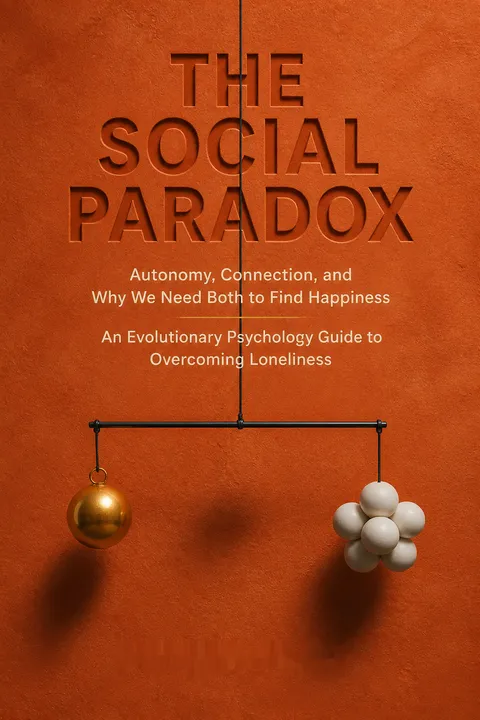
Two needs shape well-being. The book defines autonomy as directing your own choices and developing your abilities. Connection means cooperating, forming close relationships, and belonging to a group. Pursuing either can limit the other: obligations to people constrain your choices, while putting your preferences first can weaken relationships. The author argues that modern life increasingly favors autonomy, leaving many people accomplished but lonely or unfulfilled.
Comfort is not the whole story. In one survey, more than 90 percent of Hadza participants said they had been happy in the previous week, compared with fewer than half of Polish participants. Observations of Efe foragers found that pleasure remained common even during food shortages. These comparisons are suggestive, not proof that hunter-gatherers were happier overall, but they sharpen the question of what material comfort cannot provide.
The framework gives scattered complaints, from loneliness to dissatisfaction despite success, a common lens: achievement and belonging are different goods. That distinction also fits research traditions that separate perceived control from social support, both of which matter for well-being. The argument is strongest as a practical model, not as a claim that ancestral life was happier. Retrospective comparisons across cultures can be distorted by translation, expectations, and measurement. The useful test is personal and concrete: when life feels hollow, is the missing ingredient more freedom, or someone dependable with whom to share it?
Use connection to multiply safety, skill, and knowledge
Groups do more than gather. The book traces human connection to four functions: keeping watch for danger, coordinating work, teaching through language and stories, and protecting members from threats posed by other groups or individuals. Human cooperation is especially powerful because people can divide tasks and pass knowledge between generations. A hunter can share a warning or technique without giving away the knowledge itself.
Sharing became an insurance system. Among hunter-gatherers, successful hunters were expected to distribute meat, spreading the risk of failed hunts across the camp. The Ju/’hoãn maintained exchange relationships, called hxaro, with partners near and far. Ancient ostrich-shell beads found hundreds of miles from their source may indicate that such networks reach back 33,000 years, though trade is another possible explanation. Modern teams also benefit when members feel safe sharing ideas.
This account makes connection more than emotional comfort. It is infrastructure for coordination, learning, and resilience. That perspective links intimate bonds to institutions such as teams and communities: trust lowers the cost of asking for help, admitting uncertainty, and sharing information. The hxaro evidence is a good example of how material clues can illuminate social life without settling its interpretation. Still, cooperation is not automatically benevolent. Groups can coordinate to exclude outsiders or enforce harmful norms. Connection supports flourishing when people can cooperate while retaining room to question the group.
Choose growth that makes you useful without surrendering your own judgment
Autonomy helps develop competence. In the book’s account, people notice where they have promise, choose opportunities that suit them, and invest effort in becoming capable. A childhood remark that he was academically gifted helped redirect the author’s attention toward school; years of tennis practice, followed by his brother’s greater progress, helped him abandon a poor fit. Autonomy can prevent other people from choosing a life path on someone else’s behalf.
Choice has a relational price. The author argues that autonomy originally helped people become valuable group members and potential partners, yet independent goals can conflict with relationships. Shared activities and values can reduce that conflict. The book also challenges the claim that autonomy and connection are always mutually reinforcing, including in self-determination theory. It distinguishes self-governance from simply feeling willing to accept a choice made for relational reasons.
The distinction between choosing a goal and consenting to a compromise is subtle but useful. A person may freely choose to prioritize a partner, yet still give up an activity they personally value. That does not make the choice wrong; it clarifies what need it serves and whether the trade feels sustainable. In practice, autonomy can strengthen relationships when people support each other’s self-chosen pursuits. The tension is therefore not a fixed zero-sum law. It depends on time, shared interests, power, and whether compromise is reciprocal rather than routinely falling to one person.
Treat average sex differences as context, never a script for individuals
Group averages overlap. The book argues that men, on average, emphasize autonomy more, while women emphasize connection more. It stresses that differences between individuals within each sex are often larger than average differences between sexes, so group trends should not determine judgments about a person. The author connects these tendencies to biology and socialization, including different ancestral pressures around childcare and competition for mates.
Social patterns have consequences. The book describes women’s friendships as closer and more emotionally supportive on average. In a cited US survey, 41 percent of women and 21 percent of men said friends provided emotional support. Men’s isolation is linked in the book to barriers to seeking help; an Australian program called Men’s Shed offers men practical projects and companionship side by side. The author also reports higher depression among women and higher suicide mortality among men, while recognizing that no single explanation accounts for these patterns.
The most useful part of this account is its attention to how social expectations can turn average differences into different opportunities for support. A format built around shared activity may make friendship more accessible to people who dislike formal emotional disclosure. At the same time, evolutionary explanations are difficult to test directly and can too easily make current patterns seem inevitable. The book’s warning about overlapping distributions is essential: averages may help describe populations, but they are poor substitutes for asking an individual what they need, prefer, or can do.
Notice how culture and faith redraw the boundary between duty and choice
Cultures weight the balance differently. Individualist societies tend to prize personal preference; collectivist societies more often stress duties to family and community. The book links some of this variation to historical conditions. Rice farming, for example, required neighbors to coordinate irrigation, while wheat farming could be done with less community involvement. Tight cultures, often shaped by threats or high population density, also place stronger pressure on people to follow shared rules.
Religion can reshape both needs. The author argues that moralizing Abrahamic religions widened obligations beyond kin, using the Good Samaritan story as an example of compassion toward an outsider. Religious traditions also differ internally: Protestants are described as emphasizing an individual relationship with God, while Catholic and Jewish practice places relatively more weight on community and ritual. These are broad tendencies, not descriptions of every believer.
The account usefully treats culture and religion as more than private beliefs. They provide scripts for handling conflict, helping strangers, and deciding whose preferences deserve priority. The rice and wheat comparison shows how practical demands can become durable social habits. Yet agricultural history cannot explain every cultural difference, and religious communities contain wide variation. These categories work best as prompts for inquiry rather than labels that predict a person’s conduct. When a norm seems puzzling, asking what coordination problem it solves can reveal its function without requiring agreement with the norm itself.
Translate political conflict into competing priorities, not alien motives
Politics ranks shared values. The book portrays the political Left as placing more weight on fairness, harm reduction, and connection across groups. The Right places greater weight on individual rights and autonomy, while also valuing loyalty and group belonging. Both sides care about autonomy and connection, but differ over which should take priority when they clash.
Policy disputes expose the trade-off. In polling discussed in the book, people further to the Left more often favored social spending over tax reductions, while people further to the Right more often preferred lower taxes. Yet neither side was unanimous, and many conservatives supported spending to help others. The author also describes empathy as one influence on political views, while beliefs about personal responsibility and danger shape how people judge misfortune and punishment.
This model can improve political conversation by replacing caricatures with a question about which cost a person is trying hardest to avoid. One person may fear that state action will restrict freedom; another may fear that leaving hardship unaddressed abandons neighbors. The same policy can therefore look protective from one perspective and coercive from another. Values do not explain everything, however. Material interests, party identity, institutions, and unequal power also shape political choices. The framework helps interpret moral disagreement, but should not be used to reduce every political position to temperament.
Ask what convenience and achievement are costing your local relationships
Modern options loosen dependence. Cities created specialized occupations and more choice, but also brought people among strangers. The book notes that the share of people living in cities rose from fewer than one in ten before 1840 to one in three by 1960, then surpassed the rural share in 2007. Surveys cited by the author find that rural residents know and trust neighbors more, report greater friendship satisfaction, and are slightly more likely to say they are very happy.
Education and wealth expand self-sufficiency. Broad education can expose people to alternatives and help them choose better-fitting careers. But schooling also trains students to defer present social time for future achievement, while wealth makes it easier to pay for help rather than rely on neighbors. The author sees these gains in autonomy as real, but argues that modern life can erode everyday connection along the way.
The argument is not that cities, education, or wealth are mistakes. Each expands safety, choice, and opportunity, and each can free people from restrictive local norms. The sharper point is that convenience changes the need to maintain relationships: a paid service can solve a task without creating a bond. That trade can be worthwhile, but its cumulative effects are easy to miss. Rural happiness comparisons also cannot establish that location itself causes greater well-being; people differ in who moves and why. The practical question is whether a life optimized for efficiency has become socially undernourished.
Do not make marriage carry every connection your wider life has lost
Marriage has changed jobs. In many farming societies, marriage joined families and their economic interests. As people moved to cities and became less dependent on kin, romantic affection and personal choice became more central. Today, more people live alone and fewer marry, in part because women’s economic independence and contraception reduce the practical need for marriage.
Quality matters more than status. Longitudinal studies described in the book find that some people become durably happier in good marriages, while others become less happy; many return near their earlier baseline. Unmarried people are less happy on average in the surveys cited, but that does not prove that remaining single causes unhappiness. The author suggests that weak connection across life, rather than unmarried status itself, may explain some of the difference. A spouse cannot reliably replace friends, neighbors, or community.
This is a valuable corrective to two familiar simplifications: marriage guarantees happiness, or singlehood is inherently superior. Relationship quality, prior well-being, and the availability of other support all matter. The book’s interpretation of lower average happiness among unmarried people as a sign of broader disconnection is plausible, but observational comparisons cannot establish that autonomy caused either outcome. It is especially important not to turn population averages into pressure on individuals to marry. A more useful measure is whether a person has chosen relationships that provide care, trust, and room for self-direction.
Use digital contact to extend real relationships, not replace embodied ones
Online contact is useful but thinner. In-person conversation includes eye contact, rapid responses, and bodily cues that help people synchronize. The book describes research comparing live interaction with screen-mediated conversation, finding lower engagement and neural synchrony in the screen condition. Video and messaging can still help distant friends stay involved in one another’s daily lives, and asynchronous messages give people time to phrase a sensitive response thoughtfully.
Platforms can distort social life. Curated posts encourage comparison, while distance from another person’s reaction can make online exchanges harsher. The author also coins SMILSH, or social media-induced laziness in social habits: choosing easy online contact instead of uncertain but potentially rewarding in-person encounters. The proposed balance is to use digital tools for distant or hard-to-reach connections, while keeping face-to-face interaction where it is practical.
The distinction between contact and felt connection is important. A message can maintain continuity across distance, but it may not reproduce the mutual attention and timing of being together. Digital communication also has strengths that in-person settings lack, including accessibility, flexibility, and easier contact for people who feel isolated locally. The key question is not whether screens are good or bad, but what function they are serving. If online contact expands a relationship, it is a bridge. If it routinely displaces valued encounters nearby, it may become a substitute with a lower social return.
Make connection automatic by attaching it to things you already do
Lower the effort to reconnect. The book’s central advice is to add social contact to existing routines rather than rely on ambitious plans. Do a puzzle with a distant sibling, call someone during a routine commute, or exercise with a friend. The author recommends choosing activities that already appeal to both people, so connection and personal preference can be satisfied together.
Turn a good intention into a habit. An implementation intention is a plan that links an action to a recognizable cue, such as calling a friend after dinner. The book also suggests socializing at work, joining groups around existing interests, and periodically reviewing whether life has become too solitary. The balance changes across life stages, so rebalancing is ongoing rather than a permanent fix. Start with an easy experiment, then keep it if it improves daily life.
The advice draws strength from behavioral design: a plan tied to a stable cue requires less repeated negotiation than a vague intention to socialize more. Pairing connection with exercise, errands, or hobbies also reduces the perceived cost of making time. The approach respects individual differences, since connection need not mean large gatherings or constant conversation. A useful safeguard is to judge the experiment by its effects, not by a social ideal. More contact is not automatically better if it feels draining, compulsory, or unsafe; the goal is nourishing connection that fits the person and their circumstances.
Analysis
The book’s most useful contribution is its insistence that autonomy and connection are not interchangeable ingredients in a generic recipe for happiness. Autonomy develops skill, choice, and independence; connection supplies cooperation, support, and belonging. Modern institutions have made independence unusually attainable, but often by reducing the ordinary occasions that once required people to rely on one another. This gives the book a coherent account of why material progress can coexist with dissatisfaction, and a practical remedy: make relationships part of everyday routines rather than treating them as optional leisure.
Its evolutionary narrative is illuminating but should be read as a model, not a settled history of human motives. The author explicitly acknowledges that evidence about distant ancestors is indirect. Present-day hunter-gatherer societies and archaeological artifacts offer clues, but neither can directly establish what all ancestral people felt or how their psychology developed. The same caution applies to claims that cities, wealth, or education reduce happiness. Many findings are correlations, and people select into places, jobs, and relationships for reasons that also affect well-being.
The book is most persuasive when it turns a broad hypothesis into a question readers can test: does a choice provide freedom while quietly removing social support? Its risk is treating the autonomy-connection trade-off as more universal and zero-sum than everyday life warrants. Supportive relationships can expand agency, and solitude can be restorative rather than isolating. The strongest interpretation is therefore not that modern people need less autonomy, but that autonomy is incomplete when it lacks dependable social ties. Rebalancing is a way to notice what freedom has made possible and what it has made easier to neglect.
People Also Read









Glossary
Autonomy
Self-directed choiceThe author uses autonomy to mean self-governance, making independent decisions, and choosing a path based on one’s own needs, preferences, or skills. In this account, autonomy motivates people to develop abilities in areas where they may succeed. It can conflict with connection when pursuing personal goals limits time, flexibility, or attention available to others.
Connection
Belonging and cooperationThe author’s term for the motive to cooperate, form social bonds, build friendships and long-term romantic relationships, and attach oneself to a group. Connection is presented as an evolved need that supports safety, coordinated work, learning, and mutual aid. It can also impose obligations that constrain individual choice.
Immediate-return societies
Consume what is gathered nowSocieties in which people generally consume food soon after acquiring it rather than storing substantial surpluses for later. The book uses hunter-gatherer communities as examples. Limited food storage and mandatory sharing helped spread the risk of failed hunts, while also encouraging present-focused consumption and strong interdependence.
hxaro
Reciprocal exchange networkA system of gift exchange and mutual aid among Ju/’hoãn hunter-gatherers of the Kalahari. Partners live at different distances, and maintaining these relationships requires time, gifts, and help when needed. The network can provide support during local hardship and offer a place to go if conditions become difficult. Archaeological beads may suggest great antiquity, though trade is another possible explanation.
Alloparenting
Childcare by nonparentsCare of children by people other than their biological parents. The book discusses alloparenting as a source of support for mothers in ancestral settings, where raising children required substantial help. Relationships among women could help them both provide and receive this care, potentially improving children’s chances of surviving.
Sad success stories
Achievement without belongingThe author’s label for people whose accomplishments feel empty or unsatisfying because they lack close relationships with whom to share them. The phrase captures the book’s central claim that competence and achievement do not automatically provide the benefits of belonging. A person can gain autonomy while losing enough connection to undermine well-being.
SMILSH
Social-media-induced social lazinessThe author’s acronym for social media-induced laziness in social habits. It describes choosing easy online interaction instead of making an effort to attend an in-person gathering or pursue an uncertain social opportunity. The concept does not claim that online contact is useless; it warns that convenient digital contact can displace encounters that might otherwise deepen relationships.
Implementation intentions
Cue-linked action plansPlans that connect a specific action to a recognizable situation or event, such as calling a friend after finishing dinner. The book recommends them for making social contact habitual rather than dependent on repeatedly deciding to do it. A cue-linked plan reduces the effort needed to begin and helps a new behavior fit into existing routines.
Self-determination theory
Motivation and basic needs frameworkA psychological theory associated with Edward Deci and Richard Ryan that explains motivation and well-being through basic psychological needs, including autonomy and relatedness. The author agrees that both needs matter but challenges the view that they are always mutually reinforcing. He distinguishes self-governance from feeling that a choice is voluntary when it primarily serves a relationship.

Download PDF
Download EPUB
.epub digital book format is ideal for reading ebooks on phones, tablets, and e-readers.








