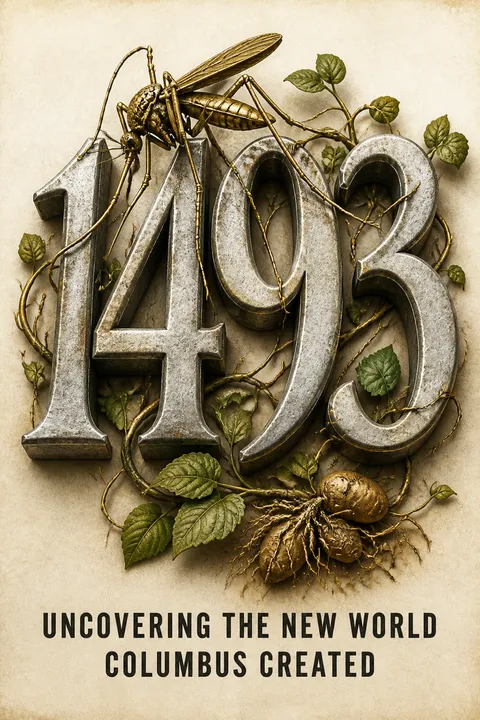


Key Takeaways
Treat 1492 as the start of a shared ecology, not a discovery story
A failed settlement mattered. La Isabela, Columbus’s first lasting European foothold in the Americas, collapsed within a few years. Yet its ships had already carried cattle, crops, insects, and microbes into ecosystems separated for millennia. The colony failed; the biological traffic did not stop.
A world remade. The Columbian Exchange is the movement of plants, animals, diseases, and people between the Americas and the rest of the world after 1492. Mann calls the resulting blending of once-distinct ecosystems the Homogenocene. Tomatoes in Italy and chili peppers in Thailand are familiar traces of a disruption that also transformed labor, wealth, and power.
The book’s central move is to make organisms historical actors. That widens the frame beyond rulers and inventions: a crop can reorganize land use, while a mosquito can alter who settles, works, or survives. This resembles systems thinking, where outcomes emerge from interacting parts rather than a single plan. The Homogenocene also complicates the popular idea that globalization is mainly a recent, digital phenomenon. The comparison should not erase earlier differences, however. A connected world is not a uniform one, and the same exchange can enrich one region while devastating another.
Watch how imported species make a colony's survival depend on ecological change
The land was not empty. Jamestown was founded inside Tsenacomoco, an Indigenous polity led by Powhatan. Its people had shaped forests with seasonal fire, planted mixed crops, and used cleared areas for food and travel. English colonists mistook this managed landscape for unused wilderness.
A colony changed its conditions. Tobacco turned Jamestown from a failing outpost into a profitable export center, but the crop rapidly depleted soil. Cattle and pigs trampled fields and consumed native foods; imported earthworms and honeybees altered forest and farm ecosystems. As English farming spread, the landscape became more familiar to Europeans and harder for Powhatan communities to sustain. Biological change helped determine the conflict’s balance alongside weapons and diplomacy.
Jamestown is a sharp corrective to the idea that settlement simply occupies vacant space. It replaces one ecological system with another, often while misreading the work already embedded in the landscape. Environmental history adds a useful question to any account of expansion: whose practices made a place productive, and whose definition of improvement prevailed? The ecological explanation does not absolve colonists of deliberate violence or dispossession. It shows how economic incentives made those choices durable, even when they destabilized the food systems on which settlers themselves depended.
Follow mosquitoes: malaria helped decide who could work and rule
Epidemics and endemic disease differ. Smallpox and other Eurasian diseases swept through Indigenous communities in devastating waves; Mann cites estimates that disease killed three-quarters or more of the Americas’ population over the sixteenth and seventeenth centuries. On Hispaniola, a Spanish count found 26,000 Indigenous people in 1514; a later observer reported fewer than 500.
Malaria persisted. Carried by mosquitoes, malaria became an enduring burden in parts of the Americas, unlike a single epidemic. It weakened European newcomers and Indigenous people, while yellow fever also killed many without prior immunity. Whether Columbus’s men had malaria at La Isabela is uncertain: the surviving Spanish word for their fever does not establish a diagnosis.
Disease makes geography active. A river, marsh, or season can become a filter on migration, military strength, and settlement patterns. The distinction between a fast-moving epidemic and a persistent endemic disease is especially valuable: the first can devastate a population quickly, while the second continually drains capacity. The book’s case is strongest when it treats disease as one influence among many. Historical diagnosis is often indirect, and mortality figures are disputed, so the biological explanation should sharpen political history rather than replace it.
Silver joined continents while governments struggled to control its current
A Pacific trade took shape. Spanish silver from the Americas crossed to Manila, where Chinese merchants exchanged silk, porcelain, and other goods. The galleon trade linked the Americas, Europe, and Asia in a sustained global network. Estimates suggest that between a third and a half of American silver ultimately reached China.
Money reshaped policy. Ming China had struggled with unreliable coins and paper currency, so merchants increasingly used silver. The government eventually required silver for taxes, creating intense demand for the metal. Silver also helped finance state projects, but fluctuating supply and value strained public revenue. Spain, too, borrowed against future silver and repeatedly defaulted. Trade could create mutual gains while weakening governments that could not manage its effects.
The silver route shows why trade is not just a meeting of willing buyers and sellers. It is also a contest over currency, taxation, military capacity, and control of markets. This distinction helps explain why states may welcome commerce and restrict it at the same time. The episode also anticipates a modern concern: dependence on a resource or payment system controlled beyond national borders. Still, neither Spain’s crises nor the Ming collapse can be reduced to silver alone. The book presents silver as a powerful link in chains of causes, not a solitary explanation.
Let hardy crops feed more people, but count the hills they expose
American crops filled a gap. Sweet potatoes and maize could grow in Chinese uplands where rice and wheat struggled. Sweet potatoes spread rapidly in Fujian during periods of failed harvests; near Yuegang, some accounts say they fed as much as 80 percent of the local population. These crops supported settlement and helped China’s population grow dramatically.
More food changed the terrain. As farmers moved into steep, thin-soiled hills, they cut forests and planted crops. Rain then carried soil downhill, damaged irrigation systems, and worsened floods in the rice-growing valleys below. The Qing also encouraged migration and pursued other population-supporting policies, so American crops were not the sole cause of growth or ecological strain. Their high yields nevertheless helped make expansion possible.
This is a classic feedback loop: a technology solves one constraint, enabling growth that creates new constraints elsewhere. The relevant unit is not just the farm or crop, but the watershed connecting upland fields to downstream rice systems. That perspective is now central to ecological economics, which asks whether private gains shift costs onto neighbors or future generations. The book’s account is persuasive as a mechanism, but its population and flood history includes multiple interacting causes. The lesson is not that productive crops are harmful; it is that yield alone is an incomplete measure of success.
Productivity without diversity turns food abundance into famine risk
The potato changed European diets. A crop domesticated in the Andes yielded abundantly and could be harvested between grain seasons. In Ireland, some laborers ate little besides potatoes. The crop helped reduce routine famine and supported population growth across northern Europe.
Uniformity made failure catastrophic. Many Irish farmers relied heavily on one variety, the Lumper. When potato blight spread in the 1840s, the harvest collapsed and more than a million people died or emigrated. The blight likely reached Europe from the Andes, possibly by way of guano ships, although that route is not proven. Modern farming methods and concentrated reliance on a single crop magnified the disaster; British relief and food policy remain part of the historical debate.
The potato’s history captures a central tradeoff in agriculture: specialization can raise output while narrowing the system’s defenses. Genetic diversity functions like a portfolio, making it less likely that one pathogen will destroy every crop at once. That principle applies beyond farming to supply chains and energy systems. Yet diversity alone cannot prevent famine when political choices restrict access to food. The Irish catastrophe was biological and social: crop failure became mass suffering within a particular structure of land, poverty, and governance.
Malaria made coerced African labor profitable where Europeans kept dying
Disease altered labor economics. In malaria-prone plantation regions, European servants and Indigenous captives often died at high rates. Many people from West and Central Africa had inherited resistance to vivax malaria and acquired protection against some malaria strains through repeated exposure. That did not make them safe from enslavement or other diseases; it made them more likely to survive than European newcomers in certain places.
Institutions followed incentives. Planters increasingly relied on enslaved Africans for tobacco, rice, and sugar production. The book connects disease risk to extractive states, colonial systems built to extract labor and wealth while investing little in local institutions. Malaria strengthened the economic case for slavery, but slavery existed elsewhere without malaria and cannot be explained by disease alone.
This argument shows how biological differences can be converted into social inequalities by institutions. Resistance that might seem advantageous in one setting became a resource exploited by plantation owners. The connection is disturbing precisely because it does not require a consciously designed plan: repeated survival advantages can shape investment and imitation over time. A useful caution is that genetic explanations can be misused to naturalize hierarchy. The book resists that move by distinguishing biological resistance from social power and by treating slavery as a political choice reinforced by disease, not dictated by it.
Count Africans and Asians as builders of the modern Americas
Migration was not mainly European. Between 1500 and 1840, an estimated 11.7 million captive Africans crossed the Atlantic, compared with roughly 3.4 million European migrants. Africans built, farmed, transported, and defended colonial societies, often alongside Indigenous people and people of mixed ancestry.
Cities made the exchange visible. Mexico City drew Africans, Europeans, Indigenous people, and Asians arriving through the Pacific trade. Juan Garrido, an African man who served with Spanish forces, helped establish wheat cultivation there. Chinese and Filipino migrants worked as sailors, craftspeople, and barbers. Colonial authorities tried to sort mixed populations into categories through the casta system, but people crossed and manipulated those boundaries.
Changing the demographic frame changes the story of the Americas. It shifts attention from a small cast of European founders to the people whose labor and knowledge made colonial economies function. Mexico City also demonstrates that globalization was not simply Atlantic: Pacific routes carried Asian people and expertise into American urban life. The language of categories matters here. Casta labels reveal official attempts to impose hierarchy, but they should not be mistaken for stable descriptions of how people understood themselves or lived.
Read maroon communities as political societies, not disappearing fugitives
Escape created new powers. Maroon communities were settlements of people who escaped slavery, often joined by Indigenous allies and other outsiders. Palmares in Brazil grew into a fortified, multiethnic society with perhaps tens of thousands of residents. It farmed crops from Africa and the Americas, built defenses, and resisted repeated attacks before Portuguese forces destroyed its capital in 1694.
Some communities won autonomy. In Panama, Spanish authorities eventually recognized maroon settlements and negotiated terms that secured freedom and self-rule. Across the Americas, communities such as Yanga’s in Mexico survived through military resistance, diplomacy, and adaptation. Their descendants often shaped forests and river landscapes through cultivation, fishing, and selective tree planting.
The maroon story restores political agency to people usually presented only as victims. These communities were not simply places to hide; they developed institutions, strategies, and shared cultures under extreme pressure. Their alliances also undermine tidy racial divisions: African, Indigenous, and European people could occupy the same political world. The survival of some communities depended on negotiation as well as resistance, a reminder that autonomy often comes in imperfect forms. Recognizing that history can also change present-day debates about land rights and conservation.
Ask who gets globalization's gains and who inherits its damage
Rubber powered industry. Natural rubber from Amazonian trees became essential for tires, electrical insulation, and machinery. In 1876, Henry Wickham carried about 70,000 rubber seeds from Brazil to Britain; only around 2,700 sprouted. Their descendants helped establish vast Asian plantations, shifting the industry away from the Amazon.
Efficiency concentrated risk. Plantations of genetically similar trees produced rubber efficiently but left forests and communities exposed to ecological damage and potential disease. Chinese investment has since helped spread rubber cultivation into Laos, bringing income and roads while also displacing forest uses and increasing pressure on water. The book closes with gardens as a model of exchange remade locally: imported plants can become home, but costs should not be exported to people with little power.
This closing tension is more useful than a simple verdict for or against globalization. Rubber created livelihoods and supported industrial life, while its production shifted ecological and social costs onto distant communities. Economics calls such spillovers externalities: costs borne by people outside the transaction. The book’s garden image offers a practical counterpoint, because gardeners experience and adapt to consequences directly. Yet local control is not automatically sustainable, and global markets are not automatically predatory. The key questions are who decides, who benefits, and who can refuse.
Analysis
1493 reframes globalization as a coupled biological, economic, and political process. Its strongest insight is causal layering: silver moves across oceans, crops alter food systems, disease changes labor markets, and each shift changes the conditions for the next. This is more than a broad cast of colorful examples. It is an argument that history becomes unintelligible when organisms and landscapes are treated as scenery.
The book also challenges the moral shorthand of globalization as either shared prosperity or exploitation. Both outcomes coexist, but they are distributed unevenly. A crop can prevent famine and drive deforestation; trade can enrich merchants while undermining state revenue; a plantation can connect continents while imposing coercive labor. The final question is therefore institutional: who controls exchange, who absorbs its risks, and who has the power to adapt?
The method has limits worth keeping in view. Some links, especially between ecological change and major political outcomes, are well-supported mechanisms but not definitive single causes. The proposed role of American reforestation in the Little Ice Age, the timing of malaria’s arrival, and the contribution of particular crops to dynastic collapse remain contested or difficult to isolate. That uncertainty strengthens rather than weakens the book’s broader lesson: complex histories demand causal humility. Mann’s narrative is most convincing when it shows how ecological forces alter probabilities and incentives, not when a single species seems to explain an empire’s fate.
The enduring contribution is a new scale of historical attention. A reader can look at a garden, a disease zone, or a commodity chain and see not timeless background but accumulated human choices and biological migrations. The modern world was not simply built by people mastering nature. It emerged from people, organisms, and institutions repeatedly changing one another, often without understanding the consequences.
Review Summary
1493: Uncovering the New World Columbus Created examines the global consequences of Columbus's voyages, exploring the Columbian Exchange of plants, animals, and microbes between continents. Mann details how this exchange reshaped economies, ecosystems, and societies worldwide, from the spread of malaria to the rise of the potato. Reviewers praise Mann's engaging writing and fascinating insights, though some note occasional oversimplification. The book offers a fresh perspective on globalization's origins and impacts, challenging readers to reconsider their understanding of world history and the interconnectedness of our modern world.
People Also Read

Glossary
Columbian Exchange
global transfer of lifeThe movement of plants, animals, microorganisms, diseases, and people between the Americas and the rest of the world after Columbus’s voyages. The exchange joined previously separated ecological regions and reshaped diets, populations, economies, and landscapes. The term was developed by historian Alfred W. Crosby and is central to Mann’s account.
Homogenocene
era of ecological mixingA proposed biological era in which formerly distinct ecosystems become more alike through the movement and establishment of organisms across oceans and continents. In Mann’s usage, the process began with post-1492 exchanges and continues through modern trade and transport. The term emphasizes that globalization is ecological as well as economic.
extractive states
systems built to extract wealthColonial systems organized to take labor and resources from a population while offering little investment in broadly shared institutions such as schools, infrastructure, or political participation. Mann uses the term, developed by economists Daron Acemoglu, Simon Johnson, and James Robinson, to describe places where disease limited permanent European settlement and distant owners relied on coerced labor.
seasoning
newcomers' disease adjustmentA colonial term for the period after arrival in an unfamiliar climate when migrants were expected to become sick, especially from diseases such as malaria. In Virginia, the first year could be fatal for many newcomers. The word made illness seem like a routine adjustment, even when it meant severe suffering or death.
Malthusian trap
population outpaces food capacityThe condition in which population growth repeatedly catches up with gains in food production, leaving people vulnerable to scarcity and famine. Thomas Malthus argued that population tends to grow faster than subsistence. Mann also highlights an ecological version: efforts to feed more people can degrade land and water systems, provoking social crisis.
casta system
colonial ancestry rankingA loose, locally enforced system in Spanish America that classified people according to ancestry and assigned social, legal, and moral meanings to those categories. Terms such as mestizo and mulatto described particular mixtures, while additional labels multiplied. The categories were never consistently applied, and people sometimes used or challenged them to improve their circumstances.
transculturation
cultural borrowing reshaped locallyA process in which people adopt something from another culture, such as a food, song, or practice, then adapt it to local needs and meanings. Mann uses the term, coined by Cuban scholar Fernando Ortiz, to describe how constant exchange produces new cultural forms rather than simple copying. A familiar garden can therefore contain a history of global movement.
FAQ
What's 1493: Uncovering the New World Columbus Created about?
- Exploration and Exchange: The book examines the ecological and economic consequences of Columbus's voyages, focusing on the Columbian Exchange that reshaped global interactions.
- Impact on History: It illustrates how the exchange of plants, animals, and diseases transformed societies on both sides of the Atlantic, leading to significant historical changes.
- Globalization Origins: Mann posits that Columbus's voyages initiated a new era of globalization, creating interconnected economies and ecosystems that continue to influence the modern world.
Why should I read 1493: Uncovering the New World Columbus Created?
- Rich Historical Insight: Charles C. Mann provides a detailed narrative that challenges traditional Eurocentric views of history, filled with fascinating anecdotes and well-researched details.
- Ecological Perspective: The book offers a unique ecological perspective on historical events, showing how biological exchanges shaped human societies.
- Relevance to Modern Issues: Themes of interdependence and ecological impact resonate with current discussions about globalization and environmental sustainability.
What are the key takeaways of 1493: Uncovering the New World Columbus Created?
- Columbian Exchange Significance: The book emphasizes the importance of the Columbian Exchange, which fundamentally altered agricultural practices and population dynamics globally.
- Human and Environmental Interactions: Mann illustrates how human actions, such as colonization and trade, have profound effects on the environment.
- Cultural and Economic Interconnections: The narrative highlights how interconnectedness of different cultures and economies began with Columbus's voyages, shaping modern globalization.
What are the best quotes from 1493: Uncovering the New World Columbus Created and what do they mean?
- “The Columbian Exchange has shaped everything about the modern world.” This underscores the book's thesis that exchanges initiated by Columbus's voyages have lasting impacts on global agriculture, economies, and societies.
- “Columbus’s voyage did not mark the discovery of a New World, but its creation.” This challenges the traditional narrative of discovery, suggesting Columbus's actions led to a new global system.
- “Every place has played a part in the human story.” This emphasizes the interconnectedness of human history, suggesting all cultures and regions have contributed to the global narrative.
How does 1493: Uncovering the New World Columbus Created connect to the concept of globalization?
- Global Economic Systems: Mann argues that Columbus's voyages initiated a global economic system that interconnected Europe, Africa, and the Americas.
- Cultural Interactions: The book illustrates how the Columbian Exchange led to significant cultural interactions and transformations.
- Environmental Changes: Mann highlights that globalization is also an ecological phenomenon, as the movement of species and diseases has had profound effects on environments and human health.
What role did disease play in the narrative of 1493: Uncovering the New World Columbus Created?
- Epidemic Consequences: Diseases brought by Europeans, such as smallpox, decimated indigenous populations in the Americas, altering the social and political landscape.
- Malaria's Spread: Mann discusses how malaria became endemic in the Americas, affecting labor dynamics and economic decisions.
- Long-term Impacts: The introduction of diseases is portrayed as a critical factor in the success of European colonization efforts.
How does 1493: Uncovering the New World Columbus Created address the ecological impacts of Columbus's voyages?
- Ecosystem Interactions: The Columbian Exchange led to the mixing of previously isolated ecosystems, resulting in significant ecological changes.
- Agricultural Transformations: The introduction of crops like tobacco and sugarcane transformed agricultural practices, leading to deforestation and soil depletion.
- Biodiversity Loss: Mann highlights the negative consequences of these exchanges, including the loss of biodiversity and the alteration of landscapes.
What is the significance of tobacco in 1493: Uncovering the New World Columbus Created?
- Economic Driver: Tobacco became a key economic driver in the early American colonies, leading to the establishment of a plantation economy reliant on slave labor.
- Cultural Exchange: Tobacco became a global commodity, influencing social practices and economies in Europe, Africa, and Asia.
- Environmental Consequences: The ecological impact of tobacco cultivation included soil depletion and deforestation.
How does 1493: Uncovering the New World Columbus Created depict the relationship between Europeans and indigenous peoples?
- Complex Interactions: The relationship was marked by both conflict and cooperation, with instances of trade and cultural exchange.
- Power Dynamics: Europeans often exploited indigenous populations for labor and resources, facilitated by the introduction of diseases.
- Cultural Misunderstandings: Differing views on land use and ownership led to conflicts that shaped the course of colonization.
How did the Columbian Exchange affect global agriculture according to 1493: Uncovering the New World Columbus Created?
- Introduction of New Crops: Crops like potatoes and maize were introduced to Europe and Asia, significantly increasing food production.
- Shift in Farming Practices: New agricultural techniques and crops led to the decline of traditional practices and the rise of monoculture farming.
- Economic Transformations: The increased food supply allowed for greater urbanization and economic development.
What role did silver play in the Ming dynasty's economy as discussed in 1493: Uncovering the New World Columbus Created?
- Silver as Currency: Silver became a crucial medium of exchange, replacing traditional currencies and leading to a "silverization" of the economy.
- Economic Instability: Reliance on silver created volatility, with fluctuations in its availability leading to economic chaos.
- International Trade Dynamics: The demand for silver fueled trade with regions like Japan and the Americas, intertwining the Ming economy with global markets.
How does 1493: Uncovering the New World Columbus Created relate to contemporary issues?
- Globalization: Mann's exploration of historical exchanges provides insights into the roots of modern globalization.
- Environmental Concerns: The discussion of introduced species and ecological disruption resonates with contemporary environmental issues.
- Cultural Identity: Themes of cultural exchange and adaptation are relevant to discussions of identity in a globalized world.
About the Author
Other books by Charles C. Mann

Download PDF
Download EPUB
.epub digital book format is ideal for reading ebooks on phones, tablets, and e-readers.








