

Key Takeaways
Treat control of reality as the regime's deepest form of power
Power reaches beyond force. The essays return to a central horror in Orwell's novel: the Party does not settle for controlling people’s actions. It tries to dictate what counts as real, rewriting records, changing public claims, and demanding that citizens distrust their own memories. Technology helps, but the more frightening machinery is the system that joins surveillance to censorship, propaganda, and bureaucracy. A telescreen matters less as a gadget than as part of that integrated structure.
Ask who controls the record. The Ministry of Truth alters history so that the Party appears consistent and successful. In the editors’ account, Orwell’s warning is not confined to one regime or ideology. Any institution that concentrates power over information can make resistance harder by making alternatives difficult to see.
What's striking is the shift from treating propaganda as a lie told by a leader to treating reality as an institutional achievement. Records, media, and shared standards determine whether people can check claims against one another. That makes resistance partly a question of infrastructure: who preserves evidence, who can inspect it, and who is trusted to interpret it? The frame is powerful, though it should not make every disputed account seem like a totalitarian project. Scale, accountability, and the possibility of correction matter.
Ask what power produces, not only what it forbids
Control can channel desire. In a discussion drawing on Michel Foucault, the book challenges the simple idea that power works only by banning sex. A regime can also organize sexuality, shape what people know about it, and direct desire toward its own purposes. Winston imagines that sexual freedom would topple the Party. Julia is less grandiose: private pleasure is a small, practical refusal to obey.
History makes the point concrete. Early Soviet policy loosened some sexual restrictions while also treating intimacy and reproduction as matters for state organization. In Romania, Nicolae Ceausescu's 1966 Decree 770 banned abortion and restricted contraception to raise birth rates. Women were expected to produce children for the state. The different examples show power operating through permission and obligation, not just prohibition.
This distinction helps explain why removing a rule does not automatically produce freedom. Institutions can convert apparent choice into a tool of governance, especially when they control education, family policy, or access to resources. The analysis also complicates the idea that private pleasure is inherently revolutionary: Julia's defiance protects a small space for herself, but does not by itself alter the system. Both forms of resistance matter, yet they work at different scales and should not be mistaken for one another.
Keep independent records and language alive against manufactured memory
Words shape what can be thought. Newspeak is the Party's planned language, designed to remove vocabulary and narrow the range of ideas citizens can express. Doublethink is the trained ability to accept conflicting claims while suppressing awareness of the conflict. Crimestop is the habit of stopping oneself from following a thought that might challenge Party doctrine. Together, these techniques turn self-censorship into a routine.
Evidence creates a foothold. Winston once finds a photograph that contradicts the official past, but destroys it instead of preserving it. Another essay connects the danger to Soviet biologist Trofim Lysenko, whose politically favored claims displaced evidence-based genetics and helped purge dissenting scientists. Independent records, open inquiry, and precise language make it possible to compare official claims with reality, even when they cannot guarantee safety.
The account links personal memory to public institutions: an individual can remember, but shared evidence lets others verify and carry that memory forward. This is why libraries, archives, scientific standards, and independent journalism are not merely technical services. They help a society retain the ability to disagree with authority on factual grounds. Yet records do not interpret themselves. Evidence needs context, and a healthy information system needs both protected access and accountable methods for deciding what the evidence supports.
Build cross-group understanding before expecting the majority to revolt
Numbers alone do not create power. Winston believes the proles, who make up roughly 85 percent of Oceania's population, could overthrow the Party. Yet their poverty, limited education, and focus on immediate grievances keep them from seeing their shared political position. The chapter extends the puzzle to societies where many people face insecurity but do not organize around common interests.
Division protects the hierarchy. Propaganda, nationalism, and war encourage people to identify with a nation or political faction rather than with others who share their economic conditions. The chapter also describes a modern version of the problem: people often select media that confirms their existing views, then assume opponents are dishonest rather than mistaken. Resisting this pattern means finding specific issues on which people across group lines can cooperate.
The useful insight is that political awareness is social, not simply a matter of individual intelligence. People need language for shared problems, trustworthy channels for discussion, and opportunities to act together. At the same time, the account risks making ignorance sound like the sole cause of political passivity. People may understand unfairness and still lack time, safety, money, or organizing power. Better dialogue matters, but structural barriers can prevent knowledge from becoming collective action.
Make surveillance answerable by making power visible too
Watching is not the only danger. One contributor argues that complete privacy is not a realistic option in a world where people routinely communicate through monitored digital systems. He argues that targeted surveillance can also burden dissidents disproportionately, since suspicion can extend to their friends and associates. His controversial proposal is to make surveillance reciprocal: people should be able to inspect what governments and companies collect and how they use it.
Power is not only governmental. Another essay broadens the warning to corporations, media owners, and other non-state institutions that can shape public information. Its reading of Orwell focuses on concentrated power, not simply a large central government. Transparency, whistleblowing, and public accountability are offered as safeguards, although the contributors do not agree that openness alone resolves the threat.
The proposal to expose powerful institutions rather than promise perfect secrecy is a useful challenge to easy slogans about privacy. It emphasizes asymmetry: surveillance becomes politically dangerous when one side can observe while the other cannot question or audit. But public disclosure cannot erase the harms of collection, and making everyone equally visible may normalize a system that should instead be limited. A defensible approach has to weigh transparency against data minimization, legal oversight, and protection for people who challenge authority.
Protect intimate bonds and embodied difference from political standardization
Love is particular. Several essays treat Winston and Julia's relationship as more than a sexual offense. Their attachment gives them a private loyalty that does not belong to the Party. One contributor argues that love cannot be manufactured by command because it depends on valuing a specific person. O'Brien first encourages the lovers' trust and hopes, then uses their attachment as leverage to break them.
Difference survives in small forms. Another essay uses Adorno's term the nonidentical for what resists being reduced to a category or political scheme. In the novel, natural landscapes, birdsong, physical discomfort, and unscripted affection briefly reveal that life is not wholly standardized. This is not a guarantee of victory. The essays present such experiences as evidence that the Party's claim to total control is incomplete.
This account makes resistance intimate as well as political. Relationships create obligations that cannot be neatly absorbed into a collective slogan, while attention to bodily experience can expose conditions that public language has normalized. Still, emotion is not automatically humane: empathy can be directed toward an in-group, and shared feeling can fuel hostility toward outsiders. The point is not to trust feeling instead of thought, but to protect the freedom to care, judge, and form attachments beyond the state's approved script.
Defend sleep and attention from the economy's permanent broadcast
Rest protects mental space. An essay on sleep argues that sleep is active, not a simple shutdown: the brain continues important work, including processing memories and emotion. In Oceania, constant work, announcements, and monitoring leave Winston exhausted and unsure of his own thoughts. The chapter connects this to the modern always-on environment of phones, alerts, and round-the-clock news.
Time has political costs. Another essay provocatively compares compulsory exercise in the novel with modern fitness routines. It argues that time and energy spent exercising can displace sleep, reading, family life, or civic activity. The claim is not that movement is harmful: the author distinguishes functional activity, such as cycling to work, from exercise pursued solely for fitness. The sharper question is what a routine costs, and who has the time and energy to maintain it.
The sleep argument gives everyday attention a political dimension: uninterrupted time helps people reflect, remember, and recover from constant demands. That connection is persuasive without requiring every notification to be treated as propaganda. The exercise critique is more debatable. Physical activity can support health and social connection, and its value depends on circumstance. Its strongest lesson is not to abandon exercise, but to notice when optimization consumes the very time and relationships that make a life worthwhile.
Treat viral emotion as a rival to evidence, not proof
Attention rewards what spreads. Post-factual democracy describes a political environment in which convenient narratives shape debate more than verifiable evidence. The epilogue points to disputes over the size of Donald Trump's inauguration crowd and the false campaign claim that leaving the European Union would free a stated weekly payment for Britain's health service. These examples matter not because politicians have never lied, but because false claims can survive exposure when audiences distrust the people correcting them.
Virality is not verification. The chapter argues that online attention is scarce, while emotionally charged stories compete intensely for it. Anger and fear can make a claim spread even when its factual basis is weak. Corrections may not erase the effect of misinformation. A reader therefore needs to ask not only whether a story is persuasive, but what evidence supports it and who benefits from its circulation.
The attention-market frame explains why fact-checking alone can feel inadequate: a correction often arrives after a story has already shaped identity and emotion. The distinction between factual claims and value judgments is essential here. Evidence can settle whether a crowd was larger or a payment claim was accurate, but it cannot by itself decide what policies people should prefer. Strong public debate needs both reliable facts and open disagreement about what those facts mean.
Make philosophy a public habit, especially when claims flatter your side
Philosophy tests assumptions. The collection presents philosophy as a practical discipline for examining arguments, comparing explanations, and asking what evidence would change a belief. A satirical Ministry of Truth handbook shows how fallacies can be used to discredit opponents, misrepresent arguments, omit evidence, or provoke fear. Recognizing these tactics does not make anyone immune to persuasion, but it offers a way to slow down before accepting a convenient conclusion.
Resistance needs institutions too. The essays connect critical thought with public education, trustworthy records, democratic accountability, and the right to challenge experts and officials. The novel's appendix describes Newspeak in the past tense, suggesting that the Party's rule did not last forever. That detail complicates the despair of Winston's ending: individual resistance can fail while the conditions for truth and civic action survive elsewhere.
The collection's most useful answer to the question of resistance is neither heroic certainty nor private cleverness. It is a practice supported by shared institutions: citizens need the skills to question claims, and they need public channels where evidence can be tested without punishment. Philosophy alone cannot defeat coercion, and expertise alone cannot decide values. Its contribution is to clarify assumptions and expose weak reasoning, especially when a claim feels satisfying because it confirms existing loyalties.
Analysis
This is an anthology, not a single, tightly unified argument. Its essays circle the same political nightmare from different directions: a state that manipulates language, intimacy, memory, attention, and even the body. The most durable shared insight is that domination rarely depends on force alone. It becomes stronger when institutions shape what people can know, whom they trust, and what they are willing to care about.
The collection's disagreements are part of its value. One essay favors reciprocal transparency as a response to unavoidable surveillance, while others stress how surveillance and concentrated power can suppress dissent. One author treats exercise as a possible diversion from civic life, while another emphasizes sleep and mental recovery. These are not equivalent claims, and readers should not mistake a contributor's provocative thesis for the volume's settled conclusion. The book is most persuasive when it gives readers tools to evaluate such arguments rather than prescribing one uniform political answer.
A central tension concerns truth. Some contributors emphasize the difficulty of describing reality independently of interpretation; the epilogue insists that factual claims still need standards and reliable methods. These positions can coexist if uncertainty is not confused with arbitrariness. Evidence may be incomplete and interpretation contested, yet a claim about an observable event can still be better supported than its denial. Democracy needs room for competing values, but it cannot function if every factual correction is dismissed as partisan by definition.
The collection's practical message is therefore institutional as well as personal. Keep records, protect independent inquiry, preserve relationships outside political control, and create conditions in which disagreement can be tested publicly. Orwell offers no guarantee that resistance wins on an individual timetable. The past-tense appendix offers a narrower hope: even a regime that demands permanence may fail to own the future.
Review Summary
"1984 and Philosophy" receives high praise from readers, with an average rating of 4.29/5. Reviewers appreciate its in-depth analysis of philosophical themes in Orwell's novel, including totalitarianism, epistemology, and power dynamics. The book is lauded for its relevance to contemporary issues like surveillance and fake news. Many find it insightful and thought-provoking, with standout essays on topics such as the relationship between sex and power, and the nature of O'Brien's character. Some readers note redundancy in content due to multiple authors, but overall, it's considered a valuable addition to the Popular Culture and Philosophy series.
People Also Read




Glossary
Newspeak
Language narrowed to limit thoughtThe Party's engineered language in 1984, designed to remove words, meanings, and distinctions that could support criticism of the regime. Its goal is not merely simpler communication. By shrinking the concepts people can express, Newspeak is intended to make dissenting ideas increasingly difficult to formulate.
Doublethink
Accepting contradictions on commandA mental discipline in which a person accepts conflicting claims while suppressing awareness of their conflict. In 1984, Party members may know that records have been altered yet also accept the official version as the only truth. The collection uses the term to examine political self-deception and the pressure to conform.
Crimestop
Stopping dangerous thoughts earlyThe learned habit of interrupting one's own reasoning when it approaches an idea considered disloyal. It includes avoiding inconvenient comparisons, failing to notice contradictions, or dismissing an argument before examining it. Crimestop helps explain how censorship can become internal, with citizens enforcing limits on their own thought.
Reality control
Forcing memory to match authorityThe Party's practice of making citizens' memories and beliefs conform to its current account of events. Records are revised, inconvenient evidence disappears, and people are expected to forget that the official story changed. The term names an attack on both public history and individuals' confidence in their own recollection.
Post-factual democracy
Politics driven by narratives over evidenceA condition in which political narratives and emotional appeals carry more influence than verifiable facts in public debate, opinion formation, and policymaking. The epilogue links it to distrust of journalism, the spread of misleading online stories, and the incentives of a crowded information environment.
Nonidentical
What resists reduction to a categoryThe term, drawn from Theodor Adorno, for the particular and unpredictable features of people or things that cannot be fully captured by a general category. In the collection's reading of 1984, attention to nature, bodily experience, and personal attachment reveals aspects of life that political systems cannot completely standardize.
mindcasting
Broadcasting thoughts as persuasive claimsA term used in an essay about Twitter for sharing thoughts, observations, and questions in ways that aim to influence an audience. The essay connects it to political assertion: a message can gain power through repetition and audience uptake even when it offers little argument or evidence.
Ingsoc
The Party's totalitarian ideologyShort for English Socialism, Ingsoc is the Party's official doctrine in 1984. The collection treats it as an ideology that justifies hierarchy and demands control over thought, language, and public reality. Orwell's choice of name also warns against assuming that totalitarian methods belong only to one political tradition.
FAQ
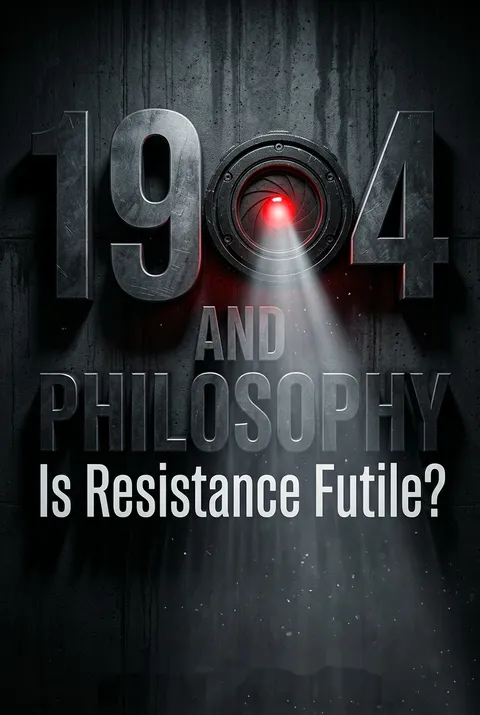
What's 1984 and Philosophy: Is Resistance Futile? about?
- Exploration of Orwell's Themes: The book examines the philosophical implications of George Orwell's 1984, focusing on themes like totalitarianism, surveillance, and freedom.
- Contemporary Relevance: It connects Orwell's insights to modern issues such as mass surveillance and misinformation, highlighting their ongoing significance.
- Resistance and Futility: A central question is whether resistance against oppressive regimes is futile, with the consensus being that it is not, emphasizing awareness and philosophical inquiry.
Why should I read 1984 and Philosophy?
- Timely Insights: The book is relevant given the rise of surveillance technologies and authoritarian tendencies in modern governance.
- Philosophical Depth: It offers a rich philosophical analysis that deepens the understanding of 1984, making it valuable for both new readers and those familiar with Orwell's work.
- Engagement with Key Concepts: Readers will engage with important philosophical concepts such as freedom, truth, and the nature of power.
What are the key takeaways of 1984 and Philosophy?
- Surveillance and Control: The book emphasizes the dangers of mass surveillance and its impact on individual autonomy, paralleling Orwell's depiction of the Party's control.
- Philosophical Resistance: It argues that philosophy can serve as a tool for resistance, encouraging critical thinking and awareness.
- Human Nature and Totalitarianism: The essays explore how totalitarian regimes manipulate human nature to maintain control, highlighting the importance of understanding our vulnerabilities.
What are the best quotes from 1984 and Philosophy and what do they mean?
- “Big Brother is watching you.”: This quote symbolizes the pervasive surveillance in Orwell's world, reflecting the loss of privacy and autonomy.
- “Freedom is slavery.”: This paradoxical slogan illustrates the Party's manipulation of language and thought, challenging readers to consider how language shapes reality.
- “Ignorance is strength.”: This phrase highlights the Party's strategy of keeping the populace uninformed to maintain power, warning against complacency.
How does 1984 and Philosophy connect Orwell's ideas to contemporary society?
- Mass Surveillance: The book discusses how modern technologies echo the surveillance state depicted in 1984, raising concerns about privacy.
- Political Manipulation: It analyzes how misinformation and propaganda are used in contemporary politics, drawing parallels to the Party's control over truth.
- Resistance Movements: The book explores how individuals and groups can resist oppressive systems today, emphasizing awareness and philosophical inquiry.
What philosophical concepts are explored in 1984 and Philosophy?
- Doublethink: This concept refers to holding two contradictory beliefs simultaneously, a key mechanism of control in 1984.
- Newspeak: The book examines how language can be manipulated to limit thought and expression, relevant to discussions about political correctness.
- Human Nature: The essays delve into the malleability of human nature and how totalitarian regimes exploit this trait.
How does 1984 and Philosophy address the question of whether resistance is futile?
- Philosophical Inquiry as Resistance: The contributors argue that engaging with philosophical ideas can empower individuals to resist oppressive systems.
- Historical Context: The book provides examples of successful resistance movements, suggesting that while the struggle may be difficult, it is not futile.
- Hope in Human Spirit: The essays convey a sense of hope, asserting that the human spirit's resilience can lead to change.
What role does technology play in 1984 and Philosophy?
- Surveillance Technology: The book discusses how technology is used as a tool for oppression, mirroring concerns about modern surveillance practices.
- Manipulation of Information: It explores how technology facilitates the spread of misinformation, drawing parallels to the Party's control over information.
- Empowerment through Technology: Conversely, the book considers how technology can empower individuals and facilitate resistance if used ethically.
How does 1984 and Philosophy interpret the concept of freedom?
- Freedom vs. Control: The book examines the paradox of freedom as presented in 1984, challenging readers to consider the true meaning of freedom.
- Philosophical Perspectives: Various essays offer different interpretations of freedom, encouraging a deeper understanding of how it can be defined and pursued.
- Collective vs. Individual Freedom: The book addresses the tension between collective security and individual freedom, exploring how societies can balance these interests.
What insights does 1984 and Philosophy provide about human relationships?
- Love and Totalitarianism: The book discusses how totalitarian regimes seek to control personal relationships, emphasizing love as a form of resistance.
- Isolation and Connection: It explores the impact of surveillance on human connections, resonating with contemporary concerns about social media and loneliness.
- Empathy as Resistance: The book suggests that fostering empathy and genuine human connections can serve as a powerful form of resistance.
How does 1984 illustrate the concept of power?
- Totalitarian Control: The book depicts a society where the Party exerts total control over every aspect of life, including thoughts and emotions.
- Surveillance and Fear: Constant surveillance creates an atmosphere of fear, ensuring compliance and obedience among citizens.
- Psychological Manipulation: The Party uses psychological tactics to break down individual resistance and reshape beliefs.
How does 1984 relate to contemporary society?
- Parallels to Modern Politics: The book's themes resonate with current issues such as political propaganda and the rise of authoritarianism.
- Impact of Technology: The role of surveillance and media in 1984 reflects contemporary concerns about privacy and social media influence.
- Critical Thinking and Resistance: The book serves as a warning about the dangers of complacency and the importance of critical thought in resisting oppressive systems.
Popular Culture and Philosophy Series Series




Download PDF
Download EPUB
.epub digital book format is ideal for reading ebooks on phones, tablets, and e-readers.








