


Key Takeaways
Test Walt's family story against the choices he refuses.
The motive keeps changing. Walt first presents meth production as a way to leave his family money after a terminal cancer diagnosis. He calculates that he needs $737,000, but refuses help from wealthy former colleagues who offer him a job or treatment funds. As the story progresses, his choices bring power, status, and the pleasure of proving his abilities. The original family rationale becomes less convincing, especially after his cancer goes into remission and he continues cooking meth.
A tragic pattern emerges. One essay compares Walt with Macbeth: both claim to act for loved ones, while pride and wounded identity help drive their crimes. The comparison makes Walt understandable, not innocent. His justifications are part of the drama because viewers can see both the need he names and the ego he may be concealing.
What's striking is how the series turns motive into something to investigate rather than accept at face value. In psychology, motivated reasoning describes how people use plausible arguments to defend conclusions that also serve their interests. Walt's family explanation can be sincere and self-serving at once. That ambiguity is more realistic than a clean reveal of either pure altruism or pure greed. The useful test is not whether a motive sounds noble, but whether the person accepts reasonable alternatives and bears the costs of the chosen path.
Judge each death by agency, intention, and the options left open.
Responsibility has degrees. The book evaluates blame through a cluster of questions: could the person choose, what did they intend, what harm followed, what reasons justified the act, and how directly did it cause the harm? These questions distinguish Walt's first killing of Emilio, made during an immediate attack, from killing the captive Krazy-8 after time to deliberate and consider alternatives.
Inaction also matters. Walt accidentally turns Jane onto her back, sees her choking, and chooses not to help. His responsibility is less direct than in a deliberate killing, but his actions helped create the danger and he could intervene. By contrast, the deaths of passengers in the plane crash are connected to Walt through a remote chain of events, making blame less clear. The point is not to count bodies, but to examine choice and proximity.
This graded approach improves on the familiar split between total innocence and total guilt. It resembles legal reasoning about intent and causation, while keeping moral duties visible even when conduct is not criminal. The Jane case is especially revealing because omission can be morally serious without being identical to direct violence. Still, causal chains are hard to weigh fairly: people often judge a known protagonist more harshly than distant contributors, or excuse a favorite character's omissions. Explicit criteria help expose those biases.
A terminal diagnosis can awaken a life without making it virtuous.
Death changes the frame. Existentialist essays present Walt's diagnosis as a shock that breaks his ordinary routine and forces him to see that his life is finite. They use being-towards-death for the awareness that mortality is not merely a distant fact, but a condition shaping how a person lives now. Another essay borrows Lacan's term the Real for an overwhelming event that breaks through the familiar story people construct about their lives. Walt's diagnosis and first murder disrupt that story.
Awareness is not absolution. Walt gains a sense of agency, but freedom also makes him answerable for what he chooses. His remission weakens the claim that crime is necessary, yet does not automatically reverse the habits and motives driving him. Facing death can clarify priorities; it cannot decide which priorities deserve pursuit.
The distinction between urgency and goodness is essential. Mortality can make neglected values vivid, but it can also narrow attention toward immediate control, pleasure, or legacy. The existential reading captures Walt's hunger to author his own life, while the moral readings resist treating self-authorship as an ethical achievement by itself. A useful extension is to ask whether a person is becoming more deliberate about values or merely less inhibited about acting on desire. Those are not the same kind of awakening.
A tidy cost-benefit calculation can hide the people outside the frame.
The arithmetic is unstable. Walt weighs choices as if he can compare his family's future security with the risks of making meth. Consequentialism judges actions by their results, but the results are difficult to predict. Walt's decisions affect Jesse, his family, drug users, business rivals, and people far outside his immediate circle. Some harms are direct; others arise through chains no one can foresee with confidence.
Different theories ask different questions. Act consequentialism judges each choice by its expected effects. Rule consequentialism asks whether a general rule allowing such choices would make life better overall. Deontological ethics emphasizes duties and constraints, while virtue ethics asks what habits and character the choices are cultivating. Walt's calculations can look efficient while still revealing pride, dishonesty, and recklessness. No single ledger settles every moral dispute.
The comparison is useful because moral decisions routinely mix prediction, principle, and character. Consequence-based reasoning forces attention to real outcomes, but it can disguise unequal burdens: a benefit to one family may be purchased with severe risks imposed on strangers. Rules can guard against that asymmetry, although rigid rules can also fail in emergencies. Character-based judgment adds a longer horizon by asking what repeated choices make easier next time. Ethical analysis is strongest when these lenses challenge one another rather than compete for a single answer.
Protect liberty without pretending producers are harmless bystanders.
Legality is not the whole argument. Drawing on John Stuart Mill, several essays discuss the harm principle: society has a stronger case to restrict conduct when it harms others, rather than merely because the majority disapproves. That raises difficult questions about drug use, since meth users may harm themselves, while addiction can also affect families and communities.
Supply carries responsibility too. One contributor argues that a cook does not force anyone to use meth and that a purer product may contain fewer dangerous contaminants. Others stress that producing and selling the drug helps sustain a market associated with addiction and serious harm. Comparisons with alcohol and tobacco expose the inconsistency of treating legal products as morally clean and illegal ones as uniquely evil. The collection favors more than a simple good-supplier, bad-user story, pointing toward help for people with addiction as well as scrutiny of the industry.
The strongest insight is that individual choice and commercial responsibility can coexist. A consumer's agency does not erase a supplier's knowledge of likely harms; a supplier's responsibility does not erase the consumer's agency. Public-health debates often improve when blame is separated from prevention: treatment, safer conditions, and reduced access to exploitative markets can matter more than sorting people into virtuous and vicious camps. The boundary remains contested, especially when addiction compromises control. That uncertainty argues for careful policy, not for pretending the problem is simple.
Respect a patient's choice by making the choice genuinely theirs.
Concern can become pressure. In a family meeting about Walt's cancer treatment, Skyler brings relatives together to change his mind. The medical ethics essay argues that this is not a neutral intervention: the group setting and emotional appeals put pressure on Walt to accept treatment. The chapter describes his cancer as advanced and treatment as uncertain, with limited expected benefit and substantial burdens. Its point is that patients need honest information about those trade-offs, not optimism used to steer them.
Support is not always coercion. Walt Jr. expresses anger without threatening to withdraw love, while Marie defends Walt's right to decide. The essay calls a freely chosen sacrifice for loved ones autonomous beneficence. Such choices can be meaningful, but outsiders may struggle to tell voluntary sacrifice from pressure. The proper response is to support the patient's decision-making and care, even when family members or clinicians disagree.
The chapter's clinical lens makes autonomy more than a slogan about individual rights. A choice is only meaningfully free when information is understandable, alternatives are visible, and emotional pressure is not disguised as neutral advice. At the same time, patients are relational beings: family commitments can be genuine reasons for choosing burdensome care, not evidence of coercion. The hard task is to distinguish a person's own values from the demands surrounding them. That distinction requires listening, not simply counting who has the strongest argument.
Efficiency becomes frightening when reason serves power without empathy.
Gus makes the danger visible. He runs a meth enterprise with the discipline of a corporation: production is organized, distribution uses his chicken restaurants, and the lab is concealed beneath a laundry facility. His careful public image contrasts with his willingness to kill, manipulate employees, and pursue revenge for the murder of his partner, Max.
Competence is not conscience. The essay uses instrumental rationality for reasoning that selects effective means to reach a goal without asking whether that goal is morally acceptable. Gus's restraint is therefore not the same as virtue or compassion. His organized methods make him more effective, not more ethical, and he foreshadows what Walt's technical skill and growing ambition can become when other people are treated chiefly as tools.
Gus is a useful counterexample to the idea that self-control is automatically moral. Delayed gratification, planning, and emotional discipline can serve care, but they can also sharpen exploitation. Contemporary institutions face the same problem when performance measures reward efficiency while leaving the human cost uncounted. The essay's sociopathic label should be treated cautiously, since a fictional character cannot be clinically assessed from a plot. The more robust point is behavioral: rational systems become dangerous when no moral limit constrains what counts as success.
Character hardens through repetition, but relationships can reshape it.
Identity is practiced. A virtue-ethics reading treats character as something formed by repeated choices, not merely a hidden essence. Walt's early hesitation, pride in his scientific work, and growing willingness to lie and kill create a pattern that becomes easier to repeat. The Macbeth comparison adds a sharper point: the acts meant to prove masculine strength repeatedly undermine Walt's family role and deepen his shame.
The supporting characters change too. Jesse is both Walt's former student and his partner, alternately protected, manipulated, and pushed toward violence. Skyler begins as a wife and mother, then becomes a financial strategist and participant in laundering Walt's money. Her choices reflect skill and agency, but also the pressure of living inside a criminal household. The series makes moral transformation relational: one person's choices alter the options and identities of others.
This account avoids the comforting idea that people simply reveal a fixed inner self. Repeated behavior can make a role feel natural, while relationships provide both constraints and new possibilities. The same view complicates blame: Skyler and Jesse make choices, but not in circumstances Walt has left untouched. Agency is real without being evenly distributed. The gender analysis matters here because domestic labor and financial competence become visible forms of power, even as women are drawn into risks created by a man's pursuit of control.
Treat scientific skill as accountable knowledge, not moral permission.
Science is powerful, not self-justifying. Walt's chemistry lets him produce unusually pure meth, improvise solutions, and use chemical knowledge in violent schemes. The science essay contrasts this expertise with Jesse's practical knowledge of local dealers and distribution. Their work succeeds through different kinds of learning, not through formal credentials alone.
Knowledge needs correction and context. Modern science gains reliability through shared methods, testing, and correction, rather than secrecy and individual flair. Yet the essay also warns against assuming that one scientific framework captures every useful form of knowledge; local and traditional expertise can matter, especially in specific environments. Technical accuracy cannot decide whether an application is humane. Walt's abilities solve the problem he chooses, but they do not make the chosen problem morally acceptable.
The distinction between knowing how and knowing whether is central to debates about dual-use research, where the same expertise can support medicine or harm. Scientific standards can make claims more reliable, but they cannot supply the ethical goals that guide their use. The collection's attention to practical and culturally situated knowledge also resists equating credentials with intelligence. A further caution is that traditional knowledge and laboratory science should not be romanticized or collapsed into one method. Their claims need evaluation appropriate to their context.
Analysis
This anthology treats Breaking Bad less as a puzzle with one moral answer than as a pressure test for the stories people tell about responsibility. Walt is sympathetic because his predicament is recognizable: precarious work, illness, wounded pride, and fear of leaving dependents behind. The series then steadily complicates that sympathy. The difference between an understandable motive and a defensible action becomes the book's central tension.
Its philosophical approaches do not fully agree, and that disagreement is productive. Existentialist readings see Walt's criminal identity as a revolt against passive living; virtue ethics sees a man cultivating destructive habits; consequentialists debate the harms he causes and the harms his product enables; libertarian arguments defend adult choice while colliding with addiction and external costs. The collection's strongest method is to let these frameworks expose one another's blind spots. Freedom without responsibility can excuse domination. Consequences without limits can justify atrocities. Rules without attention to circumstance can become cruel. Character without social context can become blame without explanation.
The television form matters. Viewers learn Walt's reasons gradually, while tension and suspense invite them to root for his ingenuity. That emotional alignment is not incidental: it demonstrates how narrative can make wrongdoing feel reasonable from inside a character's perspective. The essays ask readers to notice the gap between understanding a person and endorsing him.
The book is less a manual for moral certainty than a guide to better moral questions. Who had a choice? Who created the danger? Who was made to bear the cost? What alternatives were refused? And what kind of person is repeated action producing? Applied beyond the show, these questions challenge the familiar defense that good intentions, technical competence, or private benefit erase public harm. Walt's tragedy is compelling because each defense begins with something human and becomes a license to do more than it can justify.
Review Summary
Breaking Bad and Philosophy receives mixed reviews, with some praising its philosophical insights and connections to the show, while others criticize repetitive content and editing errors. Fans appreciate the exploration of ethical dilemmas and character development, but many note the book's limitation in covering only the first four seasons. Some essays are considered thought-provoking, particularly those on existentialism and morality, while others are seen as superficial. Overall, readers find it an interesting but flawed companion to the series.
People Also Read

Glossary
Bad faith
Self-deception about freedomIn Sartre's existentialism, bad faith is evading the freedom and responsibility involved in shaping one's life. A person may pretend to be fixed by a social role or circumstance, or act as if other people's judgments do not matter at all. The concept is used to assess Walt's changing account of who he is and why he acts.
Being towards death
Living with mortality in viewHeidegger's term for human existence understood in relation to one's own unavoidable death. Mortality is not merely a future event; awareness of finitude can shape present choices and make a person reconsider how life is being spent. The essay uses Walt's cancer diagnosis to explore this heightened awareness, without treating it as proof that his choices are good.
Autonomous beneficence
Freely chosen sacrifice for othersA term used in the medical-ethics chapter for a decision freely made to benefit another person, even when it is not in the decision-maker's own best interest. A patient might accept burdensome treatment to reach a family milestone. The concept also raises a difficult question: when does loving sacrifice remain voluntary, and when does family pressure make it coercive?
The harm principle
Restrict conduct to prevent harmAssociated with John Stuart Mill, the harm principle holds that society has grounds to restrict an individual's liberty when that person's conduct harms others. Mere social disapproval is not enough. In the book, the principle frames disputes about drug use and production, especially the boundary between self-regarding risk and harm imposed on family members, users, or communities.
Instrumental rationality
Efficient means to chosen endsReasoning that identifies effective ways to achieve a goal without deciding whether the goal itself is morally acceptable. The essay on Gus Fring uses the term to explain how discipline, planning, and organizational skill can serve criminal power. It distinguishes practical effectiveness from moral judgment, empathy, or virtue.
Rule consequentialism
Judge rules by general effectsAn ethical theory that evaluates conduct by asking whether the general rule behind it would produce good consequences if people followed it. Unlike act consequentialism, it does not judge every individual act solely by its particular outcome. The book uses the distinction to show why a helpful act can contribute to bad results without making the helper blameworthy.
The Real
What disrupts familiar realityIn the Lacanian framework used by one essay, the Real is what cannot be fully absorbed into a person's ordinary, symbolically constructed understanding of life. Traumatic events can break through that familiar frame and force it to change. The essay reads Walt's cancer diagnosis and early violence as disruptions that alter his sense of what is normal.
Heisenberg Uncertainty Principle
Limits simultaneous measurement precisionA principle in quantum physics stating that certain pairs of properties, such as a particle's position and momentum, cannot both be known with unlimited precision. One essay in the book uses the principle to suggest a metaphorical opening for uncertainty about human choice. The physics itself does not demonstrate free will; it describes limits on measurement at the quantum scale.
Clear-headedness principle
Avoid needless mental impairmentA moral principle proposed in an essay about drugs: people generally have reason to avoid activities that cloud judgment and to favor those that support clear thinking and self-command. The author treats it as a general guide rather than an absolute rule, since an impairing drug might sometimes relieve pain or prevent greater harm when no better option is available.
FAQ
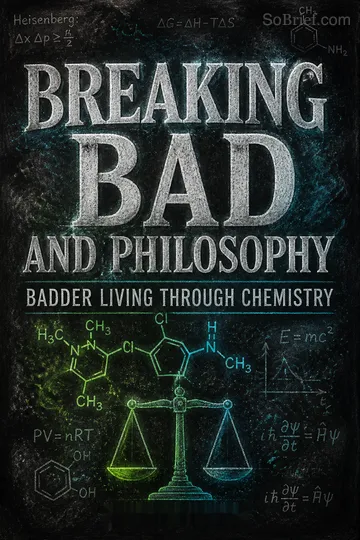
What's Breaking Bad and Philosophy: Badder Living through Chemistry about?
- Philosophical Exploration: The book delves into the philosophical, psychological, and sociological issues presented in the television series Breaking Bad, focusing on Walter White's character.
- Moral Dilemmas: It examines the ethical implications of Walt's transformation from a high school teacher to a drug lord and the consequences of his actions on his family and society.
- Philosophical Frameworks: The text references various philosophical concepts, including Nietzsche's "will to power" and existentialism, to frame Walt's journey and moral conflicts.
Why should I read Breaking Bad and Philosophy?
- Unique Perspective: The book offers a deep philosophical analysis of Breaking Bad, appealing to fans who want to understand the underlying themes and moral questions.
- Engaging Content: It presents complex philosophical ideas in an accessible manner, suitable for both casual readers and those with a background in philosophy.
- Critical Thinking: Readers are encouraged to reflect on their own moral beliefs and the nature of good and evil through the lens of Walt's choices and their consequences.
What are the key takeaways of Breaking Bad and Philosophy?
- Moral Ambiguity: The book highlights the complexity of Walter White as an anti-hero, illustrating how his motivations blur the lines between right and wrong.
- Consequences of Choices: It emphasizes that every action has repercussions, urging readers to consider the ethical implications of their decisions in their own lives.
- Philosophical Theories: The text applies various philosophical theories, such as existentialism and utilitarianism, to analyze the characters' motivations and the show's narrative.
What are the best quotes from Breaking Bad and Philosophy and what do they mean?
- “I am awake.”: This signifies Walt's awakening to his true self and the realization of his potential to break free from societal norms, marking his transformation.
- “A man provides for his family.”: This reflects Walt's justification for his illegal actions, suggesting he believes his criminal behavior is acceptable if it secures his family's future.
- “Things bad begun make strong themselves by ill.”: This quote from Macbeth parallels Walt's journey, indicating that once he starts down a dark path, it becomes easier to continue making morally questionable decisions.
How does Breaking Bad and Philosophy analyze Walter White's character?
- Transformation into Anti-Hero: The book discusses Walt's evolution from a meek teacher to a powerful drug lord, exploring the psychological factors driving this change.
- Moral Conflicts: It examines the internal struggles Walt faces as he justifies his actions, often rationalizing his criminal behavior as necessary for his family's well-being.
- Philosophical Implications: The text connects Walt's journey to philosophical concepts, such as Nietzsche's "will to power," illustrating how his desire for control and recognition shapes his decisions.
What philosophical concepts are discussed in Breaking Bad and Philosophy?
- Will to Power: Nietzsche's idea that individuals strive to assert their influence and control over their environment is a central theme in Walt's transformation.
- Existentialism: The book explores existentialist themes, particularly the idea of creating one's own meaning and identity in a seemingly indifferent universe, as seen in Walt's choices.
- Moral Relativism: It discusses the notion that moral judgments can vary based on context, highlighting how Walt's actions can be interpreted differently depending on one's ethical framework.
How does Breaking Bad and Philosophy address the ethical implications of drug manufacturing?
- Complex Moral Landscape: The authors argue that while drug manufacturing is illegal, Walt's motivations complicate the moral evaluation of his actions, raising questions about societal norms.
- Consequences for Society: The book examines the broader impact of drug trade on communities, including addiction and violence, prompting readers to consider societal responsibilities.
- Personal vs. Societal Ethics: It contrasts Walt's personal justifications for his actions with the ethical implications for society, encouraging reflection on the balance between individual desires and collective well-being.
How does Breaking Bad and Philosophy relate to contemporary societal issues?
- Reflection of Modern Dilemmas: The book connects Walt's story to real-world issues such as economic hardship, addiction, and the moral complexities of survival in a challenging society.
- Critique of the American Dream: It questions the attainability of the American Dream, suggesting that Walt's descent into crime is a response to systemic failures and societal pressures.
- Ethical Considerations in Crisis: The authors encourage readers to reflect on their own ethical beliefs and choices in times of personal or societal crisis, drawing parallels to Walt's journey.
How does Breaking Bad and Philosophy critique societal norms regarding drug use?
- Cultural Context: The book critiques the cultural context that shapes perceptions of drug use, arguing that societal norms often dictate what is considered acceptable or taboo.
- Double Standards: It highlights the double standards in society's treatment of different drugs, such as alcohol and meth, reflecting cultural biases rather than objective moral reasoning.
- Impact on Policy: The critique extends to drug policy implications, suggesting laws should be informed by a nuanced understanding of individual liberty and harm rather than moralistic judgments.
What ethical theories are discussed in Breaking Bad and Philosophy?
- Consequentialism: Explored through utilitarianism, which evaluates actions based on their outcomes, discussing how Walt's decisions can be seen as morally acceptable if they lead to greater overall happiness.
- Deontology: Contrasts consequentialism with deontological ethics, focusing on the morality of actions themselves rather than their consequences, highlighting challenges in adhering to moral rules.
- Virtue Ethics: Emphasizes the importance of character and moral integrity, arguing that Walt's transformation into Heisenberg represents a departure from virtuous behavior.
How does Breaking Bad and Philosophy address the concept of liberty?
- Individual Sovereignty: Discusses John Stuart Mill's concept of individual sovereignty, arguing for freedom to make choices as long as they do not harm others, framing Walt's decision to cook meth.
- Societal Authority: Examines the tension between individual liberty and societal authority, questioning when society is justified in intervening in personal choices.
- Consequences of Liberty: Explores the consequences of exercising liberty, particularly in the context of drug use and addiction, raising questions about responsibilities that come with freedom.
What philosophical questions does Breaking Bad and Philosophy raise about morality?
- Nature of Morality: Raises questions about whether morality is absolute or relative, challenging readers to consider how context, intention, and consequences shape moral judgments.
- Role of Intentions: Explores the role of intentions in moral evaluations, questioning whether good intentions can justify harmful actions.
- Complexity of Ethical Decisions: Emphasizes the complexity of ethical decisions, illustrating that moral dilemmas often involve competing values and interests, encouraging engagement with these complexities.
Popular Culture and Philosophy Series Series

Download PDF
Download EPUB
.epub digital book format is ideal for reading ebooks on phones, tablets, and e-readers.








