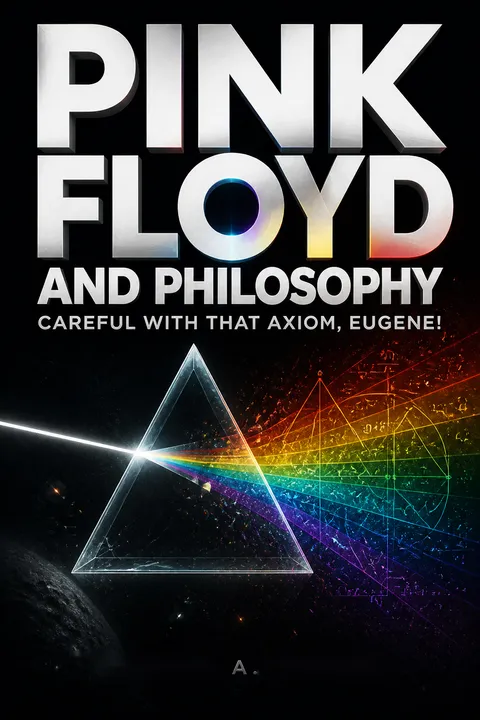


Key Takeaways
Hear Pink Floyd as philosophy built into sound, not lyrics alone.
A changing musical vision. The book traces Pink Floyd from Syd Barrett’s playful, uncanny songs toward the more structured albums shaped by Roger Waters. Barrett’s music wonders how the world might appear to a cat, a scarecrow, or an outsider. After Barrett left, the band struggled to find direction, then developed a spacious, deliberate sound on Meddle and The Dark Side of the Moon. The 1971 film Live at Pompeii captures them performing in an ancient arena without an audience, an apt image for music preoccupied with isolation, time, death, madness, and connection.
Sound carries the argument. Long forms, recurring motifs, sound effects, silences, and shifts in intensity make the albums feel like journeys through those ideas. Their meaning is not confined to the words.
What's striking is how the book treats arrangement as an argument. A clock collage can make time feel intrusive before a lyric explains why it matters; a returning musical phrase can make a listener feel trapped in repetition. This resembles embodied cognition, the idea that thought is shaped partly by bodily sensation and action. The music does not merely illustrate a thesis. It makes certain emotional conditions perceptible. That approach has limits: an audience can feel dread or spaciousness without sharing the songwriter's interpretation. The gap between musical effect and intended message is part of the art's power.
Let mortality disrupt the life you keep postponing.
Time is not a rehearsal. On The Dark Side of the Moon, the song “Time” turns the passage of years into a sudden confrontation: a person can spend youth preparing for life, then discover that life has been underway all along. Its clocks, lyrics, and guitar solo make that realization felt rather than merely stated. The album also links time to work that never seems finished, and to death as the limit that makes choices matter. Waters described the record as a call to resist greed, violence, and self-absorption, and to decide what kind of mark to leave.
Choose your own ground. The point is not to optimize every hour. It is to stop waiting for permission, certainty, or a perfect future before taking responsibility for the present.
Mortality can clarify priorities, but it can also be misused as a productivity whip. The book's stronger claim is ethical: a finite life makes attention and responsibility consequential, including how people treat one another. Research on time perspective suggests that people often value relationships and meaningful activity more when time feels limited, though such shifts depend on circumstance and are not simply a matter of attitude. The album's warning about delay therefore works best as a prompt to examine inherited plans, not as pressure to turn every moment into an achievement.
Trace alienation from private pain to the systems shaping it.
The problem has several sources. The book uses alienation to mean estrangement from something a person should be connected to. It can separate workers from their labor, artists from audiences, people from nature, and individuals from their own values. Animals makes this social diagnosis through three animal types: dogs pursue advantage through ruthless competition, pigs abuse political or moral authority, and sheep accept a comforting culture that hides exploitation. The album does not treat one institution as the sole villain. Markets can produce useful goods, governments can check abuses, and communities can sustain care, but each can also distort the others.
Beware easy answers. Its closing movement returns to mutual concern without pretending that empathy alone removes powerful interests or structural harms.
The album's animal allegory works like a compact model of institutional life. It asks how incentives, authority, and shared beliefs can reinforce each other, rather than locating every injustice in a single bad actor. That systems perspective connects naturally to political economy and organizational research, where outcomes often emerge from rules and incentives that individuals did not design. The caution is that allegory simplifies: real people can occupy several roles at once, and institutions vary widely. The framework is useful as a diagnostic, not as a literal classification of citizens.
Practice empathy as a real encounter, not a sentimental slogan.
From objects to people. Drawing on Martin Buber, one chapter contrasts the I-It relation, in which another person is treated as an object to measure or use, with the I-You relation, a reciprocal encounter with someone as a whole person. The book connects the second mode to the empathy at the center of “Echoes,” where two strangers briefly recognize themselves in each other. Such encounters can transform both people, but they are fleeting. Reflection and categorization can turn a person back into an object, so relationship requires renewed attention rather than one permanent act of insight.
Care must reach action. The argument is not that institutions can be replaced by kindness. It is that a humane community depends on people seeing others as more than functions, labels, or obstacles.
This distinction has practical force in workplaces, schools, and public services, where efficiency can quietly reduce people to cases, metrics, or labor units. The encounter model reminds readers that recognition is a form of respect, not simply warmth. It also corrects a common misunderstanding: treating someone as a whole person does not require abandoning analysis or boundaries. A doctor, teacher, or manager needs categories to do a job, but those categories should remain tools rather than definitions of the person. Care and competent structure can coexist.
Treat striking coincidences as interpretations, not proof of design.
A mashup can feel meaningful. The Dark Side of the Rainbow pairs The Dark Side of the Moon with The Wizard of Oz. Listeners report moments when a lyric, sound, or musical shift seems to match an image onscreen. The book notes that the band and album makers denied deliberately planning the synchronization. It explains the experience through apophenia, the human tendency to notice meaningful patterns among unrelated events. This capacity can support discovery and creativity, but it can also make accidents seem intentional. The comparison can still matter to a viewer because both works explore ordinary life, longing, and the desire to escape it.
Meaning is not a hidden cause. A coincidence may prompt a valuable interpretation without proving that one work was designed to fit the other.
Pattern recognition is both an engine of insight and a source of error. Science depends on noticing possible connections, then testing whether they survive controlled comparison. A film and album provide almost unlimited opportunities for selective attention: viewers remember the striking matches and overlook the mismatches. That does not make the experience worthless. It shifts the claim from secret coordination to collaborative interpretation, where the audience supplies part of the connection. This distinction protects wonder without asking coincidence to carry more evidence than it can.
Honor Barrett's artistry without turning psychological collapse into a myth.
A powerful but risky lens. The book's chapters on Barrett use Nietzsche's contrast between Apollonian form, associated with images and order, and Dionysian force, associated with intoxication and the dissolution of individual boundaries. Barrett's imaginative songs and experimental performances invite this reading, while his later withdrawal from the band gives it tragic weight. His peers moved toward more carefully planned compositions after his departure. But this is a philosophical interpretation, not a medical explanation of what happened to him. The text describes several possible influences, including illness, drug use, and the pressures of sudden fame, without resolving their relative roles.
Roughness can be expressive. His solo recordings also raise questions about whether false starts and imperfect takes resist the polished sound demanded by the music business.
The Nietzschean lens can illuminate an artistic tension between improvisation and control, but it becomes dangerous if illness is treated as the price of originality. Creative work does not require psychological collapse, and a compelling aesthetic story cannot establish a clinical cause. The book's attention to rough recording texture is more persuasive when it asks what audiences hear, rather than claiming that technical imperfection automatically resists commerce. Such recordings can challenge polish, but they can also be marketed as a distinctive style. Authenticity is a contested effect, not a guarantee.
Judge a band by its shared purpose, not a frozen lineup.
Identity survives some change. Pink Floyd's history makes a band's identity difficult to pin down. Barrett left, Gilmour joined, Wright was dismissed during The Wall, and Waters departed in 1985. Waters argued that the later group was not truly Pink Floyd; other members continued under the name and released new albums. One chapter argues that groups can retain identity through shared activity and intentions, even as members change. Another emphasizes that judgments depend on context: fans may mean the Barrett-era band, the classic quartet, or the post-Waters lineup when they say Pink Floyd.
Ask what continued. Roster, musical style, legal status, name, and creative purpose can point in different directions. No single test settles every question, so claims about the band's legacy should make their criteria clear.
This dispute resembles questions about corporations, orchestras, and political parties: an organization persists through changing members because roles, practices, and shared commitments outlast any one participant. Yet continuity of name does not settle continuity of artistic quality or authority. The most useful approach separates those questions. A later lineup may legitimately continue the group while producing music that fans judge differently. That distinction avoids both the fiction that nothing changed and the equally strong claim that any major change erases the past.
Let music reshape attention, while remembering the listener completes it.
Listening is active. The book describes Pink Floyd's albums as cinematic because they unfold in time, juxtaposing musical themes, sound effects, and emotional shifts to suggest a larger world. In The Dark Side of the Moon, a heartbeat frames the album, while clocks, voices, and recurring musical ideas make the sequence feel like a complete passage through human life. Images added to music can deepen or narrow that experience. One chapter finds Echoes paired with the final sequence of 2001: A Space Odyssey unusually cohesive; The Dark Side of the Rainbow is treated more as a playful, uneven experiment.
The audience contributes. Memory, mood, and attention shape what a listener hears, which helps explain why one album can mean different things at different ages.
The account anticipates a central insight in reception theory: artworks do not deliver identical experiences to every audience, because listeners bring histories, expectations, and attention habits. Music's temporal form makes this especially visible. A repeated phrase can produce suspense for one listener and familiarity for another. Still, interpretation is not unlimited. A listener may create personal meaning, but that does not make every reading equally supported by the work. The productive balance is to treat the experience as co-created while remaining attentive to the actual structure and context.
Build meaning through chosen effort and mutual care, not escape.
Five tempting exits. The closing chapter considers ways of coping with a world that feels broken: surrender to success and money, numb pain, long for childhood, escape through altered states or madness, or keep exploring and acting despite uncertainty. Each escape has a cost. Commercial success can estrange artists from their work and audience; numbing can leave the causes of distress untouched; childhood cannot be recovered; and Barrett's story cautions against romanticizing psychedelic escape. The alternative is drawn from Camus's Sisyphus, who continues his impossible labor with full awareness of its limits.
Effort can still matter. Pink Floyd's Animals ends with care between people as a shelter from, not a cure for, a dangerous world. Meaning appears in the act of living and in relationships that share the burden.
The ending avoids the false choice between cheerful optimism and total resignation. Its Camusian stance resembles modern accounts of psychological flexibility: people can acknowledge painful realities while still choosing actions aligned with what matters. That does not mean every burden should be accepted. Some conditions demand collective resistance, and some distress deserves clinical care rather than philosophical reframing. The chapter's best contribution is to make care concrete without promising a cure. Solidarity cannot abolish suffering, but it changes whether suffering is endured alone.
Analysis
This book is an anthology, not a single argument, and that structure is part of its value. Its contributors approach Pink Floyd through philosophy, political theory, film, psychology, musicology, and personal memory. Their common subject is alienation, but they disagree over its source and remedy. Some locate it in capitalist institutions, some in the limits of human connection, some in mortality, and others in the unsettling gap between perception and reality. The result is less a unified doctrine than a set of lenses that make familiar albums newly legible.
The strongest insight is that Pink Floyd's ideas are not carried by lyrics alone. Repetition, sonic space, transitions, and sound effects make time, estrangement, and emotional pressure into experiences. This explains why the albums can remain compelling even when listeners do not decode every line. It also complicates the familiar idea that the music simply communicates Waters's political message: the listener's response may diverge from the songwriter's intention, and the musical form can invite feelings that resist a single interpretation.
The book is most persuasive when it keeps interpretation distinct from fact. The synchrony between Oz and Dark Side can be meaningful without being planned. Barrett's music can be read through Nietzsche without his breakdown being explained by Nietzsche. Pink Floyd can continue as a group after Waters leaves without the later work being equivalent to the classic albums. These distinctions prevent philosophy from becoming a machine for converting suggestive art into certainty.
The collection's limitation is its tendency to let grand theories overtake messy lives. Mental illness, social structures, and audience behavior cannot be reduced to a metaphor, even a memorable one. Still, its best chapters leave room for that complexity. They present Pink Floyd not as a band with a coded answer to existence, but as a long argument about how people become isolated, what art can disclose, and why attention and care remain consequential in a world that offers no easy repair.
Review Summary
Pink Floyd and Philosophy receives mixed reviews, with an average rating of 3.81/5. Many readers appreciate the philosophical analysis of Pink Floyd's music and lyrics, finding it insightful and thought-provoking. Some highlight the book's exploration of themes like madness, alienation, and existentialism in Floyd's work. However, critics argue that some essays are dry, repetitive, or forced in their philosophical connections. The book is generally recommended for hardcore Pink Floyd fans and those interested in philosophy, though some found it challenging without prior philosophical knowledge.
People Also Read








Glossary
Apollonian
form, image, and orderIn the book's account of Nietzsche, the Apollonian names the ordering force associated with dreams, images, appearances, and individual boundaries. In art, it gives experience a shape that can be perceived and understood. It is presented in tension with the Dionysian, rather than as a complete artistic principle on its own.
Dionysian
intoxication and boundary dissolutionIn the book's account of Nietzsche, the Dionysian is the force associated with intoxication, music, excess, and the weakening of individual boundaries. It can suggest a shared or primal dimension of experience, but unchecked, it also threatens personal identity. The term is used to interpret Barrett's experimental work, not to diagnose his mental condition.
I-It and I-You
object use versus encounterMartin Buber's terms for two ways of relating. In an I-It relation, a person or thing is treated as an object to classify, understand, or use. In an I-You relation, the other is met as a whole being in a reciprocal encounter. The book connects the second mode to empathy and genuine communication.
Apophenia
perceived patterns in unrelated eventsA term introduced by psychologist Klaus Conrad for the perception of meaningful connections among phenomena that may be unrelated. The book applies it to synchronizations such as The Dark Side of the Rainbow. Pattern detection can contribute to creativity and discovery, but it can also make coincidence seem designed or evidential.
Collective agency
group-level intention and actionThe view that an organized group can act toward shared purposes and be evaluated as a collective, rather than treating every achievement as the work of separate individuals alone. The Pink Floyd chapter uses this idea to argue that a band's identity and artistic responsibility may persist through changes in membership, while acknowledging that members carry out the group's work.
Officeholder View
identity depends on social rolesA view of identity developed in the chapter on persistence through change. It holds that a person or group can be understood through roles recognized by relevant communities. Different constituencies may use different criteria to decide whether someone remains the same person or whether a changing band remains Pink Floyd. Identity judgments therefore depend partly on context and purpose.
Aura
an artwork's singular presenceWalter Benjamin's term for the distinctive presence and history of an artwork, tied to its particular origin and existence in a specific place and time. Mechanical reproduction weakens the work's uniqueness by making copies widely available. The Barrett chapter asks whether rough, revealing recordings can make an artwork's singular history perceptible even in reproducible form.
Cinematic music
music shaped as a journeyMusic that shares cinema's movement through time, using changing moods, textures, motifs, and juxtapositions to suggest a larger world. The book applies the term to Pink Floyd's long compositions and integrated albums, which can evoke images and narrative without requiring a film. Paired visuals may expand or constrain the listener's interpretation.
FAQ
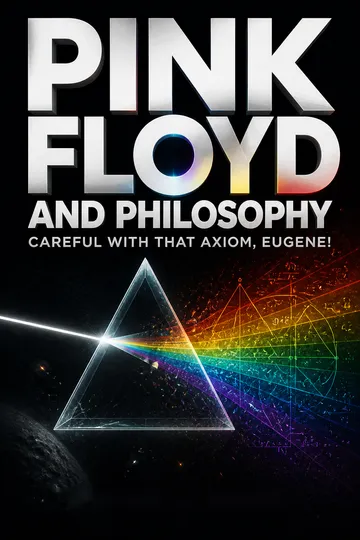
1. What is Pink Floyd and Philosophy: Careful with that Axiom, Eugene! by George A. Reisch about?
- Philosophical exploration of Pink Floyd: The book examines Pink Floyd’s music, history, and cultural impact through philosophical lenses, focusing on themes like alienation, time, madness, and identity.
- Interdisciplinary essays: Edited by George A. Reisch, it features essays by philosophers who analyze the band’s albums, lyrics, and dynamics using concepts from existentialism, aesthetics, and collective agency.
- Connection to broader philosophy: The book uses Pink Floyd’s work as a springboard to discuss universal philosophical questions about perception, reality, and the human condition.
2. Why should I read Pink Floyd and Philosophy by George A. Reisch?
- Deepens appreciation of Pink Floyd: The book offers intellectual perspectives that go beyond typical music criticism, revealing the philosophical depth in the band’s work.
- Accessible philosophical insights: It connects Pink Floyd’s music to thinkers like Nietzsche, Camus, Sartre, and Buber, making complex ideas relatable through familiar songs and albums.
- Blend of scholarship and fandom: The essays combine rigorous analysis with personal reflections, appealing to both academics and passionate fans.
3. What are the key takeaways from Pink Floyd and Philosophy by George A. Reisch?
- Music as philosophical inquiry: Pink Floyd’s albums are shown to grapple with existential questions about meaning, alienation, and the absurd.
- Band identity and continuity: The book explores how the band’s changing lineup and creative direction raise philosophical issues about group identity and artistic legacy.
- Alienation and empathy: It highlights the band’s critique of modern society and the importance of empathy and authentic connection as responses to alienation.
4. What are the main philosophical themes explored in Pink Floyd and Philosophy?
- Alienation and estrangement: The book discusses social, personal, and artistic alienation, drawing on existentialist and Marxist ideas.
- Time, death, and finitude: Pink Floyd’s meditations on mortality and the passage of time are linked to philosophical reflections on authentic existence.
- The absurd and meaning: The tension between the search for meaning and the indifference of the universe is explored, especially through Camus’s philosophy.
5. How does Pink Floyd and Philosophy by George A. Reisch analyze the concept of alienation in Pink Floyd’s music?
- Multiple forms of alienation: The book examines estrangement from self, others, work, and society, as articulated in the band’s lyrics and soundscapes.
- Marxist and existentialist perspectives: It connects Pink Floyd’s critique of capitalist society to Marx’s theory of alienation and existentialist notions of loss and absence.
- Artistic and personal alienation: The band’s internal conflicts and the metaphor of “the wall” are analyzed as expressions of alienation within the creative process.
6. How does Pink Floyd and Philosophy interpret Syd Barrett’s influence on the band’s philosophy and music?
- Barrett as a symbol: Syd Barrett’s mental illness and withdrawal are seen as emblematic of the alienation and madness in Pink Floyd’s music.
- Nietzschean and existential analysis: His life and work are interpreted through Nietzsche’s concepts of Apollo and Dionysus, highlighting the tension between order and chaos.
- Authenticity and subversion: Barrett’s raw, unpolished recordings are discussed in terms of resisting commodification and maintaining artistic authenticity.
7. What is the significance of Dark Side of the Moon in Pink Floyd and Philosophy by George A. Reisch?
- Philosophical centerpiece: The album is portrayed as Pink Floyd’s most ambitious meditation on time, death, money, and madness.
- Cinematic and immersive qualities: Its structure and sound effects create a cinematic experience that embodies philosophical themes.
- Enduring cultural impact: The book highlights the album’s lasting influence and its resonance with universal human concerns.
8. How does Pink Floyd and Philosophy address the problem of group identity and continuity in Pink Floyd?
- Agency individualism vs. collective agency: The book debates whether creative intentions belong to individuals or the group as a whole.
- Officeholder analogy: Pink Floyd’s identity is likened to an office held by different members over time, allowing for continuity despite lineup changes.
- Philosophical implications: This analysis raises questions about what defines the “real” Pink Floyd and how to evaluate albums from different eras.
9. How does Pink Floyd and Philosophy explore the relationship between perception, reality, and music?
- Indirect perception and skepticism: The book discusses how we perceive the world only through internal representations, echoing Pink Floyd’s themes of illusion and the unseen.
- The “veil” of experience: Sensory experiences are described as a barrier between us and reality, aligning with album titles like Obscured by Clouds.
- Language and private experience: Wittgenstein’s private language argument is used to connect issues of perception to communication and misunderstanding in the band’s work.
10. What role does existentialism play in Pink Floyd and Philosophy by George A. Reisch?
- Existentialist influences: The book links Pink Floyd’s themes to thinkers like Sartre, Camus, and Heidegger, focusing on freedom, authenticity, and death.
- The absurd and artistic struggle: Waters’s lyrics are interpreted as expressions of the absurd condition and the artist’s perseverance in a meaningless world.
- I and Thou relationships: Martin Buber’s philosophy is used to discuss the importance of genuine encounter and empathy as antidotes to alienation.
11. How does Pink Floyd and Philosophy analyze the role of madness in the band’s music and legacy?
- Madness as central theme: The book explores how madness symbolizes alienation, loss of self, and societal pressures in albums like The Dark Side of the Moon and The Wall.
- Foucault’s history of madness: It draws on Foucault to situate madness as both a personal and social phenomenon, critiquing medical and institutional frameworks.
- Madness and creativity: Syd Barrett’s mental illness is examined as both a source of creative genius and tragic downfall, illustrating the complex relationship between art and madness.
12. What philosophical insights about music, time, and consciousness are presented in Pink Floyd and Philosophy by George A. Reisch?
- Music as temporal experience: The book discusses how music creates auditory images that unfold in time, offering a unique form of consciousness.
- Repetition and attention: Pink Floyd’s use of repetition is shown to guide listeners’ attention and create hypnotic, immersive effects.
- Temporal escape for musicians and listeners: Playing and listening to music is described as an expanded “now,” allowing for a kind of time travel or escape from ordinary experience.
Popular Culture and Philosophy Series Series


Download PDF
Download EPUB
.epub digital book format is ideal for reading ebooks on phones, tablets, and e-readers.








