

Key Takeaways
Read Spinoza as defending civic freedom, not merely attacking religion
A book under suspicion. In 1670, Dutch church leaders urged officials to suppress an anonymous book they considered dangerous: Spinoza’s Theological-Political Treatise. Its author had already been expelled from Amsterdam’s Jewish community. The urgency was personal as well as political: his friend Adriaan Koerbagh was imprisoned for publishing radical religious views and died soon after release from harsh conditions.
The real target. Spinoza challenged clerics who used religious authority to direct private belief and public life. His book argues that freeing philosophy from theological control protects both civic peace and sincere moral conduct. Its notorious claims about miracles and Scripture are parts of that broader case, not the whole point.
The opening controversy helps correct a persistent simplification: Spinoza’s critique is not just a bid to replace religion with disbelief. It is an argument about who gets to define truth, morality, and public order. The Koerbagh episode gives the abstract defense of liberty a human cost. At the same time, Spinoza’s own proposed safeguards are not identical to modern liberal neutrality. His political solution gives the state considerable authority over public religious life.
Treat fear-driven worship as a political vulnerability, not proof of faith
Fortune fuels superstition. Spinoza begins with a recognizable predicament: people cannot control whether they lose a loved one, a livelihood, or security. When events go badly, hope and fear make them search for signs, explanations, and ways to influence unseen powers. An unusual event may seem like a divine warning; a sacrifice or vow may feel like protection.
Ritual makes fear durable. Such practices often fade when fortune improves. Religious authorities, Spinoza argues, help stabilize them through ceremony and doctrine, turning unstable superstition into organized religion. This gives clergy leverage over people whose emotions have made them vulnerable. The account echoes Hobbes’s claim that fear and uncertainty make religious belief politically useful, though Spinoza uses it to attack clerical power.
This is a strong account of how uncertainty can make people receptive to confident interpreters. It also distinguishes an explanation for religious behavior from evidence that a religious belief is true. The distinction matters: showing that fear helps sustain a practice does not prove that every participant is motivated by fear, or that religious life has no other sources. Spinoza’s sharpest insight is political: whoever claims authority over the meaning of misfortune can acquire authority over people.
Keep prophetic ethics separate from philosophical claims about reality
Imagination, not philosophy. Spinoza presents the biblical prophets as unusually imaginative and morally serious, but not as authorities on science, metaphysics, or history. Their visions and dreams reflected their individual temperaments and assumptions. Joshua, for example, described the sun as standing still during battle, consistent with the mistaken cosmology of his time.
A narrower authority. Prophets matter because their stories and teachings can move people toward justice and care for others. Their value is practical, not proof that every statement they make is philosophically true. Against Maimonides, who treats prophecy as conveying truths also available to philosophy, Spinoza separates the domains: philosophy seeks knowledge; prophetic religion guides conduct. Scripture’s authority, on this account, is strongest when it teaches ethical behavior.
The distinction between truth-seeking and moral instruction clarifies why a text can guide conduct without serving as a science textbook. It also makes room for different routes to ethical behavior: reflective understanding for some, vivid teaching for others. The tension is that Spinoza gives the prophets moral authority while denying their intellectual authority, and the boundary can be difficult to draw in practice. Ethical teaching is never entirely detached from assumptions about the world.
Explain wonders through causes before invoking divine exceptions
Nature has no interruptions. Spinoza rejects miracles understood as supernatural violations of nature. If God is identical with Nature, then the laws of nature express divine power; an exception would not demonstrate God’s greatness but contradict the order attributed to God. The parting of the sea, for instance, may be extraordinary, but it cannot be an event outside natural causation.
Wonder can mark ignorance. Spinoza allows that people may call an event miraculous when they do not know its cause. A rainbow can appear astonishing to someone unfamiliar with how light behaves in water droplets. As knowledge improves, the apparent exception becomes another natural event. Providence, too, means nature’s regular order, not a supernatural plan that interrupts it to reward or punish particular people.
The argument encourages a useful habit of inquiry: unexplained is not the same as unexplainable. It also exposes how claims of supernatural exception can end discussion just when investigation should begin. But Spinoza’s conclusion rests on a demanding metaphysical premise, that nature’s order is complete and exceptionless. The interpretive discipline is powerful even for readers who do not accept that premise; the metaphysical certainty is more debatable than the call to seek causes.
Read scripture as historical writing before treating it as authority
A human textual history. Spinoza argues that the Pentateuch was not written in its entirety by Moses. It refers to events after Moses’s death, and the biblical books contain repetitions, gaps, and conflicting accounts. He suggests that Ezra assembled older materials into a larger history, which later transmission further altered. These are claims about composition and editing, not simply about whether a passage is true.
Interpretation needs evidence. Spinoza’s method examines wording, language, authorship, historical circumstances, and the transmission of manuscripts. He insists that readers should first ask what a writer meant, rather than force the text to agree with a philosophical doctrine. The Bible’s most consistent teaching, he argues, is moral: love of God expressed through justice and care for one’s neighbor.
Treating Scripture as a historical document shifts interpretive authority away from institutions that claim exclusive access to its meaning. It also makes disagreement more accountable to evidence: language and context can support or weaken a reading. Yet historical reconstruction cannot eliminate uncertainty, especially when texts and linguistic knowledge are incomplete. Spinoza acknowledges this limitation. His approach is most persuasive as a method of disciplined inquiry, not as a promise that every passage has a recoverable, unambiguous meaning.
Judge religion by just conduct, not ritual or sectarian identity
Religion’s ethical core. Spinoza separates true religion from ceremonies, theological disputes, and membership in a particular sect. He says its central demand is to love God and one’s neighbor, expressed in justice and charity. A person may perform every ritual and still fail this test; another may live morally without knowing Scripture.
The law’s historical setting. Spinoza interprets many Mosaic commandments as political rules that helped unite and govern the ancient Hebrew state. With that state and its Temple gone, he argues, its ceremonial laws no longer have the same binding purpose. He also rejects the idea that Jews were chosen for superior wisdom or virtue, explaining their ancient success through political organization and good fortune. For him, Jewish identity depended heavily on observance, not on a separate secular essence.
This account gives moral action priority over religious status, a move that can expose hypocrisy wherever ritual becomes a substitute for ethical responsibility. It also treats law as an institution shaped by historical conditions rather than an unchanging code. The analysis is less convincing when it reduces Jewish identity so tightly to ceremonial observance. Cultural memory, language, and shared history can also sustain communal identity, even though those dimensions receive little weight in Spinoza’s argument.
Let faith guide conduct without policing philosophical truth
Different aims, different standards. Philosophy tries to understand what is true. Faith, as Spinoza defines it, aims to produce obedience to the moral law. The two should not supervise each other: Scripture cannot settle questions of physics, and philosophical demonstration is not required to determine what a biblical author meant.
Belief as practical support. For people who are not philosophers, Spinoza says certain beliefs about God, such as divine justice and mercy, can encourage moral conduct. Their usefulness to faith does not depend on their being philosophically accurate. A philosopher, by contrast, can reach virtue through understanding rather than obedience. This division is meant to protect both religious practice and free inquiry, while narrowing faith’s claims to what helps people act justly.
Separating a belief’s truth from its practical effects is a useful way to analyze how ideas shape behavior. It can explain why a community preserves teachings that motivate cooperation even when their members interpret them differently. The difficult question is who decides which beliefs count as necessary for good conduct. Spinoza’s distinction protects inquiry from clerical control, but the idea that some beliefs are socially useful can itself become a rationale for managing what others are allowed to believe.
Make government protect freedom, while watching its power over worship
The state begins in insecurity. Spinoza describes a state of nature in which people pursue their own advantage without a shared authority to restrain conflict. They form a political community to gain security and a more stable life. He favors democracy because citizens collectively make laws and, in principle, govern themselves through reason.
Public religion is different. Spinoza leaves private belief outside the state’s reach, but assigns the sovereign authority over public religious practices. He fears that independent churches and clergy create rival centers of power, dividing citizens’ loyalties and threatening civil peace. This is not a modern separation of church and state. The state is meant to foster conditions for freedom and rational life, yet it also controls the public form of worship.
Spinoza’s political model is more ambitious than a government that merely protects people from one another. It treats public institutions as capable of shaping the conditions under which citizens become freer and more rational. That vision connects political order to civic education, but it carries a familiar danger: a state that claims to promote virtue may overreach in defining it. Democracy offers a check because authority is shared, though it does not erase the risk of coercion.
Protect dissenting speech before authorities turn criticism into sedition
Thought cannot be commanded. Spinoza argues that governments cannot reliably control what people believe, and attempts to dictate belief breed resentment. He extends this principle to expression: open discussion supports intellectual work and gives citizens a peaceful way to challenge unreasonable laws.
A real, if imperfect, liberty. Spinoza does not defend speech that incites attacks on the state or urges people to break their political agreement. That exception leaves an important question: who decides what counts as sedition? The Treatise itself was published anonymously, with false details about its origin, and was officially banned in 1674. Its suppression illustrates the danger Spinoza identified, while the sedition limit shows that his own account of liberty was not absolute.
Spinoza’s defense of dissent recognizes that public criticism can stabilize a political order by allowing grievances to be voiced without violence. The exception for seditious speech, however, creates room for authorities to label inconvenient criticism a threat. That boundary is not a technical footnote; it is where a defense of liberty can be narrowed in practice. The book’s own fate makes the point vivid: an argument for open inquiry became a target of the very censorship it opposed.
Analysis
Nadler presents the Treatise as both a philosophical intervention and a response to a specific political crisis. That dual focus matters. Spinoza’s claims about prophecy, miracles, and biblical authorship can seem like isolated provocations unless they are connected to his concern about clerical authority. Each demystification weakens a different claim to power: prophecy cannot dictate philosophy, miracles cannot suspend natural explanation, and Scripture cannot serve as a blank cheque for its self-appointed interpreters.
The book’s deepest contribution is a distinction among three questions that religious conflict often collapses: What is true? What does a text mean? What conduct sustains civic life? Spinoza assigns the first to philosophy, the second to historical interpretation, and the third to religion and public law. This arrangement is conceptually clean, but the domains continually meet in practice. A moral rule depends on interpretation; a public law encodes judgments about conduct; and a state that controls worship can influence the conditions of belief even when it cannot command belief itself.
That is the Treatise’s central political tension. Spinoza wants a powerful enough sovereign to prevent rival religious authorities from destabilizing the state, yet he also insists that the sovereign should not control thought and expression. His defense of democracy reduces the distance between ruler and citizen, but does not fully resolve the danger that public order can become an excuse for suppressing dissent. The standard for seditious speech is especially vulnerable to expansion by officials who benefit from calling criticism dangerous.
The historical narrative sharpens this tension rather than merely illustrating it. Koerbagh’s imprisonment and the Treatise’s ban demonstrate that moderation depends not only on good principles but on institutions willing to tolerate the consequences of disagreement. Spinoza’s enduring question is therefore not simply whether religion or philosophy should rule. It is how a society can protect moral cooperation without allowing any authority, religious or political, to monopolize the terms of truth.
Review Summary
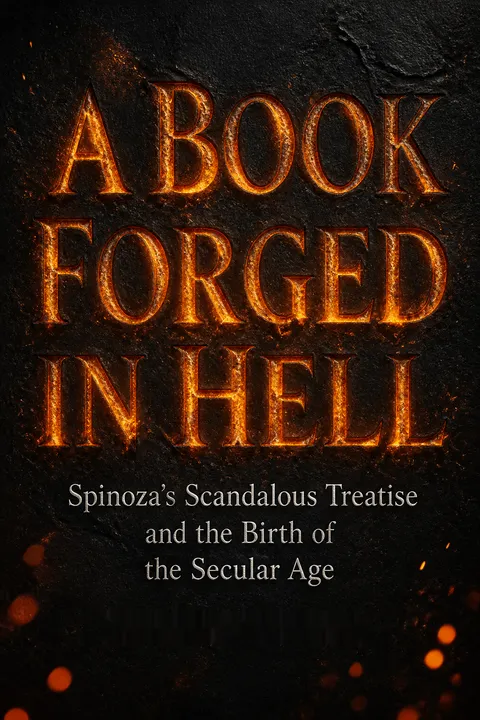
A Book Forged in Hell examines Spinoza's 1670 Theological-Political Treatise, which argued the Bible is human literature, not God's literal word, and advocated for secular government and religious tolerance. Reviews praise Steven Nadler's accessible analysis of this scandalous work that challenged miracles, prophecy, and clerical authority. Readers appreciate the historical context of 17th-century Netherlands and Spinoza's extreme excommunication at age 23. Most found it enlightening on Spinoza's influence on Enlightenment thought and secular society, though some noted repetitive or dry sections. The book successfully explains why this "book forged in hell" became foundational to modern biblical criticism and democratic theory.
People Also Read


Glossary
Deus sive Natura
God or NatureSpinoza’s formula identifying God with Nature understood as the single, infinite, necessary reality and cause of everything. It does not mean that the universe is governed by a humanlike deity who makes plans or interrupts natural laws. Individual minds, bodies, and events are finite expressions within this one reality.
Libertas philosophandi
freedom to philosophizeThe freedom to pursue and express philosophical inquiry without interference from religious authorities. In the Treatise, Spinoza argues that this liberty is compatible with piety and civic peace, and that suppressing it can damage both. It protects inquiry into truth, while his political account still restricts speech judged to threaten the state.
conatus
striving to persistSpinoza’s term for the effort by which each thing strives to continue in its existence and maintain its power. In human beings, this striving underlies self-interest. When guided by reason, it can support cooperation and virtue; when governed by confused passions, it can produce rivalry and conflict.
state of nature
life without common governmentA theoretical condition in which individuals have no shared political authority or common laws. Each person pursues what seems advantageous and has no public institution to settle disputes. Spinoza uses this condition to explain why people form a state: they seek greater security and a more reliable way to live.
God's external help
benefits from outside causesSpinoza’s name for what happens to a person through external causes, including circumstances that bring advantage or harm. Such events belong to nature’s order and are not evidence that a providential deity has singled someone out. Their effects depend partly on fortune and are not fully under an individual’s control.
God's internal help
power from one's own natureSpinoza’s name for what a person can accomplish through the powers belonging to human nature, especially by using reason to preserve and improve life. It includes acquiring knowledge and acting more effectively. This is not supernatural assistance but a natural capacity available to human beings.
true religion
justice and charitySpinoza’s term for religion stripped of sectarian dogmas and ceremonial requirements. Its central demand is love of God and neighbor, expressed through justice and charitable conduct. Philosophical understanding can ground such conduct for some people, while Scripture’s stories and teachings can encourage it among those who do not pursue philosophy.
miracle
an unexplained natural eventIn Spinoza’s account, a miracle is not a supernatural violation of nature. It is an event whose natural cause is unknown to the observer or narrator. Nature follows a fixed order, so greater understanding should replace wonder with explanation rather than treat the event as evidence of an exception to natural law.
Download PDF
Download EPUB
.epub digital book format is ideal for reading ebooks on phones, tablets, and e-readers.








