Key Takeaways
1. Financial Innovation Breeds Systemic Risk
The steps that we have taken to make the markets more attuned to our investment desires—the ability to trade quickly, the integration of the financial markets into a global whole, ubiquitous and timely market information, the array of options and other derivative instruments—have exaggerated the pace of activity and the complexity of financial instruments that makes crises inevitable.
Innovation's double edge. Financial innovation, while offering benefits like efficiency and liquidity, paradoxically increases systemic risk. New instruments and faster trading speeds create a complex, tightly coupled system where small events can trigger widespread failures. This contrasts with the real economy, which has become less risky over decades, with:
- Decreased GDP variability
- More stable disposable income
- Shallower recessions
- Diversified workforce and economic sectors
Complexity cloaks catastrophe. The proliferation of derivatives and interconnected global markets means that when dislocations occur, understanding their impact becomes incredibly difficult. This complexity, combined with rapid transaction speeds, creates a fertile ground for "normal accidents"—unforeseen failures inherent in the system's design, as seen in industries like nuclear power and aviation.
Unintended consequences. The drive to meet investor demands through new products and faster execution has led to a market structure that is inherently unstable. Each innovation, while solving one problem or creating an opportunity, adds layers of complexity and tight coupling that make the entire system more fragile and prone to severe, self-inflicted crises.
2. Liquidity, Not Just Information, Drives Markets
The principal reason that prices vary, especially in the short term, is liquidity demand.
Beyond efficient markets. The academic "perfect market paradigm" assumes markets are efficient, reacting immediately and appropriately to all information, leading to random price movements. However, this view often ignores the real-world dynamics of trading floors, where constant activity suggests something more than just information is at play.
Liquidity's true role. Far more than conveying information, markets primarily exist to provide liquidity. Traders constantly execute orders driven by diverse needs—hedging, meeting liabilities, investing new funds—none of which are information-based. These liquidity demands, not new information, are the primary drivers of day-to-day price movements, and critically, of market crashes and bubbles.
Demand moves prices. When liquidity demanders need to buy or sell quickly, they must move the market price to attract liquidity suppliers. These suppliers, like market makers or hedge funds, profit by accommodating this demand for a price. This dynamic means that individual trades, especially large ones, inevitably affect prices, challenging the "atomistic" assumption of perfect markets.
3. Leverage Amplifies Catastrophe
The very act of using that much leverage increases the likelihood that things will go against you, and the larger the hedge fund the worse it will be.
Relative value's deceptive charm. Strategies like relative value trades, which seek small profits from price convergence, inherently require massive leverage to generate significant returns. While appearing logical and risk-controlled, this high leverage (20x, 50x, or even 100x) means small adverse price movements can lead to catastrophic losses, as demonstrated by LTCM.
LTCM's fatal flaw. Long-Term Capital Management (LTCM) exemplified the dangers of excessive leverage. Despite its principals' analytical prowess, their reliance on highly leveraged relative value trades meant that when Russia defaulted in 1998, triggering a global crisis, LTCM's positions spiraled. Their models, assuming a "game against nature," failed to account for their own market-moving size and the feedback loop of forced liquidations.
Liquidity squeeze. LTCM's high leverage and large positions made it a major liquidity supplier. When market conditions turned, its need to sell assets to meet margin calls caused prices to plummet, forcing further liquidations in a vicious cycle. Banks, unaware of LTCM's full strategy due to opaque financing, demanded higher collateral, exacerbating the crisis and nearly bringing down major institutions like Merrill Lynch and Lehman Brothers.
4. Organizational Complexity Masks Danger
My great concern was that the sheer complexity of Citigroup would add so much structural uncertainty that it would become nearly impossible to react to events that were not already on the radar screen.
Citigroup's colossus. Sandy Weill's creation of Citigroup, a behemoth with 300,000 employees across 100 countries, brought immense organizational complexity. This multi-layered structure created distance between data gatherers and senior management, leading to information loss and making it difficult to identify emerging problems not already on the radar.
Consequences of scale. The sheer size of Citigroup meant that what would have been simple decisions in a leaner firm became mired in layers of management and internal politics. This complexity contributed to a series of scandals and missteps, including:
- Providing off-balance sheet structures for Enron
- Engineering WorldCom's mergers
- Predatory lending practices by Associates First Capital
- Analyst improprieties (e.g., Jack Grubman's biased recommendations)
- Fraudulent transactions in its Japanese private bank
Management's struggle. Even CEO Chuck Prince expressed exasperation, stating, "I never thought before that you had to say to people, 'You've got to make your numbers, and, by the way, don't forget not to violate the law.'" This highlights how organizational complexity can obscure ethical boundaries and make effective oversight nearly impossible, leading to a cycle of failures despite attempts at internal controls.
5. Outdated Accounting Fails Modern Finance
Accounting has failed us as investors and managers.
Pacioli's legacy, modern irrelevance. The double-entry bookkeeping method, pioneered by Luca Pacioli over half a millennium ago, remains the foundation of accounting. While revolutionary for its time, this approach, originally designed for tangible assets like railroads and manufacturing plants, is increasingly irrelevant for today's economy.
Intangibles' hidden value. Modern companies derive much of their value from intangible assets such as:
- Ideas and patents
- Proprietary software
- Brand names and trade secrets
These assets' values cannot be accurately captured by cost-based accounting, leading to a significant disconnect between market value and book value (e.g., market-to-book ratio rising from 1:1 to 6:1).
Slow, aggregated, and conflicted. Current accounting conventions are not only irrelevant but also excruciatingly slow, with quarterly and annual reports serving as mere "archaeological" records in a real-time data world. This forces analysts to "piece together clues" to discern true company performance. Furthermore, conflicts of interest often compromise the quality of financial reports, as seen in the rapid rise of restatements during the 1990s.
6. "Coarse Behavior" for Unknowable Risks
The coarse response, although suboptimal for any one environment, is more than satisfactory for a wide range of unforeseeable ones.
Beyond rational optimization. Traditional economic theory assumes "rational man" behavior, where individuals optimize utility by considering all choices and probabilities. However, real-world uncertainty, particularly "primal risks" that cannot be anticipated or modeled, renders this approach insufficient.
Lessons from biology. The cockroach, surviving for hundreds of millions of years with a simple defense mechanism (moving away from slight puffs of air), exemplifies "coarse behavior." This seemingly suboptimal response, which ignores much information, proves superior for dealing with unforeseeable environmental changes, unlike specialized creatures like the furu fish, which became extinct due to unanticipated threats.
Human application. An "omniscient planner" designing investor rules for an unpredictable future would favor coarse behavior. This means simplifying formal processes, streamlining risk models, and reducing organizational complexity. Such an approach, while appearing less fine-tuned, enhances survivability by making the system more robust and adaptable to risks that are inherently unknowable.
7. Hedge Funds: Essential, Yet Misunderstood
Though vilified and demonized by many, hedge funds and other speculative traders are not gamblers or financial parasites.
Providing market lubrication. Hedge funds, often criticized for their "wild ways," play a crucial economic role by providing liquidity to the market. They act as liquidity suppliers, taking on risk and making capital available for investment, which helps reduce market volatility and improve prices for both buyers and sellers.
Compensation for risk. The service of supplying liquidity merits compensation, as evidenced by return differentials between highly liquid and illiquid securities. Hedge funds bear significant credit and liquidity risk, and their compensation reflects this. In times of crisis, their liquidity supply can be the difference between a market closing down a few percentage points and sliding into an abrupt crisis.
Existential dilemma. The term "hedge fund" is a misnomer, describing what an investment fund is not rather than what it is. With over 5,000 diverse entities, they defy a meaningful common definition, encompassing nearly the entire universe of investment strategies. This heterogeneity makes broad-scale regulation or classification of "hedge funds" as a single entity a "fruitless exercise."
8. Market Crises Are Self-Inflicted
More often than not, crises aren’t the result of sudden economic downturns or natural disasters.
Internal market dynamics. Unlike common perception, most financial crises over the past decades, including the 1987 crash and the LTCM debacle, did not originate from external economic or natural catastrophes. Instead, they stemmed from the complex internal machinery of the market itself, which can distort small events into widespread turmoil.
The 1987 crash. The 1987 stock market crash, which saw the Dow drop over 22% in a single day, was not a rational reaction to new information. It was primarily an "unintended byproduct" of portfolio insurance strategies. As the market declined, programmed selling by portfolio insurers triggered further selling, creating a self-reinforcing downward spiral amplified by cash-futures arbitrageurs.
LTCM's self-destruction. LTCM's failure was also self-inflicted. Its highly leveraged relative value trades, while profitable in stable times, became a vulnerability when a Russian default triggered a liquidity squeeze. The firm's massive positions and need to sell exacerbated market declines, turning it from a "master of the game" into "the game" for other predatory traders.
9. The Perils of Unchecked Innovation
Just because you can turn some cash flow into a tradable asset doesn’t mean you should; just because you can create a swap or forward contract to trade on some state variable doesn’t mean it makes sense to do so.
Innovation's dark side. The relentless pursuit of financial innovation, driven by the capitalist need for ever-expanding markets and profits, often leads to the creation of complex instruments without a full understanding of their risks. Each new product, from mortgage derivatives to preference shares, adds layers of complexity and tight coupling to the system.
Japanese preference shares. The case of Japanese preference shares illustrates this peril. Designed to provide "free capital" to banks, these convertible bonds had a complex structure that became disastrous during the Asian crisis. UBS, heavily invested, faced massive losses as the underlying stocks plummeted, revealing the flawed assumption that issuing more stock would not dilute existing shares.
UBS's repeated blunders. UBS suffered multiple risk management failures due to complex, un-road-tested innovations and internal arbitrage. From index-amortizing swaps (Sheldon Epstein) to long-dated equity options (Ramy Goldstein), the bank repeatedly booked immediate profits based on flawed models, only to face hundreds of millions in losses when market conditions exposed the underlying risks.
10. The Illusion of Control
The problem is that no matter how big a team you put on the case, you can only run risk models and pound out reports on things that you can identify and measure.
Limits of knowledge. Just as Kurt Gödel's incompleteness theorems showed limits to mathematical logic and Werner Heisenberg's Uncertainty Principle delineated limits to physical inquiry, so too are there fundamental limits to our knowledge in financial markets. We cannot perfectly know the present or unfailingly predict the future, especially in complex, nonlinear systems.
More data, less understanding. The temptation to control risk through "position transparency" and more disclosure is flawed. While providing more information, it can paradoxically make markets less stable. Traders, knowing their positions are scrutinized, may alter behavior, reducing liquidity and increasing risk. The "butterfly effect" demonstrates how small, unmeasurable errors can compound into unpredictable outcomes in dynamic systems.
Regulation's unintended consequences. The conventional response to market failures—adding more controls and regulations—often exacerbates complexity and obscurity. If a system is already prone to "normal accidents," layering on more safeguards can increase complexity, leading to an "upward spiral of surprise events." A "coarse, not a more detailed, response" is needed, focusing on reducing complexity and tight coupling rather than attempting to control every identified risk.
Last updated:
Review Summary
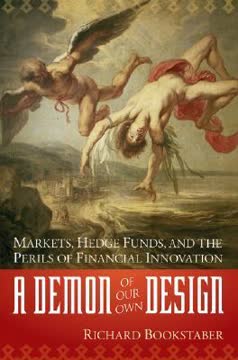
A Demon of Our Own Design receives praise for its insider perspective on financial crises, explaining how market complexity and tight coupling create systemic vulnerabilities. Readers appreciate Bookstaber's clear explanations of derivatives and market mechanics, his prescient warnings before 2008, and compelling anecdotes from Wall Street. The book's theoretical framework draws on "normal accidents" theory, arguing liquidity demands—not information—drive price movements. Critics note the disorganized structure, defensive stance on hedge funds, and lack of concrete solutions beyond reducing leverage and complexity. Most find it valuable despite technical density, though some sections feel like memoir rather than analysis.
Similar Books