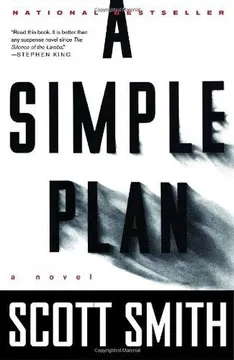


Plot Summary
The Orchard's Buried Plane
Hank Mitchell is an accountant in Ohio, married to Sarah and expecting their first child. His brother Jacob, older but distant, still shares one obligation with him: their father required them to visit his grave every New Year's Eve. On the eighth visit, Jacob brings his friend Lou and his dog, Mary Beth.
A fox darts across the road, and the dog bolts after it into Anders Nature Preserve. Following him through deep snow, the men find a small plane hidden in an abandoned orchard, watched by hundreds of crows. Inside lies a dead young pilot, his face damaged by a bird. Hank also discovers a heavy duffel bag. Lou opens it, revealing bundles of hundred-dollar bills.
The discovery grows out of a ritual built on duty rather than affection. Hank and Jacob have kept their father's demand because they fear the consequences of breaking a promise, not because the visits have repaired their relationship. The fox and the escaped dog make chance feel almost purposeful, drawing three mismatched men toward a wreck that should have remained hidden. Hank's role as an accountant initially seems to make him the voice of order, but it also gives him a ready-made way to measure and manage the temptation. The crows, the dead pilot, and the cash arrive together, making wealth inseparable from death before anyone chooses what to do.
Four Million in the Snow
Hank estimates the bundles at nearly three million dollars and argues that the men should report the wreck. Lou and Jacob want to take a share, then suggest keeping everything; Hank resists until he invents a compromise that lets him postpone the decision.
He will hide the money for six months, destroy it if anyone comes looking, and divide it only if the risk seems gone. The men carry the bag back to Jacob's truck, where a passing sheriff's vehicle catches them counting.
Hank conceals the cash and lies to Carl Jenkins, Ashenville's kindly local officer. Afterward, the brothers and Lou count the bundles in a secluded place: $4.4 million. Hank takes the bag home and tells Sarah, who agrees to keep it only if he returns $500,000 to the plane.
Hank's first compromise is not a surrender to greed so much as a way to keep decision-making power. The six-month delay lets him imagine that he can always reverse course, while his promise to burn the money turns destruction into a threat he controls. Yet he has already crossed the decisive boundary: he lies to Carl and carries stolen cash into his family home. Sarah's insistence on returning half a million is practical, but it also shows how quickly their moral discussion becomes a problem of appearances and detection. Their shared plan makes the theft domestic. The money is no longer only an object in the woods; it is now a secret arranged beneath the roof where their child will be born.
The First Body
The next morning Hank returns to the plane alone, carrying the $500,000 beneath his clothes in a baby carrier. Jacob waits beside the road while Hank replaces the money, repositions the pilot, and tries to clear evidence from the wreck. As Hank leaves, he hears a snowmobile approaching. Dwight Pederson, a farmer tracking the fox that stole his chickens, has stopped beside Jacob's car.
Jacob strikes him, then kicks him, believing he has killed him because Pederson might find the plane. Hank reaches the road as Jacob panics. After sending his brother away, Hank hears Pederson groan. He can still call for help, but instead smothers the injured man with his scarf, then stages a snowmobile accident at Anders Creek.
This is the point at which Hank's claim to be merely managing risk becomes impossible to sustain. Jacob initiates the violence in panic, but Hank makes a separate, lucid choice after the immediate danger has passed. He tells himself that Pederson is already dead, then treats the man's scarf and the surrounding snow as practical details in a cover-up. The shift is psychologically important: Hank's capacity for violence does not arrive as a transformation into someone wholly unfamiliar. It emerges through the same habits he trusts in himself, calculation, delay, and the belief that one more action can restore order. The staged accident conceals the murder, but it also gives Hank a private reason to keep choosing the money.
A Secret Takes Root
Snow covers the tracks, and the town accepts Pederson's death as a tragic accident. Hank watches the funeral from his office and finds that he can set the murder aside whenever he chooses not to think about it. His attempt to confess to Sarah falters: he first tells her that Jacob killed Pederson, then later admits that he smothered the farmer himself.
Sarah urges him to give up the money, but Hank refuses because surrender would make the murder seem pointless. Meanwhile, Lou tells his girlfriend Nancy about their windfall, and Sarah learns of it from her at a grocery store. When Lou arrives at Hank's house after midnight, he demands a packet and reveals that he knows about Pederson's death.
Hank's ability to compartmentalize becomes a form of moral self-protection. He treats the funeral as evidence that the crime is safely buried, while his emotional distance from Pederson's widow helps him preserve his image of himself as decent. His partial confession to Sarah exposes another motive: he needs her not only as a partner but as a witness who might confirm that he remains recognizable. Sarah's concern is more concrete. She sees that every additional person who knows about the money increases the chance of exposure. Lou's disclosure turns that abstract concern into leverage, and the couple's marriage becomes a place where truth is rationed according to what Hank can bear to have judged.
Lou Names His Price
Lou wants his share immediately, warning Hank that he could tell the sheriff about Pederson. Hank claims the money is stored in Michigan and promises to divide it after Sarah gives birth.
Sarah argues that Lou's threat makes waiting unsafe, while Hank insists that paying him now would let him spend freely and draw attention. Hank confronts Jacob, who admits that Lou may have learned about Pederson by guessing after hearing about their trip to the plane. Jacob says he would choose his brother over Lou, but cannot control his friend.
When Lou later asks for a $2,000 loan, Hank withdraws the money from his and Sarah's savings, knowing repayment depends on the future split. Lou's gambling losses have turned patience into a luxury he no longer has.
The money's power changes hands without changing location. Hank still possesses the bag, but Lou's knowledge gives him a claim on Hank's future behavior, while Jacob's loyalty is tested by the fact that his closest friend and his brother now demand opposite forms of allegiance. Hank responds by assigning responsibility downward, making Jacob answer for Lou and treating a loan as a temporary solution. Yet the loan quietly commits him to paying Lou eventually. The scene also reveals the limits of Hank's managerial style: he can set rules, threaten destruction, and demand promises, but he cannot make other adults obey. His increasing control is therefore partly theatrical, meant to quiet his own fear.
The Brothers' Old Debt
Sarah gives birth to Amanda, and Jacob brings the baby a worn music-box teddy bear from his own childhood. Soon afterward, Hank meets him at their parents' grave and hears what Jacob has never admitted: their mother called the night before the fatal crash, and Jacob believes their parents deliberately drove into the truck to escape ruinous debts.
He also explains that the promised farm was meant to be his. Jacob wants to buy the land back and rebuild the family home, a plan Hank doubts but cannot reject outright. Sarah has devised a way to restrain Lou: record him pretending to confess to Pederson's murder. Hank secures Jacob's help by promising to support the farm purchase, though he has no intention of keeping that promise.
Jacob's farm dream gives his attachment to the past a material shape. To Hank, the land represents failure and entrapment; to Jacob, it offers a home, a family history, and a future that might finally belong to him. His account of their parents' possible suicide complicates the brothers' shared grief by making money appear not just desirable but capable of governing life and death. Hank uses this emotional intimacy to secure Jacob's cooperation, turning the cemetery ritual into a recruitment ground. The bargain echoes their father's will: once again, a promise between brothers binds them, but this time Hank knows from the beginning that he plans to break his word.
The Tape Turns Dangerous
Hank buys a small recorder and takes Jacob and Lou drinking at the Wrangler. When Lou is drunk enough, Hank prompts him to act out a confession while Jacob plays Sheriff Jenkins. Lou names the scarf and the bridge, and Hank records him without warning. At Lou's house, Hank plays the tape and insists it will make Lou look guilty if he reports them.
Jacob admits he knew about the plan, and Lou feels betrayed by both men. Lou retrieves his shotgun and aims it at Hank. Jacob runs back with his rifle, despite Hank's effort to keep them apart. As Nancy comes downstairs, Lou raises the weapon again. Jacob fires first and kills him. Nancy accuses the brothers of murdering Lou for the money, then reaches for a pistol upstairs.
The recorder is meant to turn performance into control: Lou's words, detached from their joking context, can be made to sound like evidence. But the scheme depends on Jacob and Hank sharing a version of events, and the moment Lou realizes they have coordinated against him, the prop becomes irrelevant. Their friendship has been converted into a contest over who can define the truth. Jacob's decision to return with a rifle is both an act of loyalty and a repetition of his worst impulse, answering fear with force. Nancy's accusation punctures Hank's preferred story before he can finish building it. The gunfire is not an unforeseen intrusion into the plan; it is the consequence of treating people as pieces to be positioned.
Hank Turns on Jacob
Hank follows Nancy upstairs as she reaches for a pistol. He grabs Lou's shotgun first, but Nancy produces another gun and points it at him, so Hank fires and kills her. On the telephone, Sarah constructs a cover story: Lou found Nancy with their landlord, Sonny Major, and shot them both.
Hank goes to Sonny's trailer, lures him back, strips him of his clothes, and kills him inside Lou's house to make the affair seem real. Jacob is horrified and begins to falter. Convinced that his brother will confess to the police, Hank shoots Jacob as he walks toward the truck. He calls in the shooting and stages the scene, but Jacob is still alive when Hank leaves him on the ground.
Hank's actions now follow a grim logic of narrative repair. Each new death is meant to make the previous one appear inevitable, and Sarah's invented affair offers a story that can absorb several bodies at once. Hank calls this necessity, but the sequence shows how much agency remains in his choices: he recruits Sonny under false pretenses, decides how to stage the killings, and shoots Jacob because he predicts a confession. Jacob's survival matters because Hank mistakes an attempt at control for a finished outcome. He can arrange evidence and rehearse a story, but he cannot dictate what a wounded person will do, remember, or become.
Jacob's Last Night
The police accept Hank and Sarah's account that Lou killed Nancy and Sonny, then Jacob intervened in self-defense. At the hospital, doctors repair Jacob's catastrophic injuries and give him little chance to survive. Hank visits him briefly, holding his brother's hand as Jacob recognizes him, then returns home with Sarah and Amanda.
Jacob dies that night. Reporters descend on the family, and Hank attends the funerals, buying Jacob a suit because his brother owned none. At the graveside, Hank sees a mother playing with two small boys and is overcome by bewilderment about the crimes he has committed. The police return Mary Beth to him, but the dog does not settle into the household.
The hospital scene offers Hank a brief encounter that cannot be translated into reassurance. Jacob's recognition is too fragile to establish forgiveness, and Hank is left to supply the meaning he needs. Public sympathy reinforces the cover story, allowing him to occupy the role of grieving brother while knowing he helped create the tragedy. The funerals make this split visible: the community mourns men and women whose deaths it misunderstands, while Hank watches from within the lie. The image of children playing near Jacob's grave interrupts his neat chain of excuses. It does not produce repentance, but it exposes the distance between the family life he wants to protect and the life his choices have made possible.
Farm Notes in the Trunk
While clearing Jacob's apartment, Hank finds a decades-old farm textbook filled with his brother's notes, a diagram of their father's property, and a photograph of the family house before its demolition. The discovery shows Jacob had been preparing for the farm he hoped to reclaim.
Hank weeps, then forces the grief into silence rather than telling Sarah. He also learns that Mary Beth is grieving, but keeps the dog tied outside until its distress makes him dangerous around Amanda.
Meanwhile, Hank spends nearly all their savings on a grand piano for Sarah and a Florida condominium bought through a fraudulent government auction. The condo does not exist. Hank discovers the scam and conceals the loss, leaving the couple dependent on the stolen cash.
Jacob's notes revise Hank's judgment of his brother. What Hank dismissed as childish incompetence was an effort, however poorly equipped, to learn the work that might restore a home and a future. The discovery cannot repair their relationship, so Hank converts grief into another secret, believing that containment is the only way to remain functional. His purchases for Sarah similarly turn money into a promise of a life they have not earned and may never reach. The fake auction strips away their legitimate savings, making the stolen fortune seem indispensable. Their desires are no longer simply fantasies of luxury; they have become a financial trap that narrows the choices Hank claims to be making.
The False FBI Badge
When the snow melts, an FBI agent named Neal Baxter arrives in Ashenville seeking the missing plane. Sarah suspects he is actually Vernon Bokovsky, the older brother of the pilot, and Hank becomes convinced after Baxter avoids showing identification. Hank borrows a pistol from Carl, supposedly to put down Mary Beth, then calls Sarah and learns that the real FBI has an Agent Baxter on field duty.
Still fearing a trap, Hank tells Carl he must take a sick Amanda home and stays behind. Carl drives toward the preserve with the stranger. Hank then takes Mary Beth to the old farm and shoots him badly before finally killing him. The sheriff's department later tells Hank that Carl has been murdered and asks him to identify a body.
Hank's choice not to accompany Carl is a rare moment when he recognizes danger without trying to dominate it. He is afraid the stranger may be a murderer, yet he lets the possibility of Carl's death remain outside his responsibility because taking action might expose the money. The dog episode sharpens the cost of Hank's evasions: he claims mercy but performs the killing clumsily, turning a decision to protect Amanda into a needless ordeal for Mary Beth. His excuse about the baby carries him back into the same pattern of self-preservation, where a lie can seem kinder than a risk. By the time the police call, the private crime has collided with the public investigation.
Only Half a Million
Hank identifies the dead man at the tollbooth as Vernon Bokovsky, who was shot by state troopers after drawing a weapon. True FBI agents explain that Vernon had searched for his brother's plane and killed Carl.
They have recovered only the $500,000 Hank returned to the wreck; the rest of the ransom is missing. The agents disclose that investigators recorded the serial numbers of one bill in ten, making the remaining cash dangerous to spend. Hank calls Sarah from the police station.
She admits she has already used one hundred-dollar bill to buy champagne at Alexander's, a shop near the airport. The cashier has seen her with Amanda. Hank asks what he looked like, then leaves the station with a new problem: one marked bill can identify his family.
The revelation collapses the distinction Hank has relied on between hidden wealth and safe wealth. The agents have not merely found the source of the cash; they have made every future purchase a gamble with a one-in-ten chance of recognition. Sarah's purchase is emotionally understandable, a small attempt to begin the life they imagined, but its timing makes it dangerous. Hank does not respond by confessing or abandoning the money. Instead, he treats the cashier's memory as another threat to manage. The plot's central object changes function once more: first temptation, then leverage, then a potential evidentiary trail. The remaining cash promises escape while making every attempt to use it more perilous.
Alexander's Bloody Register
Hank reports a fabricated hitchhiker with a machete to the state police, then drives to Alexander's wearing Jacob's oversized sweatshirt and ski mask. The cashier refuses his attempted robbery and attacks him with cans and jars.
Hank swings the machete into the man's throat and waits for him to die. An elderly customer, Diana Baker, arrives just before closing. Hank could let her leave, but he fears she will remember him and describe the blood. He leads her into the storeroom and kills her too.
Hank takes her purse and retrieves Sarah's hundred-dollar bill from the register. At home, he tells Sarah that the bill was marked and that he has killed again. He burns the fortune in the fireplace, despite her pleas to keep it, then hides the remaining evidence in Jacob's trunk.
Hank's final escalation turns the logic of protection into its most naked form. The cashier and Diana have no connection to the original theft beyond occupying the wrong place at the wrong time, yet Hank makes each of them responsible for the risk he perceives. His own narration recognizes the moment when he could let Diana go, which prevents the killings from being explained away as reflex alone. Burning the cash removes the object that began the chain, but it cannot restore the lives taken to keep it. The retained evidence in Jacob's trunk shows that Hank does not truly escape the past. He destroys the fortune while preserving a private archive of the choices he refuses to discuss.
The Account Never Closes
Five and a half years later, Hank still works at the feedstore and Sarah is back at the library. They have another child, Jack, named for Jacob, but Amanda has lasting brain damage after falling into a backyard pool. Their savings vanish on her care, and the family remains in the same modest life Hank once hoped to escape.
Hank keeps the machete, mask, purse, and other evidence hidden in Jacob's trunk. He and Sarah never discuss the money or the killings. Sometimes the crimes feel unreal; at other times Hank revisits the day Jacob showed him the empty farm and lets himself grieve. That grief is one of the few feelings he trusts as proof that he remains human.
The ending refuses to make survival equivalent to resolution. Hank and Sarah remain together, raise their children, and return to ordinary work, but their domestic life is shadowed by the fortune they destroyed and the people they killed. Amanda's injury is not presented as a neat moral payment; rather, Sarah's belief that it may be punishment shows how the couple continues to search for an accounting the story cannot provide. Hank preserves evidence while avoiding confession, maintaining the contradiction between wanting the truth witnessed and fearing what truth would require. His recurring memory of Jacob's farm dream is more than nostalgia: it is the measure of the future he helped erase.
Analysis
A Simple Plan is built around the gap between moral judgment and self-description. Hank does not begin as a criminal mastermind. He begins as a conventional man who believes that care, prudence, and good intentions can keep a bad choice contained. His accounting habits supply the story's psychological engine: each act is treated as a manageable liability, and each new crime is explained as the measure needed to prevent a worse outcome. The result is not a sudden descent but a chain of decisions that lets responsibility migrate from one moment to the next.
The brothers embody rival relationships to the past. Hank wants to escape the farm and the economic failure associated with their parents; Jacob wants to restore the farm as a place of belonging. Their father's will binds them through an annual ritual, while the family history of debt shapes their fantasies about money. Jacob's dream is sentimental but not empty, and Hank's refusal to trust it reflects how thoroughly he has mistaken caution for wisdom. Sarah, meanwhile, understands risk more clearly than Hank, yet her practical intelligence helps refine the schemes that keep the secret alive.
The novel also makes storytelling a form of criminal action. Hank lies to Carl, rewrites events for Sarah, stages evidence, and finally accepts a public identity as a grieving brother. These narratives do not merely conceal violence; they help Hank experience it as something imposed by circumstance. The recurring language of having no choice is therefore less a description than a tool for avoiding agency. The ending denies the comfort of a clean moral reckoning. Hank burns the fortune but keeps the evidence, and ordinary family life continues under the pressure of what remains unsaid. His grief for Jacob offers no absolution. It only proves that a person can recognize the human cost of his actions and still refuse the consequences of that knowledge.
Review Summary
A Simple Plan receives mostly positive reviews, praised for its gripping storytelling, moral complexity, and exploration of human nature. Readers find the characters relatable yet flawed, and appreciate the novel's escalating tension. Many consider it a masterful thriller that's hard to put down. Some criticize the characters' decisions as unrealistic or frustrating. The book prompts discussions about greed, morality, and the consequences of one's actions. While not universally loved, it's generally regarded as a compelling and thought-provoking read.
People Also Read






Characters
Hank Mitchell
Accountant turned keeperHank is a cautious, self-conscious accountant who measures his life against the broader future he once expected: a better career, a larger home, and a way out of rural Ohio. His habits of calculation help him solve practical problems, but they also let him frame moral choices as temporary decisions about risk. He is acutely aware of social status, embarrassed by Jacob's poverty, and uncomfortable with emotional intimacy, even inside his marriage. As a narrator, Hank explains his conduct with unsettling calm, often noticing his own rationalizations without giving them up. His central drive is not simply wealth. He wants control over an ordinary life that feels smaller than the one he believes he deserves.
Jacob Mitchell
Lonely brother with a dreamJacob is Hank's older brother, an unemployed, socially isolated man who has remained close to their parents' home and its memories. His size and awkwardness have made him a target since childhood, and years of humiliation have left him shy, needy, and wary of being judged. He leans on Lou for companionship, while Hank's attempts to help him often carry an undertone of superiority that Jacob can feel. Beneath his passivity, Jacob has a strong attachment to family and a persistent desire to belong somewhere. His dream of restoring their father's farm is both practical longing and emotional repair: he wants a home that can hold the past without repeating its failures.
Sarah Mitchell
Pragmatic wife and plannerSarah is Hank's wife, a trained petroleum engineer whose ambitions have narrowed after marriage and a move to Delphia. She is decisive, observant, and more candid than Hank about the limits of their life. Her practicality is not the absence of desire: she has a long private list of places she hopes to visit and skills she wants to learn. In a crisis, Sarah focuses on consequences, evidence, and how a decision will affect their family. She can steady Hank, but she also helps turn fear into plans that protect their future at any cost. Her relationship with Hank is intimate and deeply collaborative, though their shared secrecy makes candor increasingly difficult.
Lou
Jacob's volatile best friendLou is Jacob's closest companion, a short, balding former baseball coach who now drifts between jobs and winter unemployment. He and Jacob share private jokes and an easy familiarity that leaves Hank feeling excluded. Lou's rough humor and drinking conceal a man under pressure from poverty, debts, and a need to be taken seriously. He sees the windfall as a chance to escape the life he has, and he is less willing than Hank to wait for perfect safety. His attachment to Nancy and dependence on Jacob give him relationships to protect, but his impatience repeatedly turns those bonds into sources of conflict.
Carl Jenkins
Small-town officer and neighborCarl is Ashenville's longtime local officer, though residents call him sheriff despite his town position. Immaculately dressed and warmly attentive, he makes even casual encounters feel personal. He remembers details about Hank's family, asks after Sarah, and treats Jacob with patient concern. Carl's kindness is genuine, but his trust in familiar people also shapes what he can imagine about them. He represents the town's close social web, where an ordinary conversation can become important because everyone knows everyone else's history.
Dwight Pederson
Farmer guarding his landDwight Pederson is a solitary farmer who lives beside Anders Nature Preserve and has been losing chickens to a fox. He appears in the story because he knows the fields and follows the animal's trail, not because he has any connection to Hank's private life. His ordinary work and familiar landscape place him close to the wreck without making him part of the conspiracy. Through his presence, the men discover that their hidden choices can collide with an unsuspecting neighbor's daily routine.
Nancy
Lou's partner and confidanteNancy lives with Lou in a rented farmhouse and works at a beauty parlor. She and Lou share the practical intimacy of people managing a precarious household together. Her casual confidence when she alludes to the windfall shows how easily private information can travel beyond the people who first made a pact. Nancy is not part of Hank and Jacob's family history, but her connection to Lou gives the consequences of their decision another domestic foothold.
Sonny Major
Lou's landlord and carpenterSonny is Lou and Nancy's landlord, a self-described carpenter who lives in a small trailer on land once owned by his family. He is a minor presence in the town's everyday economy, renting out an old farmhouse while living in view of it. His modest, precarious circumstances connect him to the same rural decline that shapes Jacob and Lou's lives. He becomes important because his home and relationship to the couple can be pulled into someone else's invented explanation.
Amanda Mitchell
Hank and Sarah's daughterAmanda is Hank and Sarah's first child, born while their secret is already taking shape. Her early crying and attachment to her mother's comfort make Hank feel uncertain about how to approach her, while Sarah's patient care gives the household much of its daily rhythm. Amanda represents the ordinary future Hank claims to be protecting, although she cannot understand the compromises made in her name. Her dependence on Jacob's old music-box bear links her childhood to a family history she will never be told.
Mary Beth
Jacob's devoted dogMary Beth is Jacob's large, mixed-breed dog, named after the only girl Jacob ever dated. He follows the men into the woods, chases the fox, and returns to them after the search. His loyalty to Jacob is uncomplicated, which makes his later presence in Hank's household emotionally difficult. Mary Beth responds to the changes around him with distress rather than understanding, becoming a measure of the grief and instability the adults refuse to name.
Neal Baxter
Polished federal investigatorNeal Baxter presents himself as an FBI agent searching for a missing aircraft. Tall, composed, and carefully dressed, he carries an air of authority that unsettles Hank even before his questions become specific. He moves through local police circles with practiced confidence, relying on the credibility of his role. His arrival forces Hank to decide how much of his own knowledge to reveal and whether the search itself is a threat.
Stephen Bokovsky
Pilot of the lost planeStephen Bokovsky is a young pilot whose plane comes down in the wooded preserve. The wreck and its cargo draw Hank, Jacob, and Lou into a decision that changes their lives. His connection to a wider criminal investigation becomes clearer only after the local events have already become dangerous.
Ruth Pederson
Dwight's grieving wifeRuth is Dwight Pederson's wife. Hank notices her at the funeral, where she receives the town's condolences while believing her husband's death was accidental. Her presence makes the private cost of the men's cover story visible, even as Hank struggles to feel more than distant sympathy.
Michael Morton
Alexander's store clerkMichael Morton works alone at Alexander's, a convenience store near the airport. He is physically imposing and confident in his own shop, where he expects a would-be robber to back down. His encounter with Hank begins as an ordinary confrontation over property and safety.
Diana Baker
Customer caught after closingDiana Baker is an elderly woman in a fur coat, on her way to a dinner party after dropping her son at the airport. She arrives at Alexander's just before closing and expects a brief, routine purchase. Her insistence on being served creates a final encounter with Hank, who has already made the store unsafe.
Plot Devices
The hidden ransom
Temptation with a priceThe duffel bag of hundred-dollar bills begins as a chance discovery in the crashed plane, but each character assigns it a different future. Lou sees immediate relief from debt, Jacob imagines a restored farm and a family, and Hank sees the means to leave behind the life he has settled for. Sarah treats it as a resource that must be managed carefully. The money's presence drives the theft, creates leverage among the men, and makes every later act of concealment seem necessary. Its eventual connection to a kidnapping changes what Hank knows about its origin without making it any safer to keep.
The cemetery promise
Family duty as leverageHank and Jacob visit their parents' grave each New Year's Eve because their father required the brothers to swear they would return. The ritual is awkward, but it is the one regular occasion that brings them together. It opens the story by placing inherited obligation beside the brothers' estrangement, then later gives Hank a setting where he can enlist Jacob's help. Their father's wishes continue to shape them after his death, not as guidance they have freely chosen but as rules they fear abandoning.
The confession tape
A voice turned into evidenceSarah proposes that Hank secretly record Lou pretending to confess to Dwight Pederson's murder. The recorder is small enough to conceal in Hank's shirt, and the scene is staged as a drunken role-play, with Jacob acting as the sheriff. The plan depends on making Lou's performance sound like a real admission and on convincing him that the brothers can use it against him. Instead, the tape intensifies Lou's sense of betrayal and helps turn an existing dispute into an armed confrontation.
The staged accidents
Violence disguised as chanceAfter Dwight Pederson is injured, Hank makes his death look like a snowmobile accident at Anders Creek. Later, Sarah invents an affair between Nancy and Sonny to explain the killings in Lou's house. These cover stories turn physical evidence into competing versions of events, allowing the characters to treat a murder scene as something that can be rearranged. The device also reveals Hank's evolving mindset: he begins by hiding one death, then starts planning additional deaths around the story he wants the police to believe.
The recorded serial numbers
A fortune made traceableThe ransom was paid in unmarked bills, but federal investigators recorded the serial numbers of about one bill in ten before the money reached the kidnappers. Once Hank learns this, he cannot tell which bills are safe to spend. Sarah has already used one hundred-dollar bill, giving Hank a reason to fear that the cashier may recognize her and Amanda. The numbers turn the fortune into a trap: keeping it is dangerous, but surrendering it means facing the crimes committed to protect it.
Download PDF
Download EPUB
.epub digital book format is ideal for reading ebooks on phones, tablets, and e-readers.








