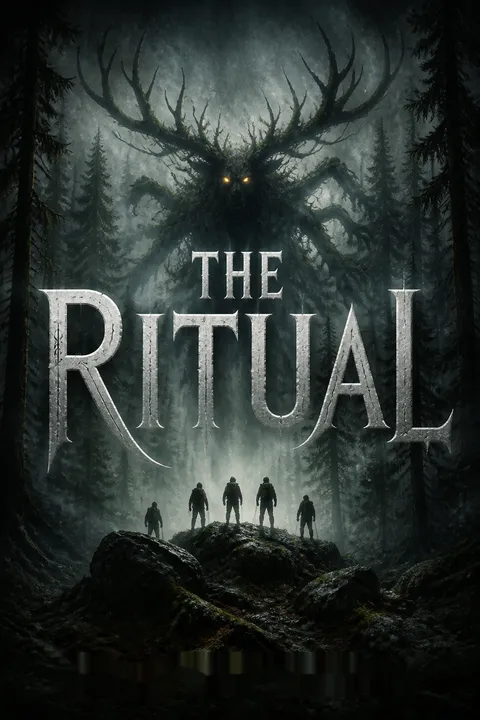


Plot Summary
Prologue
On the hike’s second day, four exhausted friends reach a spruce tree and find a large animal’s fresh, eviscerated body hanging high among its branches. The carcass is too mutilated to identify at first; its great eye and exposed jaw make the men recoil.
Hutch,2 who chose their route, has no explanation. Dom3 and Phil4 speculate, while Luke1 stays silent. Then the friends hurry away, unnerved by the absence of any smell: whatever killed the animal has done so recently.
The hanging carcass is the story’s first breach in the hikers’ ordinary expectations. Its placement matters as much as its wounds: the body has been made into a display, suggesting not only violence but an intelligence or ritual purpose. Hutch’s inability to explain it unsettles the group because he has been their practical authority. The men retreat into theories, but none can restore safety. Luke’s silence distinguishes him early: he watches rather than joins the reassuring talk, a habit that will make him more receptive to evidence and more isolated from the group.
Hutch Cuts the Map
Hutch,2 the experienced outdoorsman,2 sees that Dom’s3 injured knee and Phil’s4 blisters have made their Swedish trek too ambitious. The four friends had planned a three-day hike, but the rain, heavy packs, and slow pace threaten to leave them stranded far from their route. Hutch2 decides to cut southeast through an unmarked stretch of protected forest toward the Stora Luleälven River and huts at Skaite.
Luke,1 who has felt excluded since the reunion began, shares Hutch’s2 confidence in the plan even as he notices that the map shows marshes and no trails. The shortcut is meant to shorten the walk and shelter them from the weather. Instead, it commits all four men to unfamiliar ground.
Hutch’s detour is a practical response to real physical limits, but it also exposes the group’s dependence on his judgment. His identity as organizer makes confidence feel like competence, even when the terrain is unknown. Luke’s quiet consent carries a second cost: he wants to belong, so he suppresses the doubt that might have challenged the plan. Meanwhile, the friends’ bodies register the widening gap between their shared university past and their present lives. The danger begins not with supernatural force, but with an ordinary compromise that nobody fully wants to own.
The Forest Refuses Direction
The shortcut quickly becomes a maze of nettles, fallen trunks, and dense undergrowth. Hutch2 loses confidence in their position as the forest forces them west and north instead of south, while Dom3 and Phil4 grow more exhausted. A narrow track finally offers firmer footing, but leads to a sunken, blackened house in an overgrown clearing.
The men argue over whether entering would be trespassing; their soaked clothes, dwindling daylight, and ruined feet settle the question. Luke’s1 resentment toward Dom3 and Phil4 sharpens as they mock one another, and his sense of being the outsider returns. When he hears a tree snap somewhere in the woods, Hutch2 dismisses the sound as thunder. The four enter the house anyway, seeking shelter.
The forest defeats the hikers first through logistics: it breaks their sense of direction, drains their strength, and makes retreat seem as dangerous as continuing. This practical pressure turns the abandoned house into a choice that feels less like curiosity than necessity. Their jokes briefly preserve the old friendship, but Luke’s private accounting of who belongs with whom shows how little that bond now protects him. The snapping tree becomes a warning that can be rationalized away. Fear is not absent; the men simply lack a shared language for taking it seriously.
A Goat in the Attic
Inside the house, the friends find animal skulls and handmade crosses fixed to the walls. In the attic, Hutch2 and Luke1 discover a horned, stuffed figure displayed over a small box bed, surrounded by animal bones and scratched symbols.
Hutch2 treats it as evidence of an old, deranged household, but the find makes the house feel less abandoned than watchful. During the storm, Phil4 sees something sitting upright in an attic bed and runs downstairs in terror. The others investigate and find only the effigy.
They burn broken furniture and some of the crosses to heat the room, then eat and drink what remains of their supplies. Each man dreams of being hunted or summoned, but exhaustion and embarrassment keep them from comparing experiences openly.
The effigy gives physical form to the fears the men have been avoiding: the possibility that the house is not merely a relic of past madness, but part of a living danger. Their decision to burn the crosses for warmth is both understandable and ominous, a small act of desecration made under pressure. The nightmares then turn the group’s private vulnerability into a shared but unspoken experience. Their reluctance to discuss what they saw leaves each man alone with his fear, allowing the house to shape their behavior without anyone having to believe in it.
Luke Breaks the Friendship
At dawn, Hutch,2 Luke,1 and Dom3 find each other outside the house, shaken by their dreams; Phil4 is naked and terrified in the larder. They pack quickly, but the only visible track leads away from the route they need. As they follow it, Luke1 scouts ahead and crawls beneath the thicket to a cemetery marked by ancient standing stones, with a ruined church beyond.
Returning to the others, he finds Dom3 and Hutch2 laughing instead of moving. Luke,1 already convinced his friends dismiss him, erupts when Dom3 insults him. He shoves Dom3 down, then punches him repeatedly when Dom3 retaliates. Hutch2 separates them. Luke1 is horrified by his own violence, but the fight makes the group’s estrangement impossible to ignore.
Luke’s attack is not simply a reaction to one insult. It is the release of years of accumulated shame, loneliness, and anger, intensified by hunger and exhaustion. That history explains the force of the outburst without excusing it. The fight also changes the group’s practical structure: Hutch can no longer rely on easy camaraderie to keep everyone moving together. Luke’s perception that he is an outsider is partly accurate, but his violent attempt to reclaim status deepens the separation he fears. The forest amplifies a conflict that began long before the trip.
Bones Beneath the Altar
At the cemetery, Hutch2 identifies burial mounds and an old passage grave surrounding the church, whose carved stones appear older than its Christian use. When the rotting floor gives way beneath him, he finds a concealed heap of human and animal bones, including children’s remains.
Phil4 then reports seeing a tall shape move among the trees. The discoveries make the site’s history feel less like archaeology than evidence of repeated violence. With night approaching, the friends reject retracing their route past the hanging carcass and the house.
They push into new ground, find a trickle of water, and camp in a cramped clearing. Luke1 apologizes to Dom,3 but Dom3 refuses to accept it and says he will not speak to Luke1 except when survival requires it.
The church does not offer refuge from the forest; it reveals that human life has been folded into the same landscape of predation. The mixed bones unsettle the distinction between animal and human remains, while the old carvings imply that Christian worship was built over something older rather than replacing it cleanly. The friends’ choice to press onward is shaped by fear, but also by the social damage of Luke’s fight. His apology cannot repair trust on demand. Survival now depends on cooperation among men who have stopped believing they can rely on one another emotionally.
Hutch Vanishes at Night
That night, Luke1 learns from Hutch2 that Dom3 and Phil4 are both facing domestic and financial collapse: Phil4 has been forced out by his wife,11 and Dom3 is separated, unemployed, and worried about his children.10 Luke1 recognizes that his earlier attacks struck wounds he did not know about. Before dawn, a violent commotion tears through Dom3 and Hutch’s2 tent.
Luke1 and Phil4 emerge to find the tent ripped open and slick with blood. Dom3 is alive, but Hutch2 has disappeared. The three search the surrounding woods, calling until their voices fail, then return to the campsite. Dom3 wants to keep looking; Luke1 insists they must move while they still can. The blood makes clear that the danger has taken Hutch,2 and the two surviving friends begin to grieve.
Hutch’s disclosure reframes the hostility Luke has interpreted as contempt: Dom and Phil have been hiding crises, not simply judging Luke’s choices. That revelation arrives too late to prevent the fight, but it makes his remorse more precise. The attack then destroys the group’s usual source of direction. Hutch had mediated disagreements and managed their practical needs; with him gone, Luke must choose between search and escape. His insistence on moving is not callousness but a response to the evidence in the tent. Grief has to wait behind immediate danger.
Hutch in the Trees
Luke1 leads Dom3 and Phil4 south, carrying much of their gear because Dom3 can barely use his injured knee. They find Hutch’s naked, mutilated body wedged between branches and arranged for them to see. A barking, animal-like cry comes from nearby. Luke1 charges into the trees with his knife, driven by rage, but returns without seeing the attacker.
He argues that the killer has been following and staging the evidence, while Dom3 insists it must be an animal or a human maniac. The men continue through the forest, crossing a ravine and climbing toward higher ground. The body has changed their task: they are no longer simply lost hikers seeking a route out, but prey trying to stay ahead of something that knows where they are.
Hutch’s body transforms the earlier carcass from an inexplicable sight into a pattern of display. The killer appears to understand that its victims will find what it leaves behind, making fear part of the hunt. Luke’s charge is the first time he turns anger outward against the unseen threat, but the knife cannot restore control. Dom’s explanations are a defense against the collapse of an intelligible world. Neither response is enough to stop them moving, yet the group’s new awareness changes every decision: the forest is no longer just terrain, but an active adversary.
The Hilltop Takes Phil
At a rocky hilltop, Luke1 climbs a spruce and sees that the forest edge lies several kilometres to the southwest. He realizes their southward course would have taken them into an even deeper belt of woodland. Below, Phil4 disappears while gathering firewood. Dom,3 left alone near the tent, collapses into Luke1 in terror and can only explain that Phil4 is gone.
Luke1 stays with him rather than setting out alone. During the night, a long shape creeps onto the hill. Luke1 hurls a rock at it, striking something that shrieks, but it lashes out and splits his scalp. By morning, Dom3 has bound Luke’s1 wound with the last of their supplies. The two abandon most of their gear and head toward the route Luke1 saw from the tree.
The view from the spruce gives Luke something the group has lacked: reliable orientation. Yet the information arrives alongside another disappearance, proving that knowledge of the route does not make the journey safe. Luke’s choice to remain with Dom marks a shift from wounded self-interest toward responsibility, though he cannot save Phil. When he strikes the creature, the threat becomes physically vulnerable, but its blow leaves him badly injured. The hilltop offers a momentary vantage, not sanctuary. Their survival now depends on carrying less, trusting Luke’s bearings, and continuing despite the loss of strength.
Luke Walks Alone
Luke1 and Dom3 limp through the forest, using branches as crutches and leaving their equipment behind. They find Phil’s remains hanging from a pine, then keep moving. Luke’s1 head wound worsens; thirst, blood loss, and exhaustion blur his sight. When he turns in a thicket, Dom3 has vanished. Luke1 cannot tell whether Dom3 became lost or was taken, and the silence offers no answer.
He continues alone, hallucinating his friends and his new girlfriend12 as he stumbles toward the forest’s edge. At dawn he collapses beneath a tree, nearly unable to move. Local voices reach him through the haze, and he is carried to an old house. He wakes bandaged in a box bed, believing for a moment that he has finally been rescued.
The losses strip Luke of the social world he has spent much of the novel fearing he does not belong to. With Dom gone, he can no longer define himself through grievance or comparison; his body reduces existence to thirst, pain, and the next step. His hallucinations show the mind improvising companionship when human contact disappears. The apparent rescue is deliberately fragile: Luke has reached shelter, but he does not know who controls it or what they want. Relief itself becomes dangerous because his exhaustion makes him ready to trust any place that is not the forest.
Blood Frenzy’s Captive
The house belongs to an elderly woman8 and three Norwegian black-metal performers: Loki,5 their imposing leader; Fenris,6 a volatile drummer; and Surtr,7 a young woman who joins their rituals. They appear in animal masks and paint, then lock Luke1 in the upstairs room instead of taking him to a doctor. Fenris6 taunts him and brandishes a knife, so Luke1 strikes him with a wooden jug.
Surtr7 attacks Luke,1 and the others beat him unconscious. When they show him Dom’s mutilated body in a tree, Luke1 understands that his last companion3 is dead. Loki5 says the band did not kill the hikers, but admits they have murdered people before. He explains that they intend to offer Luke1 to an ancient power in the woods.
The band’s theatrics initially make them look like adolescents playing at evil, but their violence and Loki’s confession remove the safety of that interpretation. Their costumes turn belief into performance, yet the performance has real victims. Luke’s resistance is desperate and costly: striking Fenris protects him briefly, then gives the captors a reason to restrain him more tightly. Dom’s displayed body also completes the destruction of the friendship group, leaving Luke without a witness or ally. Loki’s ritual language gives the band a grand story about its actions, but does not make those actions less deliberate.
The Attic’s Living Dead
Loki5 insists that his band is not merely rebelling against Christianity: he believes its violence can awaken an older Norse power. He takes Luke1 to the attic, where preserved human bodies are arranged along the walls and two frail figures sit on small chairs. The old woman8 tries to stop the youths from bringing Luke1 closer. The bodies move and whisper, confirming that the house holds more than dead relics.
Loki5 and Fenris6 intend to sacrifice Luke1 on an inverted cross, dressed in a bloodstained gown and crowned with dried flowers. Luke1 is beaten, bound, and left waiting. The old woman’s8 warning and the silent figures make the promised ritual seem less like the band’s fantasy than a dangerous custom with roots older than their slogans.
The attic punctures the band’s self-image as creators of a new order. Their ritual depends on ancient beings and inherited practices they neither understand nor control. The preserved figures are not simply proof of supernatural life; they expose the ethical contradiction at the center of Loki’s creed. He reveres the dead of his imagined ancestry while treating living strangers as disposable offerings. The old woman’s resistance suggests that tradition is not a single, unified authority. Even within the house, preservation and sacrifice are contested, and Luke becomes the object through which those competing claims are enforced.
The Cross Goes Down
The elderly woman8 secretly frees Luke’s1 wrists and leaves his Swiss Army knife beside him. He wakes, realizes the restraints are gone, and takes the chance to escape. In the kitchen, Fenris6 attacks with his knife.
Luke1 stabs him with it, then takes the hunting rifle and shoots Loki5 as the giant5 comes through the doorway. Fenris6 dies outside, and Luke1 shoots him again when he continues crawling. Surtr7 escapes into the trees. Luke1 discovers the old woman8 outside, calling into the forest, and shoots her too, convinced she has been summoning the creature.
Her death does not end the danger. Luke1 enters the attic and kills the living ancient figures, destroying the household’s remaining guardians and provoking a vast, furious cry from the woods.
The old woman’s gift makes Luke’s freedom possible, but it does not settle what she intends or whether she can be trusted. Once armed, Luke answers violence with violence and crosses a boundary he had feared crossing. His actions are partly self-defense, partly revenge, and partly an attempt to end the sacrifices permanently. Yet killing the old woman and the attic figures may also remove restraints that had kept the creature contained. The scene refuses a clean moral triumph: Luke is no longer merely acted upon, but his agency is expressed through irreversible harm and uncertain judgment.
The Black Goat’s Charge
Luke1 takes the truck keys and drives into the forest with a rifle, knife, and fresh wounds. The creature pursues him through the narrow track, leaps onto the vehicle, and smashes through its windscreen. Luke1 is trapped in the cab as its horns punch into the metal around him. Before it can tear him open, he drives his small knife into its throat.
The creature withdraws into the trees, coughing, and Luke1 crawls out of the wreck. He is still lost, bleeding, and pursued by the creature’s pale young, which appear in his delirium. Rather than stop, he keeps walking. The truck has failed as an escape, but his strike has bought him the chance to reach open ground.
The truck represents a return to modern protection: a metal shell, an engine, a road. The creature breaches each layer, showing how little technology matters when the environment itself favors the predator. Luke survives not through superior force but through a small, close-range act made possible by his refusal to surrender completely. Wounding the creature does not restore mastery; it only creates an interval in which he can move. The white young that follow him preserve uncertainty about whether he has escaped the supernatural order or merely crossed its boundary.
Out Into the Open
Luke1 walks through the forest for hours, sometimes seeing small pale figures and sometimes hearing voices that are not there. He cannot tell how far he has gone, but eventually the overgrown track ends and the trees open onto a vast, bleak expanse of rock. He sits, rises again, and finds another narrow path leading away from the forest.
His body remains broken, and he has no news of his friends or certainty about what has happened to the creature. Still, the concerns that once consumed him, his wages, debts, failed business, and lonely flat, have lost their power. He understands that survival is not a promise of happiness or safety. For now, being alive and able to take another step is enough.
The ending offers neither rescue nor a full explanation. Luke emerges from the forest into physical openness, but the absence of other people keeps that freedom precarious. His transformation is not a conversion into a fearless or morally purified man; he remains injured, bereaved, and uncertain. What changes is the scale by which he measures his life. His former disappointments no longer define the whole of existence because he has encountered its abrupt vulnerability firsthand. The novel’s final relief is modest and bodily: breath, movement, and time remain available, if only for a while.
Analysis
The Ritual begins with a familiar social failure, not a supernatural one. Four former friends arrive in Sweden carrying incompatible bodies, private disappointments, and an assumption that shared history will make them close again. Hutch’s2 shortcut translates that emotional fragility into physical exposure. Once the group loses its bearings, their old habits become liabilities: Hutch2 keeps morale high instead of admitting uncertainty, Dom3 jokes to defend a collapsing sense of competence, Phil4 withdraws into fear, and Luke1 converts exclusion into anger.
The forest intensifies these conflicts while refusing to serve as a simple metaphor. Its hazards are concrete: wet clothes, damaged feet, dwindling food, and terrain that defeats navigation. The supernatural presence grows through evidence rather than explanation. A carcass is displayed, ancient sites preserve traces of sacrifice, and the creature’s pursuit turns human remains into warnings. The novel sustains dread by keeping two explanations active at once: the wilderness can kill without magic, yet the deliberate staging and impossible strength of the hunter exceed ordinary predation.
Blood Frenzy provides a human counterfeit of the same violence. Loki5 turns grievance into mythology and treats murder as proof of conviction. His group’s masks and music make cruelty theatrical, but their victims are not symbolic. The contrast exposes how easily a grand story can excuse personal brutality. The old woman,8 meanwhile, belongs to a different and older continuity, one that is neither innocent nor fully legible to Luke.1 No single belief system offers a clean moral refuge.
Luke’s1 survival is therefore not a triumph of mastery. He makes errors, loses friends, and acts violently under pressure. What changes is his relationship to his own life. Before the forest, he experiences freedom as drift and resents the responsibilities others appear to possess. Near death, he understands that ordinary existence was not a burden to escape but a fragile good he had failed to value. The ending grants him no repaired friendships or reassuring explanation, only movement beyond the trees and a renewed attention to being alive.
Review Summary
The Ritual received mixed reviews, with many praising its atmospheric horror and creepy forest setting. Readers enjoyed the first half's tense survival story but were divided on the second half's shift in tone. Some found the characters unlikeable and the writing repetitive. However, many appreciated Nevill's descriptive prose and ability to create a sense of dread. The book's exploration of friendship dynamics and ancient folklore also resonated with readers. Overall, it was considered a solid horror novel that evoked strong reactions.
People Also Read





Characters
Luke
The estranged survivorLuke is a thirty-six-year-old Londoner whose precarious work and unsettled relationships have left him feeling like a guest in his own life. He joins an old university circle hoping to recover a closeness that no longer comes naturally. His sharp observation makes him alert to danger, but his sensitivity to exclusion turns easily into resentment, and he can mistake anger for strength. He is neither a born leader nor a practiced hero; he often doubts his judgment and struggles to control his temper. The wilderness forces him to rely on immediate choices instead of his usual self-analysis. His central tension is between wanting independence and longing to matter to other people.
Hutch
The capable organizerHutch is an experienced outdoorsman, the oldest of the four friends, and the one who plans their Swedish hike. He owns a bike shop, stays physically active, and enjoys introducing others to remote landscapes. His enthusiasm is generous, but his confidence can make a risky decision sound manageable before he has tested it. Among the friends, Hutch often acts as organizer and mediator, especially when old tensions surface. He is particularly close to Dom3, a fact Luke1 notices and quietly envies. Hutch’s instinct is to keep people moving and morale intact; under pressure, that same instinct can lead him to postpone difficult conversations and overestimate what his companions can endure.
Dom
The wounded fatherDom is a former university friend whose adult life has become more precarious than he admits. He carries a painful knee injury on the hike and relies on bluster, sarcasm, and drinking to conceal how overwhelmed he feels. His marriage is breaking down, his work has disappeared, and he worries about his children10, but he keeps these troubles private from Luke1. Dom and Hutch2 have retained an easy intimacy that makes Luke1 feel displaced. His teasing can be cruel, especially when aimed at Luke’s1 uncertain work and unconventional choices, yet it comes from a person struggling to protect his dignity while his familiar role as provider and successful professional falls apart.
Phil
The strained property developerPhil is one of Luke’s1 old university friends, a wealthy property developer whose appearance and mood suggest that his life is not as secure as it looks. He is overweight, poorly prepared for the hike, and suffers from painful blisters and asthma. His marriage is collapsing, his business is in trouble, and he has been separated from his daughters11, although he does not share the details with Luke1. Phil often joins Dom3 in dismissing Luke’s1 lifestyle, making Luke1 feel judged for being single and financially insecure. Beneath his defensive humor, Phil is physically vulnerable and emotionally exhausted, and the wilderness strips away the polished success that once defined his place in the group.
Loki
The self-made prophetLoki is the tall, imposing leader of the Norwegian black-metal group Blood Frenzy. He mixes anti-Christian rebellion, Norse mythology, and political grievance into a self-serving story that makes murder seem like a sacred duty. His performance is theatrical, but he can also be calculating and persuasive, especially when managing the other members. Loki wants to believe that his actions belong to a historical awakening rather than ordinary criminal violence. His confidence depends on treating other people as symbols in a grand design. Luke’s1 refusal to accept that design exposes the distance between Loki’s claims of destiny and the immediate harm he chooses to inflict.
Fenris
The volatile drummerFenris is a thin, excitable member of Blood Frenzy who performs aggression as eagerly as he plays drums. He taunts Luke1, demands attention for the band, and reacts badly when challenged. Beneath his bluster is a need to belong to Loki’s5 project and to be seen as dangerous. He adopts the language of ancient gods and rebellion, but his behavior is impulsive and personal. Fenris’s violence is not merely a costume: he has crossed into real criminality, and his childish need for approval makes him especially unpredictable.
Surtr
The band’s feral accompliceSurtr is the young woman in Blood Frenzy, given a mythic name to match the group’s chosen identities. She joins the band’s masked performances and displays a frightening appetite for physical cruelty. Her behavior suggests a person whose impulses have been encouraged rather than restrained by the group. Surtr is closely aligned with Loki5, yet she is not simply a passive follower; she acts decisively when Luke1 resists. Her theatrical presentation turns her body and face into part of the band’s ritual spectacle, while her actions reveal the real violence beneath its imagery.
The old woman
The keeper of the houseThe elderly woman lives in the remote house and moves through it with the authority of someone accustomed to its strange routines. She is small, nearly silent, and difficult for Luke1 to read. She feeds him and tends his injuries, but her care does not make her motives transparent. Her home contains objects and remains that link the present to a much older local past. She appears to tolerate the young musicians without sharing their theatrical manner, and her quiet presence unsettles Luke1 more than their noise. She represents a form of continuity rooted in place, though its moral character remains uncertain.
Angie
Hutch’s waiting wifeAngie is Hutch’s2 wife, waiting back home while he is away. Luke1 and his friends recognize that she may be the person most likely to notice his failure to return and raise concern.
Gayle
Dom’s estranged wifeGayle is Dom’s3 wife and the mother of his children. Her separation from Dom3 forms part of the private crisis he hides during the trip, especially his fear about family life and the future.
Michelle
Phil’s estranged wifeMichelle is Phil’s4 wife, with whom he is in conflict. Her decision to leave him and their daughters has helped unravel the financial and domestic security Phil4 once presented to his friends.
Charlotte
Luke’s new connectionCharlotte is a woman Luke1 has recently begun dating. In his delirium, memories of her return as a vivid link to the ordinary life and intimacy he hopes to reach again.
Plot Devices
The unmarked forest
A maze without exitThe protected northern forest is both physical setting and active obstacle. Its old growth, fallen trees, marshes, and dense underbrush repeatedly push the hikers away from their intended direction. Hutch’s2 map and compass provide only partial reassurance because the terrain is difficult to cross and easy to misread. The forest also hides the creature and the remains of earlier human settlements. As the group loses food, strength, and companions, the forest narrows their choices until simply continuing becomes an act of survival. Its apparent hostility may be supernatural, but its real hazards are already sufficient to make escape uncertain.
The ritual remains
Evidence of old worshipAnimal skulls, crosses, rune-marked trees, burial stones, a ruined church, and the hidden attic figures form a trail of material clues. Each discovery suggests that the remote settlement once practiced rites that survived beneath or alongside Christian worship. The objects do not explain the creature on their own, but they prepare the reader to understand why Blood Frenzy believes the forest contains an ancient power. Their condition also connects violence across generations: human and animal remains are mixed, preserved, or displayed according to different customs. The clues progressively turn the hikers’ wrong route into an encounter with a buried religious history.
Displayed bodies
Fear made into a messageThe mutilated animal and the hikers’ companions are left hanging in trees where the survivors will find them. These displays echo the earlier sacrificial evidence and make the violence seem deliberate rather than accidental. They also shape the group’s behavior: the men argue over what kind of attacker could arrange a body this way, then move through the forest expecting to be watched. The displays are not merely gruesome shocks. They establish the creature’s method of turning its victims into warnings, and they foreshadow the ritual imagery Blood Frenzy later imitates in its attempted sacrifice of Luke.
Blood Frenzy’s masks
Violence dressed as mythThe band’s animal masks, corpse-like face paint, black-metal music, and chosen Norse names turn its criminal intentions into a public performance. Loki5 uses the group’s aesthetic to frame murder as a return to ancestral belief, while Fenris6 and Surtr7 act out the parts with less restraint. The contrast between staged imagery and actual violence is central: the costumes look absurd, but the people beneath them are dangerous. Their music also serves as part of the attempted invocation, joining modern subculture to the older rites they claim to revive.
The inverted cross
A staged sacrificeLoki’s5 group prepares an upside-down cross, a bloodstained gown, and a crown of dried flowers for Luke1. The props reveal how the band borrows Christian imagery to define itself against Christianity, while the old woman’s8 preparations suggest that Luke’s1 role may belong to a ritual older than the band’s rebellion. The cross becomes a point where performance, coercion, and supernatural expectation meet. It gives the captors a script for Luke’s1 death, but it does not guarantee that the ritual will work as they intend. The old woman’s8 intervention changes what happens next.
About the Author


Download PDF
Download EPUB
.epub digital book format is ideal for reading ebooks on phones, tablets, and e-readers.








