


Plot Summary
Mantises on a Dying Man
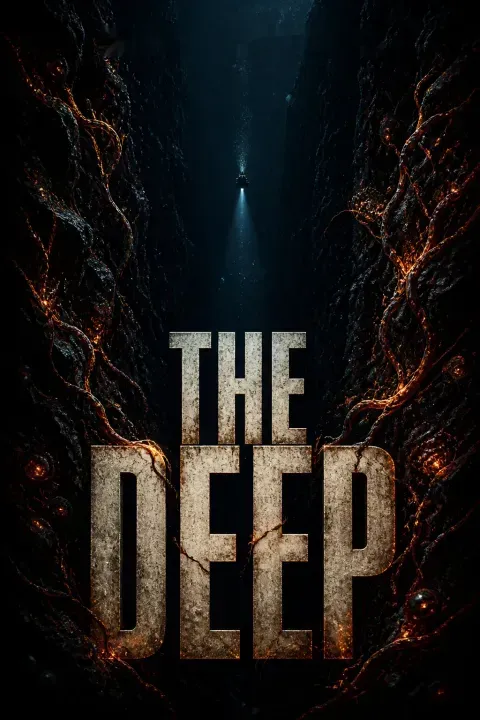
Veterinarian Luke Nelson1 travels to Guam after receiving an urgent summons. His estranged brother Clayton,2 a brilliant but emotionally void scientist, has gone silent inside the Trieste, an undersea research station eight miles deep in the Challenger Deep.
The world above is crumbling under the 'Gets, a plague that erases memory until victims forget how to breathe. On a sweltering roadside, Luke1 encounters an old man whose bare skull is carpeted with praying mantises, their abdomens coupled in mating frenzy. The man's eyes hold the Big Blank, the disease's terminal vacancy.
Luke1 brushes the insects off and redirects him, knowing the man will wander until his heart forgets its rhythm. In the nearby village of Inarajan, a smiling girl already displays the telltale spotting on her elbows, and a solitary church has been burned to cinders while every other building stands untouched.
The book opens with visceral iconography that collapses the cosmic and the intimate. The mantises mating on a dying skull fuse reproduction with decay, a motif that will echo through every subsequent horror. The 'Gets operates as a psychological inversion of what we most fear about dementia: not just losing memories, but losing the procedural knowledge that keeps a body alive. The burned church, singular among untouched buildings, suggests a targeted erasure of faith, hinting that whatever stalks this world has a particular hostility toward structures of meaning and hope.
Ambrosia's Impossible Promise
Aboard the floating research platform Hesperus, Dr. Conrad Felz9 shows Luke1 a petri dish containing a gelatinous blob the color of collected thumbprints. Named ambrosia, it resists all scientific categorization, has no matching DNA, and displays an eerie ability to add matter to itself rather than simply consuming it.
Felz9 explains its discovery: a fishing trawler hauled up a lantern fish from miles deep that should have been crushed by pressure change yet lived impossibly, its age rings too numerous to count, kept alive by a speck of this substance.
A video shows Clayton's2 earlier experiment where ambrosia entered a cancer-riddled mouse and cured it completely within seconds. Felz9 also reveals that the marine biologist who discovered the substance, Dr. Eva Parks, hanged herself shortly after surrendering the sample to Clayton's2 team.
The ambrosia is introduced as a religious artifact disguised as a scientific specimen. Its name invokes the food of the Greek gods, but the substance behaves more like a parasite that gives before it takes. The lantern fish's impossible longevity and instantaneous decay once the ambrosia departed foreshadows the Faustian bargain at the story's heart. Dr. Parks' suicide is the first warning that proximity to this substance carries a psychological contagion, a detail that casts Clayton's continued work in a more sinister light. Felz's reverence masks the terror that anyone rational should feel.
Westlake's Scarred Smile
Lieutenant Commander Alice Sykes,3 a scarred Navy sub pilot with a controlled bearing, escorts Luke1 to a cold morgue vault. Inside lies Dr. Cooper Westlake,4 the Trieste's computational biologist, who surfaced hours earlier in a submersible he was never trained to operate.
His naked body is a swollen mass of overlapping scar tissue, pink ribbons of healed flesh wrapped around every inch of skin. His face received special attention: his lips are fused together in a rictus grin, his eyes trapped inside bulbs of gnarled tissue.
The bends snapped his bones during rapid ascent, yet the most disturbing detail is his expression: he died smiling. Written inside the sub in dried blood are five words: THE AG MEY ARE HERE, followed by COME HOME WE NEED YOU COME HOME. Alice3 notes she read the message differently, seeing MAN instead of MEY.
Westlake's body is the story's first full statement of body horror as psychological metaphor. He carved himself open and healed instantly, layering scar upon scar in what reads as a frenzied attempt to reshape his own form. The smile suggests ecstasy rather than agony, implying that whatever drove him to this was not purely torturous but seductive. The divergent readings of the blood message introduce the story's central epistemological crisis: perception itself is unreliable down here. The words echo Clayton's recorded plea to Luke, establishing that multiple people have been touched by the same compulsion.
Zachary's Final Game
Seven years earlier, Luke1 picked up his six-year-old son Zachary8 from school and stopped at a neighborhood park. The boy begged for one game of hide-and-seek. Luke1 counted to twenty while Zach8 dashed toward the treeline, his giddy laughter carrying back. On the count of twenty, Luke1 opened his eyes to silence.
He searched the playground, then the surrounding woods with escalating panic. He had heard a strange sound during the count: a wet zippering, a resonant sucking. Police arrived within minutes, search dogs and helicopters worked through the night, but Zachary Henry Nelson8 was never found.
Luke's1 marriage to Abby collapsed under the weight of her unspoken blame and his own bottomless guilt. He returned to his veterinary practice but continued driving the streets at night, seeing his son's face in every crowd, haunted by the same loop of terror: twenty seconds, and a life was erased.
This is the emotional core wound that makes Luke susceptible to everything that follows. The twenty-second window becomes a psychological black hole: a span of time so brief it feels meaningless, yet large enough to swallow a family whole. The 'Gets and Zachary's disappearance are mirrored traumas: both involve the sudden absence of what was just present, both leave the bereaved still searching. Luke's nightly driving is a form of ritualized grieving that never resolves, a perpetual hide-and-seek game he cannot win. The strange sound he heard suggests intervention, but he cannot know this yet.
Descent Through Jaws
Alice Sykes3 pilots the two-person submersible Challenger 5 vertically into the Pacific. The descent is a slow free-fall through oceanic zones, each darker and more pressurized than the last. Bioluminescent phytoplankton swirl past like snow, triggering Luke's1 memory of the night he met his ex-wife Abby.
Then the attacks begin. Viperfish strike the porthole in swarming fury, their sickle-shaped jaws snagging on the hull's protective foam. Alice3 drops them deeper to escape, only for a giant squid to latch onto the sub with a sucker-studded tentacle, its parrot-like beak hammering the glass.
The pressure makes them both bleed from their eyes and noses. Alice3 notes these encounters are abnormally clustered, as if something is trying to prevent their arrival. Luke1 glimpses the Trieste through the darkness, its spider-like configuration of tubes evoking an immediate, instinctual revulsion in him.
The descent literalizes the psychological journey: each layer of ocean strips away another defense, leaving Luke increasingly vulnerable. The attacks by sea creatures invert the expected relationship between human and nature; here, the animals are not indifferent but actively hostile, as if conscripted by a hostile intelligence. Alice's observation that this clustering is unnatural plants the idea that the deep possesses agency. Luke's visceral revulsion at seeing the Trieste is the body knowing what the mind has not yet accepted: some structures are wrong in ways that precede rational understanding.
Locked Inside the Spider
Luke1 topples through the Trieste's entry hatch into freezing darkness, immediately assaulted by claustrophobia and the phantom sound of children's footsteps racing overhead. A chocolate Labrador named Little Bee6 emerges from the gloom and presses against his legs, abandoned and shivering.
Alice3 enters, and they explore the storage tunnel only to find the inner hatch locked from the other side. Through a porthole, Dr. Hugo Toy5 appears in a state of deranged hostility, screaming soundlessly and dragging a scalpel across his own throat before scuttling away.
Hours later, Luke's1 brother Clayton2 finally opens the hatch. He is gaunt, distant, and coldly denies having sent the recorded transmission begging Luke1 to come. His fingertips are bandaged, and he treats the dog as a mere specimen. When Luke1 describes the recording, Clayton2 scoffs that he would never need a veterinarian.
Clayton's denial of the transmission creates an immediate mystery: either he is lying, or something else sent that message using his voice. His emotional flatness, evident since childhood, now reads as something more sinister in this context. The dog's abandonment in the freezing tunnel suggests either cruelty or a breakdown of basic caretaking protocols. Toy's appearance establishes the mad-scientist trope but subverts it: his terror seems proportionate to genuine threat rather than mere psychosis. The children's footsteps, explained by Alice as pressure noise, already sound like something else entirely.
Knocking from the Void
In Westlake's4 quarters, Luke1 discovers a laptop containing three audio files. In the first, Westlake4 describes discovering a small hole in his lab wall, not leading to the ocean but to some impossible darkness. The hole exerts a psychological pull he finds both alarming and seductive.
In the second recording, he has fed a microphone through the hole and established communication with whatever resides beyond: one knock for yes, two for no. The entity answers his questions, claiming to be of this planet and willing to help. The third file records Westlake's4 accelerating obsession.
His bees are fascinated by the hole, swarming around it. He has stopped leaving his lab. His voice has changed, becoming possessive and paranoid. He mentions hearing a child's laughter through the hole. The final file ends abruptly with feedback and a scream. Luke1 shuts the laptop, drenched in cold sweat.
These recordings transform the horror from atmospheric to ontological. Something intelligent exists on the other side of the station walls, and it communicates in a way designed to feel collaborative rather than threatening. The one-knock-for-yes protocol exploits the scientific method itself as a vulnerability, turning rational inquiry into a vector for corruption. Westlake's rapid shift from objective researcher to jealous hoarder of the mystery demonstrates how quickly curiosity can become compulsion. The child's laughter links this entity to the footsteps overhead and, implicitly, to Luke's lost son, personalizing the cosmic threat.
The Head That Wouldn't Die
Clayton2 invites Luke1 into his lab to demonstrate his research. He produces a guinea pig frozen solid, which thaws and revives despite having been dead. When Luke1 holds it, the creature feels tumorous and wrong. It immediately attacks the other guinea pigs in its cage, hamstringing one and tearing at its genitals.
Clayton2 injects it with enough Euthasol to kill a Great Dane, but when the drug fails and the creature revives, he severs its head with surgical shears. What follows defies biology: no blood initially flows, then blood-tentacles emerge from both severed halves, reaching across the lab bench toward each other, trying to reattach.
Clayton2 traps the head in a plastic container while the body's blood probes the seal like a searching animal. He then uses a speck of ambrosia to heal the wounded guinea pig's genitals. The creature races maniacally on its wheel afterward, changed into something feral.
This sequence is the book's declaration that its horror will not respect any boundary, including death. The ambrosia does not simply heal; it transforms the healed into something predatory and wrong. The blood-tentacles reaching across the gap between severed halves externalize the substance's central property: an overwhelming drive toward wholeness that overrides the natural order. Clayton's clinical demeanor while performing these acts reveals his dangerous neutrality. He witnesses the same horror Luke does but processes it as data. The healed guinea pig's maniacal running suggests that what ambrosia grants is not restoration but a kind of perpetual, driven agitation.
The Tickle Trunk Opens
An oxygen warning forces Luke1 and Alice3 to crawl through a suffocating access chute into the purification room. Luke's1 claustrophobia triggers a hallucination of a giant millipede pursuing him through the tube, connected to a childhood memory of an insect crawling inside his infant son's sleeper.
Once inside the room, Alice3 finds a black plastic crate whose latch, impossibly, snaps open on its own. When she investigates, she flees in terror, whispering that a dead sailor named Eldred Henke, whose death she witnessed on a submarine years ago, crawled out of it.
Luke1 sees something different: a giant gray hand with eight long fingers tipped in black nails, the same hand he once saw emerge from a clown-faced Tickle Trunk his abusive mother7 forced him to keep in his bedroom. Both of them flee back through the chute as the hand pursues, tapping its nails along the metal.
The purification room sequence reveals the station's ability to generate individualized psychological torture. Luke and Alice each encounter manifestations drawn from their own guilt and terror, not a shared monster. The Tickle Trunk, one of Bethany's crueler psychological weapons, represents how childhood trauma becomes a permanent vulnerability that the Fig Men can exploit. Alice's dead sailor and Luke's monster-hand serve the same function: embodied guilt that should not be able to touch them, yet does. The hand's final wave goodbye is the most chilling detail, confirming that whatever animates these horrors possesses a mocking, playful malevolence.
Westlake's Body Breeds Bees
Luke1 reads Westlake's4 psych report journal, which begins clinically but rapidly deteriorates. Westlake4 describes the hole growing larger, the bees becoming agitated and then transformed. A single sting from one of his experimental bees causes a spreading infection: inflamed hexagonal hills across his entire body that eventually split open to birth new creatures.
These are not ordinary bees but hybrids with flesh-toned abdomens, fire-red eyes, and cruel stingers. Westlake4 becomes their queen, his progeny attacking the station's original bee colony and killing the old queen, a bloated creature the size of a puppy.
His handwriting degrades into jagged slashes, his thoughts fragmenting. He writes of putting his fingers through the hole and cutting off the changed tips. The journal's final pages are written in what appears to be blood, ending with two phrases: THE FIG MEN ARE HERE11 and DADDY COME HOME, the latter in letters gouged through multiple pages.
The journal is the story's structural masterpiece, a slow-motion descent into madness rendered in deteriorating handwriting. The bee transformation literalizes the body-horror metaphor: outside influence literally rewrites biology from within. Westlake's pride at becoming 'queen' is a dark parody of reproduction and nurture. The final phrase DADDY COME HOME is the key that unlocks the larger conspiracy: Luke is not here by accident. Someone or something has known about his lost son all along. The Fig Men, introduced as a childhood monster Luke invented for Zachary, retroactively gain terrifying reality, collapsing the boundary between protective fiction and predatory truth.
The Station Takes Toy
Luke1 follows LB6 to Dr. Toy's5 sealed quarters, where the chaos theorist ties his wrists and interrogates him. Toy5 explains his realization that the Trieste functions as a Skinner Box, a behavioral experiment where humans are the rats and whatever lives beyond the holes are the scientists, administering shocks and rewards to study their reactions.
He demands to see Luke's1 blood, explaining that the ambrosia can enter a body and change a person from within. As Luke1 works his bonds free, the ceiling suddenly buckles downward with deliberate cruelty.
It crushes Toy's5 legs first, then rolls slowly over his hips and chest, savoring the destruction. Toy's5 skull splits and his brain extrudes as the ceiling flows across him. Luke1 escapes through the hatch just before it seals, Toy's5 final sound being an infant's laugh, a perfect mimicry of Zachary's8 toddler giggle.
Toy's Skinner Box theory reframes the entire mission as a controlled experiment with no benevolent intent. The ceiling's behavior confirms his thesis: the station does not merely suffer structural failures but actively, methodically kills with apparent awareness of pain's psychological impact. Toy's death is the most graphically sadistic in the book, its slow progression designed for maximum horror. The infant's laugh that escapes his dying mouth is the clearest evidence yet that whatever occupies this place can access and weaponize Luke's most personal memories, siphoning them from his mind and projecting them through its victims.
The Hand That Crawled Away
Confronting Clayton2 in his lab, Luke1 discovers the hole hidden behind an Einstein poster. Ambrosia drips through it into a collection vessel. When Luke1 attempts to drag his brother2 to the Challenger, the dog Little Bee6 attacks Clayton,2 and in the struggle, Clayton's2 bandaged hand is revealed.
His fingers have elongated into monstrous, spider-like digits with extra joints and dark nails. Luke1 sedates Clayton2 and cuts away the bandages covering his arm: the flesh has turned translucent, the bones visible and overlapping. As Luke1 watches, Clayton's2 hand detaches itself at the wrist with a meaty tear and begins crawling across the floor independently.
Luke1 traps it in a cooler, but the other dog, Little Fly, emerges from the lab transformed into a nightmare creature. It had been pushed through the hole and returned altered. It fuses its flesh to Little Bee6 and drags her, howling, through the hole despite Luke's1 desperate efforts to hold on.
This sequence brings together every horror thread: body transformation, loss of autonomy, and the hole's insatiable hunger. Clayton's hand detaching itself literalizes the idea that the ambrosia does not heal but replaces, grafting new appendages onto the host. The fusion of the two dogs is an obscene parody of reunion, the Mushka-creature wanting its old companion back so badly it absorbs her. Luke's inability to save Little Bee despite holding her in his arms echoes his failure to save Zachary, reinforcing his role as the Human Shield who cannot actually shield anyone he loves.
Alice Woven in the Hive
Clayton's2 severed hand, now animated independently, skitters to Westlake's4 locked hatch and types the access code. The door opens on a cathedral of horror. Westlake's4 bees have built a hive of impossible scale, the ceiling pushed upward against the ocean's weight to accommodate it.
The comb is studded with human remains: fingers, bones, a pulsating organ. At the hive's center, Alice's3 body is woven into the structure. Her face has been flayed in four triangular flaps pinned open to the comb, her skull exposed.
Yet she is still alive, her eyes tracking Luke,1 her lipless mouth forming the word no when he raises a scalpel to end her suffering. A translucent sac hangs beneath the hive, something monstrous moving inside it. As the sac ruptures and a dark limb tears through, Luke1 flees. Alice's3 laughter follows him out, high and unhinged.
Alice's fate is the book's cruelest horror because she was the most competent and resilient character. Her flayed face, still alive, transforms her from protector into exhibit. The hive has repurposed her body as architecture, her nervous system presumably integrated into the colony's functions. Her refusal of death, the single word 'no,' is ambiguous: does she cling to existence, or is something else speaking through her? The birthing sac suggests that whatever the Fig Men are bringing into the world requires human tissue as a gestational medium. Luke's flight is not cowardice but the only sane response to something that has definitively defeated sanity.
The Fig Men's Ancient Bargain
Luke1 drags Clayton's2 sedated body to the Challenger but discovers an umbilical cord of ambrosia tethering his brother2 to a new hole in the wall. When Luke1 touches it, he experiences Clayton's2 memories: their mother7 sexually abused Clayton2 as a teenager, and Clayton2 methodically poisoned her over months with tree-killing chemicals until she wasted away.
Clayton2 smiles as the cord retracts him into the hole. Luke1 enters the Challenger where a false Alice3 promises escape before her eyes melt into black fluid. He wanders the transformed station, descending a staircase into the earth's basement.
There, two ancient entities, the Fig Men,11 explain their millennia-long manipulation. They engineered the discovery of ambrosia, used the 'Gets as bait, and took Zachary8 seven years ago as leverage. A cocoon births a monstrous version of his son.8 Luke1 opens his arms in acceptance as tendrils enter his face and his son8 crawls inside him.
The Fig Men represent a genuinely alien moral framework: they are not evil in any human sense but simply curious, eternal, and utterly without empathy. Their manipulation spans decades with the patience of beings for whom time is meaningless. Luke's acceptance of their 'gift' is both a defeat and the only choice a loving father could make. He becomes the Human Shield in the most literal way: taking his son inside his own body. Clayton's murder of their mother recontextualizes his entire life as a response to trauma he could never articulate. The ending's ambiguity, whether Luke is destroyed or transformed, whether anything human remains, is the book's final horror.
Epilogue
The Challenger ascends through eight miles of darkness and breaks the surface at night. The Hesperus sits abandoned, its architecture blackened by small fires. A single figure awaits on the deck: a body completely covered in scar tissue, its face carved with crude slits to allow sight, its posture trembling with feverish anticipation.
The submersible's hatch swings open. Moonlight falls upon its cargo as something shambles forth. What emerges is not Luke Nelson1 any longer. The darkness that spent eons trapped at the bottom of the world has found its vessel, its bearer, its door to the sunlit realm.
Somewhere far below, the Trieste squats in spider-like patience, its tunnels empty, waiting for the next group of hopeful scientists who will dismiss the warnings of their superstitious predecessors. They might even bring dogs with them.
The epilogue closes the loop on Westlake's corpse, revealing that the scarred body on the Hesperus was waiting for this moment, not discovered after the fact. It suggests a form of life after transformation: Westlake's body animated by something that serves the Fig Men's agenda. The final paragraphs are a chilling invitation to imagine the cycle repeating: new scientists descending, new horrors unfolding. The mention of dogs echoes Little Bee and Little Fly, the innocent creatures who suffered most and understood least. The epilogue transforms the book from a closed tragedy into an ongoing one, a trap that will spring again and again because human hope and curiosity are fundamentally incurable.
Analysis
The Deep operates at the intersection of cosmic horror and psychological trauma, arguing that the two are fundamentally the same thing. The Fig Men11 may be ancient and alien, but what makes them truly terrifying is their intimate knowledge of individual human suffering. They do not attack with claws or teeth but with memories, regrets, and the faces of lost loved ones. Every character's breaking point is personal: Westlake's4 basement monster from his Belmont home, Alice's3 drowned sailor, Luke's1 missing son and abusive mother. The entities11 study their victims for decades, cataloguing vulnerabilities, then deploy them with the precision of surgeons. The novel suggests that trauma is not merely something that happens to us but something that can be weaponized against us by forces that understand our wounds better than we do ourselves. The body horror that pervades the book is never gratuitous; each transformation expresses a psychological truth. Clayton's2 hand elongating into monstrous fingers externalizes his lifelong inability to connect. Westlake4 birthing bees from his flesh literalizes the experience of having one's body colonized by an alien intelligence. Luke1 accepting his son8 into his own body is the ultimate act of the Human Shield: becoming the container for what he cannot protect. The ocean setting functions as a perfect metaphor for the unconscious, with the Challenger Deep as the deepest basement of the psyche where the worst things have been locked away. The book's bleakest insight is that hope itself is the trap: humanity's desperate need for a cure, Clayton's2 insatiable curiosity, and Luke's1 love for his son8 are not defenses against the darkness but the very mechanisms by which it draws them down.
Review Summary
The Deep receives polarizing reviews averaging 3.41 stars. Readers praise Nick Cutter's atmospheric horror, claustrophobic setting eight miles underwater, and disturbing psychological elements reminiscent of The Shining and The Thing. Many highlight the effective terror, body horror, and childhood flashbacks. Common criticisms include excessive animal cruelty, unlikeable characters (especially Clayton), too many borrowed concepts, meandering flashbacks disrupting pacing, and anticlimactic endings. The plague subplot ("the 'Gets") feels underexplored. Despite divisiveness, most acknowledge Cutter's skill in crafting visceral, nightmare-inducing horror that deeply unsettles readers.
People Also Read









Characters
Luke Nelson
grieving father, summoned brotherA veterinarian from Iowa City whose life stopped seven years ago when his six-year-old son Zachary8 vanished during a game of hide-and-seek. Divorced and quietly self-destructive, Luke continues to drive the streets at night searching for a boy he knows he will never find. He is motivated by love that has curdled into guilt, making him vulnerable to the Fig Men's11 manipulation. As a child, he created an alter ego called the Human Shield to cope with his mother's7 psychological abuse; as an adult, he still defines himself by his capacity (or failure) to protect the innocent. His veterinary skills give him a practical, clinical eye for bodily horror, but his empathy means he feels every wound he witnesses. His journey to the Trieste is both a rescue mission for his brother2 and an unconscious death drive, a man with nothing left to lose walking willingly into the dark.
Clayton Nelson
brilliant sociopath, willing collaboratorLuke's1 older brother, a scientific prodigy whose emotional range was cauterized by their mother's7 abuse. As a child, Clayton grafted a human ear onto a mouse's back; as an adult, he engineered mice born with every form of cancer. He was recruited for the Trieste mission because his mind operates at a level that makes conventional morality irrelevant to him. He does not care whether the ambrosia cures the 'Gets; he simply wants to understand how it works. His mother's7 sexual abuse, which Luke1 only learns of through a shared memory, explains his detachment: he learned to kill his feelings to survive, then learned to kill literally by slowly poisoning Bethany7. By the time Luke1 reaches him, Clayton has already pushed one dog through the hole and put his own hand through, beginning a transformation he cannot control. He represents pure intellect without conscience, the perfect tool for entities11 that need a human mind to unlock their prison.
Alice Sykes
sub pilot, reluctant guardianA Navy lieutenant commander with a scar encircling her neck and propeller tattoos on her hips, superstitions from a life spent underwater. She has made more descents to the Trieste than anyone, ferrying personnel and supplies. Beneath her tough exterior, she carries guilt from a submarine accident where she watched a young sailor named Eldred Henke die because she could not open a sealed hatch in time. She is the most competent person in the station, her practical skills making her invaluable, but the Trieste's psychological pressure affects her as deeply as anyone. She becomes increasingly drawn to Westlake's4 locked lab, entering trance states where she attempts to crack its code as if summoned. Her fate is the most viscerally horrifying in the book: she is woven alive into the bee hive, her face flayed open, still conscious. She represents the failure of competence and courage against forces that do not respect either.
Dr. Cooper Westlake
first victim, journal-keeperA computational biologist and father to a young daughter named Hannah. He was the most emotionally normal of the three original scientists, the one Alice3 considered approachable. His journal reveals a man haunted by childhood encounters with something terrifying in his family's basement, a presence he fled but never escaped. At the Trieste, he discovered the first hole in his lab wall and became obsessed, establishing communication through knocking. His bees, initially test subjects for studying the 'Gets, became vectors for his transformation when a sting from an ambrosia-infected specimen caused his body to birth new, hybrid creatures. By the end, he had become their queen, killing the old hive's matriarch and watching his progeny colonize the lab. His journal's final pages, written in blood with gouged letters, contain the first written reference to the Fig Men11 and the phrase DADDY COME HOME, linking his madness directly to Luke's1 trauma.
Dr. Hugo Toy
chaos theorist, sacrificial warningA molecular biologist specializing in chaos theory who joined the mission despite severe claustrophobia because his daughter Jennifer had contracted the 'Gets. His role was to analyze the ambrosia's effects through the lens of instability systems, determining whether it truly cured anything or merely created chaos under an illusion of cure. He was the first to break, isolating himself in the animal quarantine quarters where he covered the walls with duct-tape runes and descended into paranoia. Before his death, he articulated the book's central thesis: the Trieste is a Skinner Box, and whatever lives beyond the holes is running experiments on the humans inside. He demanded to see Luke's1 blood because he understood that the ambrosia physically changes those it enters. The station killed him by crushing him slowly with its ceiling, an act of deliberate cruelty that confirmed his theory.
Little Bee
loyal dog, emotional anchorA chocolate Labrador retriever, one of two dogs Clayton2 brought to the Trieste as test subjects (named after the Russian space dogs Pchyolka and Mushka). She finds Luke1 in the freezing storage tunnel and immediately bonds with him, becoming his constant companion. She provides the only uncomplicated affection in the station, her presence keeping Luke1 tethered to sanity through his worst moments. She was locked in the storage tunnel by Dr. Toy5 for unknown reasons, left to freeze in the dark. Her counterpart, Little Fly, was pushed through the hole by Clayton2 and returned as a monstrosity. In the book's most heartbreaking sequence, the transformed Little Fly fuses to Little Bee and drags her through the hole while Luke1 holds her, powerless to stop it. She represents innocence devoured by a place that has no use for it.
Bethany Ronnicks
abusive mother, psychological scarLuke1 and Clayton's2 mother, now deceased. A former orderly at a home for mentally troubled boys, she became housebound and morbidly obese after a resident attacked her with a hoe, shattering her hip and knee. Confined to a chair in a dark room, she ate porridge obsessively while tormenting her family. She ruined Luke's1 father, reducing him to a servile shell, and psychologically tortured both sons. With Clayton2, she went further, sexually abusing him in his basement lab. Clayton2 eventually poisoned her with tree-killing chemicals administered in small doses through her food and toiletries until she wasted away. Her voice appears in Luke's1 mind throughout the novel as a mocking internal antagonist, the internalized abuser who whispers doubts and cruelties. The Fig Men11 eventually manifest using her form, recognizing her as Luke's1 original monster.
Zachary Nelson
lost son, ultimate leverageLuke's1 son, who vanished at age six during a game of hide-and-seek in a park near their Iowa City home. Luke1 counted to twenty and opened his eyes to find his son gone, never to be seen again. During the count, Luke1 heard a strange zippering sound and a resonant sucking, details that only later become comprehensible. Zachary was not randomly abducted but specifically taken by the Fig Men's11 influence, held for seven years in their realm as leverage against the day they would need Luke1 to serve as their bearer to the surface. His childhood fear of the 'Fig Men11' in his closet was not pure imagination but some kind of sensitivity to the entities11 watching his family. His pajamas, his laughter, and his voice are used throughout the novel to torment and lure Luke1 deeper into the station.
Dr. Conrad Felz
ambrosia custodian, bureaucratic scientistClayton's2 colleague from MIT who remained on the Hesperus while the others descended. Short, squat, and perpetually damp-lipped, he serves as the introductory expositor, explaining the ambrosia's discovery and properties to Luke1. He holds a complicated resentment toward Clayton2, who treated him as a subordinate rather than a peer. He hints that Clayton's2 genius comes at the cost of basic humanity. He shows Luke1 the cancer-mouse video and reveals Dr. Parks' suicide, information that colors Luke's1 perception of the mission before he descends. Clayton2 later accuses Felz of trying to have him declared insane so he could take over the project, a claim that may be paranoia or may be accurate.
Leo Bathgate
boat captain, fellow grieverThe captain who ferries Luke1 from Guam to the Hesperus aboard a conscripted luxury yacht. A former lobsterman, he lost his wife Mona to the 'Gets after watching her slowly forget everything, from their anniversary to how to swallow. He tells Luke1 his story without self-pity, framing it as simply what the world now requires of those left behind. His hope that Clayton2 might find answers, even though it comes too late for his wife, represents the quiet perseverance that keeps civilization functioning during the plague. He shares whiskey and squid jerky with Luke1, offering human warmth before Luke1 descends into a place where warmth cannot follow.
The Fig Men
ancient entities, cosmic antagonistsTwo ancient beings dwelling in the deepest part of the Challenger Deep, imprisoned there since before human memory by a higher power. One is tall and thin, the other squat and pear-shaped, both composed of raw sinew, translucent skin, and exposed bone. They are not malevolent in any human sense but completely pitiless, lacking the capacity to care about suffering. They have observed humanity for eons, studying exceptional minds like da Vinci and Tesla with detached curiosity, waiting for the species to develop enough to reach them. They call themselves the Fig Men, adopting the name from the childhood monster Luke1 invented to protect his son8 from closet fears. Their power is immense but bounded: they can manipulate events, manifest terrors from individual memories, and reshape flesh, but they cannot leave their prison without a human 'bearer' to carry their essence to the surface.
Plot Devices
Ambrosia
miraculous healer, corrupting lureA gelatinous substance discovered in the Challenger Deep that appears to cure all illness and reverse death. In laboratory tests, it eradicated cancer in mice and healed a guinea pig whose head had been severed. It does not simply heal but fundamentally alters what it touches, rendering flesh translucent, elongating bones, and creating a predatory aggression in its hosts. The substance is revealed to be the Fig Men's11 bait: a lure designed to attract the best scientific minds into the deep, where they can be studied and used. It functions as both a physical material and a kind of distributed intelligence, capable of forming umbilical cords that tether hosts to the holes and of transmitting memories between connected individuals. The entire Trieste mission was built around harvesting it as a cure for the 'Gets, making humanity's hope its vulnerability.
The Holes
dimensional rifts, communication portalsOpenings that appear spontaneously in the walls of the Trieste, starting as pinpricks and growing to the size of manhole covers. They do not lead to the surrounding ocean but to the Fig Men's11 dimensional prison, a darkness that shimmers like liquid. The holes exert a powerful psychological pull described as fishhooks in the brain, making it nearly impossible to look away from them. They whisper, knock in response to questions, and can consume offerings pushed through them, sometimes returning them transformed. Clayton2 covered his with an Einstein poster, which he believed muffled the pull. The ambrosia drips through the holes into the station. At the novel's climax, the holes become large enough to swallow living creatures whole, and the things that emerge from them are never the same as what went in.
The 'Gets
global plague, psychological leverA worldwide disease causing progressive, fatal memory loss. Victims first develop physical spotting on their skin, then forget minor things, then critical functions, eventually forgetting how to breathe or how to beat their hearts. It is unique in affecting only humans (and honeybees, which were the first bellwethers). The disease is not caused by the Fig Men11 but was exploited by them: it created the desperation that drove governments to invest trillions in the Trieste mission, effectively delivering the world's best scientific minds directly into the trap. The disease's psychological impact is as devastating as its physical effects, erasing not just function but identity, relationships, and the accumulated meaning of a lifetime. The Fig Men11 recognize it as a 'happy convergence' that served their purposes.
The Trieste Station
underwater prison, experimental Skinner BoxThe deep-sea research habitat constructed at the bottom of Challenger Deep, named for the bathyscaphe that first explored the trench. Built using orb physics principles (egg-shaped structures that distribute pressure), it consists of interconnected tubes and chambers that sprawl across the ocean floor in a configuration that reminded its occupants of a spider. The station was assembled by robots and then sealed from within by Otto Railsback, who died inside after completing his task. Its walls are semi-flexible, able to balloon and bubble rather than crack under pressure, a property that proves horrifying when the station turns against its occupants. The Trieste functions as a Skinner Box, a controlled experimental environment where the Fig Men11 can observe how humans respond to escalating psychological and physical pressure.
About the Author

Download PDF
Download EPUB
.epub digital book format is ideal for reading ebooks on phones, tablets, and e-readers.








