

Plot Summary
The Priest's Threat
After months of drinking away his disappointment over Miriam, his cousin's widow, Benjamin Weaver takes a job from Christopher Ufford, an Anglican priest who has received threats for preaching about poor workers.
Ufford wants the writer identified and promises payment, though Weaver has to insist on an advance. The priest's helper, John Littleton, explains that tobacco merchant Dennis Dogmill has divided Wapping's porters into competing gangs, driving wages down and making laborers furious.
Their old privileges are disappearing without replacement, and the gangs fight each other for scraps of work. Littleton suspects Greenbill Billy, a rival gang leader, may have threatened Ufford to stop his campaign for a united labor force. Weaver sets out to question the men on the docks.
The inquiry begins as paid work, but its setting makes clear that private violence grows from public arrangements. Ufford speaks for the poor while treating their danger as a cause he can manage; Littleton knows that lost wages are not an abstraction but food withheld from families. Weaver, meanwhile, is returning to work partly to escape heartbreak. His investigation therefore starts with mixed motives: professional curiosity, financial necessity, and the hope that action can quiet private grief.
A Body on the Quays
At Moore's Coffeehouse, Weaver tries to question Dogmill about Ufford's threats, but the merchant orders the proprietor to drive him away. Weaver then follows Littleton to the Goose and Wheel, where Greenbill stirs his men against Walter Yate, a porter trying to unite the rival gangs. A brawl erupts.
Weaver pulls Yate from under a raised chair, then fights beside him in the streets as the violence spreads. The two men even protect each other from attackers. When the riot abruptly subsides, Yate is gone, Weaver is surrounded by constables, and a bystander identifies him as the man who killed the porter. Weaver has rescued a stranger from the mob, only to be arrested for that stranger's murder.
The accusation grows out of the very act that should have made Weaver a witness: he entered the riot to save Yate. In a city where violence is useful to political interests, being present at a crime can matter more than what a person actually did. The scene also gives Weaver an unexpected bond with Yate. Their brief exchange of protection becomes an ethical obligation that outlasts their acquaintance, pulling Weaver toward a case he might otherwise have treated as self-preservation.
Prejudice Takes the Bench
At trial, two witnesses claim Weaver killed Yate, then admit under questioning that Arthur Groston paid them to invent what they saw. Weaver expects the confessions to end the case. Instead, Judge Piers Rowley urges the jury to distrust the witnesses' retractions and invokes Weaver's Jewishness as evidence of supposed deceit.
The jury convicts him, and Rowley sentences him to hang in six weeks. As bailiffs drag him away, a yellow-haired stranger throws herself at Weaver and slips him a lockpick and a file. Jonathan Wild, Weaver's criminal rival, has unexpectedly testified in his defense, but the stranger's gift makes the more urgent fact plain: somebody wants Weaver condemned, and somebody else wants him alive.
The courtroom turns evidence into spectacle. The witnesses expose the prosecution's fraud, yet the judge replaces proof with religious prejudice and the jury follows his lead. Weaver's profession has accustomed him to thinking that facts, properly assembled, can identify a culprit; now he experiences how institutions can refuse the facts in plain view. The stranger's tools offer a different kind of judgment, one made through action rather than legal language. They give him a chance to survive without pretending the law has protected him.
Escape Through Soot
Chained in Newgate, Weaver picks his shackles, tears a bar from his cell, and smashes through a chimney into the prison's abandoned upper rooms. He escapes onto a roof, lowers himself to the street on a rope made from his clothes, and steals garments to survive the freezing night.
He breaks into Rowley's house and forces the judge to explain himself. Rowley says Tory candidate Griffin Melbury ordered him to secure Weaver's conviction, threatening his position after the election. Weaver takes money from Rowley and escapes before servants raise the alarm.
His friend Elias Gordon urges flight, but Weaver refuses to live as a fugitive without clearing his name. Elias proposes a disguise: a wealthy Jamaican planter named Matthew Evans, hidden in ordinary society by misdirection.
The escape is both bodily ordeal and change in method. Weaver gets out by applying the skills of a former burglar, but freedom gives him no safe identity and no legal remedy. Rowley's revelation appears to offer a motive, yet it also shows how political pressure can make a judge an instrument of power. Elias's disguise answers that problem by exploiting social expectations: people notice clothes and status before faces. Weaver can no longer rely only on what he knows; he must control what others think they see.
A Rose at Groston's
Disguised in borrowed livery, Weaver visits Ufford, who treats his escape as an interruption to their contract. The curate, John North, tells Weaver that Ufford may be a Jacobite and hopes to turn the porters' anger toward the exiled Stuart cause.
North then tries to claim the reward for Weaver's capture, forcing Weaver to knock down constables and flee. At Groston's shop, Weaver learns that an unidentified man paid for the false testimony and instructed the witnesses to associate him with someone called Johnson.
Groston says the payer anticipated Weaver might come and left something for him: a white rose, the Jacobite symbol. Weaver now suspects that his murder charge is being used to attach him to a political conspiracy, though he still cannot tell who is manipulating whom.
The threat expands from a dockside killing into a struggle over political identity. North's self-interest makes his betrayal understandable without making it harmless: the promised reward is enormous beside his meager income. Groston's rose is a deliberately unstable clue, at once evidence and possible misdirection. Weaver is forced to treat symbols as uncertain testimony, much as he treated witnesses in court. The investigation becomes harder because each new fact may have been planted to shape his interpretation.
The Planter's New Face
Elias and tailor Mr. Swan build Weaver a second life, complete with fashionable clothes, a wig, and a fictional tobacco plantation in Jamaica. As Matthew Evans, Weaver calls on Dogmill and meets the merchant's sister, Grace, who entertains him while her brother delays.
Dogmill dismisses Evans's bid for commercial advice and reveals his contempt for cheap Jamaican tobacco. Weaver nevertheless studies the household and sees the ease with which Dogmill humiliates a servant. To establish himself among Tories, Weaver attends Griffin Melbury's gathering.
Outside, men hired to provoke Melbury threaten the candidate; Weaver drives them off with his blade. Melbury, grateful for the rescue, accepts Evans as an ally against Dogmill, giving Weaver access to the political circle surrounding his case.
The disguise grants Weaver entry, but it also demands that he perform wealth and colonial authority without possessing either. His new access depends on a fabricated plantation, a premise that quietly implicates him in the same imperial hierarchy he is investigating. Meanwhile, the contrast between Dogmill's power and Evans's polished manners shows that violence does not disappear among the upper classes; it is merely dressed as business or patronage. Weaver gains political access by using force, then concealing that force beneath a gentleman's identity.
Melbury's Borrowed Hero
Weaver attends a Whig gathering where Dogmill sponsors a cruel goose-pulling contest. He criticizes the spectacle, then refuses Dogmill's demand to speak privately, embarrassing the merchant before the crowd. The clash makes Dogmill's hatred of Evans public, just as Weaver intends.
In Wapping, Weaver visits Yate's widow and learns that Dogmill had previously prosecuted her husband for taking tobacco scraps, though Rowley once acquitted him. Yate's widow says her husband resisted Dogmill's control of the porters.
She also reveals that Littleton has taken over Yate's gang and is protecting the widow and her baby. Littleton believes Dogmill arranged the killing, but his confidence is not proof. Weaver leaves with a suspect, a grieving family, and a new reason to keep digging.
Weaver's public provocation is a calculated attempt to make Dogmill react, but it also places him inside the same theater of political performance that he distrusts. The widow's account gives Yate a history beyond his death: he had already challenged Dogmill and survived a prosecution. Littleton's assumption of leadership offers the porters continuity, though it also exposes him to the danger that destroyed Yate. The investigation becomes personal not through sentiment alone, but through a network of people whose livelihood and safety depend on the answer.
Miriam's Unwelcome Dance
At the Hampstead assembly, Melbury introduces Evans to his wife, Miriam, who recognizes Weaver after studying his face. Later, Weaver dances with her while she warns him that his connection to her husband could damage Melbury's campaign.
Weaver insists that Dogmill, not Melbury, is his target, but he cannot hide that he still loves Miriam. His growing closeness to Grace complicates matters: she enjoys his company, while he knows his false identity makes genuine affection dangerous.
When Grace invites him to her home, Weaver accepts, and the two begin an affair. Before they can be discovered by Dogmill, Grace quietly reveals that she knows Evans is Weaver. She has recognized his face and the distinctive way his injured leg alters his movement.
The two women illuminate different forms of constraint. Miriam has chosen a marriage and a religious conversion that give her a place in English society, while Weaver sees those choices through the wound of rejection. Grace, by contrast, pushes against her brother's authority and seeks a relationship on her own terms. Yet Weaver's disguise makes intimacy ethically unstable: Grace's feelings are real, but the name and history she has been offered are not. The romantic plot therefore tests whether a person can be seen clearly while deliberately concealing himself.
Yate's Dangerous Knowledge
Grace tells Weaver that Yate visited Dogmill shortly before he died, a meeting she had watched from the household's margins. Weaver returns to the widow, who finally explains why Yate went: he believed a prominent figure in the Whig camp secretly served the Jacobites and hoped Dogmill would pay for the name.
Dogmill later threatened the widow after Yate's death, warning her not to repeat what her husband knew. The revelation makes Yate's killing look less like a routine labor dispute and more like an effort to suppress politically dangerous information.
Grace chooses to help Weaver despite the possibility that her brother is guilty. Her willingness to examine evidence against her own family gives Weaver his first concrete link between Dogmill and Yate's secret.
This revelation joins two kinds of vulnerability: a laborer's knowledge and a woman's limited power to speak without consequences. Yate tried to convert information into money because he had no safer access to influence; his widow remained silent because Dogmill could threaten her home and child. Grace's position gives her a different leverage, but not freedom from family loyalty. Her decision to help Weaver matters because she does not mistake affection for innocence. The mystery now turns on who benefits from the secret, not merely who had the strength to kill.
Wild's Uneasy Alliance
News reaches Weaver that Groston has been murdered and that a crude note blaming him was left beside the body. Elias warns that the killings of Groston and the trial witnesses may be designed to fabricate a Jacobite plot.
Jonathan Wild sends his lieutenant, Abraham Mendes, to meet Weaver and explain why Wild has defended him: Dogmill controls the customs officers and the tobacco quays, blocking Wild's own criminal trade. Mendes confirms that Riding Officers are being used to pursue Weaver.
Wild then helps locate Spicer and Clark, the witnesses who recanted at trial, but both are found dead with another false confession and a white rose. Weaver now understands that the clues are manufactured to make his escape look like part of a treasonous conspiracy.
Wild's assistance is useful precisely because it is not benevolent. His rivalry with Dogmill aligns his interests with Weaver's, turning criminal networks into a counterweight to official corruption. The deaths of the witnesses also expose the limits of truth once its speakers are silenced. A false note can outlive the people who might refute it, and a political emblem can make murder appear ideological. Weaver must therefore build a case that survives not just an opponent's lies, but the strategic destruction of evidence.
The Pretender in London
Ufford directs Weaver to the Sleeping Bear, a guarded coffeehouse where Jacobite sympathizers gather. After the patrons drive him away, Riding Officers seize him outside, but members of the coffeehouse intervene and help him escape.
Weaver returns secretly to Ufford's house and finds coded correspondence, then discovers receipts signed by James Stuart, the Pretender, hidden inside a hollow book. Ufford, Johnson, and the Pretender himself catch him with the papers.
Johnson explains that Whigs framed Weaver as a Jacobite agent, while the Pretender offers him service abroad. Weaver refuses to betray the Hanoverian government, despite its injustice toward him. He leaves with knowledge of Ufford's treason, but the Pretender lets him go; Ufford soon flees to Rome.
The encounter forces Weaver to distinguish justice from allegiance. The state has abused him, yet he refuses the tempting symmetry of answering corruption with treason. His decision is not a simple endorsement of the government; he acknowledges that his own community has benefited from its relative tolerance. Johnson and the Pretender, meanwhile, treat political loyalty as a practical bargain as well as a belief. The secret receipts turn the vague Jacobite threat into a financed operation, but Weaver chooses not to make that discovery a weapon against everyone involved.
Grace Names the Visitor
As the Westminster election begins, Grace invites Weaver to join her and Albert Hertcomb on the canvass. Hertcomb resents Weaver's Tory sympathies, but Grace keeps him in the party. She admits that she recognized Weaver at the assembly and now tells him of Yate's visit to Dogmill, confirming that he tried to sell the name of a Jacobite inside the Whig camp.
Weaver's return to the widow supplies the other half: Dogmill threatened her after the murder. Miriam, meanwhile, fears that Weaver's plan will ruin her husband, and later warns him not to harm Melbury. Weaver tells her he will not protect Melbury at the cost of his own life. Their argument ends with Miriam choosing her husband and ordering Weaver away.
The election converts private knowledge into public risk. Grace can use her access to her brother's house, while Miriam is bound by a marriage whose political and financial stakes have become inseparable from her safety. Weaver's insistence that he will not protect Melbury marks an emotional shift: longing no longer obliges him to excuse the man who married Miriam. Yet this independence is not cleanly liberating. His choices still threaten her, and the distinction between refusing to harm someone and refusing to shield them becomes painfully consequential.
Polls Become Battlegrounds
Melbury opens with a polling lead, but Dogmill's influence turns the hustings dangerous. Greenbill's porters beat voters who support the Tories, and Littleton's men eventually answer with their own violence. Melbury calls for soldiers while secretly relying on the same rough tactics he condemns.
Littleton tells Weaver that a man called Johnson paid him to fight for Melbury, though he does not know the payer's real allegiance. Once soldiers occupy Covent Garden, the mobs disperse, but the election has already become a contest of intimidation. Weaver also learns that Riding Officers are hunting him on Dogmill's orders and traces their weekly meetings to the Broken Lamp, where Dogmill's agent pays them.
The street violence makes the election's official language of liberty look hollow. Voters can technically cast ballots, but armed men decide whether they can reach the polls safely. Melbury's dependence on Littleton reveals that moral opposition to corruption can become tactical imitation when victory is at stake. Littleton's choice is equally compromised: wages and winter survival make payment persuasive even when the political purpose is unclear. The scene does not divide the city into clean camps; it shows how poverty and ambition recruit people into systems they may not fully understand.
Greenbill Names His Master
At the Broken Lamp, Weaver watches Greenbill arrive to pay the Riding Officers, proving the gang leader works for Dogmill. He follows Greenbill into an alley, overpowers him, and forces him to explain the deaths. Greenbill admits he struck Yate with an iron bar after Dogmill ordered him to remove the porter. He also killed Groston and the two false witnesses, making their deaths look like Weaver's work.
Greenbill says Dogmill demanded that the evidence broker's murder appear to defend Weaver, but claims he was never given precise instructions about killing Yate. Weaver releases him rather than kill him, then warns him that he is coming for Dogmill. The confession gives Weaver a path to his enemy, but not yet a court-ready case.
Greenbill's account exposes how orders travel through deliberately blurred responsibility. Dogmill can claim he asked only for a nuisance to be removed; Greenbill can claim he interpreted the command as he chose. Both men benefit from the gap between intention and consequence. Weaver recognizes that a confession is not the same as justice, especially when he cannot safely deliver it to a court. Letting Greenbill go is a strategic choice, but also a moral risk: Weaver declines immediate revenge in favor of using the living witness against the powerful man who employed him.
The Price of Melbury
Melbury invites Evans to dinner and lectures him about dancing with Miriam, unaware that he is speaking to her former suitor. Weaver learns that Melbury has gambled away much of Miriam's fortune and expects Weaver to pay a large debt to Titus Miller, who holds him in a sponging house.
Miller later recognizes Weaver beneath the disguise and demands five hundred pounds, threatening to expose him. At the Monument, Miriam explains that her husband is financially desperate, has destroyed her security, and becomes frightening when angry.
She asks Weaver not to ruin Melbury, because Parliament may be their only rescue. Weaver refuses to promise protection for a man he believes corrupt and dangerous. Miriam ends their private understanding, leaving Weaver to act without her support.
Melbury's private failings puncture the noble public identity he has cultivated. His debts do not make him uniquely wicked, but they expose the material pressures beneath his language of virtue and public service. Miriam's plea is not blind devotion; she is trying to preserve the only remaining route to financial survival. Weaver's refusal marks a painful boundary between love and complicity. He can still care for her, but he will not let that care decide what justice means. The scene turns his emotional independence into a practical loss.
A Sister in Peril
Weaver and Elias forge letters that make Dogmill believe Grace has been abducted, then summon him to a tavern with Hertcomb and Greenbill. Elias pretends to be a Jamaican acquaintance who can authenticate Evans's story, while Mendes waits nearby to witness the meeting.
Weaver demands the truth about Yate. Dogmill admits he sent Greenbill to silence the porter after Yate claimed to know a Jacobite spy, and acknowledges sending threats to Ufford. He says Greenbill chose the murder method and Weaver was blamed because Greenbill mistook him for a foreign dockworker at the riot.
Weaver reveals that Grace is safe and has helped him. Greenbill tries to shoot Mendes, but Mendes returns fire and kills him. With witnesses present, Dogmill must negotiate rather than simply erase Weaver.
Weaver wins by turning Dogmill's own habits of coercion against him. The false kidnapping is not a claim to moral purity; it is a controlled deception designed to create a conversation that ordinary legal channels would suppress. Crucially, Weaver brings witnesses, anticipating that a private confession would vanish into the same system that convicted him. Greenbill's death ends the immediate danger but also removes the most direct link between Dogmill and Yate. The victory is therefore practical and compromised: Weaver secures leverage, not a clean restoration of justice.
A Verdict Without Justice
Weaver travels to Rowley's estate, where the judge confirms that Melbury ordered the conviction through Jacobite connections. Melbury feared Weaver would expose his secret political bargain, made to finance his campaign and gambling debts.
Rowley had secretly supplied the lockpick, hoping Weaver would escape, then lied when he blamed Melbury to protect the judge's own role. Weaver asks Rowley to leave the country rather than face execution. Back in London, Dogmill's influence helps clear Weaver's name, and Melbury wins Westminster by fewer than two hundred votes.
A later Jacobite scandal would have exposed Melbury, but he dies after a suspicious fall outside a gaming house. Miriam refuses to see Weaver again, while Grace later seeks his help over a misplaced watch.
The final account refuses a single mastermind. Dogmill arranged Yate's killing and the false evidence, but Melbury pressured Rowley for a different reason, while Rowley tried to spare Weaver in secret. Each man acted from self-preservation, and none supplied justice without also protecting himself. Weaver regains his name through leverage and negotiation, not a public reckoning. The political result is similarly incomplete: a candidate wins, a rival dies, and the machinery of influence survives. Emotionally, Weaver accepts that Miriam's life is no longer his to reclaim, even as Grace leaves open a modest, uncertain connection.
Analysis
The novel treats truth as necessary but insufficient. Weaver discovers that the witnesses against him were paid, that Dogmill's commercial empire reaches into customs enforcement, and that Yate carried knowledge dangerous enough to cost him his life. Yet none of these facts automatically changes the verdict. The judge can redirect the jury, newspapers can turn a fugitive into a political symbol, and a planted white rose can make a murder look like treason. Elias's advice proves essential: Weaver must not merely establish what happened, but make powerful people find it costly to deny.
That strategy does not place Weaver outside corruption. He steals, threatens, disguises himself, manipulates Dogmill with a false kidnapping, and uses political ambition as leverage. His moral distinction lies less in innocence than in limits: he refuses the Pretender's offer, refrains from killing Greenbill when he can use him, and seeks a settlement that restores his freedom without demanding a perfect reckoning. The book's justice is practical and compromised, much like the institutions it depicts.
The election offers a second, wider version of the same problem. Workers who lack the vote are still essential to the campaign, recruited to canvass, intimidate, and fight. Melbury condemns Dogmill's corruption but accepts political methods that serve his own victory. Littleton's choices are shaped by wages and hunger, not merely party belief. The result is a society where formal participation exists alongside coercion, and where political spectacle can conceal who actually benefits.
The romance plots sharpen this analysis. Miriam seeks security within a world that restricts her choices; Grace tests those restrictions more openly. Weaver's love for Miriam cannot override her judgment or her marriage, while his bond with Grace is compromised by the persona he has invented. By the end, he regains his name but not the life he once imagined. His freedom is real, yet the people and institutions that made his prosecution possible remain largely intact.
Review Summary
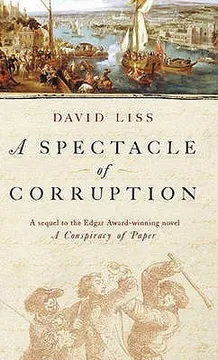
A Spectacle of Corruption is a historical mystery set in 1722 London during a contentious election. Readers praise Liss's vivid portrayal of the era's political corruption and complex plot. The protagonist, Benjamin Weaver, is a compelling Jewish ex-boxer turned investigator who must clear his name of murder. While some found the story less engaging than the first book in the series, most enjoyed the blend of history, mystery, and social commentary. The novel's exploration of 18th-century politics and society resonates with modern readers, offering both entertainment and insight.
People Also Read




Characters
Benjamin Weaver
The calculating thieftakerA Jewish former pugilist turned thieftaker, Weaver combines physical courage with a detective's habit of testing motives and probabilities. He earns money finding criminals, but he does not accept that every legal conviction is just or that every client deserves obedience. His attachment to Miriam leaves him vulnerable to romantic fantasy, while his friendship with Elias keeps his reasoning from collapsing into impulse. Weaver is resourceful in disguises and dangerous when cornered, yet he is not simply a man of force: he weighs when to strike, when to bargain, and when to let an enemy live. His central tension is between the justice he wants to believe in and the compromises required to survive.
Elias Gordon
Weaver's philosophical allyA surgeon, writer, and Weaver's closest friend, Elias is an inventive thinker whose interest in probability and misdirection helps Weaver read situations that lack reliable witnesses. He is also vain, distractible, and fond of turning danger into a chance for intellectual play. That comic self-absorption never erases his loyalty: he creates Weaver's Matthew Evans identity, supplies strategic advice, and risks himself when the investigation demands it. Elias offers a counterweight to Weaver's physical certainty, reminding him that truth alone may not change the behavior of courts or politicians. His friendship works because he can challenge Weaver without pretending to be morally or practically flawless.
Miriam Melbury
Weaver's lost belovedMiriam is the widow of Weaver's cousin and the woman he hoped to marry. Intelligent, witty, and alert to the limits placed on her, she chooses a Christian marriage partly for the social security it offers. Her decisions are not reducible to romance or faith; she seeks a life in which she can belong and make choices beyond the supervision of her former family. Her bond with Weaver is real, but she knows that his dangerous work would make marriage to him precarious. She is caught between affection for him and loyalty to her husband, and her attempts to protect that marriage reveal both her agency and the costs of the world she inhabits.
Dennis Dogmill
The brutal tobacco magnateA powerful tobacco merchant and Whig election operator, Dogmill wields money, political access, and physical intimidation with equal ease. He regards workers as replaceable and expects servants, rivals, and public officials to yield when he applies pressure. His temper is not merely theatrical; he can turn humiliation into violence without warning. Yet his attachment to his sister Grace is sincere, complicating any easy portrait of him as uniformly cold. Dogmill's defining contradiction is that he presents self-interest as ordinary business while treating the suffering it causes as irrelevant. He is most dangerous when his control is challenged, because he mistakes other people's fear for proof of his right to command.
Grace Dogmill
The observant rebel sisterGrace is Dennis Dogmill's sister, a perceptive young woman who resists being managed as a family asset. She notices who enters her brother's rooms, reads faces carefully, and understands more about political and social behavior than men assume she does. Her warmth toward Weaver is mixed with curiosity and a desire for freedom, not simple submission to romance. Grace can move through the election world in ways unavailable to many women, though those freedoms remain limited by her brother's influence and public expectations. She is courageous without being naïve: she recognizes Weaver's danger and her brother's capacity for harm, yet forms her own judgment rather than accepting either man's account.
Griffin Melbury
The ambitious Tory candidateA Tory politician from an established family, Melbury presents himself as a defender of the Church, the Crown, and traditional authority. He is eloquent and socially poised, capable of winning allies through charm, but his principles bend when political success or personal comfort is at stake. He gambles, accumulates debts, and expects others to help him manage the consequences. His marriage to Miriam complicates Weaver's private and political life, while his hostility toward Dogmill gives him a plausible public cause. Melbury's central quality is not simple hypocrisy but self-justification: he can describe ambition as service and accept methods he would condemn in an opponent.
Christopher Ufford
The wellborn labor advocateAn Anglican priest with a fine house and strong political convictions, Ufford hires Weaver to investigate threats against him. He claims to care about the porters, though his support is also shaped by his wish to mobilize them for Tory purposes. He is vain, anxious, and less competent at secrecy than he imagines. Ufford's mixture of sincere concern and political calculation makes him a useful mirror for the novel's larger question: whether benevolent motives remain benevolent when they treat other people as instruments.
John Littleton
The battered labor organizerA former shipyard agitator and Wapping porter, Littleton knows the cost of collective action from painful experience. He is opportunistic, funny, and often motivated by hunger, yet he has a strong practical understanding of how employers divide workers and how gangs can become political tools. His loyalty to Yate's men grows from shared labor rather than abstract ideology. Littleton's rough bargaining and occasional cruelty coexist with an ability to protect people weaker than himself.
Walter Yate
The murdered porter leaderYate is a young dockworker who tries to unite porters against the falling wages and disappearing privileges imposed by powerful merchants. He resists Greenbill's rivalry and believes workers can act together, even when that makes him a target. His brief encounter with Weaver in the riot establishes him as brave and capable of returning a favor under pressure. Through his widow's account, Yate emerges as a family man whose political knowledge exceeds the status assigned to him by the men who control the docks.
Anne Yate
The threatened dockside widowYate's widow is left with a young child and little protection after her husband's death. Fear makes her cautious about what she says, especially after Dogmill threatens her. Her reluctance is not a lack of intelligence but a survival strategy in a world where a poor widow has few defenses. When she eventually shares what Yate knew, her testimony gives the investigation its most important political lead.
Jonathan Wild
The rival crime brokerKnown as the Thieftaker General, Wild controls a broad criminal network and competes with Weaver in the business of recovering stolen goods. He is charming, calculating, and skilled at making self-interest look like public service. His defense of Weaver surprises those who know their history, but Wild's motives remain tied to his own conflict with Dogmill. He understands that favors are investments, not gifts, and expects people to remember what they owe.
Abraham Mendes
Wild's formidable lieutenantA powerful member of Wild's organization, Mendes is a cautious investigator with a personal hatred of Dogmill. His affection for his dogs reveals a tenderness that contrasts with his capacity for violence. He can help Weaver navigate criminal and customs networks, but he remains loyal to Wild's interests and does not pretend otherwise. Mendes's willingness to act grows from a private injury as much as from strategy.
Piers Rowley
The compromised judgeRowley presides over Weaver's trial and has the authority to guide the jury. He is a politically exposed judge whose concern for his position conflicts with his awareness of the evidence. His conduct shows how a person can recognize injustice and still participate in it when pressured. Rowley is neither fearless nor wholly without conscience, and that uneasy mixture makes him more than a simple emblem of corrupt law.
John North
Ufford's wary curateNorth is Ufford's poorly paid curate, a university-educated clergyman living with his wife and children in straitened circumstances. He distrusts his employer's politics and reads the interests behind Ufford's sermons more clearly than Ufford does. His poverty shapes his choices, including his willingness to consider the reward for Weaver's capture. North is neither a heroic informant nor a simple villain; he measures risk against the needs of his family.
Johnson
The masked Jacobite organizerJohnson is a discreet political operative who speaks for the Jacobite cause and moves through networks built on secrecy. He is patient, persuasive, and alert to the dangers posed by both government surveillance and careless allies. He offers Weaver protection and a place in the cause, but he also expects that useful people will respect the boundaries of the organization. His caution reflects a movement accustomed to operating under the threat of treason charges.
Arthur Groston
The broker of false testimonyA young evidence broker, Groston sells testimony to those who can pay and treats perjury as a trade. His stationer's shop gives his public business a respectable face, while a sign in the window advertises the work that truly supports him. Groston's willingness to manufacture witnesses makes him useful to political operators and dangerous to anyone seeking a fair trial.
Spirit Spicer and Clark
The purchased witnessesSpicer and Clark are laboring men paid to claim they witnessed Yate's murder. Under Weaver's questioning, both reveal that Groston supplied their testimony. Their opportunism makes them instruments of a larger conspiracy, but their role also shows how cheaply the prosecution's case was assembled.
Nate Lowth
The Jacobite prisonerLowth is a former soldier imprisoned for highway robbery after losing his livelihood when the new king's government disbanded his regiment. He speaks openly about his Jacobite sympathies and accepts Weaver's escape attempt without alerting the guards. His comic bargaining for wine and companionship briefly humanizes the condemned population of Newgate.
Plot Devices
Matthew Evans
A disguise for accessElias and tailor Swan give Weaver the identity of a wealthy Jamaican tobacco planter, complete with clothes, a wig, and a fabricated history. Because people notice status and costume before scrutinizing a face, Weaver can enter drawing rooms, election gatherings, and Dogmill's household without being recognized as an escaped convict. The disguise also gives him a way to provoke powerful men from within their own social world. Its weakness is that it requires lies about wealth, race, and business, and emotional intimacy makes those lies increasingly difficult to maintain.
Bought testimony
A counterfeit caseGroston supplies witnesses who falsely claim to have seen Weaver kill Yate. Their testimony initially appears to be the prosecution's strongest evidence, but Weaver exposes the payment behind it by questioning them in court. The judge then makes their retractions seem as unreliable as their original claims. Later, the witnesses' deaths and the notes planted beside bodies turn the same fraud into a continuing effort to make Weaver appear guilty of further crimes.
The white rose
A planted political signalThe white rose is associated with the Jacobite cause and appears as a clue in Weaver's investigation. Groston gives him one after explaining that a mysterious payer wanted the name Johnson attached to him. Later, roses are found beside murdered witnesses and false confessions. The symbol suggests a Jacobite plot, but its repetition is deliberate misdirection: it helps opponents turn ordinary criminal violence into apparent evidence of treason.
The Westminster election
A public corruption engineThe contested seat draws together old political rivalries, merchant influence, hired voters, labor gangs, and Jacobite anxieties. Since many workers cannot vote, candidates use them as canvassers, intimidators, or riotous crowds instead. Dogmill's control of tobacco trade and customs protections gives him an economic stake in the result, while Melbury's campaign exposes the compromises of the opposition. The election makes the murder case consequential beyond Weaver's survival, since accusations can be used to shape public opinion and determine who gains parliamentary power.
The false kidnapping
A trap for confessionWeaver arranges for Dogmill to believe Grace has been abducted, using forged letters and Elias's impersonation of a Jamaican contact to create urgency. The deception brings Dogmill, Hertcomb, and Greenbill into a room where Weaver can question them and Mendes can witness their answers. It reverses Dogmill's usual leverage by making him fear for someone he loves. The ruse does not itself prove guilt in court, but it creates the testimony and bargaining power Weaver needs to force a resolution.
About the Author



Download PDF
Download EPUB
.epub digital book format is ideal for reading ebooks on phones, tablets, and e-readers.








