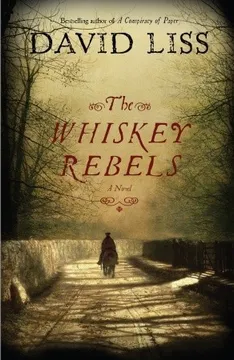


Plot Summary
Death Waits in Helltown
In early 1792, Ethan Saunders sits drunk in a Philadelphia tavern, convinced he deserves the murder Nathan Dorland has come to deliver. Ethan has stolen a merchant's watch partly from need, partly from bitterness at seeing rich men thrive while a former patriot begs for credit. Dorland's companions beat him in an alley, but Ethan's enslaved companion Leonidas and the quick, unsettling Kyler Lavien intervene.
Lavien works secretly for Secretary of the Treasury Alexander Hamilton. He explains that Cynthia Pearson, Ethan's former love, has come to ask for help: her husband Jacob is missing, and she fears for herself and her children. The rescue gives Ethan a reason to resist the death he had accepted.
Ethan's opening posture is not simple despair. He turns self-neglect into a kind of moral verdict, as if refusing to defend himself can settle the question of whether his life still matters. The stolen watch exposes the resentment beneath that pose: he sees the republic rewarding money while forgetting those who fought for it. Cynthia's request interrupts his private sentence with an obligation to another person. The plot begins when Ethan discovers that he is still capable of being needed, a possibility that is more frightening than death because it requires him to act.
The Novel Takes Shape
Joan Claybrook grows up on an Albany-area farm, more interested in books than in the work expected of a daughter. After reading Henry Fielding's Amelia, she decides to write a novel of her own and studies how stories make readers care. Near the end of the Revolution, she spots Andrew Maycott, a wounded young veteran, and rides alone to his family farm rather than waiting for a formal introduction.
Joan tells him plainly that she wants him to court her, then explains that she is seeking experience for her writing. Andrew responds to her ambition instead of treating it as a defect. When they discuss what an American novel should describe, he proposes money, not inherited property, as its central subject.
Joan's first rebellion is against the assumption that a woman must wait to be chosen. Her directness is at once romantic, intellectual, and experimental: she treats her own life as material she has a right to shape. Andrew matters because he recognizes the seriousness beneath her performance. Their conversation about money gives her a subject, but it also establishes the novel's central tension. Joan wants to turn observation into authorship, while the society around her keeps trying to make her an object within somebody else's story.
Paper for a Promise
After their marriage, Joan and Andrew settle in poor New York City, where his carpentry shop earns too little and Joan cannot finish her novel or carry a pregnancy to term. In 1788, merchant William Duer offers a possible escape: western Pennsylvania land in exchange for Andrew's unpaid military notes.
Joan questions the offer and hears a cautious account from James Reynolds, but the promise of independence still appeals to Andrew, who misses farming, and to Joan, who wants to write about distinctly American life.
They sell most of what they own and join a guided party west. Duer describes fertile land and a settled community. The journey soon shows that the guide's assurances conceal a harsher arrangement than either Maycott has agreed to face.
The exchange turns patriotic service into speculative currency. Andrew's notes represent labor the new government has not paid for, while Duer's land promises convert that unpaid obligation into a wager on the future. Joan is not merely deceived because she is inexperienced; she has carefully asked questions and still must choose under poverty's pressure. Her hope for literary material and Andrew's longing for land make the offer emotionally credible. The trap works because it sells not only acreage, but the couple's wish to recover a life that war and city poverty have denied them.
A Lease in the Wilderness
The Maycotts' journey west exposes the power of their guides, James Reynolds and Hendry, who threaten Andrew after he challenges their abuse. When Joan feeds two starving Indigenous travelers, the travelers vanish during the night, and Hendry wears the woman's bone necklace the next morning.
In Pittsburgh, Colonel Holt Tindall reveals the deeper fraud: the Maycotts have not bought their land outright but hold a costly ground lease on uncleared forest. He offers a more usable plot only if Joan submits to his sexual demands.
Andrew refuses, and Tindall sends them into the wilderness with little shelter. Before their guides can abandon them completely, Irish distiller Lorcan Dalton arrives with neighboring settlers and organizes a camp, turning a hostile delivery into the beginning of a community.
The frontier is not an empty space awaiting civilization. It is already governed by private force, racial violence, and contracts designed to make the vulnerable pay for their own dispossession. Joan's act of charity exposes how quickly a settler community can reproduce the brutality it condemns in others. Tindall's bargain also makes sexual coercion part of the land scheme, not a separate personal vice. Dalton's aid offers a countermodel, but it is practical and conditional: neighbors survive by organizing labor and sharing protection where law has failed.
Whiskey Learns Its Worth
Dalton, his partner Jericho Richmond, and the learned John Skye help the Maycotts build a cabin and establish themselves among settlers who judge skill more readily than manners.
Andrew improves their whiskey by adjusting the grain mixture and charring the barrels, creating a richer spirit that travels more profitably than raw grain. The still makes him a valued partner, and his work brings food, trade, and a place in the community. Joan, meanwhile, studies political economy and begins shaping her novel around veterans cheated by speculators.
News from the East reports that Congress will assume state war debts, vindicating the notes Duer persuaded settlers to surrender. Joan now sees the land exchange as deliberate fraud backed by powerful men.
Andrew's craft makes a local economy from what geography has made difficult: grain cannot move cheaply, but whiskey can. His innovation is both practical and expressive, a way of claiming value through knowledge rather than inherited wealth. Joan's writing develops beside it, translating economic systems into human consequences. Yet the debt news sharpens their vulnerability. Duer's earlier trade was not a gamble that happened to turn bad. The government decision makes clear that the paper Andrew surrendered was valuable all along, and that someone understood this before he did.
The Note at the Door
Back in Philadelphia, Ethan learns that Cynthia's household is watched and that Jacob has been missing for about a week. When Cynthia refuses to speak openly, her footman secretly slips Ethan her note. She warns that unknown people have intercepted earlier messages and connects the danger to Hamilton and the Bank of the United States.
Ethan's own troubles deepen: his landlady evicts him after James Reynolds pays her to do so, and an Irishman offers money if he will stop looking for Jacob. Ethan refuses, though he badly needs the cash. Lavien shelters him and brings him to Hamilton, who will not hire him for the inquiry. Ethan nevertheless begins investigating, driven by concern for Cynthia and by the chance to become useful again.
The note turns a romantic reunion into an intelligence problem. Cynthia cannot simply ask for help in public because the channels of ordinary communication have become compromised; even her household is no longer private. Ethan recognizes the danger but also filters it through his old attachment, which makes his motives both sharper and less reliable. His refusal of the bribe marks a real change, though not yet a complete reform. He is still tempted by money and performance, but for the first time he accepts hardship in order to pursue work that matters to someone else.
The Traitor's Old Wound
Ethan confronts Hamilton, who says he never spread the accusation that drove Ethan and his mentor, Richard Fleet, from the army. Hamilton claims he accepted their resignation to prevent a likely court-martial and execution, while the rumor escaped beyond his control. Ethan believes him, losing the hatred that has organized his life for ten years.
He still fears that Fleet may have betrayed the country, and refuses Lavien's offer to reopen the old case because clearing his own name could stain Fleet's memory. Hamilton also refuses to put Ethan on the Pearson inquiry, citing Ethan's connection to Cynthia. Meanwhile, Ethan learns that he has already freed Leonidas but has concealed it, afraid that his companion might leave.
Ethan's identity has depended on a clean villain: Hamilton, the man he blames for his disgrace. Discovering that Hamilton did not leak the accusation does not erase the damage, but it removes the moral simplicity that allowed Ethan to remain angry instead of grieving. His silence about Fleet reveals a more painful loyalty. Ethan would rather carry a false public stain than risk making his dead friend infamous. His treatment of Leonidas repeats the same defensive pattern in miniature: love becomes a reason to withhold another person's freedom.
The Tax Takes a Husband
As Andrew's whiskey prospers, Hamilton's excise tax threatens every small distiller in the West and strengthens Tindall's control. Tindall and his men invade the Maycott cabin, strike Joan in the stomach, and threaten her pregnancy unless she yields to them. Joan fires a concealed pistol through her apron, killing Hendry.
Tindall shoots Andrew in the heart and escapes while Joan holds her husband's body; the shock and earlier blow end her pregnancy, and the cabin fire destroys her manuscript. Tindall then accuses Joan, Dalton, and Skye of murder. The frontier community shelters her, but the loss of Andrew, child, home, and book turns grief into a question of what action remains possible.
The tax does not act as an abstraction here. Tindall converts it into a weapon against a household already trapped by leases, debt, and physical vulnerability. Joan's shot is an act of self-defense, but it also changes her relation to violence: she can no longer imagine herself as untouched by the methods she opposes. The simultaneous loss of her husband, pregnancy, home, and manuscript removes both domestic and creative futures. Her later politics grow from this compression of grief, not from a detached theory of revolution.
A Widow Arms Herself
While Joan grieves in a hunting cabin, Tindall claims that she killed Andrew and Hendry, placing her and her allies under warrants. Hugh Henry Brackenridge helps her challenge the accusation and arrange the sale of their leases and whiskey equipment. Joan also discovers that the boy Phineas killed Tindall and has left a confession that makes himself responsible.
With money from the sale, she frees Tindall's enslaved workers by giving them papers and cash. Then she gathers Dalton, Skye, Richmond, and several whiskey workers. Joan argues that Duer's land fraud and Hamilton's whiskey tax belong to the same system of oppression, and proposes using her unfinished novel's financial scheme as a blueprint for revenge.
Joan's recovery does not mean that grief has passed. She learns to make decisions while carrying it, and to treat her education as a tool rather than a private consolation. Selling the western holdings lets her leave a place that once represented possibility, but she does not abandon its people: freeing Tindall's enslaved workers keeps her critique from being only about white settlers' losses. Her proposed campaign is ethically unstable from the start. She seeks justice and wealth together, and she is willing to risk national ruin because she no longer trusts the nation to correct itself.
The Party and the Prisoner
At a gathering hosted by William Bingham, Ethan sees Jacob Pearson back in Philadelphia beside Cynthia. He uses a false summons to speak privately with her and learns that Jacob has returned without explaining his absence. At a later dinner, Jacob belittles Cynthia, threatens their son, and orders Ethan out.
Joan Maycott, a wealthy widow recently returned from the West, intervenes by turning Jacob's public temper into a source of shame, giving Ethan a chance to leave. Cynthia later tells Ethan that a scarred associate of Duer has been visiting and that an Irishman warned her to stay silent. She asks Ethan to keep helping, despite the risk to her reputation and her children's security.
Ethan's idealized memory of Cynthia collides with evidence of her present confinement. He still thinks first in terms of rescue and old love, but Cynthia's choices show that she is calculating the danger to her children and managing a husband she cannot safely leave. Joan's intervention is important because it makes public performance a weapon against private authority. Jacob controls his household through intimidation, yet he depends on the appearance of respectability. Joan punctures that appearance without forcing Cynthia into a more dangerous escape.
Pearson's Buried Crime
Lavien locates Albert Turner, the former British agent whose letters were used to frame Ethan and Fleet for selling secrets. Turner says that Jacob Pearson supplied their names as false identities for a British contact, making the incriminating correspondence appear genuine. He also admits that Pearson later helped kill Fleet: Turner lured Fleet from a tavern, and Pearson struck and stabbed him.
Ethan's old suspicion that Fleet may have been guilty collapses, replaced by the knowledge that Jacob murdered the man Ethan loved as a mentor. Lavien uses the threat of violence to force the confession, and Ethan has to stop him from mutilating Turner. The revelation makes Ethan's pursuit of Jacob personal in a way it never was before.
The revelation rewrites Ethan's memory without making it less painful. Fleet's silence and disgrace had allowed Ethan to imagine that protecting the dead man's reputation was a form of fidelity. Now the evidence gives that loyalty a firmer basis, while also exposing how carefully Jacob used other people's trust. Lavien's coercive methods complicate the pursuit of truth: the confession is useful, but it is extracted by a man willing to maim. Ethan's objection marks a boundary he wants to keep even when the answer might justify almost anything.
Joan Enters Duer's Circle
Joan takes her group to Philadelphia and enters fashionable society as a wealthy widow. She studies William Duer's trading habits, gains his confidence by reflecting his own ideas back to him, and uses a whiskey worker inside his circle to learn his plans. Duer organizes a Six Percent Club to corner government securities needed by Bank of the United States scrip holders.
He uses Jacob as a disposable investor, persuading him to buy inflated four percent securities while Duer's agents quietly gather six percents. Joan also learns that Duer diverted $236,000 from the old Treasury Board. She begins steering him toward the Million Bank, intending to use its launch to attack his power and damage Hamilton's bank.
Joan succeeds by understanding that Duer's vanity is a more dependable entrance than his greed. She does not need to predict markets; she needs to predict the man who believes he can master them. Her performance grants her access, but it also places her close to the very conduct she condemns. Each act of reassurance helps Duer harm Jacob and other investors. Joan imagines herself controlling that harm for a larger purpose, a belief that will later be tested by the human cost of the collapse she is engineering.
A Free Man's Departure
Ethan discovers that a coded message hidden in a silver capsule warns of a plot against the Bank of the United States. He follows its clues through taverns, traders, and Duer's associates, while a second cipher confirms a scheme involving Jacob and the Million Bank. In New York, Ethan obtains papers from Philip Freneau that detail Duer's plan to control bank scrip and six percent securities.
Freneau then reveals that Leonidas has been free for weeks, though Ethan concealed the papers so he would not lose his indispensable companion. Leonidas leaves, hurt that Ethan treated his liberty as a choice Ethan could postpone. Joan's faction approaches him, and he agrees to report on Ethan while promising not to let him come to harm.
The freedom Ethan thought he had granted becomes ethically hollow because he kept the fact from Leonidas. His motive is fear of abandonment, but the consequence is a repetition of mastery: Ethan makes another man's choice depend on what Ethan is willing to reveal. Leonidas's departure is not merely a breach in the investigation. It forces the story to recognize that loyalty cannot be earned by benevolence alone. Joan exploits the rupture, yet Leonidas retains judgment and sets limits on what he will do for her.
The Cage Beneath the Pier
As Ethan investigates the Million Bank in New York, he learns that Duer's associates are preparing for its opening and that Jacob is involved. Jacob and James Reynolds seize him, bind him, and lock him in an iron cage under an abandoned pier, where the rising tide will leave him cold but alive.
Ethan escapes his ropes and picks the lock, but cannot shift the heavy door alone. Joan arrives with Dalton and Reynolds, pays for his release, and claims she wants to protect Cynthia and oppose Duer. Ethan recognizes that she knows far more than she admits, but accepts her help because the bank launch is hours away. Joan's secret allegiance remains hidden from him.
The cage literalizes the loss of control that runs through each character's story. Jacob uses confinement to force information from Ethan, while Joan uses rescue to keep Ethan moving along a course she has designed. Ethan's escape demonstrates competence, but competence is not the same as freedom: he still needs another person to move the door. The scene also makes trust a tactical resource. Joan offers enough truth to win cooperation, while withholding the scale of her plan.
The Launch Goes Sideways
Ethan reaches Corre's Hotel on the morning the Million Bank opens and has already disrupted Duer's six agents: he has detained four, arranged a robbery for another, and lured the last into an appointment that keeps him away.
The bank's shares sell out rapidly, but Duer arrives too late to secure the control he wanted. Jacob, who has just been released from his own financial trap, sees the failed operation and does not invest his remaining money. Ethan believes he has protected Cynthia from total ruin.
He returns to Philadelphia with Lavien, then learns that Hamilton has been secretly paying James Reynolds, the scarred operator, whose wife Maria is Hamilton's lover. The bank crisis is not over, and Ethan's victories may have helped cause it.
Ethan's improvisation wins a local contest but cannot control the system around it. His effort to deny Duer the Million Bank also contributes to Duer's exposure, while Duer's borrowed money and overextended schemes threaten to pull the larger economy down with him. The revelation about Hamilton and Maria Reynolds adds a private vulnerability to public finance: the Treasury Secretary's judgment can be compromised by desire and blackmail. Yet Ethan does not reduce Hamilton to that weakness. He seeks confirmation from Washington, who affirms Hamilton's underlying honor.
The Wrong Enemy
Ethan asks Leonidas to find Cynthia, then recognizes that the former companion has been used by Joan's group to steer him away from New York. Leonidas reports that the Pearsons have gone west toward Pittsburgh. Ethan realizes the larger danger: Duer's collapse, not merely his attempted takeover, could trigger a market panic that destroys the bank and destabilizes the young government.
Hamilton and Lavien ride with Ethan toward New York to warn Duer and contain the damage. Joan's men intercept them on the road, kill their horses, and take them to the Bristol house where Cynthia is held. Ethan discovers that the rebellion's campaign against Duer is designed to destroy the bank as well as punish its architects.
The reversal is not that Ethan was wrong to oppose Duer, but that he mistook the target for the whole danger. In a tightly connected credit system, removing a predatory operator can produce a crisis if his debts are large enough. Joan's faction understands the moral injury of the frontier but underestimates financial interdependence. Ethan's insight arrives only after he recognizes he has been manipulated too. The plot therefore makes knowledge costly: every new fact changes what a just action requires.
Bristol's Last Standoff
At the Bristol house, Ethan and the injured Lavien try to escape, but Jacob appears with Cynthia held at gunpoint. He claims that Lavien killed Jericho Richmond, one of Joan's allies, and calls Dalton to retaliate. Ethan buys time by arguing that Jacob is the likely killer and by persuading Cynthia to confirm it.
He then insults Cynthia in public, making their apparent break convincing enough to redirect the room's attention. Dalton attacks Jacob, hurling him against the wall and killing him. During the confusion, Lavien slips away toward Philadelphia. Joan understands Ethan's deception, but lets him leave with Cynthia rather than pursue him. The group survives the standoff, though several of Joan's men are dead.
Ethan's greatest weapon is not physical strength but the ability to make other people act on a false reading of him. Here deception is protective rather than self-serving: he risks Cynthia's hurt and his own standing with Joan to create a chance for Dalton to turn on Jacob. The success is morally costly. Jacob's death arrives through a lie and a burst of violence, not through a fair hearing, while Joan's cause loses people who believed they were acting for justice. Ethan saves Cynthia, but he cannot make the rescue clean.
A Ride Against Panic
Ethan and Cynthia take horses from the Bristol stables, while Ethan rides ahead to bring Hamilton the warning. Lavien, despite his broken leg, reaches Philadelphia first and gives Hamilton time to send agents into the trading cities to buy depressed securities and steady frightened investors.
Duer's plans collapse, his creditors gather outside his Greenwich home, and he enters debtor's prison rather than face the mob. The markets panic but do not fail, and the Bank of the United States survives.
Joan's scheme wounds Hamilton's reputation and enriches her through her four percent holdings, but it does not bring down the government. Ethan has saved Cynthia from Jacob and helped avert wider financial ruin, though his reconciliation with Leonidas remains unfinished.
The ride converts abstract stakes into bodily endurance: Lavien's broken leg and Ethan's exhaustion become the price of carrying information faster than panic. The resolution preserves the bank without vindicating its critics. Hamilton's system survives, but the suffering that gave Joan's rebellion its moral force remains unresolved. Ethan's return to service is therefore partial. He has acted with courage and judgment, yet the relationship with Leonidas cannot be repaired by one successful mission. The novel ends its immediate crisis with stability, not absolution.
Epilogue
In 1804, Joan looks back on the failed attempt to destroy Hamilton's bank and the deaths it cost her group. The panic was contained, Duer was ruined, and Hamilton remained in public life. Joan later sends anonymous evidence of Hamilton's affair with Maria Reynolds to his political enemies, helping end his prospects for office.
She then encourages Aaron Burr to see Hamilton as an enemy who must answer for his insults. After Burr shoots Hamilton, Joan refuses to comfort the wounded man or reconsider her part in the chain of events. She returns to her reading, aware that revenge has altered the country less than she once hoped, but has not emptied her of purpose.
Joan's final reckoning distinguishes revenge from justice without pretending she has escaped either. The financial plot fails to topple the national system, so she shifts from economic sabotage to reputational damage and finally to Burr's personal grievance. Her work becomes more intimate as its political reach narrows. She can tell herself that Hamilton's conduct deserves exposure, yet the duel reveals how easily a public cause can become a private instrument. Her return to a novel is poignant: she once hoped to create an American literary form, but history has consumed the life in which she might have written it.
Analysis
The novel makes finance feel physical. A veteran's promise of pay becomes a lease he cannot afford; grain becomes whiskey because roads and rivers block other trade; bank scrip becomes a wager whose consequences reach servants, shopkeepers, and frontier families. This chain prevents political argument from remaining abstract. Hamilton's bank may be a rational instrument of national credit, but its benefits and burdens do not fall evenly, and the people asked to trust the system have little power to inspect it.
Joan and Ethan are parallel readers of people. Joan learns to convert social expectations about women into access, while Ethan turns his reputation as a rogue into cover for investigation. Both are skilled at performance, but each can confuse a clever maneuver with control. Joan's retaliation begins in justified outrage at fraud and state violence, then becomes dangerous when she treats a national panic as an acceptable price. Ethan begins with personal resentment and a willingness to let himself die, then discovers that service requires more than loyalty to an old love. His conflict with Leonidas shows that even generous intentions can reproduce domination when one person decides what another is ready to know.
The book's deepest question is not whether the republic is corrupt, but whether its failures can be corrected without destroying the conditions that make correction possible. Joan believes a rotten structure must be broken; Ethan and Lavien fear that a collapse will injure the very people she wants to defend. Hamilton's survival does not settle that argument. The frontier remains neglected, slavery remains part of the republic, and the whiskey tax continues to provoke resentment. The ending offers neither a clean victory nor a repaired nation. It offers the harder achievement of preventing immediate catastrophe while leaving the underlying injustice in view.
Review Summary
The Whiskey Rebels receives mostly positive reviews, praised for its engaging characters, intricate plot, and well-researched historical setting. Readers appreciate the dual narrative structure and the witty dialogue, particularly from Ethan Saunders. Some criticize the complexity of financial details and pacing issues. The novel is commended for its exploration of early American history, including the Whiskey Rebellion and financial systems. Overall, readers find it an entertaining and informative historical fiction, with many recommending it to fans of the genre.
People Also Read

Characters
Ethan Saunders
Disgraced wartime spyEthan is a former Continental spy whose gifts are reading people, adapting quickly, and persuading strangers to underestimate him. After disgrace drove him from service, he hides humiliation beneath drink, gambling, and flirtation. His loyalty to Richard Fleet and Cynthia Pearson is powerful, but it can become possessive: he sometimes decides what others should know or choose because he fears losing them. Leonidas's demand for freedom exposes that weakness. Ethan's wit is not merely comic ornament; it is his principal instrument of survival, and he must learn to use it in service of other people rather than as a shield against his own shame.
Joan Maycott
Frontier novelist and strategistJoan is a voracious reader, a sharp observer of power, and a woman impatient with the limits imposed on her ambitions. Her marriage to Andrew gives her a partner who takes her intelligence seriously, while frontier life teaches her how quickly contracts and ideals can fail the poor. She measures people closely and understands how charm, beauty, and social performance can open doors that remain closed to women who speak plainly. Joan's confidence is real, but so is her capacity to rationalize harm when she believes a larger cause requires it. Her central struggle is whether authorship can shape events without turning people into pieces in a plot.
Leonidas
Independent abolition-minded allyLeonidas is Ethan's enslaved companion, an educated, physically powerful man who has spent years building a life of his own within the limits slavery imposes. He earns money through labor, lives apart from Ethan, and insists that friendship cannot excuse ownership. His loyalty is genuine, but it is not unlimited, and his judgments of Ethan are often more accurate than Ethan's judgments of himself. Leonidas combines restraint with decisive force, and he is attentive to the way white men mistake silence for consent. His insistence on autonomy gives the story a moral standard that Ethan's benevolence alone cannot meet.
Andrew Maycott
Carpenter and distillerAndrew is a Revolutionary veteran, a skilled carpenter, and a man drawn to practical work and rural independence. He admires Joan's intellect without asking her to make herself smaller, and their shared affection gives her unusual room to pursue writing. Andrew is measured rather than meek. He can endure insult when another person's safety depends on it, but he resists attempts to treat his wife or neighbors as property. His inventive approach to whiskey-making reflects his patient, hands-on intelligence. He represents the kind of patriot whose ideals are tested not in speeches but in the daily struggle to make a home and protect others.
Cynthia Pearson
Society wife under pressureCynthia is Ethan's former beloved and the daughter of his mentor, Richard Fleet. Beautiful and socially accomplished, she is also politically perceptive and accustomed to managing danger without drawing public attention to it. Her marriage places her inside a world of wealth and influence, but status does not guarantee safety within her own home. Cynthia weighs every choice against the consequences for her children, which can make caution look like passivity to outsiders. Her history with Ethan contains tenderness and hurt in equal measure. She is not simply the object of his rescue; her judgment and courage become essential to the choices around her.
Jacob Pearson
Merchant and speculatorJacob is a prosperous Philadelphia businessman whose social standing lets him move among political and financial elites. He is ambitious, proud of his connections, and deeply invested in the appearance of authority. He treats trade as a path to consequence and believes money can protect him from the ordinary limits placed on other people. His household reveals a less polished character than his public manner. Jacob's relationships are shaped by control, status, and a belief that his judgment should prevail, making him difficult to read as merely a financial figure.
Kyler Lavien
Hamilton's secret investigatorLavien is a Treasury investigator with a history among the Maroons of Surinam, where he learned unusual physical skills and a rigid respect for freedom. A Jewish immigrant, husband, and father, he can be warm in his home and frighteningly controlled in the field. He believes in disciplined service and accepts violence as a tool when he judges the stakes high enough. His confidence often unsettles Ethan, whose improvisation contrasts with Lavien's directness. Lavien's deepest conflict lies between personal compassion and an austere conception of duty, one that can make his methods seem more certain than his moral judgment.
Alexander Hamilton
Architect of federal financeHamilton is the Secretary of the Treasury and the driving force behind the national bank, public credit, and a stronger federal government. He is energetic, disciplined, and willing to work at the expense of his own finances. His enemies see him as a would-be aristocrat; his allies see a capable builder trying to make a fragile republic function. Hamilton can be stubborn and secretive, especially when he believes disclosure would endanger the government. His public ideals coexist with private appetites and political vulnerability, making him more complicated than either his supporters or opponents want him to be.
William Duer
Speculative empire builderDuer is a wealthy merchant and financial operator whose reputation lets his decisions influence markets far beyond his personal circle. He is clever at recruiting people, managing appearances, and turning other investors' confidence into leverage. Duer tells himself that risk and sacrifice are necessary parts of a grand design, a belief that allows him to disregard the people who bear the losses. He has genuine patriotic experience, but ambition increasingly defines how he interprets it. His weakness is not lack of intelligence so much as the conviction that intelligence entitles him to command outcomes no one can control.
Lorcan Dalton
Frontier distiller and protectorDalton is a large Irish veteran who has become a distiller and a central figure in the western settlement. He responds to practical need with direct action, organizing neighbors to shelter newcomers and protect one another from Tindall's power. His loyalty is intense, and he can meet insult or danger with physical force. Dalton values competence and fellowship, though his protective instincts can become vengeful when those he loves are threatened. He gives the Maycotts a model of community built through shared work rather than formal institutions.
Jericho Richmond
Quiet frontier marksmanRichmond is a reserved veteran and exceptional marksman who shares a close life with Dalton. He speaks sparingly, watches carefully, and distrusts plans that depend too heavily on optimism or personal charm. His reserve is not indifference; he is acutely aware of what violence costs and who may be asked to pay. Richmond often acts as the skeptical counterweight to Dalton's forcefulness and Joan's ambition. His caution gives the group an internal voice of consequence, even when the others are eager to move.
John Skye
Scholar on the frontierSkye is a Scottish former schoolteacher whose education and manners set him apart from the rough settlement around him. He befriends Joan through books, offers practical hospitality, and recognizes her intellectual ambition without trying to own it. His affection for her is restrained, and he accepts that her purpose may require distance from him. Skye is patient, reflective, and often more willing to wait than Dalton or Richmond. He represents a form of loyalty that is sustained through attention, care, and honest counsel rather than authority.
James Reynolds
Scarred financial enforcerJames Reynolds is a scarred operator tied to Duer's business and to Philadelphia's trading world. He moves between threats, favors, and paid work with little attachment to any cause beyond his own advantage. His intimidating appearance makes him useful to men who would rather not dirty their own hands. Reynolds is also married to Maria, a relationship that intersects with Hamilton's private life and public vulnerability. He represents the kind of hired power that flourishes when influential men want consequences without visible responsibility.
Holt Tindall
Frontier landlord and tyrantTindall is a wealthy landholder whose control over leases, local labor, and armed retainers gives him power far beyond his estate. He combines the entitlement of a slaveholding planter with the force of a frontier boss. Tindall treats contracts as instruments of dependence and expects other people to accept his definition of their place. His polished rooms and generous public reputation conceal a brutal private code. He is an example of how local domination can exploit the gap between republican language and the realities of ownership.
Phineas
Traumatized frontier guidePhineas is a teenage guide whose childhood has been shaped by violent loss and an unforgiving frontier. He first responds to Joan's compassion with an almost filial attachment, but his experience has taught him to distrust softness and expect danger. He is watchful, skilled in tracking, and caught between the need to survive and the wish to remain human. Joan's attention unsettles him because she sees more than his hardened performance. His character shows how a violent world can train a child to mistake cruelty for an unavoidable identity.
Hugh Henry Brackenridge
Lawyer for the dispossessedBrackenridge is a Pittsburgh lawyer, writer, and defender of people whom local power would prefer to silence. Energetic and eccentric in manner, he takes cases according to their legal merit rather than the popularity of the accused. He believes law has meaning only when it protects people society finds inconvenient. Joan values him as both a lawyer and a fellow novelist, while his willingness to oppose powerful landholders makes him a rare institutional ally in the West.
Maria Reynolds
Hamilton's compromised loverMaria is a striking woman whose marriage to James Reynolds is marked by instability and financial pressure. She becomes entangled with Hamilton through a private relationship that her husband can exploit. The power imbalance is complicated: Maria has limited security and uses the attention of a powerful man, while Hamilton's position makes the affair a political vulnerability. She is neither a simple temptress nor a passive victim. Her presence reveals how intimate relationships can be converted into leverage by people who control money and information.
Aaron Burr
Ambitious political intermediaryBurr is a New York politician and senator who moves easily among social and political circles. He is charming, attentive to personal grievances, and comfortable cultivating relationships across factional lines. Ethan finds him more approachable than his reputation might suggest, while Joan recognizes that his pride and ambition can be directed by carefully chosen confidences. Burr's social ease conceals a strong sensitivity to insult, a combination that makes him both a useful source of information and a potentially dangerous ally.
Philip Freneau
Jeffersonian newspaper editorFreneau edits the National Gazette and uses its pages to attack Hamilton's policies and expose the financial interests surrounding the Treasury. He is persistent, politically committed, and willing to bend his methods when pursuing a story. Ethan recognizes that Freneau's opposition to Hamilton can make him both a valuable source and an unreliable judge of evidence. He represents the new power of partisan print, where information can challenge officials but can also be selected to serve a faction.
Ruth
Enslaved woman seeking agencyRuth, whom Tindall calls Lactilla, is an enslaved household worker who has endured separation from her child and physical abuse. She speaks with blunt practicality and understands the risks that freedom may bring when a person has no money or protection. Her caution challenges Joan's assumption that liberation is simple once a master is removed. Ruth's perspective forces the story to reckon with the difference between declaring someone free and giving them the means to live freely.
Plot Devices
War debt and ground leases
Patriotism turned into leverageAndrew's unpaid military notes are exchanged for western land through Duer's sales network. The offer appeals because the government has not settled its obligations and the Maycotts need a way out of poverty. Tindall later reveals that the land is held through expensive ground leases rather than owned outright, making the settlers pay to improve property controlled by others. The mechanism links national policy to personal dispossession: a veteran's service becomes paper that wealthy speculators can trade, while the people who surrender it shoulder the practical risk.
Frontier whiskey economy
Grain becomes portable wealthPoor roads and restricted river access make it costly for western settlers to transport grain to eastern markets. Distilling converts surplus corn and rye into whiskey that can be stored, traded, and carried more easily. Andrew improves the product by altering the mash and charring barrels, giving the settlement a valuable commodity and a measure of independence. The same liquor becomes the basis of Dalton's commercial network and later a flashpoint when the federal government imposes an excise tax on production.
Bank scrip and six percents
Credit becomes a battlefieldInvestors initially receive bank scrip, which can later be exchanged for shares through staged payments. Some payments require specie, while others require six percent government securities. Duer attempts to control those securities and the scrip itself, manipulating prices and using less informed investors such as Pearson as expendable participants. The financial structure makes private speculation a threat to the national bank: when Duer's debts and schemes unravel, the panic can spread beyond his own fortune and endanger ordinary investors and the wider economy.
Ciphered silver capsule
Secrets survive captureA tiny coded message is hidden inside a metal ball that can be swallowed by a courier if he is caught. Ethan recovers one after a street pursuit and uses his wartime habits to decipher it. Later messages and a disguised container in a tree extend the method, allowing conspirators to coordinate without ordinary letters being intercepted. The device links Ethan's old intelligence work to the new financial struggle, while also showing how secrecy can protect either public service or a private conspiracy.
Alternating testimony
Two lives expose one systemEthan's first-person account follows espionage, political finance, and the search for Cynthia, while Joan's account traces the western land fraud, the whiskey economy, and her campaign against Duer and Hamilton. Their separate perspectives initially make the same figures seem to occupy different moral worlds. As the plots converge, readers can see how the frontier's dispossession feeds the eastern financial schemes and how both protagonists mistake parts of a larger design for the whole. The structure makes information itself a source of suspense.
About the Author

Download PDF
Download EPUB
.epub digital book format is ideal for reading ebooks on phones, tablets, and e-readers.








