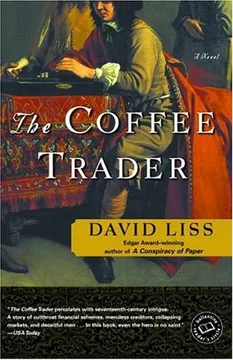


Plot Summary
A Bitter New Fortune
In May 1659, Amsterdam merchant Miguel Lienzo is nearly four thousand guilders in debt after a collapse in the sugar market, and another bad trade threatens to deepen the hole. Geertruid Damhuis, a Dutch widow with whom he shares a flirtatious, carefully bounded friendship, summons him to a disreputable tavern.
There she introduces him to coffee, a dark and bitter drink she believes will sharpen merchants and soon become essential to commerce. Geertruid wants Miguel’s trading knowledge and offers a partnership, though she has not yet worked out what they should sell or how. He asks for a week to consider, but leaves with coffee berries and an idea he cannot put aside: the strange drink might restore his fortune.
The coffee arrives as both commodity and temptation. Miguel’s debt makes the offer materially urgent, while the drink’s bitterness resists the familiar pleasures of wine and beer. Geertruid frames that difference as a commercial advantage: coffee promises alertness rather than escape. For Miguel, whose confidence depends on recovering not only wealth but social standing, the proposal offers a way to become himself again. His hesitation is therefore less about whether the idea is sound than whether he can afford to risk believing in it.
A Name in Hiding
Miguel grew up in Lisbon among New Christians forced to perform Catholic devotion while some families practiced Judaism in secret. Defying his conformist father, he sought out hidden Jewish study and later married Katarina, a devout young woman his father opposed.
After Katarina died of fever, Miguel left Portugal for Amsterdam, where he could live openly as a Jew. His younger brother Daniel eventually joined him, but the brothers remained rivals, shaped by a father who favored Daniel and treated Miguel’s independence as disobedience.
Interleaved memoirs by Alonzo Alferonda, an excommunicated merchant and moneylender, recall that Miguel once helped warn Alferonda’s family of Inquisitorial danger. Alferonda presents himself as the grateful witness to Miguel’s past, though his self-defense makes his account difficult to take at face value.
Miguel’s facility with deception began as protection against a state that made religious identity dangerous. In Amsterdam, the same skill becomes part of his commercial character, but freedom has its own authorities: the Ma’amad polices the community from within. The memoir sections complicate any settled account of who is trustworthy. Alferonda describes Miguel as a benefactor, yet his tendency to plead his own case turns memory into advocacy. The past thus supplies more than biography. It gives Miguel a survival method and asks whether a habit formed under persecution can ever be cleanly separated from opportunism.
Whale Oil Turns
At the Exchange, Miguel’s former enemy Solomon Parido offers to find a buyer for Miguel’s failing brandy futures. Miguel accepts, only to learn later that the brandy price rises after he has sold. Meanwhile, Alferonda brings him intelligence about Parido’s plan to manipulate whale oil prices.
Miguel uses the tip to buy actual whale oil, not paper futures, then sells when East India Company agents drive the market sharply upward. The quick trade earns him eight hundred guilders and restores some of his confidence.
Watching the crowd move, he realizes that coffee could be controlled in the same way, if he could shape its supply and coordinate buying across Europe. He approaches Isaiah Nunes, an East India trader, to arrange a secret, unusually large shipment.
The whale oil trade gives Miguel more than a profit. It teaches him to attend to the immediate movement of a market rather than trust a grand prediction about the future. That shift supplies the practical insight behind his coffee scheme. Yet the win is entangled with dependence: Parido appears helpful, while Alferonda provides the information that makes Miguel’s success possible. The Exchange rewards perception, but it also makes knowledge relational and unstable. Miguel’s return to confidence is real, though it rests on other men’s intelligence and on a market whose currents he cannot fully command.
Ninety Hidden Barrels
Miguel lays out a plan to Geertruid: bring ninety barrels of coffee into Amsterdam without public notice, use puts to profit when the unexpected supply lowers prices, then have agents across Europe buy up coffee simultaneously. If they own most of the available stock, they can dictate what importers pay.
Geertruid commits three thousand guilders and agrees to an equal partnership. Miguel recruits Nunes to source the shipment and promises commissions to contacts in major exchanges, insisting that each agent know only his own task.
Nunes warns that the East India Company is expanding coffee cultivation and may eventually compete, but Miguel believes that will take years. His ambition grows beyond clearing his debts. He imagines wealth, standing in the Jewish community, and a future family freed from the insecurity that has marked his life.
Miguel’s scheme is a bid to convert market uncertainty into private command. Its elegance depends on coordination, secrecy, and a belief that the East India Company will wait patiently while he builds a monopoly. Geertruid supplies capital, Nunes access, and Miguel the architecture, making the partnership appear to embody Amsterdam’s collaborative commercial culture. Yet the plan reproduces the very vulnerability it claims to master: one delayed ship or broken confidence can unsettle the whole structure. Miguel’s imagined descendants reveal the emotional stakes beneath the arithmetic. He wants not merely to prosper but to purchase security across generations.
Hannah's Other Worship
Hannah, Daniel’s pregnant wife, was raised believing she was Catholic and learned only on the eve of her arranged marriage that her family were secretly Jewish. In Amsterdam, Daniel expects her to follow Jewish customs but offers little instruction and dismisses her wish to learn.
His maid, Annetje, first comforts Hannah, then exploits her confessions to pressure her into returning to a concealed Catholic church. On one visit, Annetje runs off with Hannah’s veil and scarf, leaving her exposed in the street.
Across the canal, Hannah recognizes Geertruid speaking privately with men. Geertruid silently signals that she will keep what she saw secret. Later she approaches Hannah and assures her she will not reveal the church visits to Miguel or Daniel, asking Hannah to keep the encounter private as well.
Hannah’s religious life is shaped less by conviction than by withheld information and other people’s decisions. Her father concealed her identity, Daniel enforces obligations without teaching their meaning, and Annetje turns intimacy into leverage. The church visit is therefore not simply a return to Catholic practice; it is one of the few choices Hannah can make for herself. Geertruid’s promise offers a brief alternative to coercion, though it also creates another secret. The episode links the novel’s private plots to its commercial ones: both depend on who knows what, who controls disclosure, and what a person must risk to retain some agency.
Parido's Friendly Trap
Parido’s sudden friendliness unsettles Miguel, especially when he helps arrange the sale of the brandy futures and asks about coffee. Their history runs deeper than business: Miguel once abandoned an intended match with Parido’s daughter after she caught him with her maid.
Parido’s public accusation that Miguel fathered the maid’s child collapsed when the maid admitted there was no child, but Miguel had secretly paid her to name Parido instead. Parido has known the truth for more than a year. After Parido learns Miguel is dealing with coffee, he presses the Ma’amad to question him about the venture.
Miguel refuses to reveal his partners’ affairs and argues that the council’s demand risks making it resemble the persecuting authorities the Jews fled. The council gives him a one-day ban, while Parido gains a clearer enemy.
The conflict is not simply between Miguel’s freedom and communal rules. The Ma’amad protects a vulnerable community, but its power can also make private conduct answerable to political convenience. Miguel’s appeal to the Inquisition is strategically effective because it invokes shared trauma, though it also risks trivializing the difference between communal discipline and state persecution. Parido’s own grievance is personal, concealed beneath claims of public duty. Miguel survives the hearing by exposing that mixture, but the temporary ban marks the cost: he can outmaneuver authority without escaping its reach.
Capital Runs Thin
Miguel’s whale oil sale appears successful, but broker Ricardo withholds the proceeds, leaving Miguel unable to meet his debts. Daniel demands repayment of a thousand guilders while refusing to discuss the money he owes Miguel through his own Exchange dealings.
Miguel uses Geertruid’s funds to satisfy immediate creditors and secretly guarantees a coffee trade with Daniel’s name. Then Nunes reports that the contracted ship has been diverted, delaying the ninety barrels by months. Coffee has risen in price, so the order costs more, and Nunes demands money at once.
Miguel lies about his partners’ readiness to pay and tries to keep the venture moving. At home, Hannah begins stealing coffee berries from Miguel’s cellar, then discovers the drink itself and the boldness it seems to release in her.
The monopoly plan starts to fail not through a single dramatic reversal but through cash-flow dependence. Miguel’s paper profits cannot pay creditors, the ship cannot meet his timetable, and each solution borrows against another relationship. His false guarantee uses Daniel’s credit without consent, while his untruths to Nunes transfer risk onto a friend. Hannah’s discovery of coffee forms a quiet counterpoint: where Miguel uses it to sharpen control, she experiences it as permission to speak. The same substance thus serves competing needs, exposing how a tool’s meaning depends on who has the power to use it.
The Madman's Claim
Joachim Waagenaar, a former investor ruined alongside Miguel in the sugar collapse, begins demanding the five hundred guilders he believes Miguel cost him. He sends anonymous threats, corners Miguel in public, and eventually approaches Hannah and Annetje in the Jewish quarter.
A pig’s head bearing a bloodstained note appears at Daniel’s door, and the household fears both scandal and danger. Miguel suspects Parido, while Daniel assumes an unknown creditor is responsible.
Before the Ma’amad hearing, Miguel bribes his way into the Rasphuis to question Joachim, only to learn that Joachim knows nothing about the council. The visit exposes Miguel’s fear more than Joachim’s scheme. Miguel later seeks Hendrick’s help against the threat, but stops short of formally ordering violence.
Joachim’s demand turns an abstract market loss into an embodied debt. Miguel regards his own failure as misfortune, while Joachim experiences the same event as the destruction of a household and a marriage. Their incompatible accounts make ordinary negotiation impossible. Miguel’s visit to the Rasphuis reveals how quickly fear can make him imitate the coercive systems he resents: he bribes a guard and treats a prisoner as a source to be extracted. His half-formed request for Hendrick’s intervention shows the same drift toward force. He wants safety without admitting what that safety might cost another person.
A Familiar Rescue
Unable to find Geertruid, Miguel goes to a low tavern and witnesses a familiar trick: a trader is told his ship has been lost and urged to sell his shares cheaply, until Hendrick appears to expose the lie. Miguel recognizes the method from the night Geertruid first befriended him, when she supposedly rescued him from the same sort of fraud.
He now understands that the original villains were working for her. He concludes, wrongly, that she has been acting for Parido, and that the coffee partnership is another device to ruin him. The discovery leaves him wary of every offer of help. Yet the scheme still needs money, the shipment is late, and the market is moving. He turns to Alferonda for a loan and a way to break Parido’s hold.
The repeated scam makes Miguel’s trust feel less like a virtue than a weakness others have learned to price. His conclusion about Geertruid is plausible but premature, shaped by the fact that Parido has already used false friendship as leverage. Rather than ask what the evidence cannot yet establish, Miguel converts suspicion into certainty because certainty is easier to trade on. The episode also recasts the stories of Charming Pieter: clever deception can be entertaining when it targets the powerful, but here the performance creates a personal bond whose emotional consequences cannot be dismissed as a game.
The Cargo on Sea Lily
When Nunes tells Miguel that the coffee shipment is delayed, Miguel encounters Joachim and, in a burst of rage, shoves him hard enough to split his face against the street. Witnesses gather, but Joachim prevents them from calling the authorities, then uses what he knows about Miguel’s forbidden dealings to demand payment.
Later he returns in better clothes and offers information in exchange for a share of any profit. He reveals that Nunes has been working with Parido and that Miguel’s coffee was diverted onto a ship called the Sea Lily.
Alferonda lends Miguel fifteen hundred guilders and helps recruit Tudesco traders, while Joachim agrees to draw Dutch buyers into the coming sale. Miguel now has a way to challenge Parido, but he must risk a prohibited windhandel, selling coffee he does not own.
Joachim’s revelation changes him from an obstacle into a conditional ally, though not a forgiving one. His knowledge is valuable because he can hear what Portuguese merchants say without being recognized as part of their world. Miguel’s attack makes that alliance morally compromised before it begins: he has injured the very man whose information he needs. Alferonda’s loan and the Tudesco network broaden Miguel’s coalition beyond the Portuguese community, giving the coming contest a public market rather than a purely communal stage. The planned windhandel is the decisive ethical escalation, since Miguel will gamble on other people believing a lie.
Coffee's Price Breaks
On reckoning day, Parido surrounds the coffee market with members of his trading combination and tells Miguel that no one will buy from him. Miguel calls out sales anyway. Tudesco merchants, recruited by Alferonda, accept the first offers, then Joachim draws in Dutch traders who see an opportunity for profit.
As the selling spreads, Parido’s men cannot stop it without risking their own money, and the price falls below the level Miguel needs. Miguel also forces Nunes to transfer the coffee he had secretly sold to Parido, using the contract and threat of court action.
The market closes at twenty-five and a half guilders per barrel. Miguel wins his wager, earns from his puts, and escapes ruin. He leaves the Exchange solvent, though the victory has cost him trust in several allies.
The climax succeeds because Miguel no longer tries to command the market alone. He uses a coalition whose members have different reasons to act: Tudesco traders want profitable access, Dutch merchants follow a price movement, and Joachim has a personal stake. Parido’s social authority cannot contain incentives once they become visible to outsiders. Yet Miguel’s victory is not a clean vindication. The windhandel and his forged use of Daniel’s credit remain ethically serious, and his threat to Nunes depends on exposing another man’s misconduct. The market rewards coordination and nerve, but it does not certify the character of the winner.
Hannah Chooses Her Future
After Daniel discovers the book Miguel gave her, Hannah admits that Miguel encouraged her to learn, then claims that the child she carries is Miguel’s. The claim is false, but it breaks the marriage open.
Daniel, already facing financial trouble and humiliated by the charge, agrees to seek a divorce and leave Amsterdam. Hannah goes directly to Miguel’s new home, where he asks whether she will obey him in everything. She refuses, then grants him a limited promise, and he accepts her.
Their attachment has grown through secret coffee, arguments about women’s education, and the trust Miguel placed in her after she disclosed her Catholic visits. Hannah moves into rooms of her own while the divorce is arranged, finally choosing a life beyond Daniel’s household.
Hannah’s lie is both an act of self-assertion and a deliberate injury. She has spent years being denied the language to define her faith, learning, and future; now she uses a claim about paternity to force a decision no one else will make for her. The act does not become innocent because it liberates her. Miguel’s acceptance, meanwhile, cannot erase the imbalance between a wealthy merchant and a pregnant woman with few options. Their playful negotiation about obedience suggests the kind of relationship Hannah wants: not freedom from attachment, but a bond in which refusal remains possible.
The Widow's Real Crime
After Miguel’s victory, Parido confronts him in the Flyboat and admits that he used Joachim and Nunes to investigate Miguel, though he denies arranging Geertruid’s partnership. He insists that Geertruid was an independent partner, not his agent.
Miguel then finds Geertruid, who confirms that she borrowed the three thousand guilders from Alferonda rather than receiving them from Parido. She also reveals that she and Hendrick are the figures behind the popular Charming Pieter and Goodwife Mary robber tales.
Her coffee venture was an attempt to build her own fortune, and she stayed with Miguel because she liked him. With the Iberian agents expecting payment and Alferonda demanding interest, she must flee Amsterdam. Miguel has returned her capital, but his market maneuver has left her unable to meet the larger obligations.
The revelation dismantles Miguel’s convenient theory that every betrayal belongs to Parido. Geertruid deceived him, but not for the reason he imagined; she pursued wealth and affection at once, unable to separate partnership from performance. Her confession also collapses the boundary between fiction and commerce: the bandit stories Miguel admired were a crafted public disguise, just as her first rescue of him was staged. Miguel’s restitution cannot repair the harm, because money is not the only thing lost. The scene distinguishes accountability from absolution: Geertruid tells the truth, but truth arrives after Miguel has already acted.
Alferonda's Necessary Lie
Drunk and furious, Miguel goes to Alferonda’s home to demand why he concealed his loan to Geertruid and encouraged Miguel’s suspicion. Alferonda admits that Parido entered the coffee trade before Miguel and that he nudged Miguel toward the venture because it would damage Parido’s position.
He did not invent Geertruid’s interest, but he withheld what he knew and supplied warnings that made Miguel see Parido as the enemy. Alferonda frames the deception as revenge for his own excommunication and argues that defeating Parido served the community.
He also insists that Miguel has earned money, standing, and a chance to continue trading coffee. Miguel rejects the idea that a beneficial result can excuse being used as another man’s instrument, and leaves without forgiving him.
Alferonda’s confession exposes the moral danger in his self-appointed role as a corrective to communal power. He opposes Parido’s abuse of the Ma’amad, but he uses Miguel and Geertruid as instruments without granting them the knowledge needed to consent. His argument that Miguel benefited is a familiar rationalization: outcome is treated as proof that manipulation was justified. Miguel’s refusal matters because it separates gratitude from surrender. He can acknowledge that the scheme helped him survive while insisting that another person had no right to author his choices. The memoir’s self-defense now reads less as eccentricity than as a practiced method of evading responsibility.
A Fortune With Scars
Hendrick arrives at Miguel’s new home demanding fifty guilders for beating Joachim, a task Miguel had discussed but never clearly ordered. Hendrick admits that one of Joachim’s eyes was lost in the assault, then leaves before the city watch can find him.
Miguel is sickened by the knowledge that his attempt to feel safer helped set the violence in motion. Joachim and Clara soon leave Amsterdam before Miguel can offer help. The business victory has restored Miguel’s name and paid down his debts, but it has also cost him Geertruid, Daniel’s trust, and any easy belief that his schemes harm only their intended targets.
Hannah becomes his wife, and he loves the son she bears, Samuel, though the child is Daniel’s. A later son is named for his biological father, and coffee continues spreading through the city.
The ending refuses to make commercial success a moral cure. Miguel’s victory opens a new household and a renewed future in coffee, but Hendrick’s assault converts an ambiguous wish into bodily consequence. Miguel did not intend Joachim’s maiming, yet his earlier willingness to hire force helped make it possible. The final family arrangement is similarly uneasy: Miguel loves Samuel while knowing the child’s paternity, and later reproduces the favoritism he once resented in his own father. The novel’s restoration is therefore partial. Miguel regains a livelihood and a partner, but he cannot recover an innocent self untouched by the methods that secured them.
Analysis
The Coffee Trader places an emerging commodity inside a world where identity, credit, and reputation are all forms of capital. Miguel’s scheme appears to concern coffee, but its deeper subject is the wish to turn uncertainty into security. He wants enough wealth to escape debt, regain communal standing, and give future children a life less precarious than his own. Yet every attempt to secure that future draws him into obligations he cannot fully control: Daniel’s credit, Nunes’s access, Geertruid’s capital, Alferonda’s intelligence, and the Ma’amad’s judgment.
The novel’s two central systems, the Exchange and the Jewish council, both promise order while exposing people to risk. Traders use contracts and rumors to shape prices; the Ma’amad uses rules and exclusion to protect a vulnerable community. Neither system is simply corrupt or benevolent. Parido’s authority is partly rooted in collective survival, but he can use it to pursue a private grievance. Miguel’s improvisations resist that authority, yet they also injure people whose losses he treats as incidental. The market’s language of opportunity can disguise the human costs of speculation.
Hannah’s story makes that cost intimate. She has been assigned a religious identity, a marriage, and a household role without being given the knowledge to choose among them. Her desire to read is a demand to interpret her own life, not merely an appetite for education. Coffee briefly makes that desire audible, though it does not solve the economic and marital dependence that constrains her.
The interleaved memoirs sharpen the novel’s skepticism about self-explanation. Alferonda recounts events as a man who wants to be judged fairly, and his need to justify himself becomes evidence in its own right. Miguel, too, must confront the gap between the clever story he tells himself and the consequences others endure. His ending offers restored work, love, and family, but not innocence. Prosperity can repair a balance sheet; it cannot make every bargain just.
Review Summary
The Coffee Trader receives mixed reviews, with ratings ranging from 1 to 5 stars. Readers appreciate the historical setting of 17th-century Amsterdam and the intricate plot involving coffee trading and financial schemes. Many find the characters complex and the atmosphere well-portrayed. However, some criticize the slow pacing, confusing financial details, and lack of likable characters. The book is praised for its historical accuracy and insight into Jewish communities of the time, but criticized for uneven storytelling and occasionally flat prose.
People Also Read


Characters
Miguel Lienzo
Restless merchantA Portuguese Jewish trader in Amsterdam, Miguel is sociable, quick-minded, and attracted to risk even when debt makes caution essential. His childhood as a Converso taught him to conceal parts of himself, while life in Amsterdam gives him the chance to practice Judaism openly under the watchful Ma’amad. He values wealth for the independence and communal standing it can buy, but his appetite for schemes often outruns his care for the people entangled in them. Miguel is drawn to women who resist easy definition and to stories that celebrate clever deception. Beneath his charm lies a fear of becoming powerless, a fear that can make his confidence look like courage and his improvisation look like control.
Hannah Lienzo
Unheard wifeDaniel’s young wife, Hannah was raised under a Catholic identity and learned only shortly before marriage that her family secretly belonged to Judaism. In Amsterdam she is expected to follow unfamiliar religious customs without being given the learning that would make them meaningful. Her daily work and limited Dutch isolate her, while her intelligence and resentment remain mostly hidden behind the role of a dutiful wife. Hannah longs to read, understand her faith, and make choices about her own life. Her wish for knowledge is not an abstract rebellion: it grows from the experience of being told what she is and what she must do by people who refuse to explain either.
Alonzo Alferonda
Exiled lenderA Portuguese Jew known in Amsterdam as a moneylender, Alferonda is a short, affable man whose warm manner sits uneasily beside his reputation for frightening debtors. His memoirs repeatedly defend his choices, suggesting both a lively intelligence and a powerful need to control how others judge him. He grew up amid the danger of secret Jewish life and has lived among many communities, collecting languages, contacts, and stories. Alferonda is generous with information when it serves his purposes, and he regards cleverness as a necessary form of survival. His blend of kindness, resentment, and self-justification makes him difficult to classify as either benefactor or villain.
Geertruid Damhuis
Independent widowA Dutch widow with money, charm, and a gift for making people wonder what she is withholding, Geertruid moves more freely than the Jewish women around Miguel. She enjoys business, drink, performance, and the power of keeping others curious. Her friendship with Miguel is intimate but carefully bounded, and she recognizes that his attraction to her gives her influence. Geertruid wants wealth and self-determination in a world where women’s finances and reputations are often constrained by men. Her humor can disarm, but her habits of secrecy make it difficult for anyone close to her to know where affection ends and strategy begins.
Solomon Parido
Powerful communal judgeA wealthy merchant and member of Amsterdam’s Ma’amad, Parido holds authority in both the Jewish community and the Exchange. He is formal, observant, and accustomed to using influence to protect his interests. His wealth and public charity coexist with private grief over his only son’s condition and anxiety about his family’s future. Parido dislikes Miguel, whose irreverence and independence challenge the order he believes keeps the community safe. He can present personal grievances as matters of communal duty, making it hard to tell whether he is acting as a leader, a rival, or both.
Daniel Lienzo
Cautious younger brotherMiguel’s younger brother, Daniel is a thin, cautious merchant who prizes discipline, reputation, and the security of established relationships. He has spent much of his life measuring himself against Miguel, whose ease with people and willingness to take risks unsettle him. Daniel is closely aligned with Parido and defers to the Ma’amad’s authority, believing communal caution protects Jews from renewed persecution. At home, he expects Hannah to serve the household and accepts little challenge to his judgment. His anxiety about money and status often emerges as moral certainty, especially when Miguel’s conduct threatens the life Daniel has tried to construct.
Joachim Waagenaar
Ruined investorA Dutch investor who loses his modest fortune in the collapse that also damages Miguel, Joachim is unprepared for the speed with which financial failure erases social standing. His desperation makes him volatile and difficult to trust, but his grievance is grounded in a real loss. He wants to provide for his wife and recover a sense of dignity, even as anger distorts his judgment. Joachim’s shifting relationship with Miguel shows how shared misfortune can produce both resentment and reluctant cooperation.
Isaiah Nunes
Nervous East India traderA young, capable merchant with valuable East India Company contacts, Nunes is commercially gifted but persistently anxious. His success has not given him confidence; he fears that good fortune is temporary and that scrutiny will expose some hidden danger. He is friendly with Miguel and has helped him during hardship, yet his caution makes him vulnerable to pressure from stronger men. Nunes embodies the tension between personal loyalty and the instinct to protect one’s own household and position.
Annetje
Household maidDaniel and Hannah’s Dutch maid is quick-witted, flirtatious, and skilled at reading the weaknesses of the people around her. She offers Hannah companionship in an isolating household, then turns Hannah’s confidences into leverage. Annetje’s fluency in Dutch gives her practical power over employers who cannot follow every exchange. She resents subordination and pursues her own advantage, but her behavior also reflects a world in which service offers women few reliable protections.
Hendrick
Geertruid's rough companionA broad-shouldered Dutchman who travels with Geertruid, Hendrick combines comic warmth with a capacity for sudden violence. He jokes, performs for tavern crowds, and watches Geertruid closely, while keeping his own loyalties and history obscure. Miguel is never sure whether Hendrick is her lover, servant, or protector. His presence gives Geertruid access to a rougher world than the Exchange, and his strength makes the price of offending her difficult to ignore.
Katarina
Miguel's first wifeA devout young Jewish woman from a family of Secret Jews in Lisbon, Katarina is the wife Miguel chose despite his father’s objections. Her learning and religious knowledge represented the kind of Jewish household Miguel wanted to build. Her brief marriage leaves him grieving and helps shape his longing for a new family.
Antonia Parido
Parido's daughterSolomon Parido’s daughter is a quiet young woman caught in the marriage arrangements and family expectations of the Portuguese Jewish community. Her connection to Miguel becomes a source of lasting tension between the two men. She has little power over the choices made around her, and her future is shaped by the ambitions and injuries of others.
Aaron Desinea
Senior council leaderAn elderly, repeatedly elected leader of the Ma’amad, Desinea presides over communal hearings with ceremonial gravity. Age has weakened his sight, but he remains attentive to the institution’s reputation and the dangers that come with its authority. He can temper harsher judgments when a case threatens to damage the community.
Joseph ben Yerushalieem
Strict council memberA wealthy merchant and member of the Ma’amad, ben Yerushalieem favors strict observance and is wary of newcomers who resist communal rules. He speaks for the protective logic of the council, treating discipline as necessary to the community’s survival, even when that discipline leaves little room for individual circumstances.
Plot Devices
Coffee
The market's new fuelCoffee begins as an unfamiliar medicinal import and becomes the central object of Miguel and Geertruid’s partnership. Its stimulant effects matter commercially, since traders believe it can keep them alert, but the novel also uses it to expose differences in character. Miguel experiences it as focus and appetite; Hannah finds that it loosens the restraints on her speech. Its uncertain reputation allows merchants to debate whether it is a luxury, a medicine, or a new necessity. The drink’s spread through taverns and the Exchange gradually turns Miguel’s private speculation into a public change in commercial life.
Futures and puts
Risk made tradableThe Exchange allows merchants to speculate on a commodity’s future price without owning the goods. Calls, puts, and futures let traders magnify both profit and debt, while trading combinations can move prices by spreading rumors or timing purchases. These mechanisms give Miguel a way to turn market knowledge into leverage, but they also make him dependent on credit, brokers, and information he cannot verify. In the coffee contest, price movements become weapons: controlling supply is only one part of power, since the rival who can shape expectations may control the market before a barrel changes hands.
The Ma'amad
Community as courtAmsterdam’s Portuguese Jewish council regulates religious and social conduct, including contact with gentiles, charity, and disputes among Jews. Its authority rests partly on the community’s need to preserve the freedoms it has found in the Dutch city after persecution elsewhere. The threat of cherem, or excommunication, therefore carries consequences beyond religious exclusion: it can damage business, identity, and access to communal life. The Ma’amad provides a setting where Miguel’s commercial secrecy collides with collective security, and where Parido can blur personal rivalry with his official responsibilities.
Charming Pieter tales
A model for deceptionMiguel reads pamphlets about the clever bandit Charming Pieter and his companion Goodwife Mary, whose exploits punish the greedy and entertain the public. The stories give Miguel a language for thinking about trickery as something more playful and morally attractive than the concealment he learned as a Converso. They influence how he approaches rivals, hidden plans, and risk. Their popularity also makes readers question the boundary between rumor and fact, a question that becomes important as characters use performances and disguises to control what others believe.
Alferonda's memoirs
A self-defending witnessInterspersed chapters present Alonzo Alferonda’s account of his past, his exile, and his dealings with the other characters. The memoir gives historical context about Converso life, Amsterdam’s Jewish community, and the precarious status of the Tudesco refugees. Its first-person voice is lively but persistently self-justifying, asking the reader to accept Alferonda’s account even as it reveals his appetite for manipulation. The frame makes the novel’s central question of trust structural: events are not only hidden from characters, they are also filtered through a narrator who has reasons to shape their meaning.
About the Author





Download PDF
Download EPUB
.epub digital book format is ideal for reading ebooks on phones, tablets, and e-readers.








