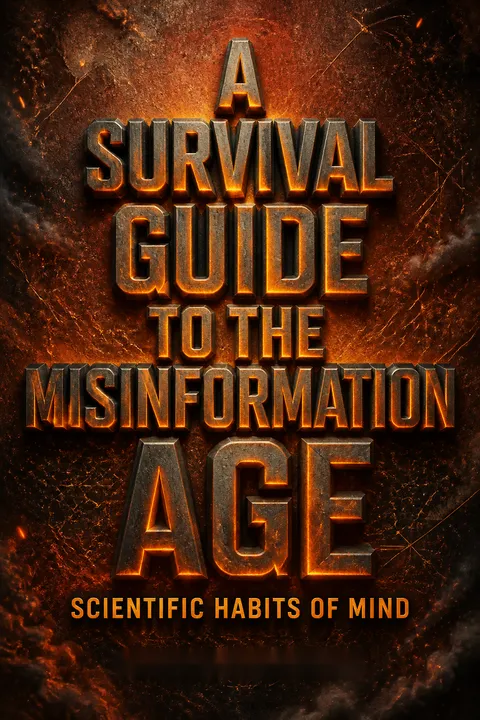


Key Takeaways
The web gives every claim reach; build your own evidence filter
Abundance changed the problem. Information once traveled slowly through small communities, where unreliable advice could be challenged by people who knew one another. Now, search engines make information nearly free and immediate, but also let misinformation spread to vast audiences. The book cites a 2015 estimate of 2.5 quintillion bytes of new data each day, much of it created too quickly for careful checking. Reach and reliability are not the same thing.
Use your own tools. Helfand calls the reasoning skills needed to evaluate information scientific habits of mind. They include checking evidence, putting numbers in context, looking for alternative explanations, and asking what would change a claim. They matter in everyday decisions about health, money, education, and politics, where an expert title or a personal story cannot substitute for scrutiny.
What's striking is that the information problem is not simply a shortage of trustworthy sources. It is a mismatch between the speed and scale of communication and the slower work of checking claims. Media literacy therefore has to include habits of verification, not merely a list of approved outlets. At the same time, individual skepticism has limits: no reader can personally reproduce every experiment. The practical goal is informed trust, grounded in methods, transparency, and opportunities for independent checking.
Make a claim scientific by specifying what could prove it wrong
Models must face tests. Helfand defines science as the systematic search for falsifiable models of nature. A model is falsifiable when some possible observation could show that it fails. Einstein's theory of relativity made precise predictions that observations could challenge. By contrast, a claim protected from every possible counterexample cannot be tested in the same way, even if it borrows scientific vocabulary.
Failure can be progress. Newton's account of gravity worked extremely well, but a small error in predicting Mercury's orbit exposed a limit. Relativity accounted for that discrepancy and passed other tests, while remaining an incomplete model rather than final truth. Scientific knowledge grows through observations, experiments, criticism, and revision. Its confidence comes not from claiming certainty, but from surviving demanding attempts to find where a model breaks.
Falsifiability is a powerful antidote to claims that explain every outcome after the fact. It turns a debate from a contest of confidence into a question about observable consequences. The criterion is most useful as a practical discipline, not a mechanical sorting machine: real research can involve indirect tests, uncertain measurements, and several connected assumptions. A failed prediction may challenge one part of a model rather than instantly settle the whole theory. The broader standard is exposure to evidence and a willingness to revise.
Use rough calculations to expose numbers that cannot be true
Estimate before searching. A back-of-the-envelope calculation is a quick estimate that uses simple arithmetic, explicit assumptions, and only the precision needed to answer a question. Asked how many piano tuners New York might support, Helfand estimates roughly 100, starting with the city's population, the share likely to own pianos, and the time needed to tune them. The point is not an exact census. It is to show whether the answer is closer to ten, one hundred, or ten thousand.
Scale makes claims legible. He estimates that two shark deaths represented fewer than one in a million U.S. deaths by early September of that year. A reported 500,000 acres burned in Colorado sounds enormous, but converting it to area shows it was about 0.29 percent of the state. Units, assumptions, and comparisons can turn intimidating numbers into useful information.
Order-of-magnitude reasoning is a form of error detection: it can reveal a mistaken unit, an implausible claim, or a dramatic statistic stripped of proportion. Its strength is speed, not precision. A rough estimate can inherit biased assumptions, so the assumptions should be visible and the result should be reported modestly. This method is especially valuable before relying on a search result, because it gives the reader a baseline against which an official-looking number can be checked.
A graph is an argument; inspect how its evidence is framed
Pictures reveal patterns. In a table of quasar measurements, the discovery of unusually red, luminous objects was easy to miss. A collaborator plotted the data, making the pattern visible and suggesting that earlier searches had overlooked a larger population. Graphs help the eye detect relationships, but the same pattern-seeking ability can also find shapes in random data.
Read the framing. Check what each axis measures, its units and scale, the legend, the caption, and any uncertainty bars. A stock-market graph with a truncated vertical axis can make a modest dip look like a collapse. A histogram's bin sizes can make random variation appear striking. Missing observations matter too: searches designed to find blue quasars can miss dust-obscured red ones. A clear picture is useful only when its construction and omissions are understood.
Graphs are not neutral windows. Choices about scale, categories, and which observations enter the picture shape what readers notice. That does not make visual evidence suspect by default; it makes careful reading essential. The red-quasar example also shows that selection bias can hide a real population, not just manufacture a false pattern. A useful question is both what the graph appears to show and what its method could not have allowed it to show.
Count the ways a coincidence could have happened before calling it meaningful
Chance is counterintuitive. In a group of 23 people, the odds are roughly even that two share a birthday. The surprising result comes from comparing every pair, not just comparing each person with one chosen birthday. Likewise, a stock tipster can appear uncannily accurate by sending opposite predictions to different groups, then contacting only those who received the winning prediction.
Set the rules first. An a priori probability is calculated before an event; an a posteriori calculation is made after noticing it. After an unusual coincidence, people often calculate only the chance of that exact event and ignore all the other coincidences they would also have found remarkable. The author uses his unexpected encounters with two subway deaths to show why a rare event is not, by itself, evidence of wrongdoing or a hidden force.
The distinction between chance and evidence depends partly on when the question is posed. A prediction made in advance is more informative than a striking pattern selected from many possible patterns after the fact. This principle applies well beyond lotteries: researchers, journalists, and investors can all overvalue the one result that stands out. Probability does not explain every event, but it provides a disciplined first check before an explanation is built around coincidence.
Report uncertainty, because precision without accuracy is confidence theater
Measurements have limits. Accuracy describes closeness to the true value; precision describes how finely a result is stated or repeated. Reporting a body temperature to tenths of a degree does not make it accurate if the instrument or the assumed normal value is off. Scientists therefore attach uncertainties to measurements and avoid inventing significant digits that the evidence cannot support.
Base rates change test results. The book gives a hypothetical disease test that correctly detects 95 percent of sick patients, while falsely labeling 5 percent of healthy people positive. If only 1 percent of people have the disease, just 16 percent of positive results would be true positives in that example. The test's apparent accuracy cannot be understood without knowing how common the condition is. Statistics quantify uncertainty; they do not turn a measurement into proof.
The medical example illustrates a general lesson in diagnostic reasoning: a test result means different things in populations with different starting risks. The same logic applies to screening, fraud detection, and risk alerts. Uncertainty is not a defect to conceal; it is information about how strongly a conclusion is supported. Still, a numerical confidence estimate is only as sound as the study design and the assumptions behind it. Precise calculation cannot repair poor data.
Treat correlation as a lead, not a verdict about cause
Co-movement is not mechanism. A correlation means that two measured quantities vary together. It does not establish whether one causes the other, whether the direction runs the other way, or whether a third factor affects both. In a Pennsylvania study, air pollution and pulmonary deaths rose together across counties. A joke that deaths might cause pollution through crematoria exposes the logical gap, even though other evidence can support a causal link from pollution to illness.
Group trends do not dictate individuals. Helfand finds that SAT scores and college grades are correlated across students, yet students with similar scores can earn very different grades. A correlation can identify a relationship worth investigating, but it cannot predict an individual's fate or explain the mechanism. Further observation, experiments, and causal reasoning are needed to move from pattern to explanation.
Correlation is valuable precisely because it can point toward questions that deserve investigation. The mistake is treating a statistical relationship as if the causal story were already settled. Confounding variables, reverse causation, and selection into a sample can all produce misleading associations. The book's distinction between population patterns and individual outcomes is equally important: a useful average is not a personal prophecy. Strong causal claims require evidence about how a proposed mechanism works, not merely a compelling scatterplot.
Test climate claims against mechanisms, measurements, and model limits
Start with physical mechanisms. Helfand frames planetary temperature as a balance between incoming and outgoing energy. Greenhouse gases allow much incoming sunlight through while absorbing some of the infrared energy Earth radiates outward. Measurements show rising atmospheric carbon dioxide, while carbon-isotope patterns point to fossil fuels as its source. Ice cores and tree rings extend climate records beyond the period of modern thermometers, though these proxies require assumptions and have limitations.
Separate evidence from forecast. Climate models reproduce many past patterns, but they contain uncertain feedbacks and have not always matched observed changes. The book uses faster-than-predicted Arctic sea-ice loss as a warning about model limits, while rejecting claims such as floating Arctic ice directly raising sea levels. Its method is to assess evidence, mechanisms, and uncertainties together, rather than treating either political conviction or model imperfection as a substitute for analysis.
The chapter's strongest contribution is methodological: a complex public dispute becomes easier to assess when observations, mechanisms, projections, and uncertainty are kept distinct. Model error deserves scrutiny, but an imperfect forecast does not erase direct measurements or established physical processes. Conversely, evidence for a trend does not make every specific impact prediction equally secure. Public discussion improves when confidence is calibrated claim by claim, rather than collapsed into a binary choice between certainty and denial.
Reject scientific costumes when claims evade tests and correction
Look past the branding. Astrology, homeopathy, and creation science can use technical language, organizations, or professional titles without meeting the book's standard for science: claims must face evidence that could change them. The Arkansas creationism case turned on this distinction. A witness argued that short-period comets implied a young solar system, but would not accept that Jupiter's gravity could alter comet orbits, nor identify evidence that could disprove his conclusion.
Bad science has consequences. The book describes Andrew Wakefield's fraudulent claim linking the MMR vaccine with autism. His small study was retracted, and his financial conflict of interest was uncovered, yet public fear persisted. In the United Kingdom, vaccination rates fell and measles cases rose. Scientific institutions can err, too: reported attempts to replicate prominent cancer studies failed at high rates. The answer is stronger scrutiny and correction, not blind trust or blanket rejection.
The distinction between science and pseudoscience is not simply about whether a claim sounds strange. It concerns how the claim handles counterevidence, conflicts of interest, and replication. The Wakefield episode also shows that correction inside journals cannot guarantee correction in public memory. People encounter claims through trusted communities and personal stories, not only through scientific papers. Reliable communication therefore requires both methodological standards and attention to the social routes by which evidence gains or loses credibility.
Build knowledge as a revisable cathedral, not a shrine to certainty
Curiosity needs discipline. The book opens with a walk through a city park, where students overlook the shoots of daffodils and the physical processes behind sunlight, warmth, and sky color. Explaining these phenomena does not drain their wonder; it connects an ordinary experience to a much larger account of nature. Yet observation alone can mislead. One student, after learning that a waning crescent Moon could appear in the morning, still insisted that the Moon never appears in daytime.
Knowledge is collective work. Science advances through shared data, criticism, replication, and revision. Helfand compares it to a cathedral assembled by many people over generations: new work may alter part of the structure, but much of what came before remains useful. Scientific understanding is incomplete, yet it enables prediction and action. The alternative is not perfect certainty, but decisions made with less regard for evidence and physical limits.
The cathedral image captures an important balance: scientific knowledge is neither a finished monument nor an arbitrary collection of opinions. Its durability comes from many people testing and improving shared accounts of the world. That collective process also depends on trust, openness, and access to criticism, conditions that can be weakened by institutional incentives or exclusion. Curiosity supplies the questions; disciplined correction makes the answers more reliable. The book's central invitation is to participate in that correction rather than treat uncertainty as a reason to stop thinking.
Analysis
Helfand's book is both a primer in quantitative reasoning and an argument about civic responsibility. Its distinctive move is to make scientific habits concrete through ordinary puzzles: a rain-soaked baseball, a dramatic graph, a lunar coincidence, a medical test, and a student's mistaken certainty about the Moon. The stories work because they expose familiar mental shortcuts before introducing formal tools. Probability, estimation, graphs, and statistics become defenses against manipulation rather than school subjects to endure.
The account also presents science as a social institution, not merely an individual method. Peer criticism, shared data, and replication help correct error, while funding incentives, publication bias, fraud, and political pressure can obstruct that correction. This makes the book more persuasive than a simple appeal to trust experts. Its standard is not obedience to authority, but a willingness to examine how a claim was tested and whether contrary evidence could matter.
The most useful tension is between skepticism and expertise. Readers should learn to question confident claims, but they cannot personally verify every result. Sound judgment therefore requires both independent checks, such as rough calculations, and appropriate reliance on communities that expose methods to scrutiny. Numeracy helps, but numbers can still mislead when measures, samples, or assumptions are poor.
The book's boundary between science and pseudoscience, grounded in falsifiability, is clear and memorable, though real research can be less tidy than the distinction suggests. Models depend on auxiliary assumptions, observations can be indirect, and a single mismatch may not identify which component failed. Helfand's deeper standard accommodates this complexity: scientific claims remain answerable to nature and open to revision. His climate discussion models that approach by treating measurements, physical mechanisms, projections, and uncertainty as related but distinct kinds of evidence. The lasting lesson is not that science removes uncertainty, but that it gives people disciplined ways to reason and act while uncertainty remains.
Review Summary
A Survival Guide to the Misinformation Age receives mixed reviews. Many praise its scientific approach and importance in combating misinformation. However, some find it too technical and math-heavy for the average reader. Reviewers appreciate the author's passion for science and critical thinking but note that the book may not reach its intended audience due to its complexity. Some criticize the tone as condescending. Despite these issues, many readers find value in the book's lessons on data interpretation, skepticism, and scientific reasoning.
People Also Read

Glossary
Scientific habits of mind
Tools for evaluating evidenceA set of reasoning practices for judging claims about the world. In the book, these include asking testable questions, estimating quantities, reading graphs carefully, using probability and statistics, examining assumptions, and considering alternative explanations. They help people evaluate information without depending entirely on personal anecdotes, authority, or intuition.
Falsifiability
Exposure to possible refutationA model or theory is falsifiable when some possible observation or experiment could show it to be wrong. Helfand uses falsifiability as a practical test of scientific status: a claim that can accommodate every possible result is not being tested against nature. Scientific models remain provisional because new evidence may reveal where they fail.
Fermi problem
A structured rough estimateAn estimation problem solved by breaking an unknown quantity into simpler factors that can be measured or reasonably guessed. The method makes assumptions explicit, tracks units, ignores corrections too small to affect the rough answer, and checks whether the result is plausible. The goal is usually an approximate scale, not an exact count.
Selection effects
Bias from what gets observedSelection effects arise when the observations collected do not fairly represent the full population or phenomenon being studied. Instrument limits, survey design, hidden subgroups, or selective publication can make some evidence more visible than other evidence. A search for blue quasars, for example, can overlook dust-obscured red quasars.
Proxies
Stand-ins for unmeasured quantitiesA proxy is a measurable quantity used in place of the quantity researchers actually want to know, often because direct measurement is impossible or historical records do not exist. Tree-ring properties and oxygen-isotope ratios can serve as proxies for past climate. A proxy must be calibrated and assessed for other factors that could influence it.
a priori and a posteriori
Before and after observationAn a priori probability is specified before an event or pattern is observed. An a posteriori probability is calculated after noticing a particular outcome. The distinction matters because people often select a striking coincidence after it occurs, then calculate its rarity without counting the many other outcomes they might also have found remarkable.
Anthropocene
Human-dominated geological eraA proposed name for the present period in which human activity substantially affects Earth's geological, chemical, and biological systems. Helfand uses the term to emphasize that people are not merely observers of planetary change: energy use, fossil-fuel combustion, and other activity alter the conditions on which human societies and other life depend.
General circulation models
Computer models of climateGeneral circulation models, also called global climate models, are numerical simulations of interactions among the atmosphere, oceans, land, and ice. They incorporate physical processes and external influences to reproduce past climate patterns and estimate future conditions under different assumptions. Their outputs depend on model structure, input data, feedbacks, and choices about future emissions.
Download PDF
Download EPUB
.epub digital book format is ideal for reading ebooks on phones, tablets, and e-readers.








