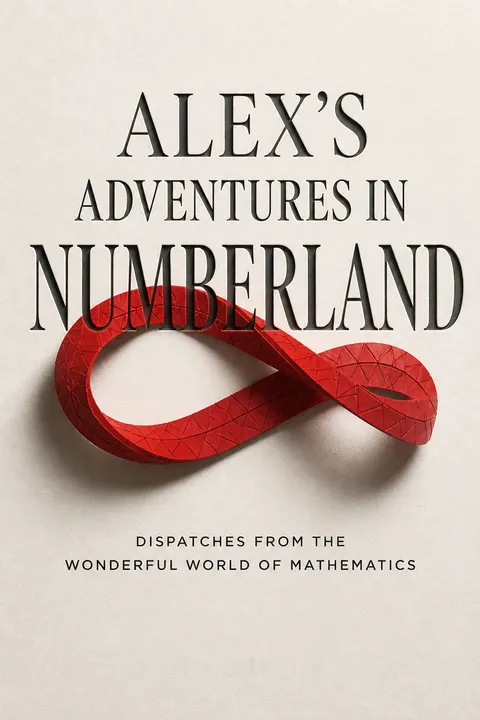


Key Takeaways
Treat mathematics as a human journey from practical counting to abstraction
Numbers began as tools. The book opens with a local newspaper challenge: estimate the traffic cones along a long road. A simple ratio of road length to spacing between cones produces a useful answer, showing how mathematical thinking can clarify ordinary problems. Historically, counting systems grew alongside needs such as farming, trade, and record-keeping. The Munduruku people of the Amazon, whose language has number words only up to five, live without many of the everyday pressures that make exact counting useful.
Then the tools transformed. Notches, fingers, and clay tokens gradually became symbols, place-value notation, and abstract ideas such as zero and infinity. The book follows these developments across cultures, showing mathematics as both a practical craft and an accumulating intellectual adventure.
What's striking is the distinction between mathematical truths and the human technologies used to reach them. A road-length estimate works regardless of culture, but the ability to express it depends on learned notation, shared conventions, and a reason to count. This resembles the history of writing: record-keeping helps create institutions, and institutions then demand more sophisticated records. The book's broad narrative usefully counters the idea that mathematics arrives as a finished, culture-free package. Its caution is that cultural difference should not be mistaken for incapacity. The Munduruku example is about a different numerical environment, not a lesser mind.
Build on intuitive quantity before demanding exact arithmetic
Approximation comes first. Research with the Munduruku found that people could compare and roughly combine sets of dots even when the amounts exceeded their number vocabulary. On a number line, their estimates placed small quantities farther apart and large ones closer together, a pattern also seen in young children before schooling teaches evenly spaced numbers. The book calls this a logarithmic scale: equal ratios, rather than equal differences, govern perceived distance between quantities.
Exactness is learned. Experiments with chimpanzees and infants suggest that humans and other animals can register small quantities and compare larger groups, while exact counting depends on symbols, language, and practice. One study cited in the book also found that teenagers with sharper approximate quantity judgments tended to perform better in formal mathematics.
This account supports a useful educational principle: connect formal symbols to estimation, comparison, and visual quantity rather than presenting arithmetic as symbol manipulation alone. It also resembles perceptual learning in music, where trained categories refine an existing capacity instead of replacing it. Still, infant looking-time experiments and cross-cultural tasks measure indirect responses, so they cannot establish a complete theory of numerical thought by themselves. The strongest claim is modest: approximate quantity is widespread, while exact number systems are culturally developed. Teaching can honor both capacities rather than treating intuition as an error to be erased.
Choose number systems for their uses, not because ten feels inevitable
Bases are design choices. A number-system base determines how many symbols are used before values roll into a new place. Shepherds in medieval Lincolnshire counted in groups of twenty, while body-based systems often used five, ten, or twenty because fingers and toes offered ready-made counters. Base ten is familiar, but it is not mathematically ordained.
Different bases excel differently. Advocates of base twelve point to its divisibility by 2, 3, 4, and 6, which makes many fractions and multiplication tables simpler than in base ten. Base sixty, inherited from ancient Babylonian mathematics, survives in the 60 seconds per minute and 60 minutes per hour. Yet changing a shared system carries enormous costs. Decimal time, tried during the French Revolution, was abandoned after only months because the public found it awkward.
Number bases resemble measurement standards and software protocols: the best design depends on the task, but widespread coordination can matter more than local elegance. A dozenal system may simplify division, while decimal notation benefits from billions of users, established instruments, and digital infrastructure. This makes reform a problem of network effects as much as arithmetic. The historical examples also expose a subtle point: convenience is not purely mathematical. It includes what people have learned, what tools support, and how costly a transition would be. A system can be imperfect and still be the sensible common language.
Recognize zero as the invention that made written arithmetic powerful
A placeholder changes everything. Place-value notation assigns value according to position, but it needs a way to show an empty position. Indian mathematicians used shunya, meaning void, first as a placeholder and then as a number in its own right. In the seventh century, Brahmagupta described rules for calculations involving zero and positive and negative quantities.
Nothing became operational. Roman numerals could record 101, but their symbols made calculation cumbersome. The Indian system combined ten digits, place value, and zero, allowing large numbers and written arithmetic to be handled efficiently. It spread through the Islamic world and into Europe, where Fibonacci's Liber Abaci helped popularize it. The transition took centuries, partly because established practitioners and authorities resisted the unfamiliar notation.
Zero shows how a representation can enlarge what a civilization is able to think with. In computing, an empty field or a zero value is not merely absence; it has a precise role inside a structured system. The same is true in accounting, calendars, and scientific measurement. The historical path also warns against treating innovation as automatic: an elegant notation can remain marginal when institutions, livelihoods, or trust favor older methods. The leap was not simply naming nothing. It was giving absence a stable place in a symbolic system, where it could participate in calculation.
Use symbols to turn one numerical trick into a general rule
Algebra generalizes. The book's 1089 puzzle starts with a three-digit number, reverses its digits, subtracts the smaller result from the larger, then adds that result to its reverse. The final answer is always 1089, provided the first and last digits differ by at least two. Algebra explains why: letters represent any eligible digits, and simplifying the expression reveals what remains true across every permitted starting number.
Notation unlocks new routes. Ancient Egyptian problems described an unknown as a heap and often relied on trial and error. Later, symbolic equations made it possible to manipulate unknown quantities systematically. Logarithms converted multiplication into addition, while Descartes' coordinate system connected equations to lines and curves. In each case, notation did more than shorten writing. It made relationships easier to inspect and extend.
Symbols act like cognitive tools: they reduce the burden of holding details in memory and make structure visible. This is the same advantage offered by diagrams in engineering or variables in computer programs. The 1089 puzzle is especially effective because it separates a satisfying surprise from its general explanation. Yet symbolic fluency is not identical to understanding. A student can manipulate an equation correctly without knowing what its terms represent, while a visual or verbal approach may reveal a relationship first. Strong mathematical practice moves between representations, using each to expose what another conceals.
Use puzzles to explore mathematical structure, not just to get answers
Play can carry serious ideas. The Pythagorean theorem says that in a right-angled triangle, the square built on the longest side has the same area as the two smaller squares combined. The book shows how rearranging pieces can make this relationship visible, and how many different proofs illuminate the same result from different angles.
Recreation can become research. Origami constructions can solve geometric problems that compass-and-straightedge methods cannot. Sudoku, which uses rules similar to a Latin square, turns logical deduction into a mass pastime without requiring arithmetic. A puzzle about crossing seven bridges led Euler to create graph theory, a way to study how points are connected without needing a geographically accurate map. Games and puzzles make abstract relationships tangible.
Puzzles lower the cost of experimentation. A learner can try a move, notice a contradiction, and revise a strategy without first mastering a large technical vocabulary. That makes recreational mathematics a useful laboratory for reasoning, much as prototypes help designers test an idea before building a finished product. The book also makes a strong case that play can lead to serious theory. One qualification matters: solving a puzzle by intuition does not automatically establish a proof. The educational opportunity is to turn the pleasure of discovery into a demand for explanation, verification, and generalization.
Judge a gamble by its long-run odds, not its most recent result
Chance has arithmetic. Probability measures how likely an outcome is, while expected value combines each possible result with its chance of occurring. A roulette bet on one number has 38 possible pockets in an American wheel, but the payout is set so that the player loses about 52.6 cents per 10 dollars wagered on average. A short run may bring a win; repeated play favors the house.
Randomness has no memory. The belief that a slot machine is due to pay after a losing streak is the gambler's fallacy. Every play has the same odds. Ed Thorp found an exception of a different kind in blackjack: because dealt cards change what remains in the deck, tracking those cards can reveal when the player's odds improve. That is information, not luck correcting itself.
The distinction between long-run expectation and short-run experience is central to financial decisions, clinical risk, and public policy. People often evaluate a choice by its vivid outcome, while expected value forces attention to repeated consequences. However, an average is not a promise to any individual. Variance, bankroll, and the ability to withstand losses matter, which is why a positive-expectation bet can still be ruinous if stakes are too large. Thorp's card counting illustrates the key boundary: a forecast improves when new information changes the probability model, not because randomness owes anyone a balancing result.
Question the measurement process before trusting a neat statistical curve
Data contain noise. Bellos weighed 100 baguettes from one bakery. Their weights clustered around roughly 400 grams, suggesting a bell-shaped distribution, the pattern often called a normal distribution. But the readings were affected by the time of day and seasonal heat: bread lost weight as it dried. The apparent pattern therefore mixed the production process with the measurement conditions.
Extremes tend to soften. Francis Galton observed that unusually tall parents tended to have children closer to average height, a pattern he called regression to the mean. The concept also explains why a poor performance is often followed by a better one even without special intervention. The book's example of flight instructors mistaking this rebound for the effect of punishment shows how easily cause can be confused with statistical tendency.
The baguette experiment is a compact lesson in measurement validity: a precise instrument cannot rescue a poorly designed study. Before interpreting a distribution, analysts need to ask how observations were collected, which variables changed, and whether selection shaped the sample. Regression to the mean is equally important in evaluating interventions. A team selected after an unusually bad season may improve simply because extreme outcomes are unlikely to repeat. That does not prove the intervention failed. The right comparison is a suitable control group, not the before-and-after story alone.
Admire the golden ratio without making it a universal beauty formula
A sequence approaches a famous ratio. The Fibonacci sequence begins 0, 1, 1, 2, 3, 5, 8, with each new term formed by adding the previous two. Ratios of neighboring terms approach phi, about 1.618. Fibonacci counts appear in some flower petals and spiral arrangements in plants, where growth patterns can help distribute leaves or seeds efficiently.
Pattern is not proof of taste. Dentist Eddy Levin used a gauge based on phi and claimed to find the ratio in attractive teeth, handwriting, and many other forms. The book presents the appeal of these examples, but also reports research finding no single rectangle that people universally prefer. A mathematical ratio may describe some natural or designed patterns without determining what everyone finds beautiful.
The golden ratio is a useful case study in the difference between mathematical recurrence and cultural interpretation. A plant can arrive at a pattern through growth constraints without embodying a cosmic aesthetic rule. People, meanwhile, can find meaning in a ratio partly because they have been taught to look for it. This does not make the pattern uninteresting; it makes the explanation more disciplined. The strongest account distinguishes a measurable proportion, a plausible biological function, and a claim about human preference. Those are separate hypotheses, and each needs its own evidence.
Treat infinity as a family of sizes, not one endless quantity
Some infinite sets can be counted. The Hilbert Hotel story imagines a hotel with infinitely many numbered rooms. Even when it is full, it can fit a new guest by moving each person one room along, or make room for infinitely many guests by shifting occupants into even-numbered rooms. This illustrates countable infinity, where members can be paired with the natural numbers.
Other infinities are larger. Cantor's diagonal argument shows that decimal expansions between zero and one cannot be placed in a complete numbered list: any proposed list can be used to construct a decimal missing from it. The book also explores infinite series. The harmonic series adds smaller and smaller fractions, yet its total grows without bound. Infinite processes can therefore behave very differently from one another.
Cantor's result challenges the instinct that infinity is simply an amount too large to finish counting. It instead makes infinity a question about structure and correspondence. This kind of reasoning has modern echoes in computer science, where some problems can be enumerated while others cannot be exhaustively searched. The hotel analogy makes the idea vivid, but it can also tempt readers to imagine infinity as a physical place. Its real force comes from the precise pairing argument. The distinction between countable and uncountable sets is not a metaphor about size alone; it is a theorem about possible mappings.
Change geometry's assumptions and the shape of space changes
Euclid's rules are one model. Euclidean geometry assumes that through a point outside a line there is exactly one parallel line. For centuries, mathematicians tried to derive this rule from Euclid's other assumptions. Bolyai and Lobachevsky instead explored what happens when it is changed. Their work produced non-Euclidean geometry, in which the parallel-line rule and familiar facts about triangles differ.
Curvature describes the alternatives. On a sphere, triangle angles add to more than 180 degrees. On a negatively curved surface, they add to less. Daina Taimina made the latter easier to picture by crocheting models that expand as rows are added. These geometries are not mathematical mistakes. Riemann's broader framework later helped Einstein describe curved space-time in general relativity.
This chapter offers a powerful lesson about models: a system can be internally rigorous without matching everyday intuition, and multiple systems can be useful in different settings. Flat geometry suits ordinary construction, while spherical geometry is better for routes over the Earth. The point is not that truth becomes arbitrary, but that assumptions determine which conclusions follow. Taimina's textile models also show how physical craft can expand abstract understanding. Still, a model is an aid, not the object itself. A crocheted surface makes curvature graspable while remaining a finite, approximate representation of an ideal mathematical space.
Analysis
The book's central achievement is to make mathematics feel less like a school subject and more like a changing human practice. Its travel narrative connects counting in the Amazon, abacus training in Japan, the invention of zero in India, gambling in Nevada, and abstract geometry. Those locations are not decorative: each shows how mathematical ideas emerge from particular needs, habits, and ways of seeing. The sequence of chapters moves from the bodily and practical toward symbols, probability, statistics, and infinity, while recurring stories make the history feel cumulative rather than encyclopedic.
The strongest intellectual thread is the tension between intuition and formal systems. Humans and animals can estimate quantities, yet exact arithmetic depends on conventions and notation. Decimal counting feels natural largely because it matches ten fingers, but other bases solve different tasks. Zero appears simple only after a culture has made absence usable as a number. Geometry, meanwhile, demonstrates that apparently self-evident rules can be replaced by other consistent assumptions. Mathematics is therefore both discovered and invented: relationships can be rigorous and stable, while the languages and models used to reach them remain historically contingent.
The book also offers a practical defense against innumeracy. Probability exposes the fallacy of believing that a streak must reverse. Statistics teaches that a bell curve can be an artifact of measurement choices, and regression to the mean can masquerade as the effect of an intervention. These ideas matter beyond casinos and bread scales because institutions routinely make consequential decisions from incomplete data.
A limitation is inherent in the book's breadth. Some research findings are necessarily compressed, and colorful examples can make uncertain claims feel more settled than they are. The chapter on the golden ratio, for instance, appropriately distinguishes botanical patterns from universal aesthetic preference, but the narrative's pleasure in coincidence can still invite overinterpretation. That tension is also part of the book's value: wonder is a productive beginning, provided it is followed by testing. The lasting lesson is not that every pattern conceals a grand message. It is that disciplined curiosity can reveal how much structure hides inside ordinary quantities, games, tools, and ideas.
Review Summary
Alex's Adventures in Numberland is a captivating exploration of mathematics, blending history, culture, and philosophy. Readers praise Bellos's engaging writing style and ability to make complex concepts accessible. The book covers diverse topics, from ancient number systems to modern mathematical theories, appealing to both math enthusiasts and novices. While some found certain sections challenging or less engaging, most reviewers appreciated the book's unique approach to mathematics, highlighting its cultural significance and real-world applications. Overall, it's recommended for those seeking a fresh perspective on mathematics and its role in society.
People Also Read


Glossary
Approximate number sense
Intuitive quantity estimationA basic capacity to compare or estimate amounts without counting each item exactly. The book presents it as widespread among humans and found in other animals. It is useful for judging relative quantities, but it becomes less precise as amounts grow and differs from exact counting with number words and symbols.
Cardinality
A set's exact amountThe quantity represented by a number, as in five objects. Bellos distinguishes cardinality from ordinality, which concerns a number's position in an ordered sequence. The distinction matters in the chimpanzee Ai's training: she could learn that a digit represented a quantity and separately learn where it belonged in a sequence.
Ordinality
Position in a sequenceThe order of numbers relative to one another, such as knowing that 2 comes before 4. It differs from cardinality, which is the number of objects in a group. The book uses chimpanzee experiments to show that recognizing a quantity and understanding its place in a number sequence are related but distinct abilities.
Place-value system
Value determined by positionA method of writing numbers in which a symbol's position determines its value. In a base-ten system, a digit can represent units, tens, hundreds, and higher powers of ten depending on its column. Place value makes large numbers manageable and, when combined with a zero placeholder, supports efficient written arithmetic.
Logarithmic scale
Equal ratios, equal spacingA scale in which positions reflect ratios rather than equal numerical differences. On such a scale, the distance from 1 to 2 resembles the distance from 2 to 4. Bellos uses it to describe quantity judgments made by the Munduruku and young children before schooling familiarizes them with a linear number line.
Expected value
Average payoff over timeA theoretical average outcome calculated by multiplying each possible result by its probability and adding those products. A casino bet can have a negative expected value even when it sometimes pays out substantially. The measure describes repeated play or long-run averages, not what any single player is guaranteed to win.
Law of large numbers
Repeated trials approach expectationThe principle that, across many repetitions of a random process, observed frequencies tend to approach their expected probabilities. A coin may produce an unusual result over a few flips, but thousands of flips are more likely to yield a proportion near half heads. The principle explains why casinos rely on large volumes of play.
Regression to the mean
Extremes tend to be followed by milder resultsThe tendency for an unusually high or low observation to be followed by one closer to the average when outcomes include random variation. It can create misleading stories of improvement or decline. For example, a performer selected after an exceptional result may do less well next time without any change in skill or treatment.
Hyperbolic plane
Negatively curved geometryAn ideal surface with constant negative curvature. Its geometry differs from Euclidean geometry: through a point outside a given line, more than one parallel line can pass, and triangle angles sum to less than 180 degrees. Daina Taimina's crocheted models provide a physical approximation that helps people visualize its expansion.
Countable infinity
Infinity that can be listedAn infinite collection whose members can be matched one by one with the natural numbers. The natural numbers, even numbers, and positive fractions are all countable in this sense, despite their apparently different densities. Cantor's work contrasts countable infinity with larger, uncountable collections such as the real numbers between zero and one.
FAQ
What's Alex's Adventures in Numberland about?
- Exploration of Mathematics: The book is a journey through the world of mathematics, exploring its history, concepts, and cultural significance. Alex Bellos travels to various countries to uncover how different cultures understand and use numbers.
- Personal Journey: Bellos shares his personal experiences and realizations about mathematics, transitioning from a journalist back to a mathematician. He emphasizes the joy and wonder of mathematical discovery.
- Diverse Topics: The book covers a wide range of mathematical topics, including arithmetic, algebra, geometry, and statistics, while also delving into the lives of mathematicians and their contributions to the field.
Why should I read Alex's Adventures in Numberland?
- Engaging Narrative: The book combines storytelling with mathematical concepts, making it enjoyable and easy to read. Bellos's humor and curiosity draw readers into the fascinating world of numbers.
- Cultural Insights: Readers gain insights into how different cultures approach mathematics, highlighting the diversity of mathematical thought across the globe.
- Inspiration for All: The book aims to inspire a love for mathematics, showing that it is not just a dry subject but a creative and exciting field.
What are the key takeaways of Alex's Adventures in Numberland?
- Mathematics is Everywhere: The book illustrates that mathematics permeates everyday life and various cultures, enhancing our perception of the world.
- Historical Context: Bellos provides historical context for mathematical concepts, enriching the reader's understanding of mathematics as a human endeavor.
- Mathematical Curiosities: The book is filled with intriguing mathematical puzzles and curiosities, engaging readers and demonstrating the playful side of mathematics.
What are the best quotes from Alex's Adventures in Numberland and what do they mean?
- "Maths can also be inspiring...": This quote encapsulates Bellos's mission to demystify mathematics and present it as a vibrant field, encouraging readers to appreciate its beauty and creativity.
- "The journey soon became geographical...": Reflects Bellos's approach to learning mathematics through exploration and real-world experiences, emphasizing the connection between abstract concepts and practical applications.
- "Numberland is a remarkable place...": Serves as an invitation to readers to engage with mathematics, suggesting that exploring mathematical ideas can be as enriching as traveling to new places.
How does Alex's Adventures in Numberland illustrate the cultural significance of mathematics?
- Cultural Practices: The book highlights unique cultural approaches to mathematics, illustrating that mathematical understanding is shaped by cultural context.
- Historical Figures: Bellos shares stories of historical mathematicians from various cultures, showcasing their contributions and societal influences.
- Mathematics as a Language: The author posits that mathematics serves as a universal language, transcending cultural boundaries and emphasizing collaborative discovery.
What is the significance of pi in Alex's Adventures in Numberland?
- Historical Importance: Bellos traces the history of pi, highlighting its significance in mathematics and its fascination for mathematicians due to its irrational and transcendental nature.
- Cultural References: The book explores pi's appearances in various cultural contexts, showcasing its broader impact beyond mathematics.
- Mathematical Properties: The author explains pi's role in geometry and its appearance in various mathematical formulas, underscoring its importance in understanding shapes and dimensions.
What is the 1089 trick mentioned in Alex's Adventures in Numberland?
- Simple Steps: The trick involves choosing a three-digit number, reversing it, and performing specific operations to consistently yield 1089.
- Algebraic Explanation: Bellos explains this phenomenon using algebra, showing how the properties of the digits involved lead to a fixed outcome.
- Mathematical Magic: This trick exemplifies the surprising nature of numbers, serving as a fun introduction to algebraic thinking.
How does Alex's Adventures in Numberland explain the concept of probability?
- Basic Definition: Probability measures the likelihood of an event occurring, expressed as a fraction between 0 and 1.
- Gambler's Fallacy: The book discusses the mistaken belief that past random events influence future outcomes, such as assuming a coin flip result is "due."
- Law of Large Numbers: Bellos explains how this principle states that as trials increase, experimental probability converges to theoretical probability, aiding in understanding randomness.
What is the relationship between the Fibonacci sequence and the golden ratio in Alex's Adventures in Numberland?
- Fibonacci Sequence Definition: Starts with 0 and 1, with each subsequent number being the sum of the two preceding ones.
- Connection to the Golden Ratio: As Fibonacci numbers increase, the ratio of consecutive numbers approaches the golden ratio, illustrating a natural approximation.
- Occurrence in Nature: Both the sequence and the ratio are found in natural patterns, highlighting the mathematical order in nature.
How does Alex's Adventures in Numberland address the concept of combinatorics?
- Definition of Combinatorics: Deals with counting, arrangement, and combination of objects, essential for probability and statistics.
- Applications in Real Life: Discusses real-world applications like scheduling and optimization, demonstrating combinatorial mathematics' practical importance.
- Fascinating Problems: Presents intriguing problems, such as Sudoku grid possibilities, showcasing combinatorial mathematics' vastness and richness.
What role does the concept of infinity play in Alex's Adventures in Numberland?
- Understanding Infinity: Introduces infinity through sequences and limits, explaining it as a concept challenging our understanding of mathematics.
- Mathematical Paradoxes: Discusses paradoxes like Hilbert's Hotel, illustrating infinity's counterintuitive properties and complexities.
- Cultural Interpretations: Explores how different cultures perceive infinity, linking it to philosophical and spiritual ideas, enriching understanding beyond mathematics.
How does Alex's Adventures in Numberland illustrate the concept of the bell curve?
- Definition of the Bell Curve: A graphical representation of data clustering around a central mean, characterized by its bell shape.
- Applications in Statistics: Used in fields like psychology and economics to analyze data distributions, helping understand data points' relation to the average.
- Real-World Examples: Provides examples like human heights and test scores, demonstrating normal distributions' prevalence in real-life data.
About the Author

Download PDF
Download EPUB
.epub digital book format is ideal for reading ebooks on phones, tablets, and e-readers.








