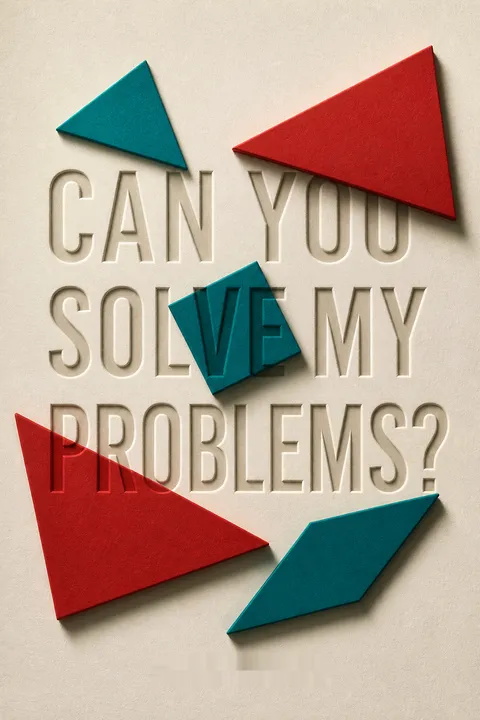


Key Takeaways
When a pattern works five times, test what would make it fail
A pattern can mislead. The opening number-tree puzzle appears to follow a simple rule: subtract one circle's number from another to get the next. The rule works repeatedly, then misses the final result by one. The real pattern is that the digits in the two circles add up to the next number. A solver who stops at the first plausible rule gets trapped by a deliberately convincing coincidence.
Check the final step. The puzzle illustrates a wider habit of thought: treat a solution as a hypothesis, not a discovery. Bellos's collection rewards close reading, alternative interpretations, and a willingness to restart. Its problems need no advanced mathematics, but they can be hard precisely because an easy-looking assumption points in the wrong direction.
This is a compact lesson in overfitting. A rule that explains several observations can still be wrong, especially when the data set is small and a clever puzzle-maker has chosen examples to support competing explanations. The same caution matters in science, forecasting, and everyday pattern recognition. A useful test is to ask what new observation would distinguish the leading explanations. In a puzzle, that means checking every case. In real life, it also means remembering that patterns can be accidental, and that more evidence may be needed before a theory deserves confidence.
Use what others cannot infer, not only what they can see
Silence can carry information. In the muddy-face puzzle, two girls see mud on each other but cannot see their own faces. Neither moves when asked to step forward. That hesitation tells each girl that the other cannot yet determine her own state. After the question is asked again, both infer that they must also be muddy.
Knowledge has layers. Cheryl's Birthday uses the same structure: one friend knows the month, another the day, and each statement changes what the other could know. Under the intended interpretation, the date is July 16. The puzzle became famous partly because readers disagreed about what Albert already knew, showing how much a logic problem depends on clearly stated assumptions.
These puzzles model a powerful idea from epistemic logic: reasoning can depend not just on facts, but on who knows them and who knows that others know them. That structure appears in negotiations, group decisions, and coordination. The birthday puzzle also shows why formal clarity matters. A sentence such as knowing that another person is ignorant can describe either an inference or information received in advance. Those readings produce different conclusions. The disagreement is not a failure of logic; it exposes a hidden assumption that needed to be made explicit.
Turn a messy set of clues into a table before guessing
Make exclusions visible. A grid puzzle asks solvers to match several categories, such as five houses, their colours, residents, pets, drinks, and shoes. In the Zebra Puzzle, each clue rules out combinations as well as confirming others. A table lets the solver mark both kinds of information, so deductions accumulate instead of being held in memory.
Let constraints do the work. In Dudeney's train puzzle, the worker roles, surnames, and locations initially seem disconnected. But the guard's location, a neighbour's salary, and the namesake clue narrow the possibilities step by step until Smith is identified as the driver. The method is simple: list the options, record what cannot be true, and use each new restriction to reduce the remaining choices.
A table is more than a neatness aid. It externalizes working memory, making contradictions easier to spot and preventing a solver from quietly forgetting a constraint. This is the same advantage offered by diagrams in engineering and checklists in high-stakes work: they turn an invisible mental state into something inspectable. The method is especially effective when categories are finite and mutually exclusive. It is less useful when the problem has vague or changing possibilities, where a tidy grid can create false confidence by making an incomplete model look complete.
A one-metre change can lift a rope sixteen centimetres
Geometry cancels scale. Imagine a rope fitted tightly around the Earth, then lengthened by one metre and raised evenly. The added length is shared around the full circle. Since a circle's circumference is 2 pi times its radius, the increase in radius is one metre divided by 2 pi, or about 16 centimetres. The result does not depend on the Earth's enormous circumference.
Small inputs can surprise. A related puzzle asks how much farther a person's head travels than their feet when walking around a sphere. The difference is 2 pi times the person's height, whether the sphere is Earth, Jupiter, or an atom. In both cases, the large radius disappears from the calculation. The unexpected answer comes from identifying what changes and what cancels.
The surprise comes from a failure of scale intuition: people imagine the extra metre being diluted across a planet-sized circle, although the radius change is set by a simple proportional relationship. This is a useful reminder that units and formulas often reveal which quantities matter. It also demonstrates the value of idealization. A perfectly circular, evenly raised rope is a mathematical model, not a practical engineering plan. Real terrain and uneven tension complicate construction, but they do not undo the underlying geometric result.
Change the representation when the obvious method stalls
Translate actions into states. In the three-jug problem, pouring between unmarked containers can feel like blind trial and error. Instead, record the amounts in the two smaller jugs as a pair of numbers. Bellos shows that these states match the points where a ball rebounds around a rhombus-shaped table. The physical motion of the ball traces the sequence of legal pours.
A new model can remove a nuisance. With an unevenly burning fuse, cutting it in half does not produce a reliable half-hour segment. Lighting both ends makes it burn out in exactly half an hour regardless of unevenness. A biased coin can also simulate a fair one: compare two-flip outcomes, heads then tails and tails then heads, and repeat matching pairs. In each case, the right representation makes a hidden structure usable.
Representation changes are among the most generative moves in problem solving. A liquid-pouring task becomes a path through states; a physically irregular fuse becomes a timing device through its endpoints; biased probabilities become balanced by pairing outcomes. Similar translations underpin computation, where a problem is recoded into a form that an algorithm can handle. But a clever representation is not automatically a proof. The solver still has to show that every allowed state or outcome is accounted for, and that the translated model preserves the original rules.
Search for invariants before counting every possibility
Look for what cannot change. An invariant is a property that remains fixed under the allowed moves or constraints. To test whether domino-shaped mats can cover a chessboard missing two opposite corners, colour the squares alternately black and white. Every mat must cover one square of each colour, but the altered board has two more squares of one colour than the other. A complete tiling is therefore impossible, without trying arrangements one by one.
Parity can guide strategy. In the one-hundred-coin game, the first player can choose to collect all odd-positioned or all even-positioned coins. Each move by the opponent leaves the chosen parity available at an end. The first player compares the two parity totals and chooses the larger, guaranteeing at least as much value as the opponent.
Invariants turn an enormous search into a short argument. The checkerboard proof is a simple instance of a broader mathematical strategy: find a property every legal move preserves, then compare it with the target state. The coin game adds a strategic dimension, since the player uses parity not merely to explain the game but to control it. Such arguments are powerful because they avoid exhaustive enumeration. Their limitation is that the chosen property may be too coarse: an invariant can establish impossibility or a guarantee, but often cannot identify the exact solution.
Pair and regroup numbers to expose structure brute force hides
Organize before calculating. The familiar sum from 1 to 100 becomes easy when the first and last terms are paired, then the second and second-last, and so on. Each pair totals 101, and there are 50 pairs, giving 5,050. The method appears in a medieval problem about pigeons on a hundred-step ladder, long before the later story about the young Gauss popularized it.
Factorization reveals hidden counts. The book's final problem asks how many zeros end 100 factorial, the product of every whole number from 1 to 100. Each zero requires a factor of 10, made from a 2 and a 5. There are more than enough 2s, so count the 5s: multiples of five contribute 20, and the extra factors in 25, 50, 75, and 100 add four more. The answer is 24 zeros.
Both examples replace arithmetic labour with structural accounting. Pairing is a form of symmetry, while counting factors reduces a huge product to the scarce ingredient that limits the result. These are early versions of ideas used in algorithms: reorganize a task so repeated work disappears, or identify the bottleneck that determines the output. The book's historical framing is useful too. The point is not that one famous mathematician owns a trick, but that elegant methods can recur across centuries and settings.
Follow puzzles across cultures to see mathematics acquire new tools
Puzzles travel and mutate. A river-crossing problem recorded in the ninth-century collection associated with Alcuin has appeared in different places with different animals and social roles. The underlying task stays recognizable while local retellings reflect their own concerns. Such puzzles belong to a shared culture, not always to a single identifiable inventor.
Recreation can teach new mathematics. Medieval hundred-animal problems asked how to buy a fixed number of birds for a fixed sum. Early solvers used guesses and arithmetic; later writers expressed the conditions as equations, helping demonstrate the power of algebra. In Japan, sangaku geometry problems were displayed on wooden tablets at temples, while the puzzle publisher Nikoli helped popularize Sudoku after reshaping its presentation. Mathematical play has repeatedly crossed into public life.
The collection treats puzzle history as more than a procession of clever individuals. It shows ideas being copied, adapted, and improved, much like folk tales or technologies. That perspective makes attribution more complicated but also more realistic: a puzzle can have many versions and no recoverable first author. The bird problems are especially revealing because the same recreational question can serve different mathematical purposes as notation changes. A caveat is that cultural descriptions should not turn diverse societies into simple stereotypes. The strongest evidence comes from specific texts, practices, and documented adaptations.
Use play to enter rigorous ideas, not escape them
A puzzle can be a proof in disguise. Euclid's geometry begins from a small set of accepted statements and derives further results step by step. Bellos connects that tradition to construction puzzles using a ruler and compass, where the challenge is to produce a precise object under strict rules. The pleasure comes from seeing why the construction works, not merely from reaching the answer.
Play can model serious mathematics. Tangloids uses three connected strings and two end pieces. After certain rotations, the strands can be untangled by sliding the pieces; after a single rotation, they cannot. The physical trick demonstrates a subtle fact about rotations in three-dimensional space. Across its 125 problems, the book moves from household objects to geometry, logic, and number theory, showing how curiosity can lead into formal reasoning.
Play lowers the emotional cost of engaging with abstraction. A person may resist a formal definition but happily manipulate a string, arrange coins, or test a conjecture. Once the pattern becomes visible, proof can explain why it must hold beyond the particular demonstration. This is a strong educational sequence: encounter, experiment, formalize. Yet a satisfying reveal is not the same as understanding. The best use of a puzzle is to ask what assumptions made the result possible, and whether the reasoning extends beyond the one memorable example.
Analysis
This book is an anthology rather than a single argument, so its central claim emerges through repetition: puzzles are enjoyable because they turn uncertainty into a tractable world of rules, and valuable because solving them expands the ways a person can reason. Its 125 problems range from verbal logic and geometry to physical props and number theory. The historical stories provide continuity, linking medieval river crossings, Victorian puzzle culture, Japanese temple geometry, and contemporary newspaper puzzles without pretending that every problem has a single known inventor.
The most useful thread is methodological. A solver learns to distrust an attractive first pattern, separate facts from assumptions, track what other people know, choose a representation that preserves relevant information, and search for quantities that cannot change. These are not one universal technique. They are a repertoire, and the book's variety is part of the teaching: a grid helps with matching clues, while a parity argument or a geometric cancellation solves a different kind of difficulty.
The format also makes the reader an active participant. Problems are offered before solutions, so the narrative alternates between frustration and explanation. That experience matters because the final answer is often less memorable than the mistaken route that preceded it. The number-tree puzzle is an especially clear example: the solver sees how easily several observations can support the wrong rule.
The collection's main limitation is also inherent to puzzles. Their worlds are artificially clean. People are assumed to reason perfectly, objects behave ideally, and rules are exact. Real situations rarely cooperate. Still, that artificiality is productive when treated as a laboratory rather than a manual for life. A puzzle isolates a principle so it can be seen. The reader's task is then to recognize where that principle applies, and where the assumptions do not.
Review Summary
Can you solve my problems? is a well-received puzzle book, praised for its diverse collection of brainteasers and engaging historical context. Readers appreciate the range of difficulty levels, detailed explanations, and the author's passion for puzzles. Many find it suitable for all ages and a great way to stimulate critical thinking. Some reviewers note it's best enjoyed in print format and as an occasional diversion rather than read straight through. A few found certain puzzles too simple or complex, but overall, the book is highly recommended for puzzle enthusiasts.
People Also Read





Glossary
common knowledge
Shared, recursively known informationA fact is common knowledge when everyone in a group knows it, everyone knows that everyone knows it, and this mutual awareness continues recursively. In logic puzzles, a public statement can matter even when it adds no new fact, because it makes the fact and its availability to others explicit.
sangaku
Japanese temple geometry tabletsSangaku are wooden tablets displaying geometry problems, often with carefully composed diagrams and brief written descriptions. They were offered or displayed at Japanese shrines and temples, making mathematical problems a public and visual form of intellectual expression. Many surviving examples date from the seventeenth to nineteenth centuries.
Tangloids
A string rotation puzzleTangloids is a puzzle model made from three strings joined between two end pieces. A player rotates one piece through the strings, then tries to undo the resulting tangle by sliding the pieces without rotating them. The puzzle illustrates a property of rotations in three-dimensional space: two rotations can be untangled in a way that one rotation cannot.
alphametic
Letters stand for digitsAn alphametic is an arithmetic problem in which letters replace digits. Each letter represents a distinct digit, and the completed substitution must make the arithmetic correct. For example, a written addition can encode a phrase, with the solver deducing the digits from column sums and carries.
autobiographical number
Digits count their own occurrencesAn autobiographical number is a number whose digits describe how often specified digits appear in the number itself. In the four-digit example 1210, the digits state that the number contains one zero, two ones, one two, and no threes. The book also presents versions with ten digits.
pandigital number
Uses every digit onceA pandigital number uses each digit in a specified set exactly once. In the book's ten-digit examples, the relevant set is 0 through 9. A ten-digit pandigital number cannot begin with zero, since that would make it a nine-digit number.
Wason selection task
Test a conditional ruleThe Wason selection task asks which cards must be turned over to test a conditional statement. In the book's version, cards show a letter on one side and a number on the other, and the rule links vowels with odd numbers. The key is to check cases that could disprove the rule, not only cases that appear to support it.
FAQ
What is "Can You Solve My Problems?" by Alex Bellos about?
- Curated puzzle collection: The book is a curated anthology of 125 mathematical and logical puzzles spanning the last two millennia, selected by Alex Bellos for their ingenuity, entertainment, and thought-provoking qualities.
- Wide-ranging puzzle types: It covers a broad spectrum of puzzle types, including logic, geometry, practical problems, prop-based puzzles, and number games, each with historical context and stories about their origins.
- Accessible to all: The puzzles require logical thinking and creativity but do not demand advanced mathematical knowledge, making the book accessible to a general audience.
- Celebration of puzzle culture: Bellos explores the cultural, historical, and intellectual significance of puzzles, showing how they reflect mathematical discovery and human curiosity.
Why should I read "Can You Solve My Problems?" by Alex Bellos?
- Sharpen your mind: The book offers a fun and challenging way to exercise logical reasoning, problem-solving, and creative thinking skills.
- Learn puzzle history: Readers gain insight into the evolution of puzzles, their role in mathematics, and their cultural significance across different eras and societies.
- Enjoy diverse challenges: With puzzles ranging from ancient riddles to modern brainteasers, there’s something for every level and interest.
- Experience joy of discovery: Bellos emphasizes the pleasure and satisfaction that comes from solving puzzles, making the book both entertaining and intellectually rewarding.
What are the key takeaways from "Can You Solve My Problems?" by Alex Bellos?
- Puzzles as universal language: Puzzles transcend time and culture, offering a playful yet profound way to engage with mathematics and logic.
- Problem-solving strategies: The book demonstrates that many puzzles are difficult not because of their complexity, but because of the approach—sometimes a change in perspective is all that’s needed.
- Historical context matters: Understanding the origins and evolution of puzzles enriches the solving experience and highlights the creativity of past mathematicians and puzzle-makers.
- Fun and learning combined: The act of puzzling is both enjoyable and educational, expanding one’s toolkit for tackling real-life challenges.
How is "Can You Solve My Problems?" by Alex Bellos structured?
- Thematic chapters: The book is divided into chapters by puzzle type—Logic Problems, Geometry Problems, Practical Problems, Problems with Props, and Problems for Purists.
- Chronological order: Within each chapter, puzzles are presented roughly in chronological order, showing the development of puzzle styles and themes over time.
- Difficulty varies: Puzzles are not ordered by difficulty, as what is hard for one person may be easy for another; some are marked as especially tough.
- Quick-fire teasers: Each chapter begins with ten short, themed questions (often from UK Mathematics Trust competitions) to warm up the reader.
What kinds of puzzles are included in "Can You Solve My Problems?" by Alex Bellos?
- Classic logic puzzles: River crossings, truth-tellers and liars, kinship riddles, and deduction-based mysteries.
- Geometric challenges: Problems involving shapes, areas, and spatial reasoning, often inspired by historical texts and Japanese sangaku.
- Practical and real-world puzzles: Scenarios involving coins, weights, jugs, and everyday objects, often requiring clever reasoning or algebraic thinking.
- Prop-based and hands-on puzzles: Tasks using coins, matches, stamps, and string, encouraging physical manipulation and experimentation.
- Number games and purist puzzles: Problems focused on arithmetic, number patterns, and mathematical properties, including the famous "four fours" challenge.
What is Alex Bellos’s approach to teaching problem-solving in "Can You Solve My Problems?"?
- Emphasis on reasoning: Bellos encourages step-by-step logical deduction, often walking the reader through the reasoning process for selected puzzles.
- Highlighting misdirection: He shows how many puzzles are designed to lead solvers down the wrong path, teaching the importance of questioning assumptions.
- Encouraging playfulness: The book celebrates intellectual play, curiosity, and the joy of discovery, rather than rote calculation or memorization.
- Learning from failure: Bellos suggests that even when a puzzle is not solved, the solution can be as enlightening as the process, often revealing new techniques or ideas.
What are some of the most famous or historically significant puzzles featured in "Can You Solve My Problems?" by Alex Bellos?
- Wolf, Goat, and Cabbages: An ancient river-crossing puzzle from Alcuin’s "Problems to Sharpen the Young."
- The Zebra Puzzle (Einstein’s Riddle): A complex logic grid puzzle about houses, nationalities, and pets.
- Cheryl’s Birthday: A viral logic puzzle from a Singaporean math competition, famous for its shared-knowledge reasoning.
- The Four Fours: A classic number puzzle challenging solvers to express numbers using exactly four 4s and mathematical operations.
- The 7-Eleven Problem: A modern algebraic puzzle involving prices and products, illustrating the power of prime factorization.
How does "Can You Solve My Problems?" by Alex Bellos connect puzzles to mathematical history and culture?
- Historical anecdotes: Each puzzle is accompanied by stories about its origin, evolution, and the mathematicians or cultures that popularized it.
- Cultural adaptations: Bellos shows how classic puzzles have been adapted across regions and eras, reflecting local customs and concerns.
- Mathematics as recreation: The book highlights how, historically, mathematics was often pursued for amusement and intellectual diversion, not just practical calculation.
- Influence on mathematics: Some puzzles have inspired significant mathematical discoveries or have been used to teach important concepts.
What advice does Alex Bellos give for solving puzzles in "Can You Solve My Problems?"?
- Don’t assume the obvious: Many puzzles are designed to mislead; always question your initial assumptions and look for alternative interpretations.
- Use logical elimination: Systematically ruling out possibilities is often key, especially in grid-based or deduction puzzles.
- Draw diagrams and grids: Visual aids can clarify relationships and help organize information, especially for complex logic or spatial puzzles.
- Enjoy the process: Bellos encourages solvers to embrace the challenge, learn from mistakes, and find satisfaction in both the struggle and the solution.
What are some of the best quotes from "Can You Solve My Problems?" by Alex Bellos and what do they mean?
- "The best puzzles are pieces of poetry." — Bellos emphasizes the elegance, brevity, and beauty of well-crafted puzzles, likening them to art.
- "Often a problem is difficult not because it is a ‘difficult problem’ but because we are going about it the wrong way." — This highlights the importance of perspective and approach in problem-solving.
- "Puzzles are captivating because they appeal to the human impulse to make sense of the world; they give us pleasure because we are making sense out of something." — Bellos connects the joy of puzzling to a fundamental human drive for understanding.
- "Most importantly, however, puzzles indulge our intellectual playfulness. They are fun. They reflect a childlike sense of curiosity." — The book celebrates the playful, joyful side of mathematics and logic.
How does "Can You Solve My Problems?" by Alex Bellos help readers improve their problem-solving skills?
- Exposure to variety: By presenting a wide range of puzzle types, the book broadens the reader’s repertoire of strategies and approaches.
- Step-by-step solutions: For selected puzzles, Bellos provides detailed reasoning, modeling effective problem-solving techniques.
- Encouragement of persistence: The book normalizes struggle and failure as part of the learning process, encouraging readers to keep trying.
- Transferable skills: The logical, creative, and analytical skills developed through puzzling are applicable to real-world challenges and other areas of life.
What makes "Can You Solve My Problems?" by Alex Bellos unique among puzzle books?
- Curatorial expertise: Bellos’s selection is informed by deep research, correspondence with puzzle experts, and a passion for mathematical history.
- Storytelling approach: Each puzzle is contextualized with engaging stories, making the book as much about the culture of puzzling as the puzzles themselves.
- Balance of challenge and accessibility: The book is designed to be approachable for non-mathematicians while still offering depth and challenge for experienced solvers.
- Celebration of play: Bellos’s infectious enthusiasm for puzzles and intellectual playfulness sets the tone, making the book both educational and delightful.
About the Author
Download PDF
Download EPUB
.epub digital book format is ideal for reading ebooks on phones, tablets, and e-readers.








