

Key Takeaways
Treat numbers as signals your mind interprets, not neutral labels
Numbers carry baggage. Jerry Newport, a gifted mental calculator, sees large numbers as prime factors waiting to be uncovered. Most people are less intense, but still respond to number patterns: odd numbers are linked with luck across several cultures, and an experiment found that people were more likely to call a baby a boy when its picture appeared beside odd digits. In another study, shoppers preferred a fictional shampoo named Zinc 24 to Zinc 31, and would pay more for it. Familiarity with multiplication facts may make 24 easier to process, and easier processing can feel like liking.
Small cues steer choices. Prices ending in 9 can make products seem discounted, while precise house prices may seem lower than slightly smaller round prices. These effects are not universal rules. They depend on the product, setting, and expectations. The point is that numbers can shape judgment before people realize they are making a numerical judgment.
What's striking is how number meaning sits between arithmetic and culture. A digit can be a quantity, a familiar school fact, or a symbol of luck, and people may blend these roles without noticing. That makes numeracy partly a question of attention: consumers and decision-makers can ask whether a number is evidence or merely a persuasive cue. The studies described here establish influence in specific settings, not a universal law of choice. A price ending in 9 may suggest a bargain in one shop and cheapness in another.
Use leading digits to flag suspicious data, not to convict anyone
Ones appear more often. In many datasets spanning different sizes, the first digit is not evenly distributed. Benford's law predicts that about 30.1 percent of leading digits are 1, about 17.6 percent are 2, and only about 4.6 percent are 9. Simon Newcomb noticed the pattern in worn logarithm tables; Frank Benford later found it in data ranging from river areas to city populations. Its scale invariance means that changing units, such as miles to kilometers, does not destroy the pattern.
A screen, not a verdict. Forensic accountants use Benford's law to identify financial records that merit closer inspection. The book recounts how an investor's fabricated statements failed the test. But the law applies only when the data has the right characteristics, including a broad range of values. Recurring prices or restricted ranges can produce legitimate deviations, so a mismatch calls for investigation, not an automatic accusation.
Benford's law is a striking example of a statistical regularity becoming a practical instrument. Its strength lies in triage: it can help investigators decide where scarce attention belongs. That is a useful model for data science generally, where anomalies are leads rather than explanations. The same distinction matters in election analysis and scientific measurement. A suspicious distribution can reveal a problem, but cannot identify its cause by itself. Treating a screening rule as proof would turn a helpful diagnostic into a source of false confidence.
When outcomes have long tails, averages conceal who gets most
A few dominate the totals. In a power law, one quantity changes in a regular way as another quantity's rank or size changes. Word use offers a vivid example: in James Joyce's Ulysses, a word ranked tenth appeared roughly ten times as often as one ranked hundredth. A few words do most of the work, while many appear rarely. Similar long-tailed patterns show up in city populations, book sales, wealth, and the scale of violent events.
Growth can amplify advantage. Networks can develop power-law patterns through preferential attachment: new websites or people are more likely to connect to already popular ones. In cities, doubling population is associated in the book's examples with roughly 15 percent more inventors per person, but about 15 percent fewer gas stations per person. These are observed patterns, not promises that every system follows one exact curve.
The long-tail lens changes what counts as a representative case. Averages work well when observations cluster around a typical value, but become misleading when a small number of outliers dominate the total. This has consequences for planning: a city, market, or network may need to be understood through both its ordinary cases and its exceptional hubs. The book also usefully separates description from mechanism. Preferential attachment can explain one route to unequal networks, but a similar-looking curve in another field does not prove the same process is operating.
Turn inaccessible distances into triangles you can calculate
Measure by inference. Thales estimated the Great Pyramid's height by comparing its shadow with the shadow of a staff. Because sunlight produces matching angles, the small and large triangles have the same shape, letting a measurement close at hand reveal a height no one needed to climb. Centuries later, Eratosthenes used the different noon shadows in Alexandria and Syene to estimate Earth's circumference. His result was within about 4 percent of the modern value.
One baseline can unlock a map. Triangulation uses measured angles and one known distance to calculate many other distances. Surveyors used it to map France and India, and the Great Trigonometrical Survey helped identify Mount Everest as the world's highest peak. Modern GPS also relies on trigonometric relationships. The central move is to represent a physical problem with a geometric model, then calculate what cannot be measured directly.
Triangulation demonstrates the power of a model that makes a distant object mathematically reachable. The method does not eliminate measurement; it strategically replaces many hard measurements with angles and one carefully measured baseline. That is a recurring design principle in science and engineering: measure the quantities that are accessible, then use structure to infer the rest. The result is only as good as the assumptions, however. Eratosthenes benefited from unusually favorable geography, including cities roughly on the same meridian.
Look for conics behind orbits, projectiles, mirrors, and roofs
One cone, four curves. Slice a cone at different angles and the outlines are a circle, ellipse, parabola, or hyperbola, collectively called conic sections. For centuries, Greek mathematicians studied these curves as abstract geometry. Much later, Kepler found that planets travel in ellipses, with the Sun at one focus, while Galileo showed that projectiles follow parabolic paths. The old geometry became a map of physical motion.
Shape determines function. A parabolic mirror sends light from its focus outward in parallel beams, which makes it useful in headlights and searchlights. An elliptical reflector can concentrate light at a second focus. The catenary is a different curve, but offers a related lesson in structural geometry: an upside-down hanging-chain shape makes an especially stable arch. Abstract curves can turn out to be practical designs, even when their original investigators had no application in mind.
The story of conic sections is a strong case for curiosity-driven research. Apollonius's detailed study of slices through cones did not depend on a promise of practical payoff, yet the same curves later described planetary motion, projectiles, and optical devices. Mathematics often supplies a library of forms before science knows which form it needs. Still, the connection is not magic: a curve becomes useful when its geometry matches the forces or reflections in a particular system. A model's success depends on those physical conditions, not on the elegance of the shape alone.
A rotating circle can explain waves, sound, and digital audio
Rotation makes a wave. Track the height of a point on a spinning wheel as the wheel turns, and its rise and fall traces a sinusoid, or sine wave. Springs and pendulums produce similar repeating motion when they oscillate. Joseph Fourier showed that complicated repeating waves can be reconstructed by adding sinusoids with different frequencies and amplitudes. Even a square-edged signal can be approximated by a sum of smooth waves.
Sound has two views. A clarinet's sound can be described as a changing air-pressure wave over time, or as a set of component frequencies. Fourier analysis moves between these descriptions. Sound engineers use frequency information to store and modify audio, removing parts listeners are unlikely to hear. The wave and its frequency spectrum encode the same sound differently, much as a street map and a list of coordinates describe the same place in different forms.
Fourier's insight is a lesson in representation: a difficult object in one form can become manageable in another. A jagged waveform is awkward to edit directly, while its frequency components can be separated, compared, and selectively removed. The same strategy appears wherever complex signals are decomposed into simpler building blocks. The reconstruction is not always perfect in practice. Audio compression depends on what listeners can detect, and the book's example of difficult-to-reproduce sounds shows that a mathematically clean transformation still leaves engineering trade-offs.
Convert growth rates into doubling times before intuition misleads you
Small percentages compound. Exponential growth occurs when a quantity increases by the same proportion repeatedly. A sheet of paper doubles in thickness with every fold, while a population growing 6 percent annually more than triples over 20 years. The Rule of 72 gives a quick estimate of doubling time: divide 72 by the annual percentage growth rate. At 6 percent, doubling takes about 12 years; at 1 percent, about 72.
The curve hides its speed. In Albert Bartlett's bacteria example, a bottle is full at noon and half full one minute earlier. At 11:55, it is only about 3 percent full, yet has just five minutes before capacity. The illustration captures why exponential growth can be underestimated. It does not, by itself, prove when population or resource limits will be reached. Real systems can change growth rates, constraints, and behavior.
Doubling time is a practical antidote to percentage blindness. Percentages sound small when detached from duration, but the Rule of 72 converts them into a timescale people can reason about. The bacteria bottle is effective because it reveals how little warning remains near a capacity limit. Its lesson is strongest as a model of exponential acceleration, not as a literal forecast for society. Demographic and resource systems include feedback and policy choices, so arithmetic identifies pressure without settling the future.
Let new number systems earn their place by what they explain
Negative numbers gained a map. Ancient mathematicians resisted quantities below zero, but Indian scholars used debts and fortunes to make them concrete. John Wallis later pictured negative and positive numbers as opposite directions on a number line. The extension made equations such as x + 2 = 0 solvable without treating negative values as nonsense. Multiplying two negatives gives a positive because that rule preserves the consistency of ordinary arithmetic.
Imaginary numbers describe rotation. The symbol i represents the square root of minus one. Pairing real and imaginary parts creates complex numbers, which can be drawn as points on a plane. Multiplying by i rotates a point by a quarter-turn. This geometric interpretation makes complex numbers useful in fields such as engineering and physics. Euler's identity connects e, pi, i, 1, and 0 in one equation, joining concepts that arose from different mathematical problems.
The history of negative and imaginary numbers shows that usefulness can precede intuition. A new mathematical object may initially feel unreal because familiar physical metaphors have not caught up. The number line made negatives visible as positions, and the complex plane gave imaginary numbers a geometric role. Those representations do more than soothe discomfort: they reveal operations as transformations. The caution is that a useful formal system is not automatically a literal picture of nature. Its physical interpretation must be established in each application.
Use calculus to translate a changing quantity into its rate and total
Change has a local rate. Calculus grew from attempts to understand motion, curves, and area. Differentiation finds a curve's gradient at each point, which can represent instantaneous speed. For the curve y = x squared, the gradient at position x is 2x. Integration works in the opposite direction, accumulating area under a curve. The Fundamental Theorem of Calculus shows that these operations are reverse sides of one relationship.
The tools travel beyond geometry. Newton used calculus to connect position, speed, and motion under gravity. Engineers later applied related mathematics to design clothoid curves, where curvature changes gradually. Such curves ease the transition between straight and circular railway tracks, and help make roller-coaster loops safer. Calculus turns continuous change into equations that can be analyzed and used to make predictions.
Calculus is powerful because it links a system's local behavior to its accumulated history. A rate of change answers how fast something is moving now; integration answers how much has accumulated across an interval. Their connection gives models a two-way structure, rather than a collection of unrelated formulas. The historical struggle over infinitesimals also matters: productive techniques can outpace their foundations. Modern calculus uses limits to make the reasoning more rigorous, preserving the insights while clarifying what the early methods left informal.
Demand proof when patterns look obvious, especially after a few examples
A pattern is not a proof. Connect points around circles and the first few region counts appear to double, but the sixth case breaks the pattern. Mathematical proof prevents a persuasive run of examples from masquerading as certainty. Euclid's proof that there are infinitely many primes illustrates proof by contradiction: assume there are only finitely many, multiply them together, and add one. The resulting number either is a new prime or has a prime factor outside the list.
Proof builds from declared assumptions. Euclid's axiomatic method starts with basic assumptions and derives theorems step by step. Proof by induction establishes an endless sequence by proving its first case and showing that each case implies the next. Computer-assisted proofs extend the toolkit, but also raise questions about software reliability and how much of a proof humans can independently check.
Proof is mathematics' answer to the limits of intuition. Examples can suggest a conjecture, but only a valid chain of reasoning explains why it must hold beyond the cases already observed. The book's contrast between Euclid's hand-built arguments and computer-verified results points to a changing standard of trust. Formal verification can reduce certain errors, yet it shifts some confidence onto software and its implementation. The deeper lesson is not that one method is always superior, but that claims need scrutiny matched to their complexity.
Simple local rules can build computation, replication, and apparent life
Neighbors can generate complexity. In John Conway's Game of Life, each square on a grid is alive or dead. A dead cell becomes alive with three live neighbors; a live cell survives with two or three; otherwise it dies. These compact rules produce stable forms, moving spaceships, and glider guns that emit repeating patterns. A glider gun helped show that the grid could support logic gates and memory, allowing a Life pattern to emulate a computer.
Replication is a separate hurdle. John von Neumann studied how a machine could make a copy without requiring an infinite set of instructions to copy its own instructions. In 2010, Andrew Wade's Gemini became the first Game of Life pattern to self-replicate, using a traveling blueprint and constructors. The result does not prove that nature is a cellular automaton, but it demonstrates how local rules can create behavior that looks organized and purposeful.
The Game of Life separates the complexity of an outcome from the complexity of its rules. At one scale, observers see spaceships and computation; at another, there are only cells updating from nearby states. This is a useful lens for biological and social systems, where simple interactions can generate patterns no individual component plans. Yet resemblance is not explanation. A cellular automaton can model a phenomenon without establishing that the phenomenon is literally computed by a grid. The model's value lies in what it clarifies and predicts.
Analysis
The book's central achievement is not a single theorem or a single mathematical method. It repeatedly changes the reader's scale of attention. A price tag becomes a psychological cue; a newspaper becomes evidence of a statistical law; a shadow becomes a measuring instrument; and a grid of living and dead cells becomes a possible computer. Mathematics appears less as a sealed school subject than as a collection of ways to translate between representations.
That translation is the book's deepest connective thread. Similar triangles convert inaccessible distances into ratios. Fourier analysis converts a complicated sound into component waves. Calculus converts a curve into rates and accumulated areas. The complex plane turns an abstract number into a rotation. In each case, the new representation exposes structure that was difficult to see in the original form. The stories of Thales, Eratosthenes, Kepler, Newton, and Conway make these shifts human: mathematical progress often begins with a question that seems impractical, eccentric, or even impossible.
The book also invites a necessary distinction between pattern and cause. Benford's law can flag anomalous data, but does not establish fraud. Power laws describe unequal distributions, but do not prove one mechanism across wealth, cities, and networks. A cellular automaton can generate lifelike complexity without showing that the universe is one. These limits do not weaken the mathematical ideas. They clarify what mathematics contributes: disciplined structure, conditional inference, and tools for asking better questions, not automatic explanations of every observed regularity.
The narrative's playful tone is therefore more than decoration. Surprise lowers the barrier to abstraction, while historical conflict shows that mathematical ideas are often resisted before they become ordinary. The enduring invitation is to treat numbers and shapes as both tools and objects of curiosity. Their value lies in helping people calculate the world, and in revealing that the world contains patterns no one had thought to look for.
Review Summary
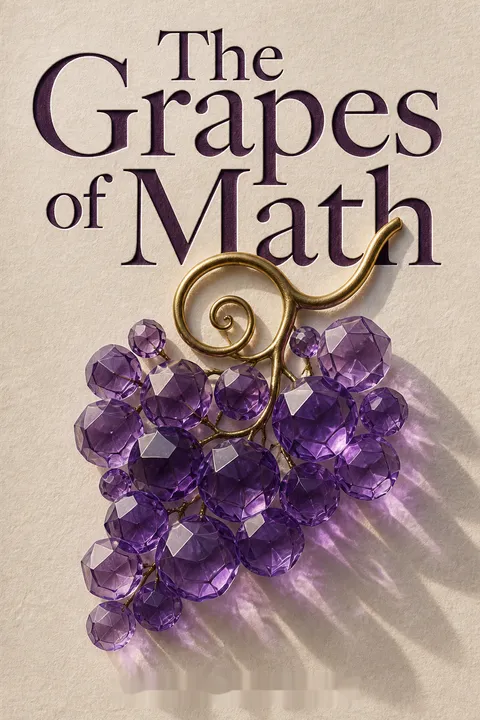
The Grapes of Math receives mostly positive reviews for its engaging and accessible approach to mathematics. Readers praise Bellos's ability to explain complex concepts in an entertaining way, covering topics from number theory to calculus. Many appreciate the historical context and real-world applications provided. Some find certain sections challenging, but overall the book is commended for making math fun and interesting. Reviewers note it's a great read for both math enthusiasts and those looking to expand their mathematical understanding.
People Also Read

Glossary
Benford's law
Leading-digit distributionA statistical pattern found in many datasets spanning several orders of magnitude. The leading digit is 1 about 30.1 percent of the time, with progressively lower frequencies for larger digits, down to about 4.6 percent for 9. It can help identify data that deserves scrutiny, but deviations do not by themselves prove manipulation.
Zipf's law
Rank predicts frequencyA power-law pattern in which an item's frequency tends to decrease as its rank rises. In texts, the most common words appear far more often than the next-ranked words, and the drop-off continues into a long tail of rare words. Similar rank-frequency patterns have been observed in city populations and other human systems.
Power law
A long-tail relationshipA relationship in which one quantity varies as a power of another, either directly or inversely. Power laws can produce distributions with many small cases and a few extremely large ones. When plotted on logarithmic scales, an ideal power-law relationship forms a straight line, whose slope indicates the exponent.
Triangulation
Distance from measured anglesA method for calculating distances by building a network of triangles. Surveyors measure the angles between visible landmarks and establish one known baseline. Trigonometric relationships then allow them to calculate the remaining lengths, making it possible to map terrain without measuring every distance directly.
Conic sections
Curves sliced from conesThe circle, ellipse, parabola, and hyperbola, formed by intersecting a cone with a plane at different angles. Greek mathematicians studied their properties, and later scientists found them in planetary orbits, projectile paths, and optical devices. Their equations and geometries connect abstract curves to physical behavior.
Fourier series
Waves built from sinusoidsA representation of a periodic wave as a sum of sinusoidal waves with different frequencies, amplitudes, and phases. The component waves can combine to approximate signals that look nothing like a sine wave, including square-edged patterns and musical sounds. The representation supports analysis and processing of sound and other periodic phenomena.
exponential constant
Constant of continuous growthThe number e, approximately 2.71828, which arises naturally in continuous exponential growth and decay. Its defining feature is that the curve y = e to the power x has a gradient equal to its height at every point. The constant also appears in compound interest, probability, and the geometry of the catenary.
complex plane
Map of complex numbersA coordinate plane whose horizontal axis represents real numbers and whose vertical axis represents imaginary numbers. A complex number a + bi corresponds to the point with coordinates (a, b). This picture makes addition a translation and shows multiplication by i as a quarter-turn, helping explain the use of complex numbers in describing rotations.
calculus
Mathematics of continuous changeThe paired methods of differentiation and integration. Differentiation calculates rates of change, such as a curve's gradient or an object's instantaneous speed. Integration calculates accumulation, such as the area under a curve. The Fundamental Theorem of Calculus links the two operations as inverses, making calculus central to modeling changing systems.
proof by induction
Prove each step followsA proof technique for an infinite sequence of statements. First, prove the initial statement. Then prove that whenever one statement in the sequence is true, the next one must also be true. Together, these steps establish every statement in the sequence, much like a first falling domino topples all the dominoes arranged after it.
cellular automaton
Local rules update cellsA discrete mathematical model made of cells, each of which changes state according to fixed rules based on neighboring cells. Repeated updates can generate large-scale patterns and complex behavior from simple local interactions. Cellular automata are used as mathematical experiments and models, including in Conway's Game of Life.
FAQ
1. What is The Grapes of Math by Alex Bellos about?
- Exploration of math in life: The book explores how mathematical concepts are deeply woven into everyday experiences, from natural phenomena to human behavior, making math accessible and engaging.
- Wide range of topics: Bellos covers a broad spectrum, including prime numbers, trigonometry, calculus, fractals, and cellular automata, connecting abstract ideas to real-world applications.
- Math as story and play: The author presents mathematics as both a playful game and a rigorous language, using stories, history, and puzzles to reveal the beauty and surprise in logical thought.
2. Why should I read The Grapes of Math by Alex Bellos?
- Accessible to all readers: The book assumes no prior mathematical knowledge, introducing concepts progressively and making them understandable for general audiences.
- Engaging storytelling: Bellos uses anecdotes, historical context, and interviews with mathematicians and mental calculators to make math relatable and entertaining.
- Broader perspective on math: Readers are encouraged to appreciate the patterns, surprises, and cultural meanings behind numbers, enhancing both understanding and enjoyment of the world.
3. What are the key takeaways from The Grapes of Math by Alex Bellos?
- Numbers have personalities: Numbers evoke feelings and cultural associations, influencing behavior and preferences in subtle ways.
- Cultural and psychological impact: The book explores how beliefs about numbers vary globally and how psychological studies reveal our processing of numbers.
- Math shapes perception: Bellos shows that mathematics is not just abstract but reflects and shapes our understanding of the world, from consumer choices to scientific discovery.
4. What are the best quotes from The Grapes of Math by Alex Bellos and what do they mean?
- "Mathematics is the science of patterns." This quote encapsulates the book’s central theme that math is about discovering and understanding patterns in nature, society, and thought.
- "Proofs are like jokes: they have a setup and a punch line." Bellos uses this analogy to highlight the joy and surprise in mathematical reasoning, where the "aha!" moment brings satisfaction.
- "Numbers are not just symbols, but characters with stories." This reflects the book’s exploration of the cultural and emotional significance of numbers in human life.
5. How does Alex Bellos in The Grapes of Math explain our emotional and cultural relationship with numbers?
- Numbers as characters: Bellos discusses how people develop personal attachments to favorite numbers and how numbers are seen as lucky, masculine, feminine, or calm.
- Cultural differences: The book examines global variations, such as the avoidance of 4 in East Asia and the preference for odd numbers in Japan.
- Numbers influence behavior: Studies cited show how numbers affect consumer choices, pricing, and even judicial decisions, demonstrating their subtle power in society.
6. What is Benford’s Law and how does The Grapes of Math by Alex Bellos explain it?
- Definition and discovery: Benford’s Law states that in many real-world data sets, smaller digits appear as the leading digit more frequently, with 1 appearing about 30% of the time.
- Historical context: The law was first noticed by Simon Newcomb and later formalized by Frank Benford, who found it held across diverse data sets.
- Mathematical explanation and use: The law is scale-invariant and arises from multiplicative growth; it is used in forensic accounting and fraud detection due to its predictive power.
7. What are power laws, Zipf’s Law, and Pareto’s Law as described in The Grapes of Math by Alex Bellos?
- Power laws overview: Power laws describe relationships where one quantity varies as a power of another, leading to "long tail" distributions with a few common or large items and many rare or small ones.
- Zipf’s Law: This law shows that word frequencies and city populations are inversely proportional to their rank, with the most common being vastly more frequent than the rest.
- Pareto’s Law: Also known as the 80/20 rule, it describes how a small percentage of people hold most of the wealth, illustrating the prevalence of power laws in social and natural systems.
8. How does The Grapes of Math by Alex Bellos explain the importance of triangles and trigonometry?
- Historical significance: Triangles were central to ancient Greek mathematics, enabling measurements of inaccessible heights and distances.
- Trigonometric ratios: The book explains sine, cosine, and tangent as essential tools for navigation, astronomy, and modern GPS technology.
- Triangulation and mapping: Bellos details how triangulation revolutionized cartography and was crucial in major surveys, such as the measurement of Mount Everest.
9. What are conic sections and why are they important according to The Grapes of Math by Alex Bellos?
- Definition and types: Conic sections are curves—circles, ellipses, parabolas, and hyperbolas—formed by slicing a cone at different angles.
- Applications in science and technology: Ellipses describe planetary orbits, parabolas are used in satellite dishes and headlights, and hyperbolas appear in physics and engineering.
- Historical development: The study of conics by Apollonius laid the groundwork for Kepler’s laws and Newtonian physics, linking geometry to celestial mechanics.
10. How does Alex Bellos in The Grapes of Math explain the circle constant tau (τ) and critique pi (π)?
- Critique of pi: Bellos presents arguments that pi, relating circumference to diameter, is less fundamental than tau, which relates circumference to radius.
- Introduction of tau (τ): Tau is defined as τ = 2π, and its use simplifies many mathematical formulas involving circles and rotations.
- Cultural and mathematical significance: Advocates like Michael Hartl promote tau for its clarity, and Bellos discusses its potential to better reflect the essence of circular geometry.
11. How does The Grapes of Math by Alex Bellos explain imaginary numbers, Euler’s identity, and the complex plane?
- Imaginary numbers introduction: Bellos traces the history and necessity of imaginary numbers, introducing the symbol i as the square root of -1.
- Euler’s identity: The book highlights Euler’s identity, eiπ + 1 = 0, as a unifying equation connecting five fundamental constants and demonstrating mathematical beauty.
- Complex plane visualization: Bellos explains how the complex plane allows geometric interpretation of complex numbers, with multiplication by i corresponding to a 90-degree rotation, aiding understanding in physics and engineering.
12. What is the Mandelbrot set and how does The Grapes of Math by Alex Bellos describe fractals and their significance?
- Definition and discovery: The Mandelbrot set is a fractal defined by iterating z → z² + c on the complex plane, with an infinitely complex boundary and self-similarity at every scale.
- Mathematical and cultural impact: The set challenged the idea that complexity decreases with scale, inspiring art, computer graphics, and a renewed connection between pure math and natural sciences.
- Extensions and 3D fractals: Bellos discusses the creation of 3D fractals like the Mandelbulb, illustrating how simple rules can generate astonishing complexity and ongoing mathematical exploration.
About the Author
Download PDF
Download EPUB
.epub digital book format is ideal for reading ebooks on phones, tablets, and e-readers.








