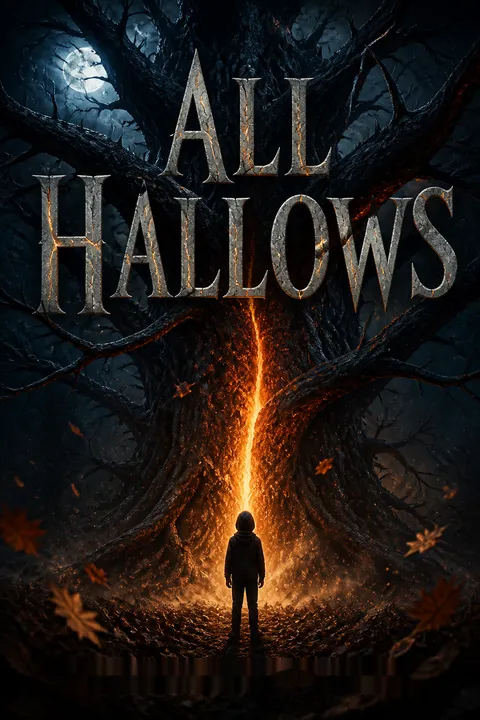


Plot Summary
The Last Haunted Woods
On October 31, 1984, Tony Barbosa1 and his seventeen-year-old daughter Chloe3 assemble their backyard Haunted Woods for its final Halloween. Tony1 has found a new job, but the family's finances have already forced them to sell their home. As they work, a little girl in an old Raggedy Ann costume16 slips between the trees and disappears.
She leaves behind a worn doll, which Tony1 and Chloe3 plan to return if she comes back. Their attraction, built from years of shared scares and charity nights, gives father and daughter a pocket of happiness while the rest of the family strains. Tony1 does not yet understand that the lost child16 belongs to a danger far more serious than any prop in his woods.
The Haunted Woods gives the opening its double meaning: it is both a lovingly made performance and a fragile family inheritance. Tony and Chloe can still create a controlled kind of fear, one with timed surprises, volunteers, and an exit. Their financial collapse has already stripped away the home that anchors the tradition, so this last setup is a form of mourning disguised as preparation. The abandoned doll interrupts that ritual with an unplanned child, placing genuine vulnerability inside a space designed to imitate it. The story begins by making the line between staged terror and real danger almost invisible.
Teenagers Between Worlds
Vanessa Montez,5 a punk-loving senior with a new driver's license, spends the afternoon with her lifelong best friend, Steve Koenig.6 Their teasing hides a dependable intimacy: Vanessa5 has told Steve6 she is gay, but has not told her parents, while Steve6 once hoped their closeness might become romance.
They admit to sharing a crush on Julia Sweeney,9 the red-haired daughter of the neighbors. On the street, thirteen-year-old Rick Barbosa4 heads out with his friend Billie Suarez,12 eager to make this possibly final year of trick-or-treating count.
The Sweeney children9 prepare for their own neighborhood rounds as their parents' marriage quietly frays. A silent scarecrow-costumed boy14 trails Rick's4 group, and Vanessa5 later notices the same unsettling newcomer near the Haunted Woods.
The adolescents are poised between childhood rituals and adult choices, but they do not cross that threshold at the same pace. Rick still measures the night by candy and familiar routes, while Vanessa and Steve use irony to manage the pressure of leaving school, home, and one another. Their shared attraction to Julia briefly makes friendship feel spacious rather than competitive. Yet the scarecrow's unexplained presence unsettles the ordinary social map. The chapter's emotional groundwork matters because the supernatural threat will exploit precisely what these young people lack: reliable adult protection, confidence in their own perceptions, and a clear route into adulthood.
Barb's Breaking Point
Barb Sweeney7 returns from errands to find the garage still dismantled and her husband Donnie8 gone, despite his promise to finish the work. She searches local bars, where she learns he has a familiar drinking routine and a reputation for pursuing women. When Donnie8 finally comes home drunk, Barb7 demands that he stop drinking and betraying their marriage.
Their argument turns physical, their children watching as he strikes her and leaves. Their youngest, eleven-year-old Charlie,10 runs to a hidden refuge in the bushes. There he meets Sarah Jane,15 a frightened girl in clown makeup who says a figure called the Cunning Man25 is hunting her. Charlie's10 older brother Brian11 finds him and brings him home, but Sarah Jane's15 warning follows them.
Barb's confrontation converts a long private pattern into a public rupture. Donnie's charm has allowed him to treat consequences as temporary inconveniences, while Barb's patience has made endurance look like consent. Once she draws a boundary, he leaves rather than renegotiate the terms of family life. Charlie experiences this not as an adult dispute but as a child's sudden loss of safety; his meeting with Sarah Jane gives that emotional abandonment a supernatural echo. Brian's effort to retrieve his brother marks him as a caretaker without making him a substitute parent. The family crisis and the haunting now occupy the same night.
The Basement Behind Rumors
While trick-or-treating, Rick Barbosa4 and Billie Suarez12 see Zack Burgess17 usher a frightened, injured boy into his house. The neighborhood has long spread stories about Zack17 and his wife Ruth,18 but the children go to the basement window to learn whether this boy is actually in danger.
They hear Zack17 and Ruth18 treat him gently, until the boy asks about other children hidden in the house. Rick4 realizes the adults are lying. Billie12 pounds on the front door to draw Zack17 upstairs while Rick4 breaks into the basement and pulls the boy, who calls himself Leonard,13 away from Ruth.18
The children escape into the woods. Zack17 pursues them, but a pair of floating flames appears behind him, and his screams stop. Ruth18 later finds his ruined body and sees the same unnatural presence.25
The Burgesses' house exposes the moral danger of treating rumor as either proof or harmless gossip. Rick and Billie have heard lurid stories about their neighbors, but the decisive evidence is not the neighborhood's suspicion. It is Leonard's distress, the adults' sudden evasions, and the locked space behind the ordinary basement room. Rick and Billie act on observation rather than certainty, a form of judgment that is both courageous and dangerous. The Cunning Man's arrival makes the supernatural threat visible, but it does not erase the human crime that brought the children to the house. The horror has more than one source.
Leonard's Stolen Years
Rick4 and Billie12 hide with Leonard,13 who finally says he was taken from Iowa in 1961 and held in a dead world called Dubnos. He believes Halloween's brief opening between worlds can let him escape for good by midnight. Before they can get help, he attacks Billie12 when she tries to call the police, then changes into a rotting, inhuman creature.
Rick4 and Billie12 flee, but Leonard13 catches Rick,4 tears out his heart, and whispers over it. Rick's4 body rises again, transformed into something rotten and no longer fully himself. Billie12 escapes alone and runs toward the Barbosa home.1 The rescue has become another trap: the boy13 they risked themselves to save was also part of the danger stalking Parmenter Road.
Leonard's history turns the familiar Halloween idea of a temporary disguise into an account of stolen time and arrested development. He has been a child for decades, but innocence is not the same as harmlessness. His violence shatters the rescuers' assumption that victimhood guarantees moral safety, while his plea for help had been sincere enough to make their choice understandable. Rick's death is the brutal consequence of that uncertainty, and Billie's escape leaves her carrying knowledge no child should have to bear. The transformation also makes the body itself unreliable: the person they recognize can remain visible even when his agency and life have been taken.
The Affair in the Woods
Elsewhere on Parmenter Road, Donnie enters the Haunted Woods and finds Tony Barbosa with Alice, along with their neighbors Kev and Catherine Sullivan. Drunk and intent on hurting everyone, he boasts that he has slept with both Alice and Catherine. Kev punches Donnie and beats him while the others watch. Julia, arriving through the attraction with friends, sees her father bleeding and strikes him herself before fleeing.
Tony sends Donnie away, then faces Alice's shame and the damage to their marriage. Chloe pursues Julia to comfort her, while the Haunted Woods' carefully staged scares continue around the wreckage of the adults' real lives. Donnie's confession makes the neighborhood's polite surfaces impossible to restore.
Donnie weaponizes truth not to repair trust but to spread his humiliation outward. His confession makes Alice and Catherine answer for their choices, yet it also reveals his own habit of using other people's pain as an excuse to avoid responsibility. Julia's punch is not a simple rejection of her father; it is a child's attempt to reclaim power in a relationship where adults have repeatedly controlled the terms. Tony, meanwhile, must absorb a betrayal while managing a public spectacle on the night he hoped to preserve as a family memory. The attraction's artificial scares become background noise to consequences no one can switch off.
A Party Turns Cruel
At the Koenigs' Halloween party,21 Vanessa5 and Julia9 draw closer after Julia9 leaves the Haunted Woods. Mr. Koenig21 makes a crude sexual insinuation toward Vanessa,5 then later insults her and Julia9 when he sees them together. Vanessa's5 father, Johnny,19 strikes him and carries his family home. Vanessa5 realizes Steve6 must have told his parents she was gay, the one confidence she had shared with him.
Hurt and furious, she runs into the woods. Julia9 follows, and the two kiss, turning their long-hidden attraction into something chosen rather than guessed. Arthur,14 the scarecrow-costumed newcomer,14 finds them there and begs for help until midnight, claiming the Cunning Man25 will come for him. Despite their doubts, they agree to stay with him.
Vanessa's exposure shows how disclosure can be taken from someone and converted into social leverage. Mr. Koenig's insult is especially damaging because it joins homophobia to the neighborhood's judgment of Julia's father, as if a daughter's sexuality were another stain inherited from a parent. Johnny's intervention gives Vanessa visible familial love, but it cannot repair Steve's breach of trust. Julia's kiss offers a different kind of disclosure, one made freely and met with reciprocity. Arthur's plea then tests the girls' newly found solidarity: they choose to help a frightened stranger even while their own security has been shaken.
The Child at Midnight
Barb7 takes Sarah Jane15 into the Sweeney home after Charlie10 says the girl is fleeing the Cunning Man.25 She offers food and a place to wait, but Sarah Jane15 knocks Barb7 down when she tries to contact a social worker. Later, the child drags Charlie10 toward the back door. Donnie8 has returned, but something has taken possession of his body: the Cunning Man has made him its vessel.
It stops Sarah Jane,15 frees Charlie,10 and destroys the witch-spawn inside her. At the Barbosa home,1 Delilah,16 the Raggedy Ann girl,16 has also gained the family's trust. She attacks Chloe3 and drags her into the woods. Tony,1 Alice,2 and Billie12 follow, as the transformed Donnie warns them that they have until midnight to reach the Blackthorn.
The two lost girls initially invite the adults' most humane response: shelter a child before demanding explanations. That response becomes perilous because Sarah Jane and Delilah can imitate the vulnerability that ordinarily calls for care. Barb's instinct is not foolish; it is ethically serious, even though it leaves her exposed. The Cunning Man's use of Donnie's body complicates rescue further, forcing the family to accept help from a creature wearing the face of the man who has harmed them. Trust is no longer a stable virtue or flaw. It becomes a decision made under pressure, with children paying the price for every mistaken reading.
Rick Comes Back Wrong
Following Billie12 back to the woods, Tony1 and Alice2 learn that Rick4 has died and returned as a rotting creature under Leonard's13 influence. They find him fighting Delilah16 while she drags Chloe3 along the trail. The Cunning Man25 intervenes, allowing Chloe3 to escape, but Rick4 attacks his family when they try to hold him.
Tony1 and Alice2 bind their son with a belt, while Billie12 and Chloe3 help keep him down. The Cunning Man25 urges them to destroy Rick4 before the corruption spreads. Instead, the parents stay with their child, even as Tony1 learns that other children may still be in danger. He leaves Alice,2 Chloe,3 and Billie12 to guard Rick4 and follows the Cunning Man25 deeper into the woods.
The parents' response to Rick forces the novel's hardest distinction between love and recognition. His body is present and his voice can still appeal to them, but the person they raised is being used as a weapon. Refusing to destroy him is not sentimental denial; it is a refusal to let the monster dictate what counts as his son. At the same time, Tony cannot remain beside his family without abandoning other endangered children. Alice's willingness to hold Rick while Tony goes shows care divided between immediate grief and responsibility beyond the family. No choice restores what has already been lost.
The Blackthorn's Bargain
Arthur14 leads Vanessa5 and Julia9 to an ancient blackthorn tree with a split in its trunk. He cuts his palm and uses a small fire to show them a vision of the Cunning Man25 taking him as a child. The proof persuades Vanessa,5 but Julia9 notices Arthur's14 story shifts whenever she questions him. When the girls try to leave, Arthur14 attacks them and reveals the rotting creature beneath his scarecrow disguise.
Steve6 has followed the trail to apologize to Vanessa.5 He tackles Arthur14 and saves Julia9 from being strangled, but a second witch-spawn, Leonard,13 emerges from the trees. The blackthorn opens into a storm-lashed world, and the creatures demand a human offering before midnight. Steve6 is killed as the girls are seized.
Arthur's blood ritual gives the girls evidence, but evidence does not automatically produce trustworthy interpretation. Julia's suspicion develops from small inconsistencies rather than supernatural expertise, while Vanessa is drawn toward the possibility that the impossible might be true. The scene therefore separates belief from discernment: the vision may be genuine, yet Arthur's purpose remains concealed. Steve's arrival is an attempted act of repair, but his remorse cannot undo the betrayal that drove Vanessa away. His death makes the cost of delayed reconciliation concrete, while the opening tree transforms their earlier threshold between adolescence and adulthood into a literal passage between worlds.
Midnight's Final Hunt
The Cunning Man25 reaches the blackthorn clearing as Leonard13 and Delilah16 try to take Vanessa5 and Julia9 through. Leonard13 chooses to flee into Dubnos rather than risk facing his pursuer; Delilah16 attacks the Cunning Man25 instead. Tony1 arrives with a shovel from the Haunted Woods and kills Delilah16 with a single blow, then carries the injured Vanessa5 from the clearing while Julia9 follows.
The Cunning Man25 defeats the remaining threat and enters the blackthorn passage, taking Donnie's occupied body with him. As the portal closes, Rick's4 corruption fades, but his life does not return. Alice,2 Chloe,3 and Billie12 remain beside his body. The night's supernatural assault ends, leaving the families with deaths that no explanation can make ordinary.
The climax refuses the comforting equation of victory with restoration. Tony can save Vanessa and help end the immediate threat, but he cannot recover Rick or Steve, and Donnie's final role does not erase the harm he caused while alive. Leonard's retreat is a choice shaped by fear, not a conversion into goodness; Delilah's destruction likewise comes through desperate action rather than a clean moral system. The closing portal releases Rick from the witch-spawn's corruption only in the limited sense that his body becomes his own again. The living must carry both relief and irreversible grief.
November Leaves the Street
After dawn, the police investigate the murders and accept a version of events that leaves out the supernatural. Barb,7 concussed and exhausted, cannot make officials believe Sarah Jane15 attacked her or explain what happened to Donnie.8 Vanessa5 refuses to tell Detective Cardiff the impossible truth, then receives Julia9 at the hospital; both girls remember the night clearly.
Tony1 and Alice2 put the Barbosa house up for sale and plan to move, though they remain together for now so they can help Chloe3 survive the loss of Rick.4 Tony1 and Chloe3 leave the ruined Haunted Woods behind. In the final image, the old Raggedy Ann doll lies among wet leaves near the path, a small reminder that Halloween's danger may not be finished.
The aftermath divides truth from what can be publicly established. The police need a coherent account, but the survivors have witnessed events that ordinary investigation cannot contain, so silence becomes both self-protection and a new burden. Vanessa's memory remains intact even as she withholds it, while Barb's injury gives officials an excuse to discount her account. The Barbosas' move is not a neat cure for grief; it is a practical attempt to live somewhere the woods and the neighborhood cannot continually reactivate the night. The abandoned doll refuses closure, preserving the story's uncertainty without undoing its human losses.
Analysis
All Hallows places its supernatural horror inside the ordinary pressures of one Massachusetts neighborhood: layoffs, alcoholism, infidelity, racism, adolescent secrecy, and the fear of growing up without protection. The paranormal danger does not replace these problems. It makes their consequences harder to evade. Children are endangered by monsters in the woods, but they are also exposed to adult selfishness, careless gossip, and failures of attention. The novel's most capable rescuers are teenagers who act before they possess enough power or knowledge to feel safe.
Halloween gives the story a precise structure. Masks make identities visible and concealable at once; the attraction's monsters are intentionally false, while the frightening figures beyond its paths exploit the same costumes and expectations. The night also creates a threshold in time. Children can be taken from one world and, for a brief interval, attempt to return. This supernatural liminality reflects the human characters' own unstable positions: Rick4 is no longer comfortable as a child but cannot control his family's future; Vanessa5 is deciding whom to trust with her identity; Julia9 is trying to separate love from the patterns her parents have taught her.
The novel is unsparing about love's limits. Tony's1 devotion to his family cannot keep the house, marriage, or son intact. Barb's7 protective instincts do not guarantee that she can interpret every danger correctly. Steve's6 affection for Vanessa5 does not excuse his betrayal, and Donnie's8 love for his children cannot undo the years of harm he caused. Yet these failures do not make care meaningless. People still choose to protect one another, to believe a frightened child, to stay beside a friend, or to carry an injured stranger toward help.
The ending refuses a clean restoration. The surviving families must live with grief, and the police convert an impossible night into a comprehensible but incomplete account. The haunted woods become a place to leave, not a mystery neatly solved. What remains is the difficult distinction between saving someone and undoing what happened to them.
Review Summary
All Hallows received mixed reviews, with ratings ranging from 1 to 5 stars. Many readers appreciated the nostalgic 1980s Halloween atmosphere and well-developed characters. However, some found the pacing slow and the multiple POVs confusing. The book was praised for its creepy elements and unexpected plot twists, but criticized for not being scary enough. Some readers felt the domestic drama overshadowed the horror elements. Overall, it was considered a good entry-level horror novel with strong character development and atmosphere.
People Also Read




Characters
Tony Barbosa
The Halloween makerTony is a devoted father and a craftsman of communal fear, happiest when building the Haunted Woods with Chloe3. His memories of his late father shape the way he tries to give his children traditions and time, though he is not always sure he is doing it fairly. Financial trouble and strain in his marriage have left him grieving a home he cannot preserve. Tony's love is practical: he repairs props, keeps promises where he can, and steps toward danger when someone needs protection. His story asks how a person keeps caring after disappointment has exhausted his pride.
Alice Barbosa
The restless motherAlice loves her family but is troubled by the feeling that domestic life has narrowed her choices. Her imagination wanders, and she is drawn to attention that makes her feel newly visible, even when she understands the damage that impulse can cause. She is more practical than Tony1 about the Haunted Woods and less able to share his delight in horror, yet she helps sustain the family tradition. Alice's central tension is between wanting a stable home and fearing that stability means being trapped. Her maternal instincts remain strong even when shame makes it difficult for her to face those she has hurt.
Chloe Barbosa
Tony's Halloween partnerChloe is Tony's1 seventeen-year-old daughter, a confident and capable teenager who has helped build the Haunted Woods since childhood. Their shared tradition gives her a bond with her father that she does not have with her brother Rick4. She is observant about her parents' financial and emotional trouble, often reading what they do not say. Chloe is loyal to friends and quick to act when someone is in danger, but her independence does not make her immune to family upheaval. She is learning that adulthood may arrive not as freedom but as the obligation to choose who needs her first.
Rick Barbosa
The reluctant young heroRick is thirteen, a horror-film enthusiast who still wants the familiar pleasures of Halloween and the comfort of neighborhood routines. He is close to Billie12, even as their friendship begins to carry new, uncertain feelings. Rick dislikes being treated as younger than he is, but he has a strong instinct to protect children who seem more vulnerable than himself. The impending sale of his home gives ordinary childhood rituals an added weight. Rick's bravery is impulsive rather than polished: he acts before he fully understands the danger, and his loyalty often outruns his self-preservation.
Vanessa Montez
The sharp-edged outsiderVanessa is a perceptive, irreverent teenager who uses punk style and humor to mark distance from a world that often objectifies or misunderstands her. She loves her parents but worries that honesty about her sexuality could alter the safety of their relationship. Steve6 is her oldest and most trusted friend, while her attraction to Julia9 opens the possibility of being seen differently. Vanessa's sharpness is both armor and play; she enjoys unsettling people, but she is deeply loyal when someone is in need. Her challenge is not simply to reject judgment, but to decide whose trust she can risk.
Steve Koenig
Vanessa's lifelong friendSteve is a warm, thoughtful teenager whose closeness with Vanessa5 has lasted since childhood. He is shy around romance and once hoped their friendship might become something else, but he accepts that Vanessa5 loves him in a different way. His humor and easy companionship give Vanessa5 a place to rest from the social world she distrusts. Steve wants to grow up without inheriting the hypocrisies he sees in adults, though he does not always recognize the full meaning of his father's behavior. His affection is sincere, but sincerity alone does not prevent him from making a damaging mistake.
Barb Sweeney
The family's battered anchorBarb is the mother of Julia9, Brian11, and Charlie10, and she has spent years trying to preserve a workable family life alongside an unreliable husband. She is not naturally composed, but she has learned to hide frustration until it breaks through in a rush. Her loyalty to her children competes with the hope that Donnie8 might become the husband he once promised to be. Barb's strength is not invulnerability: she can misjudge, lose control, and still make a fresh decision about what her children need. When faced with a frightened child, she responds first with shelter and food, guided by the mother she wants to be.
Donnie Sweeney
The charming drinkerDonnie is a Massachusetts lawyer whose ease with people has long helped him evade consequences. He is affectionate and entertaining with his children, yet his need for admiration and his drinking repeatedly pull him away from family obligations. Donnie learned early to treat charm as his defining gift, and over time he has used it as both a social tool and an excuse. He can recognize the harm in his behavior without consistently changing it. His role complicates the idea that a person is either loving or selfish: Donnie can be both, and the people around him bear the cost of that contradiction.
Julia Sweeney
The daughter who choosesJulia is Barb7 and Donnie's8 eighteen-year-old daughter, a red-haired young woman who has survived a turbulent adolescence and hopes to attend community college. She loves her family but has grown tired of managing the emotional consequences of her parents' conflict. Julia is perceptive about men who mistake persistence for entitlement, and cautious about trusting friends who minimize her concerns. Her attraction to Vanessa5 has remained private, partly because she has not wanted to expose either of them to gossip. Julia's courage tends to surface when someone else is threatened, even when she is frightened herself.
Charlie Sweeney
The youngest SweeneyCharlie is eleven, affectionate toward his father and close to his older brother Brian11. He is sensitive to the tension in his parents' marriage, though he cannot explain why adults who love one another keep causing each other pain. His imagination and his fascination with old horror movies give him ways to process fear. Charlie wants to be treated as capable, but he still needs the reassurance of family. His compassion for a frightened child is immediate, even when he himself feels abandoned.
Brian Sweeney
The protective older brotherBrian is the thirteen-year-old middle child, reliable enough to look after Charlie10 even while he is still a boy himself. He and Charlie10 bicker, but Brian instinctively protects him when other people cross a line. Family upheaval draws him into a more responsible role, one he approaches with humor when he can. Brian does not claim to replace his father; he offers the kind of support a brother can actually give, which makes his presence important to Charlie10.
Billie Suarez
Rick's steadfast friendBillie, whose given name is Guillerma, is Rick's4 closest friend and a Cuban American teenager who loves comic books and dresses as Storm for Halloween. She is direct, stubborn, and unwilling to let other people define her dignity, especially when neighbors treat her differently because she is Black. Billie shares Rick's4 sense of humor and childhood history, but she is also quick to notice when he is frightened or overwhelmed. Her loyalty is active rather than sentimental: she stays beside him, challenges him, and makes difficult choices even when she fears the consequences.
Leonard Blanchet
The lost trick-or-treaterLeonard appears to Rick4 and Billie12 as a small, injured boy with no clear adult looking after him. He is quiet, frightened, and strangely focused on the presence of other children. His insistence on being called Leonard rather than by a nickname makes him seem unusually formal for his age. He asks the teenagers to protect him but remains unwilling to trust the police, leaving them uncertain about what happened before they found him. His story joins the innocence of Halloween childhood to the fear of being lost beyond anyone's reach.
Arthur Griggs
The scarecrow newcomerArthur is a lanky, new boy in the neighborhood who wears a handmade scarecrow costume and keeps glancing behind him as if expecting someone to follow. He describes his family as old-fashioned and speaks with an unusually formal manner. His interest in Vanessa's5 reference to H. G. Wells offers a brief glimpse of an intellectually curious teenager beneath the costume. Arthur's visible anxiety draws sympathy, though his reserve makes it difficult for others to know what he truly wants.
Sarah Jane
The frightened clown girlSarah Jane is a young girl in worn clown makeup whom Charlie10 encounters while hiding after his father's departure. She seems frightened and asks him to help her stay hidden from the Cunning Man25. Her language carries a sadness that feels older than her small frame, and her fear quickly redirects Charlie's10 attention from his own family crisis. Sarah Jane's appearance ties the neighborhood's ordinary Halloween to a threat that the children cannot yet understand.
Delilah
The lost Raggedy AnnDelilah is the little girl in the faded Raggedy Ann costume who appears near the Haunted Woods. She carries an old doll and presents herself as a child in need of help, vulnerable enough to awaken the protective instincts of both adults and teenagers. Her arrival is difficult to separate from the neighborhood's Halloween festivities, and the people who meet her struggle to decide how best to keep her safe. The contrast between her old-fashioned costume and the modern street gives her an uncanny presence.
Zack Burgess
The feared neighborZack lives with Ruth18 on Parmenter Road and has become the focus of disturbing neighborhood stories. He is accustomed to being treated as an outsider, and his friendliness toward some teenagers can seem at odds with the rumors surrounding him. Zack's house contains a carefully divided basement, one side arranged for ordinary domestic life and another kept private. He and Ruth18 share a close, complicated partnership that shapes how they respond when their private world is threatened.
Ruth Burgess
Zack's guarded partnerRuth is Zack's17 wife and partner in the isolated life they have built on Parmenter Road. She can perform warmth when children or neighbors are present, but beneath that composure lies a volatile, watchful personality. Ruth's history has left her with deep shame and a need to control what others can discover. She sees herself as more strategic than Zack17 and is alert to the danger of being exposed. Her relationship with him combines shared secrets, resentment, and dependence.
Johnny Montez
Vanessa's protective fatherJohnny is Vanessa's5 Dominican father, a warm and generally sociable man who has worked hard to give his daughter a secure home. He remembers childhood poverty and racial hostility, experiences that sharpen his awareness of prejudice even when he prefers to avoid conflict. Johnny's affection for Vanessa5 is unmistakable, though her wish to be seen as strange and independent sometimes differs from his desire for her to be accepted. He and his wife20 make a stable center in Vanessa's5 life.
Lucy Montez
Vanessa's loving motherLucy is Vanessa's5 Vietnamese mother, affectionate and attentive, with a gentleness that makes her reluctant to hurt people she loves. She knows her daughter is different from the image other parents might prefer, even if she does not always understand why Vanessa5 wants to stand apart. Lucy's instinct is to offer reassurance and keep family life harmonious. Her loving nature creates safety for Vanessa5, but it can also leave important truths unspoken between them.
Mr. Koenig
Steve's domineering fatherSteve's6 father is a successful, status-conscious host whose Halloween party draws much of the neighborhood. He enjoys being the center of adult conversation and assumes that his authority in his home extends to the young people around him. His manners can disguise a judgmental streak, especially toward anyone who challenges his ideas of respectability. For Steve6, his father is both a provider and a model of adulthood he hopes not to imitate.
Kev and Catherine Sullivan
A strained neighborhood marriageKev and Catherine are neighbors whose marriage has seemed troubled to the people around them. During Halloween, they attend the Haunted Woods and briefly appear at ease together. Catherine is connected to Tony1 and Alice's2 circle, while Kev is protective when Donnie's8 behavior turns openly aggressive. Their presence brings the private consequences of infidelity into the same public space where the neighborhood gathers to celebrate.
Owen O'Leary
The reckless older teenOwen is an older neighborhood teenager who smokes, drinks, and needles Vanessa5 and Steve6, though he is not simply a bully. He tries to organize his own party within the larger Koenig21 gathering and has moments of unexpected courtesy. His casual confidence reflects the freedoms and risks that the younger teens are beginning to approach.
Cynthia Walukevich
Julia's on-and-off friendCynthia has been Julia's9 intermittent best friend since childhood. She wants to help Julia9 through the crisis at home, but her attempts to steer Julia9 toward her boyfriend can make her support feel manipulative. Cynthia is not without affection; she is simply poor at recognizing when her good intentions have become pressure.
The Cunning Man
The autumn hunterThe Cunning Man is a frightening presence associated with the woods and the children who vanish on Halloween. He appears as a tall, shadowed figure with fire burning where eyes should be, and his pursuit makes adults and children alike feel the limits of their strength. The name is first spoken by frightened children, leaving the neighbors to decide whether they are hearing a child's fantasy or a warning. His relationship to the otherworldly events is initially mysterious, and his arrival changes the meaning of every Halloween costume and wooded path.
Plot Devices
Barbosa's Haunted Woods
Fear made by handTony1 and Chloe's3 annual backyard attraction turns a patch of local forest into a carefully timed sequence of actors, props, fog, lights, and sounds. It establishes their bond and gives the neighborhood a shared Halloween ritual, while its final year mirrors the family's financial crisis. The practical features of the attraction, including curtains, generators, paths, and a gravedigger's shovel, later shape what characters can see and how they move. Its staged monsters also sharpen the contrast between manufactured scares and the genuine danger entering the woods.
The Raggedy Ann Doll
A warning left behindTony1 finds an old Raggedy Ann doll after a costumed girl16 disappears among the trees. He assumes it belongs to a neighbor's child and keeps it in hopes of returning it. Its costume and presence recur as the night grows more dangerous, connecting a lost object to the repeated appearances of a child16 who asks adults for help. The doll's worn, familiar design makes it easy to mistake a genuine warning for harmless Halloween decoration.
The Blackthorn
A door between worldsA massive, ancient blackthorn tree stands in a clearing the teenagers do not know. At midnight its trunk opens into Dubnos, a dead, storm-struck realm connected to the witch Carmun and the children who serve her. The opening has strict timing, so the characters must reach the tree before the crossing closes. The tree gives the novel's supernatural conflict a physical destination and makes the passing of Halloween a deadline. It also provides the final route through which the remaining otherworldly threat can depart.
Blood in the Fire
Memory made visibleArthur14 spills his blood into a small fire and uses the smoke and flames to show Vanessa5 and Julia9 an image of his childhood abduction. The vision gives them evidence for an experience too strange to accept from testimony alone. Yet the ritual proves only that the event happened, not that Arthur's14 account of his present intentions is honest. Its function is therefore double: it draws the girls deeper into the mystery while demonstrating that true information can still be used to manipulate trust.
The Cunning Man's Possession
A body shared unwillinglyThe Cunning Man25 takes control of Donnie Sweeney's8 body, leaving Donnie's8 awareness trapped inside while the supernatural hunter pursues the witch-spawn. Donnie's8 remaining attachment to his children affects what the shared body does, even as the Cunning Man's25 purpose drives it forward. The device forces the story's damaged father to become both a threat-shaped figure and a possible means of rescue. It also complicates the reader's judgment of responsibility: the familiar face remains, but the person acting through it is no longer simply Donnie8.
About the Author
Other books by Christopher Golden
Download PDF
Download EPUB
.epub digital book format is ideal for reading ebooks on phones, tablets, and e-readers.








