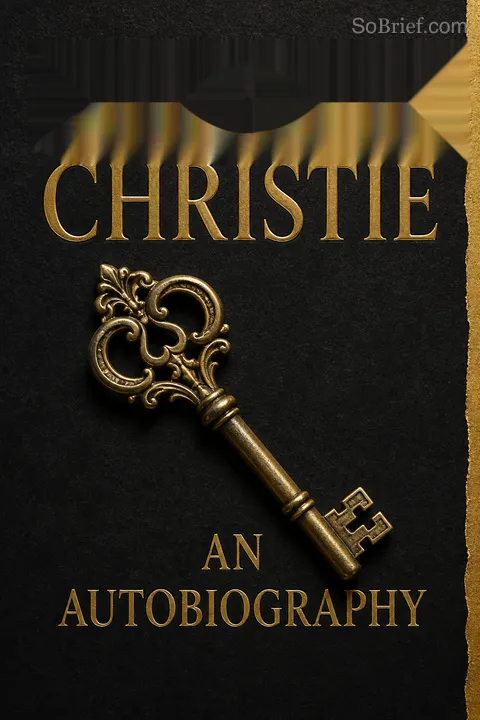


Key Takeaways
Use memory to find what mattered, not to reconstruct everything.
Memory chooses its evidence. Christie begins her autobiography not as a full record, but as a handful of recollections prompted by a smell, a place, or an old song. A tiny red spider on her third birthday, her canary hiding all day on a curtain pole, and the feel of her mother’s hand in a moment of distress matter more than many supposedly important events. She worked on the book for about fifteen years, stopping at seventy-five.
Joy guides the telling. Christie admits that memory leaves blank stretches and that people remember different details from the same journey. Her account moves freely across time, returning to the scenes she wants to keep. The result is less a complete chronology than a portrait assembled from vivid fragments, with ordinary pleasures at its center.
What's striking is that the memoir treats remembering as an act of selection, not a courtroom reconstruction. That gives readers a useful distinction: a life story can be emotionally revealing without being comprehensive. The sensory fragments show what the narrator values, while the gaps mark the limits of what she chooses to tell. This approach invites attention to the pattern formed by memories rather than a search for a perfectly consistent record. It also calls for caution: a joyful emphasis can illuminate a life, but it cannot stand in for every experience or every person's perspective.
Protect a child's time for making worlds out of ordinary things.
Home made room for invention. Christie remembers a secure childhood shaped by affectionate parents, a patient nurse, a garden, and plenty of unstructured time. She turned paths into railway lines, a hoop into a horse or train, and a cupboard into a multi-storey house. Her imaginary companions had names, family histories, adventures, and even a school of their own. A child’s play could occupy her for hours without a toy designed to direct it.
Solitude was not neglect. The adults around her were loving, but they did not arrange constant entertainment. Her mother told stories and invented games; her nurse repeated familiar tales. Together, novelty and repetition gave Christie both security and material for her own inventions. She later connected this childhood habit of self-entertainment with her lifelong ability to escape boredom.
The distinction between being left alone and being left unsupported matters here. Christie’s independence grows inside dependable relationships, not in their absence. Her games also show how imagination works with constraints: a garden, a hoop, or a cupboard becomes more than its intended use because the child supplies the missing world. That is a useful corrective to the assumption that creative play requires elaborate equipment. The memoir’s ideal childhood is also materially privileged, however, with space, servants, and adult attention. Its lesson is not to copy the setting, but to make room for self-directed play wherever possible.
Notice people closely, then invent beyond what observation can prove.
Observation supplied the spark. Christie was a quiet child who often kept information to herself and preferred imagined companions to social performance. She watched people, listened to household stories, and stored small details without always knowing why. As a hospital dispenser during the First World War, she handled medicines and poisons. Those materials helped her imagine a poisoning, a family of suspects, and a Belgian refugee detective who became Hercule Poirot.
Fiction required transformation. Christie learned not to copy real acquaintances directly. A man’s beard or a person’s manner might start an idea, but the character had to become invented. Her first detective novel, The Mysterious Affair at Styles, combined her knowledge of poison with a puzzle about motive, access, and misleading clues. The private act of imagining turned observed fragments into an original plot.
The movement from noticing to invention is more than inspiration; it is a boundary between evidence and interpretation. Christie’s point that a stranger can serve as a starting point, but not a finished character, anticipates a basic discipline of fiction: observation offers particulars, while imagination tests what those particulars might mean. Her pharmacy work also made technical knowledge part of the story’s architecture rather than decorative background. The method has a limit: a vivid clue can tempt a writer to overvalue appearance. Strong characterization depends on giving people motives and contradictions, not merely memorable surfaces.
Treat writing as a craft, not a destiny bestowed at birth.
Talent needed a fit. Christie never describes herself as a child determined to become a famous author. She tried music seriously, but a teacher judged that she lacked the temperament for public performance. Writing suited her better because she could work privately and at her own pace. When her mother urged her to try a story, she discovered that the work could absorb her. Advice from novelist Eden Philpotts helped her see that dialogue was a strength and that explaining too much weakened a story.
Publication taught business. Her first book was accepted after revisions, but the contract bound her to offer the same publisher five more novels on poor terms. She later learned to use an agent and to examine contracts. The change from amateur to professional was not a revelation of destiny; it came through repeated practice, editorial advice, persistence, and a clearer understanding of how books were sold.
What's valuable is the refusal of the born-genius story. Christie’s career emerges from experimentation, an honest reading of her limits, and practical learning about the publishing trade. Her account also separates two questions often confused: whether someone can make work, and whether that work can earn a living. An early contract can purchase access at the cost of leverage, so creative ambition benefits from commercial literacy. At the same time, her path depended on financial security and useful connections. Persistence matters, but opportunity affects which forms of persistence can become a profession.
Judge love by daily companionship as well as dramatic feeling.
Different attachments felt different. Before marrying Archie Christie, Agatha turned down Reggie Lucy, a trusted friend with whom she felt peaceful but not passionately drawn. Archie, a young flying officer, felt like a stranger who made ordinary conversation exciting. They married suddenly during the First World War, despite little money and objections from family. Their early life was often happy, but shared enthusiasm did not guarantee lasting compatibility.
Love does not remove risk. Years later, after her mother died and Agatha was overwhelmed by clearing Ashfield, Archie fell in love with another woman and asked for a divorce. Agatha hoped he would change his mind, but he did not. She also describes her own mistake in idealizing him rather than fully understanding his needs. Her story distinguishes affection, stability, romantic intensity, and the hard work of sustaining a marriage.
The contrast between Reggie and Archie avoids a simple rule that either calm companionship or intense attraction is the right basis for marriage. The memoir instead shows how different kinds of attachment can be mistaken for certainty, especially when a young person has limited experience. Its most sobering observation is that love does not guarantee that two people want the same life. The account is shaped by the gender conventions of its period, including the assumption that a woman’s future centers on marriage. Readers can value its attention to tenderness and respect while recognizing that commitment also requires honest conversation about needs, not just good feeling.
Let useful work test your courage and uncover unexpected talent.
Service became a vocation. During the First World War, Christie volunteered with a Voluntary Aid Detachment, or V.A.D., a wartime medical service staffed by volunteers. She began as a ward-maid, cleaning brass, then learned practical nursing: tending wounds, handling difficult patients, and helping in an overwhelmed hospital. The work frightened her at times, but she found it meaningful and believed she might have trained as a nurse after the war.
A job can feed imagination. Later, in the dispensary, she studied medicines and learned how doctors used different preparations. She saw the danger of mistakes and the value of careful checking. The work was repetitive, but its materials and procedures entered her fiction. A professional setting can train attention, reveal a capacity one did not know one had, and provide concrete knowledge that makes invented stories more convincing.
Christie’s nursing experience is compelling because courage appears as repeated action, not a fearless personality. She feels squeamish, makes mistakes, and continues learning under pressure. That is a more practical model of courage than the heroic pose: competence develops through exposure, feedback, and responsibility to someone else. Her account also shows how paid or volunteer work can shape creative perception without becoming the worker’s permanent identity. Service is not automatically ennobling, and the memoir’s hospital was understaffed and chaotic. Still, the experience gave Christie both a vocation she valued and knowledge that later served her writing.
Take the rare journey, but budget for its real costs.
A gamble opened the world. In 1922, Christie and Archie joined a British Empire Exhibition tour that travelled through South Africa, Australia, New Zealand, Hawaii, and Canada. Archie risked leaving his job; Christie went with him, leaving their young daughter in family care. They gained extraordinary experiences, including the Victoria Falls, Australian station life, and surfing in Honolulu. But the tour’s allowance dwindled, Christie suffered severe seasickness and pain, and Archie became seriously ill in Canada.
Adventure has an invoice. The trip became a test of ingenuity as well as wonder. In New York, Christie stretched one breakfast across the day and used a jar of meat extract to make a hot drink when money ran short. The journey gave them memories they treasured, but their return brought unemployment and financial strain. Taking a chance can enlarge a life, but enthusiasm alone does not pay the costs of getting home.
The world tour is not presented as a frictionless reward for boldness. Its vivid pleasures sit beside illness, dwindling money, and the uncomfortable dependence that follows a risky choice. That balance gives the episode its force: a worthwhile gamble can still produce costs that need to be managed. The memoir also shows that adventure is often socially supported, since relatives cared for Rosalind and governments hosted parts of the delegation. Risk-taking is therefore not merely an individual virtue. It depends on who absorbs the downside, a question worth asking before any supposedly personal leap.
When grief breaks the old life, change place and begin again.
Loss arrived in layers. Christie’s mother died after a long illness, and at the same time her marriage to Archie collapsed. She was clearing the family home, sleeping poorly, forgetting familiar details, and becoming so exhausted that a stalled car brought her to tears. She did not immediately recognize how badly the strain was affecting her. Archie’s departure and the public attention around their separation made ordinary life feel impossible.
Distance made a start possible. Christie took her daughter and secretary Carlo to the Canary Islands, where she forced herself to write The Mystery of the Blue Train despite grief and interruption. The work was not one she liked, but it restored some income and momentum. Later, when a dinner conversation revived her interest in Baghdad and archaeology, she abandoned a planned trip to the West Indies and travelled alone. A change of setting did not erase loss; it gave her room to act while carrying it.
The memoir is unusually clear about how emotional strain can impair ordinary functioning: forgetting a name, losing appetite, or crying over a stalled car. Its practical implication is not that relocation cures grief, but that changing routines and surroundings can interrupt the cues that keep distress inescapable. Christie’s work also gave her an immediate task when financial and emotional resources were depleted. That can be stabilizing, although productivity should not be mistaken for recovery. Her story gives no neat timetable for mourning, and its candor makes that uncertainty part of the lesson.
Build partnership around shared curiosity, not identical expertise.
A new life took shape. Christie met archaeologist Max Mallowan during her first trip to Iraq. They connected through conversation, travel, and a shared interest in seeing how people lived. Their partnership did not require identical skills: Max brought scholarly expertise, while Christie learned, photographed finds, cleaned delicate ivories, and observed the people and routines around the dig. They married in 1930 and worked together for decades.
The work rewarded different eyes. At Arpachiyah, Max’s excavation uncovered a burned pottery workshop, preserved with its vessels beneath collapsed debris. Christie helped clean and assemble objects and found beauty in the marks of human craftsmanship. At Nimrud, she later cleaned ivories, including a remarkable carved head recovered from a well. She did not pretend to be a professional archaeologist. Her curiosity and attention made her a valued partner without requiring her to become a copy of Max.
This partnership is strongest when difference is treated as an asset rather than a gap to erase. Max’s stratigraphic and historical questions coexist with Christie’s interest in objects, makers, and the human scene around excavation. Their collaboration suggests that shared attention can bind people more deeply than identical training. It also complicates the idea that only formal expertise creates value: careful cleaning, recording, and observation matter to the work. Yet the memoir remains clear that Max led the archaeology. Respectful partnership includes recognizing uneven roles rather than disguising them as sameness.
Call a life good without pretending it was painless.
Pleasure survived change. Christie’s life includes her father’s death, war, divorce, the loss of her daughter’s husband, and the disappearance of Ashfield beneath new houses. It also includes a good marriage to Max, a daughter and grandson, beloved homes, successful books and plays, and years of archaeological travel. In old age she could no longer enjoy some pleasures, such as long walks and swimming, but still valued music, reading, sleep, dreams, and sitting in the sun.
Contentment is not denial. The autobiography ends at seventy-five with Christie grateful for the people around her and for the life she had lived. She does not claim that every choice was right or every loss resolved. Instead, she holds grief and delight together, remembering a vanished childhood home without insisting it can be restored. The result is a particular, unsentimental measure of a life: not perfection, but a capacity to remain interested in living.
The closing vision resists both sentimental triumph and bleakness. Christie counts the ordinary pleasures that remain available while acknowledging that age removes others. That is not a universal prescription for how anyone should face loss; her security, family, and work shaped what she could enjoy. But her account offers a grounded form of gratitude: it names the actual pleasures rather than treating contentment as a vague virtue. The vanished house sharpens the point. Some things cannot be recovered, yet their place in a life does not vanish with their physical form.
Analysis
This autobiography is less a life record than a designed act of attention. Christie begins with the premise that memory arrives in flashes, then organizes those flashes around a few durable concerns: the pleasures of home, imaginative independence, the making of stories, and the changing forms of love. Its chronology is deliberately loose. A reader moves from a childhood garden to wartime nursing, from a failed marriage to a desert crossing, then into archaeological work. The movement feels less like a career ladder than a succession of rooms entered and left.
That structure also revises the familiar image of Christie as a self-assured literary machine. She describes shyness, misjudgment, financial inexperience, creative blocks, and dependence on practical support. Her emergence as a professional writer is gradual and contingent. The autobiography locates craft in observation and repetition, while refusing the myth that she always knew her destination. Her later partnership with Max similarly expands her identity without replacing her earlier self. She remains a novelist, mother, traveller, amateur photographer, and participant in excavation, each role opening a different way of noticing.
The memoir’s warmth should not be mistaken for social neutrality. Its happy childhood depends on inherited resources and extensive domestic service. Christie often recognizes servants as skilled people, yet also remembers the vanished servant hierarchy with nostalgia. Her travel and archaeological stories are told from a British, colonial position: local people are vivid presences, but frequently described through the assumptions of a visiting European. The book preserves affection and curiosity while leaving those power relations largely unexamined. Gender expectations also shape her reflections on marriage and women’s work, sometimes narrowing the possibilities she imagines.
The preface notes that the famous disappearance is omitted. That absence matters: the book is selective by design, and its silences cannot be treated as accidental proof. Christie offers a persuasive account of the life she wants to remember, not a complete archive. Its deepest achievement is to make that limitation visible while still delivering a coherent emotional truth: a life can include error, grief, and irretrievable loss, and remain a life one is glad to have lived.
Review Summary
An Autobiography receives mostly positive reviews, with readers praising Christie's conversational tone and fascinating life story. Many appreciate the insights into her writing process and the historical context of her experiences. Some find certain sections less engaging, particularly in the latter half of the book. Reviewers note that Christie omits some controversial events, like her 11-day disappearance. Overall, fans of Christie's work and those interested in early 20th-century life will likely enjoy this memoir.
People Also Read

Glossary
Beit Agatha
Christie's writing roomThe name, written in cuneiform on a card, for the small private room made for Christie at the Nimrud archaeological expedition house. It gave her a place to write while surrounded by the noise and practical work of the dig. The name means Agatha's house.
Mary Westmacott
Christie's fiction pseudonymThe pen name Christie used for several novels that were not detective stories. Writing under another name allowed her to work in a different literary mode without relying on readers' expectations of Hercule Poirot or crime fiction. She kept the identity behind the name secret for many years.
The Order of the Faithful Dogs
Christie's loyal friendsA private label Christie and her secretary Carlo used for friends who remained loyal and supportive during her marital crisis and the resulting publicity. The playful classification reflects a serious judgment: steadfastness mattered greatly to Christie, especially when other acquaintances withdrew or distanced themselves.
The Order of the Rats
Christie's unreliable friendsThe companion category to the Order of the Faithful Dogs. Christie and Carlo applied it to people who disappointed them or avoided association with Christie when her separation became public. The label was a private shorthand for sorting social behavior under pressure, not a formal organization.
Ninevite 1-5
Prehistoric pottery sequenceThe numbered archaeological sequence Max Mallowan used for successive prehistoric levels uncovered in the deep excavation at Nineveh. The numbering ran upward from the lowest level near virgin soil. The associated pottery changed across levels, helping archaeologists describe cultural periods even where written records did not exist.
V.A.D.
Wartime volunteer medical serviceShort for Voluntary Aid Detachment, the wartime service in which Christie volunteered during the First World War. V.A.D. members supported hospital work, though they were not equivalent to fully trained nurses. Christie first worked as a ward-maid, then gained practical experience caring for injured soldiers.
FAQ
What's An Autobiography by Agatha Christie about?
- Personal Journey: The autobiography chronicles Agatha Christie's life from childhood through her successful writing career, offering insights into her family, relationships, and personal experiences.
- Writing Career: Christie discusses her evolution as a writer, from her early struggles to her breakthrough with The Mysterious Affair at Styles and her development into a renowned author.
- Historical Context: The book provides a backdrop of significant historical events, including both World Wars, and their impact on her life and work.
Why should I read An Autobiography by Agatha Christie?
- Insight into a Legend: The autobiography offers a unique perspective on the life of Agatha Christie, one of the most successful authors in history, known as the "Queen of Crime."
- Inspiration for Writers: Aspiring writers can gain valuable insights into Christie's creative process, her struggles, and her resilience in the face of challenges.
- Rich Personal Stories: The book is filled with engaging anecdotes and reflections that reveal Christie's personality, her relationships, and her love for archaeology and travel.
What are the key takeaways of An Autobiography by Agatha Christie?
- Value of Childhood: Christie emphasizes the importance of a happy childhood, stating that it is one of the luckiest things that can happen to a person.
- Embrace Your Uniqueness: She highlights the importance of accepting oneself, emphasizing self-acceptance and individuality.
- Persistence in Writing: Christie underscores the importance of perseverance in the face of rejection and self-doubt, noting that writing was always fun for her.
What are the best quotes from An Autobiography by Agatha Christie and what do they mean?
- "I like living.": This quote encapsulates Christie's zest for life, highlighting her appreciation for existence despite its challenges.
- "If you can’t take the risk of doing something you want, when the chance comes, life isn’t worth living.": Christie emphasizes the importance of seizing opportunities and taking risks.
- "Loyalty and courage are two of the finest things there are.": This underscores the virtues of loyalty and courage as essential qualities that enrich human relationships and personal integrity.
How did Agatha Christie’s childhood influence her writing?
- Family Dynamics: Her childhood was marked by strong family ties, particularly with her mother and sister, providing emotional support and inspiration for her characters.
- Literary Exposure: Growing up in a literature-valuing household, Christie was exposed to various authors and genres, igniting her passion for storytelling.
- Imagination and Play: Engaging in imaginative play and storytelling as a child, Christie developed a playful approach to narrative that manifested in her intricate plots.
What role did World War I play in Agatha Christie’s life?
- Nursing Experience: Christie served as a nurse during the war, gaining firsthand experience in the medical field, which influenced her understanding of human suffering.
- Impact on Writing: The war served as a backdrop for many of her stories, shaping themes of loss, trauma, and the human condition.
- Social Change: The war brought significant changes in societal roles, particularly for women, leading to greater independence and opportunities.
How did Agatha Christie develop her famous character Hercule Poirot?
- Inspiration from Real Life: Christie was inspired by Belgian refugees during World War I, leading to the creation of Hercule Poirot.
- Character Traits: Poirot is characterized by his attention to detail, logical reasoning, and distinctive personality, making him relatable and memorable.
- Evolution Over Time: Poirot evolved as a character throughout Christie's career, reflecting changes in society and crime-solving techniques.
What challenges did Agatha Christie face as a female writer?
- Societal Expectations: Christie navigated societal expectations regarding marriage and family, balancing her writing career with her roles as a wife and mother.
- Recognition and Acceptance: As a female author in a male-dominated literary world, Christie faced challenges in gaining recognition and proving her worth.
- Personal Struggles: She experienced personal hardships, including the pressures of fame and a tumultuous marriage, which influenced her writing.
How did Agatha Christie’s travels influence her writing?
- Cultural Experiences: Her travels exposed her to various cultures and settings, enriching her storytelling and inspiring exotic locations in her plots.
- Character Development: Diverse characters she encountered influenced her own character creation, enhancing her understanding of human nature.
- Plot Ideas: Many novels were inspired by her travels, drawing from experiences to create intriguing plots, such as those set in the Middle East.
What was Agatha Christie’s writing process like?
- Amateur to Professional: Christie transitioned from an amateur writer to a professional, emphasizing discipline and writing even when uninspired.
- Use of Dictation: Initially struggling with dictation, she later found it useful for her writing, despite self-consciousness.
- Plot Development: Christie developed plots based on real-life experiences and observations, weaving them into her narratives.
How did Agatha Christie view her success?
- Surprise at Popularity: Christie expressed surprise at her success, often attributing it to luck rather than talent.
- Desire for Privacy: Despite fame, she valued privacy and often felt overwhelmed by public attention, desiring to escape the spotlight.
- Legacy of Writing: Christie acknowledged her work's impact on readers and the literary world, remaining humble about her achievements.
What impact did World War II have on Agatha Christie’s life and work?
- Disruption of Normalcy: The war disrupted her life, forcing adaptation to new circumstances, including hospital work and loss of friends.
- Inspiration for Writing: Wartime experiences influenced her writing, leading to stories reflecting the realities of the time.
- Resilience and Adaptation: Christie demonstrated resilience, continuing her writing and maintaining creativity despite challenges.
About the Author
Other books by Agatha Christie







Download PDF
Download EPUB
.epub digital book format is ideal for reading ebooks on phones, tablets, and e-readers.








