

Plot Summary
Mrs Ferrars Dies
Dr James Sheppard is called to King’s Paddock after the wealthy widow Mrs Ferrars dies from an overdose of veronal. His sister Caroline insists that Mrs Ferrars chose death out of remorse for poisoning her husband, a theory James publicly rejects and privately fears may be true.
Roger Ackroyd, who hoped to marry Mrs Ferrars, confirms the secret: she confessed to killing her husband and said an unknown person had extorted money from her. She promised to identify the blackmailer in a letter. That morning, Ackroyd’s housekeeper, Miss Russell, has already visited James with questions about drug addiction and hard-to-detect poisons. Her curiosity seems incidental, but James remembers it.
The opening makes private knowledge more dangerous than public scandal. Caroline’s gossip is treated as comic, yet her guess about Mrs Ferrars’s guilt proves more accurate than James’s professional certainty. Ackroyd’s dilemma is also moral rather than merely romantic: reporting the crime would expose the woman he loved, while concealing it would make him complicit. Miss Russell’s questions about drugs introduce a quieter form of pressure, the kind that can pass as ordinary curiosity until later evidence changes its meaning.
The Locked Study
At dinner in Fernly Park, Ackroyd tells James that Mrs Ferrars’s letter has arrived, but refuses to read it while his friend remains. James urges him to examine it, then leaves at about ten minutes to nine with the letter still unopened. At the gate he meets a disguised stranger asking directions to the house.
Back home, James receives a telephone call from someone claiming to be Parker, the butler, and races back to Fernly. Parker denies making the call. The study door is locked from within, so James and Parker break it open and find Ackroyd dead, stabbed with a Tunisian dagger. The window stands open, muddy shoe prints mark its sill, and Mrs Ferrars’s letter has vanished.
The locked room turns the household into a sealed moral arena: every person’s movements acquire weight, and ordinary objects become potential testimony. James’s report initially seems orderly, but the missing letter and counterfeit call make the evidence unstable from the start. His return also places him at the scene at precisely the moment the crime becomes public. The chapter’s central tension lies between what can be observed and what can be trusted. A locked door looks like a fact, yet the path by which it was locked remains unknown.
Poirot Takes the Case
The neighbor James recently met while gardening is revealed as Hercule Poirot, the retired Belgian detective who moved to King’s Abbot for quiet. Flora Ackroyd, Roger’s niece, asks him to investigate because her fiancé, Ralph Paton, has disappeared and the police are turning toward him.
Inspector Raglan points to the rubber-studded prints, Ralph’s financial troubles, and his unexplained absence. Poirot examines the study and notices details Raglan dismisses: the moved chair, the open window, and the way the room was left. On the path, he finds a scrap of stiff white cloth and an empty goose quill in a summer-house. The clues widen the case beyond the obvious footprints.
Poirot’s return to detective work begins with a contradiction: Flora hires him to protect Ralph, while the available evidence appears to condemn him. Unlike Raglan, who organizes facts around a suspect, Poirot asks what each fact is doing in the scene. The summer-house clues also redirect attention from the house’s formal entrances to its hidden social geography, where private meetings can occur beyond the servants’ notice. Flora’s loyalty is not yet proof of Ralph’s innocence, but it gives the investigation an emotional stake beyond the puzzle.
The Missing Forty Pounds
The family solicitor, Mr Hammond, explains that Ackroyd’s will leaves Flora twenty thousand pounds and the residue of his estate to Ralph, while providing legacies for the household staff. When the family checks Ackroyd’s bedroom, forty pounds are missing from a hundred-pound roll kept in a collar box.
The police question parlourmaid Ursula Bourne, who is leaving after an argument with Ackroyd, and housemaid Elsie Dale, who had access to the bedroom. Ursula’s account of her dismissal does not match the circumstances James later learns, and no one can confirm where she was during the crucial period. Mrs Ackroyd also reveals her resentment over money, giving Poirot another reason to distrust appearances.
The missing cash converts abstract inheritance into immediate pressure. Flora and her mother have lived under Ackroyd’s control of everyday spending, while Ralph’s debts make the future estate a visible temptation. The servants’ circumstances matter too, since a small sum can carry a different weight for someone with limited power. Poirot’s attention to Ursula’s unsupported account reflects a larger principle: a plausible story is not the same as a verified one. At Fernly, money does not simply motivate crime; it shapes who can afford to tell the truth.
A Ring Without a Name
At the inquest, Ralph’s absence deepens suspicion. Poirot gathers the household and asks Flora to persuade Ralph to come forward. She does not know where he is, but announces that she will publicly confirm their engagement; Poirot asks her to wait. In the garden, he retrieves a wedding ring from the goldfish pond, marked with a date and an initial.
Caroline helps investigate what footwear Ralph kept at the inn, and learns he had black boots as well as the rubber-studded shoes the police associate with the prints. Poirot also questions the family about what they have concealed. Each discovery suggests that the case contains private relationships and motives not visible in the police timetable.
The ring shifts the investigation from public arrangements to intimate commitments, but its inscription withholds more than it reveals. Flora’s insistence on standing by Ralph is an act of loyalty and a public refusal to let suspicion dictate her relationships. Poirot’s request that she delay the announcement shows how even a sincere gesture can interfere with the search for truth. Caroline’s boot inquiry appears trivial, yet it demonstrates the novel’s method: a domestic detail can become decisive when placed beside the right timeline.
Secrets Behind Fernly
Mrs Ackroyd admits to James that she searched Roger’s desk for his will and had opened the silver table while examining its contents. Her account explains why Miss Russell claimed to find the table open, but leaves James wondering where the housekeeper went before dinner. Poirot tests Parker, whose nervousness and interest in the blackmail suggest guilt.
Parker admits an earlier blackmail scheme involving a former employer, but his bank book does not support his involvement with Mrs Ferrars. Geoffrey Raymond then confesses that he was deeply in debt before Ackroyd’s five-hundred-pound bequest. Mr Hammond confirms Mrs Ferrars paid out roughly twenty thousand pounds, and Poirot learns Major Blunt also received a legacy of similar size.
This section complicates the idea that one secret explains every suspicious behavior. Parker has a history of blackmail, Raymond had debts, Mrs Ackroyd coveted access to the will, and Blunt has received a large sum. Yet Poirot distinguishes morally compromising behavior from evidence of murder. His scrutiny does not absolve these characters; it sorts their concealments by what they can actually explain. James’s own role as the conduit for confessions gives him unusual access, while his impulse to judge each person as harmless or respectable repeatedly proves inadequate.
Flora's Costly Confession
Poirot realizes that Flora did not visit her uncle’s study after all. She had taken the forty pounds from Ackroyd’s bedroom and only pretended to have said goodnight, so Parker would not remember seeing her descend the private stairs. Flora admits she stole the money because she had been living beyond her means and felt trapped by dependence on her uncle.
She also confesses that she and Ralph understood each other’s weakness. Hector Blunt, who loves Flora, claims that Ackroyd gave him the missing money for her, hoping to spare her humiliation. Poirot sees through the lie but recognizes the tenderness behind it, and urges Blunt to stop hiding his feelings from her.
Flora’s theft makes her morally compromised without making her a murderer. Her confession is a turning point because she stops defending the polished version of herself that Fernly’s class expectations demand. Blunt’s false claim is an act of care, but it also exposes the limits of protective deception: he wants to preserve Flora’s dignity while refusing to risk his own emotional honesty. Poirot treats truth not as a weapon to punish weakness, but as the only way to distinguish a desperate act from a lethal one.
Miss Russell's Son
The goose quill in the summer-house suggests a visitor who used drugs, and Poirot connects it with Miss Russell’s questions to James. Police find Charles Kent, a drug-dependent man, in Liverpool; James recognizes his voice as the stranger he met outside Fernly. Kent admits he visited the estate but refuses to explain why. His alibi places him at a public house before the suspected murder window.
Poirot tells Miss Russell that Kent is under suspicion and that the murder may have occurred earlier than believed. Alarmed, she admits Kent is her son, born before she married, and explains that she met him in the summer-house, gave him money, and sent him away. Kent’s visit is no longer a mystery, but the murder remains unsolved.
The quill functions as a material trace of dependence, while Miss Russell’s careful respectability shows the cost of keeping family history hidden. She has supported her son at a distance, but the meeting risks exposing both his addiction and her past. Poirot’s pressure breaks her silence by making the danger concrete: an innocent man may be charged if she withholds the truth. Her confession clears one path through the timeline, yet it also demonstrates how protective secrecy can allow suspicion to settle on someone else.
Ursula Breaks Her Silence
Poirot plants a newspaper report claiming Ralph has been arrested, prompting Ursula Bourne to seek him out. She reveals that she is Ralph’s secret wife, married to him months before Roger arranged his engagement to Flora. Ursula had told Ackroyd the truth on the afternoon of the murder, and the confrontation left Ralph fearing that he had lost his inheritance.
That evening she met him in the summer-house, where they argued before she returned to Fernly. She has stayed silent because the timing makes her look capable of killing Ackroyd. Poirot shelters her and arranges a meeting with the household. James secretly knows where Ralph is, having hidden him in a nursing home, but has not told Poirot.
Ursula’s silence has protected a marriage while making her appear guilty, a sharp example of how social vulnerability can distort the meaning of evidence. Her account gives Ralph a compelling motive and places him near the estate, but it also clarifies why he vanished: he feared that Ursula might be accused. James’s concealment of Ralph is framed as loyalty, yet it deprives the investigation of a crucial witness and leaves Ursula exposed. The false newspaper notice is manipulative, but it gives Ursula a reason to trust Poirot with the truth.
The Dictaphone Speaks
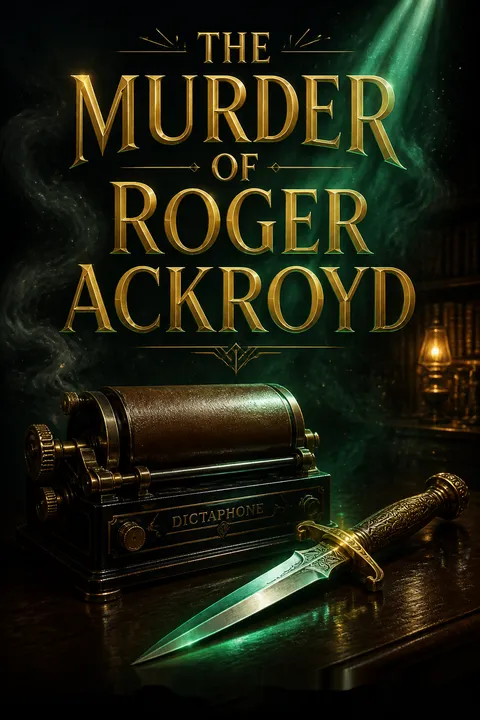
At Poirot’s gathering, Ursula is introduced as Ralph’s wife, shocking the family and explaining the ring. Poirot then resolves the apparent evidence that Ackroyd was alive at half-past nine. A dictaphone, secretly bought by Ackroyd and borrowed by James for repair, had been set to play a recorded passage at that hour. The machine is missing because the killer removed it after the body was found.
Poirot explains that Ursula and Ralph were meeting in the summer-house, Charles Kent had already left, and the conversation Raymond and Blunt heard was a recording. Ralph then appears, brought from the nursing home where James hid him. He says he never entered the study and had no alibi, leaving the real murderer still among them.
The dictaphone overturns the case’s central clock. What appeared to be a reliable timestamp was only a manufactured performance, and the machine’s absence is more revealing than the sound it produced. By restoring the actual sequence, Poirot separates three people who seemed to converge on Ackroyd’s final moments. Ralph’s return resolves the emotional question of whether he can face the truth, but his lack of an alibi preserves the legal danger. The gathering therefore moves from revelation to a narrower, more urgent problem: who needed the false timeline?
The Doctor's Hidden Minutes
Poirot identifies James as Ackroyd’s killer. James had blackmailed Mrs Ferrars after recognizing that she poisoned her husband, and Ackroyd’s letter threatened to expose him. He killed Ackroyd before leaving Fernly, then used Ralph’s shoes to plant prints at the window, locked the study, and timed the dictaphone to play later.
James had carried the machine in his medical bag and removed it when the false telephone call brought him back to the house. The extra minutes in his walk to the gate, the shifted chair, and his unusual insistence that Ackroyd read the letter all fit the plan. James denies the conclusion to Poirot, but the evidence leaves no escape from it.
The revelation recasts the narrator’s apparent modesty as a carefully managed instrument. James did not need to fabricate every observation; he arranged for true details to produce false conclusions. The planted footprints, genuine call, and recorded voice each exploit the trust people place in material evidence. His medical authority also grants him access to bodies, rooms, and private information. Poirot’s method exposes not just a culprit but a narrative strategy: James has made himself seem like the neutral witness precisely because readers are accustomed to trusting the person who records events.
A Manuscript's Last Page
After Poirot confronts him, James returns to his account and writes the explanation the reader has just received. He acknowledges that his narration omitted the crucial minutes in Ackroyd’s study, that the dagger was chosen to conceal his own weapon, and that the missing dictaphone was in his bag.
He plans to send the manuscript to Poirot, trusting the detective to protect Caroline from the public knowledge that her brother was a murderer. James considers taking veronal, the drug that killed Mrs Ferrars, and ends his account with that intention. The book does not narrate the act itself; it leaves the reader with the completed confession and the decision he has made.
The ending makes authorship part of the crime’s final mechanism. James’s manuscript began as an attempt to record Poirot’s failure, but it becomes a confession designed to control the aftermath. His concern for Caroline is genuine, yet even his final act is shaped by concealment and self-direction. Veronal links his intended death to Mrs Ferrars’s, without making their choices morally equivalent: she was driven by blackmail and remorse, while James seeks to avoid judgment. The unresolved final act denies easy closure and leaves accountability in Poirot’s hands.
Analysis
The novel’s central trick is also its ethical question: how much authority should a reader grant to the person arranging the evidence? James’s professional identity and unshowy manner encourage trust, while his narration gains credibility by appearing modest and exact. Poirot succeeds not by finding a single spectacular clue but by noticing that several ordinary facts have been arranged to produce a false sequence: a call that brings the doctor back, a chair moved to conceal an object, shoes that implicate Ralph, and a recorded voice mistaken for a living man. Each clue is legible, but only when separated from the story James has made them tell.
The village itself is a system of surveillance without reliable verification. Caroline’s gossip, servants’ observations, and family rumor preserve fragments of truth, yet social assumptions distort them. Respectability makes Miss Russell conceal her son; financial dependence drives Flora to hide a theft; Ralph’s evasions make him look guilty; and James exploits everyone’s expectation that a doctor is a neutral witness. The book’s treatment of weakness is especially unsentimental. Vulnerability may explain deception, but it does not excuse the choice to turn secrecy into violence.
Poirot’s method offers a counterweight to the community’s appetite for confident judgment. He attends to motives without reducing people to them, and distinguishes a stolen forty pounds from a murder, a drug user from an assassin, and a frightened disappearance from proof of guilt. Yet the resolution is not simply a triumph of reason. James retains control over the final account by choosing how to confess and by contemplating death before public exposure. The completed manuscript offers truth, but not full restitution. The reader is left to recognize that accurate details can still deceive when the narrator controls their order, emphasis, and omissions.
Review Summary
The Murder of Roger Ackroyd is widely regarded as one of Agatha Christie's best works, featuring a shocking twist ending that surprises most readers. The novel follows Hercule Poirot as he investigates the murder of Roger Ackroyd in a small English village. Readers praise Christie's masterful plotting, clever misdirection, and complex characters. Many consider it a must-read for mystery fans, with its ingenious narrative structure and unexpected resolution. The book's enduring popularity and critical acclaim have cemented its status as a classic of the detective genre.
People Also Read




Characters
Dr James Sheppard
The village doctorJames is King’s Abbot’s doctor and the first-person narrator, a bachelor who shares a home with his formidable sister Caroline. His professional habits make him attentive to symptoms, timing, and the details of people’s bodies, while his dry humor helps him keep emotional distance from village life. He presents himself as practical and restrained, but his narration also reveals a strong investment in controlling what others know. His position gives him unusual access to the village’s private troubles, from medical consultations to the conversations of wealthy households. James’s relationship with Caroline combines affection, irritation, and dependence, while his friendship with Ralph makes him more personally involved in the Ackroyd household than he initially admits.
Hercule Poirot
The retired detectivePoirot is a retired Belgian detective who has settled beside James in King’s Abbot, hoping for a quieter life among his vegetable marrows. His tidy habits, formal courtesy, and appetite for careful observation can make him seem vain or comical, but he is highly disciplined about separating evidence from assumption. He studies motives and habits as closely as physical traces, often noticing what people regard as too ordinary to matter. Poirot is also alert to emotional pressure: he understands that a suspect may conceal a theft, a family history, or a love affair for reasons very different from murder. His working relationship with James begins as an informal partnership, though Poirot keeps his interpretations to himself until he is ready to act.
Caroline Sheppard
The village intelligence serviceCaroline is James’s older sister, a perceptive, outspoken woman whose home is the center of King’s Abbot’s informal news network. She gathers information through servants, tradespeople, neighbors, and her own sharp memory, then passes it along with complete confidence. Her appetite for gossip can embarrass James, who worries that private details will travel through the village, but Caroline’s observations are often more accurate than his professional skepticism allows. She has a strong need to feel useful and trusted, and Poirot’s respect for her insight delights her. Beneath the meddling is genuine warmth: when Ursula arrives in distress, Caroline’s first response is comfort rather than interrogation.
Roger Ackroyd
Fernly's generous patriarchRoger Ackroyd is a wealthy manufacturer and the most influential man in King’s Abbot. Genial in public, he supports local institutions and takes an active interest in village life, yet his household knows him as exacting and unusually cautious with money. He raised Ralph Paton, his late wife’s son, as his own, and hopes to bind Ralph and his niece Flora to the family through marriage. Ackroyd’s romantic attachment to Mrs Ferrars makes him vulnerable to a revelation that conflicts with his law-abiding instincts. His desire to protect the woman he loves and his suspicion of someone close to his household create the private crisis that precedes the murder.
Ralph Paton
The charming heirRalph is Ackroyd’s adopted son, a handsome former army captain whose charm makes people eager to forgive his extravagance and unreliability. He lives beyond his means and repeatedly finds himself in financial difficulty, but those who know him see weakness and impulsiveness rather than cruelty. Ralph’s relationship with Ackroyd is affectionate yet strained by the older man’s authority and expectations. He is drawn toward easy solutions when pressure builds, and his fear of disappointing people can make him evasive at the very moment candor is most needed. Flora and James both care about him, although their loyalty takes different forms.
Flora Ackroyd
The determined nieceFlora is Ackroyd’s niece, a young woman whose beauty and polished manner conceal a sharp awareness of money and social dependence. She has lived under her uncle’s financial control and longs for room to make her own choices. Her apparent composure can be mistaken for innocence or calculation, but she is more complicated than either label allows. Flora understands Ralph’s weaknesses partly because she recognizes her own susceptibility to pressure. She acts decisively when she believes someone she cares about is being wronged, and she resists being treated as a passive object of family arrangements. Her connections with Ralph and Hector Blunt reveal different kinds of loyalty and possibility.
Ursula Bourne
The capable parlourmaidUrsula is the parlourmaid at Fernly, competent and reserved in a household where her education and bearing attract notice. She comes from an impoverished Irish family and chooses domestic service as practical work, not as a performance of social gentility. Ursula values honesty and independence, yet the people she loves draw her into secrets that conflict with those values. Her directness can appear stubborn, especially when she believes someone is evading responsibility. She is protective of her private life and wary of the social consequences of exposure, but she also has the courage to approach Poirot when she believes the truth may help someone she cares for.
Miss Russell
Fernly's formidable housekeeperMiss Russell has managed Fernly’s household for years and maintains a stern, self-sufficient manner. She values competence and financial independence, and she does not welcome the status Mrs Ackroyd assumes as a wealthy dependent. Her conversations with James reveal an unexpected interest in drugs, poisons, and crime fiction, though she gives little away about why she asks. Miss Russell’s sense of respectability is a source of security, but it also makes her guarded when private matters threaten to become public.
Hector Blunt
The taciturn big-game hunterBlunt is Ackroyd’s old friend, a stocky, quiet big-game hunter whose bluntness and lack of social polish set him apart from Fernly’s more performative characters. He is observant, loyal, and more emotionally perceptive than his sparse speech suggests. His affection for Flora makes him attentive to her distress, though he initially hides his feelings behind practical reassurance. Blunt prefers action to explanation and is uncomfortable with the rituals of polite society, but he does not confuse emotional restraint with indifference.
Geoffrey Raymond
Ackroyd's efficient secretaryRaymond is Ackroyd’s young secretary, valued for his efficiency and calm handling of business. He is sociable and quick with humor, often easing the strain in a room without appearing to take much seriously. His work gives him detailed knowledge of Ackroyd’s papers, habits, and finances, while his own modest means leave him sensitive to how suspicion might attach to a debt. Raymond is generally candid once he understands that silence has begun to look incriminating.
Mrs Cecil Ackroyd
The anxious dependentMrs Ackroyd is the widow of Roger’s younger brother and lives at Fernly with her daughter Flora. She is talkative, socially ambitious, and acutely concerned with money, yet often disguises self-interest beneath appeals to propriety and maternal worry. Her conversation wanders because she approaches uncomfortable subjects indirectly. She resents her dependence on Roger and is sensitive to the limits placed on her household, while her love for Flora is entangled with anxiety about status and security.
Parker
Fernly's watchful butlerParker is Ackroyd’s butler, a practiced servant who understands how much can be learned by listening while appearing occupied with routine duties. His deferential manner and careful attention to household procedure make him difficult to read. When the crime occurs, his visible nervousness draws suspicion, but it also reflects his awareness that past conduct may make him look guilty. He is shrewd about money and alert to opportunities, though not every secret he carries belongs to the murder.
Mrs Ferrars
The troubled widowMrs Ferrars is a wealthy widow who recently moved to King’s Abbot and became close to Roger Ackroyd. Attractive and socially composed, she has also been living under intense private strain. Her reputation is shaped by village rumor about the death of her husband, while her own choices leave her vulnerable to blackmail. She wants affection and a future with Ackroyd, but guilt and fear complicate her ability to accept either.
Charles Kent
The drug-dependent visitorCharles Kent is a young man with a rough manner and a history of drug dependence. He has spent time in North America and returns to England with little stability or money. His defiance makes cooperation with the police difficult, but it also masks vulnerability and a strained family connection. Kent’s presence near Fernly becomes important because his visit is private, not because he belongs to Ackroyd’s household.
Inspector Raglan
The confident local investigatorRaglan is the experienced inspector from Cranchester who takes charge of the official investigation. He trusts organized timelines, witness statements, and physical evidence, and his confidence helps him move quickly through a complicated case. He is not immune to revising his conclusions, though he is protective of his professional standing. Poirot’s presence both irritates and assists him.
Colonel Melrose
The chief constableMelrose is the county chief constable and a local acquaintance of several people at Fernly. He balances the police investigation with the family’s request for Poirot’s help, preferring cooperation without public fuss.
Mr Hammond
The family solicitorHammond is Ackroyd’s precise, reserved solicitor. He knows the terms of the will and has handled Mrs Ferrars’s financial affairs, making him a useful source of documented facts rather than village speculation.
Plot Devices
The Missing Letter
A motive in blueMrs Ferrars’s letter is expected to identify the person who blackmailed her, and Ackroyd receives it shortly before his murder. He refuses to read it while James is present, then it disappears from the study after the body is found. Its absence gives the police a plausible motive and encourages suspicion of anyone who might fear exposure. Poirot also considers whether Ackroyd could have destroyed it himself. The letter’s importance lies not only in its contents but in the way its disappearance narrows the suspects while concealing the role of the person who had the best opportunity to remove it.
The Dictaphone
A false timestampAckroyd’s dictaphone supplies the apparent proof that he was alive at half-past nine. A recorded passage sounds like a conversation to Raymond and Blunt, helping place the murder later than it occurred. The machine is absent when police search the study, a detail that initially seems less important than the body, dagger, and footprints. Poirot eventually recognizes that the recorded voice was mistaken for live speech and that the machine itself had to be removed. Its playback turns a manufactured sound into an alibi and makes the timing of the crime seem far more certain than it is.
The Planted Footprints
A trail toward RalphRubber-studded shoe prints on the study windowsill appear to connect Ralph Paton to the murder. They fit the police theory because Ralph owns matching shoes, has financial troubles, and disappears after the crime. Poirot notices that matching footwear does not prove who made the prints, then learns Ralph also had boots. That overlooked distinction allows him to infer that someone could wear Ralph’s shoes while Ralph wore different footwear. The prints are therefore both evidence and misdirection: they record a real passage across the sill but point toward the wrong person.
The False Telephone Call
A staged returnA caller at the railway station claims to be Parker and reports Ackroyd’s murder, sending James back to Fernly before the household would otherwise discover the body. The call seems like a practical alert, but its timing gives the caller access to the study after the door is broken open. Investigators wonder why anyone would arrange for the crime to be discovered at night instead of in the morning. Poirot treats that question as central and eventually learns the call was real but its message was falsely represented. The device makes James’s presence seem accidental while giving the murderer a reason to return.
The Concealed Manuscript
A witness becomes authorJames writes a chronological account of Poirot’s investigation, presenting himself as a careful observer who records what he knows. His manuscript becomes an extension of the mystery because it is selective: events are accurately described, but the crucial interval in the study is hidden inside the narration. Poirot recognizes the significance of James’s restrained self-portrait and the way his account gives details without explaining their full context. After the accusation, James completes the manuscript as a confession and plans to send it to Poirot. The document changes from an apparent record of a detective’s failure into evidence of the narrator’s own design.
FAQ
Synopsis & Basic Details
What is The Murder of Roger Ackroyd about?
- Wealthy man murdered: Roger Ackroyd is found murdered in his study, setting off an investigation in the quiet village of King's Abbot.
- Secrets and relationships: The story explores the complex relationships and hidden secrets of the villagers, particularly those closest to Ackroyd.
- Unlikely narrator: Dr. James Sheppard, the village doctor, narrates the events as he assists detective Hercule Poirot in solving the crime.
- Twists and turns: The investigation uncovers blackmail, secret marriages, and financial troubles, leading to a shocking revelation about the murderer's identity.
Why should I read The Murder of Roger Ackroyd?
- Classic mystery: It's a quintessential Agatha Christie novel, showcasing her mastery of plot twists and character development.
- Unreliable narrator: The story employs an unreliable narrator, adding a unique layer of suspense and deception that challenges the reader.
- Psychological depth: The novel delves into the psychology of the characters, exploring their motivations and hidden desires.
- Surprising ending: The shocking and unexpected resolution is considered one of the most ingenious in detective fiction.
What is the background of The Murder of Roger Ackroyd?
- Post-WWI England: The novel reflects the social dynamics of post-World War I England, with its class distinctions and changing social norms.
- Small village life: The setting of King's Abbot, a typical English village, highlights the close-knit community and the prevalence of gossip.
- Emerging detective fiction: The novel is a product of the Golden Age of Detective Fiction, a period marked by intricate plots and amateur sleuths.
- Social commentary: The story subtly critiques the societal expectations and hidden hypocrisies within the seemingly peaceful village setting.
What are the most memorable quotes in The Murder of Roger Ackroyd?
- "The truth, however ugly in itself, is always curious and beautiful to the seeker after it.": This quote encapsulates Poirot's unwavering dedication to uncovering the truth, regardless of the consequences.
- "I always come back to it.": This recurring phrase highlights the importance of the telephone call as a central clue in the investigation, emphasizing Poirot's methodical approach.
- "Everyone concerned in them has something to hide.": This quote reflects the pervasive atmosphere of secrecy and deception that permeates the novel, suggesting that appearances can be deceiving.
What writing style, narrative choices, and literary techniques does Agatha Christie use?
- First-person narration: The story is told from Dr. Sheppard's perspective, creating a sense of intimacy and immediacy while also concealing crucial information.
- Red herrings: Christie masterfully employs red herrings to mislead the reader, presenting numerous suspects with plausible motives.
- Foreshadowing: Subtle hints and clues are scattered throughout the narrative, foreshadowing the eventual revelation of the murderer's identity.
- Limited perspective: The reader's knowledge is restricted to what Dr. Sheppard chooses to reveal, creating a sense of suspense and uncertainty.
Hidden Details & Subtle Connections
What are some minor details that add significant meaning?
- The silver table: The silver table in the drawing-room, where the murder weapon is kept, symbolizes the hidden dangers and secrets lurking beneath the surface of polite society.
- The summer-house: The summer-house serves as a meeting place for clandestine encounters, highlighting the themes of deception and hidden relationships.
- The goose quill: The goose quill found in the summer-house is a subtle clue that points to Charles Kent's drug use and connection to Miss Russell.
- The locked door: The locked study door symbolizes the barriers to truth and the deliberate attempts to conceal the murderer's actions.
What are some subtle foreshadowing and callbacks?
- Caroline's suspicions: Caroline's early suspicions about Mrs. Ferrars foreshadow the later revelation of her involvement in her husband's death.
- Drug-taking conversation: Miss Russell's conversation with Dr. Sheppard about drug-taking foreshadows Charles Kent's addiction and his connection to her.
- The will discussion: The discussion about Ackroyd's will foreshadows the financial motives that drive some of the characters' actions.
- The chair position: The seemingly insignificant detail of the chair's position in the study becomes a crucial clue in Poirot's reconstruction of the crime.
What are some unexpected character connections?
- Ursula Bourne and Ralph Paton: The secret marriage between Ursula Bourne and Ralph Paton reveals a hidden connection that complicates the investigation.
- Charles Kent and Miss Russell: The relationship between Charles Kent and Miss Russell, as mother and son, adds a layer of complexity to the housekeeper's character.
- Mrs. Folliott and Ursula Bourne: The connection between Mrs. Folliott and Ursula Bourne as sisters reveals a shared family history and social standing.
Who are the most significant supporting characters?
- Caroline Sheppard: Caroline's gossiping nature and keen observations provide valuable insights and clues that aid Poirot's investigation.
- Parker: Parker's role as the butler gives him access to information and opportunities that make him a key suspect and witness.
- Miss Russell: Miss Russell's mysterious past and connection to Charles Kent add intrigue and complexity to the story.
- Geoffrey Raymond: Geoffrey Raymond's position as Ackroyd's secretary makes him privy to financial details and personal matters, making him a significant player in the investigation.
Psychological, Emotional, & Relational Analysis
What are some unspoken motivations of the characters?
- Dr. Sheppard's desire for recognition: Dr. Sheppard's eagerness to assist Poirot and document the case suggests a desire for recognition and validation.
- Flora Ackroyd's longing for independence: Flora's engagement to Ralph and later to Hector Blunt reveals her desire for financial security and freedom from her controlling mother.
- Hector Blunt's unrequited love: Hector Blunt's stoic demeanor hides his deep affection for Flora, influencing his actions and decisions.
- Mrs. Ackroyd's social climbing: Mrs. Ackroyd's constant concern with social status and financial security reveals her ambition and desire for upward mobility.
What psychological complexities do the characters exhibit?
- Dr. Sheppard's duplicity: Dr. Sheppard's ability to maintain a facade of trustworthiness while concealing his guilt highlights the complexities of human nature.
- Ralph Paton's weakness: Ralph Paton's inability to make decisive choices and his tendency to succumb to temptation reveal his inherent weakness.
- Ursula Bourne's strength: Ursula Bourne's determination to protect her husband and her willingness to sacrifice her own reputation demonstrate her inner strength.
- Miss Russell's stoicism: Miss Russell's stoic demeanor and guarded nature conceal her past and her deep concern for her son.
What are the major emotional turning points?
- Dr. Sheppard's decision to murder Ackroyd: Dr. Sheppard's decision to murder Ackroyd marks a turning point in his character, transforming him from a trusted doctor into a cold-blooded killer.
- Flora's confession: Flora's confession to stealing the money is an emotional turning point, revealing her vulnerability and her desire for honesty.
- Ursula's revelation of her marriage: Ursula's revelation of her marriage to Ralph Paton exposes the hidden relationships and secrets that complicate the investigation.
- Blunt's declaration of love: Blunt's declaration of love for Flora is an emotional turning point, revealing his true feelings and his willingness to protect her.
How do relationship dynamics evolve?
- Dr. Sheppard and Poirot: The relationship between Dr. Sheppard and Poirot evolves from a seemingly collaborative partnership to a tense confrontation, culminating in the revelation of Dr. Sheppard's guilt.
- Flora and Ralph: The relationship between Flora and Ralph shifts from a business arrangement to a friendship based on shared vulnerability and understanding.
- Flora and Hector: The relationship between Flora and Hector evolves from a casual acquaintance to a genuine connection based on mutual respect and affection.
- Ursula and Ralph: The relationship between Ursula and Ralph is tested by secrets, financial troubles, and the pressures of the investigation, ultimately revealing the strength of their bond.
Interpretation & Debate
Which parts of the story remain ambiguous or open-ended?
- The extent of Parker's involvement: The extent of Parker's involvement in the blackmail scheme remains somewhat ambiguous, leaving room for speculation about his true motives.
- The future of Flora and Hector: The future of Flora and Hector's relationship is left open-ended, allowing readers to imagine their life together.
- The impact on King's Abbot: The long-term impact of the Ackroyd murder on the village of King's Abbot and its inhabitants is not fully explored, leaving room for interpretation.
What are some debatable, controversial scenes or moments in The Murder of Roger Ackroyd?
- Dr. Sheppard's narration: Dr. Sheppard's narration is a constant source of debate, as readers question his reliability and interpret his actions.
- Poirot's methods: Poirot's methods, particularly his manipulation of suspects and his withholding of information, are often debated for their ethical implications.
- The ending's morality: The ending, in which Poirot allows Dr. Sheppard to take his own life, raises questions about justice and morality.
The Murder of Roger Ackroyd Ending Explained: How It Ends & What It Means
- Dr. Sheppard's confession: Dr. Sheppard's confession reveals his motive for killing Ackroyd: to protect himself from exposure as a blackmailer.
- Poirot's moral dilemma: Poirot faces a moral dilemma in deciding whether to turn Dr. Sheppard over to the police or allow him to take his own life.
- Protecting Caroline: Poirot ultimately chooses to protect Caroline from the scandal and grief that would result from her brother's public trial.
- Justice and consequences: The ending raises questions about the nature of justice and the consequences of one's actions, leaving the reader to ponder the complexities of morality.
Hercule Poirot Series

















About the Author
Other books by Agatha Christie




Download PDF
Download EPUB
.epub digital book format is ideal for reading ebooks on phones, tablets, and e-readers.








