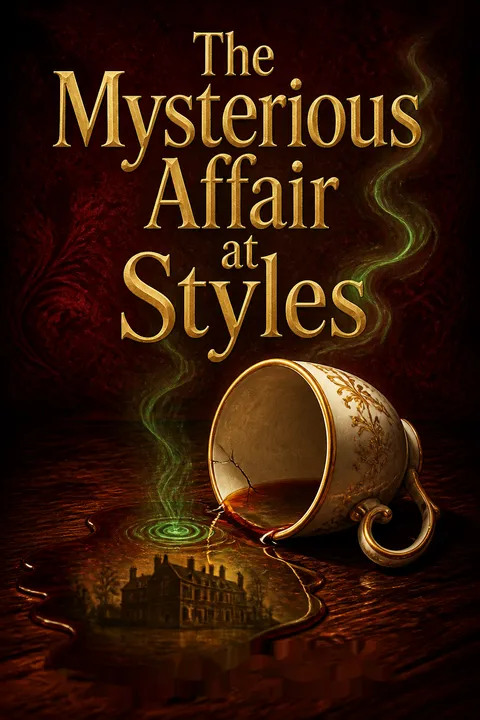


Plot Summary
Styles Welcomes a Wounded Guest
Invalided home from the Front, Arthur Hastings accepts an invitation from John Cavendish, his old acquaintance, to recover at Styles Court. John lives there with his wife, Mary, his younger brother, Lawrence, and his wealthy stepmother, Emily Inglethorp.
Emily has recently married Alfred, a younger man whose black beard and attentiveness make Hastings wary and John openly resentful. The family depends on Emily’s money, though she has long supported John and Lawrence generously. Cynthia Murdoch, an orphaned young woman Emily sponsors, works at a nearby hospital dispensary.
Evelyn Howard, Emily’s blunt companion and trusted helper, keeps the household running. Mary’s reserve, Lawrence’s gloom, and John’s easy charm give Hastings no clear guide to the tensions beneath the gracious country-house routine.
The house is introduced as both refuge and trap. Wartime scarcity and Emily’s wealth bind the Cavendishes to a woman whose generosity also gives her authority over their lives. Alfred’s arrival intensifies that dependence: the family suspects his motives, yet cannot simply remove him. Hastings enters as an outsider, but his personal loyalties and attraction to Mary already color his view. The mystery begins in an environment where affection, money, and obligation are difficult to separate.
Evelyn Howard Walks Out
Evelyn confronts Emily about Alfred, accusing him of pursuing her fortune and spending time with Mrs. Raikes, a neighboring farmer’s wife. Emily rejects the warning, so Evelyn packs a case and leaves Styles. Before going, she asks Hastings to watch over Emily and the family, whom she considers eager for money.
The household loses the one person who challenged Emily without seeking her favor. Hastings soon learns that John is also struggling financially, while Mary spends time with Dr. Bauerstein, a visiting specialist in poisons.
Evelyn’s departure sharpens the household’s unease, but Emily continues her charities and social plans. To Hastings, the comfortable country house now feels less protected, and every strained relationship seems capable of concealing a private grievance.
Evelyn’s departure changes the household’s balance of power. Her bluntness is not merely temper; she has made herself independent of Emily’s gifts, which allows her to criticize the very people who rely on them. Once she leaves, warning and protection become indistinguishable in Hastings’s mind: he has been entrusted with a danger he does not yet understand. The scene also establishes how money distorts perception. Evelyn may be right about Alfred, but her certainty encourages others to mistake suspicion for proof.
A Cup Goes Upstairs
On July 16, Emily performs at a village charity event; Cynthia stays overnight with friends, leaving the right wing unusually quiet. The next day, Hastings and Lawrence visit Cynthia’s hospital dispensary, where its locked poison cupboard makes joking about poison feel less harmless.
They meet Hastings’s old friend Hercule Poirot, a Belgian refugee and former police detective staying nearby. Back at Styles, Emily appears upset after a private argument with Mary, who presses her about a paper Emily refuses to show.
At supper, Alfred prepares Emily’s coffee, but she is later seen carrying a cup toward her room. She plans to finish letters and retire. Dr. Bauerstein visits that evening, muddy from a walk; after he leaves, Alfred goes out, saying he will return with a latch-key.
Ordinary routines become evidence without anyone recognizing them as such. Cynthia’s absence, the dispensary’s poisons, Emily’s private papers, and the evening coffee each acquire weight only after the household’s assumptions collapse. Poirot’s arrival places a methodical observer in the story, while Hastings remains emotionally invested in the people he is observing. The crucial uncertainty is not simply who entered Emily’s room, but what she knew before she went to bed and why several people wanted access to her secrets.
The Locked Bedroom
Before dawn, Lawrence wakes Hastings because Emily is suffering violent convulsions behind a locked door. The family breaks in, but Emily dies after briefly calling for Alfred. Alfred is absent, and his bed has not been slept in; he later claims he spent the night elsewhere after forgetting his latch-key.
Dr. Bauerstein insists on a postmortem, and the doctors identify strychnine poisoning. Hastings asks Poirot to investigate before the room’s clues disappear.
Poirot finds a crushed coffee cup, a damp stain smelling of coffee, candle grease, a scrap of green fabric caught in the bolt between Emily’s room and Cynthia’s, and a partly burned document that appears to be a will. He also notes that the bedroom doors were fastened from within, though someone seems to have entered.
The locked room converts a family crisis into a problem of physical possibility. Yet the evidence does not offer a simple answer: the broken cup and coffee stain suggest one route, while the burned will and disturbed bolt point elsewhere. Poirot’s attention to small discrepancies counters Hastings’s urge to settle quickly on Alfred, whose absence and reputation make him an easy target. Emily’s dying appeal seems to confirm that suspicion, but the room itself warns that appearances have been arranged or misunderstood.
The Obvious Suspect Escapes
Poirot learns from servants that Emily argued with someone, received a troubling paper, and wrote several letters before dying. Gardeners confirm that she made a new will on the afternoon of her death, then Poirot finds it was burned. At the inquest, the postmortem confirms strychnine, while the chemist’s assistant identifies Alfred as the man who bought poison.
Poirot distrusts evidence that makes the case too neat. He produces witnesses placing Alfred miles away at the time of the purchase, accompanying Mrs. Raikes, and argues that someone disguised as the conspicuous bearded husband must have entered the shop. The jury returns a verdict of murder by persons unknown. Alfred is not arrested, and suspicion turns back toward the household.
Poirot’s first major victory is negative: he prevents a plausible suspect from being convicted on evidence that looks unusually complete. His reasoning treats excess certainty as a warning, not a comfort. The inquest also exposes the danger of social shorthand. Alfred’s beard, marriage, and apparent greed make the chemist’s identification persuasive, while the newly made will seems to supply a motive for everyone. By insisting on the alibi, Poirot breaks the apparent chain and reveals that the case has been deliberately staged.
John Enters the Dock
Poirot searches for another explanation, finding a recently trimmed black beard in the attic costume chest and fingerprints belonging to Lawrence on a strychnine bottle at Cynthia’s dispensary. Dr. Bauerstein is arrested, but not for Emily’s murder: police suspect him of wartime espionage.
Then Scotland Yard arrests John. Investigators have found a phial of strychnine and Alfred’s pince-nez hidden in John’s room, and the prosecution links him to financial trouble, Mrs. Raikes, the argument with Emily, and the disguised chemist’s visit.
Mary stands by her husband despite their strained marriage. Lawrence’s nervous behavior and the poison-bottle fingerprints give the case another possible target, leaving the household and Hastings unsure which apparent clue can be trusted.
The inquiry’s shift from Alfred to John shows how evidence can be made to fit a person once a story has been chosen. John’s debts and affair are genuine, but they do not prove murder; Lawrence’s fingerprints are also real, but their meaning is uncertain. The planted objects in John’s room exploit the family’s existing anxieties, turning private flaws into public evidence. Mary’s loyalty becomes more visible under pressure, even as Hastings still struggles to distinguish her reserve from concealment.
A Trial Turns on Memory
Two months later, John faces trial. The prosecution builds a circumstantial case from his money problems, his connection to Mrs. Raikes, the poison-shop signature, and the objects found in his room.
The defense counters with an anonymous note that sent John to a remote meeting place when the poison was bought, but the handwriting is challenged. Lawrence’s dispensary fingerprints and a costume supplier’s record of a beard order muddy the case further. Mary watches the proceedings with fierce anxiety.
Poirot, keeping his own role concealed, tells Hastings he still lacks the final link. While discussing the trial, Hastings recalls that Poirot’s hand shook when he once straightened ornaments on Emily’s mantelpiece. The memory sends Poirot racing back to Styles.
The courtroom magnifies the novel’s central problem: a fact can be true and still mislead. John’s financial distress and affair make him vulnerable to accusation, while the defense’s anonymous note appears convenient enough to invite doubt. Poirot’s breakthrough comes not from a new laboratory result but from Hastings’s memory of an involuntary gesture. Their partnership is imperfect, yet precisely that imperfection matters: Hastings notices what Poirot once dismissed, and recollection restores the missing physical detail.
The Letter in the Vase
Poirot gathers the household and produces scraps of a letter hidden among the mantelpiece spills. It identifies Alfred and Evelyn as partners in a plan involving bromide powders and Emily’s medicine.
Evelyn had arranged for strychnine to settle in the tonic, so Emily would receive a fatal concentrated dose at the bottom of the bottle. A sedative in the drinks had kept Emily and Cynthia asleep while Mary entered Emily’s room, seeking proof of John’s infidelity; Mary’s frightened movements explain the green fabric, candle grease, and missing coffee cup, but not the murder.
Emily had discovered Alfred’s letter, burned her new will, and kept the evidence. Poirot reads the recovered fragments aloud in substance. Alfred attacks him, is subdued, and both Alfred and Evelyn are exposed as conspirators.
The solution separates guilt from proximity. Mary’s secret entry explains several suspicious traces, but her motive was jealousy and fear, not murder. Alfred and Evelyn exploited the house’s habits, Emily’s prescribed tonic, and the family’s ready suspicion of one another. The delayed poison made the death appear disconnected from its cause, while the false clues invited a swift conviction. Poirot’s reconstruction restores agency to details that had seemed incidental, showing how domestic routines can be turned into instruments of crime.
Styles Finds Its Way Back
With Alfred and Evelyn in custody, John is cleared and returns to Mary. Their marriage had begun without the passionate certainty Mary wanted; distance, pride, and John’s involvement with Mrs. Raikes had deepened the breach.
The danger surrounding his trial forces them to confront what they still mean to each other, and Mary welcomes him home. Lawrence and Cynthia also move toward a more honest understanding after his protective behavior is explained. Poirot admits he could have cleared John earlier, but chose to preserve the chance of convicting the true conspirators.
His choice placed John at risk and prolonged Mary’s anguish, a cost the detective accepts as necessary. Hastings leaves Styles with his faith in Poirot restored and his own romantic hopes gently disappointed.
The resolution gives emotional consequences to the investigation’s deliberate delay. Poirot’s decision is not a clean triumph: it secures the exposure of the conspirators while allowing an innocent man to face a murder trial. John and Mary’s reunion depends less on a sudden change of character than on the crisis stripping away their practiced distance. Hastings, meanwhile, remains the affectionate observer rather than the romantic hero. The case restores the household, but it cannot erase what its members concealed from one another.
Analysis
The novel makes its country-house setting feel less like a sealed puzzle box than a small economy of dependence. Emily’s money supports John and Lawrence, her sponsorship supports Cynthia, and her influence organizes the household’s public life. Those bonds are affectionate but unequal. Characters therefore have reasons to hide things before murder enters the picture: pride, jealousy, financial anxiety, fear of scandal, and the desire to remain free. The crime exploits a household already trained to protect appearances.
Poirot’s method offers a counterweight to that social pressure. Hastings repeatedly favors the most vivid explanation, especially Alfred’s apparent greed or Bauerstein’s suspicious presence. Poirot instead asks whether each piece of evidence fits with the others. The unusually direct trail against Alfred is suspect precisely because it seems to resolve the case too easily. The crucial proof finally comes not from an impressive new instrument but from an overlooked paper fragment and Hastings’s memory of a small physical gesture. The novel treats attention as a discipline: observation matters, but interpretation must remain open to revision.
The mystery also distinguishes culpability from suspicious behavior. Mary enters Emily’s room and conceals her actions, yet does so out of marital jealousy rather than murderous intent. Lawrence’s handling of poison and his evasions likewise acquire meaning through motives different from the apparent one. The investigation asks readers to resist the satisfying shortcut of equating secrecy with guilt. At the same time, the real conspiracy shows how access to ordinary household routines can make violence almost invisible.
Poirot’s choice to withhold evidence until the trial exposes the moral cost of solving the case. He protects the possibility of convicting the actual conspirators, but John and Mary must endure a public accusation and its private damage. Their reconciliation follows the crisis, yet it does not make Poirot’s decision harmless. The ending offers restoration, not a claim that justice arrives without collateral suffering. Its emotional resolution depends on the same fact as its detective solution: people become legible only when their actions are placed in context.
Review Summary
The Mysterious Affair at Styles introduces Hercule Poirot in his first published case. Set in an English country house, the plot revolves around a poisoning murder with multiple suspects. Readers praise Christie's intricate plotting, red herrings, and Poirot's deductive skills. While some find the narrative style dated, most appreciate the classic whodunit elements and Christie's ability to keep readers guessing. The book is considered a strong debut, showcasing Christie's talent for crafting complex mysteries and memorable characters, particularly Poirot.
People Also Read





Characters
Arthur Hastings
The loyal observerA wounded former soldier on leave at Styles, Hastings narrates the case and brings Poirot into it. He is generous, brave, and eager to detect patterns, but his confidence often outruns his evidence. His loyalty to John and attraction to Mary influence what he notices and how he interprets it. Hastings is not a foolish observer so much as an emotionally transparent one: he sees individual details clearly, yet can mistake an appealing theory for a sound conclusion.
Hercule Poirot
The methodical detectiveA celebrated Belgian detective and refugee, Poirot is Hastings’s old friend and the investigator whose precision anchors the mystery. He values order, careful observation, and the testing of every detail against a theory. His tidy manner can look comic, but it reflects a serious conviction that overlooked facts matter. Poirot is compassionate as well as analytical, though his judgment about how best to protect people can bring real emotional costs.
Emily Inglethorp
The generous household headA wealthy, energetic older woman, Emily supports her stepsons and takes an active role in charities and village life. Her generosity is genuine, but it comes with an expectation that others accept her plans and remember what she has done for them. That mixture of kindness and authority shapes every relationship at Styles. Emily’s money gives her influence over the household, while her confidence in her own judgments makes her vulnerable to those who know how to flatter her.
John Cavendish
The strained heirEmily’s elder stepson and Mary’s husband, John is an easygoing country gentleman facing financial pressure. He values loyalty and prefers to avoid painful confrontations, a habit that leaves important tensions unaddressed. His dependence on Emily’s support complicates his position in the household, while his marriage has grown distant. John’s friendly manner makes him easy to like, but his instinct to keep trouble quiet can make his actions difficult for others to read.
Mary Cavendish
The guarded wifeJohn’s wife, Mary is intelligent, proud, and difficult to read. Raised across different cultures after the death of her Russian mother, she values independence and resists being treated as someone else’s possession. Her marriage began without the romantic certainty John hoped for, leaving both of them vulnerable to silence and misunderstanding. Mary’s self-command can appear cold, but strong feeling lies close beneath it; she is especially sensitive to betrayal and to any threat to her freedom.
Evelyn Howard
Emily’s outspoken companionEmily’s longtime companion and practical helper, Evelyn is blunt, observant, and fiercely protective of the woman she serves. She refuses to accept gifts that would compromise her independence, so she can speak to Emily more freely than the dependent members of the household. Her forceful manner can make her judgments seem absolute, but it also reflects genuine concern and a strong sense of what loyalty requires.
Alfred Inglethorp
Emily’s new husbandEmily’s younger husband, Alfred is a conspicuous presence at Styles, with a carefully maintained beard, glasses, and a manner of deference toward his wife. The Cavendishes distrust him and resent the changes his marriage brings to their home. He is difficult for Hastings to place, in part because his attentive public behavior sits uneasily beside the family’s suspicions. His position makes him a focus of scrutiny from the moment he appears.
Lawrence Cavendish
The withdrawn younger brotherJohn’s younger brother, Lawrence trained as a doctor before turning to writing. Reserved and melancholic, he is less socially assured than John and carries a private emotional life that Hastings struggles to understand. His medical knowledge gives him a particular connection to the story’s questions about poisons and medicine. Lawrence’s tendency to retreat into silence leaves other people to interpret his actions for him.
Cynthia Murdoch
The hospital dispenserAn orphan supported by Emily, Cynthia works in a Red Cross hospital dispensary and lives at Styles as a dependent member of the household. She is lively, capable, and frank, but she knows her position relies on another person’s generosity. Her professional familiarity with medicines brings her close to the case’s practical details. Cynthia’s humor and energy sometimes conceal how uncertain she feels about her place in the Cavendish family.
Dr. Bauerstein
The poison specialistA skilled London specialist staying in the village, Bauerstein is known for his expertise in toxicology and his friendship with Mary. His presence gives the case medical authority while also provoking Hastings’s jealousy and suspicion. He is observant, self-contained, and accustomed to being taken seriously. Because his private activities are not immediately clear to those around him, both his expertise and his secrecy invite competing interpretations.
Dorcas
Emily’s faithful servantThe long-serving parlourmaid at Styles, Dorcas knows Emily’s routines and cares deeply for her. Her loyalty to the Cavendish brothers shapes what she is willing to say, but her memory preserves important details about the household.
Albert Mace
The village chemist’s assistantA young pharmacist recently installed at the village shop, Mace becomes an important witness after a sale of strychnine. His certainty is sincere, but his limited familiarity with the people of Styles leaves room for mistaken identification.
Inspector Japp
Poirot’s police colleagueA Scotland Yard inspector who knows Poirot from earlier cases, Japp brings official authority and practical police work to the investigation. He is brisk and experienced, but willing to reconsider his first conclusion when Poirot offers a sound reason.
Plot Devices
The household medicine
A delayed poison mechanismEmily’s prescribed tonic contains strychnine, while bromide powders can cause the strychnine to settle into a concentrated deposit. This medical detail explains why a final dose can be fatal even though earlier doses appeared harmless. It also turns the delay between the suspected poisoning and Emily’s collapse into a clue rather than an inconsistency. The method depends on the household’s familiar medicine routine and on no one thinking to inspect the bottle’s contents closely.
The false appearance
A trail designed to misleadA beard, glasses, clothing, a poison-shop register, and objects planted in John’s room direct suspicion toward the wrong people. Their force comes from fitting the household’s expectations: Alfred looks distinctive, John has money troubles, and Lawrence has medical training. Poirot treats the suspiciously complete case as a warning. The disguise and planted evidence show how a criminal can exploit not only physical resemblance but also the stories witnesses already want to believe.
The spill vase
A hidden letter survivesA set of narrow paper strips hidden among the mantelpiece spills preserves the document that links the conspirators to the murder plan. Poirot’s earlier handling of the ornaments gives the hiding place a physical history; Hastings’s recollection of Poirot’s shaking hand prompts him to search it again. The vase turns an apparently decorative object into the last surviving piece of evidence, and its discovery depends on memory as much as forensic skill.
FAQ
Synopsis & Basic Details
What is The Mysterious Affair at Styles about?
- A War-Weary Invitation: Captain Arthur Hastings, recovering from injuries sustained in WWI, accepts an invitation from his old friend John Cavendish to stay at Styles Court, the family estate in Essex, setting the stage for a classic country house mystery.
- A Tense Family Dynamic: Upon arrival, Hastings discovers a household rife with tension, particularly surrounding John's wealthy stepmother, Emily Inglethorp, and her much younger, recently married husband, Alfred Inglethorp, whose motives are widely distrusted by the family.
- Sudden Death, Master Detective: The fragile peace is shattered when Emily Inglethorp is found dead, seemingly poisoned, in her locked bedroom. Hastings, recalling his past acquaintance with the brilliant Belgian detective Hercule Poirot, who is now a refugee living in the nearby village, enlists his help to unravel the perplexing crime.
Why should I read The Mysterious Affair at Styles?
- Birth of a Legend: This novel marks the debut of Hercule Poirot, one of fiction's most iconic detectives, offering readers the chance to witness his "little grey cells" in action for the very first time, establishing his unique methods and eccentricities.
- Masterclass in Misdirection: Agatha Christie expertly crafts a complex plot filled with red herrings, intricate alibis, and subtle clues, challenging readers to piece together the truth alongside Hastings, making for a highly engaging and satisfying puzzle.
- A Glimpse into Post-WWI Society: Beyond the murder, the story provides a fascinating snapshot of English society immediately after World War I, touching on themes of class, financial strain, and changing social norms, all observed through the eyes of a returning soldier.
What is the background of The Mysterious Affair at Styles?
- Post-WWI Setting: The story is set in England shortly after World War I, a period of significant social and economic upheaval. Hastings's convalescence from the Front and the presence of Belgian refugees (including Poirot) directly reflect the war's impact, influencing character circumstances and the overall atmosphere of the novel.
- Country Estate Dynamics: Styles Court, a grand but financially strained country house, serves as a microcosm of the era's changing class structures. The Cavendish family's dependence on Emily Inglethorp's wealth, and their resentment towards Alfred, highlight the anxieties of maintaining aristocratic lifestyles in a new economic reality.
- Christie's Personal Experience: Agatha Christie herself worked in a dispensary during WWI, gaining knowledge of poisons that she meticulously wove into the plot. This personal background lends authenticity to the details of strychnine and bromide, making the medical and chemical aspects of the murder particularly convincing.
What are the most memorable quotes in The Mysterious Affair at Styles?
- "Everything matters.": Poirot's foundational philosophy, stated early in his investigation (Chapter IV), emphasizes his meticulous attention to even the smallest details, which Hastings often dismisses, and serves as a guiding principle for his detective work.
- "Imagination is a good servant, and a bad master.": Poirot's caution to Hastings (Chapter V) highlights the danger of jumping to conclusions or letting personal biases cloud judgment, a recurring theme as Hastings frequently misinterprets clues.
- "The happiness of one man and one woman is the greatest thing in all the world.": Poirot's profound justification for his unconventional actions (Chapter XIII) reveals a deeper, humanistic side to his pursuit of justice, suggesting that sometimes, the restoration of personal happiness can be as important as legal retribution.
What writing style, narrative choices, and literary techniques does Agatha Christie use?
- First-Person Narrative (Hastings): The story is told through the eyes of Captain Hastings, providing a limited, often biased, and occasionally naive perspective. This narrative choice allows Christie to mislead the reader alongside Hastings, making Poirot's eventual deductions more surprising and impactful.
- Meticulous Detail & Red Herrings: Christie's style is characterized by precise descriptions of the crime scene, character interactions, and timelines, yet she masterfully sprinkles in numerous red herrings and seemingly irrelevant details that divert attention from the true culprit, challenging the reader's own powers of observation.
- Poirot's Eccentric Method: The introduction of Hercule Poirot showcases his unique blend of psychological insight, logical deduction, and fastidious nature. His reliance on "little grey cells" and his insistence on "order and method" establish a distinct detective archetype that would become a hallmark of the Golden Age of Detective Fiction.
Hidden Details & Subtle Connections
What are some minor details that add significant meaning?
- The Pink vs. White Candle Grease: Poirot's observation in Mrs. Inglethorp's room (Chapter IV) that the large patch of candle grease on the floor is white, while Lawrence's candle (the only one brought in during the alarm) is pink, subtly indicates that another person was in the room before the family arrived, a crucial detail for the "locked room" puzzle.
- The Unprinted Chemist's Label: The empty bromide powder box found in Mrs. Inglethorp's room (Chapter IV) lacks a chemist's name on its label, a detail Poirot points out as "odd." This seemingly minor omission later becomes a key indicator that the powders were not dispensed by a professional chemist, but rather by someone with medical knowledge within the household, like Cynthia or Miss Howard.
- The "L." on the Parkson's Parcel Label: The initial "L." on the theatrical costumier's parcel label (Chapter IX), found by Miss Howard, is initially debated by Hastings as possibly a "T." or "J." Poirot's certainty that it's an "L." (for Lawrence) is a subtle hint that Lawrence Cavendish ordered the disguise, linking him to the plot, even if his role is later revealed to be one of protection rather than guilt.
What are some subtle foreshadowing and callbacks?
- Mary Cavendish's Poison Remark: Early in the novel (Chapter I), during a casual conversation about murder, Mary Cavendish states, "Not in a case of poisoning... Dr. Bauerstein was saying yesterday that, owing to the general ignorance of the more uncommon poisons among the medical profession, there were probably countless cases of poisoning quite unsuspected." This seemingly innocent remark foreshadows the method of murder and her later, albeit innocent, involvement with a narcotic.
- Miss Howard's "Instinct": Miss Howard's vehement declaration (Chapter I) that if someone she loved were murdered, she would "know at once" who the criminal was, even if she couldn't prove it, is a powerful piece of foreshadowing. Poirot later uses this very "instinct" against her (Chapter VIII), revealing that her outward hatred for Alfred Inglethorp masked a deeper, more complex, and ultimately incriminating, emotional connection.
- The Bell Wire Incident: Dorcas's casual mention (Chapter IX) that Mrs. Inglethorp's bell wire was "nibbled through" on Monday, the day before the murder, and repaired on Tuesday morning, is a critical piece of foreshadowing. It reveals the murderer's initial plan to isolate Emily, which was thwarted by her forgetting her medicine, leading to the delayed poisoning and the "last link" of evidence.
What are some unexpected character connections?
- Alfred Inglethorp and Evelyn Howard's Secret Alliance: The most unexpected connection is the conspiratorial relationship between Alfred Inglethorp and Evelyn Howard. Initially presented as bitter enemies, their shared motive of greed and their pre-existing romantic entanglement are revealed as the true driving force behind the murder, subverting reader expectations based on their outward animosity.
- Lawrence Cavendish's Protective Love for Cynthia: Lawrence's seemingly aloof and nervous demeanor towards Cynthia is revealed to be a mask for deep affection. His actions, such as crushing the coffee cup and falsely testifying about the bolted door (Chapter XIII), are driven by a desperate desire to shield Cynthia from suspicion, highlighting a hidden romantic connection.
- Mary Cavendish's Jealousy and Pride: Mary's strained relationship with John and her flirtation with Dr. Bauerstein are initially presented as signs of her independence or even infidelity. However, Poirot reveals her "madly jealous" nature (Chapter XII) and her deep pride, which, combined with a misunderstanding about John's infidelity, drove her to administer the narcotic to Emily, believing she was protecting her husband.
Who are the most significant supporting characters?
- Dorcas, the Observant Maid: Dorcas, the parlourmaid, is far more than a background figure. Her detailed recollections of the quarrel (Chapter IV), Emily's agitated state, the "slip of paper," and the order for a fire (Chapter XII) provide crucial, often overlooked, pieces of the puzzle that Poirot meticulously reconstructs.
- Dr. Bauerstein, the Red Herring/Spy: Dr. Bauerstein serves as a multi-layered supporting character. Initially presented as a potential love interest for Mary and a red herring for the murder, his true role as a German spy (Chapter X) adds a layer of wartime intrigue and explains his suspicious movements, while also diverting attention from the real culprits.
- Cynthia Murdoch, the Unwitting Accomplice: Cynthia's role as a V.A.D. in the dispensary (Chapter II) and her access to poisons make her a plausible suspect, but her innocence is key. Her unwitting administration of the narcotic to Emily (given by Mary) and her later discovery of the "extra coffee-cup" (Chapter IX) are pivotal to unraveling the complex plot, making her an essential, if often passive, player.
Psychological, Emotional, & Relational Analysis
What are some unspoken motivations of the characters?
- Emily Inglethorp's Need for Control: Emily's constant "running a hundred societies" (Chapter I) and her habit of making new wills annually (Chapter V) reveal an unspoken motivation: a deep-seated need to exert control over her family and her fortune, even from beyond the grave, which ultimately makes her vulnerable to manipulation.
- Alfred Inglethorp's Calculated Greed: While outwardly playing the devoted husband, Alfred's unspoken motivation is pure, calculated greed. His "impassive" face (Chapter I) and "unctuous" voice mask a cold, methodical mind focused solely on acquiring Emily's wealth, as evidenced by his pre-marriage will and his later scheme with Miss Howard.
- Mary Cavendish's Protective Jealousy: Mary's "intense power of stillness" (Chapter I) and her later "icy unconcern" (Chapter IX) regarding Bauerstein's arrest hide a fierce, unspoken jealousy for John. Her actions, including administering the narcotic, are motivated by a desperate desire to protect her husband from perceived infidelity and scandal, even if her suspicions were misplaced.
What psychological complexities do the characters exhibit?
- Hastings's Bias and Blind Spots: Captain Hastings, the narrator, exhibits a psychological complexity rooted in his personal biases and romantic inclinations. His immediate distrust of Alfred Inglethorp and Dr. Bauerstein, coupled with his admiration for Mary Cavendish, consistently blinds him to crucial clues and Poirot's subtle deductions, making him an unreliable, yet endearing, observer.
- Lawrence's Introverted Protectiveness: Lawrence Cavendish, initially described as "unusually shy and reserved" (Chapter II), displays a complex psychological depth. His quiet nature masks a fierce protectiveness, particularly towards Cynthia, leading him to commit acts of misdirection (crushing the coffee cup, lying about the bolt) to shield her, even at his own peril.
- Evelyn Howard's Mask of Gruff Loyalty: Miss Howard's "hearty, almost painful grip" and "deep voice, almost manly" (Chapter I) present a gruff, loyal exterior. However, her "unnatural vehemence" against Alfred (Chapter VII) is a psychological mask, concealing her true, passionate, and ultimately criminal, alliance with him, driven by a shared desire for Emily's fortune.
What are the major emotional turning points?
- Miss Howard's Departure and Warning: Evelyn Howard's dramatic departure after her "row with Alfred Inglethorp" (Chapter I), where she warns Hastings to "watch that devil—her husband!", is a major emotional turning point. It injects a palpable sense of foreboding and suspicion into the household, shifting the emotional landscape from simmering tension to overt distrust.
- Mary Cavendish's Panic and Confession: Mary's "sudden cry that startled me: 'No, no—not that—not that!'" (Chapter III) upon Hastings's suggestion of poison, followed by her later, quiet confession to Poirot about administering a narcotic (Chapter XII), marks a significant emotional turning point. It reveals her deep fear and panic, and her desperate attempt to protect John, even if it meant concealing her own actions.
- Poirot's "Woman's Happiness" Deliberation: Poirot's internal struggle over whether to immediately clear John Cavendish, knowing it might hinder the conviction of the real criminals, is a profound emotional turning point (Chapter IX, XIII). His decision to allow the trial to proceed for the sake of John and Mary's reconciliation highlights his complex moral compass and his belief in the transformative power of shared adversity.
How do relationship dynamics evolve?
- John and Mary's Reconciliation Through Adversity: The relationship between John and Mary Cavendish undergoes a significant evolution, moving from a strained, distant marriage marked by "drifting apart" and "misunderstanding" (Chapter IX, XIII) to a profound reconciliation. The shared ordeal of John's murder trial forces them to confront their pride and rediscover their love, ultimately strengthening their bond.
- Emily and Alfred's Deceptive Alliance: The dynamic between Emily and Alfred Inglethorp is revealed to be a calculated deception. What appears to be an infatuated older woman and her devoted, if opportunistic, young husband (Chapter I) is exposed as a cold, manipulative partnership designed to exploit Emily's wealth, culminating in her murder.
- Lawrence and Cynthia's Budding Romance: The initially "constrained" (Chapter II) relationship between Lawrence Cavendish and Cynthia Murdoch subtly evolves into a mutual affection. Lawrence's protective actions during the investigation, driven by his love for Cynthia, and Cynthia's later "You dears!" kiss (Chapter XIII), signify the blossoming of a genuine, if understated, romance.
Interpretation & Debate
Which parts of the story remain ambiguous or open-ended?
- The Exact Nature of John's Affair with Mrs. Raikes: While the prosecution asserts John's "intrigue with a certain Mrs. Raikes" (Chapter XI) and Miss Howard alludes to it (Chapter I), the full extent and emotional depth of this relationship remain somewhat ambiguous. It serves primarily as a motive and a red herring, rather than a fully explored subplot, leaving readers to infer its true significance to John's character and marriage.
- The Depth of Mary's Feelings for Dr. Bauerstein: Mary's relationship with Dr. Bauerstein is presented with deliberate ambiguity. Hastings suspects a romantic connection, and Mary herself says "Perhaps" when John asks if she's in love with him (Chapter IX). However, Poirot later dismisses this, stating she "does not care, and never has cared one little jot" (Chapter X), leaving the reader to ponder whether her actions were purely strategic or if there was a fleeting emotional component.
- The Long-Term Impact of the Trial on John and Mary: While Poirot orchestrates the trial for John and Mary's "happiness" and they reconcile, the long-term psychological impact of being accused of murder and the public scandal on their relationship is left open-ended. The narrative concludes with their immediate reconciliation, but the lasting scars of such an ordeal are only hinted at.
What are some debatable, controversial scenes or moments in The Mysterious Affair at Styles?
- Poirot's Deliberate Deception of Hastings: Poirot's decision to intentionally mislead Hastings throughout the investigation, particularly about his suspicions and the true identity of the murderer (Chapter XIII), is a debatable point. While Poirot justifies it by Hastings's transparent nature, it raises questions about the ethics of a detective manipulating his closest friend and narrator.
- The Ethical Justification of Poirot's "Woman's Happiness" Gambit: Poirot's choice to allow John Cavendish to be brought to trial, even though he knew John was innocent, to force a reconciliation with Mary (Chapter XIII), is highly controversial. It prioritizes a specific outcome (conjugal happiness) over immediate justice and potentially puts an innocent man through immense suffering, sparking debate about the boundaries of a detective's role.
- Alfred Inglethorp's Calculated Self-Incrimination: Inglethorp's strategy of manufacturing evidence against himself to secure an acquittal and immunity (Chapter XIII) is a morally ambiguous and controversial act. It highlights a loophole in the legal system and presents a villain who is not only a murderer but also a master manipulator of justice, challenging the reader's sense of fairness.
The Mysterious Affair at Styles Ending Explained: How It Ends & What It Means
- The True Culprits Revealed: The Mysterious Affair at Styles ending explained reveals that the murder of Emily Inglethorp was a meticulously planned conspiracy between her new husband, Alfred Inglethorp, and her companion, Evelyn Howard. They intended to inherit her fortune, with Howard administering bromide to precipitate strychnine already in Emily's tonic, and Inglethorp creating a false alibi and manufactured evidence to frame John Cavendish.
- Poirot's "Last Link" and Hastings's Insight: Poirot discovers the "last link" – a charred fragment of a letter from Alfred to Evelyn, detailing their plot and the "stroke of genius" bromide idea – hidden in a spill vase, thanks to Hastings's casual observation about Poirot's shaking hand (Chapter XI, XII). This letter, combined with the discovery of the black beard and pince-nez (used by Howard to impersonate Alfred at the chemist's), provides irrefutable proof.
- Justice, Reconciliation, and Poirot's Philosophy: The ending signifies the triumph of Poirot's "little grey cells" and his unique brand of justice. Beyond solving the crime, Poirot orchestrates events (allowing John's trial) to force a reconciliation between John and Mary Cavendish, believing that "the happiness of one man and one woman is the greatest thing in all the world" (Chapter XIII). This highlights themes in The Mysterious Affair at Styles of love, forgiveness, and the complex interplay between legal justice and emotional well-being, leaving the Cavendish family to rebuild their lives while the true villains face their fate.
Hercule Poirot Series

























About the Author
Other books by Agatha Christie




Download PDF
Download EPUB
.epub digital book format is ideal for reading ebooks on phones, tablets, and e-readers.








