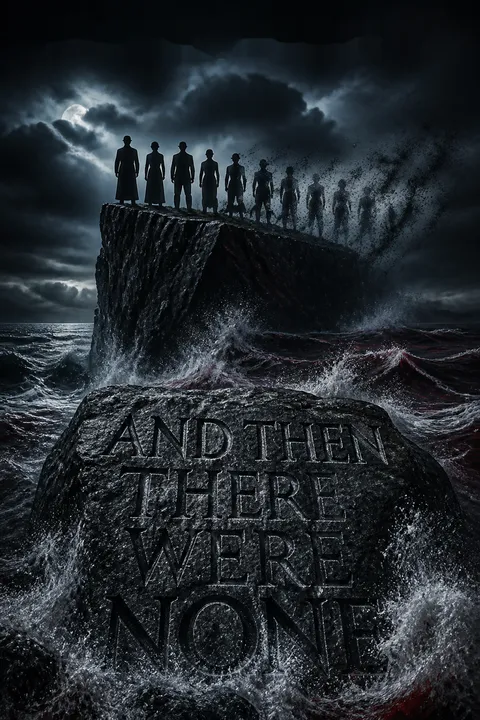


Plot Summary
Ten Invitations, Ten Secrets
Retired judge Lawrence Wargrave,2 governess Vera Claythorne,1 doctor Edward Armstrong,4 and five other strangers travel toward Indian Island after receiving invitations shaped to their private interests.
A wealthy young driver, Anthony Marston,8 expects entertainment; General Macarthur7 anticipates old friends; Emily Brent6 believes she has been offered a free holiday. Former policeman William Blore5 has a different assignment: he is pretending to be a South African guest while secretly watching the others.
Philip Lombard3 has accepted a fee from the elusive Isaac Morris,11 who gives him almost no explanation. Each traveler carries a troubling memory, though none yet knows the others have been summoned for the same reason. The island's owner, U.N. Owen, remains a name on paper, not a person any of them has met.
The invitations turn ordinary motives into mechanisms of capture. A holiday, a paid job, professional work, and a lucrative errand all make the journey seem self-directed, so each guest arrives believing they have chosen the island. Blore and Lombard appear to have special knowledge, but each is also being handled by the unseen organizer. The concealed pasts are not yet public facts; they are private stories people have learned to manage or forget. This opening establishes a sharp asymmetry: the host knows enough to manipulate each person, while the guests know almost nothing about the host or one another.
The Island's Empty Throne
At Sticklehaven, the arrivals meet and ride a small motor launch to the rocky island. Blore5 introduces himself as Mr. Davis, while Vera,1 Lombard,3 and Macarthur7 travel with Wargrave2 and Brent;6 Armstrong4 and Marston8 arrive separately. The modern house looks inviting, but its hosts are absent. Butler Thomas Rogers9 explains that Mr. Owen has been delayed, and his wife Ethel10 seems frightened despite the careful order of the rooms.
In Vera's1 bedroom, a framed children's rhyme describes ten figures disappearing one by one. At dinner, the guests discover matching porcelain figures at the table's center. Their host's absence, the rhyme, and the island's distance from shore turn a promised gathering into something harder to explain.
The house offers comfort without security. Its clean modern surfaces and prepared drinks imply a competent host, yet no host appears to confirm that impression. The rhyme shifts unease from atmosphere into a readable pattern: the guests can see that their number and the small figures correspond. Vera's discomfort around the sea also quietly connects the island's setting to a memory she is trying to avoid. Blore's false identity adds another layer of performance, but his disguise is only one among several. Before any crime occurs, the guests are already living inside a structure someone else has arranged.
A Voice Names the Dead
After dinner, a hidden gramophone sends a recorded accusation into the drawing room, naming each guest and the Rogerses9 in connection with a death. The recording comes from an adjoining room, where Lombard3 finds the machine set against the wall.
Wargrave2 takes charge of questioning the household and discovers that Rogers9 has never met his employer. The invitations prove equally false: Brent6 never knew the supposed friend who wrote to her, and the name U.N. Owen can be rearranged to suggest an unknown person.
Blore5 admits his real identity and surveillance assignment. The guests explain their accusations away in different ways, but Lombard3 openly acknowledges abandoning men in Africa, while Marston8 treats the deaths of two children as a driving mishap.
The recording converts concealed histories into public evidence, but it does not establish a single standard of guilt. Some guests reject the accusations as lies; others defend themselves through legality, accident, or rank. Lombard's candor and Marston's indifference make the group's moral differences visible, while Brent's refusal to explain herself protects her self-image rather than answering the charge. Wargrave's courtroom manner steadies the room, yet his process cannot identify who arranged the recording. The wordplay in U.N. Owen offers a solution to the host's name but no solution to the danger. Inquiry begins under conditions where evidence and performance are already tangled.
The First Figure Falls
The gathering breaks apart after the recording, but Marston8 soon returns to the drinks and collapses while swallowing whiskey and soda. Armstrong4 examines him and finds that he has died from a fast-acting poison, probably cyanide. The shared bottles are clean, and the guests saw Marston8 pour his own drink, so his death initially resembles suicide.
Yet no one can imagine a motive: moments earlier, Marston8 had seemed energized by the evening and unconcerned about the children he had killed with his car. Lombard3 and Armstrong4 carry the body upstairs. When Rogers9 later clears the dining table, he notices that one of the ten porcelain figures is gone. The rhyme's first death has matched the first figure's disappearance.
Marston's death punctures the guests' assumption that the accusation was merely theatrical. Because he dies in the room after serving himself, the physical scene appears to close off the possibility of murder, even as the lack of motive keeps suicide from making sense. His casual response to the children's deaths offers a portrait of harm without remorse, not simply a reckless driver. The missing figure supplies a second kind of evidence, symbolic rather than forensic, and its exact correspondence with the rhyme makes coincidence difficult to sustain. The mystery now asks whether the pattern is a killer's signature or a trap designed to make the survivors interpret events in a particular way.
The Boat Never Comes
By morning, Ethel Rogers10 has died in her sleep after Armstrong4 gave her a sedative. He cannot determine whether her heart failed naturally, and Blore5 suspects her husband9 may have poisoned her to silence her after the accusation. The motor launch has missed its usual arrival, and rough weather makes rescue unlikely. Rogers9 insists that no one else is on the island, but the remaining guests cannot verify his claim.
A second porcelain figure has vanished, leaving eight. Lombard3 and Armstrong4 compare Marston's8 unexplained cyanide death with Mrs. Rogers's,10 and the rhyme's sequence makes both deaths look connected. They begin searching the bare island for a hidden killer, while the weather and missing boat cut off their easiest escape.
The absence of the boat changes suspicion into confinement. Until now, the guests could imagine leaving once they had sorted out the host's deception; the delayed launch removes that future and forces them to live with one another's possible danger. Mrs. Rogers's death is especially destabilizing because it can be read as natural failure, murder by her husband, suicide, or a consequence of the previous night's terror. Blore's theory is plausible but remains an inference, and the group's dependence on uncertain explanations becomes part of the threat. The dwindling figures intensify the pattern without identifying its author, giving the island's design power over how the guests interpret each death.
Macarthur Waits at Sea
While Vera1 watches for the boat with Emily Brent,6 Brent6 explains that her former servant Beatrice Taylor15 became pregnant and was dismissed; afterward, Beatrice15 took her own life. Brent6 feels no responsibility for the consequences of her severity. Elsewhere, General Macarthur7 sits by the sea and tells Vera1 that he deliberately sent his wife's lover, Arthur Richmond,16 into a mission from which he expected him not to return.
He describes the years of isolation that followed. Soon after, Armstrong4 finds Macarthur7 dead, struck behind the head with a heavy object. The storm breaks as the body is carried into the house. When Wargrave2 weighs the evidence, he concludes that the person behind the killings must be among those still alive.
These confessions show how guilt can be buried beneath a person's preferred account of the past. Brent narrates Beatrice's suffering as proof of the servant's fault, while Macarthur finally names his act as murder after years of treating it as a private wound. Vera hears both accounts, but they do not offer her a simple model of remorse: Brent feels none, and Macarthur's acceptance is closer to exhaustion than repair. His death makes that acceptance literal by removing the first person willing to speak openly. Wargrave's conclusion that the killer is one of them closes off the comforting possibility of an intruder and turns every relationship into a possible threat.
The Judge Opens Court
Wargrave2 gathers the survivors after Macarthur's7 body is examined and conducts an impromptu inquiry. He argues that the island has no hiding place large enough for an outsider, so U.N. Owen must be one of the guests or the Rogerses.9 The group reviews who could have poisoned Marston,8 drugged Mrs. Rogers,10 or struck Macarthur,7 but nobody has a reliable alibi.
Armstrong's4 medical skill makes him suspect, while Lombard's3 revolver and concealed recruitment make him hard to trust. Wargrave2 warns everyone to stay alert. The next morning, Rogers9 is found in the washhouse with his head split by a hatchet while he was chopping wood. Six porcelain figures remain, and the man who ran the household is gone.
Wargrave's method offers order without certainty. He separates what can be established from what can only be guessed, but the survivors have too little evidence to clear anyone, including the judge himself. His legal authority gives the frightened group a procedure to follow, yet procedure cannot restore the protections of a real court: no witnesses can be tested outside the room, and every suspect has access to everyone else. Rogers's killing demonstrates the limit of the inquiry almost immediately. The murderer can act in ordinary domestic space, at a task as routine as preparing firewood, making both work and proximity dangerous.
The Butler's Last Morning
Rogers's9 murder leaves the guests without their butler9 and makes the rhyme's dwindling count harder to dismiss. Vera1 and Emily6 prepare breakfast while the men inspect the body and search the house; no concealed room or stranger appears. Blore5 begins to suspect Emily,6 whose calmness seems to him like religious fanaticism, but Lombard3 points out that suspicion is not proof.
Emily's6 refusal to accept medical help later that morning leaves her alone in the dining room. The other survivors discuss the killings nearby, then return to find her dead, her face discolored and a pinprick on her neck. A bumblebee is at the window, but Armstrong4 identifies an injection wound: someone has used his missing syringe.
Rogers's murder strips away the household's last appearance of normal service, while Emily's death reveals how easily routine can conceal a second attack. The kitchen scene briefly makes Vera and Emily collaborators in maintaining ordinary life, but that work cannot protect them. Blore's suspicion of Emily rests partly on her character and manner, exposing how quickly fear turns social stereotypes into evidence. The bee is a precise theatrical clue, not a cause of death, and its presence makes the murderer seem to be directing the survivors' attention. The lost syringe implicates Armstrong by access, but its disappearance also leaves open the possibility that someone has deliberately framed him.
A Judge in Scarlet
After Emily's6 death, the survivors find Armstrong's4 hypodermic missing and later recover it outside beside another broken porcelain figure. Wargrave2 orders the drugs secured and each person searched, but Lombard's3 revolver is also gone. That evening, a strip of scarlet curtain and Emily's6 gray wool reappear as props in a scene: Wargrave2 sits motionless in a judge's wig, with a mark on his forehead.
Armstrong4 declares him shot, and the others count him among the victims. Vera1 had screamed after seaweed touched her neck in the dark, drawing the group upstairs and giving the killer a moment alone. The apparent murder leaves Vera,1 Lombard,3 Blore,5 and Armstrong4 alive, but it provides no body of evidence beyond the disguise and wound.
The apparent execution works because the survivors are primed to read every object through the nursery rhyme. A missing curtain, a missing skein of wool, and a judge's wig become components of a staged scene; the guests are not merely solving a murder but reacting to a performance designed to direct their attention. Vera's terror is exploited as a diversion, making her bodily fear part of the killer's timing. The recovered syringe and disappearing revolver show that searches can create confidence without control. Wargrave's apparent death seems to remove the most authoritative mind in the group, leaving four people with less trust and no dependable way to distinguish a victim from a witness.
The Marble Bear Falls
During the night, Armstrong4 leaves the house and disappears. Blore5 and Lombard3 follow his trail, while Vera1 stays barricaded in her room. By morning, the sea has calmed, but no rescue boat has arrived. Blore5 goes back to the house alone for food; a heavy marble bear-shaped clock falls from Vera's1 window and crushes his head.
Vera1 and Lombard3 find him on the terrace, then search the shore and discover Armstrong's4 drowned body wedged among the rocks. The pair are now the only living people they can see. Lombard3 has recovered his revolver, though Blore5 had suspected he never lost it. Vera1 believes Armstrong's4 disappearance was a deliberate false trail, but neither survivor can explain how the doctor4 died or who moved the clock.
The survivors' last alliance is built on incomplete evidence. Blore's practical caution cannot protect him when he separates from the others, and Lombard's confidence in the revolver does not make him trustworthy. The marble bear, earlier a decorative object in Vera's bedroom, becomes a weapon whose ordinary domestic presence hides its lethal use. Armstrong's body seems to answer the question of his disappearance, but it deepens the central impossibility: if he is dead, someone else must have remained active. Vera's theory of a false trail is shrewd, yet it cannot tell her whether Lombard is an ally or the final threat.
Two Left on Indian Island
Vera1 and Lombard3 move the drowned Armstrong4 above the tide line, then face the fact that only the two of them remain. She asks Lombard3 for pity, but he sees her vulnerability as a chance to take control. While he reaches for her, Vera1 has already removed the revolver from his pocket and shoots him through the heart.
Believing the immediate danger has ended, she returns to the house, where the final porcelain figure and the rhyme's last verse seem to promise a future beyond the island. In her bedroom she finds a noose and a chair beneath the ceiling hook. The sight revives the memory of Cyril14 and her part in his drowning. She climbs onto the chair, puts the rope around her neck, and kicks the chair away.
Vera's final actions combine agency and surrender. She reads Lombard accurately enough to anticipate his lunge and uses the gun to survive him, but survival does not release her from the memory she has suppressed. The staged room turns that memory into an instruction, and exhaustion makes the distinction between external threat and internal compulsion collapse. Her ability to act decisively against Lombard contrasts with her inability to imagine a life beyond the island. The ending therefore refuses the simple logic of a last survivor's triumph: Vera wins the immediate contest and still cannot escape the moral story she has carried with her.
Epilogue
Investigators find ten bodies on Indian Island and no clear route by which a killer could have escaped. Their inquiries confirm some accusations, weaken others, and leave the central puzzle unresolved. Isaac Morris,11 who arranged the island's purchase, is also dead.
The answer arrives in a confession written by Wargrave2 and cast into the sea in a bottle. He explains that he recruited the guests because he believed they had caused deaths beyond the reach of the law.
He arranged every killing to follow the nursery rhyme, deceived Armstrong4 into helping stage his apparent death, then murdered him and manipulated the final survivors. After Vera's1 death, Wargrave2 engineered his own apparently impossible shooting, hoping to leave behind a crime no investigator could solve.
The confession resolves the mechanics while preserving the story's central moral unease. Wargrave claims to have acted for justice, but his plan is also an outlet for a private appetite for murder and theatrical recognition. He appoints himself investigator, judge, and executioner, then treats his own guilt as a technical problem to conceal rather than a moral limit. His chosen victims are not all equivalent, and some of the accusations cannot be proved as crimes. By making the confession depend on chance discovery, the epilogue exposes his contradiction: he wants the perfect unsolved crime, yet also wants an audience capable of appreciating his ingenuity. The final revelation explains the puzzle without making his justice legitimate.
Analysis
The novel makes judgment its central dramatic problem by placing ten people with different relationships to harm inside a closed system where evidence cannot be independently verified. The guests arrive with histories that range from recklessness to deliberate betrayal, from negligence to an act carried out under color of law. Their defenses reveal how people preserve a livable self-image: Marston8 minimizes consequence, Brent6 assigns blame outward, Macarthur7 converts vengeance into military duty, and Wargrave2 trusts procedure to distinguish guilt from innocence. Yet the island offers no neutral court. Every witness is also a suspect, and every discovery can be staged.
The rhyme gives the plot an unnerving regularity. Its sequence seems to promise that death is mechanically inevitable, while the missing figures let the survivors count down without understanding who controls the count. This form of fatalism intensifies the guests' fear, but the murders still depend on human choices, preparation, and deception. The pattern is not fate; it is a design made to look like fate.
Wargrave's2 confession exposes the deepest contradiction. He condemns people for escaping legal punishment while arranging a private execution beyond any appeal or public scrutiny. His supposed devotion to justice cannot be separated from his wish to kill and to be admired for the ingenuity of his crime. The result is not a correction of failed law but a counterfeit court that gives one person absolute power. Vera's1 ending completes this critique from the opposite direction: she survives the immediate contest through quick perception, yet guilt and exhaustion undo the freedom survival seemed to promise. The book leaves readers with a disturbing distinction between explanation and justification. Knowing who arranged the deaths solves the puzzle; it does not make the deaths just.
Review Summary
And Then There Were None is widely praised as a masterpiece of mystery fiction. Readers appreciate Christie's clever plot, psychological depth, and ability to keep them guessing until the end. Many consider it her best work and a defining example of the "locked room" mystery genre. The novel's atmosphere and tension are frequently highlighted. Some readers note the dated language and racial insensitivity of earlier editions. Overall, it's highly recommended for mystery fans and considered a classic of the genre.
People Also Read









Characters
Vera Claythorne
The controlled governessVera is a capable young governess who has recently taken a temporary secretarial post. Her athletic confidence and experience in authority make her appear composed, but memories of the child she once cared for trouble that self-command. She notices shifts in other people's behavior and often reasons clearly under pressure, though fear can make her retreat into an old, carefully managed account of herself. Her connection to the sea is both practical and emotionally charged. Among the strangers, she is observant without being socially powerful, and she must decide whom she can trust while keeping her own past from overwhelming the present.
Lawrence Wargrave
The retired judgeWargrave is a retired criminal judge whose small, watchful manner contrasts with the authority he assumes when others need order. He thinks in evidence, sequence, and the language of responsibility, and he is accustomed to assessing people from a position of institutional power. His dry skepticism makes him difficult to read; he can seem detached even when the room is frightened. The other guests recognize his legal reputation and look to him for structure, although his certainty about human motives is not the same thing as certainty about the facts. He embodies the appeal and limitation of judgment: a disciplined mind cannot produce proof where none exists.
Philip Lombard
The armed adventurerLombard is a resourceful, physically confident adventurer who accepts dangerous work for money and has learned to survive by improvising. He reads a room quickly, spots weaknesses in other people's arguments, and prefers action to prolonged uncertainty. His self-preservation is explicit rather than disguised as duty, which makes him unusually candid and unusually hard to trust. He carries a revolver and keeps parts of his history to himself, so practical competence and danger travel together. His easy manner draws Vera1 into conversation, but he approaches the island as a test of nerve, not a place where moral claims deserve automatic deference.
Dr. Edward Armstrong
The successful physicianArmstrong is a prominent doctor whose success has come after years of professional uncertainty. He values the authority his career has earned him, yet the strain of work and a history he would rather keep buried leave him vulnerable to pressure. In a crisis, he can be efficient and medically precise, especially when the others need a death assessed. He also wants reassurance and can be influenced by people whose status or confidence appears greater than his own. His medical knowledge makes him useful to the group, but it also places him under suspicion whenever poison, sedatives, or injections are involved.
William Blore
The blunt investigatorBlore is a former police inspector hired to watch the guests while posing as a wealthy South African. Practical, observant, and physically solid, he trusts methodical questioning more than intuition. His bluntness can expose useful details, but he is prone to treating an untested theory as settled when it fits what he already suspects. He is ambitious and protective of his professional standing, especially when others challenge the integrity of his past work. On the island, his training makes him an investigator and a suspect at once: he understands how evidence can be staged, yet cannot make the group trust him.
Emily Brent
The unyielding moralistBrent is a sixty-five-year-old spinster who prizes discipline, respectable conduct, and religious certainty. She regards self-control as evidence of character and judges other people's choices by a strict moral code. Her upright posture and careful routines remain steady even when the island unsettles everyone else. She has little patience for explanations that soften responsibility, but applies that severity unevenly when examining her own actions. Her conflict with Vera1 reveals how conviction can protect a person from shame as effectively as it can guide behavior. Brent's certainty makes her a forceful presence in a house where every guest is being asked to account for the past.
General Macarthur
The haunted soldierMacarthur is an elderly retired general whose military bearing conceals a long, private unease. He values loyalty and order, but his memories of wartime command have become inseparable from an intimate betrayal. Rumors have made him withdraw from old companions, leaving him alert to the possibility that others know more than they say. On the island, he is drawn to the sea and to the prospect of an end to his isolation. His quietness sets him apart from the more argumentative guests, and his willingness to face a buried truth unsettles Vera1.
Anthony Marston
The reckless young driverMarston is wealthy, handsome, and accustomed to moving quickly through the world. Cars, good food, drink, and physical excitement interest him more than reflection or social nuance. His confidence makes him seem almost immune to consequence, and he has little instinct for how his actions affect people outside his immediate circle. The guests' first impression of him is shaped by his spectacular arrival and casual ease. He serves as a stark contrast to characters who experience guilt as a continuing burden: Marston rarely pauses long enough to consider what his choices mean.
Thomas Rogers
The anxious butlerRogers is a professional butler who has been engaged by letter to prepare Indian Island for its guests. He takes pride in service and maintains household routines even when the strange arrangements begin to frighten him. His manner is deferential, but his unease shows in his hands, his silences, and his readiness to obey instructions from an unseen employer. He and his wife10 have only recently arrived, so even the house that should be their workplace remains unfamiliar. Rogers's place between employer and guest makes him vulnerable to both the household's secrets and the guests' suspicions.
Ethel Rogers
The frightened housekeeperEthel Rogers is the cook and housekeeper on Indian Island, working alongside her husband9 after the couple were hired through an agency. She appears pale, nervous, and easily overwhelmed, especially when the guests begin to discuss the accusation against her and Rogers9. Her fear is visible enough to invite interpretation, but the others cannot know whether it comes from guilt, shock, or the strangeness of the household. She is responsible for maintaining a domestic world that is already breaking down. Her presence sharpens the distinction between those who command the house and those who must keep it running.
Isaac Morris
The discreet fixerMorris is a London intermediary who handles the practical arrangements for the island's owner. He recruits Lombard3, manages payments, and keeps his client's identity concealed. His manner is businesslike and deliberately uninformative, making him a channel through which the unseen host can manipulate events without appearing in person. Morris knows how to make a transaction look ordinary, and his work connects the guests' separate invitations to a single plan. The others have almost no direct knowledge of him, but his arrangements shape their passage to Indian Island.
Fred Narracott
The island boatmanNarracott is the local boatman who ferries the guests from Sticklehaven and normally brings supplies from the mainland. He knows the island's geography and the hazards of landing in rough weather, but not the real purpose of the gathering. His practical competence gives the guests their only regular connection to the coast, making his expected arrival an important measure of their isolation.
Hugo Hamilton
Vera's absent belovedHugo is a young man connected to the family where Vera1 worked as a governess. He and Vera1 shared an intimate attachment, but poverty and family circumstances made marriage seem out of reach. Vera1 remembers his tenderness as well as his disappointment, and his absence continues to shape how she understands the past. He remains an emotional presence in her thoughts even when he is nowhere near the island.
Cyril Hamilton
The child in Vera's pastCyril is the young boy Vera1 once cared for as a governess. Energetic and persistent, he is fascinated by the sea and repeatedly tests the limits set by the adults around him. His relationship with Vera1 forms a crucial part of her private history and helps explain why the island's shoreline affects her so strongly.
Beatrice Taylor
Emily's former servantBeatrice once worked in Emily Brent's6 household. Brent6 remembers her as a servant whose private life violated the standards Emily6 expected, while Vera1 hears the story as evidence of the damage those standards could inflict. Though absent from the island, Beatrice becomes an important measure of how differently the guests interpret responsibility.
Arthur Richmond
Macarthur's fellow officerRichmond was a young officer who served under General Macarthur7 during the war. He was known to the General7 as a capable subordinate and became connected to the private history that Macarthur7 has never fully put away. His absence still shapes the General's7 sense of loyalty, loss, and command.
Edward Seton
Wargrave's notable defendantSeton is a man whose trial under Wargrave2 became a notable criminal case. His courtroom manner impressed observers, and the disagreement around the verdict later contributed to Wargrave's2 public reputation. Though he never appears on the island, his case illuminates how legal judgment can be disputed even when a judge believes the evidence is clear.
Plot Devices
The nursery rhyme and figures
A countdown made visibleA framed children's rhyme appears in each bedroom, and ten porcelain figures sit at the dining table. As guests die, figures disappear in sequence, making the rhyme both a clue and a script for the killer's staging. The objects let the survivors measure their dwindling number, but they do not identify who is controlling the pattern. Because the guests know the verses, each new disappearance shapes their expectations and makes them vulnerable to misdirection. The rhyme's final image also becomes a psychological trigger for Vera1.
U.N. Owen
An identity hidden in plain sightEvery guest receives an invitation or assignment supposedly arranged by U.N. Owen, whose name can be read as an unknown person. Tailored details make the invitations credible, while Morris11 handles the practical arrangements and keeps the true employer concealed. This device explains why strangers converge on the island without knowing one another or the host. It also keeps suspicion broad: the guests understand that someone has researched them, but cannot tell whether that person is outside the party or among them.
The gramophone accusation
Private guilt made publicA prepared recording lists the guests' alleged roles in deaths and is played through a gramophone hidden in an adjoining room. Its formal, prosecutorial tone makes the gathering feel like a trial before the guests know who has convened it. The accusations are not all alike: some describe deliberate actions, some negligence, and some events whose criminal status is uncertain. The recording forces each person to choose between confession, denial, and self-justification, while revealing how much the unseen organizer knows about their histories.
The isolated island
No easy escapeIndian Island is separated from the Devon coast by rough water and reachable only by boat. The guests depend on Narracott's12 regular supply run, but a storm delays him and prevents a quick departure. The house is exposed rather than labyrinthine, so the island offers no obvious hiding place for an intruder; that apparent simplicity pushes suspicion back onto the people inside. The geography removes outside help at the exact moment the guests most need it and turns weather into part of the killer's plan.
The staged evidence
Misdirection through familiar objectsThe missing syringe and revolver, the scarlet curtain, Emily Brent's6 wool, seaweed, and the marble bear clock all acquire meaning through their altered use. Familiar objects become clues, weapons, or props, allowing the killer to create false conclusions and exploit the survivors' attention. The staged image of Wargrave2 in judge's costume convinces the others that he has been killed, while Vera's1 fear supplies a distraction. The objects matter not as supernatural signs but as practical tools in a carefully timed performance.
FAQ
Synopsis & Basic Details
What is And Then There Were None about? (a synopsis, not spoilers/ending)
- Ten strangers lured: Ten individuals, each with a dark secret, are invited to a secluded island under various pretenses.
- Accusations and isolation: Upon arrival, they are accused of past murders and find themselves trapped, with no means of escape.
- A deadly game unfolds: As the guests begin to die one by one, they realize they are part of a twisted game, where a nursery rhyme dictates their fate.
Why should I read And Then There Were None?
- Masterful suspense: The novel is a masterclass in suspense, keeping readers guessing until the very end with its intricate plot.
- Psychological depth: It delves into the psychology of guilt, fear, and paranoia, exploring the dark side of human nature.
- Classic whodunit: As a quintessential whodunit, it offers a satisfying puzzle with a shocking twist, making it a must-read for mystery fans.
What is the background of And Then There Were None? (e.g. historical, political, geographical, cultural, technological, other)
- Post-war anxieties: Written in 1939, the novel reflects the anxieties of the pre-World War II era, with themes of justice and retribution.
- British social classes: The characters represent a cross-section of British society, highlighting class tensions and moral ambiguities.
- Island setting: The isolated island setting is a classic trope in mystery fiction, creating a sense of claustrophobia and inescapable danger.
What are the most memorable quotes in And Then There Were None? (e.g. 3 most memorable/iconic/powerful quotes, quotes that define a pivotal moment, decisions, theme, or character)
- "Ten little Indian boys went out to dine...": This nursery rhyme, repeated throughout the book, foreshadows the deaths and creates a chilling atmosphere.
- "In the midst of life, we are in death.": This quote, uttered by Emily Brent, highlights the theme of mortality and the suddenness of death.
- "None of us are going to leave the island.": General Macarthur's acceptance of their fate underscores the sense of inevitability and despair.
What writing style, narrative choices, and literary techniques does Agatha Christie use?
- Third-person limited: Christie employs a third-person limited point of view, shifting between characters to build suspense and reveal their inner thoughts.
- Foreshadowing and red herrings: She masterfully uses foreshadowing and red herrings to mislead the reader and create a sense of unease.
- Simple, direct prose: Her writing style is clear and concise, focusing on plot and character development rather than elaborate descriptions.
Hidden Details & Subtle Connections
What are some minor details that add significant meaning?
- The china figures: The disappearing china figures on the dining table directly mirror the deaths, serving as a tangible countdown.
- The missing items: The disappearance of the scarlet curtain and grey wool foreshadows the judge's disguise and the method of his death.
- The weather: The storm that isolates the island symbolizes the characters' growing isolation and the impending doom.
What are some subtle foreshadowing and callbacks?
- Rogers' nervousness: Rogers' constant anxiety and dropping of the coffee tray foreshadow his guilt and fear of exposure.
- Macarthur's resignation: Macarthur's repeated statements about wanting the end foreshadow his acceptance of death and his past crime.
- Vera's fear of the sea: Vera's aversion to the sea and her recurring memories of Cyril foreshadow her eventual demise by hanging, a symbolic drowning.
What are some unexpected character connections?
- Wargrave and Seton: The judge's personal connection to the Seton case, revealed in his confession, adds a layer of personal vendetta to his actions.
- Hugo and Vera: The revelation of Hugo's connection to Vera and his knowledge of her crime adds a layer of complexity to her motivations.
- Morris and the victims: Morris's role as the facilitator of the island gathering, and his own death, connects him to the victims in a twisted way.
Who are the most significant supporting characters?
- Isaac Morris: Though not present on the island, Morris is crucial as the facilitator, setting the stage for the murders and obscuring the killer's identity.
- Fred Narracott: The boatman, Narracott, provides a link to the outside world and a sense of normalcy, highlighting the island's isolation.
- The victims' pasts: The victims' pasts, revealed through the gramophone recording, are crucial in understanding their motivations and the reasons for their selection.
Psychological, Emotional, & Relational Analysis
What are some unspoken motivations of the characters?
- Wargrave's desire for control: Wargrave's actions are driven by a need for control and a desire to play God, dispensing his own form of justice.
- Lombard's self-preservation: Lombard's primary motivation is self-preservation, leading him to abandon his men and prioritize his own survival.
- Vera's guilt and fear: Vera is driven by her guilt over Cyril's death and her fear of being exposed, making her vulnerable to manipulation.
What psychological complexities do the characters exhibit?
- Emily Brent's self-righteousness: Emily Brent's unwavering self-righteousness masks a deep-seated fear of her own mortality and moral failings.
- Armstrong's professional arrogance: Armstrong's arrogance and belief in his own infallibility blind him to the danger he is in, making him an easy target.
- Blore's insecurity and prejudice: Blore's insecurity and prejudice lead him to make rash judgments and underestimate the true threat.
What are the major emotional turning points?
- The gramophone recording: The playing of the gramophone record is a major turning point, shattering the guests' sense of security and forcing them to confront their pasts.
- The discovery of the bodies: Each discovery of a dead body intensifies the fear and paranoia, pushing the characters closer to the edge.
- Vera's breakdown: Vera's breakdown after the seaweed incident marks a shift in her character, revealing her vulnerability and descent into madness.
How do relationship dynamics evolve?
- Initial distrust: The guests initially distrust each other, forming tentative alliances based on shared fears and suspicions.
- Erosion of trust: As the deaths continue, trust erodes, and the guests become increasingly isolated and paranoid.
- Final confrontation: The final confrontation between Vera and Lombard highlights the complete breakdown of trust and the desperate fight for survival.
Interpretation & Debate
Which parts of the story remain ambiguous or open-ended?
- The nature of justice: The novel leaves open the question of whether Wargrave's actions constitute justice or are simply acts of a madman.
- The extent of guilt: The degree of guilt of each victim is left somewhat ambiguous, prompting readers to question the nature of moral responsibility.
- The possibility of redemption: The novel does not offer any redemption for the characters, leaving readers to ponder the consequences of their actions.
What are some debatable, controversial scenes or moments in And Then There Were None?
- Lombard's actions in Africa: Lombard's admission of abandoning his men raises questions about the morality of self-preservation versus duty.
- Emily Brent's lack of remorse: Emily Brent's lack of remorse for Beatrice Taylor's death sparks debate about the nature of morality and compassion.
- Vera's final act: Vera's suicide, while seemingly inevitable, raises questions about the extent to which she was manipulated and her own culpability.
And Then There Were None Ending Explained: How It Ends & What It Means
- Wargrave's confession: The ending reveals Wargrave as the mastermind, driven by a desire for justice and a fascination with murder.
- The perfect crime: Wargrave's meticulous planning and execution of the murders highlight his intelligence and his ability to manipulate others.
- Unsolved mystery: Despite the confession, the novel leaves a lingering sense of unease, questioning the nature of justice and the darkness within the human soul.
About the Author
Other books by Agatha Christie






Download PDF
Download EPUB
.epub digital book format is ideal for reading ebooks on phones, tablets, and e-readers.








