

Key Takeaways
The climate crisis is an alarm from a civilization in overshoot.
One crisis, many failures. The authors describe “multiple cascading crises”: connected breakdowns across ecosystems and human institutions, not separate problems with separate fixes. Climate disruption sits alongside soil loss, pollution, species decline, water and food insecurity, and social inequality. Scientists had warned of a human-made environmental collision in 1992; a 2017 warning signed by more than 15,000 scientists said material consumption and population growth were intensifying ecological and social threats.
Look beyond carbon alone. The authors argue that climate change is one consequence of humanity’s broader demand on ecosystems, which exceeds their ability to regenerate on a human time scale. Even a hypothetical climate fix would leave other pressures intact. Their central question is therefore not simply how to lower emissions, but how to change the scale and organization of human life.
The systems perspective helps explain why isolated victories can disappoint: emissions may fall while land use, mining, or biodiversity pressures rise. This resembles the idea of a system boundary in engineering. A measurement is useful only if it captures the system being managed. Climate remains a powerful focus because it is measurable and politically legible, but treating it as the whole crisis risks optimizing one indicator while exporting harm elsewhere. The challenge is to hold several ecological limits in view without making the problem so vast that action feels pointless.
Plan around humanity's appetite for dense energy, not fantasies of self-control.
Energy-seeking is biological. The authors call humanity’s drive to obtain concentrated energy “human-carbon nature.” Like other organisms, people seek energy-rich resources; human intelligence, cooperation, and division of labor have made that search unusually powerful. Agriculture began the long drawdown of soil carbon, while later societies extracted energy from forests, coal, oil, and natural gas. These systems arose in different political forms, not only under capitalism.
Good intentions are insufficient. The authors argue that replacing capitalism is necessary for justice and sustainability, but it will not erase the appeal of energy that saves labor and makes life more comfortable. They therefore call for collective limits on energy use, including a fair cap and rationing, rather than assuming a more equitable system will automatically restrain consumption.
This argument usefully shifts environmental policy from moral exhortation to institutional design. Behavioral science repeatedly shows that choices respond to defaults, incentives, and available infrastructure, not merely stated values. A person may support lower consumption and still depend on fossil-fuel-intensive systems for work, food, or care. Yet describing energy appetite as biological can sound deterministic if taken too far. Biology sets tendencies and constraints, but social rules shape which tendencies are rewarded. The practical question is how to make restraint fair, democratic, and compatible with human needs.
Make justice central without pretending anyone stands outside the system.
Responsibility is unequal. The authors assign primary responsibility for today’s crises to the wealthy and powerful, especially fossil-fuel-powered capitalism and the global North, with the United States playing a leading role. Colonial extraction and unequal access to wealth mean that people have contributed very differently to ecological damage and will suffer its consequences unevenly.
Complicity is also widespread. The authors ask affluent readers to examine their own dependence on high-energy systems. Driving is one example: an individual can choose to drive less, but car-dependent cities make that choice difficult. Replacing a gasoline car with an electric one does not eliminate mining, manufacturing, or infrastructure costs. Personal changes matter, but they cannot substitute for changing the systems that make destructive choices routine.
This is a valuable way to avoid two common errors: blaming everyone equally, and treating ordinary participation in an unsustainable system as moral innocence. Climate justice scholarship often distinguishes responsibility, capacity to act, and vulnerability to harm; that triad helps make the authors’ “we” more precise. A shared human predicament does not imply shared blame. The hardest political task is to pair that moral clarity with institutions that distribute both reductions and protections fairly, rather than asking those with the least power to carry the greatest burden.
Ask what population, community scale, competence, and speed sustainability require.
Four questions widen the frame. The authors ask about the sustainable size of the human population, the appropriate scale of communities, the limits of human competence to manage complex systems, and the speed of change required. They argue that Earth cannot sustain indefinitely a population approaching eight billion at today’s aggregate consumption. As a rough planning starting point, they suggest no more than half the current population using no more than half the current energy and materials, while acknowledging uncertainty and citing estimates near two to three billion.
Scale matters too. The book points to “Dunbar’s number,” an estimate of roughly 150 stable social relationships, as a clue that smaller groups may support belonging and democratic participation better than huge institutions. The authors see no simple blueprint for either population reduction or a transition to smaller communities.
The four questions are useful because they force environmental politics to confront scale, a dimension often obscured by targets for technology or emissions. Still, carrying capacity is not a fixed number independent of diet, infrastructure, inequality, and ecological condition. The authors acknowledge uncertainty, but their numerical starting point could be misread as a settled scientific prescription. Population policy also carries a history of coercion and eugenics. Any responsible debate must put voluntary reproductive freedom, women’s education, and equitable access to resources ahead of treating people as a problem to be managed.
Use technology to power down, not preserve high-consumption life.
Innovation has side effects. “Technological fundamentalism” is faith that advanced technology can solve problems created by earlier technology while allowing high energy use to continue. The authors point to the Green Revolution: improved crops and industrial farming increased yields, but also intensified fossil-fuel use, chemical contamination, soil damage, and farmers’ dependence on purchased inputs. The Haber-Bosch process, which uses natural gas to make nitrogen fertilizer, supports a substantial share of global food production while contributing to water pollution.
Humility is a safety measure. The authors also cite successive refrigerants that were introduced as safer replacements before their own harms became clear, along with nuclear accidents and proposals for geoengineering. They do not reject research or renewable energy. They argue that technology should help societies reduce energy use and adapt, not promise endless growth.
The distinction is not between “technology” and “nature,” but between technologies that increase dependence and those that preserve options. Risk analysis calls attention to externalities and cascading failure: a system can work impressively for years while accumulating vulnerabilities that appear only under stress. The fertilizer example is especially sharp because it links food security to energy security. At the same time, technological gains can reduce specific harms, and abandoning them wholesale could worsen human suffering. The sounder test is whether a tool improves resilience across its full life cycle, not whether it sounds innovative.
Prepare for systemic failure by building resilience, not just stronger defenses.
Collapse is not the end of Earth. The authors use apocalypse in a secular sense: the disclosure that existing economic and political arrangements may end, not a prediction that the planet or humanity will disappear. They draw on Joseph Tainter’s account of collapse, in which societies add complexity to solve problems until the costs of maintaining that complexity outweigh its benefits. No precise date or trigger can be predicted.
Adaptability beats mere durability. Robustness means withstanding shocks while remaining intact; resilience means recovering and adapting after shocks. The authors argue that pouring resources into preserving a car-based, energy-intensive system may make it more robust briefly while making society less adaptable. They contrast that with public transit and lower-energy food systems. Their religiously rooted framework distinguishes “royal” accommodation to power, “prophetic” criticism of injustice, and “apocalyptic” recognition that the system itself may be ending.
The robustness-resilience distinction is widely useful beyond ecology. It appears in disaster planning, public health, and network design: tightly optimized systems can be efficient in ordinary conditions yet brittle when a key input fails. The authors’ focus on adaptation encourages investment in relationships, local capacity, and alternatives rather than only defending existing infrastructure. The caution is that “collapse” can become too elastic a term, covering everything from institutional decline to catastrophic breakdown. Planning is strongest when it identifies specific vulnerabilities and prepares for disruption without pretending the worst outcome is certain.
Seed future communities with practical skills, shared stories, and public spaces.
A remnant is a community after catastrophe. The authors borrow “saving remnant” from religious traditions to describe people who preserve the possibility of renewed community after a severe disruption. They do not present it as a group of the righteous or as a survivalist project. They outline three overlapping kinds of work: reduce suffering now, help communities adapt in coming years, and prepare for life beyond current systems.
Build what people can use. A lower-energy future will need repair and construction skills, food growing and storage, cooking, and practical knowledge. It will also need stories that help people understand lives not organized around consumption, and familiar gathering places that sustain face-to-face ties. Religious congregations, union halls, and clubs offer examples of how routine and shared space can help people belong. Individual self-reliance matters, but cooperation matters more.
This vision reframes preparedness from private stockpiling to shared capability. In disaster research, social networks often determine whether people can access information, shelter, and practical help; community ties are infrastructure, even when they are not made of concrete. The emphasis on storytelling is equally important, since people need a shared account of why sacrifice is necessary and what remains worth protecting. Such local projects cannot replace broader policy or guarantee safety. Their value is that they create skills and trust that can serve people under many possible futures.
Separate genuine needs from consumer wants before scarcity makes the choice.
Wants can feel necessary. The authors identify basic needs as food, water, clothing, shelter, healing, security, and social connection. Many other things that affluent societies treat as necessities are wants shaped by habit, advertising, and convenience. Their morning coffee is a modest example: enjoyable, familiar, and not essential. The authors argue that societies must learn to consume less in aggregate, while distributing what remains more fairly.
Consumption is an identity. They describe “Consumer” as a social role encouraged by a market economy, in which products help people express who they are. Decluttering alone does not change that system or its ecological costs. Nor is this an endorsement of austerity imposed on people already in poverty. The authors want a collective, democratic conversation about which needs should be met, which luxuries cannot be sustained, and how limited resources should be shared.
The needs-versus-wants distinction can reveal how markets turn convenience into expectation, but it is not always easy to draw. Mobility, communication, or medical care may look like luxuries in one context and necessities in another. That ambiguity makes collective decision-making essential, especially because powerful groups have often defined “discipline” for others while protecting their own consumption. The strongest version of the authors’ argument is not that everyone should want less equally, but that societies should make needs secure first, then debate discretionary consumption within ecological limits.
Trade human supremacy for gratitude to an ecosphere that owes us nothing.
Grace without special status. “Ecospheric grace” is the authors’ secular adaptation of religious grace: life is a gift of the living world, but it does not mean humans are favored or protected. The ecosphere supplies the conditions for life without promising that any species will survive. The authors point out that bacteria predate humans and are likely to persist after us, a reminder that human importance is not the measure of life’s value.
Humility follows from dependence. The book rereads the story of the Fall as a warning against the belief that intelligence gives humans enough knowledge to control the world. Human intervention has repeatedly produced unintended consequences, from soil degradation to climate disruption. The authors argue that respect for other species is not merely sentimental: human survival depends on functioning ecosystems, even when the ecosphere itself is indifferent to us.
This idea offers a moral language for ecological care without requiring belief that nature is benevolent or designed for human benefit. It also counters the “steward” metaphor when that language quietly preserves human authority over other life. Ecological ethics can rest instead on dependence, kinship, and the recognition that nonhuman organisms have their own forms of flourishing. Indifference is not the only possible interpretation of nature, however; some readers may find reciprocal relationship more motivating. The practical standard is whether a worldview encourages restraint and care without making human comfort the sole measure.
Keep acting without requiring hope that today's systems can be saved.
Hope depends on the goal. The authors reject hope that nearly eight billion people can sustain current high-energy arrangements. They do retain hope that people can reduce suffering and ecological damage while building more livable communities. Robert Jensen describes acting without expecting large victories: doing useful work because it makes a decent life possible. He recalls his friend Jim Koplin, who tended a garden, joined community efforts, and cared for neighbors despite deep awareness of suffering.
Action need not promise success. Wes Jackson compares civilization’s long extraction of ecological wealth to a Ponzi scheme that cannot continue indefinitely. He asks people to work toward a softer landing rather than trust in guaranteed rescue. The authors’ closing ethic is to face reality honestly, resist self-deception, and let care for other people and the living world guide action.
This is a demanding but useful account of motivation: action can be grounded in responsibility and daily practice rather than confidence in a particular outcome. It resembles commitment-based ethics, where the worth of an act does not depend entirely on winning. That can protect people from the exhaustion of measuring every effort against global success. Yet hopelessness can also narrow imagination and discourage coalition-building. The distinction between abandoning a fantasy of business as usual and abandoning the possibility of meaningful change is crucial. The authors’ position is strongest when it preserves that distinction.
Analysis
The book’s distinctive move is to connect political economy with evolutionary biology. Capitalism, colonialism, and patriarchy explain who controls resources and who pays for extraction; human-carbon nature explains why replacing one economic system may not by itself end the drive to capture more energy. That double account resists both individual blame and institutional innocence. It also yields a hard implication: justice requires not only redistribution, but limits on aggregate material throughput.
Its most useful practical contribution is a change in the planning question. Rather than ask how to preserve the familiar system with cleaner inputs, readers are asked to assess population, scale, human competence, and the time available. The distinction between robustness and resilience then gives the argument a usable test: does a proposed intervention defend existing arrangements, or increase the ability to adapt when they fail?
The framework also has limits worth keeping visible. Carrying capacity depends on consumption patterns, technology, ecosystem condition, and distribution, so a population figure cannot function as a neutral policy target. The authors acknowledge uncertainty and the danger of coercive population politics, but their proposed numerical starting points remain open to challenge. Likewise, the language of species-wide energy seeking is powerful as a warning against utopian confidence, yet it can understate how institutions and cultures change what people desire and consider normal.
The book is most persuasive when it treats humility not as withdrawal, but as a discipline for action: test assumptions, account for indirect costs, and build communities able to respond to disruption. Its sober conclusion is not that change is futile. It is that the goal should shift from preserving endless growth to making a just, less energy-intensive future more possible, even without assurance that society can reach it in time.
Review Summary
An Inconvenient Apocalypse receives mixed reviews, with ratings ranging from 1 to 5 stars. Some praise its honest assessment of environmental collapse and thought-provoking ideas, while others criticize it as preachy, repetitive, and lacking practical solutions. Readers appreciate the authors' candid approach to discussing climate change and societal challenges, but some find the religious references and philosophical musings unnecessary. The book's core message about the need for drastic changes in human consumption and population is widely acknowledged, though opinions differ on its effectiveness in presenting this information.
People Also Read







Glossary
multiple cascading crises
Interlocking social and ecological failuresA description of connected environmental and social disruptions that compound rather than occur as isolated problems. Climate change, biodiversity loss, soil degradation, pollution, resource scarcity, and institutional instability can reinforce one another. The term warns that addressing a single symptom may leave the wider system of pressures intact.
human-carbon nature
Human drive to capture energyThe authors’ term for humans’ biological tendency, shared with other organisms, to seek energy-rich resources. Human intelligence, cooperation, and division of labor have made this energy seeking unusually extensive. The concept explains why changing political and economic institutions is necessary but may not be sufficient to limit ecological damage.
species out of context
Humans living beyond ancestral conditionsThe idea that humans evolved in small, mostly egalitarian groups of foragers, while most people now live in large, complex, high-energy societies shaped by agriculture and industry. The authors use the term to question whether present social arrangements fit human capacities or ecological limits, without claiming that a return to the past is possible.
technological fundamentalism
Faith in technological rescueA strong faith that advanced technology can solve ecological and social problems, including problems created by earlier technologies, while allowing high consumption and economic growth to continue. The authors do not reject research or technology outright. They argue that technology should support adaptation and reduced energy use rather than serve as a promise that limits can be ignored.
Overton Window
Range of politically acceptable proposalsThe range of policy positions considered acceptable in mainstream political debate at a given time. The book uses the concept to distinguish what politicians may be willing to propose now from what ecological conditions may require. The authors argue that political acceptability should not prevent people from examining difficult questions about population, scale, technological limits, and the speed of change.
robustness
Ability to withstand shocksThe capacity of a system to absorb disruption while preserving its existing structure. In the book’s comparison, a society may make infrastructure more robust by adding technology or energy inputs to keep it functioning. That can offer short-term stability while increasing dependence and reducing the ability to adapt if those inputs become unreliable.
resilience
Ability to adapt after disruptionThe capacity of a system to recover from shocks and adjust to changed conditions. The authors contrast resilience with merely protecting existing arrangements. Local skills, adaptable institutions, and lower-energy alternatives may help communities continue functioning through disruption, even when the previous system cannot be restored.
saving remnant
Community surviving catastropheA religiously rooted term the authors repurpose to describe the people and practices that may preserve the possibility of renewed community after severe social disruption. It does not mean a morally superior group or an isolated survivalist enclave. The focus is on reducing suffering and preserving skills, stories, and relationships useful to a lower-energy future.
ecospheric grace
Life received without special statusThe authors’ secular reinterpretation of grace as the gift of life and its supporting conditions, supplied by the ecosphere without a promise of protection or human superiority. The concept encourages gratitude and humility while rejecting the idea that nature exists for human use or owes humanity continued survival.
dual population problem
People and their material consumptionWes Jackson’s phrase for considering human numbers together with the quantity of goods and resources people consume. Population totals alone do not show ecological impact, because consumption differs greatly across people and societies. The concept calls attention to both the number of consumers and the material scale of their lives.
FAQ
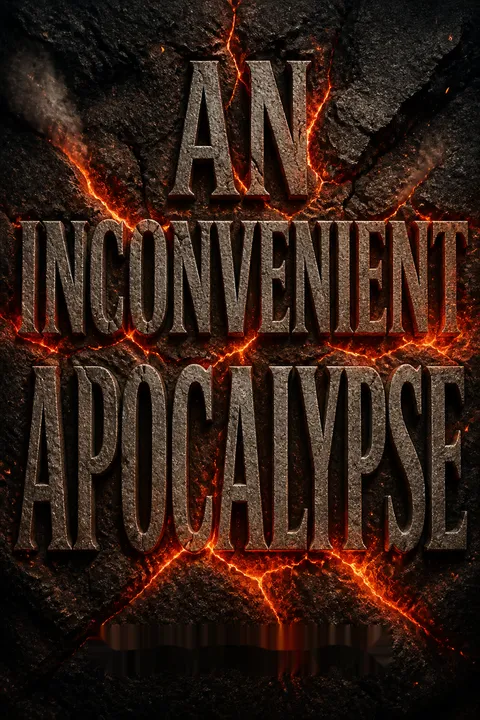
What is "An Inconvenient Apocalypse" by Wes Jackson and Robert Jensen about?
- Explores Environmental Collapse: The book examines the intertwined crises of environmental collapse, climate change, and the fate of humanity, arguing that current social, economic, and political systems are unsustainable.
- Focuses on Human Nature: It delves into the biological and historical roots of humanity’s drive for energy-rich carbon, tracing problems back to the invention of agriculture and the rise of hierarchical societies.
- Challenges Technological Optimism: The authors critique the widespread belief that technological innovation alone can solve ecological crises, emphasizing the need for humility and acceptance of limits.
- Calls for Radical Change: The book advocates for a dramatic reduction in population and consumption, a move toward smaller, more flexible communities, and a new understanding of what it means to be human in the ecosphere.
Why should I read "An Inconvenient Apocalypse" by Wes Jackson and Robert Jensen?
- Honest Assessment of Crisis: The book offers a candid, unflinching look at the scale and complexity of the environmental and social crises facing humanity.
- Unique Perspective: Written by two experienced thinkers with backgrounds in ecology, philosophy, and activism, it combines scientific insight with philosophical reflection.
- Challenges Comforting Illusions: It pushes readers to question common assumptions about progress, technology, and human exceptionalism.
- Practical and Philosophical Guidance: The book provides both a framework for understanding the crises and suggestions for how to respond meaningfully, even in the face of daunting challenges.
What are the key takeaways from "An Inconvenient Apocalypse"?
- Multiple Cascading Crises: Humanity faces interconnected crises—ecological, social, and economic—that cannot be solved in isolation.
- Limits of Human Systems: Current systems based on endless growth and high energy consumption are fundamentally unsustainable.
- Human-Carbon Nature: The drive to seek energy-rich carbon is a core aspect of human nature, not just a product of capitalism or recent history.
- Need for Downscaling: A sustainable future requires fewer people, less consumption, and smaller, more resilient communities.
- Humility and Grace: The authors call for humility in the face of ecological limits and propose a secular concept of "ecospheric grace" as a guiding principle.
How do Jackson and Jensen define "multiple cascading crises" in "An Inconvenient Apocalypse"?
- Interconnected Failures: The term refers to the simultaneous and interacting breakdowns in ecological, social, and economic systems.
- Beyond Isolated Problems: The crises are not discrete issues that can be solved separately; they are systemic and reinforce each other.
- Immediate and Long-Term Threats: These crises create both urgent short-term dangers and long-term existential risks for humanity.
- Demand for Systemic Change: Addressing these crises requires a holistic approach that goes beyond individual actions or technological fixes.
What is meant by "human-carbon nature" in "An Inconvenient Apocalypse"?
- Biological Drive for Energy: The authors argue that all life, including humans, is driven by the need to seek out energy-rich carbon.
- Root of Ecological Crisis: This drive, combined with human cognitive abilities and social cooperation, has led to overexploitation of carbon sources (soils, forests, fossil fuels).
- Not Just Capitalism: The problem predates capitalism and is rooted in the very nature of Homo sapiens since the advent of agriculture.
- Policy Implications: Any solution must account for this deep-seated tendency, not just focus on changing economic systems.
How do Jackson and Jensen critique technological optimism in "An Inconvenient Apocalypse"?
- Limits of Innovation: They argue that faith in technological solutions—what they call "technological fundamentalism"—ignores the biophysical limits of the planet.
- Unintended Consequences: Past technological fixes have often created new problems, sometimes worse than the ones they were meant to solve.
- Renewables Are Not a Panacea: The authors highlight the material and ecological costs of renewable energy infrastructure, challenging the idea that renewables can simply replace fossil fuels at current consumption levels.
- Call for Humility: They advocate for an "ignorance-based worldview," recognizing the limits of human knowledge and the need for caution in deploying new technologies.
What are the "four hard questions" posed in "An Inconvenient Apocalypse," and why are they important?
- Size: What is the sustainable size of the human population?
- Scale: What is the appropriate scale for human communities and social organization?
- Scope: What is the scope of human competence to manage our interventions in the ecosphere?
- Speed: At what speed must we move toward new living arrangements to avoid catastrophe?
- Importance: These questions challenge the boundaries of mainstream political debate and force a reckoning with the fundamental changes needed for sustainability.
How do the authors of "An Inconvenient Apocalypse" address the issue of population and consumption?
- Dual Population Problem: They emphasize both the number of people and the "population of people’s things" (aggregate consumption) as central to ecological overshoot.
- Carrying Capacity: The book argues that Earth’s sustainable carrying capacity is well below current human population and consumption levels.
- Difficult Conversations: The authors acknowledge the moral, political, and practical challenges of discussing population control and consumption reduction.
- Call for Fewer and Less: They advocate for policies and cultural shifts toward fewer people and less material consumption as essential for a livable future.
What is the concept of a "saving remnant" in "An Inconvenient Apocalypse"?
- Biblical Roots, Secular Use: Borrowed from Jewish and Christian traditions, the "saving remnant" refers to the portion of humanity that survives and rebuilds after catastrophe.
- Planning for Collapse: The authors suggest that, given the likelihood of systemic collapse, efforts should focus on ensuring that a remnant can endure and create a more sustainable society.
- Not About Righteousness: The concept is not about being morally superior but about preparing for a future defined by "fewer and less."
- Emphasis on Skills and Stories: The saving remnant will need new stories, practical skills, and community spaces to thrive in a low-energy world.
How do Jackson and Jensen use religious language and concepts in "An Inconvenient Apocalypse"?
- Secularized Religious Ideas: They draw on religious stories and concepts (e.g., the Fall, grace, prophetic and apocalyptic traditions) to frame their analysis, even though they are not religious believers.
- Ecospheric Grace: The authors propose "ecospheric grace" as a secular alternative to divine grace, emphasizing gratitude for the gifts of the ecosphere without claims of human specialness.
- Humility over Hubris: Religious narratives are used to illustrate the dangers of human arrogance and the need for humility in the face of ecological limits.
- Community and Meaning: They recognize the value of religious routines and spaces for fostering community and meaning, which will be important in a post-collapse world.
What practical advice or methods do Jackson and Jensen offer in "An Inconvenient Apocalypse"?
- Focus on What’s Possible: They encourage readers to act within their capacities, challenging themselves to expand what is possible but recognizing human and systemic limits.
- Prepare for Downscaling: Practical steps include learning skills for low-energy living, building resilient local communities, and fostering new stories and identities beyond consumerism.
- Collective Conversations: The authors stress the importance of collective, democratic decision-making about needs versus wants, and about how to manage resources fairly.
- Embrace Frugality and Community: They advocate for a shift from individual consumption to shared spaces, routines, and values that support resilience and mutual aid.
What are the best quotes from "An Inconvenient Apocalypse" and what do they mean?
- "We are all apocalyptic now." – This phrase captures the idea that anyone paying attention to ecological realities must confront the end of current systems and the need for radical change.
- "Life is the scramble for energy-rich carbon." – This definition highlights the biological basis of the ecological crisis and the universality of the drive for energy.
- "Less is less, but less is OK." – The authors challenge the minimalist slogan "less is more," arguing that while the future will involve less material abundance, it can still be meaningful and fulfilling.
- "Hope and fear cannot alter the seasons." – Quoting Chögyam Trungpa, they remind readers that reality is indifferent to human emotions, and that honest engagement with the world is more important than optimism or despair.
- "The old future’s dead and gone / Never to return / There’s a new way through the hills ahead / This one we’ll have to earn." – From John Gorka, this quote encapsulates the book’s message that the future will not be a continuation of the past, and that building a livable world will require effort, adaptation, and humility.
Download PDF
Download EPUB
.epub digital book format is ideal for reading ebooks on phones, tablets, and e-readers.








