

Key Takeaways
Read five personal planets as a system, not a Sun-sign label.
Five distinct lenses. McCord presents the Sun, Moon, Mercury, Venus, and Mars as a compact map of personal energies. The Sun concerns identity and expression; the Moon, emotional needs and daily responses; Mercury, thought and communication; Venus, values, connection, and receiving; Mars, motivation and action. Together, they offer a richer portrait than the familiar Sun-sign shorthand.
Interpret the mix. The book calls these the five personal planets and treats their sign placements as ingredients in an individual chart. Birth time and location help determine some placements, especially the Moon. Two people with the same Sun sign may differ because their other placements add distinct needs, habits, and ways of relating. The practical invitation is to notice how the lenses combine, rather than treating one label as a complete identity.
What's useful is the division of self-understanding into questions people can actually examine: What gives a sense of identity? What feels emotionally safe? How does the mind process a disagreement? What kind of affection feels welcome? How does someone mobilize effort? The five-part structure makes a sprawling chart more approachable without pretending that one placement explains everything. Its main strength is as a vocabulary for reflection. The limitation is that vivid descriptions can feel uniquely accurate even when they are broad, so the chart is most useful when tested against specific lived patterns rather than accepted as a verdict.
Use the Sun's neighboring signs to spot what growth asks of you.
Four points of soul growth. McCord's named framework places a Sun sign alongside three related signs: the preceding sign as an energetic blind spot, the following sign as ongoing development, and the opposite sign as balancing energy. The blind spot points toward qualities that may be less accessible; development suggests capacities to cultivate; the opposite offers a contrasting perspective. These are prompts for growth, not additional Sun signs.
A concrete example. For an Aries Sun, the book associates Pisces with surrender and stepping back, Taurus with patience and follow-through, and Libra with considering other people and relationships. The framework turns a sign description into a set of questions: What am I missing? What skill would help me mature? What perspective could steady my usual approach? McCord sees these points as a way to work with the full zodiac rather than remain inside one identity.
This framework is memorable because it makes development relational. A strength can become limiting when used alone: initiative can turn into impatience, and independence can become isolation. The neighboring signs supply counterweights, helping readers imagine growth as adding a capacity rather than rejecting a personality. That is a generous model of change. Its usefulness does not depend on accepting that a soul chose its birth sign. Even readers who treat astrology metaphorically can use the four positions as a structured exercise in identifying strengths, neglected capacities, and useful alternatives.
Let your Moon name emotional needs, not certify your childhood story.
Needs beneath the surface. The Moon sign is presented as a guide to private feelings, comfort, intimacy, and the responses that shape daily life. The book also links it to a maternal connection, proposing that the birth moment and early experiences of care can leave an emotional imprint. Because birth itself is not consciously remembered, this should be approached as McCord's interpretive lens, not as proof of what a mother felt or what happened.
Use it as a question. A Moon sign can prompt reflection on what creates a sense of home, how someone asks for care, or what happens under stress. McCord suggests comparing family members' Moon signs to think about differences in emotional needs. A useful application is to ask relatives about their memories and needs, while keeping chart-based interpretations separate from verified family history.
The Moon chapter is strongest when it directs attention toward needs that can otherwise remain unnamed: safety, solitude, stimulation, reassurance, or emotional expression. Naming a need can improve communication without requiring an astrological explanation for its origin. The maternal interpretation, however, calls for particular care. A chart cannot establish a parent's inner state at childbirth, and a symbolic account should not be used to manufacture certainty about childhood or family trauma. Reflection can open a conversation; it should not replace evidence, memory, or a person's own account.
Balance your Mercury habits with the opposite sign's missing perspective.
The mind has a style. Mercury describes how a person learns, communicates, takes in information, and makes decisions. McCord recommends looking to the sign opposite Mercury when habitual thinking becomes rigid or stressful. An opposition means two signs sit across from each other on the zodiac wheel. Their contrast can suggest a useful counterbalance, not a demand to abandon one's natural style.
Change the mental altitude. The book pairs Gemini's busy attention to details with Sagittarius's wider view, and Virgo's drive to analyze with Pisces's compassion and willingness to let some questions rest. It also describes Mercury retrograde as an apparent backward motion from Earth's perspective; a person born with natal Mercury retrograde may prefer more time to process before speaking or deciding. The practical move is to notice a mental rut and deliberately try its contrasting perspective.
The opposite-sign idea works as a form of perspective-taking: a detail-focused mind can ask what the larger pattern is, while an expansive thinker can ask which specifics remain unchecked. That is a useful corrective to the instinct to double down on one's default strategy. The book's examples also make clear that balance is not sameness. A reflective person need not become impulsive, and an analytical person need not stop analyzing. The challenge is to select the counter-perspective that helps in a particular moment, rather than treating every contrast as equally relevant.
Build relationships around what you can receive, not only what you give.
Venus and self-worth. Venus describes what someone values, how they connect, what helps them feel loved, and how comfortable they are receiving affection or support. McCord makes self-worth central: a person may give generously yet struggle to accept care, compliments, or help. Venus therefore concerns not just romance, but friendship, personal values, pleasure, and the ability to recognize one's own worth.
Look for reciprocity. The sign descriptions repeatedly ask whether giving and receiving are balanced. A Cancer Venus, for example, may be drawn to caretaking and need stronger boundaries; a Libra Venus may prioritize harmony so much that personal needs go unspoken. In both cases, the work is to express needs directly and notice whether others respond with mutual care. The book frames this as growing self-acceptance, not earning love through service or performance.
The strongest relationship insight here is that generosity and intimacy are not the same thing. If care flows in only one direction, the giver may feel indispensable while remaining unknown. Asking for help or naming a preference makes a relationship more informative: it reveals whether the connection can hold two people's needs. This reframes receiving as participation, not passivity. Astrological labels may help some readers begin the conversation, but the more dependable evidence is the behavior between people: whether they listen, respond, and make room for one another.
Choose an action style your Mars can sustain, then follow through.
Mars is action in motion. McCord connects Mars with desire, physical energy, assertion, confidence, and the way a person pursues goals. Its sign is used to describe a preferred pace and method. Aries Mars may move quickly and need physical outlets; Taurus Mars tends to observe, then persist; Libra Mars may need discussion before deciding; Pisces Mars may rely more on intuition and need room for rest.
Match method to commitment. These contrasts invite practical questions: Does movement clear frustration? Does a steady routine work better than a burst of effort? Is discussion helping a decision, or delaying it? The book emphasizes that action can become more effective when people understand their own patterns and communicate them to others. Mars retrograde is described as a more inward, considered approach to asserting oneself, rather than immediate forward motion.
This account usefully separates motivation from moral worth. A slower pace does not automatically mean laziness, and quick action is not always courage; each method has benefits and costs. The practical test is whether the approach helps someone honor commitments without exhausting themselves or overriding others. That emphasis on fit gives the Mars material a grounded use even for readers who reject planetary causation. The chart can suggest questions about pacing, while completed work, physical experience, and honest feedback provide better guides to whether a strategy is working.
Read the whole chart before turning a sign into a verdict.
Six chart components. The book introduces signs, planets, houses, aspects, elements, and modalities as different layers of interpretation. Signs describe styles of energy; planets identify themes such as communication or desire; houses locate those themes in areas of life. Aspects describe angular relationships between planets, including conjunctions, oppositions, trines, and squares. The four elements are Earth, Air, Water, and Fire; the three modalities are cardinal, fixed, and mutable.
Context changes meaning. A Sun sign is only one part of a chart, and a planet's meaning is shaped by its sign and relationships to other placements. The author also notes that Western Tropical astrology is one interpretive tradition among several. For practical use, start with the five personal planets, then add chart context as needed. This avoids assuming that a short Sun-sign description captures a person's full personality or life experience.
This layered approach explains why the book warns against reducing people to twelve categories. It also puts a limit on easy interpretations: once signs, planets, houses, and aspects interact, a chart becomes more complex than a simple personality quiz. Complexity can enrich reflection, but it can also make a reading difficult to disconfirm, since almost any behavior may be assigned to some placement. A disciplined reader should therefore keep interpretations specific, distinguish observation from explanation, and remain willing to revise a reading when real experience does not support it.
Treat each sign as a spectrum you can consciously redirect.
Traits can shift expression. McCord describes each sign as having a range from lower to higher expressions, which she calls an energy spectrum. A quality is not treated as a fixed destiny: Aries initiative can become impatience, while its conscious form can be courageous leadership; Virgo's eye for improvement can become harsh perfectionism or practical service. The point is to recognize when a familiar strength has tipped into an unhelpful pattern.
Turn interpretation into practice. The book repeatedly recommends journaling, noticing recurring reactions, asking for feedback, and using a contrasting sign's qualities to regain perspective. A sign description is most useful when it leads to a specific question: What am I doing now, what is it costing, and what alternative response could I try? McCord presents astrology as a continuing practice of self-discovery, not a one-time label that removes responsibility for choices.
The spectrum model is the book's clearest defense against fatalism. It gives readers room to acknowledge a tendency without treating it as permission to behave badly or as an unchangeable limit. The distinction between impulse and deliberate expression is also practical: awareness creates a pause in which another response can be chosen. Yet a chart should not be the authority that decides which traits are authentic. The most constructive use is as a prompt for observation, followed by attention to consequences and the freedom to describe oneself in other terms.
Analysis
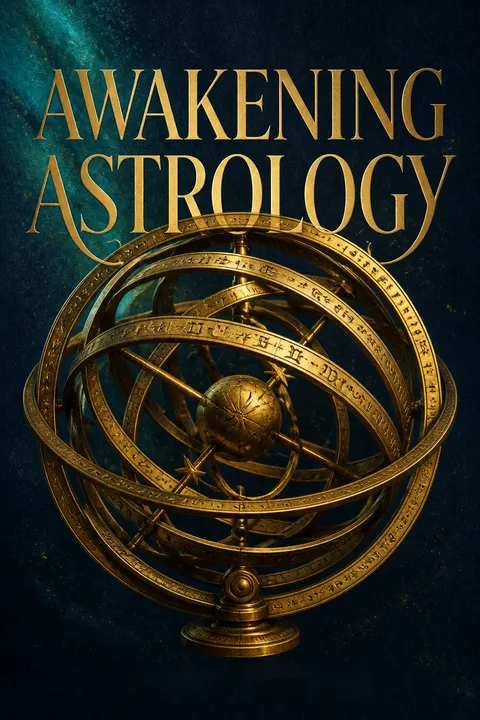
Awakening Astrology is a practical guide to reading five personal placements as a language for self-reflection. Its organizing idea is not that a Sun sign tells the whole story, but that identity, emotional needs, thinking, relating, and action form a more complicated personal pattern. The book's most useful structural move is to turn placements into questions about habits and choices. The four Sun growth points, especially, offer a memorable way to consider strengths, neglected capacities, and counterbalancing perspectives.
The method is psychologically appealing because it gives people an organized vocabulary for experiences that can otherwise feel vague. A reader can use a Moon description to ask what creates emotional safety, or a Mars description to examine pace and motivation. The framework also stresses agency: signs have less helpful and more conscious expressions, and readers are invited to develop rather than submit to a label.
That value should be separated from the book's causal claims. The text presents planetary placements as energetic influences and sometimes treats the Moon sign as insight into a mother's feelings during childbirth or early maternal imprinting. Those claims are not established by the reflective usefulness of the framework. A chart cannot verify a parent's state of mind, explain a remembered event, or diagnose trauma. The book's self-validating approach also risks confirmation bias: readers may notice matching descriptions and overlook mismatches, especially when traits are broad or contradictory.
The most defensible reading is therefore symbolic rather than predictive. Astrology can serve as a set of prompts for noticing behavior, articulating preferences, and discussing differences, provided the person retains authority over their own account. Concrete experience, direct communication, and revisable interpretations should take precedence over chart-based certainty. Under that boundary, the book offers an accessible map for reflection; without it, the map can be mistaken for evidence about who someone must be or why their life unfolded as it did.
Review Summary
Awakening Astrology receives positive reviews, with an overall rating of 4.41/5 stars. Readers praise it as an excellent introduction to astrology and a valuable reference for the five main personal planets. The book is lauded for its fresh approach, insightful content, and approachable writing style. Some reviewers consider it an essential astrology reference, while others appreciate its beginner-friendly content. A few readers found it basic, but most enjoyed the learning experience and plan to keep it as a valuable resource.
People Also Read




Glossary
Five personal planets
Core personal chart lensesThe Sun, Moon, Mercury, Venus, and Mars, treated in this book as the most useful placements for understanding personal identity and everyday patterns. In McCord's framework, they correspond respectively to self-expression, emotional needs, thinking and communication, relating and receiving, and motivation and action. Their combined signs form a more detailed picture than the Sun sign alone.
Four points of soul growth
Four Sun-related growth lensesMcCord's framework for interpreting a Sun sign through four positions: the Sun sign itself, the preceding sign as an energetic blind spot, the following sign as ongoing development, and the opposite sign as balancing energy. Each position suggests a different reflective question about identity, overlooked qualities, possible growth, or useful perspective.
energetic blind spot
Less accessible sign qualitiesIn the book's Sun-sign framework, the zodiac sign preceding a person's Sun sign. It represents qualities the person may overlook or find harder to access, and is offered as a prompt for exploring neglected options or responses. The term is interpretive, not a claim that someone objectively lacks the traits associated with that sign.
ongoing development
A sign for growthThe zodiac sign following the natal Sun sign in McCord's four-point framework. It represents qualities the reader can cultivate to expand or mature their self-expression. The suggested qualities may feel unfamiliar at first, and the framework encourages treating them as possible capacities rather than fixed obligations.
balancing energy
An opposing-sign perspectiveThe sign opposite a planet's sign, or, in the four Sun growth points, the sign opposite the Sun. McCord uses it as a contrasting perspective that can soften habitual responses and help a person consider other needs or approaches. For example, the opposite of a detail-focused stance may encourage broader perspective or greater compassion.
energy spectrum
A range of sign expressionsMcCord's description of each sign as having less conscious and more developed expressions. A tendency such as determination may support persistence in one situation and become stubbornness in another. The spectrum model emphasizes that readers can notice how a trait is operating and choose to cultivate a more constructive expression.
Divine Feminine
Conscious receptive qualitiesThe book's term for a more conscious expression of qualities associated with receptivity, nurturing, trust, creativity, emotion, and connection. McCord links this development especially to Venus and the Moon, and describes it as involving self-acceptance, emotional awareness, and the ability to receive care while maintaining personal needs.
Divine Masculine
Conscious assertive qualitiesThe book's term for a more conscious expression of qualities associated with action, intention, self-assertion, strength, and protection. McCord describes it as emerging through awareness and healing of less conscious patterns, so that confidence and leadership can be expressed with consideration for others rather than domination.
Dancing with the Moon
Working with lunar needsMcCord's phrase for engaging with the Moon sign through emotional reflection, rituals, therapeutic processes, and attention to personal needs. The practice aims to make private feelings and interpretations easier to recognize, communicate, and work with in daily life and close relationships.
Download PDF
Download EPUB
.epub digital book format is ideal for reading ebooks on phones, tablets, and e-readers.








