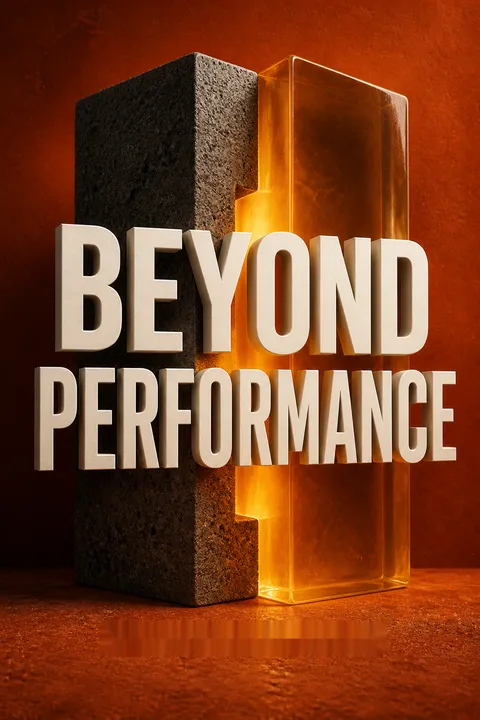


Key Takeaways
Build organizational health alongside results, or today's wins may mortgage tomorrow.
Two jobs at once. Performance is what an organization delivers now. Organizational health is its ability to align people, execute well, and renew itself faster than competitors. The authors argue that neither can substitute for the other. In their analysis, companies in the top health quartile were 2.2 times more likely to have above-median EBITDA margins than lower-quartile companies. They also report that transformations addressing performance and health together were nearly twice as successful as health-only efforts, and nearly three times as successful as performance-only efforts.
Coke's turnaround. When Neville Isdell took over Coca-Cola, he pursued growth while rebuilding morale, shared direction, capabilities, and relationships with bottlers. Within two years, shareholder returns had shifted from negative to positive, while staff turnover fell and employee engagement improved. The lesson is not to trade results for morale, but to build the organizational conditions that make results repeatable.
What's compelling is the shift from treating culture as a pleasant byproduct to treating it as productive capacity. A workforce that shares priorities and can adapt is not merely happier; it can coordinate more effectively. Still, health is harder to measure than revenue, and survey scores can be mistaken for reality. The strongest interpretation is therefore practical: use health measures to identify friction and test whether it changes, rather than treating a high score as proof of durable success.
Treat culture as operating capacity, not corporate wallpaper.
Success can conceal decay. Atari was celebrated for rapid growth, but teamwork weakened, research investment fell, communication broke down, and product quality suffered. Poor games alienated customers, skilled employees left, and the company collapsed. Its failure was not simply a bad product cycle. It had weakened the systems that generated future products.
Contrast, not slogans. Pixar took a different approach: its leaders prioritized building teams able to improve stories, and treated trust and room for failure as necessary ingredients of creative work. The authors also point to IBM under Lou Gerstner, which rebuilt collaboration across business units and reduced bureaucracy while improving its results. These cases suggest that culture is expressed through ordinary decisions about information, investment, accountability, and risk, not through the words on office walls.
The useful distinction is between culture as atmosphere and culture as a pattern of coordination. The latter affects whether bad news travels, whether ideas cross team boundaries, and whether people can correct mistakes before they become expensive. This view also avoids the common trap of romanticizing culture: Pixar's tolerance for experimentation made sense for creative work, but a safety-critical operation needs different guardrails. A healthy culture is not one universal personality. It is a set of habits fitted to the work.
Run change as five questions, not a one-way checklist.
A map for transformation. The book organizes change around the 5As: Aspire asks where the organization is headed; Assess examines readiness; Architect turns the gap into a plan; Act manages implementation; and Advance builds the ability to keep improving. Each stage addresses both business results and organizational health. For example, a plan to improve customer service must consider operational capabilities as well as the mindsets and behaviors that shape customer interactions.
Expect to double back. These stages are frames for thinking, not a rigid sequence. Assessing readiness may reveal that the goal is unrealistic, sending leaders back to refine it. Planning may expose a health constraint that changes the proposed strategy. The process is meant to build an organization's ability to learn and adapt, not merely complete a temporary change program.
The framework's strength is that it makes neglected questions visible. Leaders often move from ambition straight to a list of initiatives, skipping the diagnosis of whether the organization can carry them out. The iterative design is equally important: real systems rarely behave like tidy project plans. A caution is that five labels can create a false sense of completion. Their value depends on whether leaders revisit assumptions when evidence contradicts the original plan.
Set a two-to-three-year destination, then test ambition against evidence.
Make the future actionable. A distant vision can inspire, but a medium-term destination gives people something concrete to organize around. Tata Motors, facing falling demand and a major loss, divided its recovery into phases: first reduce costs, then consolidate at home, then expand internationally. The sequence made a large ambition more manageable without reducing it to a stream of annual targets.
Stretch without distortion. The authors recommend combining data with informed intuition and setting goals that are difficult but attainable. Sears mechanics, pressured to meet a high hourly billing target, performed unnecessary repairs. The goal changed behavior, but not in the intended direction. They also report that transformations with clear aspirations for both health and performance were 4.4 times more likely to be extremely successful than those with performance aspirations alone. Involve a broad group of leaders so goals are understood and owned, not merely announced.
A medium-term horizon balances two common errors: a vision so distant that it cannot guide choices, and short-term targets that encourage people to sacrifice future capacity. The Sears example adds an important design test: ask what people might do to hit the measure when supervision is limited. Co-creation can improve commitment, but it does not replace executive responsibility. Leaders still need to challenge popular targets when market facts or likely side effects make them unsound.
Diagnose the beliefs beneath behavior before prescribing new routines.
Look below the symptom. The discovery process traces organizational outcomes back through management practices and visible behavior to the mindsets shaping that behavior. A bank tried to improve sales by reducing paperwork and supplying sales scripts. Results remained disappointing until interviews uncovered the deeper barrier: many bankers were uncomfortable selling and preferred administrative work. The intervention had addressed the process, not the reason people avoided customers.
Check capability and belief. The authors distinguish capabilities, or what the organization can do, from mindsets that affect whether people will do it. They recommend testing strategic capabilities against three criteria: scarcity in the industry, superiority to substitutes, and difficulty of imitation. Institutional capability depends on technical tools, management systems, and employee behaviors working together. In assessing health, investigate both what is failing and what already works, then focus on a small number of shifts rather than trying to change everything.
This approach helps explain why identical procedures can produce different results in different teams. A process may be sound on paper yet conflict with employees' professional identity, incentives, or confidence. The diagnostic work also gives leaders a chance to hear realities filtered out of formal reporting. But interviews do not reveal a single, objective truth about a culture. Perceptions should be compared across roles and checked against observable behavior, customer experience, and operating data.
Choose a few mutually reinforcing strengths instead of excelling at everything.
Build a context-specific recipe. The Organizational Health Index groups health into nine areas, including direction, leadership, accountability, capabilities, motivation, and innovation. The authors argue that organizations need a basic level across all areas, but should become distinctive in a smaller set of mutually supportive practices. Their research found that organizations in the top quartile on six or more of the 37 practices were likely to rank in the top quartile for overall health.
Four patterns, not one ideal. The book identifies four organizational archetypes: leadership driven, execution edge, market focus, and knowledge core. A retailer competing on customer insight may need a different combination of practices from a professional-services firm built on expertise. Practices can reinforce or undermine one another: incentives and internal competition may boost individual effort, but can work against collaboration needed for innovation. Choose strengths that fit the strategy, existing capabilities, and one another.
The idea of complementary practices is a useful corrective to management fashions that present one preferred culture as universally best. Organizations are systems: a reward, reporting rule, or leadership behavior changes the context in which other practices operate. The archetypes can help leaders ask better questions about fit, but they should not become labels that excuse weaknesses. A distinctive operating model still requires enough competence across the basics, and the right combination can change as the organization and its market change.
Make every business initiative teach the organization how to change.
Plan a portfolio, not a pile. Performance initiatives should be balanced across near-term results, medium-term gains, and longer-term opportunities, while varying how familiar or risky the work is. P&G CEO Alan Lafley narrowed attention to a few core businesses and markets, and also identified work the company should stop. Clear choices prevented its effort from dissolving into too many competing projects.
Influence the human system. The influence model offers four levers for shifting mindsets: a credible story, reinforcement through rewards and working systems, skills for the new behavior, and role modeling by respected people. At P&G, Lafley spent time observing customers and used that behavior to demonstrate the company's intended customer focus. The levers can be built into ordinary performance projects, so employees experience business improvement and cultural change as connected work rather than separate programs.
The portfolio idea links strategy to capacity: every initiative consumes leadership attention, employee time, and money, so the organization must choose what not to do. Pairing initiatives with behavior change makes implementation a learning environment rather than a technical rollout. The four levers also expose contradictions. A story about empowerment will ring hollow if approvals remain centralized or mistakes are punished. Communication is most credible when the operating system visibly supports the behavior being requested.
Pilot the idea, then pilot whether others can repeat it.
Prove value, then prove repeatability. A first pilot tests whether an initiative can work. A second tests whether it can be delivered sustainably by other people and locations. At insurer Eureko, one manager achieved major efficiency gains through personal influence, but the approach did not transfer. A later pilot developed a repeatable method and trained people to lead the rollout. This distinction prevents a charismatic local success from being mistaken for an organization-wide solution.
Match scale to the work. The book describes three rollout patterns: linear, moving location by location; geometric, expanding in increasingly large waves; and big bang, implementing broadly at once. Execution also needs a change engine: a coherent program structure, clear ownership across leaders and employees, and regular evaluation. Track initiative progress, health, business performance, and stakeholder value, then adjust when results or conditions change.
The second pilot tests an often overlooked question: does the intervention work because of its design, or because one unusually capable person is carrying it? That question matters whenever an organization wants to scale. The rollout choices also show why speed is not a virtue in isolation. A rapid launch can be appropriate in a crisis, while complex, high-risk work may need staged learning. Measurement should support correction, not turn the program into a contest to protect the original plan.
Turn transformation into infrastructure, and leadership into a renewable resource.
Make improvement routine. A successful change program should leave behind systems for sharing knowledge, finding improvement opportunities, learning from experience, and providing specialist support. Caterpillar, for instance, created a process for carrying customer-reported problems to investigation teams, dealers, and product development so that a local issue could improve future products and help other customers.
Develop leaders who can endure. Centered leadership describes five capacities: finding meaning, framing difficulty constructively, building relationships, taking action amid uncertainty, and managing energy. These qualities support the ongoing work of improvement, rather than a short burst of transformation. The authors emphasize practice in real work, feedback, and reflection. A leader who inspires change but burns out, or exhausts everyone around them, cannot sustain renewal.
The key transition is from relying on a temporary campaign to making improvement part of how work is organized. Knowledge repositories alone are not enough; people need routines that make useful knowledge easy to find, discuss, and apply. The leadership model rightly treats energy and resilience as operating concerns, not private luxuries. Yet personal resilience should not be used to normalize excessive workloads. Durable improvement requires better systems as well as individuals who can recover from setbacks.
Make senior leaders prove the change through decisions, not speeches.
The top sets the signal. The senior leader must make the transformation personally meaningful, model the desired behavior, build a capable and committed top team, and stay involved where impact is at stake. Employees watch what leaders fund, reward, tolerate, and spend time on. If those signals contradict the change story, the story loses credibility.
One Wells Fargo in practice. CEO John Stumpf led a shift toward better cooperation across business units, aiming to make the bank easier to use and more responsive to customers. The program linked customer-focused initiatives with new ways of working across the company. In its first 500-day phase, cross-selling rose 18 percent to 5.2 products per customer, customer attrition in the community bank fell from about 20 percent to under 10 percent, and the ratio of engaged to disengaged employees rose from 4:1 to 7:1. The organization then applied its collaboration capability to the Wachovia merger.
The Wells Fargo case makes the book's thesis concrete: a shared direction mattered because it changed cross-unit decisions, customer initiatives, and measures of progress together. Senior leaders are unusually powerful signals, but their influence depends on consistency over time, not theatrical gestures. The case is also a reminder to separate contribution from proof. Many changes and favorable conditions can affect results at once, so a compelling success story should be paired with careful evaluation of which mechanisms actually produced the gains.
Analysis
The book's central contribution is not the claim that culture matters. That idea is familiar. Its more useful move is to treat organizational health as a managed capability, alongside financial and operational performance, and to connect that claim to a practical sequence of decisions. The distinction between near-term output and the ability to align, execute, and renew helps explain why a company can look successful while its capacity to succeed is eroding.
The five-stage approach is strongest when read as a diagnostic discipline rather than a universal recipe. It asks leaders to make ambition concrete, assess readiness, select a coherent set of interventions, learn during implementation, and build mechanisms for continued improvement. Its attention to mindsets is especially valuable because it explains why new processes can fail despite apparently rational design. The book's cases show how identity, trust, incentives, and unwritten norms shape what people actually do.
The evidence deserves a measured reading. The authors draw on a very large survey base and report correlations between health and financial performance, as well as survey-based comparisons of transformation success. Those findings make the relationship plausible and practically important, but they do not by themselves establish that health causes a specified share of performance. Organizations with strong results may also have more resources to invest in health, and survey responses can reflect reputation or recent events. The described field tests add support, but the examples are not a substitute for independent, replicated causal research.
That qualification does not undo the framework. It clarifies how to use it: treat health indicators as hypotheses about operating conditions, then check them against customer outcomes, employee behavior, and business results. The book is most convincing when it insists on both-and thinking without pretending that every organization can maximize every dimension at once. Its practical challenge to leaders is to make people-related conditions observable, discussable, and accountable, while remaining alert to measurement's limits.
Review Summary
Beyond Performance receives generally positive reviews, with readers praising its comprehensive framework for organizational change and performance improvement. Many find the book's emphasis on both performance and organizational health valuable. Readers appreciate the practical examples and case studies provided. Some criticize the book for being too dense or repetitive, while others find it an essential resource for leaders and consultants. The book's research-based approach and focus on sustainable performance are frequently highlighted as strengths. Some readers note that the content may be more applicable to large organizations or senior leadership roles.
People Also Read









Glossary
organizational health
capacity to adapt and performThe ability of an organization to align its people, execute effectively, and renew itself faster than competitors so that strong performance can be sustained. In this book, health is broader than employee satisfaction or engagement. It includes the management practices and capabilities that help an organization respond to current demands and shape future opportunities.
5As
five questions for changeA transformation approach organized around five questions: where the organization wants to go, how ready it is, what it must do, how it will manage implementation, and how it will keep improving. The stages are called Aspire, Assess, Architect, Act, and Advance. They are intended as flexible frames, since new information can require leaders to revisit earlier choices.
organizational health index (OHI)
survey of organizational healthA survey tool developed to assess organizational health through employee reports about outcomes and management practices. It covers nine elements of health and 37 practices, giving leaders information about both how an organization is functioning and what actions may be contributing to that condition. The book presents it as a way to establish baselines and compare results across organizations.
Four Archetypes
four patterns of healthy organizationsFour combinations of management practices that can support strong organizational health: leadership driven, execution edge, market focus, and knowledge core. The archetypes describe different ways organizations can build strength, rather than a single ideal culture. Leaders are advised to choose a pattern that fits their strategy and context, while maintaining a sound baseline across essential practices.
discovery process
method for finding root mindsetsA structured inquiry that traces organizational health outcomes through management practices and visible behaviors to the underlying mindsets that shape them. Tools include repeated why-questions in interviews, image-based or card-sorting focus groups, and analysis of organizational texts. The purpose is to identify a small number of beliefs that either support or obstruct the desired change.
influence model
four levers for shifting mindsetsA model for changing mindsets and behaviors by shaping the work context through four levers: a compelling story, reinforcement mechanisms, skills required for change, and role modeling. The model emphasizes that communication alone is insufficient. Employees are more likely to adopt new behavior when the message, incentives, systems, abilities, and examples around them point in the same direction.
change engine
system for sustaining change energyA model for organizing implementation around three linked elements: program structure, broad ownership, and evaluation. Structure connects initiatives to an overall direction, ownership gives leaders and employees responsibility for change, and evaluation tracks progress so the program can be adjusted. The model aims to sustain energy while the organization continues its regular work.
centered leadership
capacities for sustained leadershipA leadership model intended to help people sustain performance and personal resilience during continuous improvement. Its five elements are meaning, framing, connecting, engaging, and energizing. Together, they describe ways leaders can draw motivation from purpose, interpret difficulty constructively, build relationships, act despite uncertainty, and manage the energy needed for themselves and others.
Download PDF
Download EPUB
.epub digital book format is ideal for reading ebooks on phones, tablets, and e-readers.








