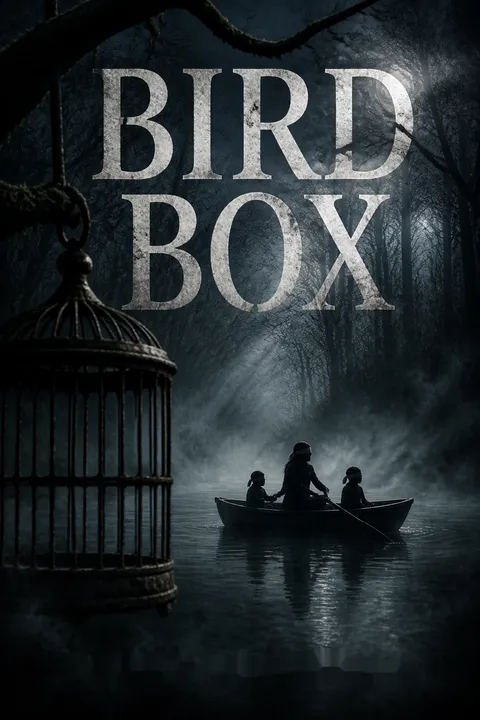


Plot Summary
Fog on the River
At dawn, Malorie wakes the four-year-old children she calls the Boy and the Girl, ties their blindfolds, and leads them from the boarded house to a rowboat. She has spent years preparing for this escape, but the fog gives her a chance she cannot postpone. The children must listen for danger because Malorie will row without sight.
She tells them not to stop, remove their blindfolds, or fall asleep, then pushes away from the dock. The boat catches on the riverbank; the Boy helps free it, and she resumes rowing. Birds and splashes mark a living world she cannot see. The crossing begins with hope, but every sound could announce an animal, a stranger, or the thing that has kept them indoors.
The opening makes motherhood an act of controlled risk. Malorie does not simply choose between a safe house and a dangerous river; she recognizes that safety has become another form of harm. Her children have been protected so thoroughly that they have never seen the sky, and the fog briefly makes movement possible without making it safe. The blindfolds are both practical armor and the inheritance of a childhood shaped by terror. By making the children’s hearing essential to the journey, the scene gives them agency while exposing the cost of Malorie’s training.
News Behind the Curtains
Nine months before the children are born, Malorie lives with her sister Shannon and suspects she is pregnant after a brief encounter with Henry Martin. News reports describe people attacking others and killing themselves after apparently seeing something.
At first Malorie treats the stories as distant sensationalism, but Shannon takes them seriously, and signs of fear spread through their neighborhood: covered windows, hidden faces, and people shielding their eyes. Malorie confirms the pregnancy and tells her parents, who live far away in the Upper Peninsula.
She and Shannon begin covering the house and staying inside as reports multiply. When their parents stop answering, Malorie wants to drive north, but Shannon refuses to risk the trip. The outside world closes in while Malorie prepares to become a mother.
The crisis arrives in fragments rather than as a single visible catastrophe. That gradual accumulation matters psychologically: Malorie can keep treating each report as an exception until ordinary behaviors, such as driving and looking through a window, become suspect. Her pregnancy intensifies the conflict by giving her a future to protect before she knows what threatens it. Shannon’s alarm can look theatrical to Malorie, yet her precautions prove more perceptive than skepticism. The sisters’ disagreement is not a contest between courage and cowardice. It shows how people use different emotional strategies to manage danger when no reliable explanation is available.
A Sister Lost
After months of confinement, Malorie hears a noise upstairs and finds Shannon dead in the bathroom, with scissors in her chest. The exposed window makes the cause feel unmistakable: Shannon must have seen something outside. Malorie calls the police and her parents, but neither answers.
Unable to bring herself to leave the house immediately, she covers Shannon with a scarf, then searches old newspapers for the classified that advertised a refuge in Riverbridge.
She drives there alone, pregnant and grieving, repeatedly closing her eyes when something moves at the edge of her vision. The people inside make her wait while they check she has not brought anything in with her. At last, Tom and the other residents admit her, giving her shelter and a reason to keep going.
Shannon’s death converts an abstract threat into a personal certainty, but it also leaves Malorie with a painful residue of guilt: she survives by leaving her sister behind. Her response is practical before it is resolved. She searches for an address, drives with her eyes intermittently shut, and accepts the risk of strangers because isolation has become more dangerous than distrust. The refuge’s cautious inspection of her shows that compassion and suspicion must coexist. In this world, welcoming someone is not a simple moral gesture. It requires a procedure that acknowledges how easily help itself might carry danger across the threshold.
The Riverbridge House
Tom, a former teacher, introduces Malorie to the housemates: Don, Jules, Felix, and Cheryl. They live without running water, draw from a well, and cover every window. Tom explains that the house belongs to George, who died after encountering one of the beings believed to cause the violence. A hydroelectric plant still supplies power, and the cellar holds canned food, but neither resource is limitless.
Malorie learns the residents use blindfolds outdoors and take turns guiding one another to the well. Tom gives her a bedroom and shares his own grief: his daughter Robin died after the crisis began. His willingness to care for a pregnant stranger comes from knowing that people cannot survive by treating every new arrival as an enemy.
The house is a small social experiment built from logistics and bereavement. Its food inventory, well rope, blindfolds, and chores offer order where public institutions have vanished. Tom’s hospitality is not naïve; it is a deliberate refusal to let fear dictate every relationship. His disclosure about Robin also establishes a bond with Malorie through loss, while distinguishing their responses. Malorie is forced to imagine a future child; Tom lives with the irreversible absence of one. Their shared grief gives the household emotional cohesion, but the dwindling supplies ensure that care will eventually face material limits.
Two Pregnancies, One Table
Two weeks after Malorie arrives, the housemates gather for a rare evening of music and rum. The radio host Rodney Barrett, one of their last connections to the outside, takes his own life on air. Almost immediately, a pregnant neighbor named Olympia knocks at the door. Tom lets her in despite Don’s warning that the cellar stores cannot feed everyone indefinitely.
Olympia is about as far along as Malorie and has lost contact with her husband, an air-force serviceman. Her warmth softens the house, but two impending births sharpen its practical anxieties: no doctor, no medicine, and no clear plan for delivery. Malorie and Olympia become companions in a place where the future is frightening, but neither woman has to face it entirely alone.
Olympia’s entrance tests the refuge’s ethics at the point where generosity becomes costly. Don sees an additional mouth; Tom sees a person whose need is immediate. Both are responding to real conditions, which prevents the disagreement from becoming a simple morality play. The pregnancies create a parallel bond, but they also make the house’s fragility concrete: survival now includes childbirth, not merely food and shelter. The radio host’s death punctures the residents’ remaining sense of connection to a larger society. Their music-filled evening cannot restore normal life, yet it briefly lets them practice being a community rather than a collection of people waiting for disaster.
The Well Goes Quiet
Tom tells Malorie how George tried to find a safe way to view the beings indirectly. George recorded the outside through a video camera, watched the footage while tied to a chair, and died after whatever he saw drove him to tear against the ropes.
The experiment destroys the house’s hope that a screen or altered viewpoint might offer protection. Later, Felix hears unexplained movement while fetching water from the well and runs back, convinced something may have been inside it.
The residents barricade doors and windows, then face an immediate problem: they are running out of safe drinking water. Tom drinks from the questionable bucket after the group locks him alone in a bedroom. He emerges unharmed, and the household resumes using the well.
George’s experiment establishes the limits of curiosity in a world where knowledge can be lethal. Tom remembers him not as foolish but as a person whose drive to solve problems outran the protections available to him. Felix’s frightening sound then turns uncertainty into a material crisis: without water, the household cannot wait indefinitely for proof. Tom’s decision to test the bucket resembles George’s willingness to act, but it is narrower and shared with the group. The episode reveals that survival requires experiments, while also showing why every experiment produces fear. A successful test can restore routine without resolving the danger that prompted it.
Dogs Against Darkness
Tom argues that the household cannot keep waiting indoors, so he and Jules leave wearing homemade helmets, carrying weapons, and using broomsticks to navigate. They search nearby homes for dogs that might guide or warn them. After a dangerous night among abandoned houses, they return with two huskies and a box of birds that grow louder when someone approaches.
The dogs can lead them through streets; the birds can alert the house to visitors. The success is real, but not uncomplicated: the men have encountered bodies and the remains of families who could not escape. Their return gives the residents new tools and a glimpse of progress, while confirming that every step outside carries a human cost.
Tom’s expedition transforms ingenuity from private speculation into collective action. The improvised helmets, measured routes, dogs, and birds do not defeat the threat; they create narrow, usable margins of safety. This distinction keeps the household’s hope grounded in work rather than miracle. The dead families encountered along the way also make the abandoned suburb legible as more than a backdrop. Each empty home contains a failed attempt at survival. Tom’s willingness to leave is emotionally tied to Robin: he keeps acting in a world that took his daughter, partly because action is how he continues to care for the living.
The Notebook in Gary's Case
Gary, a middle-aged stranger with a briefcase, arrives asking for food and shelter. The housemates vote to admit him, though Don objects. Gary describes a former refuge where a man named Frank believed the beings were harmless and blamed people’s fear for the violence. Frank’s writings became increasingly hostile, and Gary claims Frank eventually tore down the window coverings and left.
Don, who has long feared human lawlessness as much as the beings, is drawn to Gary’s account. The two spend more time together, discussing whether people make themselves go mad by expecting it. Malorie notices the growing alliance and distrusts Gary’s certainty, but she cannot yet explain why his polished theories make the house feel less secure.
Gary brings a competing explanation into a community whose routines depend on accepting the danger as real. His account appeals to Don because it offers an alternative to helplessness: if fear itself is the cause, then disciplined belief might restore control. This is psychologically seductive, particularly for someone exhausted by rules that have not produced a cure. Malorie’s unease is initially less articulate than Don’s arguments, which makes the coming conflict a struggle over credibility as well as safety. The briefcase functions as a concrete object around which suspicion can gather, while Gary’s eloquence gives him influence beyond his status as a newcomer.
The Door Opens Again
Tom and Jules set out again, this time measuring a three-mile route to Tom’s home so they can bring back medicine. They use the dogs and a repeated song to keep their steps on course. The journey takes a week, and the house deteriorates into anxious arguments about whether the men are dead.
Tom and Jules return with food, medicine, and a phone book. Before they arrive, Malorie secretly searches Gary’s briefcase and finds Frank’s notebook. Its handwriting matches the pages Gary described, and its author vows to remove the coverings and unlock the doors.
Malorie recognizes that Gary had concealed possessing the notebook. At dinner she exposes the lie, and the housemates vote to expel him. Gary leaves wearing one of Tom’s helmets, while Don’s trust in Malorie and the group fractures.
This turning point braids practical progress with a collapse of trust. Tom and Jules’s return proves that measured risk can bring food and medicine, but Malorie’s discovery shows that danger can also sit quietly inside the house. Gary’s false account is not merely a factual inconsistency; it makes every earlier conversation newly suspect. The vote to expel him protects the household from a known threat while creating another uncertainty, because the group can no longer monitor him. Don’s alienation is especially consequential. The refuge depends on shared judgment, and the same vote that enforces a boundary deepens the division that Gary cultivated.
Labor Beneath the Roof
After Gary is expelled, he does not leave the neighborhood. Don secretly helps him remain in the house, where Gary continues persuading him that the beings are harmless. When Malorie and Olympia go into labor, the household moves them to the locked attic, considered the safest room. As the women struggle through delivery, Don pulls down the coverings and opens the house to the outside.
The residents are attacked in the resulting chaos. Gary appears in the attic and explains that he has been watching the beings without going mad. Olympia sees one, loses her grasp on reality, and dies after giving her newborn daughter to Malorie. Malorie delivers a son, covers both babies’ eyes, and survives while the rest of the household is lost.
Childbirth makes the body both the site of new life and the place where control can fail. Malorie and Olympia must trust other people at the exact moment their physical vulnerability is greatest. Don’s betrayal follows a psychological progression: Gary’s theory offers him relief from fear, then becomes a justification for removing the protections on which the household depends. Olympia’s final act of giving Malorie her baby preserves one small instance of care amid catastrophe. Malorie’s first act as a mother is not to see her son’s face, but to shield it. Protection here is costly, immediate, and inseparable from grief.
A Telephone After Death
With both newborns in her arms, Malorie follows the ringing telephone through a house she cannot safely look at. She speaks to Rick, who tells her about Tucker, a self-sufficient community with food, medicine, and a route along the river. The river splits into four channels; she must take the second from the right and open her eyes at a signal. Malorie cannot leave immediately.
She cleans the house over months, buries the dead near the well, and raises the children alone. She calls Rick again when she can, but the telephone lines eventually fail. Four years pass. She teaches the children to identify sounds, navigate familiar paths, and keep their blindfolds on, while wondering whether safety has become another kind of prison.
The telephone call offers infrastructure and hope, but not rescue. Rick cannot take the risk of coming for Malorie, so the possibility of a safer life depends on her recovering enough strength to make the journey herself. Her years of cleaning and caregiving are not a pause in the plot; they are the labor that makes departure conceivable. The graves around the well bind daily survival to mourning, as each trip for water crosses the memory of the lost household. Malorie’s instruction gives her children remarkable competence, yet the same discipline narrows their world. Her eventual decision must reckon with both sides of that inheritance.
The Microphones and Victor
Alone with two babies, Malorie remembers Tom’s idea of using microphones and amplifiers to detect movement outside. She blackens a car’s windshield, pads its bumpers, and takes Victor, Jules’s border collie, to search for equipment. After repeated blind drives, she finds a bar and locates microphones on its stage. Victor leads her to a cellar, where he encounters something that drives him mad.
He attacks the air, injures himself, and dies while Malorie gathers the equipment. Unable to abandon the babies, she leaves with the microphones and returns home by following the car’s odometer, briefly opening her eyes to check it. The new alarm system helps her protect the house, but its price deepens her isolation.
Malorie’s search marks a shift from inheriting Tom’s plans to adapting them herself. The microphones are not simply useful equipment; they represent her decision to act without waiting for a stronger or more experienced person to lead. Victor’s fate destroys the hope that animals might be immune to the beings’ effects, and it makes Malorie’s technical success inseparable from grief. Her brief removal of the blindfold is not a liberated gaze but a desperate instrument check, undertaken because the babies depend on her return. The episode complicates competence: the skill that keeps a person alive does not spare them from the losses required to use it.
A Man Without a Blindfold
On the river, the Boy hears an engine approaching. A man in another boat stops beside them and claims he has been traveling with his eyes open. He urges Malorie to remove her blindfold and argues that she is depriving the children of the world. When she refuses, he moves closer and threatens to take the blindfolds himself.
He says he has seen one of the beings, then begins to laugh and shout as his mind unravels. Malorie pushes the rowboat free from the bank and rows away while the children hold their places. The man’s voice fades behind them. Malorie does not hate him; she feels sorrow for someone whose brief certainty has turned into another danger on the river.
The stranger makes the central conflict intimate: he does not attack with a weapon but with an argument about what childhood should contain. His appeal to beauty is emotionally powerful because Malorie herself mourns what her children have never seen. Yet his certainty becomes coercive, and his eventual breakdown demonstrates the peril of mistaking confidence for proof. The children’s obedience protects them, but Malorie’s response is not uncomplicated triumph. She recognizes that the man may have wanted to help before fear and exposure overtook him. The encounter preserves moral ambiguity without weakening the practical rule: in this world, an invitation to look can be fatal.
Wolves at the Bank
Later, the Boy detects movement in the trees, and the rowboat strikes the bank. A pack of wolves attacks. One tears Malorie’s shoulder while the children scream and the boat catches between two stumps. Malorie reaches forward, feels the wood, and shoves the boat free before the animals can climb aboard. She ties a strip of her jacket around the wound and keeps rowing, though blood loss and pain weaken her.
Eventually she rows against the current without realizing it. The Boy places his hands over hers and helps correct their course. Malorie then faints. While she is unconscious, the children use the paddles together to free the boat from another snag. When she wakes, she finds them still blindfolded and still moving downstream.
The wolf attack exposes the limits of Malorie’s control more brutally than the stranger did. She can train the children, but she cannot prevent injury, exhaustion, or the moment her body stops obeying her. The Boy’s help reverses their established relationship without erasing it: his competence exists because Malorie taught him to listen, and now it temporarily keeps her alive. Her collapse also reveals that the children are not merely extensions of her senses. They can make decisions together in her absence. Their survival offers pride and terror at once, because it means they are capable of continuing without her.
Tom Calls from the Fork
As the river nears its split, birds in the trees begin shrieking and falling into the boat. The Boy recognizes a voice beneath the noise: a recording of Tom’s message, placed at the channel by Rick’s community to guide Malorie. She understands that the signal means she must open her eyes and choose the correct branch.
Before she can act, the boat stops beside something in the water. The unseen presence pulls at her blindfold, then releases it. The Boy listens carefully and tells Malorie that it is moving away. She trusts his hearing, even as the birds continue to die around them and Tom’s recorded voice repeats. The journey has delivered her to the choice she feared most.
The recording turns Tom’s care into a presence that survives his death. He cannot row beside Malorie, yet his voice has been positioned to bring her toward a community and a decision. The bird attack makes that assistance harder to receive: the alarm system that once protected the house becomes a mass of noise and falling bodies. The creature’s touch tests whether Malorie’s protection is merely fear or a choice she can consciously reclaim. By asking the Boy to assess what is happening, she uses the very training she once worried had taken too much from him. Trust becomes an act of listening rather than sight.
Color Beyond the Blindfold
At the fork, Malorie asks the children to confirm that the presence has gone behind them. Trusting their answer, she opens her eyes long enough to identify the second channel from the right. The colors overwhelm her, so she closes her eyes and rows onward until the boat strikes the community’s warning fence.
Constance, a sighted resident, guides Malorie and the children inside. Rick welcomes them at Tucker, a former school now operating as a self-sufficient refuge.
Malorie learns that many residents blinded themselves after an earlier attack killed people in their settlement, though they no longer consider blindness necessary behind their defenses. Once she sees that the children are safe, Malorie removes their blindfolds. She names them Tom and Olympia, honoring the people whose care shaped their lives.
The ending does not claim that safety has been fully solved. Tucker’s history shows that another community has paid dearly to survive, and its residents carry the consequences in their bodies. What changes is the scale of possibility: food, medicine, work, and other people replace the isolated house as the children’s world. Malorie’s brief look at the river is a controlled passage between fear and knowledge, not a simple cure. Naming the children gives them an identity beyond the roles imposed by survival. The names also preserve a bond with the dead without making the children responsible for repeating their lives.
Analysis
Bird Box turns perception into a material danger. Seeing is not simply a source of knowledge; it can destroy the observer’s ability to remain connected to other people. The threat therefore reverses the usual moral priority placed on visibility and revelation. Malorie survives by refusing information that would ordinarily be understood as necessary, then compensates through listening, memory, and trust. Her children’s finely trained hearing is both an extraordinary resource and evidence of what fear has taken from their childhood.
The story’s shelters are never absolute. The Riverbridge house has food, electricity, a well, and communal routines, yet supplies diminish and trust can fail from within. Tom’s inventions create limited protections rather than solutions. His interest in testing ideas contrasts with Malorie’s increasingly intimate knowledge of their costs. Her decision to leave is not a rejection of his influence; it grows from the persistence he modeled, carried into a risk he cannot take for her.
The novel also examines how people use explanation to manage helplessness. Gary’s theory appeals to Don because it offers a way to reclaim agency, while Malorie’s suspicion begins with inconsistencies she cannot immediately prove. Their conflict shows that skepticism can be valuable, but certainty can turn skepticism into another form of dogma. The danger is not only believing too much or too little. It is allowing a preferred explanation to overrule the concrete consequences of one’s actions.
At Tucker, survival has required blindness, collective labor, and painful compromises. The community offers Malorie safety without restoring the world she lost. Her brief look at the river and her children’s first sight of the facility mark a change in what is possible, not a clean return to normality. The ending’s force comes from this modest expansion: after years of treating the outside as an unnamed threat, Malorie reaches a place where people can build, farm, heal, and share responsibility. Hope becomes credible because it is organized and imperfect, not because danger has vanished.
Review Summary
Bird Box is a chilling post-apocalyptic thriller that has captivated readers with its unique premise and atmospheric writing. The story follows Malorie as she navigates a world where seeing something mysterious drives people to madness and violence. Readers praise the book's tension, suspense, and ability to evoke fear of the unknown. While some found the ending unsatisfying, most were impressed by the novel's originality and its exploration of survival in a world where sight becomes deadly. The book's effectiveness in creating a sense of dread and its character-driven narrative have made it a standout in the horror genre.
People Also Read








Characters
Malorie
Mother at the thresholdMalorie is a young woman whose pregnancy coincides with the collapse of ordinary life. She begins as a skeptical observer, then becomes a resourceful survivor whose decisions center on keeping her children alive. Her discipline is formidable: she develops routines, teaches the children to listen, and turns scraps of equipment into protection. That discipline also troubles her, because she knows fear has shaped their childhood and limited what they can experience. Malorie is neither naturally fearless nor emotionally untouched; she keeps moving while grieving Shannon, Tom, and the life she remembers. Her deepest conflict is how to protect her children without mistaking mere survival for a life worth having.
Tom
The house's hopeful inventorTom is a former teacher and father whose daughter died during the crisis. He responds to loss by making plans: he studies the house, invents protective gear, and volunteers for dangerous trips that might improve life for everyone. His curiosity is practical as well as intellectual, but George’s fate makes clear that investigation can carry terrible consequences. Tom’s steadiness helps Malorie imagine a future beyond immediate fear. He does not erase danger with optimism; he argues that people must test possibilities rather than surrender to stagnation. His combination of grief, ingenuity, and hospitality makes him a moral center of the household.
Shannon
Malorie's protective sisterShannon is Malorie’s younger sister and housemate before the crisis fully overtakes their lives. More dramatic and immediately alarmed than Malorie, she follows the unfolding reports closely and urges precautions. Their familiar arguments reveal affection as much as friction: they share a home, habits, family history, and a sense of humor. Shannon’s fear makes her attentive to changes that Malorie initially dismisses. Memories of their childhood closeness later give Malorie a treasured connection to the open sky and to a world that existed before the blindfolds.
Don
The wary ration keeperDon is one of the refuge’s earliest residents, a careful and often combative man who worries about food, risk, and the possibility of violent survivors. His skepticism serves a genuine purpose: the group cannot afford to ignore shortages or open its door thoughtlessly. Yet prolonged uncertainty leaves him vulnerable to explanations that promise more control than the evidence supports. Don’s need to challenge others is partly a defense against helplessness, though it can harden into distrust. His changing alliances reveal how fear can make a person seek certainty even when that certainty threatens the people around him.
Olympia
The neighbor who knocksOlympia is a pregnant neighbor who reaches the Riverbridge house after losing contact with her husband. Gentle, open, and socially warm, she carries traces of ordinary domestic life into a household organized around precautions. Her companionship gives Malorie someone who understands the bodily and emotional uncertainty of pregnancy in a world without doctors. Olympia is less practiced than Malorie at living under constant threat, but her kindness is not weakness. She helps make the refuge feel briefly like a home rather than a bunker, and her hopes for motherhood expose what the crisis has taken from the people inside it.
Gary
The persuasive outsiderGary arrives with a briefcase, an elaborate manner, and a story about a former refuge. He presents himself as observant and rational, especially when describing people who believe the beings cause the violence. His account appeals to residents who are tired of living by rules they cannot verify. Gary’s language is polished enough to make speculation sound like expertise, and he understands that people under pressure long for a theory that restores choice. His presence forces the household to decide how much trust a stranger’s apparent intelligence deserves, particularly when his claims challenge the precautions keeping them alive.
Jules
Tom's steadfast companionJules is a physically capable housemate and a close companion to Tom on dangerous expeditions. He once owned Victor, and his affection for the dog shows a tenderness that contrasts with the harsh routines of survival. Jules supports practical efforts to improve the household while remaining alert to what their plans might cost. His experience with dogs helps the group turn animals into guides, though he never treats that work as risk-free. He is loyal without being merely obedient, and his presence gives Tom a partner for decisions too dangerous to attempt alone.
Felix
The nervous callerFelix is one of the younger residents, sociable and often eager to keep the household’s spirits from collapsing. Before communications fail, he makes repeated calls in search of other survivors. He helps Tom and Jules on their expeditions and takes part in the group’s improvised routines. Felix’s fear is visible rather than hidden, especially when he hears something at the well, but he continues to do necessary work. His emotional openness gives the house a counterweight to Don’s suspicion and Tom’s purposeful optimism.
Cheryl
The household's steady workerCheryl is the only other woman among the first residents and contributes practical labor to the refuge, from washing clothes to caring for the birds. She can be blunt, particularly when the group takes on new responsibilities, but her caution comes from an understanding of how little margin they have. Cheryl has lost contact with her parents, giving her a private grief beneath her capable manner. Her daily care of the birds creates a modest connection to the outside world and gives her a task that feels like a continuation of the person she was before the crisis.
The Boy
Malorie's keen listenerMalorie’s son grows up blindfolded and learns to distinguish sounds with exceptional precision. She depends on his hearing to navigate the river, but he is more than a tool for survival: he notices her distress and acts when she cannot. His quiet discipline reflects the education Malorie has given him, while his moments of uncertainty and fear reveal the child beneath it. His eventual name is connected to the adults whose ingenuity and care helped shape his world.
The Girl
Malorie's patient observerMalorie’s daughter is raised alongside her brother with strict rules about listening and keeping her eyes covered. She is attentive and patient, but her questions reveal curiosity that her mother’s instructions cannot entirely extinguish. During the river journey, she reports what she hears and persists through discomfort and fear. Her later name honors the pregnant neighbor whose kindness helped Malorie endure the refuge years.
Victor
The loyal border collieVictor is Jules’s border collie and a familiar presence in the Riverbridge house. His alertness makes the humans wonder whether animals can detect dangers they cannot see. Malorie later relies on him while searching for equipment, trusting his guidance in streets she must cross blind. Victor represents companionship and practical help, but also the limits of assuming animals are protected from the crisis.
Rick
The voice beyond the houseRick is a representative of Tucker, a community organized around blind safety and self-sufficiency. He cannot come to Malorie, but he explains how she can reach the facility and gives her a reason to imagine a life beyond the shuttered house. His practical instructions are paired with an honest acknowledgment of the danger involved. Rick represents not a miraculous rescue but a functioning society that has learned, imperfectly, how to adapt.
George
The refuge's restless theoristGeorge owns the Riverbridge house and invites strangers to shelter there. Curious and determined, he tests a theory that indirect viewing might make the beings safe to observe. His experiment leaves Tom with both a warning and an enduring question about how far people should go in pursuit of knowledge.
Frank
The absent dissenterFrank is a former member of Gary’s earlier refuge, known through the writings Gary describes. He rejects the community’s belief that the beings cause the violence and records his increasingly hostile ideas in notebooks. His unseen presence matters because competing explanations can be as disruptive to a frightened group as an external threat.
Constance
Tucker's sighted guideConstance is a sighted resident who meets Malorie at Tucker’s river entrance. She guides the injured mother and her children from the boat into the facility, offering a first experience of practical help beyond the Riverbridge household. Her confidence contrasts with the residents who chose blindness for protection, showing that the community has developed more than one way to live with the danger.
Robin
Tom's remembered daughterRobin is Tom’s young daughter, remembered as perceptive, curious, and fond of details other people overlook. Her death shapes Tom’s grief and helps explain why he continues trying to create a safer future for the people around him. She remains a presence in his choices, though the household knows her chiefly through his memories.
Plot Devices
Blindfolds
Protection through darknessThe beings cause people who see them to become violently unstable, so survivors cover their eyes outdoors and shield windows indoors. Blindfolds allow characters to move through the world, but they replace sight with dependence on touch, sound, and trust. Malorie makes them central to her children’s upbringing, using strict routines to keep the children safe. The cloth also becomes a psychological boundary: it protects against what is outside while limiting what the children can know about the world they are meant to inherit.
Sound Training
Hearing as navigationBecause sight is dangerous, Malorie teaches the children to identify footsteps, birds, branches, water, and distant movement. Their practice begins as a survival measure and becomes essential on the river, where their reports help her avoid danger and correct her course. The children's exceptional hearing gives them meaningful agency, especially when Malorie is injured or unconscious. It also reflects the cost of their upbringing: they have been trained with a rigor that ordinary childhood would never require.
Bird Alarm
A living warning systemTom brings home birds whose calls grow louder when someone approaches their box. The residents use them to detect visitors without looking outside, and Cheryl takes responsibility for feeding them. The birds turn an ordinary animal behavior into a practical alarm, letting the household respond to knocks and movement. Their role also points to the story’s uncertainty about animals: birds and dogs can help humans, but they are not guaranteed to be immune to the beings’ effects.
Frank's Notebook
Doubt made portableGary’s account of Frank’s writings introduces a theory that the beings are harmless and that human expectation produces the violence. When Malorie discovers the notebook in Gary’s briefcase, she realizes he has concealed an important part of his story. The notebook gives physical form to ideas that might otherwise remain a persuasive conversation. It also forces the household to decide whether a person’s theories, behavior, and omissions are enough to justify excluding him from shelter.
Tom's River Recording
A voice marks the routeAfter Malorie reaches the river fork described by Rick, a speaker plays a recording of Tom’s voice. The message confirms that she has reached the intended route and prompts the most frightening choice of the journey: opening her eyes long enough to identify the correct channel. The recording links Tom’s earlier attempts to improve the household’s safety with the final path out. It serves as guidance, but it cannot make the decision for Malorie or protect her from what waits beside the boat.
FAQ
Synopsis & Basic Details
What is Bird Box about?
- Post-apocalyptic survival story: Bird Box follows Malorie, a woman navigating a world where seeing mysterious entities causes madness and death. She must protect herself and her children by remaining blindfolded.
- Perilous journey for safety: The story centers on Malorie's desperate attempt to reach a rumored safe haven by traveling down a river, relying solely on her children's hearing and her own instincts.
- Exploration of fear and trust: The narrative delves into the psychological impact of living in constant fear, the fragility of human connections, and the lengths people will go to survive in a world gone dark.
Why should I read Bird Box?
- Unique premise and suspense: The novel offers a fresh take on the post-apocalyptic genre, creating intense suspense through the unseen threat and the characters' reliance on senses other than sight.
- Psychological depth and character development: Bird Box explores the complex emotions of fear, paranoia, and hope, showcasing the resilience of the human spirit and the evolution of Malorie as a character.
- Thought-provoking themes: The story raises questions about the nature of fear, the power of belief, and the importance of human connection in the face of unimaginable horror, making it a compelling and memorable read.
What is the background of Bird Box?
- Global societal collapse: The story is set in a contemporary world that has been rapidly overtaken by an unexplained phenomenon causing people to become violently insane and suicidal upon seeing something.
- Focus on psychological horror: The background emphasizes the breakdown of social structures and the psychological impact of the unseen, creating a sense of dread and paranoia.
- Limited information on the cause: The novel deliberately avoids explaining the origin or nature of the entities, focusing instead on the characters' reactions and survival strategies, enhancing the mystery and fear.
What are the most memorable quotes in Bird Box?
- "Under no circumstances will either one of you remove your blindfold. If you do, I will hurt you.": This quote highlights Malorie's desperate measures to protect her children, showcasing the harsh realities of their world and her fierce determination.
- "You are saving their lives for a life not worth living.": This internal thought reveals Malorie's internal conflict, questioning the value of survival in a world devoid of normalcy and the vastness of the sky.
- "They can't haunt you forever. They can't force you to live like this forever. You know that, miss?": This quote, spoken by the man on the river, encapsulates the central conflict of the story, challenging the characters' reliance on fear and the possibility of moving beyond it.
What writing style, narrative choices, and literary techniques does Josh Malerman use?
- Limited third-person perspective: The narrative primarily follows Malorie's point of view, creating a sense of intimacy and allowing readers to experience the world through her limited senses and emotional state.
- Emphasis on sensory details: Malerman uses vivid descriptions of sounds, smells, and tactile sensations to build suspense and immerse the reader in the characters' world, compensating for the lack of visual information.
- Non-linear timeline and flashbacks: The story alternates between Malorie's present journey and her past experiences, gradually revealing the events that led to the current situation and adding layers of complexity to her character.
Hidden Details & Subtle Connections
What are some minor details that add significant meaning?
- The color purple: The recurring presence of purple stains, especially blood, throughout the house foreshadows the violence and madness that have occurred there, and the lingering trauma.
- The bicycle horns: The children's entertainment with bicycle horns highlights their limited world and the small joys they find, emphasizing the sacrifices they've made for survival.
- The well water: The well water, initially seen as a source of life, becomes a symbol of potential contamination and danger, reflecting the characters' growing paranoia and the fragility of their safety.
What are some subtle foreshadowing and callbacks?
- The classified ad: The classified ad for a "safe house" foreshadows Malorie's journey and the hope she clings to, while also highlighting the desperation of the times.
- Tom's stories about Robin: Tom's stories about his daughter, Robin, foreshadow his own tragic end and the dangers of the new world, while also emphasizing his love for his child.
- The mention of the Upper Peninsula: The early news reports from the Upper Peninsula foreshadow the eventual fate of Malorie's parents, creating a sense of dread and loss.
What are some unexpected character connections?
- Malorie and Tom's shared grief: Both Malorie and Tom have lost loved ones in the chaos, creating a bond between them and highlighting the shared trauma of the new world.
- Don and Gary's alliance: The unexpected alliance between Don and Gary reveals the vulnerability of even the most skeptical characters to manipulation and the dangers of internal division.
- Jules and Victor's bond: The strong bond between Jules and his dog, Victor, emphasizes the importance of companionship and loyalty in a world where human connections are fragile.
Who are the most significant supporting characters?
- Tom: Tom's optimism and resourcefulness provide a counterpoint to the darkness of the world, and his ideas and actions drive much of the plot, making him a crucial figure in Malorie's journey.
- Jules: Jules's loyalty and bravery make him a valuable ally to Tom, and his actions highlight the importance of companionship and the willingness to take risks for the greater good.
- Don: Don's skepticism and internal conflict serve as a cautionary tale, highlighting the dangers of division and the vulnerability of even the most hardened characters to manipulation.
Psychological, Emotional, & Relational Analysis
What are some unspoken motivations of the characters?
- Malorie's fear of failure: Malorie's actions are driven by a deep-seated fear of failing to protect her children, leading her to make difficult and often harsh decisions.
- Tom's desire for redemption: Tom's actions are motivated by a desire to atone for the loss of his daughter, seeking to find a way to make the world safer for others.
- Gary's need for validation: Gary's actions are driven by a need to validate his beliefs and prove his superiority, leading him to manipulate others and ultimately betray the group.
What psychological complexities do the characters exhibit?
- Malorie's internal conflict: Malorie struggles with the balance between protecting her children and allowing them to experience the world, highlighting the psychological toll of living in constant fear.
- Tom's idealism vs. pragmatism: Tom's optimism and idealism are constantly challenged by the harsh realities of the new world, forcing him to make difficult choices that test his beliefs.
- Don's skepticism and paranoia: Don's skepticism and paranoia reveal the psychological impact of the unseen threat, highlighting the dangers of internal division and the fragility of trust.
What are the major emotional turning points?
- Shannon's death: Shannon's death is a major emotional turning point for Malorie, forcing her to confront the reality of the new world and the need to protect herself and her unborn child.
- Tom's death: Tom's death is a devastating blow to the group, shattering their sense of hope and forcing them to confront the fragility of their existence.
- The encounter with the man on the river: The encounter with the man on the river forces Malorie to confront her fears and the possibility of madness, highlighting the psychological toll of living in constant fear.
How do relationship dynamics evolve?
- Malorie and Tom's bond: Malorie and Tom develop a deep bond based on shared grief and a mutual desire to protect others, highlighting the importance of human connection in the face of adversity.
- The housemates' fragile community: The housemates form a fragile community based on shared survival, but their relationships are constantly tested by fear, paranoia, and the threat of betrayal.
- The breakdown of trust: The arrival of Gary and his manipulation of Don lead to a breakdown of trust within the group, highlighting the dangers of internal division and the fragility of human connections.
Interpretation & Debate
Which parts of the story remain ambiguous or open-ended?
- The nature of the creatures: The novel deliberately avoids explaining the origin or nature of the entities, leaving their true form and intentions ambiguous and open to interpretation.
- The extent of the madness: The novel leaves the extent of the madness and its effects on different individuals open-ended, raising questions about the nature of sanity and the power of belief.
- The future of the sanctuary: The ending provides a sense of hope, but the future of the sanctuary and the challenges the characters will face remain open-ended, leaving the reader to imagine what comes next.
What are some debatable, controversial scenes or moments in Bird Box?
- Malorie's treatment of her children: Malorie's harsh training methods and the emotional toll they take on her children raise questions about the ethics of survival and the sacrifices parents make to protect their children.
- The decision to let Gary in: The decision to let Gary into the house, despite the risks, highlights the tension between compassion and self-preservation, sparking debate about the limits of trust and the dangers of internal division.
- The ending's ambiguity: The ending, while hopeful, leaves many questions unanswered, prompting debate about the nature of safety and the possibility of true freedom in a world where the threat remains unseen.
Bird Box Ending Explained: How It Ends & What It Means
- Arrival at the sanctuary: The ending sees Malorie and her children reaching a sanctuary, a community of survivors who have found a way to live without fear, offering a sense of hope and a new beginning.
- The power of human resilience: The ending emphasizes the resilience of the human spirit and the ability to find strength and community even in the darkest of times, highlighting the importance of hope and connection.
- The ambiguity of the future: While the ending provides a sense of closure, it also leaves the future open-ended, suggesting that the challenges of the new world will continue, but that the characters have found a way to face them together.
Bird Box Series

About the Author




Download PDF
Download EPUB
.epub digital book format is ideal for reading ebooks on phones, tablets, and e-readers.








