

Plot Summary
The Rim Says Yes
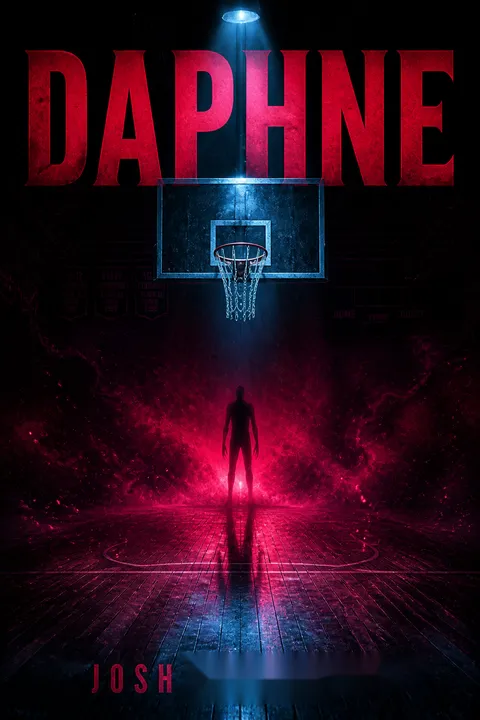
Seventeen-year-old Kit Lamb sinks the deciding free throw in Samhattan High's summer-league final, but her triumph has a private shadow: before releasing the ball, she asked the gym rim whether Daphne would kill her. It answered yes. The question comes from a story teammate Natasha Manska told the night before, about a towering, denim-wearing woman whose ghost supposedly hunts Samhattan athletes.
Kit's friends celebrate around her while she tries to quiet the familiar heat of a panic attack. Her anxiety has already led her to call emergency services on herself once, and even a career-making shot cannot stop her from fearing what she cannot control. She finally steadies herself by turning her attention back to the win.
The opening makes athletic success and dread occupy the same instant. Kit has reached the scene she once imagined as pure triumph, yet her mind inserts a question that makes the rim both sporting equipment and oracle. Her fear is not simply of a monster. It is fear of her own mind, and of the possibility that naming an anxiety might make it stronger. The scene establishes the book's central pressure: Kit must learn whether attention gives fear its power, while the story refuses to let her dismiss that fear as merely irrational.
A Name Under the Town
After the final, Kit and her teammates return to Garland Park, where they have long asked questions of a crooked, netless basketball rim. Its rules forbid repeating a question, and Kit trusts its answers more than she admits.
She avoids telling her friends what she asked in the gym, then grows unsettled when the name Daphne appears to surface in casual conversation and in her own thoughts. At the creek, Kit embraces Dana Berger when Dana admits their senior year together is nearly over.
A strange rumble interrupts them, sounding to Kit like a garage door opening. Meanwhile, freshman-to-be Tammy Jones and two friends cross the cemetery and notice a long, unmarked patch of dirt. Tammy thinks of Daphne and senses that the name belongs to a local secret, not just Natasha's tale.
The town's geography gives buried memory a physical map. A rim answers questions, a cemetery sits at the city's center, and a suspicious rectangle of dirt suggests that Samhattan's past has not vanished so much as been covered over. Kit's friendship with Dana offers a brief, ordinary refuge, but their impending separation also exposes how much Kit avoids imagining the future. The unsettling sound near the creek links private fear to the town's concealed history. The story's menace grows not through proof, but through small recognitions that characters cannot explain away.
Tammy's Window
That night, Kit's mother tells her that Tammy has been killed in her bedroom, with severe injuries to her head and face. The family has no clear explanation for how anyone entered, and police soon report that a framed team photograph has disappeared from Tammy's room.
Kit's teammates flood her phone with anxious messages, while her parents try to protect her and contact the authorities. The news sends Kit into a panic unlike her earlier attacks: grief and a real threat have arrived together, so her usual fear-management routines offer little relief.
She retreats upstairs to write, then takes part of a Xanax Dana had previously given her. Tammy's death turns Natasha's frightening story into a possibility the friends can no longer treat as harmless entertainment.
Tammy's murder changes the meaning of Kit's anxiety. Until now, panic has been a distressing but familiar false alarm; suddenly, the world supplies an external danger that appears to confirm her worst expectations. The missing team photo makes the threat feel deliberate and connected to the girls, though it gives the police no usable identity. Kit's decision to take medication shows the cost of facing an emergency with limited tools, while her journal becomes the one place she can try to order experience. Fear is no longer only a symptom. It is also a response to evidence.
The Gym Turns Interrogation Room
Detective Carla McGowan gathers the Samhattan girls' team in the gym, the same place where Kit recently won the final. McGowan believes a strong man may have killed Tammy, but Natasha challenges the assumption that the attacker must be male.
The players offer no clear suspect, only possibilities, including someone from Tammy's former workplace. Kit watches McGowan's uncertainty and worries that the police cannot protect them. Afterward, McGowan meets veteran officer Chuck Larson, who hints that the girls' team has a history of terrible incidents people stopped discussing.
His unease makes McGowan suspect that Tammy's death belongs to a pattern rather than a single private grievance. For Kit, the gym's bright court has become a place where adults search for answers and find none.
The interview exposes two failures of perception. McGowan initially narrows the possible killer through gender assumptions, while the teenagers have no evidence strong enough to replace her theory. Natasha's insistence that women belong in the search is both a practical challenge and a refusal to accept familiar categories as facts. The location sharpens the contrast: the gym once held Kit's greatest public achievement, but now it hosts the investigation into a teammate's death. Larson's hint of earlier violence suggests that Samhattan's danger depends partly on what its institutions and residents have trained themselves not to remember.
Melanie Sees Her
That night, quiet teammate Melanie Jack remembers hearing Daphne's story as a child and recalls an adult warning the children not to repeat the name. At home, Melanie sees a huge woman in denim moving outside, then appearing in the house where her mother cannot see her.
Melanie grabs scissors, but the figure tears off her arm and uses it to strike her head. As police respond, Melanie's mother can report only the smell of smoke and alcohol. Meanwhile, McGowan visits Principal Janice Taylor, who produces a file on two Samhattan basketball players killed in 2011.
Their journals also mention Daphne. Before McGowan can study the papers, Taylor receives news that Melanie is dead. The second murder confirms that the team's danger is escalating, while the old case suggests the name has followed players for years.
Melanie's silence is not ignorance. She has carried an earlier fragment of the story without being able to connect it to the present, a form of memory shaped by an adult command to forget. Her death makes the haunting visible to the reader while leaving the people around her unable to see it. At the same time, the old file turns private recollection into institutional evidence: other players wrote about Daphne before they died. The killings now form a disturbing repetition, but the system that might interpret the pattern has already inherited the town's habits of forgetting.
Kennedy Follows the Graffiti
Eighteen-year-old Kennedy Lichtenstein, a former player born without hands, is saving money to leave Samhattan. At work in Hi-Fi Grocery, coworker Zach Gold shows her graffiti naming Daphne and tells her the legend.
Kennedy had been warned as a child not to speak of the woman, and the rediscovered story takes hold. She begins spotting the same message in hidden places and buys a denim jacket, trying to understand why the figure has entered her thoughts. On her birthday, Kennedy goes alone into the cemetery before her friends arrive.
As she touches the dirt at her favorite secluded spot, she feels hands where her wrists end. A figure behind her embraces her, then crushes her head. Kennedy's death shows that the threat reaches beyond the current students and the stolen team photo.
Kennedy's perspective complicates the outsider motif. She has built a life by adapting to a body other people treat as incomplete, and she values the freedom of standing at the edges of town. Her curiosity about Daphne is therefore not simple credulity. She recognizes a figure who seems, at first, to share her outsider status. The repeated graffiti makes memory feel contagious and material, appearing in workplaces and private spaces until it occupies her attention. Kennedy's fate overturns the comfort of identification: shared exclusion does not guarantee shared ethics, and an imagined kinship can become a dangerous projection.
The Man Beneath Kit's Bed
As fear spreads, Dana buys an antique gun and gathers friends behind the school, convinced the police cannot keep the players safe. McGowan confiscates it and orders the team back into supervised homes. That night, Kit hears a man beneath her bed and screams for her parents and the officers outside.
Police arrest Peter Lords, who says he has no weapon and claims Daphne is coming. Kit recognizes that he wanted to watch her die, not necessarily kill her himself.
McGowan interrogates Lords after another teammate, Kennedy, is found dead while he is in custody, proving he cannot be responsible for every attack. He identifies Zach Gold as a fellow Daphne enthusiast. The captured intruder is therefore a real danger and a useful lead, but not an answer to the murders.
Peter Lords gives the authorities a human suspect without giving them a human explanation. His desire to witness Kit's death converts fandom into complicity, even if he did not commit the killings. Dana's gun reflects the team's shrinking trust in official protection, while McGowan's attempt to restore order cannot prevent an attack inside a guarded home. The distinction between a dangerous admirer and the actual killer matters: belief in Daphne can draw people toward violence, but it does not make every believer the same kind of threat. The mystery deepens as the police gain a name and lose certainty.
The Highway Exit Fails
After Kennedy's death, center Emily Holt and her mother, Jan, decide to leave town rather than wait for police protection to fail again. Driving toward the highway, they encounter a barefoot woman blocking a narrow street.
Jan sees no one beside the car, but Emily feels a powerful hand seize her shoulder and recognizes the denim-clad figure from Natasha's story. The unseen attacker crushes Emily's body as Jan tries to pull her back into the vehicle. Jan accelerates in panic and crashes into a warehouse wall.
The attempted escape demonstrates that distance from Samhattan offers no reliable safety once the girls are thinking about Daphne. It also leaves the police with another scene that resists ordinary explanation and another family caught between what one person sees and what another cannot.
Emily and Jan choose the most practical response available: leave the town and the threat behind. The road, however, becomes a narrow stage on which practical reasoning cannot protect Emily because Jan cannot perceive the attacker. Their different experiences create a terrifying split between witness and victim, and Jan's effort to save her daughter turns the vehicle into a second source of danger. The scene rejects the idea that safety is merely a matter of location. Once fear has entered the family's perception, the boundary between home, road, and outside world no longer holds.
Natasha Learns the First Story
After Emily's death, Natasha tells her mother, Quincy, the version of Daphne she gave the team. Quincy remembers seeing a seven-foot figure inside a rabbit costume at a candy store when she was a child. She later learned that a girl had disappeared from the store, and now connects the abduction to Daphne.
Quincy also recalls that the missing girl's older sister played basketball, and that the team eventually killed Daphne after the police failed to act. Her memories come back in fragments, then begin to fade again.
Soon afterward, Natasha sees the towering woman in her family's house. She gets her parents outside, but returns to find her father in the basement. Daphne is there too, invisible to the officers who enter. Natasha is crushed on the stairs as the police arrive.
Quincy's recovered memory revises the moral shape of the legend. Daphne was not simply a misunderstood outsider killed by cruel athletes; she abducted children, and the basketball team retaliated after official justice failed. That history does not justify what happened afterward, but it makes the town's silence more complicated than a single act of repression. Quincy's memory also behaves like the town's: vivid when summoned, then slipping away. Natasha's death follows her attempt to protect her parents, turning the family home into another place where testimony cannot secure safety.
McGowan Finds the Vann Guards
McGowan follows Lords's lead to Zach Gold and discovers his online group, the Vann Guards, a circle of Daphne admirers that includes Zach. Chief Barbara Pollen finally shares police photographs and a video of Daphne abducting the child Quincy remembers, then warns that Samhattan has collectively buried the event without a formal cover-up.
Zach's group deny the killings, and Zach admits he showed Kennedy the graffiti at Hi-Fi. McGowan visits the store and finds the same writing on walls and shelves, then traces it to Coach Wanda's employee card. Searching Wanda's home, she finds a basement shrine bearing the names Daphne Vann and Wanda Vann. The coach is actually Brea Delany, the abducted child, and McGowan races to the school gym.
McGowan's investigation succeeds when she stops treating the town's silence as an absence of evidence. The photographs and video make Daphne's past undeniable, while the faded writing at Hi-Fi shows how suppression and fascination coexist in the present. The Vann Guards are a plausible threat because they romanticize the story, but the trail leads somewhere more intimate: the coach has built her identity around the woman who abducted her. Brea's revelation turns the mystery into a study of trauma's aftermath. Survival has not freed her from the past; it may have fused her identity to it.
Kit Leaves the Safe Room
With her friends dying and the police surrounding her house, Kit goes to Third-and-Fourth-Eye Books seeking a way to stop thinking about Daphne. Patricia Maxwell, a classmate who studies meditation, leads Kit through a visualization exercise using basketball.
Kit cannot keep Daphne out of the imagined game, and the exercise collapses into visions of another teammate being attacked. She leaves the bookstore shaken, but Patricia's advice changes the question: Kit does not have to erase fear to act.
Kit's journal also recalls the first panic attack that made her call 911, triggered by the overwhelming realization that she could choose any future. When Dana learns Kit has vanished from her guarded house, she escapes through the attic and heads to the gym, knowing her friend will go where she feels strongest.
Patricia offers Kit no supernatural defense and no promise of emotional purity. Her method exposes the limits of suppression: the harder Kit tries to remove Daphne from thought, the more completely the image occupies her inner world. The basketball visualization fails, but it gives Kit a way to understand the failure without treating it as personal weakness. Her old panic began not with a concrete threat but with limitless possibility, revealing that uncertainty itself can overwhelm her. Dana's escape echoes Kit's decision to seek help: both act while afraid, rather than waiting to feel safe.
The Last Shot Sends Her Back
At the Samhattan gym, Kit asks the rim whether Daphne is dead, whether her friends are gone, and whether the attacker is close. The shots confirm the danger. Dana arrives with a stolen police gun as Coach Wanda and McGowan enter; the coach attacks Kit, and Daphne kills McGowan. Dana shoots Daphne, who falls and rises again.
Kit breaks free, takes the ball, and drives toward the basket. Instead of asking the rim for an answer, she commands it to send Daphne away and makes the layup. Daphne disappears. Dana and Kit leave together as sirens approach, alive but carrying the cost of the night. Kit does not claim her fear is cured. She has finally acted inside it, choosing a shot rather than another prediction.
The climax resolves the book's central conflict by changing Kit's relationship to the rim. It has served as a truth machine, reinforcing her belief that the future is fixed; in the final play, she stops asking what will happen and acts to shape what happens. The decisive shot is not proof that positive thinking can control every catastrophe. It is a concrete act of agency at the moment when passivity would mean waiting for the next answer. Kit's victory remains costly, with friends and allies lost, but it breaks the pattern of treating fear as prophecy.
Analysis
Daphne makes anxiety more than a private disorder and folklore more than a decorative source of scares. Kit's panic has recognizable physical and psychological force, but the town's history gives her fear an external shape that cannot be dismissed as irrational. The novel's most unsettling mechanism is the way memory circulates: Natasha tells a story, classmates recover childhood fragments, graffiti reappears, and old journals reveal that earlier players also became fixated. Samhattan's silence is not a neat conspiracy. It is a social habit that protects residents from painful knowledge while leaving the conditions for repetition intact.
Basketball supplies the book with a counter-language. Practice depends on repetition, attention, and a willingness to shoot again after a miss. The rim initially seems to offer Kit the certainty she cannot produce for herself, but its answers risk making her a spectator to her own future. Her final shot matters because it changes the ritual's purpose. She does not ask the rim to predict safety. She uses the skills she has built to act while afraid.
The novel also refuses an uncomplicated victim story. Daphne's life contains both horrific harm and the violence committed against her, while Brea's survival shows how trauma can twist memory and identity without excusing the harm that follows. This does not flatten responsibility into a single cause. Instead, it asks how a community's unspoken injury can shape the people who inherit it. Kit cannot restore the dead or undo Samhattan's history. She can stop treating fear as a verdict, choose help and connection, and make one decisive move in the present.
Review Summary
Daphne is a horror novel that has received mixed reviews. Many readers found it creepy and captivating, praising the exploration of anxiety and the unique monster concept. Some appreciated the basketball elements, while others found them excessive. The book's pacing and character development were points of contention. Several reviewers compared it favorably to Malerman's previous works, particularly Bird Box. Overall, it's seen as an engaging but divisive read that blends coming-of-age themes with psychological horror.
People Also Read









Characters
Kit Lamb
An anxious clutch shooterKit is a seventeen-year-old Samhattan basketball star whose calm, practiced shooting contrasts with the panic she privately records in her journal. She is observant, loyal, and unusually attentive to the meanings other people overlook, but she also seeks certainty wherever she can find it. The team's question-asking rim becomes a trusted guide because its answers seem firmer than her own judgment. Kit's private writing lets her examine fear without having to perform confidence for her friends. Her deepest struggle is not simply anxiety, but the belief that fear makes her defective or powerless. Basketball gives her discipline and a language for action, even when the rest of her life feels impossible to control.
Dana Berger
Kit's fearless best friendDana is Kit's closest friend and basketball partner, a quick-witted guard who knows when to protect Kit and when to challenge her. She is affectionate without being sentimental, and she notices the distance between Kit's public victories and private distress. Dana's own future feels uncertain as high school ends, but she is willing to act decisively when the people she loves are threatened. Her loyalty is practical: she seeks Kit, questions what the police are doing, and trusts the team's shared knowledge of its friends. Dana's humor helps her manage fear, though it cannot make grief disappear.
Natasha Manska
The team's dark storytellerNatasha is a funny, blunt teammate who collects odd facts and urban legends, then uses humor to keep uncomfortable subjects at a manageable distance. She introduces Daphne's story to the team without fully understanding its history or power. Her confidence can make her seem careless, but beneath it she is perceptive about the way institutions dismiss women and how fear circulates among friends. Natasha speaks openly about depression and is more emotionally candid than she first appears. Her relationship with her mother is combative and intimate, shaped by their shared intelligence and stubbornness.
Carla McGowan
A detective chasing buried historyMcGowan is a forty-one-year-old detective who has moved between police departments and struggles to keep urgency from pushing her beyond legal limits. She is energetic, impatient with bureaucratic delay, and deeply committed to solving crimes that others treat as routine. Her first theories are constrained by familiar assumptions, but the girls' challenge makes her reconsider who can be dangerous. McGowan's own history of crossing lines complicates her effort to protect the team: she wants action, yet knows that certainty can make her reckless. She is an outsider to Samhattan's shared habits of forgetting, which gives her a chance to see what residents avoid.
Daphne Vann
Samhattan's denim-clad terrorDaphne is the towering woman at the center of Samhattan's half-suppressed history. The stories describe her in denim, surrounded by heavy music, and remembered as both frightening and difficult to understand. Different people inherit different versions of her past, and those differences shape whether they see a victim, a monster, or a warning. Her name becomes more than local folklore once the basketball players begin thinking about her again. Daphne's legend exposes the town's tendency to make a person into a story, then avoid examining what that story conceals.
Coach Wanda
The team's demanding coachCoach Wanda is a disciplined coach who teaches the Samhattan girls precision, endurance, and sportsmanship. She expects her players to work when tired and to take responsibility for one another. Her steady presence helps Kit understand that confidence is built through practice rather than granted by a single victory. Wanda is a respected adult in a town where the girls have few reliable sources of guidance, and her authority shapes how they understand the game and their own strength.
Patricia Maxwell
A student of the mindPatricia is Kit's classmate, a spiritually curious student who works at Third-and-Fourth-Eye Books and reads seriously about meditation and attention. Her unconventional appearance makes her easy for others to dismiss, but she is thoughtful rather than merely eccentric. Patricia offers Kit a practical exercise in directing attention, while acknowledging that difficult thoughts cannot simply be erased. Her guidance is imperfect, yet it gives Kit a different framework for responding to fear.
Tammy Jones
A gifted incoming freshmanTammy is a fourteen-year-old basketball talent with a sharp handle and confidence in her ability to earn a place on the high-school team. Her parents encourage her ambition while keeping her grounded. She is close to two longtime friends who share her humor and curiosity. Tammy's visit to the cemetery shows how a name can intrude on ordinary thoughts before anyone understands its significance.
Melanie Jack
The team's quiet observerMelanie is a reserved teammate who often chooses silence rather than speaking to fill a room. She is thoughtful, prone to insomnia, and more aware of her own inner life than her friends may realize. A childhood memory gives her a private connection to the story of Daphne, though she has long pushed it out of reach. Melanie's careful attention makes her especially sensitive to the gaps between what people say and what they are afraid to remember.
Kennedy Lichtenstein
A graduate on the fringeKennedy is eighteen, newly graduated, and still eligible for summer basketball. Born without hands, she has developed her own ways to move through the world and does not regard herself as defined by what she lacks. She is reflective, independent, and saving money to leave Samhattan for a wider life. Kennedy values the city's overlooked corners, partly because she has often lived at the edges of other people's attention.
Emily Holt
A hard-earned starting centerEmily is Samhattan's starting center, a player who earned her role through persistence after being cut early in high school. She is practical, strong, and proud of the work behind her progress. Her mother, Jan, has taught her to approach danger with common sense, but Emily also trusts what she personally experiences. She represents the players whose confidence comes less from natural acclaim than from surviving repeated setbacks.
Quincy Manska
Natasha's sharp-minded motherQuincy is Natasha's intelligent, outspoken mother, a woman whose confidence often clashes with her daughter's. She drinks heavily and can turn conversation into a contest, yet she is observant and protective. Her childhood memories connect Natasha's present-day legend to a real event she had almost entirely forgotten. The strain of remembering reveals both her courage and the fragility of a family history shaped by silence.
Barbara Pollen
Samhattan's wary police chiefPollen is an experienced police chief who knows the city's history and the limits of official explanations. She is cautious, unsentimental, and accustomed to carrying trauma without discussing it. Her reluctance to revisit Daphne's case reflects a broader local habit rather than a deliberate conspiracy. When she does speak, she gives McGowan the evidence and freedom to pursue a dangerous lead.
Zach Gold
A grocery worker and fanZach works at Hi-Fi Grocery and becomes fascinated by Daphne through the messages and stories circulating among local enthusiasts. His interest leads him to show Kennedy the graffiti, an act whose consequences he cannot foresee. Zach is not as forceful as the people around him, and his fear makes him a reluctant source of information. He represents the boundary between curiosity about a legend and the damage caused when fascination becomes fixation.
Peter Lords
A dangerous admirerPeter is an older Daphne enthusiast whose fixation goes beyond collecting stories. He breaks into Kit's house because he wants to witness what he believes is coming. His presence makes the threat feel human and immediate, even though his arrest cannot account for the attacks. Peter's devotion reveals how horror can attract spectators who mistake proximity to violence for understanding it.
Evelyn Lamb
Kit's perceptive motherEvelyn is Kit's observant, affectionate mother, often quicker than her husband to notice when anxiety is gathering. She tries to protect Kit without reducing her to her panic, and she knows that well-meant questions can sometimes make distress worse. Evelyn's steadiness gives Kit a place to return to, even as the family faces a threat they cannot explain.
Jason Lamb
Kit's supportive fatherJason is Kit's warm, good-humored father, proud of her basketball and attentive to her emotional life. He uses small gestures and shared jokes to show affection, though he cannot always tell when his concern will intensify Kit's worry. His support is practical and sincere, and he tries to reassure his daughter while recognizing that reassurance alone cannot solve what is happening.
Jan Holt
Emily's protective motherJan is Emily's practical mother, determined to take her daughter out of Samhattan when the killings escalate. She trusts decisive action more than speculation and sees family safety as more important than work or routine. Her fear becomes visible as the attempt to escape turns dangerous.
Plot Devices
The question-answering rim
A court-side oracleThe girls use the rims at Garland Park and Samhattan High to answer questions by shooting a basketball. Their rules forbid asking the same question twice, and the result of a shot is treated as a yes or no. For Kit, whose anxiety makes uncertainty difficult to bear, the ritual gradually acquires authority beyond a game. It frames the story's central conflict between prediction and agency: the rim seems to disclose a future, but Kit must eventually decide whether to keep asking what will happen or act on what she wants to happen.
Kit's Jolly Journal
A private witnessKit writes to an imagined companion in a paper journal she calls Jolly. The entries let her describe panic, grief, superstition, and memories she struggles to share with friends or family. They also give the reader access to the gap between Kit's public identity as a successful athlete and her private fear that she is losing control. As the crisis worsens, writing becomes less a cure than a way to remain present with what she feels. The journal's repeated self-questioning mirrors the rim's questions while offering Kit a different form of attention.
Samhattan's buried memory
A town-wide blind spotResidents recognize Daphne's name but struggle to remember where they heard it or what happened to her. Their silence is not organized as an official conspiracy; it behaves like a shared reflex that keeps painful history out of ordinary conversation. As characters recover fragments from childhood, old journals, police files, and graffiti, the town's forgetfulness becomes an active force in the plot. The device links personal trauma to civic memory, showing how an entire community can perpetuate a silence without any one person consciously enforcing it.
The missing team photograph
A stolen target listThe disappearance of a framed basketball team photograph from Tammy Jones's bedroom makes the murders look deliberate and connected to the players. It gives police a concrete clue even as the attacks leave little other evidence. The photograph also directs attention toward the team's shared identity, drawing the girls, their families, and the authorities into the same anxious circle. As the violence reaches players who do not fit a simple pattern, the image's significance shifts from a straightforward suspect's trophy to a sign that the threat understands the team's connections.
Daphne's graffiti
A spreading invitationThe repeated writing of Daphne's name and the message that she lives appear in Hi-Fi Grocery and other places around Samhattan. Zach Gold treats the marks as intriguing evidence of a shared fascination, while Detective McGowan reads them as a possible trail to the person behind the attacks. Their recurrence links fandom, fear, and the town's buried past. The graffiti turns private obsession into a public signal, making it harder for residents to dismiss the legend as something safely confined to memory.
About the Author




Download PDF
Download EPUB
.epub digital book format is ideal for reading ebooks on phones, tablets, and e-readers.








