

Plot Summary
Prologue
When King Arianus lies near death from a head wound, his daughter Zhuana learns that armed men are already gathering to decide who will rule Veldria. The scarred warrior Varden blocks her from leaving the room, while her father’s chief druid, Alric, reveals a hidden passage and urges her to escape.
Zhuana resists leaving her father until his final lesson, to survive, gives her a reason to go. She slips through the tunnel toward the sacred grove, where no one may spill blood. Alric’s plan saves the teenage heir from a coup and begins the hard education in judgment that will shape her rule.
The opening makes survival a political act before it becomes a physical one. Zhuana’s instinct is to remain beside her father and meet danger directly, but Alric teaches her that courage without judgment can serve the plotters more than the people she hopes to protect. Her father’s final instruction is both intimate and practical: it gives her permission to leave without turning flight into cowardice. The hidden passage also establishes a recurring tension in the novel. Power belongs not only to those who hold a throne, but to those who understand when a visible confrontation is a trap.
Star Gate Childhood
At ten, Bethany Sylvana is nearly crushed in the crowd gathered for Emperor Rigel’s celebration. She climbs the pedestal of a stone statue to see over the throng and watches diviners open the Argent Arch, bringing strange objects and creatures from faraway lands. The spectacle gives shape to her dream of becoming a diviner.
Years later, she recognizes a constellation on a banner brought to her mother’s tailoring shop and offers to finish its embroidery. The visiting diviner dismisses her knowledge and leaves. Charlton Balforth, a kindly senior cleric who has lost his wife and daughter, gives Bethany books instead, including the reference works she cannot access through school. His gift turns her private ambition into a course of study.
Bethany’s calling begins not as a prophecy but as a response to a public demonstration of access and possibility. The gateways make distant worlds visible to an ordinary child, while the diviner’s dismissal shows how institutions police who may claim expertise. Her answer is not rebellion for its own sake. She studies, memorizes, and practices with the tools available to her. Charlton’s generosity matters because it offers recognition without demanding obedience, an alternative to the empire’s transactional forms of patronage.
The Twenty-First Candidate
Bethany arrives late to the School of Divination’s entrance test with Charlton, who persuades the officials to let her compete despite her lack of academy schooling. At Speaker’s Corner, she finds that her assessor is the same diviner who once scorned her knowledge of the stars. During the timed clock examination, Bethany answers accurately until he disqualifies her for allegedly keeping her hands on the clock after the bell.
The crowd’s objection changes nothing, and she leaves believing the future she had built through years of study has closed. Her fellow candidate Xander Cole had helped her up after she stumbled on the platform, but his kindness offers little comfort against a decision backed by authority.
The test measures more than astronomical knowledge. It exposes how formal merit can be overruled by an assessor’s judgment, particularly when a candidate lacks the credentials that make her legible to elites. Bethany cannot appeal effectively because the procedure gives the institution control over both the rules and their interpretation. Her defeat is not evidence that she is unqualified, but it still destabilizes her sense of earned belonging. The contrast between Xander’s spontaneous help and the assessor’s calculated exclusion introduces two kinds of recognition: one human and immediate, the other institutional and politically consequential.
Veldria Burns
Eighteen years into her reign, Zhuana faces the Harna, a starving host led by Torian Varlish, who demands passage north through Veldria. She refuses to open her gates without safeguards, then sneaks back toward the camp with Maven Dresk to discover why the Harna are fleeing.
There, prisoners burn the dead, including a corpse with glossy, diamond-patterned black skin. When guards kill a prisoner whose nails have turned black, Zhuana recognizes the refugees’ warnings of a spreading sickness.
She accepts that neither surrender nor victory can protect her people and orders Veldria evacuated. The city is set ablaze to delay the Harna, and tens of thousands follow Zhuana toward the Eternal Empire, carrying their food, weapons, and fear of the darkness behind them.
Zhuana’s defining decision revises the lesson she learned as a girl. Once she escaped a coup by leaving a doomed room; now she must persuade an entire nation to abandon its home. Her investigation gives her a basis for choosing flight, but not certainty about what the disease is or how far it has spread. Burning Veldria is both a military delay and an emotional severance: she denies the conqueror an intact prize while sacrificing the place that made her queen. Her willingness to carry the people rather than the throne forward turns survival into a collective responsibility.
A Daughter’s Bargain
As Bethany’s mother, Maryam, begins losing her sight and suffering severe headaches, Bethany realizes the family’s tailoring work cannot pay for the care she needs. Emperor Rigel summons Bethany and reveals that she is his daughter, born from his marriage to Maryam before his rise to the throne.
He offers access to the University’s best clerics and a place at the School of Divination, but expects Bethany to become his hidden informant among the diviners. She refuses to owe her success to him, yet accepts because Maryam needs treatment. Rigel arranges for a candidate to withdraw, restoring Bethany to the school after her wrongful dismissal. Maryam later explains the marriage’s end, while Bethany conceals Rigel’s role in her admission.
Bethany’s opportunity arrives through the same power structure that first excluded her, so accepting it cannot feel like uncomplicated rescue. She chooses care for her mother over the pride of remaining untouched by Rigel, but she refuses to interpret his intervention as proof that he owns her achievement. The distinction matters psychologically: her agency is not the absence of dependence, but the ability to name what she has accepted and why. Maryam’s account complicates Bethany’s image of her father without softening the costs of his political choice to erase their marriage.
One Vote for Julian
Crown Prince Julian fears losing his confirmation vote because the death of Bryan Quinn, his wife Samara’s brother, has turned her father Declan against him. Emperor Rigel secures the Wardens but cannot count on the Guildsmen or enough Crusaders. Samara steals her father’s signet and uses it to order tax inspections that keep many Guildsmen away from Everlast; a second inspection at the Argent Arch traps more voters in transit.
Kendrick Conway votes with the Wardens after Tristan Benedict reminds him that his family’s hosting of the coming fielding depends on imperial favor. Julian survives confirmation by a single vote, 256 to 255. The victory preserves his claim but leaves him acutely aware that most of the court remains unconvinced.
The vote dramatizes a conflict between legitimacy as procedure and legitimacy as consent. Julian’s confirmation is technically valid, yet its narrow margin makes the result psychologically unstable. Samara understands that political power can be exercised through logistics, not only speeches or force: control the routes and obligations, and the absent become part of the vote. Kendrick’s decision shows how public loyalty can be purchased through family prospects, even when it collides with private moral judgment. The victory therefore solves the immediate succession question while creating a lasting need for Julian to stage a more persuasive demonstration of authority.
Children as Hostages
After weeks on the road, Zhuana brings her displaced nation to Grendal, a walled mountain city blocking the route north. Its council rejects her offer of gold and demands a bond: one hundred children, including her sixteen-year-old son Garric.
Zhuana accepts because the other route is too difficult for the exhausted population and because Grendal’s leaders have watched her approach through Imperial spyglasses. Garric takes responsibility for the younger children during their two-day separation.
The council returns them unharmed as the Veldrians pass through Grendal’s settlements. Zhuana has secured the road, but the agreement depends on trust she cannot truly afford to give, and the ordeal gives her people a fresh reason to fear being at another nation’s mercy.
The hostage agreement makes diplomacy tangible by placing its cost in the bodies of children, including Zhuana’s own son. Her decision is not a failure of resolve but a calculation made under constrained options: the Veldrians need a route, and Grendal will not accept wealth as a substitute for leverage. Garric’s role also shifts him from protected heir toward public responsibility. The safe return seems to validate Zhuana’s judgment, yet the bargain leaves a moral debt and a political vulnerability that Maven can later exploit when scarcity makes the people question the value of restraint.
The Grendal Raid
Beyond Grendal, the Veldrians’ grain is running out and the badlands ahead appear nearly barren. Maven Dresk convenes a public accounting of supplies, making the danger of starvation impossible to ignore, then backs Dan Logrin’s proposal to raid the farms and villages they have just passed.
Zhuana sees that opposing the raid could leave her people hungry, so she redirects their anger toward Grendal’s hostage bargain and authorizes the attack. Her warriors seize food and equipment, killing defenders; afterward, Garric confronts her over the people they have butchered.
Zhuana insists that a ruler must put Veldrians first. The promised three-week crossing of the badlands stretches into nine weeks of sickness, dwindling provisions, and abandoned carts before the exhausted refugees reach a river and forest.
Maven does not openly challenge the queen. He engineers a situation in which her own followers make the policy he wants seem unavoidable. Zhuana’s speech transforms the recent hostage bargain into justification for retaliation, but the resulting raid exposes the moral cost of treating every outside group as a future threat. Garric’s protest matters because he sees the people harmed as neighbors rather than merely obstacles. His mother answers with the logic of state survival, revealing the tension between her political duty and the ethical example she hopes to pass to her heir.
The Observatory Doors
After Rigel’s intervention restores her place, Bethany leaves the Fabric District and moves into the Observatory, where her mother will be cared for by Charlton and Dahlia. High Diviner Azren welcomes the new class, while Diviner Trask warns that students will be tested emotionally, physically, and mentally.
Bethany recognizes Xander from the entrance examination and meets Carina Mallow, a frank, capable student from Kargul. Xander is cold toward Bethany because his friend Tomek withdrew, apparently after pressure from adults, and Bethany does not yet know her father caused the vacancy.
The curriculum begins with meditation, staff movements, calculations, and gateway knowledge. The school gives Bethany access to the life she wanted, but every lesson makes clear that failure may endanger travelers as well as students.
The Observatory replaces the arbitrary assessment with a demanding system whose stakes are ethically serious: a diviner’s errors can injure people who trust them. That gives Bethany a genuine route to competence, though her admission still rests on a concealed political intervention. Xander’s suspicion creates a social cost she cannot explain without exposing Rigel’s manipulation. Carina’s openness offers a different kind of companionship, one grounded in shared vulnerability rather than institutional standing. The school’s routines also translate Bethany’s private study into embodied skill, asking her to regulate attention and movement, not simply accumulate facts.
A Mind Finds Stillness
A practical examination places Bethany on a pedestal surrounded by a stone ring, a sand mound, a dirt pile, a wooden structure, and a heavy arch. She has already been shown samples of the materials but fails to recognize that she was meant to compare their weight.
Instead, she reasons from symmetry and relative mass, setting the pointer close enough to pass. Trask warns that her staff work and concentration remain weak. Later, Bethany finally succeeds at meditation by remembering how small she felt beneath the stars as a child.
That calm helps her follow Madam Mei’s slow staff forms, until Mei accelerates the class too quickly and Carina accidentally strikes Gregor, injuring his head. Trask tells the students Gregor will recover and removes Mei from instruction.
Bethany’s near miss reveals a mind capable of powerful inference but prone to panic when a task’s purpose is hidden. She does not pass through effortless brilliance; she finds a method after confronting the possibility that she has failed. Her later meditation breakthrough reframes focus as a relationship to thought, not its suppression. The injury in Mei’s class then prevents that insight from becoming a simplistic promise that calm solves everything. Training can itself create danger when authority misjudges readiness, and the school must acknowledge that responsibility rather than blame the student who held the staff.
The Weaver’s Breath
During the first delirium exercise, Diviner Gallow gives the students flasks containing the rare substance known as Weaver’s Breath. Bethany sees the stars multiply and feels the tapestry, the network connecting all things, as a vivid physical reality.
Carina experiences an overwhelming vision but returns to herself. Later, during the final timed gateway exercise, Bethany reaches the Crystal Dome on time while Carina arrives six hours late, disoriented and repeating fragments of what she experienced.
Bethany and Xander stay with her until Observatory diviners take her away for treatment. Trask later tells Bethany that Carina has been sent home and needs distance from the school. Bethany grieves the loss and, unable to help her friend, begins searching books for answers about the gateways.
The Breath converts abstract cosmology into an experience that can destabilize the self. The school’s warnings are not theatrical decoration; they foreshadow the damage Carina suffers when perception overwhelms her ability to orient herself. Bethany’s response is to stay beside her, even though she cannot repair the harm, and then to seek knowledge rather than accept the institution’s silence. Her grief also produces a new intellectual impatience. She has learned that mastery of a system does not necessarily mean understanding its origins or limits.
The River Byre Meeting
The Veldrians establish a fortified camp beyond the River Byre, near the Imperial city of Lexia. Crown Prince Julian arrives to negotiate, having learned from envoys that the refugees number more than sixty thousand and that Maven killed Zhuana’s husband in a ritual duel years earlier.
Zhuana asks for land and protection in exchange for her people’s military service. Julian refuses permanent settlement and offers instead to send traders and consult the Assembly of Nobles.
He also suggests the Veldrians fight the empire’s eastern enemies, the Jaynians, in return for land outside the empire. Zhuana rejects both the delay and the distant reward. She leaves the meeting without agreement, while Julian hopes trade will keep the border quiet until imperial forces can assemble.
The negotiation is shaped by incompatible definitions of security. Zhuana needs a durable home inside the empire before the threat behind her catches up; Julian needs time and political consent before admitting a large armed population. Each recognizes the other’s leverage, but neither can offer what the other considers safety. The history between Zhuana and Maven adds a private fracture to the delegation, since the man who killed her husband remains one of her most powerful advisers. Their impasse is not caused by poor communication. It follows from competing obligations that make compromise dangerous to both leaders.
Sixty Against Sixty
Zhuana authorizes Maven’s followers to raid Wist, an Imperial village, while publicly denying responsibility. Samara visits the burned settlement and returns shaken by the dead. Julian demands sixty Veldrian heads, but Zhuana invokes her people’s ritual judgment and offers sixty unarmed warriors against sixty Imperial guardsmen.
Julian agrees to wait three weeks, using the delay to prepare the empire. At the contest, Alric gives the Veldrians firewater that dulls pain and drives them into a frenzy.
They kill all sixty guardsmen; Julian then enters the fight himself and slays the three Veldrians left standing, suffering a deep wound to his arm. His public intervention restores some Imperial pride, but the result hardens both sides and gives each a story of justice.
The contest turns diplomacy into a spectacle whose rules are already shaped by political need. Zhuana uses ritual to avoid surrendering her own people to execution, while Julian accepts because refusal would make him appear weak and cost him time. Firewater changes the fight’s physical terms, but the decisive public image is Julian entering the bloodshed after his soldiers fall. His victory lets him recast a strategic disaster as personal courage. For Zhuana, the same event confirms that Imperial promises are fragile and that her people may soon need to force their own protection.
The Yellow Pyramid
For an independent field test, Bethany walks for eight days to the Yellow Pyramid, a remote gateway whose position she has studied only in books. She must return to Everlast by the exact moment of sunset, calculating the time difference and opening the portal herself.
At the summit, she uses the Weaver’s Breath and her staff to enter the path of stars, where disorientation nearly persuades her that she has failed. Remembering her mother and Xander, she steadies her breathing, arranges the constellations, and opens the Crystal Dome gateway at the required time.
She arrives among the waiting students and learns that Carina has not yet returned. Bethany refuses to leave, then waits five hours with Xander until Carina finally emerges, confused and unable to orient herself.
The journey is Bethany’s first proof that knowledge can become action under pressure. Her success depends on calculation, physical endurance, and the emotional regulation she has struggled to learn. The memories of Maryam and Xander work as anchors, not as magical rescues; Bethany still has to interpret the stars and move the staff herself. Her choice to wait for Carina extends her understanding of competence beyond individual survival. She has passed the task, but she does not treat the person who failed as disposable.
Maryam Becomes Her Ward
For the final examination, Bethany must travel through six gateways in a prescribed order and return to the Crystal Dome before sunset, carrying a ward chosen at random. The name revealed is Maryam, whose blindness and poor health make the responsibility especially frightening.
Bethany opens the first portal with her mother beside her, then guides her through climates ranging from Ganouda’s humid heat to Malange’s winter cold.
Repeated exposure to the Breath leaves Bethany nauseated and exhausted, but Maryam’s presence gives her a reason to continue and a companion who can be honest about her pain. Bethany reaches Everlast with the required tokens. High Diviner Azren verifies them and grants her the staff she used, declaring her a full diviner.
The final test turns Bethany’s private fear for her mother into the practical substance of her professional duty. Maryam is not a symbolic burden but a real ward whose pain, blindness, and fatigue require Bethany to manage the journey with care. Their dependence runs both ways: Bethany guides the route, while her mother’s trust sustains her when the Breath and exhaustion threaten her concentration. Graduation is therefore not simply proof of technical skill. It is an earned acceptance of responsibility for another person’s vulnerability.
The Fielding’s Hidden War
While Julian recovers from his arm wound, Samara plans to use the coming fielding to strengthen his claim by arranging for nobles and newly knighted soldiers to swear fealty to him. The event will be hosted at Fernley Manor by Kendrick Conway, whose sons hope to be knighted there.
Declan Quinn visits Kendrick and reveals that Samara used his stolen signet to order the tax inspections that disrupted Guildsmen before Julian’s confirmation.
He asks Kendrick to keep Julian from taking control of the fielding and hints that another successor might be found before the next scheduled vote. Declan also investigates a rumor that Rigel fathered another child during his campaigns. Kendrick is caught between his order, his family, and his conviction that Julian is unfit.
The fielding is more than a military gathering. It is a stage on which legitimacy can be made visible through ritual, kinship, and public allegiance. Samara plans to convert a narrow legal win into a spectacle of consensus; Declan counters by exposing the manipulation beneath that win and seeking an alternate path to power. Kendrick becomes the point where these strategies meet, because his family will host the event while his loyalties pull in opposite directions. The rumor of Rigel’s other child introduces a possible political solution without resolving whether the rumor is true.
The Darkness Reaches Grendal
After Julian’s fight buys the empire time, Zhuana secretly sends scouts back toward the lands her people crossed. They find Grendal destroyed: bodies lie in the streets with black nails, while surviving locals burn homes and attack one another.
Zhuana and Alric then witness the first scaled creatures approaching through the wasteland, including one small enough to have once been a child. Archers kill the stragglers, but the sight confirms that the sickness has transformed people into predators.
Zhuana keeps the discovery from her followers until they have a settlement, fearing panic will undermine her authority. When Julian sends word that his wounds prevent further talks, she treats the delay as another warning and orders Alric to obtain ingredients for more firewater while her people prepare for war.
The enemy Zhuana fled is no longer a rumor or a single contaminated body; it is a visible transformation advancing through the places she passed. The small creature makes the threat intimate, collapsing the distance between military danger and civilian loss. Zhuana withholds the news for tactical reasons, yet secrecy also leaves her carrying fear alone and makes her rule dependent on controlled information. Her preparations for war are not a sudden appetite for conquest. They are a response to two dangers converging: the spreading darkness and an empire whose negotiations may not finish before it arrives.
Bethany Enters the Arch
After graduating, Bethany accepts a well-paid post as house diviner to the Conways of Esk, which will help secure Maryam’s expensive medicine. Rigel then summons her and admits that he influenced the appointment so she can report on Julian and Declan during the fielding.
Bethany insists that her achievement belongs to her, not to him. At the Argent Arch, Diviner Brooks tells her that the corpus itself recommended her, resisting the palace’s attempt to claim control over diviners.
Bethany opens the gateway while crowds watch, bound for Fernley Manor and the family at the center of the coming political struggle. She leaves Everlast with a new title and a task she did not choose, uncertain whether she can keep her father’s designs separate from her own future.
The ending makes Bethany’s success inseparable from the institutions that want to use it. Rigel treats her new position as an intelligence channel, while the corpus asserts that her professional standing is its own responsibility. Bethany’s insistence that she earned her place preserves an inner boundary, even though she accepts the assignment and its financial benefit. The Argent Arch, once the image that opened her childhood imagination, now carries her into a world where knowledge can be both vocation and surveillance. The novel closes at the threshold, with her independence real but still under pressure.
Analysis
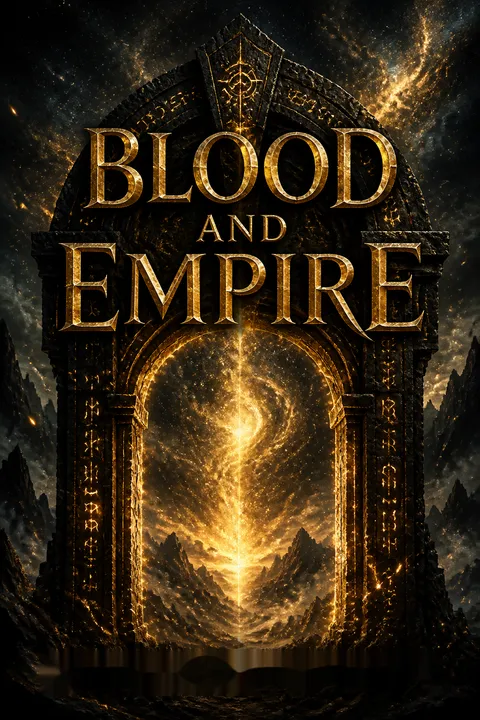
Blood and Empire places three kinds of crisis on the same map. Bethany confronts the limits of personal opportunity, Zhuana confronts the responsibility of keeping a people alive, and Julian confronts the gap between possessing a claim and being trusted with power. Their stories meet through institutions that promise order: the School of Divination, the Veldrian council, and the Assembly of Nobles. Each institution can protect people, but each can also distort judgment when its procedures become more important than the lives those procedures serve.
The novel treats knowledge as both liberation and liability. Bethany’s self-taught astronomy lets her challenge social exclusion, yet the diviners themselves admit that the gateways’ origins and operation remain only partly understood. Julian can command armies and invoke Imperial justice, but his political grasp is often narrower than Samara’s. Zhuana reads the danger of the black-scaled sickness before the empire does, but her survival logic leads her to authorize violence against Grendal. No character possesses the whole picture, and action cannot wait until certainty arrives.
The strongest emotional counterpoint is between Bethany’s care for Maryam and Zhuana’s care for an entire population. Bethany’s final examination makes her mother a literal ward, turning affection into an obligation she must carry through physical danger. Zhuana must make the inverse choice: she often sacrifices personal tenderness, and sometimes other people’s safety, to preserve the collective. Their decisions suggest that duty is not inherently noble or corrupt. Its moral value depends on whether the person exercising it can still see those who bear its costs.
The ending deliberately withholds a clean resolution. Bethany reaches the position she dreamed of, but her father has tied it to surveillance. Zhuana knows the catastrophe is advancing, while Julian’s empire is still absorbed in succession and military display. The book closes as its characters cross thresholds rather than escape them: the gateway toward Esk, the frontier toward war, and the fielding toward a contest over who can claim the empire.
Review Summary
People Also Read



Characters
Bethany Sylvana
Aspiring divinerA seamstress’s daughter from Everlast’s Fabric District, Bethany is curious, disciplined, and unusually able to retain complex knowledge about stars and gateways. She wants to become a diviner because the gateways once showed her that the world is larger than the narrow future available to her. Her loyalty to Maryam gives her ambition a practical urgency, while her growing friendship with Xander and Carina gives her a place among peers. Bethany is neither effortlessly confident nor immune to fear; she often doubts whether she belongs, then works through that doubt by observing, calculating, and continuing. Her central struggle is to build a life of her own without allowing powerful patrons to define what her gifts are for.
Zhuana Arianus
Exiled warrior queenQueen of Veldria and mother to Garric, Zhuana is a trained fighter who also knows that leadership demands decisions beyond the battlefield. Alric taught her to distinguish courage from stubbornness, and she tries to carry that lesson into choices involving refugees, enemies, and her own people. She is observant, politically alert, and accustomed to controlling her emotions in public. Her relationship with Maven Dresk is marked by duty and mistrust, while her bond with Garric exposes the private cost of ruling. Zhuana’s deepest motive is the survival of her people, though her certainty that she must put them first can harden into a dangerous moral simplicity.
Julian Malventus Livius
Contested imperial heirThe emperor’s son and designated successor, Julian has spent his life preparing for power through study, physical training, and political performance. He is intelligent and capable, but his pride makes him vulnerable when other people question his fitness to rule. He loves Samara and trusts her ability to understand political mechanisms he tends to approach as tests of personal merit. The death of Bryan Quinn shadows his public reputation and sharpens his resentment toward Declan. Julian wants to prove that he deserves the empire, yet repeatedly confuses a successful display of strength with the broader trust that stable rule requires.
Samara
Strategic imperial princessJulian’s wife and Declan Quinn’s daughter, Samara is socially perceptive, ambitious, and practiced at turning other people’s assumptions into leverage. Her beauty attracts notice, but she is more interested in the practical machinery behind political outcomes: votes, access, timing, and public stories. She supports Julian with fierce loyalty, while her hostility toward her father reflects a long history of feeling underestimated within her own family. Samara believes she and Julian must act together against a court that would otherwise define their future for them. Her strategic gifts can protect those she loves, but they also encourage her to treat political rules as obstacles to outmaneuver.
Kendrick Conway
Warden lord and soldierLord of Esk, husband to Anthea, and father to Troy, Caden, and Isabelle, Kendrick is a celebrated veteran who prefers family life and practical work to court politics. His personal code is shaped by loyalty to the Wardens and responsibility for the people under his care. He is blunt, physically capable, and uncomfortable when old comrades try to turn affection into political pressure. His vote for Julian places those values in conflict with his relationship to Declan, whose family has suffered from Julian’s actions. Kendrick’s reluctance to seek power does not make him politically irrelevant; it makes his choices especially valuable to people who want his name and influence.
Declan Quinn
Guildsman power brokerLord of Graystone and leader of the Guildsmen, Declan is Samara’s father and Anthea’s brother. He is a meticulous lawmaker who reads political systems as carefully as other people read maps. The death of his son Bryan has deepened his grief and intensified his opposition to Julian, while the strain has also damaged his marriage to Meredith. Declan’s work preserving knowledge at Graystone Abbey reflects a long view of history and his belief that the empire may one day fail. He understands the difference between private anger and public strategy, but his determination to secure justice can make revenge and political principle difficult to separate.
Xander Cole
Bethany’s gifted classmateA talented student from a once-prosperous trading family, Xander wants to become a diviner partly to help his relatives escape debt. He is quick-minded, observant, and capable of humor, though pressure and family strain can make him guarded. His friendship with Bethany grows from initial kindness into a bond shaped by mutual encouragement and the shared demands of training. Xander initially resents the circumstances that displaced his friend Tomek, without knowing the full story behind Bethany’s admission. He is motivated by both affection and duty, and his wish to rescue his family risks making his own future feel like another obligation.
Maryam Sylvana
Bethany’s devoted motherMaryam is a seamstress from Loriastris who built a working life in Everlast while raising Bethany largely on her own. Warm, practical, and proud, she has protected her daughter from the political world surrounding Rigel and taught her not to mistake wealth for kindness. Her failing vision and worsening headaches change the balance between mother and daughter, as Bethany increasingly becomes her caregiver. Maryam remains emotionally perceptive even when she can no longer see clearly, and she wants Bethany to pursue a future without surrendering her independence to her father.
Charlton Balforth
Bethany’s cleric mentorA senior cleric at the House of Healing, Charlton offers Bethany books, encouragement, and practical help without making her feel indebted. He is a widower who carries the memory of his wife and daughter with quiet tenderness. His sympathy for the poor and his belief that learning should be widely available make him an early counterweight to the empire’s gatekeeping institutions. Charlton supports Bethany’s talent while respecting that her decisions belong to her, and he continues to look after Maryam when Bethany’s studies take her away.
Rigel Regus Livius
A calculating emperorEmperor of the Dymantine Empire, Rigel is Julian’s father and Bethany’s father, though he has kept Bethany’s parentage private. He is disciplined, politically experienced, and haunted by the sacrifices surrounding his family. His view of leadership prioritizes the empire’s survival above individual claims to mercy or fairness. Rigel can show care, but he tends to express it through arrangements, resources, and expectations rather than intimacy. He regards Bethany’s intelligence as useful to the state, creating tension between paternal concern and his instinct to deploy every available advantage.
Alric
Druid and trusted adviserAlric is the chief druid who teaches Zhuana and remains her most trusted adviser. His knowledge of healing, plants, ritual, and the Veldrian customs gives him influence beyond the battlefield. He is cautious and morally serious, willing to question Zhuana when fear or necessity pushes her toward choices with lasting costs. Though physically gaunt and often anxious about the decisions she makes, he remains loyal to her and to the survival of the people they lead.
Maven Dresk
Warrior noble and rivalA powerful Veldrian noble with a broken nose and a commanding presence, Maven is both a military leader and a persistent political rival to Zhuana. He is pragmatic about food, force, and the survival of his followers, but he also knows how to use public pressure to advance his position. His relationship with Zhuana carries the weight of an old personal conflict, yet both remain bound by the needs of their people. Maven’s bluntness can look like strength, while his careful timing reveals a subtler appetite for influence.
Garric
Veldrian prince and heirZhuana’s teenage son, Garric is serious, dutiful, and increasingly conscious of what his mother’s rule demands from him. He takes responsibility for younger Veldrians and studies the behavior of adults who claim to protect their people. His bond with Zhuana is loving but not uncritical; he is willing to question her when survival seems to excuse harm. Garric’s youth makes his political education especially urgent, as he must learn both the practical burdens of leadership and the moral costs that accompany them.
Carina Mallow
Bethany’s candid friendA capable student from Kargul, Carina is sociable, direct, and often the first to speak when a room turns tense. She misses the outdoor life of her former home and carries complicated feelings about her family, including her stepmother. Her easy humor helps Bethany feel less isolated at the Observatory, while her questions encourage their classmates to speak honestly about ambition and fear. Carina is bright and determined, but the intensity of diviner training tests the emotional resilience she and the others are still developing.
Anthea Conway
Kendrick’s political-minded wifeKendrick’s wife and Declan’s sister, Anthea is a resourceful social strategist who understands the importance of family reputation and political alliances. She cares deeply for her children and helps prepare the Conway estate to host the fielding. Her religious conviction and polished manners coexist with a sharp awareness of what powerful people expect. Anthea knows that her husband’s decisions affect not only his own standing but the future of their children, and she tries to steer the family through court politics without losing sight of their domestic life.
Tristan Benedict
Warden leader and old friendLeader of the Wardens and Kendrick’s longtime friend, Tristan is sociable, politically forceful, and skilled at appealing to personal loyalty. He values the stability of the empire and expects members of his order to support the emperor, even when a vote seems lost. His friendship with Kendrick is genuine, but he does not hesitate to invoke family honor and future opportunity when he needs Kendrick’s cooperation.
Diviner Trask
Stern school instructorA senior instructor at the School of Divination, Trask is exacting and unsentimental about the danger of gateway travel. He expects students to earn trust through focus and technical competence, and he communicates failure plainly. Though his manner can feel severe, he treats the students’ training as a public responsibility rather than a private contest. His assessments force Bethany to confront the gap between knowing the material and being ready to guide another person safely.
Diviner Gallow
Unyielding examinerGallow is a bald, sharp-featured diviner who assesses Bethany at both the entrance examination and later stages of training. He is controlled, observant, and willing to use emotional pressure to test how students respond under strain. His severity reflects the school’s belief that a lapse in concentration can endanger a ward.
Torian Varlish
Harna king in flightThe emaciated, perfumed king of the Harna leads a desperate population north in search of escape. Torian is proud, suspicious, and unwilling to expose the full nature of the threat driving his people. His demands place Zhuana in an impossible position, while his fear of the darkness reveals that conquest is only one force shaping the crisis.
Roos Bannon
Lexia’s cautious commanderCommander of Lexia’s garrison, Bannon is a veteran soldier who approaches the Veldrian arrival with caution. He supplies Julian with information, oversees the border defenses, and questions the risks of bringing Samara to the frontier. His experience gives him a practical counterweight to Julian’s eagerness to turn the crisis into a test of leadership.
Plot Devices
The gateways and tapestry
Travel through woven spaceAncient structures built by the vanished Eidar allow diviners to travel between distant places. Diviners use astronomical knowledge, calculations, and a staff to locate and open a gateway, then navigate the tapestry, the hidden network connecting the world. Travelers who accompany a diviner become wards and follow in a waking sleep. The gateways make the empire’s size manageable, but their origins and limits remain poorly understood, leaving the institution dependent on inherited methods and uncertain knowledge.
The Weaver’s Breath
Altered gateway perceptionA rare substance kept inside a diviner’s staff, the Breath brings the diviner into an altered state in which the tapestry becomes perceptible. The experience can be exhilarating, disorienting, and dangerous. Students are trained in meditation, staff work, and concentration so they can navigate without being overwhelmed. Its use makes gateway travel possible, but it also creates a serious psychological and physical risk that the school cannot eliminate.
Veldrian firewater
Pain-suppressing battle drugPrepared by Veldrian druids from specialized ingredients, firewater is used to strengthen warriors and suppress their experience of pain. Alric gives it to the unarmed fighters who face the Imperial guardsmen, allowing wounded combatants to keep attacking beyond ordinary limits. The potion helps transform the contest into a devastating display of Veldrian endurance, while raising ethical questions about how far a leader may push people who are already prepared to die.
The three noble orders
Institutional control of successionThe Assembly of Nobles is divided among the Crusaders, Wardens, and Guildsmen, whose interests and votes shape imperial succession. A candidate’s claim depends not only on birth but on support across these organized blocs. The system gives the empire a check on hereditary power, while also creating opportunities for factional pressure, strategic absence, and bargaining over family interests. Julian’s narrow confirmation exposes how easily formal legitimacy can survive without broad confidence.
The black-scaled sickness
A spreading threat behind flightRefugees bring scattered reports of a plague and of people with black nails or glossy, diamond-patterned skin. Zhuana first sees evidence among the Harna dead, then later confirms that the sickness has devastated Grendal and produced predatory, scaled creatures. The threat explains why entire populations are fleeing north and makes ordinary border policy inadequate. Its true scope remains uncertain, which drives Zhuana to seek Imperial protection and eventually prepare her own people for war.
About the Author






Download PDF
Download EPUB
.epub digital book format is ideal for reading ebooks on phones, tablets, and e-readers.








