

Key Takeaways
Use seven days to change your perspective, then make the change behavioral
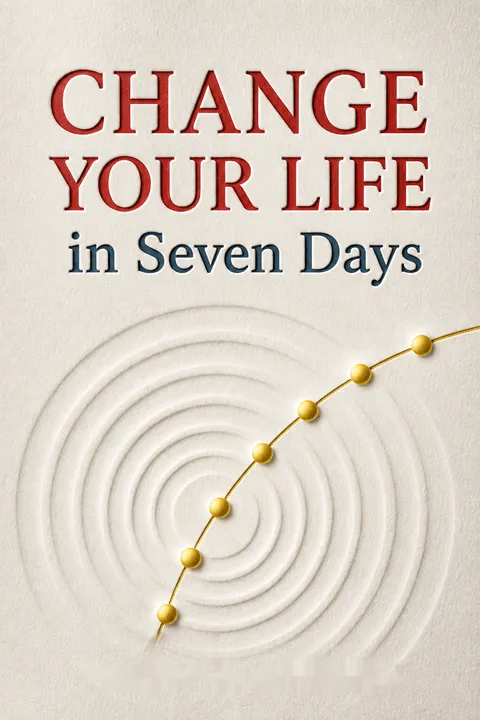
A week is a beginning. McKenna’s central claim is that life can shift quickly when people change how they interpret a situation and respond to it. The book turns this idea into seven days of exercises in self-image, emotional states, perspective, goals, health, money, and happiness. Its recurring image is a road that veers only slightly at first but eventually leads somewhere different. The opening story of Roger Bannister’s four-minute mile illustrates how one achievement can expand other people’s sense of what is possible.
Practice matters more than promises. The book’s exercises ask readers to imagine, rehearse, and repeat new responses, then act on them. Seven days can introduce a useful practice, but the title is not a guarantee that every life problem can be resolved in a week. External conditions, support, and sustained effort still shape what changes are possible.
The book’s strongest premise is practical: interpretation influences action, and action can create new evidence about what is possible. That is compatible with cognitive approaches that help people notice and revise habitual appraisals. The Bannister story is memorable because it shows how perceived limits can loosen socially, not only privately. Still, a changed perspective cannot erase a material barrier or make every goal attainable. The seven-day structure works best as a focused experiment, not a deadline for transformation. Readers can ask what changed in their behavior, not merely whether they felt inspired.
Practice a truer self-image until your choices give it evidence
Identity shapes behavior. McKenna defines self-image as the picture a person holds of who they are. He argues that behavior often follows this internal picture: someone who sees themselves as unattractive, incapable, or undeserving may act in ways that reinforce the belief. He proposes three selves: the authentic self, the feared self-image, and the pretend self presented to win approval. His own account supplies the cautionary example: career success and public recognition did not resolve his sense of inadequacy.
Imagine, then participate. His exercise is to picture an ideal, authentic version of oneself, notice how that person moves and responds, and mentally step into that perspective. The aim is not to invent a flawless persona, but to reduce the effort spent hiding and to behave more consistently with valued qualities.
This model makes identity concrete by showing how self-beliefs can guide attention, choices, and social signals. It also resembles behavioral approaches that build confidence through repeated actions rather than waiting for confidence to arrive first. The useful test is whether the imagined self leads to observable conduct, such as speaking honestly or attempting a difficult task. A risk is treating every painful self-belief as merely false programming. Some reflect real experiences or unmet needs. Self-compassion and accurate feedback make a healthier foundation than replacing self-criticism with an equally rigid ideal.
Change your inner movie before accepting its emotional verdict
The mind represents events. McKenna calls mental pictures, remembered sounds, and inner speech internal representations: personal interpretations of events, not the events themselves. He argues that body posture and these inner representations influence emotional state. In his example, a fearful flyer repeatedly imagines a plane filling with smoke and crashing. Rehearsing that catastrophe intensifies the fear; imagining the flight as comfortable changes the emotional response.
Adjust the picture. The book suggests stepping outside an upsetting memory, making its image smaller or dimmer, and moving it farther away. For a positive memory, it recommends mentally re-entering the scene and strengthening its sensory detail. The terms association and dissociation refer to experiencing a memory from inside it or observing it from outside. McKenna presents these as tools for changing emotional intensity, not as changes to the past.
The method draws attention to a genuine feature of emotion: recollection is active, and the way a person revisits an event can affect how it feels. Cognitive reappraisal uses a related principle by changing the meaning assigned to a situation. But image manipulation is not equally suitable for every memory. A distressing experience may require professional support, especially when symptoms persist or interfere with daily life. The wider lesson is not to distrust emotion, but to notice how mental rehearsal is shaping it and choose a response appropriate to the situation.
Reframe setbacks to uncover choices without pretending pain is good
Meaning changes response. A farmer in the book answers each turn of fortune with uncertainty. A strong crop is followed by ruined fields, captured horses, his son’s injury, and finally a reprieve from military conscription. What looks disastrous at one moment later appears fortunate, and vice versa. The story illustrates how premature conclusions can narrow attention.
Ask a more useful question. McKenna recommends searching for a truthful interpretation that preserves agency, not denying the facts. Instead of asking why something always goes wrong, a person might ask what could make the next step workable. He also presents four questions from Byron Katie’s approach: Is the belief true? Can it be known to be true? What happens when it is believed? Who might the person be without it? Such questions examine a thought rather than automatically obeying it.
Reframing is useful when it opens options that a single, despairing interpretation has hidden. The farmer’s story works because it resists assigning a final meaning before events unfold. In psychology, this resembles cognitive flexibility, the ability to consider more than one interpretation without losing contact with evidence. The necessary limit is that some events are simply harmful, unjust, or tragic. Optimism becomes counterproductive when it pressures people to call suffering a gift. A sound reframe acknowledges the loss, then asks what response remains possible.
Build goals from values, then turn your dream into milestones
Values point the way. McKenna’s dream-setting system treats core values as a compass, a large dream as direction, and goals as milestones. To identify values, he asks what would matter if time were short, then suggests looking beneath desired possessions for the feeling they promise. In one seminar example, a participant named money, then recognized that security and respect were the deeper aims.
Plan for reality. The process moves from listing values and imagining a broad future to defining visible signs of progress, anticipating obstacles, and setting dated steps. It also asks whether the dream belongs to the reader, whether pursuing it harms others, and what resources are available. McKenna emphasizes that rehearsal should lead to action, even if the first action is small. A goal is useful when it supports a worthwhile life, not when it merely looks impressive.
Connecting goals to values helps distinguish achievement from accumulation. This is close to self-determination theory, which emphasizes autonomy and personally meaningful aims as supports for motivation. Breaking a large ambition into milestones also makes feedback and adjustment possible. The book’s vivid future visualization can clarify direction, but it can also create a feeling of progress without actual progress. A practical safeguard is to pair each milestone with a next action, a date, and a way to learn from the result. Values should guide the plan, while evidence revises it.
Build resilience by pairing deliberate effort with real recovery
Stress has a bodily side. McKenna describes the fight-or-flight response as the body’s preparation for danger, including a faster heartbeat, muscle tension, and reduced attention to digestion. The response can be useful in an immediate threat, but repeated activation without recovery can leave people feeling strained. His practical suggestions include relaxing when the body begins to flag, taking a brief rest, and using movement to discharge tension. He proposes 10 to 15 minutes of brisk exercise as a modest starting point.
Alternate strain and rest. He uses exercise training as an analogy: challenge a system, then allow it to recover. The chapter also discusses laughter, sleep, and paying attention to how food affects personal energy. These suggestions are about supporting well-being, not replacing medical care. McKenna’s broader message is to treat the body as part of the change process, rather than trying to manage every difficulty through thought alone.
The emphasis on recovery usefully counters the idea that stamina means pushing without pause. Exercise, sleep, and social enjoyment can support mood and functioning, while relaxation can help people respond less reactively to everyday demands. The book’s account of stress and disease, however, is more sweeping than the evidence warrants. Stress is one influence among many, and neither positive thinking nor visualization can reliably prevent or cure serious illness. The sound application is modest: notice strain, use evidence-based health care when needed, and build routines that make recovery possible.
Create income by delivering distinctive value people can recognize
Value is exchanged socially. McKenna argues that money represents confidence in goods, services, and the people providing them. He links greater earning potential to four features: uniqueness, how many people benefit, the impact of the benefit, and whether customers perceive that value. His example of a struggling record company makes the last point: when it raised the price of inexpensive cover-song albums, sales improved, suggesting that price had shaped perceived quality.
Track the financial picture. The chapter recommends calculating net worth by subtracting liabilities from assets and building a financial reservoir, meaning savings that can cover several months or more of expenses. It also encourages spending less than one earns, studying capable wealth creators, and asking what useful product or service one could offer. Confidence may help someone present their work, but it cannot substitute for genuine value or sound financial decisions.
The focus on useful value gives ambition a contribution-oriented test: who benefits, and why would they pay? The distinction between value and visibility is especially important. Excellent work can remain poorly rewarded when customers cannot find it or when bargaining power is unequal. The price example also shows that perceived value is not a neutral measure of actual quality. Financial security depends on more than mindset: wages, access to capital, health, and luck matter. The strongest takeaway is to improve the offer and understand its market, without treating wealth as proof of personal worth.
Design happiness through meaningful challenge, focused attention, and recovery
Happiness is not only pleasure. McKenna distinguishes pleasant sensations from satisfaction that remains after an effort. Drawing on Mihaly Csikszentmihalyi’s account of flow, he describes a state of absorbed engagement in which attention is focused and the challenge is balanced with the person’s perceived skill. Clear aims, useful feedback, concentration, a sense of control, and reduced self-consciousness can help create it. Time may seem to pass differently during deep involvement.
Make the task engaging. A dull task can become more absorbing when a person chooses a purpose for doing it, while a task that feels overwhelming can be divided into a more manageable challenge. The chapter also recommends finding personal strengths and attempting at least one difficult thing each day. Pleasure has a place, but the book argues that lasting fulfillment also comes from meaningful effort.
Flow is a valuable lens because it shifts attention from chasing a mood to shaping the conditions of an activity. The challenge-skill balance explains why both boredom and overload can interrupt engagement. It also connects naturally to good teaching and skilled work, where feedback and increasing difficulty keep practice absorbing. Yet flow is not a universal cure for unhappiness, and some valuable tasks remain tedious. Nor should difficulty become a moral rule. Recovery, relationships, and circumstances matter alongside individual engagement.
Repeat a short daily practice, then prove it through action
Rehearsal prepares behavior. Across the book, McKenna asks readers to repeat imagery, breathing, self-talk, and emotional-state exercises until they become easier to access. His daily success workout combines relaxation, imagining the authentic self in the coming day, reviewing five values, recalling gratitude, and considering actions connected to a larger dream. He suggests that a short, consistent routine can make the exercises more familiar.
Use practice in the world. The book’s seven-day sequence is not meant to end with imagining success. It repeatedly asks readers to take a concrete step, notice what happens, and adjust. A confidence gesture, for example, is paired with memories of confidence and then mentally rehearsed in a challenging situation. The general rhythm is simple: prepare attention, try a real action, and use the result as feedback. Repetition is useful when it supports behavior, not when it becomes a substitute for it.
The daily routine gives the book a practical bridge from insight to action. Repeated cues can make a response easier to retrieve, and specific plans are generally more actionable than broad intentions. The key distinction is between rehearsal and rehearsal alone. Mental practice can support preparation, but outcomes also depend on skill, opportunity, and real-world feedback. A reader can strengthen the method by tracking one behavior, such as making a difficult call or taking a walk, rather than judging progress only by mood. Consistency should serve flexibility, not become another test of self-worth.
Analysis
Change Your Life in Seven Days is a motivational self-help book organized as a seven-day training sequence. Its central method is to alter the mental and bodily processes that shape a response, then use repeated practice to make a different response more available. The book moves from self-image and emotional state to perspective, values-based goals, health, money, and happiness. This structure gives readers a rare combination of an overarching argument and concrete exercises.
The most persuasive material concerns attention and rehearsal. A mental image can amplify fear, a bodily posture can influence mood, and a better question can reveal an action that a self-defeating question obscures. These are plausible, testable propositions. The book becomes especially useful when imagined change is followed by a small external behavior, then revised in response to what happens. That cycle is more robust than positive thinking alone because it turns an internal belief into evidence.
The weakest material appears when the author treats a useful psychological tool as a broad causal law. Claims about visualization improving immunity, hypnosis changing disease outcomes, or poverty arising from limiting beliefs risk overstating what an individual can control. Such claims can blur the difference between coping with illness and curing it, or between financial agency and structural disadvantage. Likewise, a short-term shift in mood should not be equated with lasting recovery from trauma, depression, or material hardship.
The most responsible reading preserves the book’s agency without adopting its most expansive promises. Its exercises can help people notice how they are framing experience and rehearse more useful behavior. They cannot guarantee health, wealth, or happiness. Seven days is best understood as a structured start: clarify what matters, practice a new response, take observable action, and seek appropriate support where self-help is insufficient. The book’s enduring value lies in that practical loop, not in the claim that the mind can command every outcome.
Review Summary
Change Your Life in Seven Days received mostly positive reviews, with an average rating of 3.72 out of 5. Many readers found the book inspiring and helpful, praising its practical exercises and motivational content. Some reported significant positive changes in their lives after applying the techniques. Critics found the advice obvious or unrealistic, and some were skeptical of the hypnosis elements. The included CD/DVD was generally well-received. Several reviewers noted the book's similarity to other self-help works but appreciated its concise, actionable approach.
People Also Read








Glossary
Self-image
Inner picture of identityMcKenna uses self-image for the picture a person holds of themselves, including what they believe they can do and what treatment they deserve. He argues that behavior often follows this internal picture, creating a loop in which actions and feedback reinforce identity. The book distinguishes this image from a person’s more authentic qualities.
Internal representations
Mental pictures and soundsInternal representations are the pictures, remembered sounds, and inner speech through which a person experiences an event in their mind. McKenna argues that these representations are interpretations rather than the event itself, and that changing their qualities can change emotional intensity. The term is part of his account of how people influence their emotional state.
Dissociation
Observing a memory externallyIn McKenna’s terminology, dissociation means imagining a remembered event from outside oneself, as if watching oneself in a scene. He recommends it as one way to reduce the intensity of some upsetting memories. It describes a mental perspective-taking exercise, not erasure of the event or a substitute for appropriate trauma care.
The Negativity Fast
A five-step response to distressThe Negativity Fast is McKenna’s process for responding to a negative feeling. A person identifies the thought or image connected to it, considers what the feeling may be signaling, takes a practical step if needed, then reduces the image’s intensity and imagines a preferred outcome. The method treats emotion as a possible signal while encouraging a deliberate response.
Dream-setting system
Values, dreams, and milestonesMcKenna’s dream-setting system starts with a person’s core values, uses a broad dream to set direction, and breaks that direction into goals with timelines. It also asks what success would look like, what obstacles might arise, and what resources are available. The design is intended to connect daily actions with a larger idea of a worthwhile life.
Flow
Absorbed, engaging activityFlow is the term McKenna uses, following psychologist Mihaly Csikszentmihalyi, for deep involvement in an activity. It is associated in the book with clear aims, feedback, concentration, a sense of control, and a challenge that fits perceived ability. The activity is engaging in itself, rather than valuable only for a later reward.
Law of Reversed Effort
Inner conflict undermines effortMcKenna uses this term for the idea that conscious effort can be undermined when it conflicts with a deeply held expectation or belief. For example, someone who expects to remain poor may continue to focus on poverty while trying to escape it. The book presents this as a principle of hypnosis and self-suggestion, not as a universal scientific law.
Law of Attraction
Attention shapes what is noticedIn this book, the Law of Attraction means that sustained attention tends to bring more of the attended subject into a person’s experience. McKenna applies it to noticing opportunities and maintaining a focus on abundance. The term should be understood as his motivational framework, not evidence that thoughts alone cause external events to occur.
Poverty consciousness
Identity organized around scarcityPoverty consciousness is McKenna’s name for beliefs and habits that keep a person focused on lack, unworthiness, or fear of having money. He argues that these expectations may influence choices and financial behavior. The concept addresses one possible psychological influence, but it does not account for structural causes of poverty or imply that individuals are responsible for all financial hardship.
Wealth anchor
Cue linked to positive statesA wealth anchor is McKenna’s exercise for linking a physical gesture, pressing the thumb and middle finger together, with positive feelings associated with wealth. The user recalls or imagines feelings such as confidence or security while repeating the gesture. The book proposes that the cue may help bring back the associated state; it does not generate money by itself.
Financial reservoir
Savings for future securityMcKenna uses financial reservoir for savings set aside to cover a period without income. He recommends building a reserve that could cover several months or more of expenses, so that risk and unexpected costs feel more manageable. It is a practical savings concept in the book, not a promise of financial independence.
FAQ
What is [Change Your Life in Seven Days] by Paul McKenna about?
- Seven-day transformation program: The book presents a structured, seven-day self-improvement system designed to create profound changes in your life by focusing on key areas such as values, dreams, health, money, and happiness.
- Blend of psychology and hypnosis: It combines the latest psychological techniques, hypnotic methods, and practical exercises to help reprogram your mind for success and happiness.
- Mind and body integration: Paul McKenna emphasizes the power of the unconscious mind, visualization, and physiological responses to create lasting change and attract success.
Why should I read [Change Your Life in Seven Days] by Paul McKenna?
- Rapid, actionable results: The book promises dramatic life changes in just one week, with step-by-step exercises that are easy to apply, even for busy people.
- Expert guidance: Paul McKenna is a world-leading hypnotist with decades of experience, offering proven methods that have helped thousands overcome limitations and unlock their potential.
- Holistic approach: The program addresses not just financial success, but also health, happiness, and personal fulfillment, ensuring a balanced and sustainable transformation.
- Bonus resources: Readers gain access to a free hypnotic recording online, which reinforces the book’s positive benefits and accelerates progress.
What are the key takeaways from [Change Your Life in Seven Days] by Paul McKenna?
- Values and purpose alignment: True success and happiness come from living in alignment with your core values and a clear sense of purpose, not just chasing material goals.
- Mindset shapes reality: Your beliefs and focus create your financial and emotional outcomes; cultivating confidence and a positive mindset is essential.
- Health and happiness foundations: Physical well-being and emotional states like happiness and flow are critical, with practical techniques provided to maintain energy and positivity.
- Consistent action required: Visualization and mental rehearsal are important, but real change comes from taking daily, manageable steps toward your goals.
What is the seven-day structure of [Change Your Life in Seven Days] by Paul McKenna?
- Daily cornerstone themes: Each day focuses on a key area—purpose and values, self-image, emotional mastery, dream-setting, health, money, and happiness.
- Building momentum: The program is designed to build on each day’s lesson, reinforcing positive habits and creating lasting change.
- Practical exercises: Every day includes actionable exercises, such as visualization, self-image reprogramming, and emotional state mastery, to help you internalize and apply the concepts.
How does [Change Your Life in Seven Days] by Paul McKenna explain the importance of self-image?
- Self-image drives behavior: Your self-image is the internal map of who you believe you are, and your actions rarely deviate from this image.
- Negative self-image consequences: Holding a negative self-image can lead to self-sabotage, unworthiness, and self-destructive behaviors, regardless of external success.
- Reprogramming techniques: The book teaches visualization and hypnotic methods to help you reprogram your self-image, unlocking greater confidence and happiness.
What is the "Big Dream" exercise in [Change Your Life in Seven Days] by Paul McKenna and why is it important?
- Clarifies true desires: The exercise asks you to list what’s most important to you and imagine your ideal life without limits, helping you connect with your deepest aspirations.
- Focuses on positive goals: It encourages you to concentrate on what you want, rather than what you wish to avoid, conditioning your mind for success.
- Removes mental barriers: By brainstorming without judgment, you unlock creativity and open yourself to new possibilities beyond current circumstances.
How does [Change Your Life in Seven Days] by Paul McKenna address overcoming obstacles and fear of failure?
- Failure as feedback: The book reframes failure as valuable feedback, encouraging you to learn and adjust your strategies until you succeed.
- Permission to fail: It advocates giving yourself permission to fail multiple times, reducing fear and building resilience.
- Proactive obstacle management: By projecting into the future and questioning your dreams’ clarity and authenticity, you can identify and address hidden obstacles before they arise.
What is the role of beliefs in [Change Your Life in Seven Days] by Paul McKenna?
- Beliefs as life filters: Your beliefs shape your perceptions, decisions, and emotional responses, acting as windows through which you view the world.
- Changing limiting beliefs: The book provides exercises to identify and alter limiting beliefs, opening up new possibilities and experiences.
- Empowering belief embodiment: Visualization techniques help you internalize empowering beliefs, fostering a more resourceful and confident mindset.
How does [Change Your Life in Seven Days] by Paul McKenna teach mastery of emotional states?
- Emotions as controllable states: Emotional states are influenced by your physiology and internal representations, and can be shifted instantly through imagination and body language.
- Practical techniques: Exercises like dissociation from negative memories, association with positive ones, and creating physical anchors help you master your emotions.
- Imagination over willpower: The body responds more readily to vivid imagination than to direct commands, making mental imagery a powerful tool for emotional change.
What are the health foundations and techniques recommended in [Change Your Life in Seven Days] by Paul McKenna?
- Stress management: The book explains stress as a natural response and emphasizes balancing stress exposure with quality recovery time for resilience.
- Power naps and relaxation: Techniques like the ultradian rhythm and power naps help recharge your body and mind, enhancing focus and well-being.
- Inner Smile and laughter: Practices such as the Inner Smile and medicinal laughter promote endorphin release, improving mood and immune function.
- Exercise for happiness: Even light physical activity helps dissipate tension and triggers the body’s relaxation response.
How does [Change Your Life in Seven Days] by Paul McKenna explain creating money and wealth consciousness?
- Money as confidence: The book teaches that money is a symbol of self-confidence and faith in your abilities or services.
- Overcoming scarcity mindset: It highlights the importance of changing limiting beliefs about money to create abundance and financial success.
- Practical financial tools: Readers are guided to calculate their net worth, financial independence number, and use visualization and wealth anchoring to program their minds for prosperity.
What are the best quotes from [Change Your Life in Seven Days] by Paul McKenna and what do they mean?
- "What you resist persists.": This quote illustrates the law of reversed effort, emphasizing that focusing on what you don’t want only reinforces it.
- "The more confidence we have in ourselves and/or our products or services, the more we will be able to charge for them.": It encapsulates the idea that self-belief is the foundation of financial and personal success.
- "Happiness is not a result—it's a state of mind and body.": This reminds readers that happiness is an internal state to be cultivated, not something dependent on external circumstances.
- "Every day, the happy person does at least one difficult thing.": This encourages embracing challenges as a path to fulfillment and flow.
- "I have so much to do today I will need to meditate twice as long!" — Mahatma Gandhi: This underscores the importance of mindfulness and mental preparation in managing a busy, successful life.
About the Author
Other books by Paul McKenna




Download PDF
Download EPUB
.epub digital book format is ideal for reading ebooks on phones, tablets, and e-readers.








