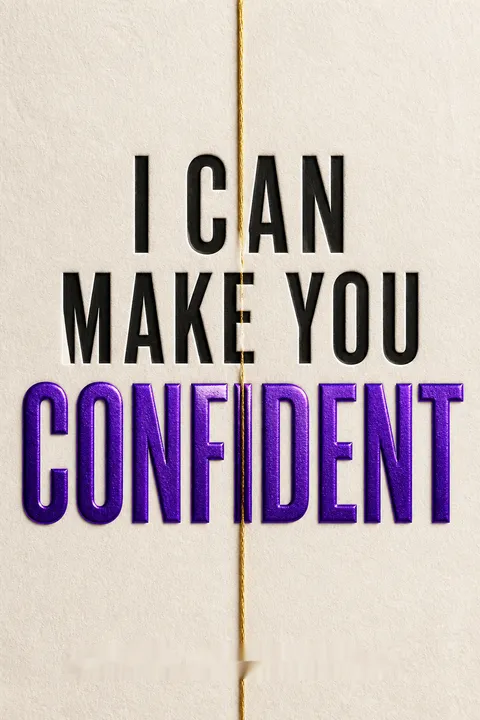


Key Takeaways
Build confidence by rehearsing useful responses, not by waiting to feel ready.
Confidence is practiced. McKenna treats confidence less as a fixed personality trait than as a pattern of thoughts, feelings, and actions that can be strengthened through repetition. Someone who repeatedly anticipates failure may learn to feel anxious automatically; someone who practices resourceful responses can make those more familiar instead. The practical question shifts from “Am I a confident person?” to “What response am I rehearsing when a challenge appears?”
Start with small repetitions. Imagine meeting a difficult situation with steadier posture, supportive self-talk, and a willingness to act. Then practice those responses in real situations. The book’s central promise is that repeated practice can make confidence more available, even when uncertainty remains.
The useful shift is from identity to behavior: a person need not first decide they are confident before trying a confident action. This resembles skills learning, where repeated practice makes a response easier to retrieve under pressure. Yet confidence is not the same as competence. Feeling assured can help someone attempt a task, but preparation, feedback, and judgment still determine whether the attempt is effective. Confidence works best as permission to engage, not as proof that a plan is sound.
Choose honest self-respect over the exhausting performance of invulnerability.
Confidence is not swagger. McKenna distinguishes genuine ease with oneself from loudness, status display, or pretending to be someone else. He describes a successful client who routinely exaggerated small achievements. However impressive his real results were, he could never match the inflated image he presented, and McKenna interpreted that gap as a source of distress.
Aim for congruence. The book calls the less performative self the “authentic self”: a person acting in line with who they are, rather than constantly trying to look superior or be right. Its exercises ask readers to imagine feeling at ease, then adjust posture and self-talk to match that state. The purpose is not to construct a more convincing facade, but to reduce the need for one.
This distinction connects confidence with psychological congruence: less energy goes into managing appearances when behavior aligns with private standards. That can also improve trust, since other people often notice inconsistencies between claims and conduct. The idea should not be mistaken for a demand to reveal everything or ignore social roles. Professional composure and tact are not automatically inauthentic. The sharper test is whether presentation serves the situation or becomes a constant defense against feeling ordinary.
Change the inner movie before asking your body to perform differently.
Mental images shape anticipation. The book argues that vivid memories and imagined scenes can evoke real feelings. A person picturing a presentation going badly may generate anxiety before speaking; picturing an attentive audience and a clear delivery can support a more useful state. McKenna’s “Success Highlight Films” ask readers to imagine a future self succeeding, then mentally step into that scene and experience it from the inside.
Edit the scene deliberately. The suggested practice makes constructive images brighter, larger, and more vivid, while shrinking and dimming a mild unpleasant memory. McKenna also recounts coach Vince Lombardi showing his Green Bay Packers successful plays rather than failure clips. The lesson is to give attention to the behaviors one wants to rehearse, not only to feared outcomes.
Mental rehearsal is a useful bridge between intention and action: it lets a person practice cues, sequences, and emotional responses before a high-pressure moment. In cognitive behavioral approaches, imagery can also help expose catastrophic predictions to examination. But vividness alone does not guarantee accuracy or success. Rehearsal should include obstacles and recovery, not only a flawless highlight reel. Otherwise, the first real setback can feel like evidence that the practice was false.
Use posture and attention to make confidence physically available.
The body and mind interact. McKenna describes a two-way relationship: thoughts affect bodily state, and bodily posture can influence thoughts and feelings. He recommends standing or sitting upright without rigidity, and imagining a gentle lift through the spine. The intention is to practice a bodily pattern associated with alertness and ease, rather than waiting for the right mood to arrive.
Find a center. His “One Point” exercise directs attention to a spot below the navel, which he presents as a way to feel more centered and steady. In his story, an aikido instructor remained difficult to push off balance after McKenna moved his attention to that area. The book uses the exercise before a stressful event or in the moment to interrupt distraction and regain composure.
The practical value here does not depend on accepting the book’s language about life energy. Posture, breathing, and attentional focus provide concrete ways to interrupt spiraling self-monitoring and return attention to the task. This is consistent with embodied approaches to emotion, which treat bodily state as part of how people experience a situation. The effect is likely to vary, and an upright posture cannot resolve a genuinely unsafe or unfair circumstance. It can, however, help someone meet it more deliberately.
Treat persistent emotion as information, not merely an obstacle to erase.
Feelings can carry messages. McKenna suggests first changing the inner images, self-talk, and posture that may be amplifying an uncomfortable feeling. If the feeling eases, the distress may have been maintained by those mental habits. If it persists, he recommends asking what needs attention. The book offers possible interpretations: fear may signal a need to prepare, frustration may point to a poor strategy, and guilt may indicate a violated personal standard.
Use coping tools carefully. The book also presents Thought Field Therapy, a sequence of tapping on specified body points while focusing on distress and rating its intensity. It describes this as a way to reduce overwhelm. Emotional labels are prompts for reflection, not universal diagnoses, and persistent or severe distress may require professional help rather than another self-guided exercise.
This approach usefully avoids two extremes: obeying every emotion as fact, and dismissing every emotion as noise. Treating a feeling as a hypothesis encourages checking what situation, belief, or need may be involved. The tapping sequence may function for some people as a structured attention and calming ritual. However, claims that particular tapping points reliably remove distress require stronger evidence than a person’s immediate sense of relief. Emotional regulation can support problem-solving, but it should not replace it.
Practice confidence for five minutes, then take one meaningful daily risk.
Make practice repeatable. McKenna’s five-minute daily workout combines four habits: supportive self-talk, vivid positive imagery, confident body language, and a daily step beyond one’s comfort zone. The routine includes imagining past or future success, looking at oneself through the eyes of someone loving, offering oneself a genuine compliment, and using a remembered confident feeling as a cue for an upcoming challenge.
Finish with action. The last minute is for writing down an inspired next step and choosing one that feels slightly risky. The point is not to feel permanently upbeat. It is to repeatedly connect a more supportive inner state with behavior in the world. The book also recommends listening to its accompanying hypnosis recording regularly as reinforcement, while presenting the exercises as the active practice readers can use themselves.
A short routine can lower the threshold for consistent practice, especially when it ends in a specific behavior rather than more reflection. The sequence also resembles implementation planning: people identify an action in advance and link it to an approaching situation. Its strength is simplicity, though a daily “risk” should be calibrated. A difficult conversation or a first attempt may stretch capability; reckless exposure or ignoring legitimate danger does not build sound confidence.
Set vivid goals you control, then shrink them to tomorrow’s action.
Make the destination compelling. McKenna argues that goals should matter enough to energize daily effort. He favors describing what one wants, rather than dwelling on what one wants to avoid. A golfer who repeatedly pictured a ball landing in a bunker, even while mentally rejecting that outcome, kept directing attention there. The proposed correction is to picture the intended target instead.
Keep the next step yours. “I want my boss to respect me” depends on another person’s behavior; a goal about how to communicate or what action to take is more controllable. Large ambitions can feel overwhelming, so McKenna advises breaking them into pieces small enough to act on within a day. His example of an actor learning a long play shows how a daunting whole becomes manageable when divided into scenes.
The combination of a meaningful direction and a near-term action solves a common planning problem: distant goals inspire, but they rarely specify what to do next. Focusing on controllable behavior also reduces dependence on other people’s choices. Still, vivid goals need checkpoints. A goal can be compelling yet poorly matched to resources or changing circumstances. Breaking it down should create opportunities to learn and revise, not merely turn an initial ambition into an unquestionable obligation.
Move before certainty arrives, while checking that the risk is worth taking.
Action can precede confidence. McKenna describes a friend who committed to contacting five people each day about a business idea. The first calls felt uncomfortable, but the task became easier through repetition, and he secured a deal before reaching fifty contacts. The book’s “action habit” is the practice of moving forward before feeling completely ready, then correcting course as new information appears.
Assess the downside. McKenna proposes rating a possible reward and risk from 1 to 10, then subtracting risk from reward to produce an “Action Number.” Asking someone out, in his example, may have a high potential benefit and a comparatively small downside. This is a rough prompt for judgment, not a guarantee: serious, irreversible, or safety-related decisions require more than a quick score.
Taking a small step before certainty can generate information that thinking alone cannot provide. It also resembles exposure-based learning, in which manageable contact with an avoided situation can loosen the link between uncertainty and threat. The useful word is manageable. A simple numerical score can reveal a lopsided risk, but it can also create false precision, especially when consequences affect other people or are difficult to reverse. Good action combines courage with proportionate due diligence.
Treat rejection as information about the route, not a verdict on your capacity.
Setbacks need not end the attempt. McKenna illustrates persistence with three stories. J.K. Rowling’s children’s manuscript was rejected by major British publishers before one accepted it. James Dyson developed a working vacuum prototype after 5,127 attempts, then continued seeking interest. Runner Kelly Holmes returned to competition after leaving sport, facing injuries, and receiving a cancer diagnosis, and won two Olympic gold medals in Athens in 2004.
Learn, then adjust. The book asks readers to distinguish not getting the desired result from being incapable of ever succeeding. It recommends reviewing what was unusual about the obstacle, what can be learned, and what might change in the next attempt. Persistence matters, but the point is not to repeat the same failed approach indefinitely. Resilience means returning with information, not simply refusing to stop.
These stories make persistence memorable, but exceptional outcomes can obscure the many reasonable projects that should be abandoned or redesigned. The strongest lesson is not that enough effort guarantees victory. It is that a setback alone does not establish incapacity, and that experiments can be revised. A useful decision rule asks whether new attempts are producing learning, improving the odds, or consuming resources without progress. Persistence is most powerful when paired with feedback and a genuine option to change course.
Prepare your message, then give the audience more attention than your nerves.
Performance has three parts. For public speaking, McKenna recommends managing one’s state, knowing the subject, and speaking with passion. A leading actress told him that experience had not eliminated her stage fright; she imagined critics judging her, became tense, and then made mistakes that seemed to confirm her fear. Rehearsing a more supportive interpretation helped her approach the stage differently. Knowing the subject, he argues, is more useful than memorizing every sentence.
Turn outward in social settings. The book applies a similar principle to dating and conversation: reduce self-monitoring and attend to the person in front of you. It suggests remembering people around whom one already feels comfortable, then mentally rehearsing a relaxed interaction. The emphasis is on genuine interest and listening, not on performing confidence to manipulate someone’s response.
The outward shift is a practical antidote to self-consciousness: attention spent tracking every gesture leaves less available for listening and adapting. Preparation supports that shift because a speaker who understands the material can respond rather than recite. The advice is less complete for people facing severe anxiety, hostile audiences, or structural barriers that practice alone cannot remove. Still, it reframes performance from “How am I doing?” to “What does this situation need from me?”
When a relationship harms you, prioritize safety over any mental technique.
Recognize the accumulated pattern. McKenna describes a technique developed from Richard Bandler’s work with women who had left abusive partners. They recalled harmful incidents in sequence, allowing the repeated pattern to outweigh an idealized picture of the relationship. The book calls this the “Threshold Technique,” presenting it as a way to weaken emotional attachment to a person or situation that is causing harm.
Do not make memory work the safety plan. The book itself advises people dealing with past trauma to consult a specialist. That caution matters especially when abuse is ongoing: recalling painful events may intensify distress, and emotional detachment alone does not remove practical danger. Decisions about leaving or staying can involve risks that require trusted support and professional guidance. A visualization exercise is not a substitute for a safety plan.
The technique highlights how selective attention can preserve an idealized relationship despite repeated harm. Seeing the whole pattern can help someone recognize what isolated good moments conceal. But deliberately intensifying painful memories is not a neutral intervention, particularly for trauma survivors. Abuse also involves practical and interpersonal risks, not only emotional attachment. The book’s strongest safeguard is its recommendation to seek specialist help; readers should treat that as central, not as a footnote to a self-help exercise.
Analysis
This book’s most durable idea is that confidence is not a prerequisite for action. It is partly a result of practicing responses that make action possible: directing self-talk, rehearsing outcomes, changing posture, clarifying goals, and taking manageable steps despite uncertainty. Its strongest contribution is therefore procedural. Instead of asking readers to adopt a grand belief about themselves, it gives them repeatable ways to alter the conditions under which they approach a challenge.
The approach combines techniques from mental imagery, behavioral rehearsal, goal setting, and attention control. That combination makes the advice memorable and immediately usable, but the book often presents its explanations with more certainty than the evidence warrants. Claims that the unconscious can be programmed like a computer, that emotional baselines are set in early childhood, or that tapping sequences work through acupuncture points should not be treated as settled science. The exercises may help through rehearsal, focused attention, expectation, or relaxation without proving every proposed mechanism.
A second limitation is the risk of equating a useful internal state with an adequate response to external conditions. A confident person can still be wrong, unprepared, or trapped in an unsafe environment. The author’s practical emphasis on action is strongest when paired with his advice to assess risk, learn from outcomes, and seek specialist support for trauma. Confidence should not silence fear automatically: fear can be mistaken, but it can also identify a real threat.
The book is best used as a toolkit rather than a theory of the mind. Readers can test which practices help them prepare, speak, connect, or recover from setbacks, while checking results against real-world feedback. Its central promise becomes more credible when translated modestly: practice can make a capable response easier to access, but it cannot guarantee success or replace skill, support, and sound judgment.
Review Summary
"I Can Make You Confident" receives generally positive reviews, with readers praising its practical exercises, visualization techniques, and accompanying hypnosis CD. Many report increased confidence and positive life changes after using the book's methods. Some find the content motivating and easy to follow, while others appreciate the mind-body connection emphasis. Critics note the book's reliance on manifestation concepts and dated approach. Overall, readers find value in the quick read and actionable advice, though experiences vary regarding long-term effectiveness.
People Also Read




Glossary
One Point
Centering attention in the bodyA focus point McKenna locates below the navel, roughly halfway between the navel and spine. His exercise asks a person to place attention there, sometimes with a hand or an imagined ball of energy, while facing a stressful situation. The book presents this as a way to feel physically centered and psychologically steadier.
Success Highlight Films
Mental rehearsal of successAn imagery exercise in which a person pictures a more successful version of themselves in a sequence of positive moments. The reader first watches the imagined scene, then mentally steps into it, experiencing it from their own perspective. McKenna recommends making the imagery vivid and using it to rehearse upcoming challenges.
Motivation Switch
A cue for motivated feelingsA mental association created by recalling a time of strong motivation while pressing the thumb and middle finger together. Repeating the pairing is intended to make the finger movement a cue for those feelings. The exercise then links the state to a task the person wants to approach with greater energy.
5-Minute Daily Confidence Workout
Brief daily confidence practiceMcKenna’s short routine combines success imagery, self-compassion, confident self-talk, a recalled confident feeling, and a concrete action. The final step is to choose one action that feels somewhat risky and take it within the next day. The routine is meant to make confidence practice regular and connect it with behavior.
Thought Field Therapy (TFT)
Tapping sequence for distressA technique attributed in the book to psychologist Roger Callahan. The user focuses on a stressful feeling, rates its intensity, and taps specified body points in a sequence while continuing to attend to the distress. The book also includes eye movements, humming, and counting, then asks the user to rate the feeling again.
Threshold Technique
Revisiting harmful relationship memoriesA technique the book attributes to Richard Bandler’s work with women leaving abusive relationships. It asks a person to recall several painful experiences involving a partner, then mentally review them in sequence to counter an idealized view of the relationship. The book advises specialist help for people dealing with trauma; this exercise is not a safety plan.
About the Author
Other books by Paul McKenna


Download PDF
Download EPUB
.epub digital book format is ideal for reading ebooks on phones, tablets, and e-readers.








