



Plot Summary
The Golden Hotel Bombing
In Ahanashtan, former Saypuri operative Rahul Khadse12 kills a hotel guard and takes his key to reach Ashara Komayd,2 the former prime minister2 who once ended his career. Disguised by a strange black coat and shoes, he slips past her security and plants a directional mine beside her suite. A pale young woman appears across the street, gestures a warning, and somehow reaches Shara’s2 balcony in an instant.
Khadse12 triggers the bomb before they can escape. The Golden Hotel loses a corner, and the news reports Shara2 dead. In a safe house, Khadse12 waits for confirmation, then laughs with relief. Far away, the report reaches Sigrud je Harkvaldsson,1 an aging Dreyling operative hiding among loggers.
The opening makes political violence intimate and procedural. Khadse does not attack Shara in a battlefield or public confrontation; he studies routines, uses a dead guard’s key, and trusts equipment he barely understands. His laughter after the explosion is less triumph than the release of a man who has finally completed a grievance. The strange girl’s impossible movement unsettles the apparent realism before the story explains why the assassination belongs to a larger conflict. Shara’s reported death is both the plot’s rupture and the emotional signal that draws Sigrud out of hiding.
The Logger Leaves His Cover
For thirteen years, Sigrud1 has concealed his identity in the forests near Bulikov, working as a logger and waiting for Shara2 to call him back. When he hears she has been killed, he quits the camp, retrieves a buried cache of money, papers, and weapons, and remembers his dead daughter,14 Signe.14
He performs the Dreyling Oath of Ashes, marking himself with the remains of a sacrificed fawn and vowing to pursue justice. His grief nearly overwhelms him, but he turns it into a task: return to Ahanashtan and find Shara’s killer.12 On the train, he notices he has scarcely aged, an unsettling change he cannot explain. The journey carries him back toward a life he had tried to abandon.
Sigrud’s return is driven by attachment, but he experiences attachment as a debt that must be paid in violence. His promise to Shara never came; her death gives him a reason to stop waiting, while the memory of Signe deepens his conviction that he arrives too late for everyone he loves. The Oath of Ashes turns private mourning into a ritual of retaliation. His unchanged appearance hints that his body, like his grief, has been held in a state of suspension. The story frames his mission as both courageous loyalty and another possible repetition of the same destructive pattern.
A Code Beneath Ash
At the ruined Golden Hotel, Sigrud1 finds blood where a guard was killed and uses a jar, petals, and grave earth to reveal hidden Divine defenses. The wards do not protect Shara’s2 destroyed room, but glowing marks lead him to a concealed message. A coded note describes a Saypuri operative with a scar across his throat, and Sigrud1 recognizes Khadse.12
He breaks the old Bulikovian partisan cipher in a telegram ordering a meeting at the Suvin coal warehouse. The instructions make clear that Khadse12 answers to a powerful employer and will receive another target list there. Sigrud1 prepares traps and weapons, then hides inside a coal pile for nearly twenty hours as Khadse’s12 armed team enters the building.
Sigrud’s old tradecraft is useful, but it cannot explain the evidence he finds. The jar exposes miracles that ordinary sight misses, while the cipher reconnects his present investigation to obsolete intelligence practices. This combination establishes the novel’s central tension: the world has modernized, but the machinery of power still relies on secrecy, inherited violence, and people trained to disappear. Sigrud’s patient infiltration is not only a return to competence. It is a return to a role that has repeatedly made him an instrument of other people’s decisions.
The Warehouse Ambush
Sigrud1 draws Khadse’s12 guards away with a radio signal, kills them one by one, and uses ropes, a prepared weak floor, and a flash-bang to reach the warehouse’s upper level. He wounds Khadse,12 whose miraculous coat turns bullets and blades aside, but finally stuns him and takes him alive. In a waterfront slaughterhouse, Sigrud1 finds a coded list that includes Tatyana Komayd,3 Shara’s2 missing adopted daughter.
Khadse12 admits he was hired to locate children before their parents died, but he has never met the employer, whom he calls Nokov.6 After Khadse12 reveals the name, Sigrud1 kills him. Darkness then enters the room as a voice searches for its dead agent, forcing Sigrud1 to face a threat beyond any Ministry operation.
The capture offers Sigrud the revenge he has pursued, yet the interrogation replaces certainty with a much larger danger. Khadse is responsible for Shara’s death, but he is also a disposable contractor in a campaign against children. Sigrud’s decision to kill him closes one account while opening another. The miraculous coat and the unseen employer make conventional expertise insufficient, even as Sigrud’s tactical skill remains effective. His violence is practical and deliberate, but its consequences keep expanding beyond the people he intended to punish.
Night Breaks Into Day
A wall of darkness closes around Sigrud,1 and the unseen voice threatens to drag him into a realm of endless night. The pale young woman who had watched the slaughterhouse intervenes, carrying him through a shifting version of the building’s past. She identifies herself only as one of Shara’s2 allies and refuses to explain more.
Sigrud1 uses the protective miracle from Khadse’s12 shoes, a coat that resists impact, and explosives to distract their pursuer. The blast tears through the slaughterhouse, and Sigrud1 escapes into the river. Injured but alive, he learns from Khadse’s12 list that Tatyana3 is still in danger. He decides to enter Ghaladesh, despite being a fugitive there, and find her before the unseen employer does.
The rescue makes time and darkness physical obstacles rather than abstract powers. The girl survives by borrowing shelter from earlier moments, while Sigrud survives by combining that supernatural refuge with blunt explosives and bodily endurance. Neither understands the other’s methods, yet their brief cooperation works because both are responding to immediate danger. Sigrud’s choice to pursue Tatyana extends his attachment to Shara into a responsibility toward someone he barely knows. He is no longer acting only to avenge the dead; he is trying to prevent another loss.
Shara’s Empty House
In Ghaladesh, Sigrud1 breaks into General Turyin Mulaghesh’s7 home and learns Shara2 had warned her that he might come. Mulaghesh7 says Tatyana3 has vanished and passes on Shara’s2 cryptic instruction to find her with the woman who shared Shara’s2 love.
She also reveals that Shara2 had been investigating a classified operation called Rebirth and the supposedly lost dreadnought SS Salim. Sigrud1 searches Shara’s2 emptied estate, finding her private rooms hidden below the mansion, along with books, family photographs, and a financial article about Ivanya Restroyka,4 Vohannes Votrov’s16 former fiancée.
He follows that clue, but a Ministry officer watching through a miraculous mirror spots him. Armed attackers close in, and Sigrud1 escapes by setting the house ablaze.
The estate turns intelligence gathering into an act of trespass through grief. Sigrud finds evidence of Shara’s private life, but the empty public rooms show how thoroughly she separated that life from her political identity. Mulaghesh’s message depends on shared history, requiring Sigrud to remember Vohannes and identify Ivanya himself. Meanwhile, the mirrored surveillance network reveals that state power has absorbed the very tools Shara once used. The fire is a tactical escape, but it also makes Sigrud’s return costly: in trying to reach Shara’s daughter, he destroys the home where she raised her.
The Girl Behind Gates
Sigrud1 reaches Ivanya Restroyka’s4 guarded sheep ranch and collapses from an unexplained cold after she challenges him at gunpoint. When he wakes, he meets Tatyana,3 a sharp, bookish teenager who resents being confined and kept ignorant of her mother’s2 past. Sigrud1 recognizes her resemblance to the girl who saved him, though neither can explain it.
He trains Taty3 with a rifle, turning her impatience into the first practical knowledge she has of danger, and begins to trust her with more than protection. Ivanya4 confirms that one of Shara’s2 orphanage cases, Malwina Gogacz,5 was repeatedly impossible to find. A telegram places the Salim in the Sartoshan Sea, so Sigrud1 leaves the ranch to uncover what Shara’s2 investigation began.
The ranch becomes a provisional family, but its safety is built on confinement and withheld information. Taty’s anger is not simply adolescent defiance; it is a response to adults deciding that protection entitles them to control what she knows. Sigrud’s weapons lesson is his imperfect attempt to give her agency, although he initially teaches through the habits of a handler rather than a trusted companion. His own fear of attachment appears in his effort to ration care. Taty’s resemblance to Malwina quietly links the personal mystery to Shara’s larger search among displaced children.
The Prison Beneath Salim
On the wreck of the SS Salim, Sigrud1 finds a sealed chamber beneath a Divine ward and a captain’s journal describing a boy held in darkness and tortured by Vinya Komayd’s13 agents. Malwina5 appears and resets the recent past, but Sigrud1 remembers the discarded version. She explains that Vinya13 imprisoned a Divine child in an attempt to understand or control the gods, and that the boy eventually escaped.
Shara2 had later recruited Malwina5 to protect other Divine children. Because Sigrud1 has lost days reaching the wreck, Malwina5 sends him nine days back to before his departure, giving him a chance to reach Bulikov on time. The journey leaves him with the knowledge of a disaster that, in this version of events, has not yet happened.
The Salim reveals that the antagonist’s violence began inside a state project meant to secure Saypur against Divine power. The ship is not a battlefield but a prison, and its official disappearance conceals both torture and institutional fear. Malwina’s manipulation of time offers a literal second chance, yet Sigrud alone carries memories from the erased sequence. His survival is again entangled with injury and abnormal endurance. The rewind also sharpens the novel’s concern with historical responsibility: changing events does not erase what people learned or what they must now choose to do.
The Aero-Tram Trap
Back at the ranch, Sigrud1 tells Taty3 and Ivanya4 that the Ministry is hunting them, then takes them toward Bulikov by aero-tram. At Ahanashtan station, Taty3 foresees an attack on the ordinary express train, so the group buys passage on the new cableway instead. Captain Kavitha Mishra8 pursues them in a second tram and sends an armed team to sabotage their car.
Sigrud1 crawls through the dismantled toilet hatch, climbs a frozen cable tower, and boards the attackers’ tram from below. Ivanya4 shoots an adhesive bomb out of the air, while Sigrud1 fights through the cars. Mishra8 consumes a black pearl and transforms into a being of silence. Sigrud1 and Ivanya4 defeat it long enough to sever the pursuer’s cables, then reach Bulikov.
The cableway turns modern infrastructure into a trap suspended over the mountains. Taty’s unexplained foresight saves the group from one attack, while Sigrud’s improvised boarding plan forces Ivanya to act under pressure rather than remain the cautious financier of their escape. Mishra’s transformation shows that Nokov’s influence reaches into the Ministry and can remake human agents into something less than human. Yet the danger does not erase ordinary consequences: the tram’s passengers remain at risk, and Sigrud’s body accumulates new injuries. Their survival depends on cooperation, not one exceptional fighter.
Shara Between Seconds
In Bulikov, Malwina5 leads Sigrud1 beneath the Solda Bridge through a sequence of hidden Divine locks and into a sanctuary held inside Tavaan’s10 domain of sleep. There he finds hundreds of sleeping Divine children and, to his shock, Shara,2 preserved as the instant after the hotel bomb wounded her. She is not restored to life; Malwina5 has stretched one dying moment so Shara2 can still advise them.
Shara2 confirms that the children are endangered and that she had built a covert network to shelter them. The gathered children make Sigrud1 a small golden sword called Flame, a tool meant to undo the enemy’s creations. Malwina5 then sends him to seek Olvos,9 the secluded goddess whose help could change the war.
Shara’s presence gives Sigrud the reunion he longed for while denying him the comfort of a true return. She is a moment preserved at the edge of death, a reminder that love cannot reverse loss simply because it can delay its finality. The sanctuary’s sleeping children embody protection through withdrawal, but their hiding place is also a fragile dependence on Tavaan’s power. Flame represents a collective gift rather than a personal weapon: the children lend Sigrud a capacity they cannot safely exercise themselves.
Olvos Refuses the War
At Olvos’s9 secluded sanctuary, Sigrud1 asks the last known goddess to help stop Nokov.6 She refuses, explaining that divine intervention could make her vulnerable and that Nokov6 is her son.6 She also recognizes the cause of Sigrud’s1 unnatural survival: when he endured the Finger of Kolkan in prison, its miracle mistook him for its own god and attached itself to him.
It converts suffering into power, keeping him alive while feeding his belief that pain makes him righteous. Olvos9 will not remove it. She warns that Sigrud1 must choose differently when his next chance comes. As he leaves, the sanctuary’s refuge is already under attack, and Olvos9 prepares to face the son6 she would not save.
Olvos’s refusal is a moral choice shaped by the danger of concentrated power, not indifference alone. Her relationship to Nokov makes the political stakes personal, but she cannot rescue him without risking the world’s dependence on a single god. Sigrud’s own survival is likewise exposed as a compromise: the miracle protects him by rewarding the very self-punishment that keeps him violent and isolated. The goddess gives him no cure, only the possibility of choosing against the logic that has sustained him.
The Sanctuary Door Falls
While Sigrud1 is away, Taty’s3 visions warn Ivanya4 that Nokov6 has found the sanctuary. They follow her glimpse of a hidden entrance and arrive as he breaks through Tavaan’s10 doors. Ivanya4 and Taty3 help wake and evacuate a handful of children, and Taty3 finds Shara2 alive in her suspended instant.
Tavaan10 holds the doors long enough for them to escape, but Nokov6 overwhelms the refuge and consumes the sleeping children. The survivors emerge into Bulikov’s park with Malwina,5 who realizes most of her siblings are gone. Shara2 and Taty3 are reunited, but their reunion comes amid catastrophe. Nokov6 has absorbed enough Divine power to begin reshaping the city’s walls and building a vast staircase toward the sky.
The sanctuary’s collapse transforms a hidden population into visible casualties of a conflict they did not choose. Taty’s foresight becomes consequential action: she does not merely predict danger, she carries Ivanya to the place where a few lives can still be saved. Shara’s reunion with her daughter is brief and immediate, grounded in checking for injuries rather than explaining history. Nokov’s victory gives grief a political form: he treats his own suffering as permission to consume others and remake the world without their consent.
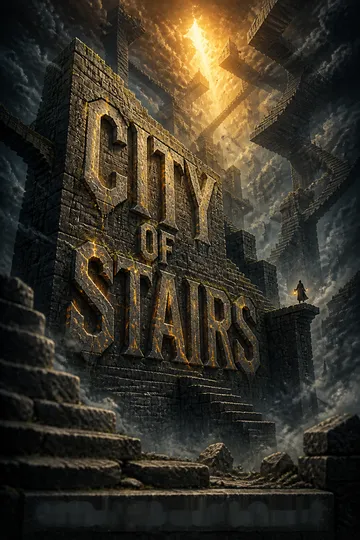
Bulikov Becomes a Staircase
Nokov6 turns Bulikov’s miraculous walls into a black tower and climbs toward the heavens, intending to extinguish the dawn. Sigrud1 returns with Flame and uses it to cross the darkness surrounding the city. Ivanya4 and Taty3 help him lure Nokov’s6 silent seneschal away from the staircase; Ivanya4 beheads the creature with Flame after Sigrud1 pins it in place.
Shara2 then confronts Nokov6 with Sigrud’s1 knife, trying to draw him away from the others. Nokov6 kills her, and Taty’s3 suppressed identity awakens. She reunites with Malwina5 as Sempros, the divided being of past and future, and freezes time. Together they overpower Nokov,6 but Sempros begins erasing the world to end its history of suffering.
The battle compresses the novel’s political and personal conflicts into one escalating choice. Nokov turns a city’s inherited protections into a weapon, while Shara uses her own life to redirect his attention and protect her daughter. Taty’s awakening makes her immensely powerful, but power does not resolve grief; it magnifies the temptation to impose a final answer on everyone. The climax refuses to equate victory with justice. Even the survivor who can stop Nokov may reproduce his central error by treating other lives as material for a supposedly better world.
The Future Lets Go
Pinned to a wall by the seneschal’s spear, Sigrud1 tears himself free and climbs the tower while Sempros begins erasing moments from existence. The stairs confront him with scenes from his life: family he avoided, people he killed, and chances he mistook for burdens.
Near the summit, Signe’s14 image gives him the strength for one last leap. He reaches the fused sisters and tells Taty3 that grief cannot authorize her to remake everyone’s lives. She relinquishes her godhood and disperses Divine power across the world, letting ordinary people inherit small, unpredictable miracles.
The force that kept Sigrud1 unnaturally alive leaves him, and his wounds nearly kill him. Taty3 uses its remaining power to save him. He survives, aged and mortal, and leaves with her for the Dreyling Shores.
Sigrud’s ascent makes memory an ethical ordeal rather than a simple review of the past. He must see not only what was done to him, but what he did to others while calling his violence necessary. His appeal to Taty succeeds because he offers no promise of a painless world; he asks her to relinquish the authority to decide for everyone. Dispersing the power does not guarantee goodness. It does, however, replace a single divine will with many human choices, including the possibility of failure.
Epilogue
The world does not return to normal. Miracles appear across Saypur, the Continent, and the Dreyling Shores, forcing governments to decide whether to police powers no one fully understands. Mulaghesh7 takes charge of Saypur’s response, arguing that the newly miraculous are still citizens.
Sigrud,1 Taty,3 and Ivanya4 reach the Dreyling homeland, where Taty3 begins making friends and Sigrud1 slowly recovers. He watches the changed harbor at Voortyashtan and recognizes his daughter14 Signe’s14 work in its renewal. Later, he walks with Taty3 to the shore, sits beneath a tree, and dies while she is away watching seal pups. She returns, takes his hand, and stays beside him as the waves continue.
The ending refuses to treat the dispersal of divine power as a clean solution. It creates new possibilities and new abuses, leaving political responsibility with people rather than a god or a single institution. Mulaghesh’s insistence on citizenship matters because the new powers could easily become a pretext for registration, coercion, or war. Sigrud’s death completes the release that Olvos would not force upon him: he becomes mortal, accepts care, and finally reaches a quiet place without turning grief into a weapon. Taty’s return to his side answers his promise through presence, not rescue.
Analysis
City of Miracles asks what people do with pain once they gain the power to make it matter. Sigrud1 has survived by interpreting suffering as a credential: because he has been hurt, he believes he can answer harm with violence. The scar on his palm makes that belief materially useful, which is precisely why it is difficult to relinquish. Nokov6 and the awakened Taty3 follow a larger version of the same logic. Each imagines that enough power can correct the world’s injustices, but each risks turning private grief into authority over everyone else.
The novel sets three models of protection against one another. Vinya13 tries to control danger through secret state projects. Shara2 protects vulnerable children by building a quiet network and withholding information, even from those she loves. Olvos9 withdraws because she fears that divine intervention will concentrate belief and power in herself. None is harmless. Secrecy leaves Taty3 unprepared, institutional control produces the Salim’s prison, and restraint allows suffering to continue. The book avoids an easy verdict because each response begins with a recognizable fear and carries its own victims. Sigrud’s1 decisive change is not that he becomes less capable of violence, but that he stops treating pain as proof of righteousness. On the tower, his memories expose the people he ignored, the family he avoided, and the young soldiers he killed while overwhelmed by grief. When he reaches Taty,3 he does not offer a perfect political blueprint. He asks her not to decide the meaning of every life for everyone else. Her dispersal of divine power makes no promise that people will use freedom well. It makes responsibility plural. The ending’s new miracles may produce wonder, exploitation, or both, but no single being gets to dictate reality alone.
Review Summary
City of Miracles concludes Robert Jackson Bennett's acclaimed Divine Cities trilogy with Sigrud je Harkvaldsson as protagonist, thirteen years after City of Blades. Following Shara's assassination, Sigrud emerges from exile seeking revenge while protecting her daughter from divine threats. Readers praise Bennett's exceptional character development, showing Sigrud's depth beyond typical warrior archetypes. The novel blends mystery, action, and emotional resonance while exploring themes of grief, violence, power, and redemption. Reviews highlight Bennett's elegant prose, unpredictable plotting, and mature worldbuilding. Most consider it a perfect, satisfying conclusion featuring breathtaking action sequences and a bittersweet ending that moved many to tears.
People Also Read






Characters
Sigrud je Harkvaldsson
Exiled Dreyling operativeA towering, scarred Dreyling who has served as Shara Komayd’s2 intelligence operative and spent years hiding from Saypuri authorities. Sigrud is practical, observant, and frighteningly capable with knives, weapons, and improvised plans. He measures worth through endurance and usefulness, which makes him loyal but also leaves him unable to imagine a life beyond danger. His grief over his daughter14 and estrangement from his family have hardened into a belief that suffering is the only honest form of power. Shara’s2 judgment once gave his violence direction; without her, he must learn to distinguish protection from revenge and commitment from self-destruction.
Ashara Komayd
Reformer and former prime ministerA brilliant former prime minister and intelligence operative, Shara combines scholarly curiosity with a strategist’s distrust of easy answers. She understands history as a force that institutions use to justify their choices, yet she also believes gradual reform can widen who gets to shape society. Her care for her adopted daughter3 is fiercely protective, sometimes becoming secrecy and control. Shara’s relationship with Sigrud1 rests on long trust, shared danger, and the knowledge that neither can expect the other to choose personal loyalty over an operation. Her defining tension is between the ruthless methods she knows and the more humane political future she wants to build.
Tatyana Komayd
Shara’s sheltered daughterShara’s2 adopted teenage daughter, Tatyana is an avid reader with a particular gift for economics and forecasting. Raised by tutors and kept apart from ordinary school life, she has learned to sound composed while remaining lonely, curious, and frustrated by adult secrecy. Her grief is complicated by the feeling that her mother’s2 public identity and private history were hidden from her. Tatyana wants an ordinary life, not power or a heroic role, and she is willing to question the methods used in her name. Her intelligence is less about certainty than noticing patterns others dismiss, a quality that becomes essential when danger arrives.
Ivanya Restroyka
Reclusive Continental magnateA wealthy Continental businesswoman and former fiancée of Vohannes Votrov16, Ivanya has withdrawn to a sheep ranch after surviving war and personal loss. She distrusts cities, institutions, and assurances of safety, so she prepares for danger with weapons, routes, and supplies. Beneath her hard pragmatism is a capacity for loyalty and tenderness, though she often disguises both as irritation. Her connection to Shara2 began through charitable work for displaced children, and she becomes a reluctant guardian to Taty3. Ivanya’s caution is not cowardice; it is the survival strategy of someone who has watched grand political hopes collapse into private grief.
Malwina Gogacz
Girl who walks through historyA small, sharp-tongued Continental girl with an upturned nose and an instinctive suspicion of strangers. Malwina has spent much of her life evading people who want to find or use her, making caution feel more natural than trust. She is capable, quick-thinking, and accustomed to carrying responsibilities alone, but her defenses conceal deep attachment to the other children she protects. Shara2 becomes an important ally because she offers protection without treating Malwina as a weapon. Malwina’s bluntness is often a shield against helplessness, and her loyalty becomes clearest when she must choose between preserving herself and standing with others.
Nokov
Shadow-bound enemyA mysterious and increasingly powerful figure who operates through darkness, hidden messages, and human agents. Nokov hires Khadse12 to locate children and arranges miraculous protections that make the assassin difficult to trace. His confidence grows with every success, while his obsession with controlling the world is rooted in a history of injury and abandonment. He sees his own suffering as a warrant to impose a final order on everyone else. That mixture of genuine trauma and immense power makes him dangerous: he is not merely cruel, but convinced that domination can repair what was done to him.
Turyin Mulaghesh
Veteran general and politicianA blunt, battle-tested former general and parliamentary leader who has survived both military service and political compromise. Mulaghesh shares a long history with Shara2 and Sigrud1, but she does not romanticize either of them. Her directness makes her a useful source of truth when Sigrud1 is tempted to act without considering the cost. She understands that institutions can do harm while still believing they can be made more accountable. Her dry humor and impatience conceal a steady loyalty to people whose causes she considers worth the trouble.
Kavitha Mishra
Ministry officer and watcherA Saypuri military intelligence officer who operates a network of miraculous mirrors for Nokov6. Mishra is disciplined and capable, but her loyalty grows from disillusionment with both Saypur and the Continent. Nokov’s6 promises give her the sense that someone shares her despair about political failure. Her work requires her to turn observation into intervention, making secrecy feel like service. Beneath her obedience is a person who wants to believe that the violence she enables will lead somewhere better.
Olvos
Secluded Divine powerA powerful Divinity who has withdrawn from ordinary political life and watches events from a protected sanctuary. Olvos is cautious about intervention because she understands how belief can magnify divine power and distort the being who wields it. Her restraint can look like coldness, especially to mortals facing immediate danger, but it arises from fear of creating another unchecked authority. She is burdened by the consequences of old choices and by her intimate connection to the conflict, yet refuses to treat power as a simple tool for correcting every wrong.
Tavaan
Keeper of the sleeping refugeA young-looking, bald Continental figure who oversees a hidden sanctuary associated with sleep and dreams. Tavaan is sardonic and impatient with visitors, but takes the safety of the sleeping children seriously. Her domain makes her both protector and custodian, leaving her isolated in a place she rarely leaves. She dislikes being treated as a child because of her appearance and resents how easily others assume she can bear endless responsibility. Her humor offers a thin but persistent defense against the loneliness of her task.
Voshem
Guide through possibilityA genial young Continental man who serves as a guide through the hidden routes leading to the children’s refuge. Voshem sees possibility everywhere, including in circumstances that others find bleak, and his optimism is both a gift and a vulnerability. He treats secrecy as a practical safeguard rather than an excuse to withdraw from life. His role is brief, but his openness shows how different Divine temperaments can be from the grim conflict surrounding them.
Rahul Khadse
Assassin for hireA former Saypuri operative with a scarred throat, Khadse is skilled, resentful, and comfortable with close, brutal violence. He believes the Ministry discarded him after years of service, and he carries that grievance into paid work against former colleagues. Money and professional pride motivate him more reliably than loyalty to any government. His relationship with Sigrud1 is shaped by old institutional rivalries and mutual recognition of how easily the state uses operatives, then abandons them.
Vinya Komayd
Shara’s formidable auntA former prime minister and senior intelligence figure whose policies and secret projects shaped both Shara’s2 career and the conflict surrounding the Divine children. Vinya is capable of ruthless decisions made in the name of national security, reflecting a belief that danger must be controlled before it grows. Her influence lingers through classified operations and the people she trained or discarded. She represents the older political order Shara2 tried to reform, but her motives arise from fear of vulnerability as much as ambition.
Signe Harkvaldsson
Sigrud’s gifted daughterSigrud’s1 daughter, remembered for her intelligence, inventive skill, and determination to improve the places where she lived. Signe’s work in engineering and reconstruction stands opposite her father’s1 life of covert violence, though both share a stubborn drive to make difficult things possible. Her absence shapes Sigrud’s1 guilt and his fear that closeness only brings loss. The tools and public works associated with her remind him that a person’s influence can continue through what they build and the opportunities they leave behind.
Hild Harkvaldsson
Sigrud’s estranged wifeSigrud’s1 wife and the mother of his children, Hild is practical, perceptive, and unwilling to let his self-loathing excuse his absence. Their history contains deep affection as well as years of separation and unspoken hurt. Hild understands that Sigrud’s1 work has changed him, but she expects him to take responsibility for how he treats the family he left behind.
Vohannes Votrov
Bulikovian builder and reformerA Continental construction magnate and former lover of Shara2, Vohannes believed that a better society could be built through ambitious public works and political change. His association with Ivanya4 and Shara2 links private grief to the transformation of Bulikov. Even in memory, he represents a hopeful confidence that the city and its institutions can be remade.
Plot Devices
Living Miracles
Reality under hidden pressureMiracles are not simply spells but alterations of reality that can persist, change, and behave almost like living systems. They create the walls of Bulikov, protect the Golden Hotel, conceal messages, and enable characters such as Malwina5 to move through earlier moments. The same flexibility makes miracles dangerous: they can be repurposed by people or powers who do not understand their consequences. As the story unfolds, miracles reveal that the Divine world is less orderly than governments claim, and that its leftover mechanisms can still shape ordinary lives.
Finger of Kolkan
Pain turned into survivalA Divine instrument of punishment once used on Sigrud1 in prison leaves a permanent scar on his left palm. The injury becomes the center of an altered miracle that protects him from aging and helps him endure forces that should kill him, while converting suffering into a kind of power. Its protection is not a gift without cost: it reinforces Sigrud’s1 belief that he deserves pain and that rage is the only justice available to him. The scar is both a practical defense and a psychological trap, binding his survival to his refusal to forgive himself.
The Black Lead
A threat against the DivineBlack lead is the rare weapon associated with the ability to kill a Divinity, making its location and ownership consequential to the conflict. Shara’s2 possession of it shapes her caution and the enemy’s attempts to neutralize her. The weapon is not merely a stronger form of ammunition: it represents the possibility that mortals can resist supposedly absolute power. Its presence also sharpens Shara’s2 central political concern, that a tool capable of ending a god could become just as dangerous in the hands of a government.
Malwina’s Time Bubbles
The past as temporary shelterMalwina5 can draw fragments of the past around herself, using earlier versions of places as cover and, under extreme conditions, resetting recent events. The ability lets her hide from a pursuer who commands darkness and gives Sigrud1 a second chance to reach Bulikov. It is powerful but limited: manipulating time strains Malwina5, cannot freely rewrite distant history, and leaves Sigrud1 carrying memories of an erased sequence. The device makes memory an active force, not a passive record, and asks what responsibility remains when the past can be altered but not truly forgotten.
Flame
A borrowed tool against darknessThe Divine children collectively create a small golden sword for Sigrud1, binding it to his will. Flame is not strong enough to defeat every Divine power, but it can cut through the enemy’s works and give Sigrud1 a chance against the silent seneschal. Its strength wanes as the children who made it are lost, so the blade also measures the cost of the conflict. Unlike Sigrud’s1 private weapons, Flame is a shared gift, built from the sleepers’ hope that someone might lead them toward safety.
The Divine Cities Series

About the Author
Other books by Robert Jackson Bennett





Download PDF
Download EPUB
.epub digital book format is ideal for reading ebooks on phones, tablets, and e-readers.








