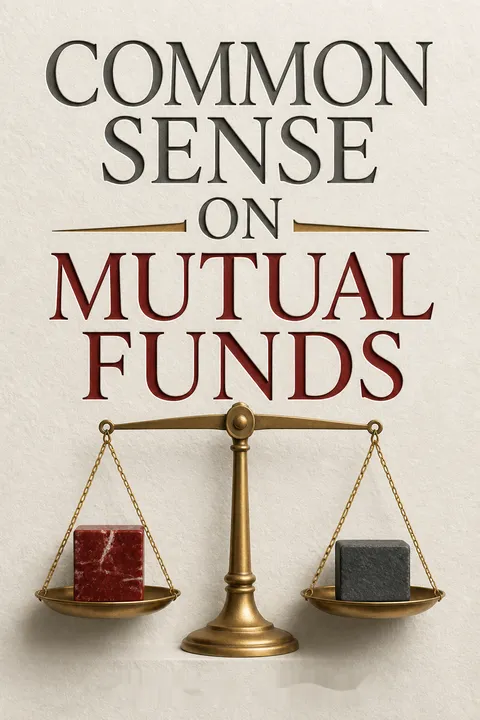


Key Takeaways
Invest through the seasons, not the headlines
Markets have seasons. Bogle opens with Chance, the gardener, a character from Jerzy Kosinski's novel who mistakes a garden's seasonal cycle for a philosophy of life. His simple observation gives investors a useful image: economies and markets have downturns, but short-term forecasts rarely reveal when recovery will come. Bogle points to the U.S. economy's long history of growth through depressions, wars, and recessions, while stressing that this history is no guarantee.
Control what you can. The decade ending in 2009 showed the danger of assuming the market always rises: stock returns were negative on balance even as the economy continued to grow. Investors cannot control market returns, but can control costs, risk exposure, and how long they stay invested. Bogle's practical advice is to begin early, invest regularly, avoid impulsive trading, and keep a plan through bad markets.
The garden metaphor helps separate a long-term investment horizon from a short-term emotional response. That distinction matters because losses are experienced immediately, while the evidence for recovery is abstract and historical. Still, patience is not a universal answer: money needed soon cannot safely be exposed to a long stock-market winter. The useful principle is not simply to wait, but to match the investment horizon to the goal, so a temporary decline does not force a permanent sale.
Forecast returns from earnings and dividends, not market moods
Separate business from sentiment. Bogle applies Occam's Razor, the idea that a simpler explanation is often more useful, to stock returns. He breaks long-term returns into three parts: the dividend yield when shares are bought, subsequent earnings growth, and changes in the price investors pay for earnings, measured by the price-earnings ratio. The first two reflect business performance; the third reflects changing expectations and can swing sharply.
Bonds start with yield. Historical U.S. data through 2008 showed that dividend income and earnings growth together explained almost all of the market's long-run real return. Over shorter stretches, expanding or contracting valuations can dominate. Bond returns are simpler to estimate: the starting yield is their most useful guide, though later interest-rate changes affect prices and reinvestment. Neither framework predicts the next year. Both help set more rational long-term expectations.
This decomposition is valuable because it turns a vague forecast into a set of assumptions that can be challenged separately. An investor can ask whether earnings growth is plausible, whether the starting yield is attractive, and whether the price already assumes unusually good news. The main caution is that historical averages are not guarantees, especially when the sample reflects one country's exceptional economic history. A return model is best treated as a discipline for thinking, not a machine for timing markets.
Set your stock-bond mix to survive losses without surrendering growth
Balance serves two jobs. Stocks have historically delivered greater long-term growth than bonds, while bonds have often softened stock-market declines. Bogle offers two-thirds stocks and one-third bonds as a rough starting point, not a universal prescription. In the 1929-1932 collapse, a portfolio split 60% stocks and 40% bonds lost about half as much as an all-stock portfolio. During the later recovery, however, stocks substantially outperformed bonds.
Fit the mix to the person. Age, time horizon, income needs, debt, other retirement income, and tolerance for losses all matter. A 65-year-old might use age as a rough prompt to consider a 65% bond allocation, but pension income and personal circumstances can change the answer. Rebalancing restores the intended risk level; redirecting new contributions can do so with fewer tax consequences in taxable accounts.
Asset allocation is partly a mathematical decision and partly a behavioral one. Bonds can reduce expected growth, but a portfolio that an investor can hold during a crash may outperform a theoretically higher-return portfolio abandoned in panic. This makes tolerable risk more useful than maximum risk. The age-based rule is only a heuristic: life expectancy, health, guaranteed income, and bequest goals can all point in different directions. A sensible allocation is a personal risk budget, not a formula to obey mechanically.
Use broad, low-cost index funds to capture nearly all market returns
Arithmetic favors low costs. Before expenses, investors as a group own the market and therefore collectively earn its return. After expenses, they collectively earn less. An index fund aims to hold a broad market portfolio with little trading and low operating costs. Bogle's historical illustration compared a balanced index fund costing about 0.2% annually with an average active balanced fund: over 50 years, a $10,000 investment grew to about $1.615 million in the index fund and $1.08 million in the active fund.
Choose the index carefully. The S&P 500 represents large U.S. companies, not the entire market; a total-market fund includes smaller companies too. Index funds still carry market risk, and fees, trading efficiency, and taxes vary. Bogle also warns that many exchange-traded funds invite frequent trading or concentrate on narrow sectors, departing from the patient, diversified approach that makes indexing effective.
The compelling feature is not that index funds discover a secret source of return. They reduce the number of ways investors can lose market returns to fees, trading, taxes, or overconfidence. This is a powerful application of arithmetic rather than a claim that every active manager lacks skill. The harder question is whether investors can resist turning a low-cost index vehicle into a trading instrument. A sound product cannot by itself correct behavior that defeats its design.
Choose funds by cost and consistency, not yesterday's leaderboard
Past winners fade. Bogle documents how high-performing funds tend to drift back toward average market or peer returns, while funds with high expenses often remain disadvantaged. He calls this reversion to the mean: unusually strong or weak results tend to become less extreme over time. Across several decades of comparisons, top-quartile funds commonly lost their relative edge in the next period. A strong past record rarely identified a durable future winner.
Use durable evidence. For investors choosing active funds, Bogle advises checking low expenses first, then examining risk and consistency within a comparable investment style. He warns against star managers, star ratings, excessive fund size, and owning a tangle of overlapping funds. Past returns can reveal how unevenly a fund performed, but cannot promise future results. Once a carefully selected portfolio is in place, review it deliberately rather than switching whenever a ranking changes.
Mean reversion is a warning against extrapolating success, not a calendar for predicting when a reversal will occur. A fund can remain exceptional for a long time, and a cheap fund can still be badly managed. The most defensible distinction is between information that persists, such as an expense ratio, and information that is unstable, such as recent performance. This framework reduces the temptation to treat a compelling historical chart as evidence of a repeatable investment process.
Turnover can tax you twice: in trading costs and lost deferral
Activity has a bill. Rapid trading creates commissions and market-impact costs, and can generate taxable capital-gains distributions. Bogle argues that investors often compound the damage by chasing recent winners, then selling after they disappoint. In his account of the decade through 2003, investors in the 200 largest funds earned about 6.5% annually, compared with 9.8% reported by those funds, because investors tended to add money after good performance and withdraw after bad performance.
Deferral has value. A capital gain left unrealized can continue compounding before its tax is paid. Low-turnover index funds may therefore be especially useful in taxable accounts, while tax-deferred retirement accounts reduce the immediate importance of distributions. Bogle's point is not that taxes should dictate every choice. It is that taxes are a real cost, and a fund's reported return may not resemble the return an investor actually keeps.
This is a particularly important distinction between investment performance and investor experience. A fund can report a respectable time-weighted return while its shareholders earn much less through poorly timed contributions and withdrawals. That gap resembles a broader behavioral pattern: people often buy confidence after prices rise and seek safety after prices fall. Tax rules can intensify the penalty. Yet tax efficiency should not justify holding an unsuitable asset or taking excessive risk merely to defer a bill.
Diversify globally only for a reason, not because a model says so
Foreign exposure adds risks. Bogle questions the idea that every investor must own international stocks in proportion to each country's share of global markets. Currency movements can swamp local market results: a weak dollar can lift foreign returns for U.S. investors, while a strong dollar can reduce them. Economic and political conditions, accounting standards, and market liquidity also differ across countries.
Home is not a guarantee. U.S. firms already earn substantial revenue abroad, so a domestic stock portfolio can have global business exposure without directly holding foreign shares. Bogle considers international investments optional and suggests limiting them to about one-fifth of the equity allocation. He acknowledges that emerging markets may grow quickly, but their political and valuation risks are uncertain. The principle is to diversify intentionally, rather than infer future returns from recent international outperformance.
The useful insight is that geographic diversification is not risk-free diversification. Currency exposure and different political institutions can change the character of a portfolio, not simply smooth its returns. But the case for staying mostly domestic is also historically contingent. U.S. multinational revenues do not perfectly substitute for owning foreign companies, and national leadership can change. The durable lesson is to distinguish a reasoned allocation from a mechanical market-weighting rule, while resisting the urge to chase whichever region just led.
Ask who benefits when a fund gathers assets or raises fees
Fund owners and managers differ. Bogle argues that many fund companies earn more by attracting assets than by improving the returns shareholders receive. Advertising, sales payments, and 12b-1 fees can increase fund costs, while rapid inflows may complicate a manager's strategy. Funds are legally owned by their shareholders, yet outside management companies often control their operations. Bogle sees this separation as a conflict that weakens investor representation.
Governance matters. Fund directors are supposed to oversee managers and protect shareholders, but Bogle criticizes boards that approve high fees without demanding clear evidence of value. His proposed remedy is stronger fiduciary oversight, more transparent costs, and structures that put shareholder interests first. The practical test for investors is straightforward: examine total fees, sales charges, turnover, and whether the fund's incentives reward stewardship or asset gathering.
This argument applies agency theory to ordinary investment products: when decision-makers are paid for assets gathered, growth can become a goal even when it does not improve client outcomes. The critique is persuasive, but high fees alone do not prove misconduct, and independent boards can vary in effectiveness. A useful response is to focus on observable incentives and results rather than assume every provider acts in bad faith. Governance is most credible when investors can see how fees are set and what service they purchase.
Build investment institutions around owners, not marketing targets
A setback became a structure. After Bogle was fired following a failed merger, he fought to keep Wellington's funds in Philadelphia and founded Vanguard in 1974. The company was organized to serve the funds and their shareholders rather than outside owners of a management company. It launched the first index mutual fund in 1975 and shifted to no-load distribution in 1977. Each choice followed the same aim: reduce conflicts and costs for investors.
Culture makes structure real. Bogle describes leadership through purpose, persistence, patience, and service. Vanguard called its employees a crew, treated workers as partners, and framed investor communication around candor and fair dealing. The larger principle is the Golden Rule applied to finance: treat clients as people whose savings matter, and colleagues as people whose work matters. Structure helps, but daily conduct determines whether it is more than branding.
The founding story gives the book a human counterpoint to its financial arithmetic. A governance design can align incentives, but it cannot substitute for culture, competence, or accountability. Vanguard's growth offers a real example of an alternative structure, not proof that every organization can reproduce its outcomes. The deeper lesson is that values become economically meaningful when embedded in ownership, compensation, product choices, and customer treatment. Trust is not a slogan; it is a repeated operational decision.
Analysis
Bogle's argument works because it joins two levels usually kept apart: portfolio arithmetic and institutional design. At the portfolio level, market returns are uncertain, but fees are observable, persistent, and subtractive. That asymmetry supports a simple strategy: diversify broadly, hold costs down, and avoid making forecasts do more work than they can. His strongest insight is not merely that indexing often wins, but that investors can control the friction between market returns and personal outcomes.
At the institutional level, Bogle asks why investors should trust a system in which fund shareholders bear investment risk while external managers capture predictable fee revenue. This is an agency problem, not simply a complaint about expensive products. His Vanguard example gives the critique practical force, though it also creates an obvious evidentiary limitation: the author is defending an institution he founded. Lower costs and strong asset growth support his case, but do not alone prove that mutual ownership explains every performance difference or that another structure would work equally well elsewhere.
The book's historical claims also need careful framing. Long U.S. stock records are informative, but the earliest data are incomplete, survivor-biased, and drawn from a country whose economic and institutional success is not guaranteed to repeat. Mean reversion is a valuable antidote to extrapolating extraordinary returns, not a reliable market-timing signal. Likewise, long horizons can reduce the variability of average historical returns without eliminating the danger of a poor outcome when withdrawals begin.
The lasting contribution is a hierarchy of decisions. First choose a portfolio that fits the investor's horizon and ability to bear losses. Then minimize costs, taxes, and unnecessary turnover. Only after those choices should fund selection become a search for manager skill. This order turns common sense from a slogan into a decision process, while leaving room for uncertainty, disagreement, and the possibility that history will not repeat itself neatly.
Review Summary
Common Sense on Mutual Funds by John C. Bogle is highly regarded for its thorough analysis of the mutual fund industry and advocacy for low-cost index investing. Readers appreciate Bogle's data-driven approach, clear explanations, and long-term perspective. The book emphasizes the importance of minimizing costs, staying invested for the long haul, and avoiding market timing. While some find it dense and repetitive, many consider it an essential read for investors seeking to understand mutual funds and make informed decisions about their portfolios.
People Also Read




Glossary
Occam's Razor
Simplifies return analysisBogle uses Occam's Razor, the principle that simpler explanations are often preferable, to analyze long-term investment returns. For stocks, he separates the initial dividend yield, subsequent earnings growth, and changes in the price-earnings ratio. For bonds, he emphasizes the starting yield. The method organizes assumptions; it does not predict short-term market movements.
Investment return
Business-driven stock returnIn Bogle's return analysis, investment return is the part of stock performance generated by the dividend yield at purchase and the later growth of corporate earnings. It reflects the economic results of the businesses represented by the shares, rather than changes in how much investors are willing to pay for those earnings.
Speculative return
Valuation-driven returnSpeculative return is the effect of a change in the price investors assign to corporate earnings, commonly measured through a change in the price-earnings ratio. It can strongly raise or reduce stock returns over shorter periods, but Bogle argues it cannot reliably compound forever in one direction.
Reversion to the mean
Returns gravitate toward normsBogle uses reversion to the mean for the tendency of unusually strong or weak fund, market-sector, or market returns to move closer to longer-term averages. The process can take years and does not identify when a reversal will occur. High fund costs can keep weak performers below average even as other results normalize.
Four dimensions of investing
Return, risk, cost, and timeBogle's framework treats investment outcomes as shaped by four interacting dimensions: reward, risk, cost, and time. Time magnifies both compounding returns and compounding costs, while a longer horizon has historically narrowed the range of average annual stock returns. The framework encourages investors to assess all four factors together rather than focus only on return and volatility.
Investment relativism
Short-term benchmark fixationInvestment relativism is Bogle's term for the industry's intense focus on whether a fund beats a benchmark, especially over short intervals. He argues that managers may imitate index holdings to avoid looking bad in comparisons, even when this weakens their independent investment judgment and does little to improve investors' long-term results.
Time-weighted return
Fund-level performance measureA time-weighted return measures the change in a fund's per-share value over a period, adjusted for distributions. It describes the performance reported by the fund while largely ignoring when investors added or withdrew money. It can therefore differ substantially from what the fund's shareholders collectively earned.
Dollar-weighted return
Investor-experience returnA dollar-weighted return accounts for how much money was invested in a fund at different times. Contributions made before weak performance and withdrawals made after gains affect the result more when larger sums are involved. It can reveal why investors earn less than the fund's published time-weighted return.
12b-1 fee
Fund-paid distribution chargeA 12b-1 fee is an annual charge deducted from fund assets to pay for distribution, sales, or marketing expenses. Because it reduces the fund's return, shareholders bear the cost even if they do not use the sales channel it supports. Bogle argues that these fees often benefit fund managers more than investors.
FAQ
What's Common Sense on Mutual Funds about?
- Investment Philosophy: The book emphasizes long-term investing, simplicity, and low costs, advocating for index funds over actively managed funds.
- Historical Context: John C. Bogle provides a historical perspective on market returns to inform future investment strategies.
- Practical Guidance: Offers advice on asset allocation, fund selection, and minimizing costs to maximize returns.
Why should I read Common Sense on Mutual Funds?
- Expert Insight: Written by John C. Bogle, founder of Vanguard and a pioneer of index investing, offering authoritative insights.
- Timeless Principles: Emphasizes simplicity and cost-effectiveness, principles that remain relevant in investing.
- Investor Empowerment: Demystifies the investment process, encouraging individuals to take control of their financial futures.
What are the key takeaways of Common Sense on Mutual Funds?
- Long-Term Focus: Success in investing requires a long-term perspective to navigate market volatility.
- Cost Matters: Lower-cost funds consistently outperform higher-cost alternatives, highlighting the importance of minimizing expenses.
- Simplicity is Key: Advocates for straightforward investment strategies to avoid the pitfalls of complexity.
What are the best quotes from Common Sense on Mutual Funds and what do they mean?
- "Cost matters.": Highlights the core philosophy that minimizing costs is essential for maximizing returns.
- "To invest with success, you must be a long-term investor.": Stresses the importance of patience and a long-term perspective.
- "When all else fails, fall back on simplicity.": Advocates for a straightforward approach in a complex financial landscape.
How does John C. Bogle define asset allocation in Common Sense on Mutual Funds?
- Diversification Principle: Involves dividing investments among asset classes like stocks and bonds to manage risk.
- Guideline for Investors: Suggests starting with two-thirds in stocks and one-third in bonds, adjusting for risk tolerance.
- Risk Management: A balanced portfolio helps withstand market volatility and achieve long-term objectives.
What is the significance of indexing in Common Sense on Mutual Funds?
- Indexing as a Strategy: Allows investors to capture market performance without high costs of active management.
- Performance Comparison: Notes that the S&P 500 Index outpaces most equity mutual fund managers over the long term.
- Cost Efficiency: Index funds have lower expense ratios, crucial for better long-term returns.
What does John C. Bogle say about the role of costs in mutual fund performance?
- Impact of Costs: High costs can severely diminish investment returns, akin to weeds impeding a garden's growth.
- Expense Ratios: Discusses how these can consume a significant portion of returns, with average equity fund charges rising.
- Long-Term Consequences: Even small cost differences can lead to substantial wealth differences over time due to compounding.
How does Common Sense on Mutual Funds address the issue of taxes?
- Tax Implications: Mutual funds often realize taxable capital gains, reducing net returns.
- Impact of High Turnover: High portfolio turnover leads to frequent capital gains distributions, typically taxed at higher rates.
- Tax-Managed Funds: Advocates for funds that minimize distributions and focus on tax efficiency to retain more returns.
What is the concept of "reversion to the mean" in Common Sense on Mutual Funds?
- Definition: Refers to investment returns moving back toward historical averages over time.
- Implications for Investors: Warns that high past performance funds are likely to regress, making it risky to chase them.
- Statistical Evidence: Provides data showing most funds revert toward the mean, indicating past performance isn't a reliable predictor.
How does John C. Bogle suggest investors should select mutual funds?
- Focus on Low Costs: Advises selecting low-cost funds as they correlate with better long-term performance.
- Evaluate Consistency: Use past performance to assess consistency and risk, not just historical returns.
- Limit Number of Funds: Suggests owning four or five funds to avoid over-diversification.
What are the criticisms of actively managed funds presented in Common Sense on Mutual Funds?
- High Costs and Fees: Criticizes for high fees leading to underperformance relative to market indices.
- Inconsistent Performance: Many actively managed funds fail to deliver consistent outperformance.
- Market Efficiency: Suggests it's difficult for active managers to consistently outperform due to market efficiency.
How does John C. Bogle view the future of mutual funds?
- Need for Change: Believes the industry must evolve to better serve investors, moving away from "casino capitalism."
- Focus on Costs: Emphasizes reducing costs to improve investor returns.
- Long-Term Perspective: Advocates for a long-term investment perspective, warning against short-term speculation.
About the Author
Other books by John C. Bogle

Download PDF
Download EPUB
.epub digital book format is ideal for reading ebooks on phones, tablets, and e-readers.








