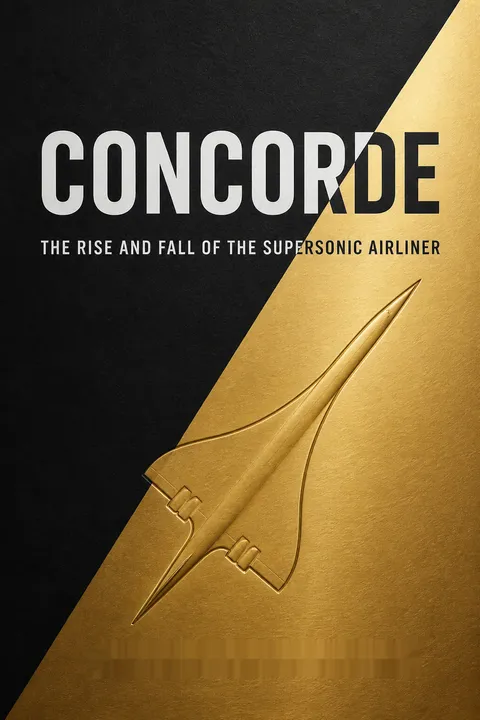


Key Takeaways
Treat Concorde as a national wager, not a normal airline investment.
Prestige helped launch it. Britain had lost its early lead in jet travel after three fatal Comet crashes grounded the world’s first jet airliner. In 1956, officials formed the Supersonic Transport Aircraft Committee, or STAC, partly to keep Britain’s aircraft industry competitive and restore national standing. France joined the project through a treaty signed in 1962. The governments understood that private companies were unlikely to fund such an expensive leap alone.
The forecast missed badly. Estimates suggested a market of 150 to 500 supersonic aircraft, with profitability possible after selling just thirty. In reality, only twenty Concorde aircraft were built, and fourteen entered passenger service. The project delivered extraordinary engineering and industrial expertise, but its original commercial case never materialized.
What's striking is how clearly the project separates national return from commercial return. Public investment can create skills, research, and industrial capability that a single company cannot capture, a familiar rationale for funding basic science and infrastructure. But prestige is a poor substitute for explicit public accounting: it can justify worthwhile spillovers while also shielding weak forecasts from scrutiny. Concorde’s history suggests that ambitious projects need more than a compelling vision. They need honest estimates of who benefits, who pays, and what capabilities remain if the market disappoints.
Design for the whole flight, not just the dazzling cruise.
One wing had two jobs. Concorde needed a shape efficient at Mach 2, yet also capable of taking off and landing at ordinary airports. Its long, thin ogival delta wing generated lift through large swirling flows of air called vortices. Those vortices worked at low speeds, but required the aircraft to approach the runway at a steep angle. A drooping nose gave pilots a view of the runway during takeoff and landing.
Researchers tested the compromise. The HP.115, a small delta-wing research aircraft, demonstrated safe, slow flight. The BAC 221, adapted from a Fairey Delta 2, tested features including the drooping nose. These and other experiments helped the team avoid adding heavy flaps that would have increased drag and fuel use.
The wing illustrates a central principle of systems engineering: a design is only good relative to the full set of conditions it must survive. Optimizing one performance measure can make the whole system worse, especially when takeoff, landing, maintenance, and airport compatibility matter as much as peak speed. The prototypes also show why simulation and physical testing complement each other. Elegant calculations narrow the options, but real machines expose handling problems that equations alone may not settle.
Let hard partnership turn national rivalry into technical rigor.
The partners divided the work. Britain led on engines, drawing on Bristol and Rolls-Royce experience; France led on the airframe. Manufacturing was split across facilities, with parts moving between Britain and Toulouse. Teams even retained their different measurement systems, so plans had to accommodate both imperial and metric dimensions.
Disagreement improved the design. Engineers on each side challenged proposals from the other, making it harder for weak assumptions to pass unchecked. But divided leadership, duplicated production, political strain, and the effort spent on a medium-range version that was abandoned in 1966 all added cost. Concorde’s development depended on cooperation, yet cooperation alone did not make the project efficient.
This collaboration resembles a useful form of organizational friction: independent teams can catch errors precisely because they do not share every assumption. But productive disagreement requires clear authority, shared goals, and mechanisms for resolving disputes. Without them, scrutiny turns into delay and duplicated work. Concorde’s structure offers a practical lesson for international research: divide responsibilities where expertise is strongest, but establish common standards and decision rights early enough that political balance does not become an engineering burden.
A speed race can produce a marvel without producing a market.
Rivals amplified the race. The Soviet Tu-144 flew before Concorde, in December 1968, but a fatal crash at the 1973 Paris Air Show and subsequent technical problems undermined its prospects. The United States pursued the larger, faster Boeing 2707, designed for Mach 3. Its swing-wing design proved difficult to develop, while costs and environmental opposition grew. Congress ended federal funding in 1971 before the aircraft entered production.
Competition was not demand. Governments and manufacturers treated supersonic flight as a test of national capability, while airlines had to consider operating costs, passenger loads, routes, and fuel. The Tu-144 and Boeing projects show how a political contest can accelerate invention while encouraging schedules and ambitions that outrun practical use.
Technology races often reward visible milestones, such as a first flight, more than reliability, affordability, or adoption. That incentive can be useful when a field needs urgency, but it can also produce prototypes that answer a prestige question rather than a customer problem. The comparison is not simply between free markets and state planning: both the American and Anglo-French projects relied on government support. The deeper distinction is whether institutions can change direction when evidence weakens the original case.
Build the airline around speed's value, not speed alone.
Concorde sold time at a premium. It carried roughly one hundred passengers across the Atlantic in about three hours, but its limited range and high fuel use restricted its routes. A return ticket could cost about £8,000 by 2003. The Boeing 747 offered more room and far lower fares, while budget services opened transatlantic travel to passengers Concorde could never serve.
A small market could still pay. After British Airways concentrated on transatlantic flights and targeted business customers, its Concorde service became profitable. Air France’s operation remained less successful. The contrast shows that Concorde was not simply an economic failure: it could earn money under particular conditions, but it could not become mass transport or sustain a broad route network.
Concorde is a case of market segmentation, not a general solution to air travel. For passengers whose time was valuable enough, a steep fare could make sense; for most travelers, the 747’s capacity and lower cost mattered more. This is a reminder that efficiency depends on the objective being measured. Speed per passenger is not the same as affordability, total fuel use, or public accessibility. A successful niche product can be commercially real without becoming a model for an entire industry.
Treat the sky as shared space, where noise has political costs.
A sonic boom crossed private boundaries. A sonic boom is the sound of pressure waves reaching the ground after an aircraft flies faster than sound. Supersonic tests over Oklahoma City exposed residents to eight booms a day; authorities received more than 15,000 complaints and nearly 500 damage claims. Concorde’s boom restricted where it could fly supersonically, while airport noise created a separate obstacle.
Public resistance changed the route map. The United States banned commercial supersonic flight over land, and political opposition delayed Concorde’s access to New York until 1977. Environmental concerns included noise, fuel consumption, and possible effects on the ozone layer. Some claims were disputed, but the disturbances experienced by people beneath flight paths were immediate and difficult to dismiss.
The boom makes an invisible externality audible: passengers gain time, while people on the ground absorb noise they did not choose. Environmental economics calls for these costs to be included in decisions rather than treated as someone else’s problem. That does not settle whether supersonic travel should exist, but it clarifies the test it must pass. Technical performance is insufficient if the public bears the disruption. New designs must earn social permission as well as meet engineering standards.
Design safety around failure chains, not confidence in a clean record.
One small object triggered disaster. On 25 July 2000, a metal strip left on the runway by a departing DC-10 damaged a Concorde tyre during takeoff. Debris contributed to damage to a fuel tank; leaking fuel caught fire, and the aircraft crashed near Gonesse, killing all 109 people aboard and four on the ground. Investigators also examined earlier tyre failures and other operational factors. No single factor explains every part of the chain.
The fleet returned with changes. Concorde received Kevlar fuel-tank liners, stronger tyres, and other modifications before service resumed in 2001. The aircraft had a long record without a fatal crash, but a strong record could not eliminate vulnerabilities. The crash and rising maintenance burdens formed part of the context for retirement in 2003.
Safety engineering studies how failures combine, not only whether individual components usually work. A rare tyre failure became catastrophic because debris, fuel, ignition, and flight conditions interacted. This is why near misses and incident histories matter even when they do not produce casualties. At the same time, one dramatic accident should not erase decades of operational evidence or automatically prove that a whole design is unsafe. Good risk assessment compares both the failure mechanism and the effectiveness of proposed safeguards.
Let engineering necessity, not decoration, create lasting beauty.
Its shape came from aerodynamic demands. Concorde’s long nose, narrow fuselage, and curved delta wing were consequences of high-speed flight and the need to operate at ordinary airports. The result struck many observers as beautiful because its visible form expressed what the machine was built to do. In a 2006 public design poll, Concorde ranked first among British designs, ahead of such familiar landmarks as the London Underground map and the Spitfire.
The cabin took longer to catch up. Early interiors were comparatively plain, and later redesigns attempted to bring more comfort and visual coherence to the passenger experience. The contrast underscores that a successful exterior does not guarantee every part of a product feels equally considered.
Concorde supports the idea that function can generate aesthetic force, but it also shows that beauty is not purely technical. The aircraft’s outline mattered, and so did the cultural associations attached to flight, national achievement, and a future that seemed within reach. Public design polls capture affection as much as formal judgment. The cabin’s less celebrated interiors are a useful counterpoint: coherence between engineering and human experience is designed, not automatically produced by technical excellence.
Hypersonic speed remains a research feat, not an airline service.
A record is not a passenger system. NASA’s unmanned X-43A reached about Mach 9.7 in 2004, but it needed a rocket-assisted launch, flew only briefly under its own scramjet power, and ended in the sea. A scramjet is an engine that burns fuel while incoming air remains supersonic. It cannot simply propel an aircraft from an airport runway at ordinary takeoff speeds.
The missing pieces are substantial. Future concepts described in the book face extreme heating, difficult materials, noise, fuel, and passenger-comfort problems. Some proposed designs would require rocket launches or windowless cabins. Researchers also explored quieter supersonic aircraft, but promising models and test flights did not amount to a practical, certified airliner.
A record-setting vehicle proves that a physical limit can be approached under specific conditions. An airline must satisfy a much broader system of requirements: repeated departures, emergency handling, maintenance, cost, comfort, and public acceptance. This distinction is familiar in technology development, where laboratory performance often precedes viable deployment by decades. The lesson is not to dismiss ambitious research, but to avoid confusing peak speed with readiness. Concorde itself took years of testing before carrying passengers.
Keep test facilities and skilled teams alive between aviation breakthroughs.
Breakthroughs depend on places as well as ideas. Concorde drew on decades of research at Britain’s Royal Aircraft Establishment and on engine testing at Pyestock. The book describes Pyestock’s closure and the loss of much of its infrastructure, while the Filton site that built Concorde later closed as an aircraft manufacturing location. Its last aircraft flight was a rebuilt Spitfire in 2012.
Expertise does not survive on paper alone. Concorde’s development relied on test rigs, wind tunnels, mechanics, engineers, and accumulated practical knowledge. Some of that work later benefited Airbus, but dismantling facilities and teams makes future projects harder to restart. The aircraft’s retirement therefore marks not only the end of a service, but a question about whether societies still invest in the capacity to build ambitious machines.
Research capacity behaves like infrastructure: it is expensive to maintain, easy to overlook when idle, and slow to recreate once dispersed. The economic case for keeping every specialized facility open is not automatic, especially as tools and industries change. But decisions should count the option value of expertise, not just the immediate operating cost. Concorde’s legacy is strongest when judged not as a machine alone, but as a network of people and institutions whose capabilities can serve projects beyond one aircraft.
Analysis
Concorde is best understood as three different projects that happened to share one airframe. As an engineering project, it was a remarkable success: its wing, engines, fuel management, and control systems made sustained Mach-2 passenger flight possible. As an airline product, it was viable only in a narrow niche, with premium fares, limited routes, and a clientele able to convert saved hours into economic or personal value. As a political project, it was unstable, because the same governments that made development possible also argued over cost, national advantage, and public legitimacy.
That distinction unsettles the simple story of triumph or folly. The aircraft was neither a mass-market breakthrough that failed only because of bad luck, nor a useless prestige object. It created knowledge and capabilities, and some operators eventually made money from it. Yet its benefits were concentrated, while taxpayers helped absorb development costs and people below its flight paths endured noise. The public opposition was therefore not merely resistance to progress. It was also a dispute about who defined progress and who paid its side effects.
The book’s strongest narrative insight is that technical elegance cannot insulate a machine from its operating environment. Concorde’s design solved an aerodynamic problem, but not the economic problem of making speed affordable, the political problem of noise over populated land, or the institutional problem of sustained manufacturer support. Its crash exposed a concrete safety vulnerability, but the aircraft returned after modifications. Its retirement reflected a larger convergence of maintenance costs, weak demand, and declining willingness to support an exceptional machine.
The ending raises a broader question about innovation. A society can celebrate a machine’s beauty while letting the facilities and skilled communities that made it disappear. Preserving every old technology would be wasteful, but treating research capacity as disposable creates dependence on others and narrows future choices. Concorde’s enduring significance lies in that tension: it demonstrated what coordinated public ambition can accomplish, and how little technical achievement alone can guarantee a durable place in everyday life.
People Also Read








Glossary
Supersonic Transport Aircraft Committee (STAC)
British supersonic planning committeeA British committee established in 1956 to assess whether a supersonic passenger aircraft was technically possible and commercially worthwhile. Chaired by Morien Morgan, it brought together government, aircraft makers, airlines, and researchers. Its studies helped define the design options and research program that preceded the Anglo-French Concorde project.
ogival delta wing
Curved supersonic delta wingConcorde’s distinctive wing, shaped as a swept delta with a curved leading edge. The geometry supported efficient high-speed flight while generating strong vortices that provided lift at lower speeds. This allowed the aircraft to take off and land without conventional flaps, though it required a steep approach and a drooping nose for pilot visibility.
supercruise
Sustained supersonic cruiseThe ability of an aircraft to maintain supersonic flight without relying continuously on afterburners. Concorde used afterburners for takeoff and briefly to accelerate through the sound barrier, then switched them off for its Mach-2 cruise. This distinguished its long-distance operating method from aircraft that needed afterburning thrust to remain supersonic.
sonic boom
Ground impact of shock wavesThe sound produced when pressure waves generated by an aircraft flying faster than sound reach the ground. The boom can be heard over a wide area and may disturb people or damage property. Concern about repeated booms restricted Concorde’s supersonic routes, especially over populated land, and became a major political obstacle to commercial supersonic travel.
scramjet
Supersonic-combustion jet engineA ramjet engine designed to burn fuel while the air moving through its combustion chamber remains supersonic. Unlike Concorde’s engines, it does not first slow the incoming airflow to subsonic speed. Scramjets can support extremely high speeds, but experimental vehicles require assistance to reach operating speed and do not yet provide the full capabilities needed for passenger airline service.
Download PDF
Download EPUB
.epub digital book format is ideal for reading ebooks on phones, tablets, and e-readers.








